- Market Value (2025): USD 724.4 Mn
- Estimated Value (2026): USD 820.0 Mn
- Forecast Value (2036): USD 2833.2 Mn
- CAGR (2026-2036): 13.2%
How does the Natural White Fonio Market break down by segment?
Decorticated white fonio grain leads Product Form at 46.00%; Cleaned and decorticated leads Processing Level at 41.00%.
Which Product Form dominates?
Decorticated white fonio grain is expected to hold 46.00% share in 2026.
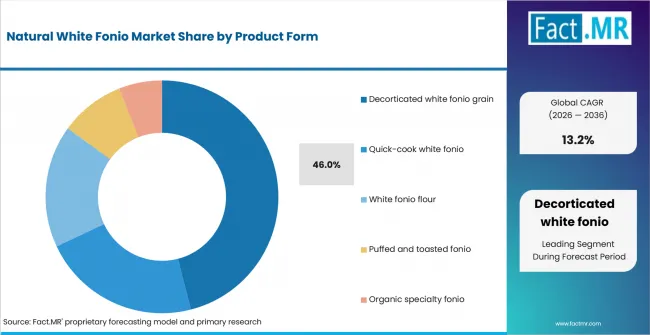
Natural White Fonio Market Analysis By Product Form | Source: Fact.MR
Decorticated white grain leads because it solves the first practical barrier for new users: husk and grit removal. Retailers can place it beside rice or quinoa. Restaurants can test it as a side dish without in-house grain cleaning.
Yolélé’s current product page presents fonio as a gluten-free, non-GMO grain that can be prepared in about five minutes, supporting convenient retail and foodservice applications.
What leads the Processing Level segment?
Cleaned and decorticated is projected to account for 41.00% share in 2026.
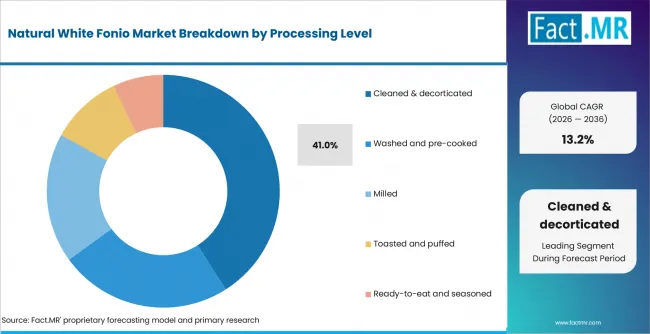
Natural White Fonio Market Analysis By Processing Level | Source: Fact.MR
Cleaned and decorticated fonio leads the processing mix because it turns informal cereal handling into a packaged food input. The step lowers preparation time. It also helps importers ask for clearer specifications on moisture, foreign matter and grain color.
In February 2026, ANSD's Situation Economique et Sociale du Senegal reported 6,275 tonnes of fonio production for 2024-2025, based on Direction de l'Agriculture data. The figure provides an official national production benchmark for Senegal's fonio supply before downstream cleaning and branding.
How does End-use Channel shape demand?
Retail packaged grain is anticipated to capture 36.00% share in 2026.
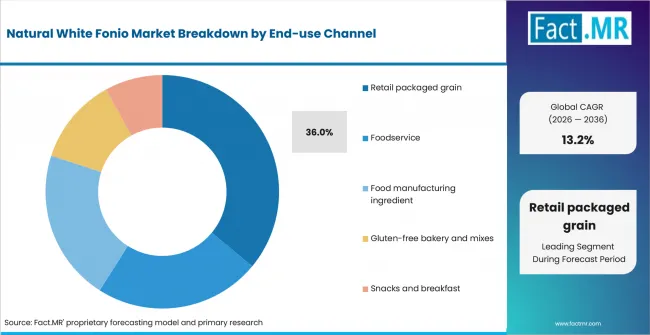
Natural White Fonio Market Analysis By End Use Channel | Source: Fact.MR
Retail packaged grain leads the channel mix because fonio still needs consumer education in many markets. Clear pack information on cooking time and origin helps shoppers understand how to use the grain at home.
USDA Economic Research Service reported on June 11, 2026 that U.S. food spending reached USD 2.51 trillion in 2025, including USD 1.10 trillion for food at home and USD 1.41 trillion for food away from home.
What supports Conventional West African within Sourcing Position?
Conventional West African is estimated to represent 44.00% share in 2026.
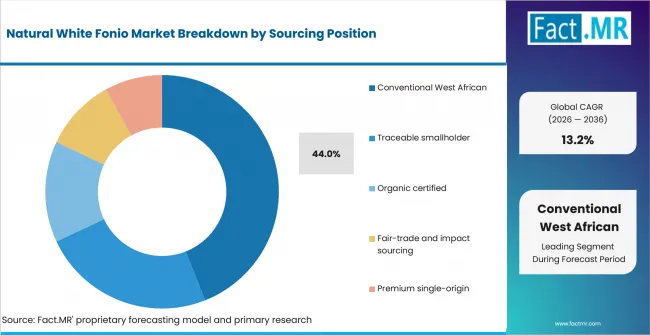
Natural White Fonio Market Analysis By Sourcing Position | Source: Fact.MR
Conventional West African sourcing leads because Mali, Senegal and Nigeria already connect fonio cultivation with local food culture. Organic and fair-trade lots are attractive in export channels. Conventional supply remains the larger base for cleaned grain.
Aduna’s official fonio page presents the grain as organic, pre-washed and naturally gluten-free, with preparation in about three minutes. The brand also highlights direct sourcing from small-scale farmers in Burkina Faso, combining convenience with clearly communicated ingredient origin.
What is accelerating Natural White Fonio Market adoption, and what is holding it back?
Adoption is expected to rise through cleaned grain formats, retail education and traceable West African sourcing. Growth is limited by small-grain cleaning losses, price sensitivity and data gaps.
Drivers Impact Analysis
| DRIVER | (~) % IMPACT ON CAGR | GEOGRAPHIC RELEVANCE | IMPACT TIMELINE |
|---|---|---|---|
| Cleaned grain convenience in retail packs | +1.7% | North America, Europe, West Africa | Short term (<= 2 years) |
| Decortication and washing capacity | +1.4% | Mali, Senegal, Nigeria | Medium term (2-4 years) |
| Gluten-free ingredient testing | +1.1% | USA, France | Medium term (2-4 years) |
| Traceable smallholder sourcing | +0.8% | West Africa, Europe | Long term (>= 4 years) |
Source: Fact.MR analysis. Updated Sep 5, 2026
- Cleaned grain convenience: Quick-cook and ready-to-use white fonio reduce the learning curve for shoppers and make the grain easier to trial in retail packs.
- Decortication and washing capacity: Processing capacity is expected to raise usable yield and lower rejection risk when buyers require clean grain with stable preparation behavior.
- Gluten-free ingredient testing: Manufacturers can test white fonio flour in bakery and breakfast mixes where rice, corn and oat bases already compete for shelf space.
- Traceable smallholder sourcing: Origin records support premium packs because retailers and importers want a clearer link between the West African crop and shelf claims.
Opportunity Impact Analysis
| OPPORTUNITY | (~) % IMPACT ON CAGR | GEOGRAPHIC RELEVANCE | IMPACT TIMELINE |
|---|---|---|---|
| Quick-cook white fonio packs | +1.2% | USA, France, Senegal | Short term (<= 2 years) |
| Fonio flour for gluten-free bakery | +1.0% | USA, France | Medium term (2-4 years) |
| Premium smallholder-origin ranges | +0.7% | Europe, North America | Long term (>= 4 years) |
Source: Fact.MR analysis. Updated Sep 5, 2026
- Quick-cook white fonio packs: Precooked formats help retailers explain fonio through preparation time, so new users face fewer steps at home.
- Fonio flour for gluten-free bakery: Milled white fonio gives formulators a grain base for breads, pancakes and mixes that need alternative flour behavior.
- Premium smallholder-origin ranges: Traceable sourcing gives brands a stronger origin story when the pack moves into organic, impact and specialty-food channels.
Restraints Impact Analysis
| RESTRAINT | (~) % IMPACT ON CAGR | GEOGRAPHIC RELEVANCE | IMPACT TIMELINE |
|---|---|---|---|
| Small-grain cleaning losses | -0.8% | West Africa | Short term (<= 2 years) |
| Limited consumer familiarity | -0.6% | USA, France | Medium term (2-4 years) |
| Premium price sensitivity | -0.5% | Europe, North America, Nigeria | Medium term (2-4 years) |
Source: Fact.MR analysis. Updated Sep 5, 2026
- Small-grain cleaning losses: Fonio's tiny grain size makes stone removal and decortication harder than many larger cereals, which raises the value of specialist processing.
- Limited consumer familiarity: Many shoppers still need recipes and cooking cues before white fonio becomes a repeat grain purchase.
- Premium price sensitivity: Imported packs compete with cheaper cereals and gluten-free staples, so brands need clear proof of cooking value and origin.
Which countries are scaling the Natural White Fonio Market through 2036?
- The country comparison spans 3.04 percentage points and forms three practical growth bands across the forecast period.
- Mali remains 0.80 percentage point above Senegal through domestic cereal output and local processing interest.
- Senegal remains 0.92 percentage point above Nigeria because crop visibility and Dakar-linked processors support formal channels.
- Nigeria records the midpoint at 13.2% CAGR due to acha familiarity and crop-input support for smallholders.
- France remains 0.66 percentage point above the USA owing to organic retail behavior and origin-led specialty foods.
- The USA closes the displayed range through specialty retail, foodservice testing and gluten-free product positioning.
Comparable CAGRs create different entry conditions due to crop aggregation, cleaning capacity, origin documentation and retail education. Full report coverage includes North America, Latin America, Western Europe, Eastern Europe, East Asia, South Asia & Pacific, Middle East & Africa.
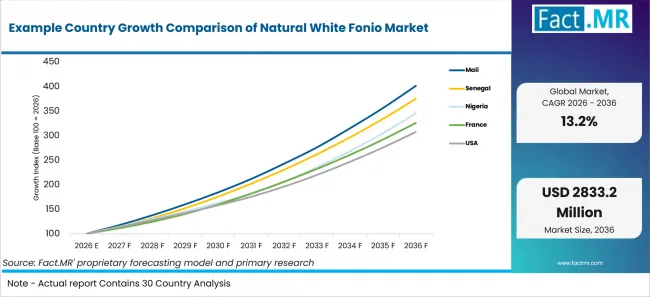
Example Country Growth Comparison Of Natural White Fonio Market | Source: Fact.MR
| Country | CAGR (2026-2036) |
|---|---|
| Mali | 14.9% |
| Senegal | 14.1% |
| Nigeria | 13.2% |
| France | 12.5% |
| USA | 11.9% |
Source: Fact.MR analysis. Updated Sep 5, 2026
What supports Mali adoption?
14.9% CAGR, supported by domestic cereal output and local grain processing.
Mali has an established cereal-production base that includes fonio among the country's principal cereals. In April 2026, the Government of Mali reported 11,452,540 tonnes of cereal output for the 2025 campaign. This broad cereal total provides sector context for processing infrastructure serving crops such as fonio.
How is Senegal scaling demand?
14.1% CAGR, backed by crop-data coverage and domestic processing.
Senegal benefits from crop visibility through DAPSA's Annual Agricultural Survey, which covers all 45 departments and reports indicators including yield, cultivated area and production. This nationwide framework provides a consistent basis for monitoring the agricultural supply base relevant to fonio sourcing and processing.
What supports Nigeria's growth?
13.2% CAGR, shaped by acha familiarity and crop-input programs.
Nigeria has a documented domestic acha research base. The National Cereals Research Institute operates a dedicated Acha Research Programme and reports that Nigeria's first acha varieties were registered and released in 2021, including NCRIACH 2 (Digitaria exilis). This research base supports continued work on locally adapted acha production and processing.
How is France developing demand?
12.5% CAGR, supported by organic retail and provenance-led buying.
France is developing demand through specialty grocery behavior and origin-led food buying. On May 28, 2026, the French agriculture ministry published 2024 organic-sector figures showing 25,105 downstream companies certified organic. The figure indicates the scale of France's certified organic downstream ecosystem relevant to specialty grain distribution.
What shapes USA adoption?
11.9% CAGR, led by specialty retail and gluten-free grain use.
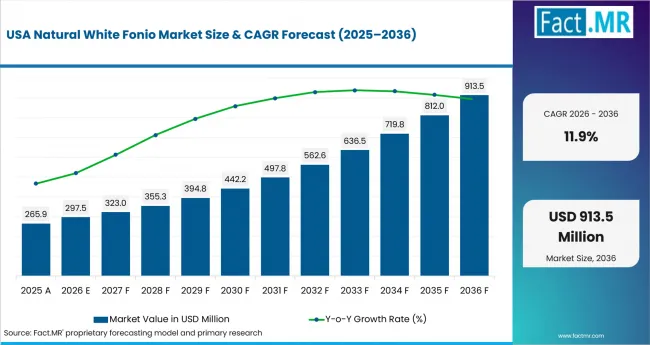
Natural White Fonio Market Country Value Analysis | Source: Fact.MR
The USA offers a large channel for fast-cooking grains and gluten-free ingredients. The Bureau of Labor Statistics reported in August 2026 that the cereals and bakery products index rose 2.7% year over year in July 2026. The figure provides a pricing-pressure signal for grain and bakery categories, while fonio adoption depends on product positioning, cooking convenience and category-specific demand.
Who leads the Natural White Fonio Market?
Yolélé participates through branded fonio grain and pilaf formats that introduce West African cereal applications to U.S. consumers. Its retail line combines quick preparation with gluten-free and non-GMO positioning.
Aduna competes through organic fonio grain, with its official product page describing pre-washed, naturally gluten-free fonio that is ready in three minutes. Farafena supports North American applications through stone-milled fonio flour suited to breads, pancakes, pizza dough, batter and other gluten-free baked goods.
Obà Food, La Vivrière and Terra Ingredients broaden market coverage across European, Senegalese and industrial ingredient channels. Obà Food sells both fonio grain and flour. La Vivrière markets precooked fonio through its Senegalese cereal-processing business, while Terra Ingredients supplies commercial-volume fonio and, with Premium Gold, launched Premium Gold Natural White Fonio for U.S. shoppers in June 2026.
Competition centers on processing quality, preparation convenience, ingredient functionality, food-safety controls and traceability. Suppliers that combine consistent processing with clear product specifications and pack claims can support both retail and manufacturer evaluation.
Which companies are the key providers?
Key companies include Yolélé; Aduna; Farafena; Obà Food; La Vivrière; and Terra Ingredients.
- Yolélé
- Aduna
- Farafena
- Obà Food
- La Vivrière
- Terra Ingredients
Bibliography
- U.S. Bureau of Labor Statistics. (2026, August 12). Consumer Price Index - July 2026.
- Zeballos, E., & Sinclair, W. (2026, June 11). Total U.S. food spending reached $2.51 trillion in 2025. Economic Research Service, U.S. Department of Agriculture.
- U.S. Food and Drug Administration. (2025, January 6). FDA releases allergen, food safety, and plant-based alternative labeling guidances.
- Gouvernement du Mali. (2026, April 3). 16ème session du Comité Exécutif National de l’Agriculture (CENA) : Les résultats de la campagne 2025 et la programmation de 2026 examinés par le Gouvernement.
- Gouvernement du Mali. (2026, June 25). 5 ans de Gouvernance du Président Assimi GOÏTA : Les secteurs primaires du Développement rural, les domaines et l’environnement font le bilan.
- Ministère de l’Agriculture, de l’Agro-alimentaire et de la Souveraineté alimentaire. (2026, May 28). Infographie - L’agriculture biologique (chiffres 2024).
- Agence nationale de la statistique et de la démographie. (2026, February 18). Situation économique et sociale du Sénégal, édition 2024: Agriculture.
- Terra Ingredients. (2026, June 16). From ancient grain to American shelves: Premium Gold Fonio is here.
This Report Answers
- The report explains where white fonio is used across product form, processing level, end-use channel and sourcing position.
- Segment analysis identifies the leading subsegments and the practical reasons brands favor them.
- Country analysis examines the listed markets and the crop, retail or policy mechanisms supporting adoption.
- Competitive analysis reviews current providers across retail grain, flour, quick-cook formats and West African sourcing.
- Application analysis assesses how cooking time, cleaning quality and origin records influence buyer decisions.
What does the Natural White Fonio Market cover?
The Natural White Fonio Market covers cleaned white fonio grain and adjacent formats used in retail packs, foodservice and food manufacturing. The market overlaps with fonio flour, gluten-free products and whole grain and high fiber foods where ancient grains help brands build differentiated food ranges.
The assessment includes decorticated grain, quick-cook white fonio, flour, toasted or puffed formats and specialty organic packs. It has practical links with gluten-free bakery products, gluten substitute ingredients and functional flour when formulators use fonio as an alternative grain base.
What is included in the scope?
The scope includes cleaned grain sold to retail brands, distributors, foodservice accounts and manufacturers. Organic packs and traceable smallholder lots are included where they fit certified grocery channels linked to organic foods and beverages and non-GMO flour positioning.
It includes milling, washing, decortication, toasting and pre-cooking when these steps are part of commercial white fonio supply. Related reference categories include millets and flour products where alternative cereals compete for shelf and ingredient use.
What is excluded from the scope?
The scope excludes raw uncleaned grain sold without commercial food-grade preparation. It also excludes finished restaurant meals, separate seasonings, unrelated cereal crops and broad gluten-free foods that contain no fonio input.
Agricultural equipment, seed supply, farm services and general food distribution are outside the scope unless the sale is directly tied to cleaned white fonio grain or a covered fonio format.
How Was the Analysis Built?
The analysis draws on 120+ sources, 35+ company portfolios, 25+ countries, and more than 20 industry interviews.
- Primary Research: Primary research includes discussions with manufacturers, service providers, technology developers, distributors, end users, and subject-matter experts. These conversations examine purchasing priorities, product adoption, operational challenges, approval requirements, competitive positioning, and the factors that influence wider market acceptance.
- Desk Research: Desk research covers government statistics, regulatory publications, company filings, trade data, technical studies, industry associations, standards, public policy, and other authoritative sources. Every source used in the analysis is documented in the bibliography.
- Market Sizing and Forecasting: Market estimates combine historical performance, demand indicators, pricing and volume trends, segment shares, company participation, country-level growth, adoption patterns, investment activity, and barriers to market expansion.
- Data Validation and Update Cycle: Findings are validated by comparing primary interviews with public data, company activity, regulatory changes, trade patterns, and industry developments. Regular updates review new product launches, capacity changes, partnerships, approvals, and shifts in commercial adoption.
Segmentation
What is the Natural White Fonio Market forecast to be worth by 2036?
USD 820.0 million in 2026 to USD 2833.2 million by 2036 at a 13.2% CAGR.
- The Natural White Fonio Market reached USD 724.4 million in 2025.
- Demand is projected to increase from USD 820.0 million in 2026 to USD 2833.2 million by 2036.
- The market is forecast to record 13.2% CAGR from 2026 to 2036 as processors, specialty retailers and ingredient brands scale cleaned white fonio formats.
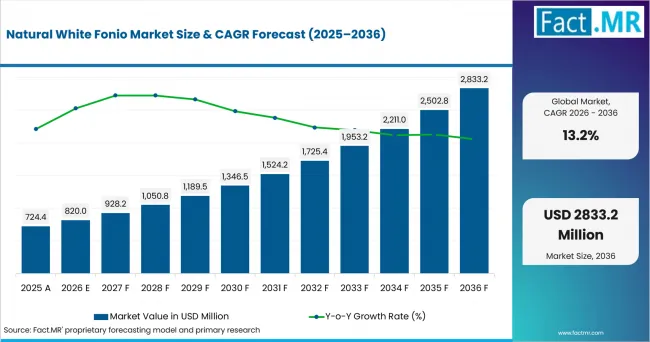
Natural White Fonio Market Value Analysis | Source: Fact.MR
What are the defining numbers behind Natural White Fonio Market growth?
An absolute opportunity of USD 2013.2 million is expected between 2026 and 2036.
- Demand Drivers in the Market
- Retail brands need white grain that cooks quickly and gives shoppers a simple swap for rice, quinoa or couscous.
- Food manufacturers need fonio flour with stable moisture and particle-size control for gluten-free bakery trials.
- West African processors need better cleaning and decortication capacity so small grains move into export-ready packs.
- Specialty importers need traceable smallholder lots with clear origin records for premium packs and store approval.
- U.S. fonio products that use a voluntary "gluten-free" claim must comply with FDA's gluten-free labeling rule under 21 CFR 101.91, including the requirement that any unavoidable gluten be below 20 ppm.
- Key Segments Analyzed
- By Product Form: Decorticated white fonio grain is expected to hold 46.00% share in 2026 because it suits everyday cooking and simple retail instructions.
- By Processing Level: Cleaned and decorticated fonio is projected to account for 41.00% share in 2026 owing to lower preparation work for shoppers.
- By End-use Channel: Retail packaged grain is anticipated to capture 36.00% share in 2026 as shelf-ready packs explain cooking time and usage.
- By Sourcing Position: Conventional West African fonio is estimated to represent 44.00% share in 2026 due to established supply across Mali, Senegal and Nigeria.
- Analyst Opinion at Fact.MR
- Shambhu Nath Jha, Principal Consultant at Fact.MR, states, "White fonio is passing through a documentation gate before it becomes a wider retail grain. The market is expected to reward processors that clean, decorticate and package grain with stable records. Suppliers with quick-cook formats, verified origin and flour-use support are better placed for repeat orders."
- Strategic Implications
- Processors should record decortication yield, cleaning method and moisture levels so importers can approve repeat shipments faster.
- Retail brands should keep cooking time, gluten-free use and West African origin close to the product name on pack.
- Food manufacturers should test fonio flour hydration before expanding bakery mixes because its grain behavior differs from rice flour.
- Export aggregators should group smallholder lots under consistent traceability records to reduce rejection risk in premium channels.
Mali is projected to record 14.9% CAGR through 2036 supported by domestic cereal output and local processing. Senegal is anticipated to post 14.1% CAGR owing to crop-data coverage and Dakar-linked processors. Nigeria is estimated to advance at 13.2% CAGR due to acha familiarity and crop-input programs. France is forecast to reach 12.5% CAGR shaped by organic retail and origin checks. The USA is expected to hold 11.9% CAGR as gluten-free grain use expands across specialty retail and foodservice.
What is the report's scope and coverage?
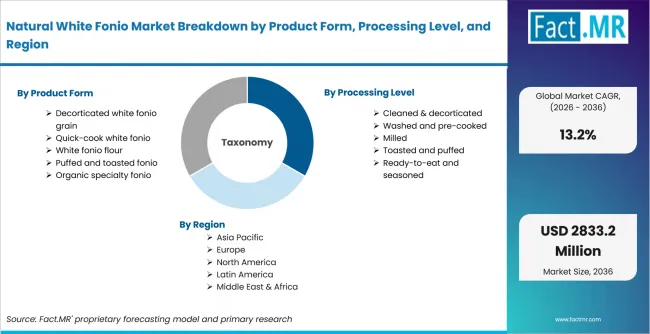
Natural White Fonio Market Breakdown By Product Form, Processing Level, And Region | Source: Fact.MR
| Attribute | Details |
|---|---|
| Quantitative Units | USD million |
| Market Definition | Cleaned white fonio grain and related formats used for retail packs, foodservice, flour, bakery mixes, snacks and breakfast products. |
| Product Form | Decorticated white fonio grain; Quick-cook white fonio; White fonio flour; Puffed and toasted fonio; Organic specialty fonio |
| Processing Level | Cleaned and decorticated; Washed and pre-cooked; Milled; Toasted and puffed; Ready-to-eat and seasoned |
| End-use Channel | Retail packaged grain; Foodservice; Food manufacturing ingredient; Gluten-free bakery and mixes; Snacks and breakfast |
| Sourcing Position | Conventional West African; Traceable smallholder; Organic certified; Fair-trade and impact sourcing; Premium single-origin |
| Regions Covered | North America; Latin America; Western Europe; Eastern Europe; East Asia; South Asia & Pacific; Middle East & Africa |
| Countries Covered | Mali; Senegal; Nigeria; France; USA |
| Key Companies Profiled | Yolélé; Aduna; Farafena; Obà Food; La Vivrière; Terra Ingredients |
| Forecast Period | 2026 to 2036 |
| Approach | Hybrid top-down and bottom-up approach using crop availability, processing capacity, retail channel fit, ingredient use, sourcing position and country-level adoption. |
Source: Fact.MR analysis. Updated Sep 5, 2026
How is the market segmented?
-
By Product Form
- Decorticated white fonio grain
- Quick-cook white fonio
- White fonio flour
- Puffed and toasted fonio
- Organic specialty fonio
-
By Processing Level
- Cleaned and decorticated
- Washed and pre-cooked
- Milled
- Toasted and puffed
- Ready-to-eat and seasoned
-
By End-use Channel
- Retail packaged grain
- Foodservice
- Food manufacturing ingredient
- Gluten-free bakery and mixes
- Snacks and breakfast
-
By Sourcing Position
- Conventional West African
- Traceable smallholder
- Organic certified
- Fair-trade and impact sourcing
- Premium single-origin
-
By Region
- North America
- Latin America
- Western Europe
- Eastern Europe
- East Asia
- South Asia & Pacific
- Middle East & Africa
Frequently Asked Questions
How big is the Natural White Fonio Market in 2026?
What is the CAGR of the Natural White Fonio Market from 2026 to 2036?
Which product form leads the Natural White Fonio Market?
Which processing level leads the Natural White Fonio Market?
Who are the leading companies in the Natural White Fonio Market?
Who worked on this report


Preview the report firsthand - request a free sample
Free SampleGet the brochure for pricing and purchase details
Download PDF