Low-Ammonia NOx Reduction Reagents Market

Low-Ammonia NOx Reduction Reagents Market Size and Share Forecast Outlook 2026 to 2036

Low-ammonia nox reduction reagents market is projected to grow from USD 0.6 billion in 2026 to USD 1.3 billion by 2036, at a CAGR of 8.2%. Urea-Based Low-Ammonia Reagents will dominate with a 34.0% market share, while power plants & utilities will lead the application segment with a 32.0% share.

Low-Ammonia NOx Reduction Reagents Market Forecast and Outlook 2026 to 2036

The global market for low-ammonia NOx reduction reagents is positioned for steady expansion, driven by stringent emission standards and a shift toward safer, more efficient deNOx chemistries. Projected to grow from USD 0.61 billion in 2026 to USD 1.34 billion by 2036, the market will advance at a CAGR of 8.2%.

Key Takeaways from the Low-Ammonia NOx Reduction Reagents Market

  • Market Value for 2026: USD 0.61 Billion
  • Market Value for 2036: USD 1.34 Billion
  • Forecast CAGR (2026-2036): 8.2%
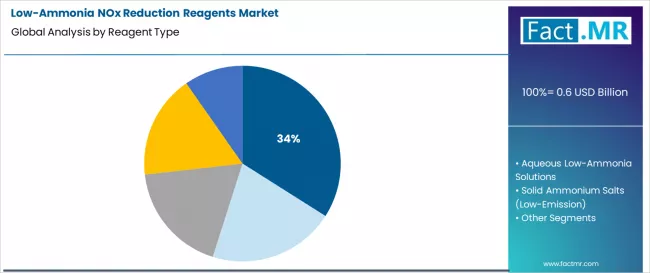
  • Leading Reagent Type Share (2026): Urea-Based Low-Ammonia Reagents (34%)
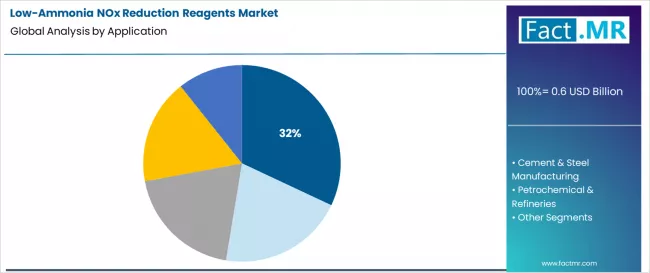
  • Leading Application Share (2026): Power Plants & Utilities (32%)
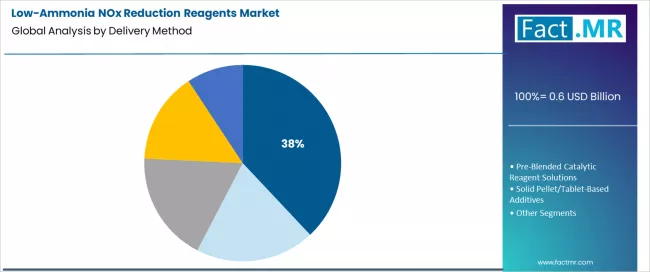
  • Leading Delivery Method Share (2026): On-Site Continuous Dosing Systems (38%)
  • Key Players in the Market: Yara International, BASF SE, Johnson Matthey, Solvay, Brenntag
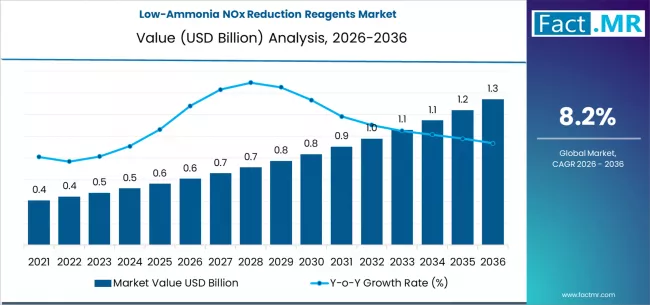
Low Ammonia Nox Reduction Reagents Market Market Value Analysis

Urea-based low-ammonia formulations represent the dominant reagent type, holding a 34% market share. Power plants and utilities constitute the leading application segment, accounting for 32% of demand. On-site continuous dosing systems are the preferred delivery method, with a 38% share, reflecting the need for precise and reliable reagent injection in large-scale operations.

This growth is primarily fueled by increasingly strict global limits on nitrogen oxide (NOx) emissions from stationary sources, alongside growing operational and safety concerns associated with handling and storing aqueous ammonia. Low-ammonia reagents, including advanced urea solutions and solid salts, offer a safer alternative with reduced toxicity and flammability risks while maintaining high NOx conversion efficiency in Selective Catalytic Reduction (SCR) and Selective Non-Catalytic Reduction (SNCR) systems.

The market's evolution centers on developing reagents that minimize ammonia slip, reduce formation of byproducts like ammonium bisulfate, and perform reliably across diverse flue gas conditions. These formulations are critical for enabling industrial operators to achieve compliance, improve operational safety, and optimize the total cost of ownership for their NOx abatement systems.

Metric

Metric Value
Market Value (2026) USD 0.61 Billion
Market Forecast Value (2036) USD 1.34 Billion
Forecast CAGR (2026-2036) 8.2%

Category

Category Segments
Reagent Type Urea-Based Low-Ammonia Reagents, Aqueous Low-Ammonia Solutions, Solid Ammonium Salts (Low-Emission), SCR Catalytic Additive Blends, Other Specialty NOx Reduction Reagents
Application Power Plants & Utilities, Cement & Steel Manufacturing, Petrochemical & Refineries, Waste-to-Energy & Incineration, Industrial Boilers & Furnaces
Delivery Method On-Site Continuous Dosing Systems, Pre-Blended Catalytic Reagent Solutions, Solid Pellet/Tablet-Based Additives, Hybrid Chemical-Catalytic Systems, Other Delivery Formats
Region North America, Latin America, Western Europe, Eastern Europe, East Asia, South Asia & Pacific, MEA

Segmental Analysis

By Reagent Type, Which Formulation Holds the Largest Share?
Low Ammonia Nox Reduction Reagents Market Analysis By Reagent Type

Urea-based low-ammonia reagents lead this segment with a 34% share. Their dominance is attributed to their optimal balance of safety, handling ease, and effective NOx reduction performance. Urea hydrolyzes to form ammonia in situ at the point of injection, eliminating the need to transport and store large quantities of hazardous aqueous ammonia. This characteristic makes it the standard choice for many power plants and industrial facilities prioritizing site safety and regulatory compliance without sacrificing deNOx efficiency.

By Application, Which Sector is the Primary Consumer?
Low Ammonia Nox Reduction Reagents Market Analysis By Application

Power plants and utilities represent the largest application segment, commanding a 32% share. Coal-fired and gas-fired power stations are subject to some of the most stringent NOx emission limits globally. Their continuous operation and large flue gas volumes require reliable, high-volume reagent supply. The sector's ongoing need to meet compliance standards, coupled with a strong focus on operational risk reduction, sustains consistent demand for advanced, low-ammonia reagent formulations.

By Delivery Method, Which System Ensures Optimal Performance?
Low Ammonia Nox Reduction Reagents Market Analysis By Delivery Method

On-site continuous dosing systems are the leading delivery method, holding a 38% share. These integrated systems precisely meter and inject liquid reagents directly into the flue gas duct, ensuring consistent stoichiometry and maximizing NOx reduction efficiency. Their dominance is due to the critical need for precise control in large-scale SCR applications, where variations in reagent flow can lead to ammonia slip or inadequate NOx conversion. This method's reliability and automation capabilities make it essential for modern emission control infrastructure.

What are the Drivers, Restraints, and Key Trends of the Low-Ammonia NOx Reduction Reagents Market?

The primary market driver is the global tightening of NOx emission regulations for industrial and power generation sources, enforced through policies like the Industrial Emissions Directive in the EU and National Emission Standards for Hazardous Air Pollutants (NESHAP) in the USA. Concurrently, heightened focus on industrial safety is pushing operators away from pure ammonia toward safer alternatives. The economic incentive to minimize ammonia slip, which represents wasted reagent and can cause downstream equipment fouling, also drives adoption of optimized, low-ammonia formulations.

A significant market restraint is the higher upfront and operational cost of some advanced low-ammonia reagents compared to standard aqueous ammonia, particularly for facilities with existing ammonia-handling infrastructure. The performance of certain alternatives can be more sensitive to flue gas temperature and composition, requiring careful system tuning. In regions with less stringent enforcement or where capital for system upgrades is limited, the transition to newer reagents may be slower despite their safety advantages.

Key trends include the development of catalytic additive blends that enhance the reactivity of urea-based reagents, allowing for effective NOx reduction at lower temperatures and reducing the risk of byproduct formation. There is growing integration of digital dosing control systems that use real-time flue gas analytics to dynamically adjust reagent injection, optimizing consumption and minimizing emissions. The market is also seeing interest in solid reagent formats like pellets or tablets for specific applications, which simplify logistics and storage for smaller or more remote industrial units.

Analysis of the Low-Ammonia NOx Reduction Reagents Market by Key Countries
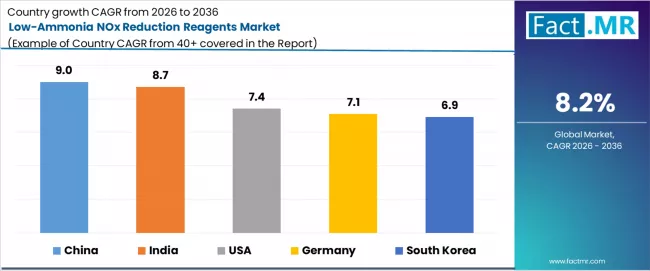
Low Ammonia Nox Reduction Reagents Market Cagr Analysis By Country

Country CAGR (2026-2036)
China 9.00%
India 8.70%
USA 7.40%
Germany 7.10%
South Korea 6.90%

How do China’s Ultra-Low Emission Standards Drive Reagent Innovation?

China’s leading CAGR of 9.00% is propelled by its ongoing enforcement of ultra-low emission standards for thermal power plants and key industries like steel and cement. The widespread retrofit and installation of SCR/SNCR systems across thousands of facilities create massive demand for deNOx reagents. A strong national push to enhance industrial safety is accelerating the shift from aqueous ammonia to safer, urea-based low-ammonia solutions, supported by domestic manufacturing of these chemicals.

What is the Impact of India’s Expanding Power Fleet and New Emission Norms?

India’s 8.70% growth is driven by stringent new emission limits for thermal power plants and a rapidly expanding industrial base. The large-scale installation of FGD and SCR systems to meet these norms generates substantial demand for NOx reduction reagents. The preference for urea-based solutions is high due to safety considerations and supply chain maturity, making low-ammonia formulations the standard choice for new installations in a cost-sensitive market.

How does the USA’s Regulatory Framework and Infrastructure Modernization Influence Demand?
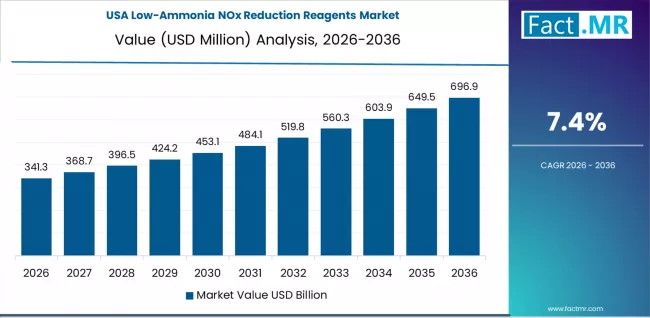
Low Ammonia Nox Reduction Reagents Market Country Value Analysis

A stable regulatory environment under the Clean Air Act and ongoing upgrades to aging power and industrial infrastructure supports the USA’s 7.40% CAGR. The focus on reducing ammonia slip and improving operational safety at existing SCR-equipped facilities drives the replacement of traditional reagents with optimized, low-ammonia formulations. Market demand is characterized by a shift toward higher-performance, specialty blends that offer total cost savings through improved efficiency and reduced maintenance.

Why is Germany a Key Market for High-Efficiency and Precision Dosing Solutions?

Germany’s 7.10% growth reflects its stringent EU-derived emission limits and leading position in high-efficiency industrial engineering. German operators prioritize reagents and dosing systems that maximize NOx conversion while absolutely minimizing ammonia slip and secondary emissions. This creates a sophisticated market for advanced low-ammonia solutions, often integrated with smart digital controls, to achieve precise compliance and optimal resource use.

What Role does South Korea’s Industrial Complex and Air Quality Policy Play?

South Korea’s 6.90% growth is anchored in its dense industrial clusters and strong national air quality improvement policies. Strict emission standards for power plants, refineries, and waste incineration facilities necessitate reliable deNOx systems. The emphasis on technological precision and urban air quality drives the adoption of advanced, low-ammonia reagent systems that ensure consistent performance and align with the country's focus on high-tech industrial solutions.

Competitive Landscape of the Low-Ammonia NOx Reduction Reagents Market
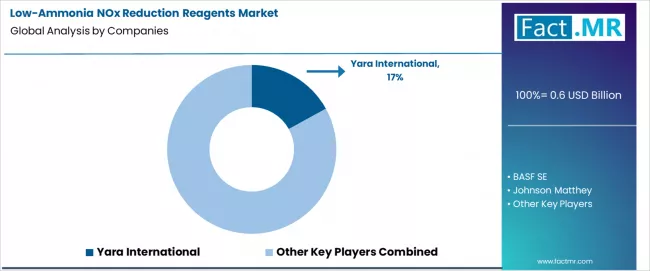
Low Ammonia Nox Reduction Reagents Market Analysis By Company

The competitive landscape is characterized by global chemical producers and specialty chemical distributors with deep expertise in emission control technologies. Leaders like Yara International and BASF compete based on the quality and consistency of their urea and chemical formulations, comprehensive technical support, and robust supply chain logistics. Competition centers on providing application-specific solutions, demonstrating reductions in ammonia slip and total cost of operation, and offering integrated dosing equipment and services. A key differentiator is the ability to deliver a complete reagent management program, including site audits, dosing optimization, and logistics support, particularly for large utility and industrial customers.

Key Players in the Low-Ammonia NOx Reduction Reagents Market

  • Yara International
  • BASF SE
  • Johnson Matthey
  • Solvay S.A.
  • Brenntag

Scope of Report

Items Values
Quantitative Units USD Billion
Reagent Type Urea-Based, Aqueous Solutions, Solid Salts, Catalytic Blends, Specialty Reagents
Application Power Plants, Cement & Steel, Petrochemicals, Waste-to-Energy, Industrial Boilers
Delivery Method Continuous Dosing, Pre-Blended Solutions, Solid Additives, Hybrid Systems
Key Countries China, India, USA, Germany, South Korea
Key Companies Yara International, BASF SE, Johnson Matthey, Solvay, Brenntag
Additional Analysis Analysis of reagent hydrolysis kinetics; impact on catalyst performance and lifespan; ammonia slip measurement and control strategies; corrosion and byproduct formation potential; total cost of ownership (TCO) models comparing reagent types; supply chain analysis for urea and precursor chemicals.

Market by Segments

  • Reagent Type :

    • Urea-Based Low-Ammonia Reagents
    • Aqueous Low-Ammonia Solutions
    • Solid Ammonium Salts (Low-Emission)
    • SCR Catalytic Additive Blends
    • Other Specialty NOx Reduction Reagents
  • Application :

    • Power Plants & Utilities
    • Cement & Steel Manufacturing
    • Petrochemical & Refineries
    • Waste-to-Energy & Incineration
    • Industrial Boilers & Furnaces
  • Delivery Method :

    • On-Site Continuous Dosing Systems
    • Pre-Blended Catalytic Reagent Solutions
    • Solid Pellet/Tablet-Based Additives
    • Hybrid Chemical-Catalytic Systems
    • Other Delivery Formats
  • Region :

    • North America

      • USA
      • Canada
    • Latin America

      • Brazil
      • Mexico
      • Argentina
      • Rest of Latin America
    • Western Europe

      • Germany
      • UK
      • France
      • Spain
      • Italy
      • BENELUX
      • Rest of Western Europe
    • Eastern Europe

      • Russia
      • Poland
      • Czech Republic
      • Rest of Eastern Europe
    • East Asia

      • China
      • Japan
      • South Korea
      • Rest of East Asia
    • South Asia & Pacific

      • India
      • ASEAN
      • Australia
      • Rest of South Asia & Pacific
    • MEA

      • Saudi Arabia
      • UAE
      • Turkiye
      • Rest of MEA

Table of Content

  1. Executive Summary
    • Global Market Outlook
    • Demand to side Trends
    • Supply to side Trends
    • Technology Roadmap Analysis
    • Analysis and Recommendations
  2. Market Overview
    • Market Coverage / Taxonomy
    • Market Definition / Scope / Limitations
  3. Market Background
    • Market Dynamics
      • Drivers
      • Restraints
      • Opportunity
      • Trends
    • Scenario Forecast
      • Demand in Optimistic Scenario
      • Demand in Likely Scenario
      • Demand in Conservative Scenario
    • Opportunity Map Analysis
    • Product Life Cycle Analysis
    • Supply Chain Analysis
    • Investment Feasibility Matrix
    • Value Chain Analysis
    • PESTLE and Porter’s Analysis
    • Regulatory Landscape
    • Regional Parent Market Outlook
    • Production and Consumption Statistics
    • Import and Export Statistics
  4. Global Market Analysis 2021 to 2025 and Forecast, 2026 to 2036
    • Historical Market Size Value (USD Million) Analysis, 2021 to 2025
    • Current and Future Market Size Value (USD Million) Projections, 2026 to 2036
      • Y to o to Y Growth Trend Analysis
      • Absolute $ Opportunity Analysis
  5. Global Market Pricing Analysis 2021 to 2025 and Forecast 2026 to 2036
  6. Global Market Analysis 2021 to 2025 and Forecast 2026 to 2036, By Reagent Type
    • Introduction / Key Findings
    • Historical Market Size Value (USD Million) Analysis By Reagent Type, 2021 to 2025
    • Current and Future Market Size Value (USD Million) Analysis and Forecast By Reagent Type, 2026 to 2036
      • Urea-Based Low-Ammonia Reagents
      • Aqueous Low-Ammonia Solutions
      • Solid Ammonium Salts (Low-Emission)
      • SCR Catalytic Additive Blends
      • Other Specialty NOx Reduction Reagents
    • Y to o to Y Growth Trend Analysis By Reagent Type, 2021 to 2025
    • Absolute $ Opportunity Analysis By Reagent Type, 2026 to 2036
  7. Global Market Analysis 2021 to 2025 and Forecast 2026 to 2036, By Application
    • Introduction / Key Findings
    • Historical Market Size Value (USD Million) Analysis By Application, 2021 to 2025
    • Current and Future Market Size Value (USD Million) Analysis and Forecast By Application, 2026 to 2036
      • Power Plants & Utilities
      • Cement & Steel Manufacturing
      • Petrochemical & Refineries
      • Waste-to-Energy & Incineration
      • Industrial Boilers & Furnaces
    • Y to o to Y Growth Trend Analysis By Application, 2021 to 2025
    • Absolute $ Opportunity Analysis By Application, 2026 to 2036
  8. Global Market Analysis 2021 to 2025 and Forecast 2026 to 2036, By Delivery Method
    • Introduction / Key Findings
    • Historical Market Size Value (USD Million) Analysis By Delivery Method, 2021 to 2025
    • Current and Future Market Size Value (USD Million) Analysis and Forecast By Delivery Method, 2026 to 2036
      • On-Site Continuous Dosing Systems
      • Pre-Blended Catalytic Reagent Solutions
      • Solid Pellet/Tablet-Based Additives
      • Hybrid Chemical-Catalytic Systems
      • Other Delivery Formats
    • Y to o to Y Growth Trend Analysis By Delivery Method, 2021 to 2025
    • Absolute $ Opportunity Analysis By Delivery Method, 2026 to 2036
  9. Global Market Analysis 2021 to 2025 and Forecast 2026 to 2036, By Region
    • Introduction
    • Historical Market Size Value (USD Million) Analysis By Region, 2021 to 2025
    • Current Market Size Value (USD Million) Analysis and Forecast By Region, 2026 to 2036
      • North America
      • Latin America
      • Western Europe
      • Eastern Europe
      • East Asia
      • South Asia and Pacific
      • Middle East & Africa
    • Market Attractiveness Analysis By Region
  10. North America Market Analysis 2021 to 2025 and Forecast 2026 to 2036, By Country
    • Historical Market Size Value (USD Million) Trend Analysis By Market Taxonomy, 2021 to 2025
    • Market Size Value (USD Million) Forecast By Market Taxonomy, 2026 to 2036
      • By Country
        • USA
        • Canada
        • Mexico
      • By Reagent Type
      • By Application
      • By Delivery Method
    • Market Attractiveness Analysis
      • By Country
      • By Reagent Type
      • By Application
      • By Delivery Method
    • Key Takeaways
  11. Latin America Market Analysis 2021 to 2025 and Forecast 2026 to 2036, By Country
    • Historical Market Size Value (USD Million) Trend Analysis By Market Taxonomy, 2021 to 2025
    • Market Size Value (USD Million) Forecast By Market Taxonomy, 2026 to 2036
      • By Country
        • Brazil
        • Chile
        • Rest of Latin America
      • By Reagent Type
      • By Application
      • By Delivery Method
    • Market Attractiveness Analysis
      • By Country
      • By Reagent Type
      • By Application
      • By Delivery Method
    • Key Takeaways
  12. Western Europe Market Analysis 2021 to 2025 and Forecast 2026 to 2036, By Country
    • Historical Market Size Value (USD Million) Trend Analysis By Market Taxonomy, 2021 to 2025
    • Market Size Value (USD Million) Forecast By Market Taxonomy, 2026 to 2036
      • By Country
        • Germany
        • UK
        • Italy
        • Spain
        • France
        • Nordic
        • BENELUX
        • Rest of Western Europe
      • By Reagent Type
      • By Application
      • By Delivery Method
    • Market Attractiveness Analysis
      • By Country
      • By Reagent Type
      • By Application
      • By Delivery Method
    • Key Takeaways
  13. Eastern Europe Market Analysis 2021 to 2025 and Forecast 2026 to 2036, By Country
    • Historical Market Size Value (USD Million) Trend Analysis By Market Taxonomy, 2021 to 2025
    • Market Size Value (USD Million) Forecast By Market Taxonomy, 2026 to 2036
      • By Country
        • Russia
        • Poland
        • Hungary
        • Balkan & Baltic
        • Rest of Eastern Europe
      • By Reagent Type
      • By Application
      • By Delivery Method
    • Market Attractiveness Analysis
      • By Country
      • By Reagent Type
      • By Application
      • By Delivery Method
    • Key Takeaways
  14. East Asia Market Analysis 2021 to 2025 and Forecast 2026 to 2036, By Country
    • Historical Market Size Value (USD Million) Trend Analysis By Market Taxonomy, 2021 to 2025
    • Market Size Value (USD Million) Forecast By Market Taxonomy, 2026 to 2036
      • By Country
        • China
        • Japan
        • South Korea
      • By Reagent Type
      • By Application
      • By Delivery Method
    • Market Attractiveness Analysis
      • By Country
      • By Reagent Type
      • By Application
      • By Delivery Method
    • Key Takeaways
  15. South Asia and Pacific Market Analysis 2021 to 2025 and Forecast 2026 to 2036, By Country
    • Historical Market Size Value (USD Million) Trend Analysis By Market Taxonomy, 2021 to 2025
    • Market Size Value (USD Million) Forecast By Market Taxonomy, 2026 to 2036
      • By Country
        • India
        • ASEAN
        • Australia & New Zealand
        • Rest of South Asia and Pacific
      • By Reagent Type
      • By Application
      • By Delivery Method
    • Market Attractiveness Analysis
      • By Country
      • By Reagent Type
      • By Application
      • By Delivery Method
    • Key Takeaways
  16. Middle East & Africa Market Analysis 2021 to 2025 and Forecast 2026 to 2036, By Country
    • Historical Market Size Value (USD Million) Trend Analysis By Market Taxonomy, 2021 to 2025
    • Market Size Value (USD Million) Forecast By Market Taxonomy, 2026 to 2036
      • By Country
        • Kingdom of Saudi Arabia
        • Other GCC Countries
        • Turkiye
        • South Africa
        • Other African Union
        • Rest of Middle East & Africa
      • By Reagent Type
      • By Application
      • By Delivery Method
    • Market Attractiveness Analysis
      • By Country
      • By Reagent Type
      • By Application
      • By Delivery Method
    • Key Takeaways
  17. Key Countries Market Analysis
    • USA
      • Pricing Analysis
      • Market Share Analysis, 2025
        • By Reagent Type
        • By Application
        • By Delivery Method
    • Canada
      • Pricing Analysis
      • Market Share Analysis, 2025
        • By Reagent Type
        • By Application
        • By Delivery Method
    • Mexico
      • Pricing Analysis
      • Market Share Analysis, 2025
        • By Reagent Type
        • By Application
        • By Delivery Method
    • Brazil
      • Pricing Analysis
      • Market Share Analysis, 2025
        • By Reagent Type
        • By Application
        • By Delivery Method
    • Chile
      • Pricing Analysis
      • Market Share Analysis, 2025
        • By Reagent Type
        • By Application
        • By Delivery Method
    • Germany
      • Pricing Analysis
      • Market Share Analysis, 2025
        • By Reagent Type
        • By Application
        • By Delivery Method
    • UK
      • Pricing Analysis
      • Market Share Analysis, 2025
        • By Reagent Type
        • By Application
        • By Delivery Method
    • Italy
      • Pricing Analysis
      • Market Share Analysis, 2025
        • By Reagent Type
        • By Application
        • By Delivery Method
    • Spain
      • Pricing Analysis
      • Market Share Analysis, 2025
        • By Reagent Type
        • By Application
        • By Delivery Method
    • France
      • Pricing Analysis
      • Market Share Analysis, 2025
        • By Reagent Type
        • By Application
        • By Delivery Method
    • India
      • Pricing Analysis
      • Market Share Analysis, 2025
        • By Reagent Type
        • By Application
        • By Delivery Method
    • ASEAN
      • Pricing Analysis
      • Market Share Analysis, 2025
        • By Reagent Type
        • By Application
        • By Delivery Method
    • Australia & New Zealand
      • Pricing Analysis
      • Market Share Analysis, 2025
        • By Reagent Type
        • By Application
        • By Delivery Method
    • China
      • Pricing Analysis
      • Market Share Analysis, 2025
        • By Reagent Type
        • By Application
        • By Delivery Method
    • Japan
      • Pricing Analysis
      • Market Share Analysis, 2025
        • By Reagent Type
        • By Application
        • By Delivery Method
    • South Korea
      • Pricing Analysis
      • Market Share Analysis, 2025
        • By Reagent Type
        • By Application
        • By Delivery Method
    • Russia
      • Pricing Analysis
      • Market Share Analysis, 2025
        • By Reagent Type
        • By Application
        • By Delivery Method
    • Poland
      • Pricing Analysis
      • Market Share Analysis, 2025
        • By Reagent Type
        • By Application
        • By Delivery Method
    • Hungary
      • Pricing Analysis
      • Market Share Analysis, 2025
        • By Reagent Type
        • By Application
        • By Delivery Method
    • Kingdom of Saudi Arabia
      • Pricing Analysis
      • Market Share Analysis, 2025
        • By Reagent Type
        • By Application
        • By Delivery Method
    • Turkiye
      • Pricing Analysis
      • Market Share Analysis, 2025
        • By Reagent Type
        • By Application
        • By Delivery Method
    • South Africa
      • Pricing Analysis
      • Market Share Analysis, 2025
        • By Reagent Type
        • By Application
        • By Delivery Method
  18. Market Structure Analysis
    • Competition Dashboard
    • Competition Benchmarking
    • Market Share Analysis of Top Players
      • By Regional
      • By Reagent Type
      • By Application
      • By Delivery Method
  19. Competition Analysis
    • Competition Deep Dive
      • Yara International
        • Overview
        • Product Portfolio
        • Profitability by Market Segments (Product/Age /Sales Channel/Region)
        • Sales Footprint
        • Strategy Overview
          • Marketing Strategy
          • Product Strategy
          • Channel Strategy
      • BASF SE
      • Johnson Matthey
      • Solvay
      • Brenntag
  20. Assumptions & Acronyms Used
  21. Research Methodology

List Of Table

  • Table 1: Global Market Value (USD Million) Forecast by Region, 2021 to 2036
  • Table 2: Global Market Value (USD Million) Forecast by Reagent Type, 2021 to 2036
  • Table 3: Global Market Value (USD Million) Forecast by Application, 2021 to 2036
  • Table 4: Global Market Value (USD Million) Forecast by Delivery Method, 2021 to 2036
  • Table 5: North America Market Value (USD Million) Forecast by Country, 2021 to 2036
  • Table 6: North America Market Value (USD Million) Forecast by Reagent Type, 2021 to 2036
  • Table 7: North America Market Value (USD Million) Forecast by Application, 2021 to 2036
  • Table 8: North America Market Value (USD Million) Forecast by Delivery Method, 2021 to 2036
  • Table 9: Latin America Market Value (USD Million) Forecast by Country, 2021 to 2036
  • Table 10: Latin America Market Value (USD Million) Forecast by Reagent Type, 2021 to 2036
  • Table 11: Latin America Market Value (USD Million) Forecast by Application, 2021 to 2036
  • Table 12: Latin America Market Value (USD Million) Forecast by Delivery Method, 2021 to 2036
  • Table 13: Western Europe Market Value (USD Million) Forecast by Country, 2021 to 2036
  • Table 14: Western Europe Market Value (USD Million) Forecast by Reagent Type, 2021 to 2036
  • Table 15: Western Europe Market Value (USD Million) Forecast by Application, 2021 to 2036
  • Table 16: Western Europe Market Value (USD Million) Forecast by Delivery Method, 2021 to 2036
  • Table 17: Eastern Europe Market Value (USD Million) Forecast by Country, 2021 to 2036
  • Table 18: Eastern Europe Market Value (USD Million) Forecast by Reagent Type, 2021 to 2036
  • Table 19: Eastern Europe Market Value (USD Million) Forecast by Application, 2021 to 2036
  • Table 20: Eastern Europe Market Value (USD Million) Forecast by Delivery Method, 2021 to 2036
  • Table 21: East Asia Market Value (USD Million) Forecast by Country, 2021 to 2036
  • Table 22: East Asia Market Value (USD Million) Forecast by Reagent Type, 2021 to 2036
  • Table 23: East Asia Market Value (USD Million) Forecast by Application, 2021 to 2036
  • Table 24: East Asia Market Value (USD Million) Forecast by Delivery Method, 2021 to 2036
  • Table 25: South Asia and Pacific Market Value (USD Million) Forecast by Country, 2021 to 2036
  • Table 26: South Asia and Pacific Market Value (USD Million) Forecast by Reagent Type, 2021 to 2036
  • Table 27: South Asia and Pacific Market Value (USD Million) Forecast by Application, 2021 to 2036
  • Table 28: South Asia and Pacific Market Value (USD Million) Forecast by Delivery Method, 2021 to 2036
  • Table 29: Middle East & Africa Market Value (USD Million) Forecast by Country, 2021 to 2036
  • Table 30: Middle East & Africa Market Value (USD Million) Forecast by Reagent Type, 2021 to 2036
  • Table 31: Middle East & Africa Market Value (USD Million) Forecast by Application, 2021 to 2036
  • Table 32: Middle East & Africa Market Value (USD Million) Forecast by Delivery Method, 2021 to 2036

List Of Figures

  • Figure 1: Global Market Pricing Analysis
  • Figure 2: Global Market Value (USD Million) Forecast 2021 to 2036
  • Figure 3: Global Market Value Share and BPS Analysis by Reagent Type, 2026 and 2036
  • Figure 4: Global Market Y to o to Y Growth Comparison by Reagent Type, 2026 to 2036
  • Figure 5: Global Market Attractiveness Analysis by Reagent Type
  • Figure 6: Global Market Value Share and BPS Analysis by Application, 2026 and 2036
  • Figure 7: Global Market Y to o to Y Growth Comparison by Application, 2026 to 2036
  • Figure 8: Global Market Attractiveness Analysis by Application
  • Figure 9: Global Market Value Share and BPS Analysis by Delivery Method, 2026 and 2036
  • Figure 10: Global Market Y to o to Y Growth Comparison by Delivery Method, 2026 to 2036
  • Figure 11: Global Market Attractiveness Analysis by Delivery Method
  • Figure 12: Global Market Value (USD Million) Share and BPS Analysis by Region, 2026 and 2036
  • Figure 13: Global Market Y to o to Y Growth Comparison by Region, 2026 to 2036
  • Figure 14: Global Market Attractiveness Analysis by Region
  • Figure 15: North America Market Incremental Dollar Opportunity, 2026 to 2036
  • Figure 16: Latin America Market Incremental Dollar Opportunity, 2026 to 2036
  • Figure 17: Western Europe Market Incremental Dollar Opportunity, 2026 to 2036
  • Figure 18: Eastern Europe Market Incremental Dollar Opportunity, 2026 to 2036
  • Figure 19: East Asia Market Incremental Dollar Opportunity, 2026 to 2036
  • Figure 20: South Asia and Pacific Market Incremental Dollar Opportunity, 2026 to 2036
  • Figure 21: Middle East & Africa Market Incremental Dollar Opportunity, 2026 to 2036
  • Figure 22: North America Market Value Share and BPS Analysis by Country, 2026 and 2036
  • Figure 23: North America Market Value Share and BPS Analysis by Reagent Type, 2026 and 2036
  • Figure 24: North America Market Y to o to Y Growth Comparison by Reagent Type, 2026 to 2036
  • Figure 25: North America Market Attractiveness Analysis by Reagent Type
  • Figure 26: North America Market Value Share and BPS Analysis by Application, 2026 and 2036
  • Figure 27: North America Market Y to o to Y Growth Comparison by Application, 2026 to 2036
  • Figure 28: North America Market Attractiveness Analysis by Application
  • Figure 29: North America Market Value Share and BPS Analysis by Delivery Method, 2026 and 2036
  • Figure 30: North America Market Y to o to Y Growth Comparison by Delivery Method, 2026 to 2036
  • Figure 31: North America Market Attractiveness Analysis by Delivery Method
  • Figure 32: Latin America Market Value Share and BPS Analysis by Country, 2026 and 2036
  • Figure 33: Latin America Market Value Share and BPS Analysis by Reagent Type, 2026 and 2036
  • Figure 34: Latin America Market Y to o to Y Growth Comparison by Reagent Type, 2026 to 2036
  • Figure 35: Latin America Market Attractiveness Analysis by Reagent Type
  • Figure 36: Latin America Market Value Share and BPS Analysis by Application, 2026 and 2036
  • Figure 37: Latin America Market Y to o to Y Growth Comparison by Application, 2026 to 2036
  • Figure 38: Latin America Market Attractiveness Analysis by Application
  • Figure 39: Latin America Market Value Share and BPS Analysis by Delivery Method, 2026 and 2036
  • Figure 40: Latin America Market Y to o to Y Growth Comparison by Delivery Method, 2026 to 2036
  • Figure 41: Latin America Market Attractiveness Analysis by Delivery Method
  • Figure 42: Western Europe Market Value Share and BPS Analysis by Country, 2026 and 2036
  • Figure 43: Western Europe Market Value Share and BPS Analysis by Reagent Type, 2026 and 2036
  • Figure 44: Western Europe Market Y to o to Y Growth Comparison by Reagent Type, 2026 to 2036
  • Figure 45: Western Europe Market Attractiveness Analysis by Reagent Type
  • Figure 46: Western Europe Market Value Share and BPS Analysis by Application, 2026 and 2036
  • Figure 47: Western Europe Market Y to o to Y Growth Comparison by Application, 2026 to 2036
  • Figure 48: Western Europe Market Attractiveness Analysis by Application
  • Figure 49: Western Europe Market Value Share and BPS Analysis by Delivery Method, 2026 and 2036
  • Figure 50: Western Europe Market Y to o to Y Growth Comparison by Delivery Method, 2026 to 2036
  • Figure 51: Western Europe Market Attractiveness Analysis by Delivery Method
  • Figure 52: Eastern Europe Market Value Share and BPS Analysis by Country, 2026 and 2036
  • Figure 53: Eastern Europe Market Value Share and BPS Analysis by Reagent Type, 2026 and 2036
  • Figure 54: Eastern Europe Market Y to o to Y Growth Comparison by Reagent Type, 2026 to 2036
  • Figure 55: Eastern Europe Market Attractiveness Analysis by Reagent Type
  • Figure 56: Eastern Europe Market Value Share and BPS Analysis by Application, 2026 and 2036
  • Figure 57: Eastern Europe Market Y to o to Y Growth Comparison by Application, 2026 to 2036
  • Figure 58: Eastern Europe Market Attractiveness Analysis by Application
  • Figure 59: Eastern Europe Market Value Share and BPS Analysis by Delivery Method, 2026 and 2036
  • Figure 60: Eastern Europe Market Y to o to Y Growth Comparison by Delivery Method, 2026 to 2036
  • Figure 61: Eastern Europe Market Attractiveness Analysis by Delivery Method
  • Figure 62: East Asia Market Value Share and BPS Analysis by Country, 2026 and 2036
  • Figure 63: East Asia Market Value Share and BPS Analysis by Reagent Type, 2026 and 2036
  • Figure 64: East Asia Market Y to o to Y Growth Comparison by Reagent Type, 2026 to 2036
  • Figure 65: East Asia Market Attractiveness Analysis by Reagent Type
  • Figure 66: East Asia Market Value Share and BPS Analysis by Application, 2026 and 2036
  • Figure 67: East Asia Market Y to o to Y Growth Comparison by Application, 2026 to 2036
  • Figure 68: East Asia Market Attractiveness Analysis by Application
  • Figure 69: East Asia Market Value Share and BPS Analysis by Delivery Method, 2026 and 2036
  • Figure 70: East Asia Market Y to o to Y Growth Comparison by Delivery Method, 2026 to 2036
  • Figure 71: East Asia Market Attractiveness Analysis by Delivery Method
  • Figure 72: South Asia and Pacific Market Value Share and BPS Analysis by Country, 2026 and 2036
  • Figure 73: South Asia and Pacific Market Value Share and BPS Analysis by Reagent Type, 2026 and 2036
  • Figure 74: South Asia and Pacific Market Y to o to Y Growth Comparison by Reagent Type, 2026 to 2036
  • Figure 75: South Asia and Pacific Market Attractiveness Analysis by Reagent Type
  • Figure 76: South Asia and Pacific Market Value Share and BPS Analysis by Application, 2026 and 2036
  • Figure 77: South Asia and Pacific Market Y to o to Y Growth Comparison by Application, 2026 to 2036
  • Figure 78: South Asia and Pacific Market Attractiveness Analysis by Application
  • Figure 79: South Asia and Pacific Market Value Share and BPS Analysis by Delivery Method, 2026 and 2036
  • Figure 80: South Asia and Pacific Market Y to o to Y Growth Comparison by Delivery Method, 2026 to 2036
  • Figure 81: South Asia and Pacific Market Attractiveness Analysis by Delivery Method
  • Figure 82: Middle East & Africa Market Value Share and BPS Analysis by Country, 2026 and 2036
  • Figure 83: Middle East & Africa Market Value Share and BPS Analysis by Reagent Type, 2026 and 2036
  • Figure 84: Middle East & Africa Market Y to o to Y Growth Comparison by Reagent Type, 2026 to 2036
  • Figure 85: Middle East & Africa Market Attractiveness Analysis by Reagent Type
  • Figure 86: Middle East & Africa Market Value Share and BPS Analysis by Application, 2026 and 2036
  • Figure 87: Middle East & Africa Market Y to o to Y Growth Comparison by Application, 2026 to 2036
  • Figure 88: Middle East & Africa Market Attractiveness Analysis by Application
  • Figure 89: Middle East & Africa Market Value Share and BPS Analysis by Delivery Method, 2026 and 2036
  • Figure 90: Middle East & Africa Market Y to o to Y Growth Comparison by Delivery Method, 2026 to 2036
  • Figure 91: Middle East & Africa Market Attractiveness Analysis by Delivery Method
  • Figure 92: Global Market - Tier Structure Analysis
  • Figure 93: Global Market - Company Share Analysis

- FAQs -

How big is the low-ammonia nox reduction reagents market in 2026?

The global low-ammonia nox reduction reagents market is estimated to be valued at USD 0.6 billion in 2026.

What will be the size of low-ammonia nox reduction reagents market in 2036?

The market size for the low-ammonia nox reduction reagents market is projected to reach USD 1.3 billion by 2036.

How much will be the low-ammonia nox reduction reagents market growth between 2026 and 2036?

The low-ammonia nox reduction reagents market is expected to grow at a 8.2% CAGR between 2026 and 2036.

What are the key product types in the low-ammonia nox reduction reagents market?

The key product types in low-ammonia nox reduction reagents market are urea-based low-ammonia reagents, aqueous low-ammonia solutions, solid ammonium salts (low-emission), scr catalytic additive blends and other specialty nox reduction reagents.

Which application segment to contribute significant share in the low-ammonia nox reduction reagents market in 2026?

In terms of application, power plants & utilities segment to command 32.0% share in the low-ammonia nox reduction reagents market in 2026.

Low-Ammonia NOx Reduction Reagents Market