- Base Value(2025): 0.55 Bn
- Estimated Value(2026): 0.58 Bn
- Forecast Value (2036): 1.0 Bn
- CAGR (2026 - 2036): 5.5%
Nisin as Natural Antimicrobial in Ready-to-Eat Foods Market Forecast and Outlook By Fact.MR
In 2025, the nisin as natural antimicrobial in ready-to-eat foods market was valued at USD 0.55 billion. Based on Fact.MR analysis, demand for nisin as natural antimicrobial in ready-to-eat foods is estimated to grow to USD 0.58 billion in 2026 and USD 1.0 billion by 2036. FACT.MR projects a CAGR of 5.5% during the forecast period.
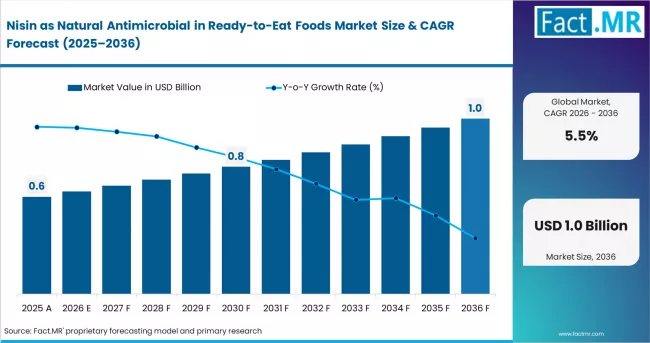
Nisin As Natural Antimicrobial In Ready To Eat Foods Market Market Value Analysis | Source: Fact.MR
| Metric | Value |
|---|---|
| Estimated Value in 2026 | USD 0.58 billion |
| Forecast Value in 2036 | USD 1.0 billion |
| Forecast CAGR (2026 to 2036) | 5.5% |
Source: Fact.MR analysis. Updated Apr 16, 2026
Summary of Nisin as Natural Antimicrobial in Ready-to-Eat Foods Market
- Market Definition
- The market covers nisin A and Nisin Z natural antimicrobial peptide ingredients in powder and liquid forms used for shelf-life extension in meat, poultry, seafood, dairy, bakery, and canned ready-to-eat food applications distributed through industrial ingredient, retail, and foodservice supply channels globally.
- Demand Drivers
- EU Regulation (EC) No 1333/2008 and its 2024 amendments are tightening approvals for synthetic preservatives in processed foods, directly accelerating clean-label nisin adoption among European RTE food manufacturers.
- China's 2024 National Food Safety Standard GB 2760 revision expanded permitted nisin use levels in processed meat and dairy, enabling scaled adoption among domestic food producers.
- U.S. retail grocery chains are mandating clean-label ingredient lists across private-label RTE product lines, compelling food manufacturers to substitute chemical preservatives with nisin-based antimicrobial systems.
- Key Segments Analyzed
- By Type: Nisin A leads with 72% share in 2026, driven by highest antimicrobial effectiveness and broadest regulatory approvals across food categories globally.
- By Application: Meat, Poultry & Seafood leads with 36% share, as RTE processed meats represent the most active clean-label preservation reformulation category.
- By Form: Powder leads with 70% share in 2026; liquid form is the fastest-growing, driven by beverage and liquid food processing applications.
- By Geography: China leads 7.0% CAGR, driven by food safety policy reform and processed food sector expansion.
- Analyst Opinion at FACT.MR
- Siddharth Sirohi, Senior Consultant at Fact.MR, opines, 'CXOs will find that clean-label mandates and synthetic preservative exits are creating a structural demand pull for documented nisin-grade ingredients, and companies with application-specific grade portfolios and regulatory file depth will capture the premium margin opportunity.'
- Strategic Implications
- Invest in Nisin A and Nisin Z grade separation and application-specific regulatory documentation. This enables access to premium EU and U.S. food manufacturer procurement.
- Develop heat-stable liquid nisin formats for beverage and liquid food processing.
- Targets fastest-growing application pipeline in Asia Pacific markets.
- Methodology
- Based on nisin ingredient shipment volumes and pricing by application grade. Validated using 2024–2025 producer revenue and food ingredient distributor data.
- Uses EU food additive regulation, FDA GRAS, Codex Alimentarius, and national food safety agency sources. Supports regional demand analysis.
- Forecasts include processed food sector growth, clean-label reformulation trends, and Asia Pacific food safety policy data.
Between 2026 and 2036, the market is expected to generate USD 0.42 billion in absolute opportunity. This reflects accelerating rather than incremental growth. Demand is sustained by clean-label reformulation mandates across EU and North American food retail chains. Growth is underpinned by rising processed food consumption in Asia Pacific and ongoing regulatory exits of chemical preservatives. Structural constraints include high nisin production costs relative to synthetic alternatives and variable regulatory approval timelines across emerging markets.
Country growth reflects clean-label policy depth, RTE food sector maturity, and regulatory status of nisin across food categories. China leads at 7.0% CAGR through rapid processed food sector expansion and government-backed food safety upgrades. The United States records 6.6% CAGR through clean-label reformulation in retail RTE meats and USDA-compliant antimicrobial substitution. Germany records 6.0% through EU regulatory pressure on synthetic preservatives and certified nisin adoption in premium processed food brands. The United Kingdom records 5.4% CAGR through post-Brexit food labelling reform and retail clean-label commitments. Japan records 4.8% through established food additive approval structures and regulated nisin use in processed dairy and seafood products. Mature markets generate replacement demand rather than volume growth, constrained by slow regulatory update cycles and premium nisin pricing relative to conventional preservatives.
Segmental Analysis
Nisin as Natural Antimicrobial in Ready-to-Eat Foods Market Analysis by Type
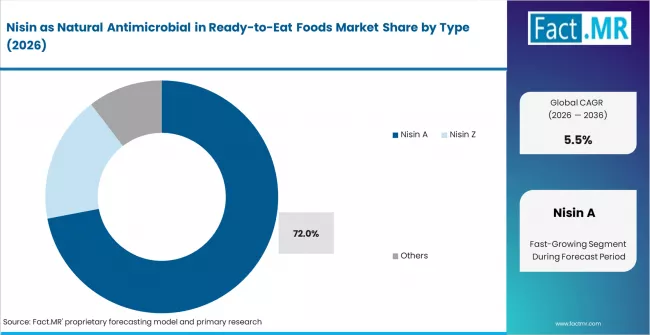
Nisin As Natural Antimicrobial In Ready To Eat Foods Market Analysis By Type | Source: Fact.MR
Based on FACT.MR's nisin in ready-to-eat foods market report, consumption of Nisin A is estimated to hold 72% share in 2026. Nisin A dominates due to its superior antimicrobial efficacy against gram-positive bacteria and the broadest global regulatory approval coverage across meat, dairy, and canned food categories.
- DSM-Firmenich Expansion: Announced capacity expansion for food-grade nisin production at its fermentation facility in the Netherlands in Q2 2024. The investment targets EU and North American clean-label processed food manufacturers seeking documented Nisin A supply. [1]
- Chr. Hansen Development: Launched a new Nisin Z concentrate with enhanced solubility for dairy and beverage applications in 2024, targeting liquid food processing lines where powder dispersion is technically constrained. [2]
- Regulatory Trend: Codex Alimentarius Commission reaffirmed nisin's GRAS-equivalent status for use in processed cheese and canned foods in its 2024 food additive standards update, reinforcing demand for certified Nisin A supply documentation. [3]
Nisin as Natural Antimicrobial in Ready-to-Eat Foods Market Analysis by Application
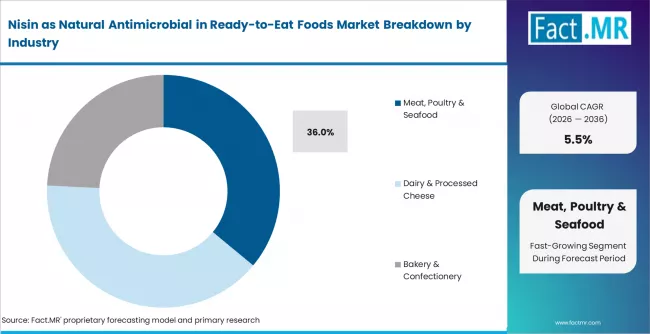
Nisin As Natural Antimicrobial In Ready To Eat Foods Market Analysis By Application | Source: Fact.MR
Based on FACT.MR's nisin in ready-to-eat foods market report, consumption in meat, poultry & seafood is estimated to hold 36% share in 2026. This segment leads as RTE processed meats face the most active clean-label reformulation mandates from retail buyers and regulatory pressure on nitrite and synthetic preservative reduction.
- Kerry Group Launch: Introduced a nisin-based clean-label antimicrobial system for cooked and cured RTE meats in North America in early 2025, specifically designed to replace sodium nitrite in retail private-label products. [4]
- IFF Development: Expanded its Natamax nisin product portfolio for dairy and processed cheese applications in 2024, with reformulated dispersion grades targeting European premium cheese manufacturers pursuing E-number-free labelling. [5]
- Application Trend: A 2024 survey by the European Food Information Council found that 68% of European consumers actively check ingredient lists on RTE food packaging, increasing retailer pressure on manufacturers to replace chemical preservative codes with natural alternatives. [6]
Nisin as Natural Antimicrobial in Ready-to-Eat Foods Market Analysis by Form
Based on FACT.MR's nisin in ready-to-eat foods market report, powder form is estimated to hold 70% share in 2026. Powder remains preferred due to stability in dry blending, compatibility with large-scale ingredient dispensing in RTE food manufacturing, and easier documentation for food additive compliance audits.
- Handary SA Development: Introduced a microencapsulated nisin powder grade for bakery applications in 2024, improving controlled-release antimicrobial activity in high-moisture baked goods subject to mould contamination during extended shelf life. [7]
- Galactic Investment: Expanded liquid nisin production capacity at its Belgium facility in early 2025, targeting liquid dairy and RTE beverage manufacturers in Europe and the Middle East seeking pump-dosable antimicrobial systems. [8]
- Powder Trend: Powder nisin remains the standard specification in industrial ingredient procurement contracts for processed meat and cheese. Supplier quality documentation requirements were reinforced by EU food additive traceability updates published in January 2025. [9]
Regional Analysis
The nisin in ready-to-eat foods market is assessed across Asia Pacific, Europe, North America, Latin America, and Middle East and Africa, covering 40+ countries with distinct demand profiles shaped by clean-label policy maturity, RTE food sector scale, and national food additive regulatory status. The full report offers market attractiveness analysis by region and country.
.webp "Top Country Growth Comparison Nisin As Natural Antimicrobial In Ready To Eat Foods Market Cagr (2026 2036)")
Top Country Growth Comparison Nisin As Natural Antimicrobial In Ready To Eat Foods Market Cagr (2026 2036) | Source: Fact.MR
| Country | CAGR (2026 to 2036) |
|---|---|
| China | 7.0% |
| United States | 6.6% |
| Germany | 6.0% |
| United Kingdom | 5.4% |
| Japan | 4.8% |
Source: Fact.MR analysis. Updated Apr 16, 2026
Source: Fact.MR (FACT.MR) analysis, based on proprietary forecasting model and primary research
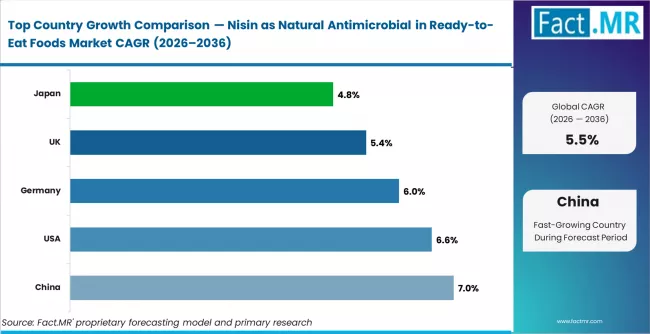
Nisin As Natural Antimicrobial In Ready To Eat Foods Market Cagr Analysis By Country | Source: Fact.MR
Asia Pacific Nisin as Natural Antimicrobial in Ready-to-Eat Foods Market Analysis
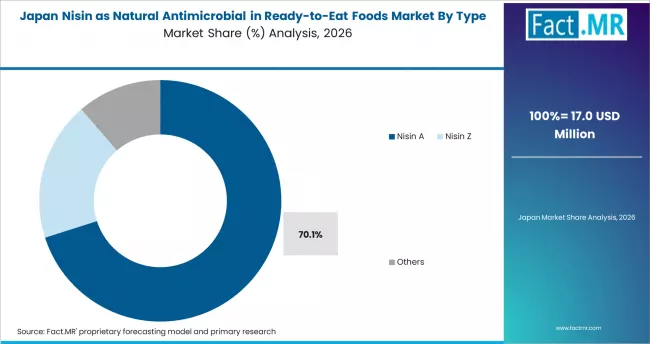
Nisin As Natural Antimicrobial In Ready To Eat Foods Market Japan Market Share Analysis By Type | Source: Fact.MR
Asia Pacific is the fastest-growing region for nisin in RTE foods. Growth is led by China's food safety policy reform and Japan's structured food additive approval ecosystem. Regional producers supply processed food manufacturers across ASEAN. Japanese and Korean firms focus on certified-grade nisin supply.
- China: Demand for nisin in China is projected to rise at 7.0% CAGR through 2036. The National Food Safety Standard GB 2760 was revised in 2024 to raise permitted nisin application levels in processed meat and dairy categories, directly enabling scaled domestic use. The Ministry of Commerce reported processed food sector output growth of 6.2% in 2024, expanding the addressable manufacturing base. E-commerce-driven demand for ambient and chilled RTE products is further accelerating clean-label antimicrobial adoption among domestic food brands.
- Japan: Growth for nisin in Japan is projected to expand at 4.8% CAGR through 2036. The Ministry of Health, Labour and Welfare maintains a structured food additive approval register that limits volatility but ensures stable certified-grade demand. Nisin retains approval for use in processed cheese and seafood products, and the Consumer Affairs Agency updated food labelling guidelines in mid-2024 to strengthen natural ingredient disclosure standards. Japanese food producers, including major dairy and seafood processors, are investing in nisin as a compliant alternative to synthetic preservatives within their documented clean-label transition plans.
FACT.MR covers China, Japan, South Korea, India, ASEAN, and ANZ. It includes food safety standard data, RTE food sector trends, and country-level forecasts.
North America Nisin as Natural Antimicrobial in Ready-to-Eat Foods Market Analysis
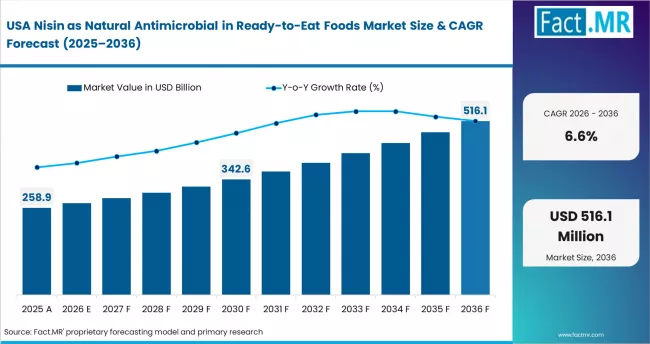
Nisin As Natural Antimicrobial In Ready To Eat Foods Market Country Value Analysis | Source: Fact.MR
North America is the largest value market for nisin in RTE foods. Growth is driven by clean-label reformulation in retail-distributed processed meats and cheese products. Leading brands include Kerry Group and IFF. Ingredient supply operates through established food ingredient distributor networks.
- United States: Nisin market in the United States is projected to advance at 6.6% CAGR through 2036. The USDA Food Safety and Inspection Service reinforced antimicrobial intervention documentation requirements for RTE meat facilities in 2024, increasing demand for approved natural antimicrobials with validated efficacy data. Major retail chains including Walmart and Kroger formalised clean-label ingredient commitments across private-label RTE product categories in 2024, compelling supplier reformulation away from synthetic preservatives. FDA GRAS status for nisin remains a key procurement qualifier for ingredient buyers.
FACT.MR's analysis of the nisin market in North America covers the U.S., Canada, and Mexico. Readers can find USDA antimicrobial compliance data, retail clean-label procurement trend analysis, and country-level demand forecasts.
Europe Nisin as Natural Antimicrobial in Ready-to-Eat Foods Market Analysis
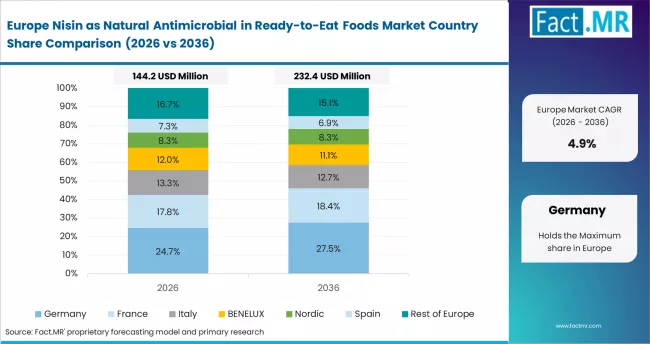
Nisin As Natural Antimicrobial In Ready To Eat Foods Market Europe Country Market Share Analysis, 2026 & 2036 | Source: Fact.MR
Europe is a regulation-driven market for nisin in RTE foods. EU food additive rules define ingredient approval standards. EFSA safety assessments guide usage limits. DSM-Firmenich and Galactic lead certified supply.
- Germany: Demand for nisin in Germany is projected to grow at 6.0% CAGR through 2036. The European Food Safety Authority published updated safety guidance on nisin use limits in processed meat and cheese applications in 2024 under Regulation (EC) No 1333/2008, tightening documentation requirements that favour established certified suppliers. Major German food retailers including REWE and EDEKA accelerated E-number elimination programmes across own-brand RTE ranges in 2024–2025, increasing demand for natural antimicrobial systems with full regulatory file support. DSM-Firmenich has expanded its compliant nisin product documentation for this segment.
- United Kingdom: Nisin demand in the United Kingdom is projected to increase at 5.4% CAGR through 2036. Post-Brexit, the UK Food Standards Agency has maintained standalone food additive approval registers, providing a distinct regulatory pathway that UK-based food manufacturers navigate separately from EU counterparts. The FSA issued updated guidance on natural antimicrobial use in processed food in January 2025, clarifying nisin's approved applications and supporting manufacturer compliance investment. UK grocery retailers including Tesco and Sainsbury's have published clean-label roadmaps that explicitly target removal of numbered preservatives from chilled RTE ranges by 2026.
FACT.MR covers Germany, France, the UK, Italy, Spain, and Rest of Europe. It includes EU food additive compliance data, retail reformulation trends, and country-level forecasts.
Competitive Aligners for Market Players
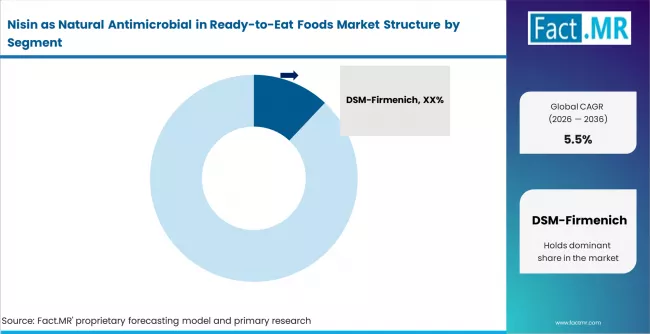
Nisin As Natural Antimicrobial In Ready To Eat Foods Market Analysis By Company | Source: Fact.MR
The nisin used in ready-to-eat foods market reflects a moderately consolidated structure, where a limited number of specialized ingredient suppliers control a significant share of global food-grade volumes. Competitive positioning is defined less by price and more by technical capabilities, including fermentation efficiency, depth of antimicrobial validation, and the strength of regulatory documentation across regions. Leading companies such as DSM-Firmenich and Chr. Hansen maintain strong positions in high-quality, certified-grade nisin supply.
Suppliers with integrated fermentation infrastructure and well-developed product portfolios hold a clear advantage in premium segments. Their ability to provide application-specific grades supported by approvals from regulatory bodies such as EFSA, FDA, and Codex Alimentarius strengthens their market position. DSM-Firmenich benefits from its large-scale production capabilities and long-standing relationships with European food manufacturers.
Kerry Group differentiates itself by offering tailored antimicrobial systems, combining nisin with other ingredients to meet specific formulation needs rather than supplying it as a standalone product.
From a demand perspective, ready-to-eat food manufacturers typically follow structured supplier qualification processes. Once a nisin grade is validated within a production system, switching suppliers becomes complex due to reformulation and revalidation requirements. Major food producers, including global meat and dairy companies, often adopt dual sourcing strategies to ensure supply security. Companies such as Handary SA and Galactic commonly serve as secondary suppliers in Europe.
Key Players
- DSM-Firmenich
- IFF (International Flavors & Fragrances)
- Kerry Group
- Chr. Hansen
- Handary SA
- Galactic
Bibliography
- [1] DSM-Firmenich. (April 2024). Production Capacity Expansion: Food-Grade Nisin Fermentation Facility Investment at Delft Netherlands Targeting EU and North American Clean-Label Ready-to-Eat Food Manufacturer Supply Under EU Food Additive Regulation (EC) No 1333/2008 Compliance Documentation Standards. dsm-firmenich.com
- [2] Chr. Hansen. (October 2024). Product Development: Nisin Z Liquid Concentrate with Enhanced Water Solubility for Dairy and Beverage Liquid Food Processing Applications Targeting European Cheese and RTD Beverage Manufacturers Pursuing E-Number-Free Ingredient Labelling. chr-hansen.com
- [3] Codex Alimentarius Commission. (2024). Food Additive Standards Update: Nisin Reaffirmation as Permitted Antimicrobial Preservative in Processed Cheese and Canned Food Applications Under Codex General Standard for Food Additives GSFA CXS 192-1995 2024 Revision. fao.org/fao-who-codexalimentarius
- [4] Kerry Group. (February 2025). Product Launch: Nisin-Based Clean-Label Antimicrobial System for Cooked and Cured Ready-to-Eat Meat Products in North America Designed as Documented Sodium Nitrite Replacement for Retail Private-Label RTE Meat Manufacturer Reformulation Programmes. kerrygroup.com
- [5] IFF. (2024). Portfolio Expansion: Natamax Nisin Product Range Reformulation for European Processed Cheese and Dairy Applications with Improved Powder Dispersion Grades Targeting Premium Cheese Manufacturers Pursuing E-Number Elimination Under EU Retailer Clean-Label Commitments. iff.com
- [6] European Food Information Council. (2024). EUFIC Consumer Research Report: Ingredient Label Reading Behaviour in European Ready-to-Eat Food Categories Including Prevalence of Preservative Code Awareness and Natural Antimicrobial Ingredient Preference Among 10,000 European Adult Consumers. eufic.org
- [7] Handary SA. (2024). Product Development: Microencapsulated Nisin Powder Grade for Bakery and High-Moisture Ready-to-Eat Food Applications with Controlled-Release Antimicrobial Activity for Extended Mould-Free Shelf Life at Ambient Storage Temperatures. handary.com
- [8] Galactic. (January 2025). Production Expansion: Liquid Nisin Fermentation Capacity Increase at Escanaffles Belgium Facility Targeting European and Middle Eastern Dairy and Liquid Food Processor Customers Requiring Pump-Dosable Natural Antimicrobial Ingredient Systems. galactic.com
- [9] European Food Safety Authority. (2024). Scientific Opinion Update: Nisin Use Levels and Safety Assessment in Processed Meat and Cheese Applications Under EU Food Additive Regulation (EC) No 1333/2008 Including Revised Acceptable Daily Intake Guidance. efsa.europa.eu
This Report Addresses
- Strategic insights on nisin demand across EU clean-label processed food reformulation, U.S. USDA-compliant RTE meat antimicrobial substitution, China GB 2760-driven food safety adoption, Japan Ministry of Health-approved dairy and seafood applications, and UK FSA-guided natural antimicrobial procurement.
- Market forecast from USD 0.58 billion in 2026 to USD 1.0 billion by 2036 at a CAGR of 5.5%.
- Growth opportunity mapping across China processed food sector expansion, U.S. retail clean-label RTE meat reformulation, Germany EU food additive compliance investment, UK FSA-guided natural preservative adoption, and Japan structured food additive approval-driven demand.
- Segment-wise analysis by type (Nisin A, Nisin Z, Others), application (meat, dairy, bakery, canned), and form (powder, liquid).
- Regional outlook covering Asia Pacific food safety policy-driven nisin adoption, North America clean-label ingredient reformulation demand, and Europe EU food additive regulation-led certified nisin procurement.
- Competitive landscape analysis of DSM-Firmenich, IFF, Kerry Group, Chr. Hansen, Handary SA, and Galactic covering fermentation capacity, regulatory documentation depth, grade portfolio breadth, and application-specific channel positioning strategies.
- Technology tracking including Nisin Z solubility improvements, microencapsulated powder grades for bakery applications, liquid dosing format development for dairy and beverage processing, and EFSA/FDA regulatory compliance documentation advances.
- Report delivery in PDF, Excel datasets, and presentation formats supported by primary interviews, producer revenue disclosures, EFSA food additive safety assessment data, Codex Alimentarius standards data, and food retail sector statistics.
Nisin as Natural Antimicrobial in Ready-to-Eat Foods Market Definition
The nisin in ready-to-eat foods market includes natural antimicrobial peptides derived from Lactococcus lactis fermentation, standardized for food-grade use in powder and liquid forms across processed meat, dairy, bakery, and canned food applications.
Nisin as Natural Antimicrobial in Ready-to-Eat Foods Market Inclusions
Includes global and regional forecasts from 2026 to 2036 segmented by type, application, and form. Covers Nisin A and Nisin Z in meat, dairy, bakery, and canned ready-meal applications sold via retail, foodservice, and industrial ingredient supply channels.
Nisin as Natural Antimicrobial in Ready-to-Eat Foods Market Exclusions
Excludes synthetic chemical preservatives, bacteriocin variants without food-grade standardisation, and finished retail packaged food product sales at consumer price. Omits probiotic cultures and fermentation ingredients not used specifically as antimicrobial shelf-life agents.
Nisin as Natural Antimicrobial in Ready-to-Eat Foods Market Research Methodology
- Primary Research: Interviews with nisin producers, food ingredient distributors, and RTE food manufacturers. Inputs from regulatory affairs managers, food technologists, and clean-label reformulation teams across North America, Europe, and Asia Pacific.
- Desk Research: Uses EU food additive regulation data and FDA GRAS notifications. Includes Codex Alimentarius nisin standards and national food safety agency approvals. Reviews producer disclosures and trade data from 2024–2025.
- Market-Sizing and Forecasting: Based on nisin ingredient shipment volumes and pricing by grade and application. Includes RTE food sector growth and clean-label ingredient demand benchmarks. Uses application and channel-specific procurement data.
- Data Validation and Update Cycle: Validated using producer revenues and food ingredient distributor data. Cross-checked with regulatory databases and food additive approval registries. Updated regularly.
Segmentation
Scope of Report
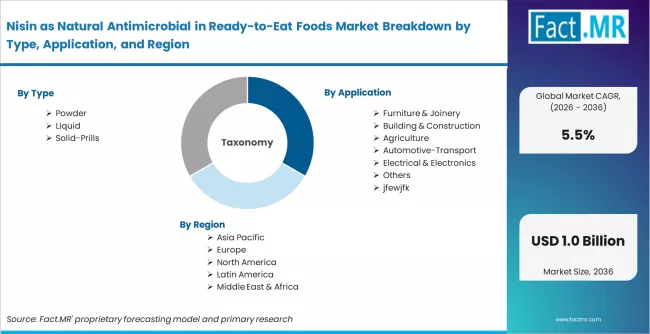
Nisin As Natural Antimicrobial In Ready To Eat Foods Market Breakdown By Type, Application, And Region | Source: Fact.MR
| Attribute | Details |
|---|---|
| Quantitative Units | USD 0.58 billion (2026) to USD 1.0 billion (2036), at a CAGR of 5.5% |
| Market Definition | The market covers nisin as a natural antimicrobial peptide derived from Lactococcus lactis, used in powder and liquid forms in meat, dairy, bakery, and canned ready-to-eat foods distributed via retail, foodservice, and industrial ingredient supply channels globally. |
| Type Segmentation | Nisin A, Nisin Z, Others |
| Application Segmentation | Meat, Poultry & Seafood; Dairy & Processed Cheese; Bakery & Confectionery; Canned & Ready Meals |
| Form Segmentation | Powder, Liquid |
| Application Coverage | Natural antimicrobial shelf-life extension in RTE meats and processed cheese, clean-label preservation in bakery and canned foods, heat-stable preservation in pasteurised dairy, and regulatory-compliant antimicrobial use in processed food formulation. |
| Regions Covered | North America, Europe, Asia Pacific, Latin America, Middle East and Africa |
| Countries Covered | USA, Canada, Mexico, Germany, UK, France, Italy, Spain, Nordic, BENELUX, China, Japan, South Korea, India, ASEAN, Australia and New Zealand, Brazil, Argentina, Chile, Saudi Arabia, GCC, Turkey, South Africa, Rest of MEA |
| Key Companies Profiled | DSM-Firmenich, IFF (International Flavors & Fragrances), Kerry Group, Chr. Hansen, Handary SA, Galactic |
| Forecast Period | 2026 to 2036 |
| Approach | Hybrid top-down and bottom-up model using nisin ingredient shipment volumes by application and form, average selling prices by grade and end-use, food preservation market growth benchmarks, clean-label ingredient procurement data, and primary interviews with food manufacturers and ingredient formulators. |
Source: Fact.MR analysis. Updated Apr 16, 2026
Nisin as Natural Antimicrobial in Ready-to-Eat Foods Market by Segments
-
By Type:
- Nisin A
- Nisin Z
- Others
-
By Application:
- Meat, Poultry & Seafood
- Dairy & Processed Cheese
- Bakery & Confectionery
- Canned & Ready Meals
-
By Form:
- Powder
- Liquid
-
By Region:
- North America
- United States
- Canada
- Mexico
- Latin America
- Brazil
- Mexico
- Argentina
- Chile
- Rest of Latin America
- Western Europe
- Germany
- United Kingdom
- France
- Italy
- Spain
- Nordic Countries
- BENELUX
- Rest of Western Europe
- Eastern Europe
- Russia
- Poland
- Hungary
- Balkan and Baltic
- Rest of Eastern Europe
- East Asia
- China
- Japan
- South Korea
- South Asia and Pacific
- India
- ASEAN
- Australia and New Zealand
- Rest of South Asia and Pacific
- Middle East and Africa
- Kingdom of Saudi Arabia
- Other GCC Countries
- Turkey
- South Africa
- Rest of Middle East and Africa
- North America
Frequently Asked Questions
How large is the nisin as natural antimicrobial in ready-to-eat foods market in 2025?
What will the market size be in 2026?
What is the projected market size by 2036?
What is the expected CAGR of the nisin as natural antimicrobial in ready-to-eat foods market?
What is the absolute dollar opportunity in this market?
Which type segment leads the market?
Which application segment holds the largest share?
Which region grows fastest?
Which country shows the fastest growth?
What factors are driving market growth?
What are the major restraints?
Who worked on this report


Preview the report firsthand - request a free sample
Free SampleGet the brochure for pricing and purchase details
Download PDF