- Market Value (2025): USD 1.8 Bn
- Estimated Value (2026): USD 2.0 Bn
- Forecast Value (2036): USD 4.5 Bn
- CAGR (2026-2036): 8.5%
What is the Non-Contact Barrier Coating Systems Market forecast to be worth by 2036?
USD 2.0 billion in 2026 to USD 4.5 billion by 2036 at an 8.5% CAGR.
- As per Fact.MR analysis, the Non-Contact Barrier Coating Systems Market reached USD 1.8 billion in 2025.
- Demand is projected to increase from USD 2.0 billion in 2026 to USD 4.5 billion by 2036.
- The market is forecast to record 8.5% CAGR from 2026 to 2036 as converters and plant coating lines add more controlled coating steps.
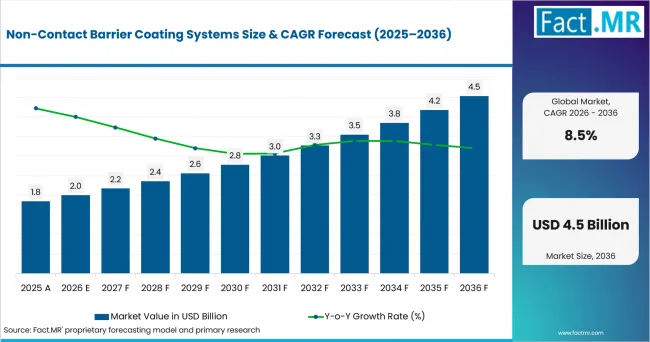
Non Contact Barrier Coating Systems Value Analysis | Source: Fact.MR
What are the defining numbers behind Non-Contact Barrier Coating Systems Market growth?
An absolute opportunity of USD 2.5 billion is expected between 2026 and 2036.
- Demand Drivers in the Market
- Packaging companies need thin and even coatings because extra coating increases cost and drying time. Touch-free systems control the coating on paper, film, and shaped parts without touching the wet surface.
- Food packaging companies are looking for other grease barriers as coating options change. In January 2025, the U.S. Food and Drug Administration determined that 35 PFAS food contact notices for grease-proof coatings on paper and paperboard were no longer effective [1].
- Parcel and protective packaging need even coatings on fast production lines. Systems that change coating flow with line speed can reduce extra coating during long production runs.
- Automated coating systems keep coating flow steady when production speed changes. Flow controls and checks help workers find problems early and use the planned amount of coating.
- Key Segments Analyzed
- By Application Technology: Airless spray is expected to hold a 34.0% share in 2026 because it can apply thicker coatings at production speed without compressed air.
- By Coating Type: Barrier coating is expected to hold a 31.0% share in 2026 because it protects packaging from moisture, grease, and chemicals.
- By Substrate: Paper and board are expected to hold a 36.0% share in 2026 because paper packaging needs coatings for protection and recycling.
- By Automation Level: Standalone automated systems are expected to hold a 29.0% share in 2026 because factories can add automatic spraying to existing production lines.
- Analyst Opinion at Fact.MR
- Shambhu Nath Jha, Principal Consultant at Fact.MR, states, “Factories check coating use, coating amount, and repeated work. As per Fact.MR analysis, systems that apply the right amount and check it during production are saw more use on long production runs.”
- Strategic Implications
- Equipment suppliers should show that the coating stays even at normal production speed. They should explain how pressure, flow, and spray settings affect the amount of coating used.
- Packaging companies should test the coating and spray method together because they can affect sealing and printing. They should also check recycling during the same test.
- Automation companies should connect coating flow with production speed and camera checks. This helps workers find coating changes before a large batch is finished.
- Coating suppliers should provide the right coating thickness and solid content for the nozzle, pump, and drying system. This reduces repeated testing before full production.
China is expected to grow at 9.8% CAGR through 2036 as high parcel volumes increase packaging production. Japan follows at 8.7% due to paper recycling and auto production. The USA records 8.3% due to parcel packaging and factory coating. France also records 8.3% as packaging use grows. Germany reaches 8.1% due to recycling needs and better control of coating lines.
How does the Non-Contact Barrier Coating Systems Market break down by segment?
Airless spray is projected to lead Application Technology at 34.0% share in 2026, while Paper / board leads Substrate at 36.0% share.
Which Application Technology dominates?
Airless spray is expected to hold 34.0% share in 2026.
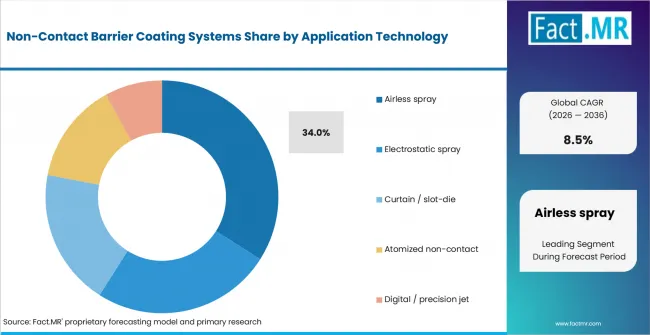
Non Contact Barrier Coating Systems Analysis By Application Technology | Source: Fact.MR
Airless spray applies thicker coatings at a steady rate. Electrostatic spray helps coating stick to metal parts, while curtain and slot-die methods work on flat materials. Precision jets apply coating to selected areas.
What leads the Coating Type segment?
Barrier coating is projected to account for 31.0% share in 2026.
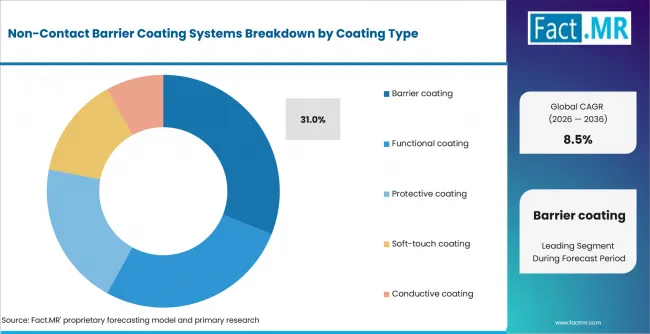
Non Contact Barrier Coating Systems Analysis By Coating Type | Source: Fact.MR
Barrier coatings lead because packaging needs protection from grease, moisture, and liquids. Protective coatings reduce wear and rust, while soft-touch and conductive coatings have specific uses. Barrier coatings are used more widely with touch-free coating systems.
These systems need to apply different coatings evenly. Good control of pressure, flow, and spray helps factories change coatings with fewer line changes.
How does Substrate shape demand?
Paper / board is anticipated to lead with 36.0% share in 2026.
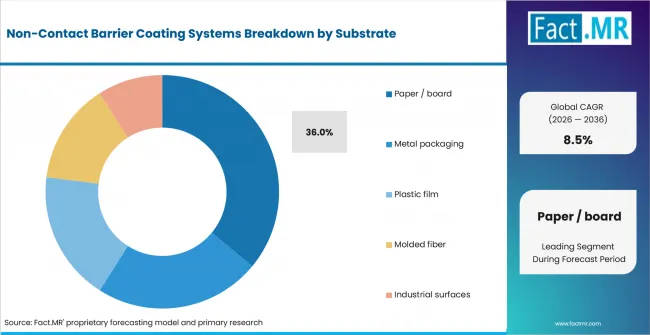
Non Contact Barrier Coating Systems Analysis By Substrate | Source: Fact.MR
Paper and board need coatings that protect packaging from grease, moisture, and liquids. Metal packaging needs coatings on the inside and outside, while film and molded fiber need different coating and drying settings.
Eurostat reported in October 2025 that paper and cardboard made up 40.4% of the 79.7 million tonnes of packaging waste generated in the EU in 2023 [2]. This makes coating use and recycling important when factories choose barrier coating systems.
What supports Standalone automated systems within Automation Level?
Standalone automated systems are estimated to represent 29.0% share in 2026.
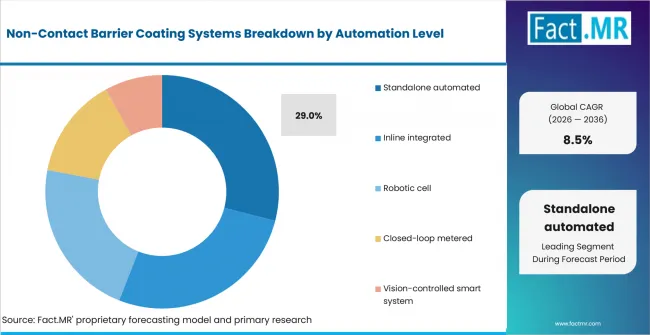
Non Contact Barrier Coating Systems Analysis By Automation Level | Source: Fact.MR
Standalone systems control spray timing, pressure, and flow without changing the rest of the production line. Inline systems work with continuous production, while robotic systems coat shaped parts. Automatic controls keep the coating even, and cameras check it during production.
Standalone systems handle specific coating work, while connected systems control coating and checking together. More control helps when products change often or parts have different shapes.
What is accelerating Non-Contact Barrier Coating Systems Market adoption, and what is holding it back?
Demand is expected to grow as packaging changes and factories improve coating control. Testing, drying, and changes to existing lines can affect system use.
Drivers Impact Analysis
| DRIVER | (~) % IMPACT ON CAGR | GEOGRAPHIC RELEVANCE | IMPACT TIMELINE |
|---|---|---|---|
| Packaging redesign for recyclable barrier structures | +1.4% | North America, Western Europe | Medium term (2-4 years) |
| Lower coating waste through controlled application | +1.1% | Global | Short term (<= 2 years) |
| Automation of repeatable coat-weight control | +0.9% | East Asia, North America | Medium term (2-4 years) |
| PFAS replacement in food-contact paper packaging | +0.7% | USA, Western Europe | Short term (<= 2 years) |
Opportunity Impact Analysis
| OPPORTUNITY | (~) % IMPACT ON CAGR | GEOGRAPHIC RELEVANCE | IMPACT TIMELINE |
|---|---|---|---|
| Precision jet systems for patterned barrier application | +0.8% | North America, Europe, Japan | Long term (>= 4 years) |
| Closed-loop metering linked with line-speed data | +0.7% | Global | Medium term (2-4 years) |
| Robotic coating of molded fiber and shaped parts | +0.6% | East Asia, Western Europe | Medium term (2-4 years) |
Restraints Impact Analysis
| RESTRAINT | (~) % IMPACT ON CAGR | GEOGRAPHIC RELEVANCE | IMPACT TIMELINE |
|---|---|---|---|
| Coating and substrate qualification time | -0.6% | Global | Short term (<= 2 years) |
| Drying limits on water-based barrier coatings | -0.5% | Global | Medium term (2-4 years) |
| Capital cost of integrated robotic or vision systems | -0.4% | Emerging manufacturing markets | Medium term (2-4 years) |
Which countries are scaling the Non-Contact Barrier Coating Systems Market through 2036?
- The country comparison spans 1.7 percentage points across the forecast period.
- China remains 1.1 percentage points above Japan as parcel volumes and green-pack rules expand coating needs.
- Japan remains 0.4 percentage point above the USA through pack recovery systems and line control.
- The USA and France both post 8.3% CAGR, although demand comes from different regulatory and production conditions.
- Germany remains 0.2 percentage point below the USA and France while recycling needs keep coating testing strict.
Comparable CAGRs can still create different entry conditions because pack volumes, recovery rules and line setup vary by country. Full report coverage includes North America, Latin America, Western Europe, Eastern Europe, East Asia, South Asia & Pacific, Middle East & Africa.
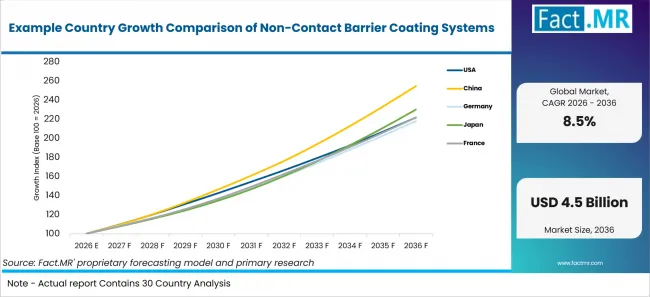
Example Country Growth Comparison Of Non Contact Barrier Coating Systems | Source: Fact.MR
| Country | CAGR (2026-2036) |
|---|---|
| China | 9.8% |
| Japan | 8.7% |
| USA | 8.3% |
| France | 8.3% |
| Germany | 8.1% |
What supports China adoption?
9.8% CAGR, supported by high parcel volumes and packaging standardization.
China is expected to grow at 9.8% CAGR through 2036 as high parcel volumes increase packaging needs. The State Post Bureau reported in May 2026 that China handled 198.95 billion express parcels in 2025, up 13.6% from 2024 [3]. High production volumes increase the need for systems that apply coating evenly during long production runs.
How is Japan developing demand?
8.7% CAGR, linked to fiber recovery and automated converting.
Japan is anticipated to grow at 8.7% CAGR through 2036 as paper packaging recycling and auto production increase coating use. The Ministry of the Environment reported in March 2025 that 617,622 tonnes of corrugated packaging were separately collected in fiscal 2023 [4]. This increases the need for systems that apply coatings evenly.
What supports USA adoption?
8.3% CAGR, backed by e-commerce packaging and coating conversion.
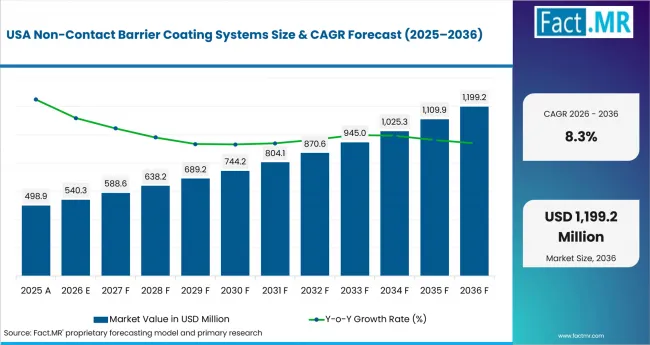
Non Contact Barrier Coating Systems Country Value Analysis | Source: Fact.MR
The USA is anticipated to record at 8.3% CAGR through 2036 as parcel packaging and factory coating increase. The U.S. Census Bureau reported in May 2025 that seasonally adjusted retail e-commerce sales were estimated at USD 300.2 billion in the first quarter of 2025 [5]. This increases the need for systems that control coating use on paperboard and protective packaging.
How is France scaling demand?
8.3% CAGR, shaped by large pack volumes and material redesign.
France is estimated to advance at 8.3% CAGR through 2036 as packaging companies focus on coating and recycling. The French Ministry for Ecological Transition reported in August 2026 that about 12.5 million tonnes of packaging enter the French market each year [6]. This increases the use of coating equipment for paper and board packaging.
What is supporting Germany adoption?
8.1% CAGR, driven by pack recovery and auto production.
Germany is forecast to post at 8.1% CAGR through 2036 as recycling affects coating choices. The German Environment Agency reported in March 2026 that Germany generated 17.9 million tonnes of packaging waste in 2023 and recycled 69.4% of it [7]. This increases the need for coatings that support recycling.
Who leads the Non-Contact Barrier Coating Systems Market?
Nordson supplies manual and automatic systems for powder and liquid coatings. In January 2025, the company announced plans to present its Encore® HD and VT Manual Powder Spray Systems at Surface World 2025. The Encore HD controls powder and air separately, while its touchscreen saves settings for different production runs. Nordson also supplies liquid spray and container-coating systems.
Graco supplies liquid-coating systems using airless, air-assisted airless, electrostatic, and rotary-bell methods. The spray method depends on the coating, finish, part shape, and production needs. Electrostatic systems help coating reach metal parts, while airless systems use pressure to spray the coating.
Dürr supplies automatic paint systems, including EcoPaintJet. It uses a robot and software to apply paint to selected areas. Dürr states that the system applies paint without extra spray outside the selected area. Sames supplies Airless, Airspray, Airmix®, and electrostatic coating systems. Its Viscobell® technology helped Elitfönster move from solvent-based to water-based coatings after tests with Sames and AkzoNobel.
WAGNER supplies manual and automatic liquid-coating systems. Its products include spray guns, pumps, mixing and dosing systems, and control units for different coating needs. Spraying Systems Co. supplies spray nozzles and AutoJet® control systems. Its Precision Spray Control technology changes coating flow when production speed changes. This keeps the coating even and reduces extra coating use.
Which companies are the key providers?
Key companies include Nordson; Graco; Dürr; SAMES; WAGNER; and Spraying Systems Co.
- Nordson
- Graco
- Dürr
- SAMES
- WAGNER
- Spraying Systems Co.
Bibliography
- [1] U.S. Food and Drug Administration. (2025, January 3). FDA determines authorization for 35 food contact notifications related to PFAS are no longer effective.
- [2] Eurostat. (2025, October 22). Plastic packaging waste in the EU: 35.3 kg per person.
- [3] State Post Bureau of China. (2026, May 22). 2025[2025 postal industry development statistical bulletin].
- [4] Ministry of the Environment, Government of Japan. (2025, March 28). [Results of municipal separate collection under the Containers and Packaging Recycling Act for fiscal 2023].
- [5] U.S. Census Bureau. (2025, May 19). Quarterly retail e-commerce sales: 1st quarter 2025.
- [6] Ministères de la Transition écologique, de l’Aménagement du territoire, des Transports, de la Ville et du Logement. (2026, August 4). Emballages professionnels [Professional packaging].
- [7] Umweltbundesamt. (2026, March 5). Verpackungsabfälle [Packaging waste].
- [8] Sames. (2025, August 28). Elitfönster chooses Sames for a cleaner paint line.
- [9] Nordson. (2025, January 27). Nordson at Surface World 2025.
This Report Answers
- The report explains how non-contact coating systems are used across spray method, coating type, substrate and control level.
- Segment analysis identifies the supplied 2026 leading subsegments and explains the operating reasons plants select them.
- Country analysis compares the USA, China, Germany, Japan and France using the supplied CAGRs and current official packaging evidence.
- Competitive analysis reviews the supplied company set across airless, electrostatic, robotic and precision-spray coating systems.
- Application analysis considers coating waste, coat-weight control, substrate handling, recyclability and line setup in equipment selection.
What does the Non-Contact Barrier Coating Systems Market cover?
The Non-Contact Barrier Coating Systems Market covers equipment that applies a functional coating while the applicator stays clear of the target surface. It includes spray and jet systems. It also includes free-flowing curtain coating for paper, board, film, metal packs, molded fiber and plant surfaces.
Coverage includes applicators, pumps, metering controls, robotic motion, line-speed control and vision feedback when these elements are sold as part of the coating system. The market focuses on equipment whose main purpose is controlled surface application of barrier, functional or protective layers.
What is included in the scope?
The scope includes airless and electrostatic spray equipment, atomized touch-free systems, curtain and slot-die units, precision-jet applicators, standalone auto stations and integrated robotic cells. Systems used for paper packaging, metal packaging, plastic film, molded fiber and factory surface treatment are included when touch-free coating is the core process.
Paper barrier coatings are closely related when packaging converters pair barrier chemistry with controlled application equipment. Packaging coatings provide a broader view of functional surface layers used across pack formats. Paper coating materials connect the equipment outlook with materials used on coated fiber substrates. Functional coating materials extend the application view into protective and specialty surface functions. Sustainable packaging adds context for packaging formats designed around recovery and material efficiency.
What is excluded from the scope?
The scope treats coating chemistry sold separately from coating equipment as an adjacent category. Contact roll coaters and blade coaters fall outside the equipment boundary when their main role is mechanical wet-film coating. Printing presses, generic pumps and general-purpose robots are covered in their own equipment categories.
Paper packaging materials show the wider substrate base served by coating and converting lines. Next-gen paper and fiber packaging provides adjacent context for barrier-treated fiber formats. High-performance molded fiber is relevant where shaped fiber parts need grease or moisture treatment. Waterproof coatings for paper and paperboard packaging cover another functional coating use case for fiber packaging. Foodservice packaging links coating demand with cups, trays, wraps and other barrier-dependent formats.
How Was the Analysis Built?
The analysis draws on 120+ sources, 35+ company portfolios, 25+ countries, and more than 20 industry interviews.
- Primary Research: Primary research includes discussions with manufacturers, service providers, technology developers, distributors, end users, and subject-matter experts. These conversations examine purchasing priorities, product adoption, operational challenges, approval requirements, competitive positioning, and the factors that influence wider market acceptance.
- Desk Research: Desk research covers government statistics, regulatory publications, company filings, trade data, technical studies, industry associations, standards, public policy, and other authoritative sources. Every source used in the analysis is documented in the bibliography.
- Market Sizing and Forecasting: Market estimates combine historical performance, demand indicators, pricing and volume trends, segment shares, company participation, country-level growth, adoption patterns, investment activity, and barriers to market expansion.
- Data Validation and Update Cycle: Findings are validated by comparing primary interviews with public data, company activity, regulatory changes, trade patterns, and industry developments. Regular updates review new product launches, capacity changes, partnerships, approvals, and shifts in commercial adoption.
What is the report’s scope and coverage?
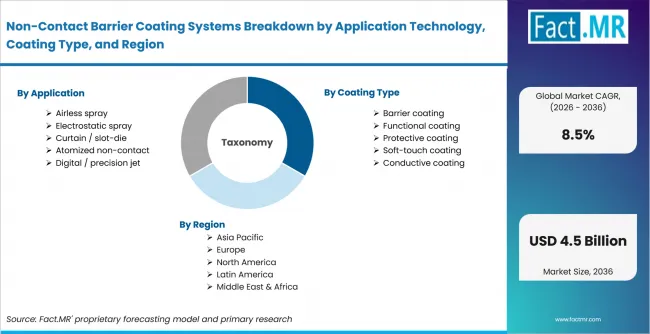
Non Contact Barrier Coating Systems Breakdown By Application Technology, Coating Type, And Region | Source: Fact.MR
| Attribute | Details |
|---|---|
| Quantitative Units | USD Billion |
| Market Definition | Non-contact equipment and integrated systems used to apply barrier, functional or protective coating without a mechanical applicator touching the target surface. Coverage includes spray, atomized, curtain, slot-die and precision-jet application where controlled delivery is a core system function. |
| Application Technology | Airless spray; Electrostatic spray; Curtain / slot-die; Atomized non-contact; Digital / precision jet |
| Coating Type | Barrier coating; Functional coating; Protective coating; Soft-touch coating; Conductive coating |
| Substrate | Paper / board; Metal packaging; Plastic film; Molded fiber; Industrial surfaces |
| Automation Level | Standalone automated; Inline integrated; Robotic cell; Closed-loop metered; Vision-controlled smart system |
| Regions Covered | North America; Latin America; Western Europe; Eastern Europe; East Asia; South Asia & Pacific; Middle East & Africa |
| Countries Covered | USA; China; Germany; Japan; France |
| Key Companies Profiled | Nordson; Graco; Dürr; SAMES; WAGNER; Spraying Systems Co. |
| Forecast Period | 2026 to 2036 |
| Approach | Hybrid top-down and bottom-up approach using coating-equipment portfolios; packaging and industrial coating activity; application technology mix; substrate use; automation adoption; country-level regulation; and supplier portfolio review. |
How is the market segmented?
-
By Application Technology:
- Airless spray
- Electrostatic spray
- Curtain / slot-die
- Atomized non-contact
- Digital / precision jet
-
By Coating Type:
- Barrier coating
- Functional coating
- Protective coating
- Soft-touch coating
- Conductive coating
-
By Substrate:
- Paper / Board
- Metal packaging
- Plastic film
- Molded fiber
- Industrial surfaces
-
By Automation Level:
- Standalone automated
- Inline integrated
- Robotic cell
- Closed-loop metered
- Vision-controlled smart system
-
By Region:
- North America
- Latin America
- Western Europe
- Eastern Europe
- East Asia
- South Asia & Pacific
- Middle East & Africa