Non-Medical Grade Ophthalmic Devices Market (2026 - 2036)

Non-Medical Grade Ophthalmic Devices Market Size and Share Forecast Outlook 2026 to 2036

Core Findings

    Non-Medical Grade Ophthalmic Devices Market Forecast and Outlook 2026 to 2036

    The non-medical grade ophthalmic devices market records USD 1.60 billion in 2026 and progresses to USD 3.9 billion by 2036 at a 9.4% CAGR. Earlier reference levels at USD 1.0 billion, USD 1.3 billion, USD 1.6 billion, USD 2.1 billion, and USD 2.7 billion illustrate a gradual shift toward wider use outside clinical environments. This category supports routine vision checks, pre-screening, and basic measurements in retail chains and high-footfall outlets.

    Non-Medical Grade Ophthalmic Devices Market Key Takeaways

    • Non-Medical Grade Ophthalmic Devices Market Value (2026): USD 1.6 billion
    • Non-Medical Grade Ophthalmic Devices Market Forecast Value (2036): USD 3.9 billion
    • Non-Medical Grade Ophthalmic Devices Market Forecast CAGR 2026 to 2036: 9.4%
    • Leading Device Type in Non-Medical Grade Ophthalmic Devices Market: Eyelid warming and dry-eye relief devices
    • Key Growth Regions in Non-Medical Grade Ophthalmic Devices Market: Asia Pacific, Latin America, North America, Europe, Middle East & Africa
    • Top Players in Non-Medical Grade Ophthalmic Devices Market: EssilorLuxottica, Carl Zeiss Vision, Panasonic, Bruder Healthcare, Xiaomi
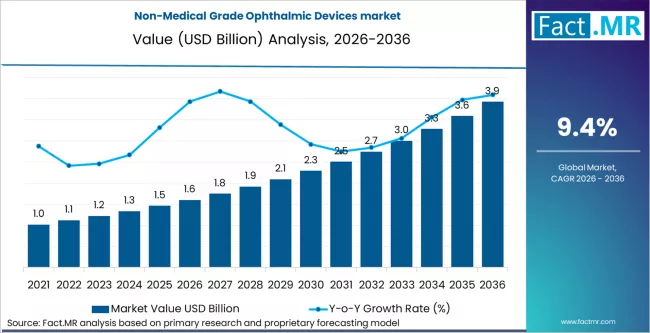
    Non Medical Grade Ophthalmic Devices Market Market Value Analysis

    Operators evaluate equipment on the basis of consistency of readings, maintenance intervals, and tolerance to intensive daily use. Equipment choices are rarely revised once store layouts, staff procedures, and service pricing are built around a fixed device set. Revenue growth is linked to network expansion, higher test volumes per location, and the addition of standardized screening services rather than frequent replacement of installed units.

    Non-Medical Grade Ophthalmic Devices Market

    Metric Value
    Market Value (2026) USD 1.6 billion
    Forecast Value (2036) USD 3.9 billion
    Forecast CAGR 2026 to 2036 9.4%

    Category

    Category Segments
    Device Type Eyelid warming and dry-eye relief devices; Eye massagers and fatigue relief devices; Blue-light filtering eyewear (non-Rx); Home vision screening devices or apps; Vision training devices or apps; Eye humidifiers and comfort devices
    Application Dry eye symptom relief; Digital eye strain and fatigue; Myopia management support; Vision screening and monitoring; Vision training and rehabilitation support; Sleep or circadian comfort (light management)
    Sales Channel E-commerce marketplaces; Optical retail chains; Direct-to-consumer (brand sites); Pharmacies and drugstores; Consumer electronics retail; Other retailers
    Region North America; Europe; Asia Pacific; Latin America; Middle East & Africa

    Segmental Analysis

    Why Do Eyelid Warming and Dry-Eye Relief Devices Lead Consumer Purchases in This Category?
    Non Medical Grade Ophthalmic Devices Market Analysis By Device Type

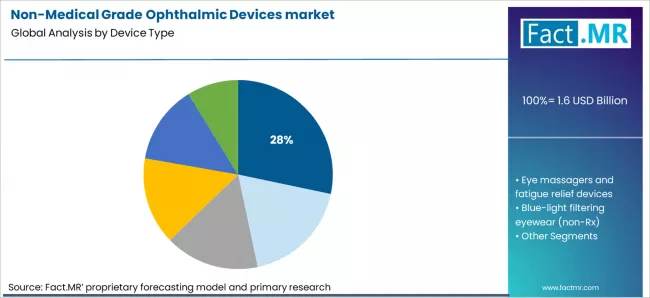
    Within the non-medical grade ophthalmic devices market, eyelid warming and dry-eye relief devices account for 28.30% of device type usage. These products address a daily comfort issue that many users manage without clinical intervention. Usage fits into morning or evening routines without setup complexity or learning curves. Retail placement and online listings often group these devices with other comfort and wellness aids rather than diagnostic tools. Replacement cycles and accessory sales also follow predictable patterns tied to regular use. Product updates in this segment focus on materials, heating consistency, and ergonomics. Eye massagers, vision training tools, and screening apps serve narrower purposes. The frequency of dry-eye discomfort keeps this category at the center of consumer purchasing decisions.

    Why Does Dry Eye Symptom Relief Dominate the Use Case Mix for These Devices?
    Non Medical Grade Ophthalmic Devices Market Analysis By Application

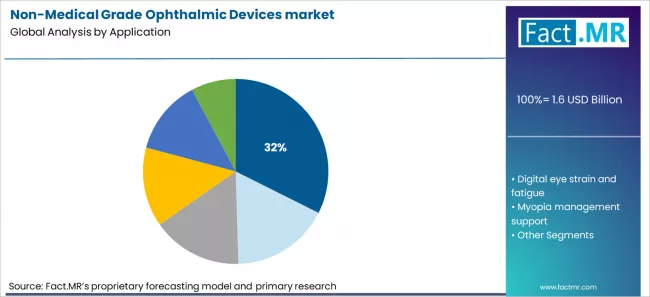
    Application patterns in the non-medical grade ophthalmic devices market show dry eye symptom relief representing 32.40% of total usage. This area generates repeated, short session uses rather than occasional checks or training exercises. Users return to these devices whenever irritation, burning, or blurred vision appears during the day. Work and screen heavy routines increase the need for quick comfort oriented interventions. Instruction materials and packaging emphasize immediate relief rather than long programs. Digital eye strain, vision screening, and training functions remain active segments. Volume flow stays highest where use frequency is greatest. The regular nature of dry eye management keeps this application at the front of overall demand.

    What are the Drivers, Restraints, and Key Trends of the Non-Medical Grade Ophthalmic Devices Market?

    • Drivers: Increasing consumer demand for vision care and eye wellness products, wider availability of non-prescription devices like smart vision testers, blue-light protection devices, and optical health monitors, and greater interest in self-screening are driving market growth across retail and direct-to-consumer channels.
    • Restraint: Concerns about accuracy compared with clinical instruments, regulatory restrictions on diagnostic claims, and limited professional endorsement reduce confidence and slow broader adoption among cautious users.
    • Trend 1: Expansion of easy-to-use portable vision screening tools and light-filtering devices tailored for everyday eye comfort.
    • Trend 2: Rising integration of digital interfaces and app connectivity to track eye health metrics and user patterns.

    Analysis of the Non-Medical Grade Ophthalmic Devices Market by Key Country
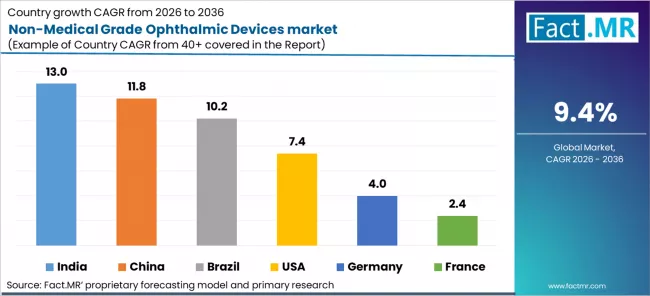
    Non Medical Grade Ophthalmic Devices Market Cagr Analysis By Country

    Country CAGR 2026 to 2036
    USA 7.4%
    Brazil 10.2%
    China 11.8%
    India 13.0%
    Germany 4.0%
    France 2.4%

    The report covers an in-depth analysis of 30+ countries; top-performing countries are highlighted below.

    How Are Retail Eye Care Chains in USA Shaping Use of Non-Medical Grade Ophthalmic Devices?

    Growth in USA runs at about 7.4% per year through 2036. Demand is driven by expansion of optical retail chains, vision centers, and screening services rather than hospital deployment. Purchase decisions focus on reliability, ease of use, and staff training time. Many operators standardize a limited set of devices across all outlets to simplify service and maintenance. Replacement cycles depend on footfall and test volume rather than on technology refresh cycles. Distribution relies on a mix of direct vendor sales and optical equipment distributors. Volume increases follow store openings and service expansion. Competitive positioning centers on service support and financing terms. Market development remains tied to retail eye care network growth and consumer spending on routine vision checks.

    What Is Driving Faster Expansion of Non-Medical Grade Ophthalmic Devices in Brazil?

    A pace near 10.2% per year through 2036 defines market growth in Brazil. Demand rises from rapid growth of private optical stores and franchised vision clinics. Entry barriers remain moderate, which supports faster installation of basic diagnostic and screening devices. Purchase decisions balance price, financing options, and local service availability. Many operators start with entry level systems before upgrading. Volume growth tracks outlet expansion and increased routine eye testing. Distribution depends on regional distributors and importer partnerships. Training support influences brand choice. Repeat orders come mainly from network growth rather than frequent equipment replacement. Market expansion remains closely linked to private retail investment and household spending patterns.

    What Is Supporting Broad Uptake of Non-Medical Grade Ophthalmic Devices in China?

    Expansion in China stays close to 11.8% per year through 2036. Large optical chains and platform backed vision service groups drive most installations. Device adoption follows standardized testing packages and rapid store rollout schedules. Registration and compliance requirements influence the timing of new product introductions. Purchase decisions emphasize throughput, speed of testing, and ease of operation. Import volumes rise ahead of major expansion phases. Local service coverage and training programs influence supplier selection. Utilization rates remain high due to aggressive customer acquisition. Replacement decisions depend more on maintenance cost and downtime than on feature upgrades. Market development remains tied to organized retail vision care growth rather than independent optician shops.

    How Are Organized Vision Care Networks in India Changing Use of Non-Medical Grade Ophthalmic Devices?

    A growth rate near 13.0% per year through 2036 sets the pace in India. Expansion of organized optical chains and eye testing centers explains most new demand. Purchase decisions emphasize financing terms, service reach, and training simplicity. Many operators adopt a small number of multi-function devices to cover basic screening needs. Import volumes increase when chains enter new cities. Utilization depends on footfall growth and pricing strategies for eye check packages. Distribution relies on national distributors and local service partners. Replacement cycles remain long due to cost sensitivity. Volume growth follows outlet openings rather than upgrades. Market development remains tied to urban network expansion and rising awareness of routine eye testing.

    What Is Defining Adoption of Non-Medical Grade Ophthalmic Devices in Germany?

    Germany maintains growth near 4.0% per year through 2036. Investment follows cautious evaluation of business return and regulatory clarity. Optical stores prioritize reliability, calibration stability, and service support. Purchase cycles remain longer than in faster growing markets. Many operators prefer maintaining existing equipment rather than frequent replacement. Distribution stays concentrated among established suppliers. Volume growth tracks gradual expansion of testing capacity rather than store count growth. Utilization efficiency matters more than breadth of device offerings. Market development stays incremental and linked to stable consumer demand and careful capital planning rather than aggressive retail expansion.

    How Are Cost Controls and Store Economics in France Influencing This Market?

    France records expansion near 2.4% per year through 2036. Investment remains conservative due to tight margins in optical retail and strong price competition. Purchase decisions focus on durability, predictable maintenance cost, and long service life. Many stores extend the working life of existing devices. Distribution relies on long standing supplier relationships. Volume growth follows modest increases in eye test volumes rather than outlet expansion. Training and compliance requirements influence adoption speed. Replacement cycles remain long. Market development stays gradual and tied to steady consumer demand rather than rapid changes in service models or aggressive equipment renewal programs.

    How Do Channel Strategy and Consumer Use Models Shape Competition in the Non Medical Grade Ophthalmic Devices Market?
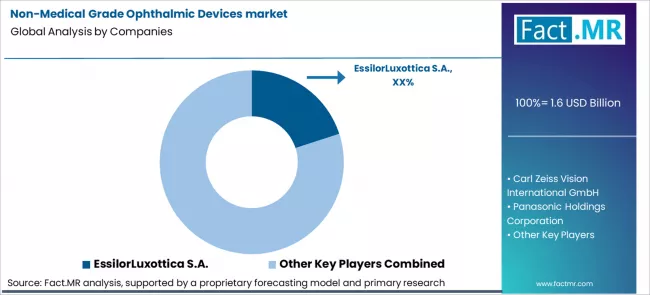
    Non Medical Grade Ophthalmic Devices Market Analysis By Company

    Route to market defines competitive standing in the non medical grade ophthalmic devices market more than technical specification depth. Retail groups first set price bands, warranty terms, and usage positioning before any device is listed. EssilorLuxottica and Carl Zeiss Vision benefit from optical channel control and established service frameworks. Panasonic participates through consumer electronics distribution and manufacturing scale. Bruder Healthcare competes through condition focused devices sold via specialist outlets.

    Xiaomi applies volume driven retail and online reach where price sensitivity shapes demand. Buyers compare suppliers using return rates, durability records, and clarity of instructions rather than clinical claims. Once a device line is accepted, volumes track shelf space and promotional cycles. Supplier shifts usually follow product refresh schedules or changes in retail listing rules.

    Key Players in Non-Medical Grade Ophthalmic Devices Market

    • EssilorLuxottica S.A.
    • Carl Zeiss Vision International GmbH
    • Panasonic Holdings Corporation
    • Bruder Healthcare Company
    • Xiaomi Corporation

    Scope of the Report

    Items Values
    Quantitative Units (2026) USD billion
    Device Type Eyelid warming and dry-eye relief devices, eye massagers and fatigue relief devices, blue-light filtering eyewear (non-Rx), home vision screening devices or apps, vision training devices or apps, eye humidifiers and comfort devices
    Application Dry eye symptom relief, digital eye strain and fatigue, myopia management support, vision screening and monitoring, vision training and rehabilitation support, sleep or circadian comfort (light management)
    Sales Channel E-commerce marketplaces, optical retail chains, direct-to-consumer brand sites, pharmacies and drugstores, consumer electronics retail, other retailers
    Regions Covered Asia Pacific, Europe, North America, Latin America, Middle East & Africa
    Countries Covered United States, Canada, Mexico, Germany, United Kingdom, France, Italy, Spain, Nordics, BENELUX, China, Japan, South Korea, India, Australia & New Zealand, ASEAN, Brazil, Chile, Saudi Arabia, Turkey, South Africa, and other regional markets
    Key Companies Profiled EssilorLuxottica S.A., Carl Zeiss Vision International GmbH, Panasonic Holdings Corporation, Bruder Healthcare Company, Xiaomi Corporation
    Additional Attributes Dollar sales by device type, application, and sales channel; installed base and test throughput per outlet, uptime, and maintenance cycles; retail network expansion, standardization of device sets, and replacement cycle behavior

    Non-Medical Grade Ophthalmic Devices Market Segmentation

    • Device Type :

      • Eyelid warming & dry-eye relief devices
      • Eye massagers & fatigue relief devices
      • Blue-light filtering eyewear (non-Rx)
      • Home vision screening devices or apps
      • Vision training devices or apps
      • Eye humidifiers & comfort devices
    • Application :

      • Dry eye symptom relief
      • Digital eye strain & fatigue
      • Myopia management support
      • Vision screening & monitoring
      • Vision training & rehabilitation support
      • Sleep or circadian comfort (light management)
    • Sales Channel :

      • E-commerce marketplaces
      • Optical retail chains
      • Direct-to-consumer (brand sites)
      • Pharmacies & drugstores
      • Consumer electronics retail
      • Other retailers
    • Region :

      • Asia Pacific
        • China
        • Japan
        • South Korea
        • India
        • Australia & New Zealand
        • ASEAN
        • Rest of Asia Pacific
      • Europe
        • Germany
        • United Kingdom
        • France
        • Italy
        • Spain
        • Nordic
        • BENELUX
        • Rest of Europe
      • North America
        • United States
        • Canada
        • Mexico
      • Latin America
        • Brazil
        • Chile
        • Rest of Latin America
      • Middle East & Africa
        • Kingdom of Saudi Arabia
        • Other GCC Countries
        • Turkey
        • South Africa
        • Other African Union
        • Rest of Middle East & Africa

    References

    • U.S. Food and Drug Administration. (2024). General wellness: Policy for low risk devices. U.S. Department of Health and Human Services.
    • International Electrotechnical Commission. (2023). IEC 62471: Photobiological safety of lamps and lamp systems. IEC.
    • World Health Organization. (2023). WHO global model regulatory framework for medical devices including in vitro diagnostic medical devices. World Health Organization.
    • UK Office for Product Safety and Standards. (2023). Electrical Equipment (Safety) Regulations 2016: Guidance for businesses. Department for Business and Trade.

    Table of Content

    1. Executive Summary
      • Global Market Outlook
      • Demand to side Trends
      • Supply to side Trends
      • Technology Roadmap Analysis
      • Analysis and Recommendations
    2. Market Overview
      • Market Coverage / Taxonomy
      • Market Definition / Scope / Limitations
    3. Market Background
      • Market Dynamics
        • Drivers
        • Restraints
        • Opportunity
        • Trends
      • Scenario Forecast
        • Demand in Optimistic Scenario
        • Demand in Likely Scenario
        • Demand in Conservative Scenario
      • Opportunity Map Analysis
      • Product Life Cycle Analysis
      • Supply Chain Analysis
      • Investment Feasibility Matrix
      • Value Chain Analysis
      • PESTLE and Porter’s Analysis
      • Regulatory Landscape
      • Regional Parent Market Outlook
      • Production and Consumption Statistics
      • Import and Export Statistics
    4. Global Market Analysis 2021 to 2025 and Forecast, 2026 to 2036
      • Historical Market Size Value (USD Million) Analysis, 2021 to 2025
      • Current and Future Market Size Value (USD Million) Projections, 2026 to 2036
        • Y to o to Y Growth Trend Analysis
        • Absolute $ Opportunity Analysis
    5. Global Market Pricing Analysis 2021 to 2025 and Forecast 2026 to 2036
    6. Global Market Analysis 2021 to 2025 and Forecast 2026 to 2036, By Device Type
      • Introduction / Key Findings
      • Historical Market Size Value (USD Million) Analysis By Device Type, 2021 to 2025
      • Current and Future Market Size Value (USD Million) Analysis and Forecast By Device Type, 2026 to 2036
        • Eyelid warming and dry-eye relief devices
        • Eye massagers and fatigue relief devices
        • Blue-light filtering eyewear (non-Rx)
        • Home vision screening devices or apps
        • Vision training devices or apps
        • Eye humidifiers and comfort devices
      • Y to o to Y Growth Trend Analysis By Device Type, 2021 to 2025
      • Absolute $ Opportunity Analysis By Device Type, 2026 to 2036
    7. Global Market Analysis 2021 to 2025 and Forecast 2026 to 2036, By Application
      • Introduction / Key Findings
      • Historical Market Size Value (USD Million) Analysis By Application, 2021 to 2025
      • Current and Future Market Size Value (USD Million) Analysis and Forecast By Application, 2026 to 2036
        • Dry eye symptom relief
        • Digital eye strain and fatigue
        • Myopia management support
        • Vision screening and monitoring
        • Vision training and rehabilitation support
        • Sleep or circadian comfort (light management)
      • Y to o to Y Growth Trend Analysis By Application, 2021 to 2025
      • Absolute $ Opportunity Analysis By Application, 2026 to 2036
    8. Global Market Analysis 2021 to 2025 and Forecast 2026 to 2036, By Sales Channel
      • Introduction / Key Findings
      • Historical Market Size Value (USD Million) Analysis By Sales Channel, 2021 to 2025
      • Current and Future Market Size Value (USD Million) Analysis and Forecast By Sales Channel, 2026 to 2036
        • E-commerce marketplaces
        • Optical retail chains
        • Direct-to-consumer (brand sites)
        • Pharmacies and drugstores
        • Consumer electronics retail
        • Other retailers
      • Y to o to Y Growth Trend Analysis By Sales Channel, 2021 to 2025
      • Absolute $ Opportunity Analysis By Sales Channel, 2026 to 2036
    9. Global Market Analysis 2021 to 2025 and Forecast 2026 to 2036, By Region
      • Introduction
      • Historical Market Size Value (USD Million) Analysis By Region, 2021 to 2025
      • Current Market Size Value (USD Million) Analysis and Forecast By Region, 2026 to 2036
        • North America
        • Latin America
        • Western Europe
        • Eastern Europe
        • East Asia
        • South Asia and Pacific
        • Middle East & Africa
      • Market Attractiveness Analysis By Region
    10. North America Market Analysis 2021 to 2025 and Forecast 2026 to 2036, By Country
      • Historical Market Size Value (USD Million) Trend Analysis By Market Taxonomy, 2021 to 2025
      • Market Size Value (USD Million) Forecast By Market Taxonomy, 2026 to 2036
        • By Country
          • USA
          • Canada
          • Mexico
        • By Device Type
        • By Application
        • By Sales Channel
      • Market Attractiveness Analysis
        • By Country
        • By Device Type
        • By Application
        • By Sales Channel
      • Key Takeaways
    11. Latin America Market Analysis 2021 to 2025 and Forecast 2026 to 2036, By Country
      • Historical Market Size Value (USD Million) Trend Analysis By Market Taxonomy, 2021 to 2025
      • Market Size Value (USD Million) Forecast By Market Taxonomy, 2026 to 2036
        • By Country
          • Brazil
          • Chile
          • Rest of Latin America
        • By Device Type
        • By Application
        • By Sales Channel
      • Market Attractiveness Analysis
        • By Country
        • By Device Type
        • By Application
        • By Sales Channel
      • Key Takeaways
    12. Western Europe Market Analysis 2021 to 2025 and Forecast 2026 to 2036, By Country
      • Historical Market Size Value (USD Million) Trend Analysis By Market Taxonomy, 2021 to 2025
      • Market Size Value (USD Million) Forecast By Market Taxonomy, 2026 to 2036
        • By Country
          • Germany
          • UK
          • Italy
          • Spain
          • France
          • Nordic
          • BENELUX
          • Rest of Western Europe
        • By Device Type
        • By Application
        • By Sales Channel
      • Market Attractiveness Analysis
        • By Country
        • By Device Type
        • By Application
        • By Sales Channel
      • Key Takeaways
    13. Eastern Europe Market Analysis 2021 to 2025 and Forecast 2026 to 2036, By Country
      • Historical Market Size Value (USD Million) Trend Analysis By Market Taxonomy, 2021 to 2025
      • Market Size Value (USD Million) Forecast By Market Taxonomy, 2026 to 2036
        • By Country
          • Russia
          • Poland
          • Hungary
          • Balkan & Baltic
          • Rest of Eastern Europe
        • By Device Type
        • By Application
        • By Sales Channel
      • Market Attractiveness Analysis
        • By Country
        • By Device Type
        • By Application
        • By Sales Channel
      • Key Takeaways
    14. East Asia Market Analysis 2021 to 2025 and Forecast 2026 to 2036, By Country
      • Historical Market Size Value (USD Million) Trend Analysis By Market Taxonomy, 2021 to 2025
      • Market Size Value (USD Million) Forecast By Market Taxonomy, 2026 to 2036
        • By Country
          • China
          • Japan
          • South Korea
        • By Device Type
        • By Application
        • By Sales Channel
      • Market Attractiveness Analysis
        • By Country
        • By Device Type
        • By Application
        • By Sales Channel
      • Key Takeaways
    15. South Asia and Pacific Market Analysis 2021 to 2025 and Forecast 2026 to 2036, By Country
      • Historical Market Size Value (USD Million) Trend Analysis By Market Taxonomy, 2021 to 2025
      • Market Size Value (USD Million) Forecast By Market Taxonomy, 2026 to 2036
        • By Country
          • India
          • ASEAN
          • Australia & New Zealand
          • Rest of South Asia and Pacific
        • By Device Type
        • By Application
        • By Sales Channel
      • Market Attractiveness Analysis
        • By Country
        • By Device Type
        • By Application
        • By Sales Channel
      • Key Takeaways
    16. Middle East & Africa Market Analysis 2021 to 2025 and Forecast 2026 to 2036, By Country
      • Historical Market Size Value (USD Million) Trend Analysis By Market Taxonomy, 2021 to 2025
      • Market Size Value (USD Million) Forecast By Market Taxonomy, 2026 to 2036
        • By Country
          • Kingdom of Saudi Arabia
          • Other GCC Countries
          • Turkiye
          • South Africa
          • Other African Union
          • Rest of Middle East & Africa
        • By Device Type
        • By Application
        • By Sales Channel
      • Market Attractiveness Analysis
        • By Country
        • By Device Type
        • By Application
        • By Sales Channel
      • Key Takeaways
    17. Key Countries Market Analysis
      • USA
        • Pricing Analysis
        • Market Share Analysis, 2025
          • By Device Type
          • By Application
          • By Sales Channel
      • Canada
        • Pricing Analysis
        • Market Share Analysis, 2025
          • By Device Type
          • By Application
          • By Sales Channel
      • Mexico
        • Pricing Analysis
        • Market Share Analysis, 2025
          • By Device Type
          • By Application
          • By Sales Channel
      • Brazil
        • Pricing Analysis
        • Market Share Analysis, 2025
          • By Device Type
          • By Application
          • By Sales Channel
      • Chile
        • Pricing Analysis
        • Market Share Analysis, 2025
          • By Device Type
          • By Application
          • By Sales Channel
      • Germany
        • Pricing Analysis
        • Market Share Analysis, 2025
          • By Device Type
          • By Application
          • By Sales Channel
      • UK
        • Pricing Analysis
        • Market Share Analysis, 2025
          • By Device Type
          • By Application
          • By Sales Channel
      • Italy
        • Pricing Analysis
        • Market Share Analysis, 2025
          • By Device Type
          • By Application
          • By Sales Channel
      • Spain
        • Pricing Analysis
        • Market Share Analysis, 2025
          • By Device Type
          • By Application
          • By Sales Channel
      • France
        • Pricing Analysis
        • Market Share Analysis, 2025
          • By Device Type
          • By Application
          • By Sales Channel
      • India
        • Pricing Analysis
        • Market Share Analysis, 2025
          • By Device Type
          • By Application
          • By Sales Channel
      • ASEAN
        • Pricing Analysis
        • Market Share Analysis, 2025
          • By Device Type
          • By Application
          • By Sales Channel
      • Australia & New Zealand
        • Pricing Analysis
        • Market Share Analysis, 2025
          • By Device Type
          • By Application
          • By Sales Channel
      • China
        • Pricing Analysis
        • Market Share Analysis, 2025
          • By Device Type
          • By Application
          • By Sales Channel
      • Japan
        • Pricing Analysis
        • Market Share Analysis, 2025
          • By Device Type
          • By Application
          • By Sales Channel
      • South Korea
        • Pricing Analysis
        • Market Share Analysis, 2025
          • By Device Type
          • By Application
          • By Sales Channel
      • Russia
        • Pricing Analysis
        • Market Share Analysis, 2025
          • By Device Type
          • By Application
          • By Sales Channel
      • Poland
        • Pricing Analysis
        • Market Share Analysis, 2025
          • By Device Type
          • By Application
          • By Sales Channel
      • Hungary
        • Pricing Analysis
        • Market Share Analysis, 2025
          • By Device Type
          • By Application
          • By Sales Channel
      • Kingdom of Saudi Arabia
        • Pricing Analysis
        • Market Share Analysis, 2025
          • By Device Type
          • By Application
          • By Sales Channel
      • Turkiye
        • Pricing Analysis
        • Market Share Analysis, 2025
          • By Device Type
          • By Application
          • By Sales Channel
      • South Africa
        • Pricing Analysis
        • Market Share Analysis, 2025
          • By Device Type
          • By Application
          • By Sales Channel
    18. Market Structure Analysis
      • Competition Dashboard
      • Competition Benchmarking
      • Market Share Analysis of Top Players
        • By Regional
        • By Device Type
        • By Application
        • By Sales Channel
    19. Competition Analysis
      • Competition Deep Dive
        • EssilorLuxottica S.A.
          • Overview
          • Product Portfolio
          • Profitability by Market Segments (Product/Age /Sales Channel/Region)
          • Sales Footprint
          • Strategy Overview
            • Marketing Strategy
            • Product Strategy
            • Channel Strategy
        • Carl Zeiss Vision International GmbH
        • Panasonic Holdings Corporation
        • Bruder Healthcare Company
        • Xiaomi Corporation
    20. Assumptions & Acronyms Used
    21. Research Methodology

    List Of Table

    • Table 1: Global Market Value (USD Million) Forecast by Region, 2021 to 2036
    • Table 2: Global Market Value (USD Million) Forecast by Device Type, 2021 to 2036
    • Table 3: Global Market Value (USD Million) Forecast by Application, 2021 to 2036
    • Table 4: Global Market Value (USD Million) Forecast by Sales Channel, 2021 to 2036
    • Table 5: North America Market Value (USD Million) Forecast by Country, 2021 to 2036
    • Table 6: North America Market Value (USD Million) Forecast by Device Type, 2021 to 2036
    • Table 7: North America Market Value (USD Million) Forecast by Application, 2021 to 2036
    • Table 8: North America Market Value (USD Million) Forecast by Sales Channel, 2021 to 2036
    • Table 9: Latin America Market Value (USD Million) Forecast by Country, 2021 to 2036
    • Table 10: Latin America Market Value (USD Million) Forecast by Device Type, 2021 to 2036
    • Table 11: Latin America Market Value (USD Million) Forecast by Application, 2021 to 2036
    • Table 12: Latin America Market Value (USD Million) Forecast by Sales Channel, 2021 to 2036
    • Table 13: Western Europe Market Value (USD Million) Forecast by Country, 2021 to 2036
    • Table 14: Western Europe Market Value (USD Million) Forecast by Device Type, 2021 to 2036
    • Table 15: Western Europe Market Value (USD Million) Forecast by Application, 2021 to 2036
    • Table 16: Western Europe Market Value (USD Million) Forecast by Sales Channel, 2021 to 2036
    • Table 17: Eastern Europe Market Value (USD Million) Forecast by Country, 2021 to 2036
    • Table 18: Eastern Europe Market Value (USD Million) Forecast by Device Type, 2021 to 2036
    • Table 19: Eastern Europe Market Value (USD Million) Forecast by Application, 2021 to 2036
    • Table 20: Eastern Europe Market Value (USD Million) Forecast by Sales Channel, 2021 to 2036
    • Table 21: East Asia Market Value (USD Million) Forecast by Country, 2021 to 2036
    • Table 22: East Asia Market Value (USD Million) Forecast by Device Type, 2021 to 2036
    • Table 23: East Asia Market Value (USD Million) Forecast by Application, 2021 to 2036
    • Table 24: East Asia Market Value (USD Million) Forecast by Sales Channel, 2021 to 2036
    • Table 25: South Asia and Pacific Market Value (USD Million) Forecast by Country, 2021 to 2036
    • Table 26: South Asia and Pacific Market Value (USD Million) Forecast by Device Type, 2021 to 2036
    • Table 27: South Asia and Pacific Market Value (USD Million) Forecast by Application, 2021 to 2036
    • Table 28: South Asia and Pacific Market Value (USD Million) Forecast by Sales Channel, 2021 to 2036
    • Table 29: Middle East & Africa Market Value (USD Million) Forecast by Country, 2021 to 2036
    • Table 30: Middle East & Africa Market Value (USD Million) Forecast by Device Type, 2021 to 2036
    • Table 31: Middle East & Africa Market Value (USD Million) Forecast by Application, 2021 to 2036
    • Table 32: Middle East & Africa Market Value (USD Million) Forecast by Sales Channel, 2021 to 2036

    List Of Figures

    • Figure 1: Global Market Pricing Analysis
    • Figure 2: Global Market Value (USD Million) Forecast 2021 to 2036
    • Figure 3: Global Market Value Share and BPS Analysis by Device Type, 2026 and 2036
    • Figure 4: Global Market Y to o to Y Growth Comparison by Device Type, 2026 to 2036
    • Figure 5: Global Market Attractiveness Analysis by Device Type
    • Figure 6: Global Market Value Share and BPS Analysis by Application, 2026 and 2036
    • Figure 7: Global Market Y to o to Y Growth Comparison by Application, 2026 to 2036
    • Figure 8: Global Market Attractiveness Analysis by Application
    • Figure 9: Global Market Value Share and BPS Analysis by Sales Channel, 2026 and 2036
    • Figure 10: Global Market Y to o to Y Growth Comparison by Sales Channel, 2026 to 2036
    • Figure 11: Global Market Attractiveness Analysis by Sales Channel
    • Figure 12: Global Market Value (USD Million) Share and BPS Analysis by Region, 2026 and 2036
    • Figure 13: Global Market Y to o to Y Growth Comparison by Region, 2026 to 2036
    • Figure 14: Global Market Attractiveness Analysis by Region
    • Figure 15: North America Market Incremental Dollar Opportunity, 2026 to 2036
    • Figure 16: Latin America Market Incremental Dollar Opportunity, 2026 to 2036
    • Figure 17: Western Europe Market Incremental Dollar Opportunity, 2026 to 2036
    • Figure 18: Eastern Europe Market Incremental Dollar Opportunity, 2026 to 2036
    • Figure 19: East Asia Market Incremental Dollar Opportunity, 2026 to 2036
    • Figure 20: South Asia and Pacific Market Incremental Dollar Opportunity, 2026 to 2036
    • Figure 21: Middle East & Africa Market Incremental Dollar Opportunity, 2026 to 2036
    • Figure 22: North America Market Value Share and BPS Analysis by Country, 2026 and 2036
    • Figure 23: North America Market Value Share and BPS Analysis by Device Type, 2026 and 2036
    • Figure 24: North America Market Y to o to Y Growth Comparison by Device Type, 2026 to 2036
    • Figure 25: North America Market Attractiveness Analysis by Device Type
    • Figure 26: North America Market Value Share and BPS Analysis by Application, 2026 and 2036
    • Figure 27: North America Market Y to o to Y Growth Comparison by Application, 2026 to 2036
    • Figure 28: North America Market Attractiveness Analysis by Application
    • Figure 29: North America Market Value Share and BPS Analysis by Sales Channel, 2026 and 2036
    • Figure 30: North America Market Y to o to Y Growth Comparison by Sales Channel, 2026 to 2036
    • Figure 31: North America Market Attractiveness Analysis by Sales Channel
    • Figure 32: Latin America Market Value Share and BPS Analysis by Country, 2026 and 2036
    • Figure 33: Latin America Market Value Share and BPS Analysis by Device Type, 2026 and 2036
    • Figure 34: Latin America Market Y to o to Y Growth Comparison by Device Type, 2026 to 2036
    • Figure 35: Latin America Market Attractiveness Analysis by Device Type
    • Figure 36: Latin America Market Value Share and BPS Analysis by Application, 2026 and 2036
    • Figure 37: Latin America Market Y to o to Y Growth Comparison by Application, 2026 to 2036
    • Figure 38: Latin America Market Attractiveness Analysis by Application
    • Figure 39: Latin America Market Value Share and BPS Analysis by Sales Channel, 2026 and 2036
    • Figure 40: Latin America Market Y to o to Y Growth Comparison by Sales Channel, 2026 to 2036
    • Figure 41: Latin America Market Attractiveness Analysis by Sales Channel
    • Figure 42: Western Europe Market Value Share and BPS Analysis by Country, 2026 and 2036
    • Figure 43: Western Europe Market Value Share and BPS Analysis by Device Type, 2026 and 2036
    • Figure 44: Western Europe Market Y to o to Y Growth Comparison by Device Type, 2026 to 2036
    • Figure 45: Western Europe Market Attractiveness Analysis by Device Type
    • Figure 46: Western Europe Market Value Share and BPS Analysis by Application, 2026 and 2036
    • Figure 47: Western Europe Market Y to o to Y Growth Comparison by Application, 2026 to 2036
    • Figure 48: Western Europe Market Attractiveness Analysis by Application
    • Figure 49: Western Europe Market Value Share and BPS Analysis by Sales Channel, 2026 and 2036
    • Figure 50: Western Europe Market Y to o to Y Growth Comparison by Sales Channel, 2026 to 2036
    • Figure 51: Western Europe Market Attractiveness Analysis by Sales Channel
    • Figure 52: Eastern Europe Market Value Share and BPS Analysis by Country, 2026 and 2036
    • Figure 53: Eastern Europe Market Value Share and BPS Analysis by Device Type, 2026 and 2036
    • Figure 54: Eastern Europe Market Y to o to Y Growth Comparison by Device Type, 2026 to 2036
    • Figure 55: Eastern Europe Market Attractiveness Analysis by Device Type
    • Figure 56: Eastern Europe Market Value Share and BPS Analysis by Application, 2026 and 2036
    • Figure 57: Eastern Europe Market Y to o to Y Growth Comparison by Application, 2026 to 2036
    • Figure 58: Eastern Europe Market Attractiveness Analysis by Application
    • Figure 59: Eastern Europe Market Value Share and BPS Analysis by Sales Channel, 2026 and 2036
    • Figure 60: Eastern Europe Market Y to o to Y Growth Comparison by Sales Channel, 2026 to 2036
    • Figure 61: Eastern Europe Market Attractiveness Analysis by Sales Channel
    • Figure 62: East Asia Market Value Share and BPS Analysis by Country, 2026 and 2036
    • Figure 63: East Asia Market Value Share and BPS Analysis by Device Type, 2026 and 2036
    • Figure 64: East Asia Market Y to o to Y Growth Comparison by Device Type, 2026 to 2036
    • Figure 65: East Asia Market Attractiveness Analysis by Device Type
    • Figure 66: East Asia Market Value Share and BPS Analysis by Application, 2026 and 2036
    • Figure 67: East Asia Market Y to o to Y Growth Comparison by Application, 2026 to 2036
    • Figure 68: East Asia Market Attractiveness Analysis by Application
    • Figure 69: East Asia Market Value Share and BPS Analysis by Sales Channel, 2026 and 2036
    • Figure 70: East Asia Market Y to o to Y Growth Comparison by Sales Channel, 2026 to 2036
    • Figure 71: East Asia Market Attractiveness Analysis by Sales Channel
    • Figure 72: South Asia and Pacific Market Value Share and BPS Analysis by Country, 2026 and 2036
    • Figure 73: South Asia and Pacific Market Value Share and BPS Analysis by Device Type, 2026 and 2036
    • Figure 74: South Asia and Pacific Market Y to o to Y Growth Comparison by Device Type, 2026 to 2036
    • Figure 75: South Asia and Pacific Market Attractiveness Analysis by Device Type
    • Figure 76: South Asia and Pacific Market Value Share and BPS Analysis by Application, 2026 and 2036
    • Figure 77: South Asia and Pacific Market Y to o to Y Growth Comparison by Application, 2026 to 2036
    • Figure 78: South Asia and Pacific Market Attractiveness Analysis by Application
    • Figure 79: South Asia and Pacific Market Value Share and BPS Analysis by Sales Channel, 2026 and 2036
    • Figure 80: South Asia and Pacific Market Y to o to Y Growth Comparison by Sales Channel, 2026 to 2036
    • Figure 81: South Asia and Pacific Market Attractiveness Analysis by Sales Channel
    • Figure 82: Middle East & Africa Market Value Share and BPS Analysis by Country, 2026 and 2036
    • Figure 83: Middle East & Africa Market Value Share and BPS Analysis by Device Type, 2026 and 2036
    • Figure 84: Middle East & Africa Market Y to o to Y Growth Comparison by Device Type, 2026 to 2036
    • Figure 85: Middle East & Africa Market Attractiveness Analysis by Device Type
    • Figure 86: Middle East & Africa Market Value Share and BPS Analysis by Application, 2026 and 2036
    • Figure 87: Middle East & Africa Market Y to o to Y Growth Comparison by Application, 2026 to 2036
    • Figure 88: Middle East & Africa Market Attractiveness Analysis by Application
    • Figure 89: Middle East & Africa Market Value Share and BPS Analysis by Sales Channel, 2026 and 2036
    • Figure 90: Middle East & Africa Market Y to o to Y Growth Comparison by Sales Channel, 2026 to 2036
    • Figure 91: Middle East & Africa Market Attractiveness Analysis by Sales Channel
    • Figure 92: Global Market - Tier Structure Analysis
    • Figure 93: Global Market - Company Share Analysis

    - FAQs -

    How big is the non-medical grade ophthalmic devices market in 2026?

    The global non-medical grade ophthalmic devices market is estimated to be valued at USD 1.6 billion in 2026.

    What will be the size of non-medical grade ophthalmic devices market in 2036?

    The market size for the non-medical grade ophthalmic devices market is projected to reach USD 3.9 billion by 2036.

    How much will be the non-medical grade ophthalmic devices market growth between 2026 and 2036?

    The non-medical grade ophthalmic devices market is expected to grow at a 9.4% CAGR between 2026 and 2036.

    What are the key product types in the non-medical grade ophthalmic devices market?

    The key product types in non-medical grade ophthalmic devices market are eyelid warming and dry-eye relief devices, eye massagers and fatigue relief devices, blue-light filtering eyewear (non-rx), home vision screening devices or apps, vision training devices or apps and eye humidifiers and comfort devices.

    Which application segment to contribute significant share in the non-medical grade ophthalmic devices market in 2026?

    In terms of application, dry eye symptom relief segment to command 32.4% share in the non-medical grade ophthalmic devices market in 2026.

    Non-Medical Grade Ophthalmic Devices Market