- Market Value (2025): USD 3.3 Bn
- Estimated Value (2026): USD 3.7 Bn
- Forecast Value (2036): USD 10.2 Bn
- CAGR (2026-2036): 10.8%
What is the Oil-Resistant Molded Fiber Market forecast to be worth by 2036?
USD 3.7 billion in 2026 to USD 10.2 billion by 2036, at 10.8% CAGR.
- The Oil-Resistant Molded Fiber Market crossed a valuation of USD 3.3 billion in 2025.
- Demand is projected to increase from USD 3.7 billion in 2026 to USD 10.2 billion by 2036.
- The market is forecast to record a 10.8% CAGR from 2026 to 2036 as foodservice chains, meal-kit brands and institutional kitchens replace plastic trays in hot-meal formats.
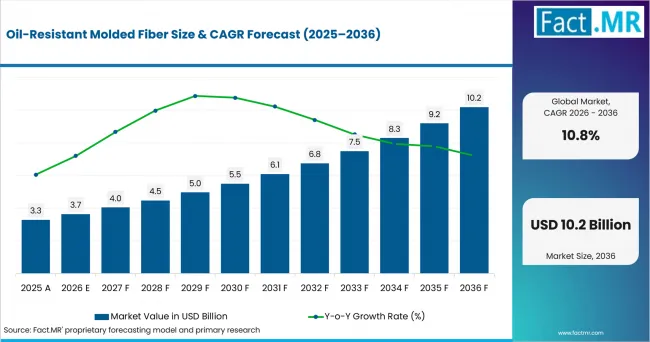
Oil Resistant Molded Fiber Value Analysis | Source: Fact.MR
What are the defining numbers behind Oil-Resistant Molded Fiber Market growth?
USD 6.5 billion absolute opportunity by 2036, led by Bagasse, Trays and hot-meal foodservice.
- Demand Drivers in the Market
- Quick-service restaurant operators need molded trays that keep fried and sauced meals away from plastic foam while limiting seepage during handoff.
- Meal-delivery platforms need clamshells and bowls that handle oil-contact foods because courier time exposes weak coatings quickly.
- Food processors need high-heat molded fiber trays supported by the shift toward frozen and chilled ready meals.
- Institutional caterers need certified fiber formats due to purchasing rules that reduce single-use plastic in public and campus foodservice.
- Packaging converters need bagasse and blended fiber options since performance treatments must match grease, moisture and heat requirements.
- Key Segments Analyzed
- By Fiber Feedstock: Bagasse is expected to hold 31.0% share in 2026 because its fiber length and residue-based supply make it practical for formed trays.
- By Performance Treatment: Grease resistant formats are projected to account for 29.0% share in 2026 owing to direct contact with fried meals and sauced foods.
- By Format: Trays are anticipated to capture 36.0% share in 2026 as hot meals and chilled prepared foods use flat pack geometries.
- By Application: Hot meals are estimated to represent 34.0% share in 2026 since oil, heat and steam create the clearest need for treated molded fiber.
- Analyst Opinion at Fact.MR
- Shambhu Nath Jha, Principal Consultant at Fact.MR, states, “Oil resistance is becoming the practical test for molded fiber in foodservice. The market is expected to reward suppliers that prove grease holdout while preserving compostability, food-contact safety or forming speed. Restaurants need packaging that survives the meal journey and proves the sustainability claim.”
- Strategic Implications
- Converters should document grease holdout, wet strength and heat tolerance by food type so chain restaurants approve packs faster.
- Foodservice brands should test trays under real delivery times because oil migration often appears after stacking and transport.
- Fiber suppliers should secure bagasse and recycled fiber streams near molding plants to reduce freight exposure and lead-time risk.
- Barrier-chemistry teams should align formulations with PFAS restrictions and food-contact clearance before scaling coated molded fiber.
China is projected to record 11.7% CAGR through 2036 due to high delivery volume and catering activity. The USA is anticipated to post 11.2% CAGR supported by food-away-from-home spending and PFAS-related packaging changes. Japan is estimated to advance at 11.2% CAGR as prepared meals and compact retail formats use more treated trays. Germany is expected to register 11.0% CAGR through recycling infrastructure and EU packaging rules. France is forecast to hold 10.5% CAGR as foodservice operators adapt to reusable and recyclable packaging requirements.
How does the Oil-Resistant Molded Fiber Market break down by segment?
Trays lead Format at 36.0%; Hot meals lead Application at 34.0%.
Which Fiber Feedstock dominates?
Bagasse holds 31.0% share in 2026.
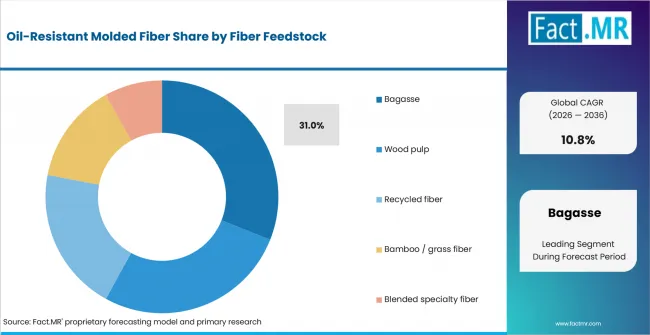
Oil Resistant Molded Fiber Analysis By Fiber Feedstock | Source: Fact.MR
Bagasse is expected to lead Fiber Feedstock because it gives trays a firm wall while reducing reliance on virgin wood pulp. Recycled fiber supports cost-sensitive formats when food-contact rules are satisfied. Bagasse has the clearest fit where trays need oil resistance and fast forming performance.
What leads the Performance Treatment segment?
Grease resistant treatment accounts for 29.0% share in 2026.
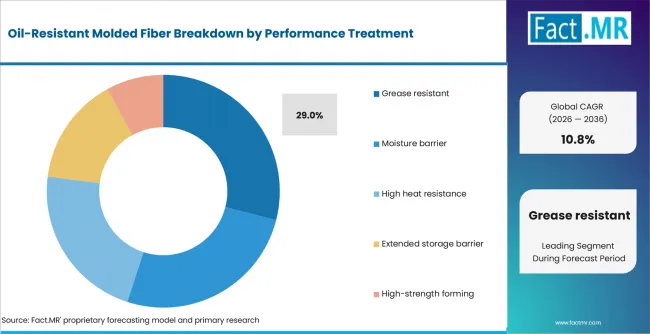
Oil Resistant Molded Fiber Analysis By Performance Treatment | Source: Fact.MR
Grease resistant treatment is projected to account for 29.0% share because hot meals place oil directly against the pack surface. Moisture barrier treatment addresses steam and chilled foods. The European Commission reported in August 2026 that new packaging rules began applying from 12 August 2026 and restrict PFAS in food-contact packaging.
How does Format shape demand?
Trays lead with 36.0% share in 2026.
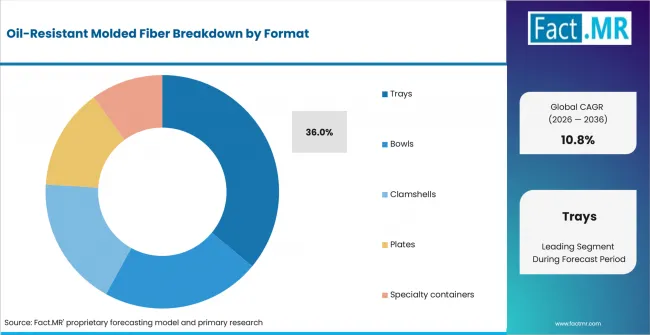
Oil Resistant Molded Fiber Analysis By Format | Source: Fact.MR
Trays are anticipated to capture 36.0% share because they suit plated meals, chilled entrees and ready-to-heat foods. Bowls fit sauced meals, while clamshells support takeaway. Trays keep their position where grease control and sealing are both needed.
What supports Hot meals within Application?
Hot meals capture 34.0% share in 2026.
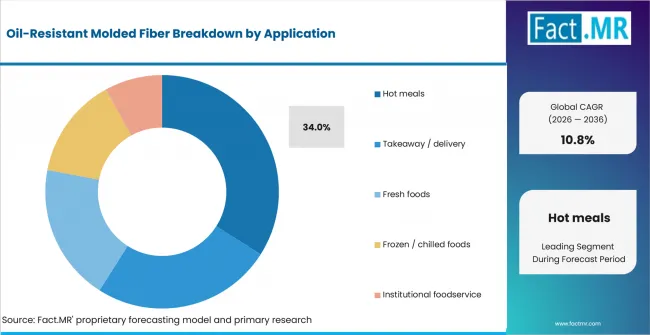
Oil Resistant Molded Fiber Analysis By Application | Source: Fact.MR
Hot meals are estimated to represent 34.0% share because oil and steam expose the limits of untreated molded fiber. Takeaway and delivery add stacking and transport stress. The Japan Foodservice Association updated its 2025 annual results in January 2026 and reported all-store foodservice sales up 7.3%.
What is accelerating Oil-Resistant Molded Fiber Market adoption, and what is holding it back?
Foodservice substitution drives it; barrier-cost pressure restrains it.
Drivers Impact Analysis
| Driver | (~) % Impact on CAGR | Geographic Relevance | Impact Timeline |
|---|---|---|---|
| PFAS-free grease barrier conversion | +1.7% | North America, Europe | Short term (<= 2 years) |
| Delivery and takeaway meal volume | +1.4% | USA, China, Japan | Short term (<= 2 years) |
| Plastic reduction rules in foodservice | +1.2% | Europe, East Asia | Medium term (2-4 years) |
| Prepared meal and chilled-food packaging | +0.9% | Japan, France, Germany | Medium term (2-4 years) |
| Recycling and fiber-packaging infrastructure | +0.7% | Europe, North America | Long term (>= 4 years) |
Opportunity Impact Analysis
| Opportunity | (~) % Impact on CAGR | Geographic Relevance | Impact Timeline |
|---|---|---|---|
| Certified compostable oil-resistant trays | +1.1% | USA, Japan, Europe | Short term (<= 2 years) |
| Frozen and chilled ready-meal formats | +0.9% | Japan, France, USA | Medium term (2-4 years) |
| Bagasse and blended-fiber sourcing | +0.8% | China, USA, Western Europe | Medium term (2-4 years) |
| Institutional foodservice replacement programs | +0.6% | France, Germany, USA | Long term (>= 4 years) |
Restraints Impact Analysis
| Restraint | (~) % Impact on CAGR | Geographic Relevance | Impact Timeline |
|---|---|---|---|
| Barrier coating cost and validation | -0.8% | Global | Short term (<= 2 years) |
| Contamination in recycling streams | -0.6% | Europe, North America | Medium term (2-4 years) |
| Heat and oil performance inconsistency | -0.5% | Global | Medium term (2-4 years) |
| Fiber supply and logistics exposure | -0.4% | China, USA, Europe | Long term (>= 4 years) |
Which countries are scaling the Oil-Resistant Molded Fiber Market through 2036?
- The country comparison spans 1.2 percentage points and forms a tight growth range across foodservice packaging markets.
- China remains 0.5 percentage point above the USA due to catering scale and delivery-packaging volume.
- The USA and Japan hold the same displayed CAGR as hot meals and prepared foods support treated tray demand.
- Germany remains 0.5 percentage point above France as recycling systems and EU packaging rules shape converter choices.
- France closes the displayed range through serviceware rules and recyclable takeaway packaging requirements.
Comparable CAGRs create different entry conditions because each country combines foodservice scale, packaging policy, recycling systems and fiber-sourcing routes differently. Full report coverage includes North America, Latin America, Western Europe, Eastern Europe, East Asia, South Asia & Pacific, and Middle East & Africa.
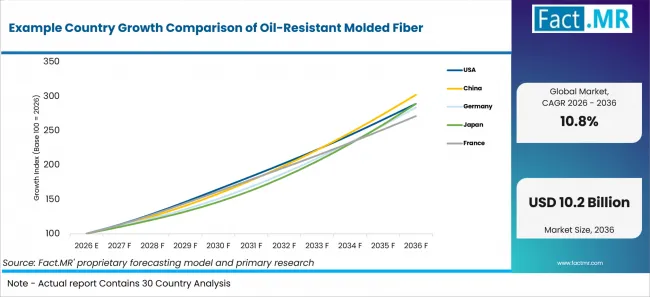
Example Country Growth Comparison Of Oil Resistant Molded Fiber | Source: Fact.MR
| Country | CAGR (2026-2036) |
|---|---|
| China | 11.7% |
| USA | 11.2% |
| Japan | 11.2% |
| Germany | 11.0% |
| France | 10.5% |
How is China scaling demand?
11.7% CAGR, driven by catering activity and delivery packaging volume.
China’s catering and parcel lanes give oil-resistant molded fiber producers a high-volume test base for trays and clamshells. The National Bureau of Statistics reported in February 2026 that catering income reached CNY 5,798.2 billion in 2025, up 3.2% year on year. China is projected to record 11.7% CAGR through 2036. Pack designs that manage oil transfer during courier handoff are expected to gain faster menu approval.
What supports USA adoption?
11.2% CAGR, supported by food-away-from-home scale and PFAS replacement.
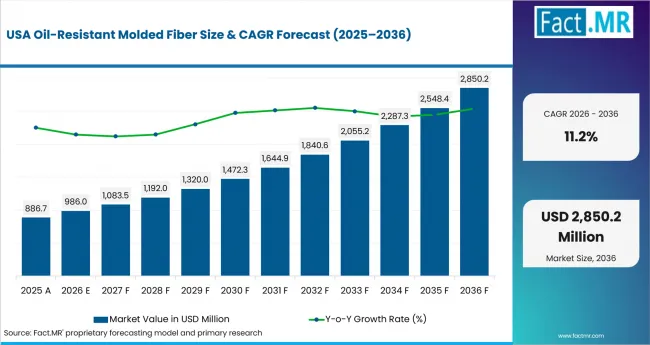
Oil Resistant Molded Fiber Country Value Analysis | Source: Fact.MR
U.S. restaurant and off-premise channels make grease holdout a visible pack-performance requirement. USDA ERS reported in June 2026 that inflation-adjusted food-away-from-home spending reached USD 1.41 trillion in 2025. The USA is forecast to post 11.2% CAGR through 2036. Fiber suppliers gain when treated trays perform across fried foods and sauced entrees.
What supports Japan’s outlook?
11.2% CAGR, led by prepared meals and compact food retail formats.
Japan’s foodservice market provides a more direct demand indicator for prepared-meal packaging. The Japan Foodservice Association updated its 2025 annual results in January 2026, and the industry survey reported all-store foodservice sales up 7.3% year on year. Japan is expected to record 11.2% CAGR through 2036. Smaller trays with clean presentation support chilled and hot-meal rotation.
What is supporting Germany’s adoption?
11.0% CAGR, backed by packaging recycling systems and EU food-contact rules.
Germany’s packaging recovery system gives fiber formats a clearer end-of-life route when food residue is managed. Destatis reported on February 19, 2026 that German hospitality turnover increased 1.4% in nominal terms and decreased 2.1% in real terms in 2025. Germany is projected to record 11.0% CAGR through 2036. Treated molded fiber suppliers need barrier recipes that suit food-contact use and material recovery.
How does France perform?
10.5% CAGR, driven by foodservice rules and recyclable takeaway packaging.
France’s restaurant serviceware rules place clear substitution pressure on takeaway and collective catering packs. Service-Public.fr verified in December 2025 that establishments able to serve 20 or more people simultaneously must use reusable serviceware for meals and drinks consumed onsite. France is forecast to record 10.5% CAGR through 2036. Recyclable takeaway containers keep molded fiber relevant where single-use packs remain part of meal service.
Who leads the Oil-Resistant Molded Fiber Market?
Huhtamaki and Sabert have direct molded-fiber food-packaging capabilities, while Pactiv Evergreen, now part of Novolex, add additional molded- and formed-fiber expertise.
Huhtamaki participates through its Fiber Packaging and Foodservice Packaging businesses, which include molded-fiber solutions for food and beverage applications. Sabert is active through molded-fiber formulations including Pulp Plus® and Pulp Ultra®, which provide different levels of moisture, oil and grease resistance for foodservice applications.
Pactiv Evergreen became part of Novolex following completion of their combination in April 2025 and maintains molded-fiber food and produce packaging capabilities. Genpak participates through its Harvest® Fiber molded-fiber foodservice containers, while CKF offers molded-fibre trays, plates and cup carriers for foodservice applications.
Competitive differentiation across these portfolios includes oil and grease resistance, moisture performance, food-contact suitability, heating compatibility, and documented recyclability or compostability performance.
Which companies are covered in the competitive set?
Companies covered include Huhtamaki, Sabert, Pactiv Evergreen, Genpak, CKF.
- Huhtamaki
- Pactiv Evergreen, part of Novolex
- Sabert
- Genpak
- CKF
Bibliography
- Biodegradable Products Institute. (2026, March). BPI Home Compostability Certification Scheme - 1.2 [Certification scheme].
- Directorate-General for Environment. (2026, August 11). New EU packaging rules start to apply, including restrictions on PFAS in food-contact packaging. European Commission.
- German Environment Agency, & Central Agency Packaging Register. (2026, January 27). Facts against myths: Packaging waste recycling in Germany is working.
- Huhtamäki Oyj. (2025, February 14). Huhtamaki to separate Fiber Foodservice business segment into two distinct segments: Fiber Packaging and Foodservice Europe-Asia-Oceania.
- National Bureau of Statistics of China. (2026, February 28). Statistical communiqué of the People’s Republic of China on the 2025 national economic and social development.
- Novolex. (2025, April 1). Novolex and Pactiv Evergreen Inc. complete combination, creating a leading manufacturer in food, beverage and specialty packaging.
- Sabert Corporation. (2025, November 19). Sabert Corporation’s Pulp Ultra® wins 2025 U.S. Plastics Pact Packaging Innovation Award for Compostability.
- Sabert Corporation. (2026, April 30). Sabert Corporation releases 2025 Sustainability Report and announces new 2030 goal, signaling shift toward end-of-life outcomes.
- Service Public Entreprendre. (2025, December 31). Produits en plastique interdits.
- Statistics Bureau of Japan. (2026, February 6). 2025 yearly average [Family Income and Expenditure Survey].
- Statistisches Bundesamt. (2026, February 19). Gastgewerbeumsatz 2025 real 2,1 % niedriger als im Vorjahr.
- U.S. Food and Drug Administration. (2025, January 3). FDA determines authorization for 35 food contact notifications related to PFAS are no longer effective.
- Zeballos, E., & Sinclair, W. (2026, June 11). Total U.S. food spending reached $2.51 trillion in 2025. U.S. Department of Agriculture, Economic Research Service.
This Report Addresses
- The report explains how oil-resistant molded fiber is used across fiber feedstock and performance treatment choices.
- Country analysis reviews China, the USA, Japan, Germany and France across foodservice and packaging regulation signals.
- Competitive analysis covers Huhtamaki, Pactiv Evergreen, Sabert, Genpak, CKF.
- Feedstock assessment covers Bagasse, Wood pulp, Recycled fiber, Bamboo or grass fiber and Blended specialty fiber.
- Application assessment covers Hot meals, Takeaway and delivery, Fresh foods, Frozen and chilled foods and Institutional foodservice.
- The forecast is supported by official statistics, provider portfolio checks and product-level evidence from company sources.
What does the Oil-Resistant Molded Fiber Market cover?
Bagasse, wood pulp, recycled fiber and specialty fiber packaging used for oil-contact foods.
The Oil-Resistant Molded Fiber Market covers formed fiber trays, bowls, clamshells, plates and specialty containers designed for oily or wet foods. It includes grease-resistant and moisture-barrier treatments where the pack remains a molded fiber food-contact format, connecting naturally with paper trays and ready meal trays.
The assessment is narrower than broad foodservice packaging because it focuses on molded fiber packs used against oil-contact meals. It is narrower than paper barrier coatings where the coating is sold separately from the formed pack.
What is included in the scope?
Oil-resistant molded fiber formats used in foodservice, retail prepared meals and institutional meal packaging.
The scope includes bagasse, wood pulp, recycled fiber, bamboo or grass fiber and blended specialty fiber formats used in oil-contact food packaging. It covers grease resistance, moisture barrier, heat resistance, storage barrier and high-strength forming where the final product is a molded fiber pack. The material scope links to sugarcane bagasse fibre, waste fibre trays, compostable food-service coatings, home-compostable serviceware, biodegradable packaging materials, fiber-based food liners and recyclable food liners.
What is excluded from the scope?
Plastic serviceware and untreated paperboard packaging are outside the scope.
Rigid plastic trays, foam clamshells, aluminum containers, flexible wraps and ordinary paperboard cartons remain outside the market boundary. Standalone coating chemicals remain outside the boundary unless they are directly integrated into an oil-resistant molded fiber pack.
How Was the Analysis Built?
The analysis draws on 120+ sources, 35+ company portfolios, 25+ countries, and more than 20 industry interviews.
- Primary Research: Primary research includes discussions with manufacturers, service providers, technology developers, distributors, end users, and subject-matter experts. These conversations examine purchasing priorities, product adoption, operational challenges, approval requirements, competitive positioning, and the factors that influence wider market acceptance.
- Desk Research: Desk research covers government statistics, regulatory publications, company filings, trade data, technical studies, industry associations, standards, public policy, and other authoritative sources. Every source used in the analysis is documented in the bibliography.
- Market Sizing and Forecasting: Market estimates combine historical performance, demand indicators, pricing and volume trends, segment shares, company participation, country-level growth, adoption patterns, investment activity, and barriers to market expansion.
- Data Validation and Update Cycle: Findings are validated by comparing primary interviews with public data, company activity, regulatory changes, trade patterns, and industry developments. Regular updates review new product launches, capacity changes, partnerships, approvals, and shifts in commercial adoption.
What is the report’s scope and coverage?
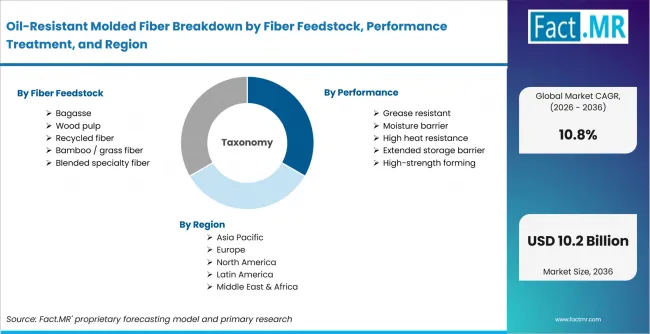
Oil Resistant Molded Fiber Breakdown By Fiber Feedstock, Performance Treatment, And Region | Source: Fact.MR
| Attribute | Details |
|---|---|
| Quantitative Units | USD billion in 2026 to USD billion by 2036 at CAGR |
| Market Definition | Molded fiber food packaging designed to resist oil, grease and wet hot foods using fiber feedstocks and performance treatments. |
| Fiber Feedstock | Bagasse; Wood pulp; Recycled fiber; Bamboo or grass fiber; Blended specialty fiber |
| Performance Treatment | Grease resistant; Moisture barrier; High heat resistance; Extended storage barrier; High-strength forming |
| Format | Trays; Bowls; Clamshells; Plates; Specialty containers |
| Application | Hot meals; Takeaway and delivery; Fresh foods; Frozen and chilled foods; Institutional foodservice |
| Regions Covered | North America; Latin America; Western Europe; Eastern Europe; East Asia; South Asia & Pacific; Middle East & Africa |
| Countries Covered | USA; China; Germany; Japan; France |
| Key Companies Profiled | Huhtamaki; Pactiv Evergreen; Sabert; Genpak; CKF |
| Forecast Period | 2026 to 2036 |
| Approach | Hybrid top-down and bottom-up approach using foodservice packaging demand, fiber-feedstock mix, treatment requirements, format use and company portfolio review. |
How is the market segmented?
-
By Fiber Feedstock
- Bagasse
- Wood pulp
- Recycled fiber
- Bamboo or grass fiber
- Blended specialty fiber
-
By Performance Treatment
- Grease resistant
- Moisture barrier
- High heat resistance
- Extended storage barrier
- High-strength forming
-
By Format
- Trays
- Bowls
- Clamshells
- Plates
- Specialty containers
-
By Application
- Hot meals
- Takeaway and delivery
- Fresh foods
- Frozen and chilled foods
- Institutional foodservice
-
By Region
- North America
- Latin America
- Western Europe
- Eastern Europe
- East Asia
- South Asia & Pacific
- Middle East & Africa