- Market Value (2025): USD 4.1 Bn
- Estimated Value (2026): USD 4.4 Bn
- Forecast Value (2036): USD 8.6 Bn
- CAGR (2026-2036): 17.0%
What is the Invisible Aero Antenna Systems Market forecast to be worth by 2036?
USD 4.4 billion in 2026 to USD 8.6 billion by 2036 at a 7.0% CAGR.
- As per Fact.MR analysis, the invisible aero antenna systems market reached USD 4.1 billion in 2025.
- Demand is projected to increase from USD 4.4 billion in 2026 to USD 8.6 billion by 2036.
- The market is forecast to record a 7.0% CAGR from 2026 to 2036.
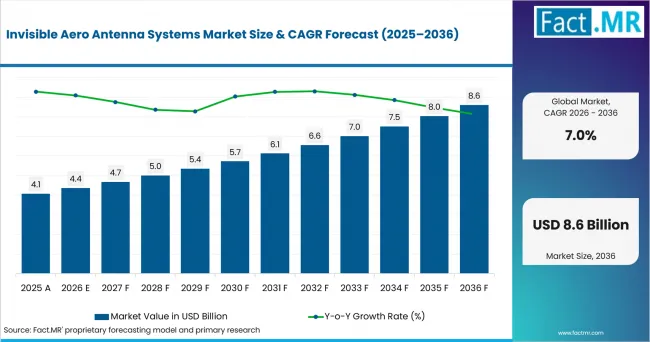
Invisible Aero Antenna Systems Market Value Analysis | Source: Fact.MR
What are the defining numbers behind Invisible Aero Antenna Systems Market growth?
An absolute opportunity of USD 4.2245 billion is expected between 2026 and 2036.
- Demand Drivers in the Market
- Combat aircraft need antennas that fit inside the aircraft without changing its outer shape. Built-in antennas reduce exposed parts while supporting radar and communication.
- Sixth-generation fighters need more built-in antennas because many sensors and communication systems must fit into limited space. In June 2025, the U.S. Department of Defense stated that the FY2026 request included USD 3.5 billion for F-47 design work [1].
- Electronic warfare aircraft need antennas that work across different frequencies with radar and communication systems. Built-in antennas provide wider coverage and help reduce interference between systems.
- Stealth aircraft use antennas built into the body, radomes, and other surfaces. This keeps the outer shape smooth while supporting antenna performance and reducing the aircraft’s visible signature.
- Key Segments Analyzed
- By Integration: Skin-embedded systems are expected to hold a 31.0% share in 2026 because the antennas are built into the aircraft surface and reduce exposed parts.
- By Platform: Fighter aircraft are projected to account 36.0% share in 2026 because they need several radar and communication systems in limited space without changing the aircraft shape.
- By Function: Radar is anticipated to capture 32.0% share in 2026 because airborne radar needs enough antenna space, good signal control, and heat control.
- By Signature Constraint: Low radar cross-section systems are estimated to represent 31.0% share in 2026 because combat aircraft use built-in antennas and smooth surfaces to reduce radar detection.
- Analyst Opinion at Fact.MR
- Shambhu Nath Jha, Principal Consultant at Fact.MR, states, “Invisible antennas fit well into the aircraft body and work reliably. More sensors and communication systems are being built into aircraft surfaces to support stealth needs. Suppliers need good antenna design, heat control, and easy installation for combat aircraft.”
- Strategic Implications
- Aircraft makers should plan antenna space and cable routes early so built-in antennas fit the aircraft design.
- Antenna suppliers should test antennas after installation because aircraft surfaces, radomes, coatings, and nearby parts can affect performance.
- Typhoon suppliers should prepare for more radar and electronic warfare systems. In June 2025, Defence Equipment & Support announced £204.6 million for the ECRS Mk2 radar on RAF Typhoon aircraft [2]
- Material suppliers should provide clear details on signal loss, heat limits, repairs, and durability. This helps aircraft makers choose materials that work well and last longer.
The UK leads at 7.9% CAGR as combat aircraft upgrades increase demand for built-in radar and electronic warfare systems. Japan follows at 7.6% as fighter programs grow. The USA reaches 7.3% as sixth-generation aircraft development continues. Germany records 7.0% with ongoing Eurofighter programs, while France reaches 6.6% as Rafale upgrades increase demand for built-in aircraft systems.
How does the Invisible Aero Antenna Systems Market break down by segment?
Fighter leads Platform at 36.0% share in 2026, while Radar leads Function at 32.0% share.
Which Integration type dominates?
Skin-embedded systems are expected to hold 31.0% share in 2026.
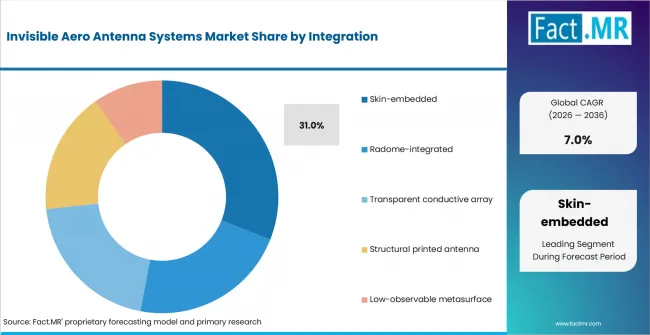
Invisible Aero Antenna Systems Market Analysis By Integration | Source: Fact.MR
Skin-embedded antennas are placed inside or just below the aircraft surface. This reduces air resistance and keeps fewer parts exposed on stealth aircraft. Radome antennas use a special cover that lets signals pass through. Transparent antennas can be placed on some windows and thin surfaces without blocking signals.
What leads the Platform segment?
Fighter aircraft are projected to account for 36.0% share in 2026.
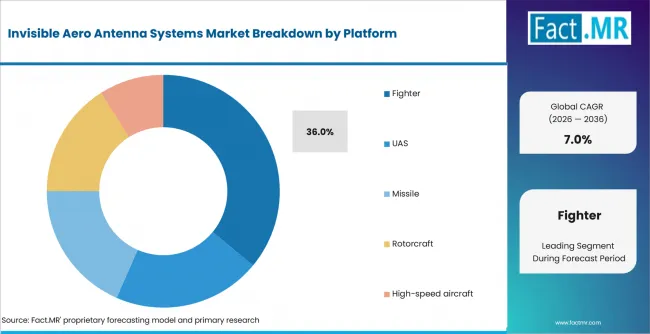
Invisible Aero Antenna Systems Market Analysis By Platform | Source: Fact.MR
Fighter aircraft need several radar and communication systems in limited space. Antennas must fit inside the aircraft without affecting airflow or safety. Missiles have less space and face high heat, while helicopters and high-speed aircraft also face heat and vibration.
In April 2025, Japan’s Ministry of Defense reported that the FY2025 budget included ¥138.7 billion for F-35A aircraft [3]. The F-35A has advanced electronic warfare systems, which increases demand for compact radar and communication systems that fit inside stealth aircraft.
How does Function shape demand?
Radar is anticipated to hold 32.0% share in 2026.
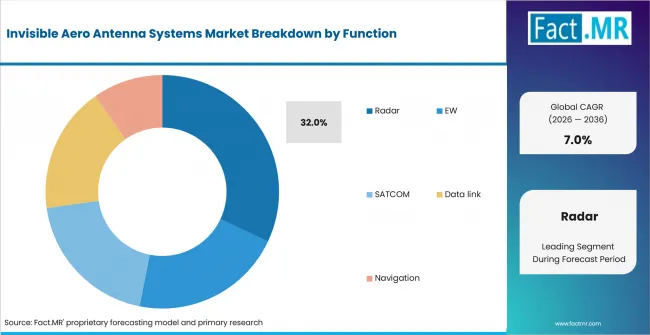
Invisible Aero Antenna Systems Market Analysis By Function | Source: Fact.MR
Radar leads because fire-control and surveillance systems need accurate signal direction and stable antennas. Electronic warfare systems need to work across many frequencies. Data links, navigation, and satellite communication also need antennas, which increases the need to fit more systems into limited aircraft space.
What supports Low radar cross-section within Signature Constraint?
Low radar cross-section systems are estimated to represent 31.0% share in 2026.
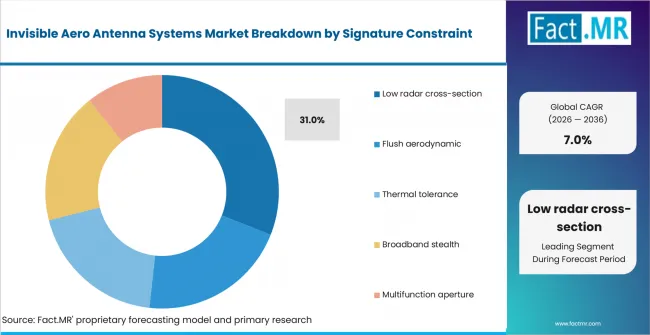
Invisible Aero Antenna Systems Market Analysis By Signature Constraint | Source: Fact.MR
Low radar detection affects the design of the entire antenna area. Engineers need to manage edges, joints, antenna connections, radome materials, and surface shapes so the antenna fits the aircraft’s stealth design. High-speed aircraft also need smooth surfaces and materials that can handle high heat.
What is accelerating Invisible Aero Antenna Systems Market adoption, and what is holding it back?
Built-in aircraft systems and stealth needs increase demand, while high testing costs and difficult maintenance can slower the use.
Drivers Impact Analysis
| DRIVER | (~) % IMPACT ON CAGR | GEOGRAPHIC RELEVANCE | IMPACT TIMELINE |
|---|---|---|---|
| Low-observable combat-air modernization | +1.6% | North America, Europe, East Asia | Medium term (2-4 years) |
| Multifunction radar and EW fit | +1.3% | Global | Short term (<= 2 years) |
| Sixth-generation fighter development | +1.0% | USA, UK, Japan, Europe | Long term (>= 4 years) |
| UAS and high-speed platform packaging needs | +0.7% | North America, East Asia, Europe | Medium term (2-4 years) |
Source: Fact.MR analysis. Updated Oct 6, 2026
Opportunity Impact Analysis
| OPPORTUNITY | (~) % IMPACT ON CAGR | GEOGRAPHIC RELEVANCE | IMPACT TIMELINE |
|---|---|---|---|
| Multifunction conformal apertures | +1.0% | Global | Long term (>= 4 years) |
| Printed and metasurface fit | +0.8% | North America, Europe, East Asia | Medium term (2-4 years) |
| Low-profile retrofit RF hardware | +0.6% | USA, Europe, Asia | Short term (<= 2 years) |
Source: Fact.MR analysis. Updated Oct 6, 2026
Restraints Impact Analysis
| RESTRAINT | (~) % IMPACT ON CAGR | GEOGRAPHIC RELEVANCE | IMPACT TIMELINE |
|---|---|---|---|
| Long airworthiness and RF approval cycles | -0.8% | Global | Short term (<= 2 years) |
| Maintenance access for embedded apertures | -0.6% | Global | Medium term (2-4 years) |
| High fit cost across materials and avionics | -0.5% | North America, Europe, East Asia | Long term (>= 4 years) |
Source: Fact.MR analysis. Updated Oct 6, 2026
Which countries are scaling the Invisible Aero Antenna Systems Market through 2036?
- The country comparison spans 1.3 percentage points across the forecast period.
- The UK remains 0.3 percentage point above Japan as combat-air upgrades support built-in airborne RF systems.
- Japan remains 0.3 percentage point above the USA through fighter upgrades and next-generation combat-air design work.
- The USA remains 0.3 percentage point above Germany as sixth-generation aircraft work supports new radar and electronic-warfare architectures.
- Germany remains 0.4 percentage point above France as Eurofighter activity supports airborne sensor and electronic-warfare integration.
- France closes the displayed range as Rafale upgrades sustains demand for compact radar, radio link, and electronic-warfare apertures.
Comparable CAGRs can create different entry conditions because aircraft program timing, approval depth, engineering capacity, and upgrade schedules vary by country. Full report coverage includes North America, Latin America, Western Europe, Eastern Europe, East Asia, South Asia & Pacific, Middle East & Africa.
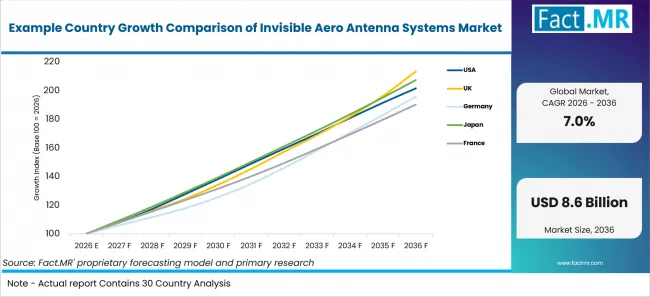
Example Country Growth Comparison Of Invisible Aero Antenna Systems Market | Source: Fact.MR
| Country | CAGR (2026-2036) |
|---|---|
| United Kingdom | 7.9% |
| Japan | 7.6% |
| United States | 7.3% |
| Germany | 7.0% |
| France | 6.6% |
Source: Fact.MR analysis. Updated Oct 6, 2026
What supports United Kingdom adoption?
7.9% CAGR, supported by GCAP activity and continued fighter fleet expansion.
UK combat aircraft programs need radar and communication systems that fit both current and future aircraft. The market is expected to grow at 7.9% CAGR from 2026 to 2036. In June 2025, the UK government announced plans to buy 12 F-35A aircraft [4]. This purchase is expected to increase demand for built-in radar, electronic warfare, communication, and navigation systems.
How is Japan scaling demand?
7.6% CAGR, driven by F-35 fleet expansion and next-generation fighter design work.
Japan is using more stealth aircraft with advanced electronic systems. The market is projected to record at 7.6% CAGR from 2026 to 2036. In August 2025, Japan’s Ministry of Defense reported that three F-35B aircraft were deployed to Nyutabaru Air Base [5]. This increases demand for compact antennas that fit inside stealth aircraft.
What underpins United States demand?
7.3% CAGR, shaped by sixth-generation aircraft work and fighter readiness needs.
U.S. aircraft programs need built-in radar and communication systems that work well and are easy to maintain. The market is anticipated to record 7.3% CAGR through 2036. In June 2026, the U.S. Government Accountability Office reported that 44% of F-35 aircraft were ready for missions in fiscal 2025 [6]. This increases demand for built-in antenna systems that are easy to test, approve, and maintain.
How is Germany developing the market?
7.0% CAGR, supported by Eurofighter production and electronic-warfare upgrades.
Germany is adding more radar and electronic warfare systems to fighter aircraft. The market is expected to grow at 7.0% CAGR through 2036. In October 2025, the Bundeswehr announced that production had started for 20 new Eurofighter aircraft [7]. This supports demand for built-in radar, communication systems, and new sensors.
What supports the France outlook?
6.6% CAGR, reinforced by Rafale F5 work and continued combat-air investment.
France has a strong fighter aircraft industry and many aircraft electronics suppliers. The market is expected to grow at 6.6% CAGR from 2026 to 2036. In July 2025, the Direction générale de l’armement reported €4 billion in new defence orders for the first half of 2025 [8]. Rafale F5 and aircraft communication projects are expected to increase demand for built-in sensors and communication systems.
Who leads the Invisible Aero Antenna Systems Market?
RTX and Northrop Grumman supply AESA radars and electronic warfare systems for fighter and military aircraft. Thales provides radar, electronic warfare, communication, navigation, and identification systems for Rafale aircraft. Leonardo supplies radar and electronic warfare systems for Gripen and Eurofighter Typhoon.
L3Harris supplies the Viper Shield electronic warfare system for F-16 aircraft. In May 2025, RTX completed the first flight test of its PhantomStrike® radar. The radar tracked several aircraft and mapped the ground during the test.
Buyers compare size, weight, power use, software, performance, and ease of installation when choosing radar and electronic warfare systems.
Which companies are the key providers?
RTX and Northrop Grumman are profiled alongside L3Harris, Thales, and Leonardo.
- RTX
- Northrop Grumman
- L3Harris
- Thales
- Leonardo
Bibliography
- [1] U.S. Department of Defense. (2025, June 26). Background briefing on FY 2026 defense budget.
- [2] Defence Equipment & Support. (2025, June 13). Funding for innovative new radar for Typhoon fighter jets is given the green light.
- [3] Ministry of Defense, Japan. (2025). Progress and budget in fundamental reinforcement of defense capabilities: Overview of FY2025 budget.
- [4] Prime Minister's Office, 10 Downing Street. (2025, June 24). UK to purchase F-35As and join NATO nuclear mission as Government steps up national security and delivers defence dividend.
- [5] Ministry of Defense, Japan. (2025, August 8).[Press conference by the Minister of Defense].
- [6] U.S. Government Accountability Office. (2026, June 11). F-35 sustainment: Actions needed to ensure updated strategy improves persistent readiness challenges (GAO-26-108113).
- [7] Bundeswehr. (2025, October 15). Eurofighter Tranche 5 geht in Produktion: Deutschland erhält 20 Stück.
- [8] Direction générale de l’armement. (2025, July 3). Le ministère des armées totalise 4 milliards d’euros de nouvelles commandes.
- [9] RTX. (2025, May 6). RTX's Raytheon completes first flight test for PhantomStrike® radar.
This Report Answers
- The report explains how invisible aero antenna systems relate to military antenna systems and how platform-level integration changes the design trade for low-profile airborne RF hardware.
- Segment analysis connects the radar function with the wider airborne radar market and evaluates why fighters account for the supplied 36.0% platform share in 2026.
- The function view covers electronic protection and sensing links that overlap with the electronic warfare market while keeping the report focused on aircraft-integrated antenna systems.
- Low-profile surface concepts are assessed alongside adjacent multi-band reflectarray antennas where flat apertures and multi-band operation create similar integration pressures.
What does the Invisible Aero Antenna Systems Market cover?
The market covers airborne antennas whose installation is designed to reduce protrusions, drag penalties, or radar-signature effects compared with conventional external hardware. It includes antenna elements integrated into skins, radomes, structural layers, conductive surfaces, and low-observable apertures used for radar, electronic warfare, satellite radio link, data link, or navigation.
The assessment covers fighters, uncrewed aircraft, missiles, rotorcraft, and high-speed aircraft. It also considers communication roles that connect with sovereign defence SATCOM platforms and the broader satellite communication market when the antenna is integrated into an airborne platform.
What is included in the scope?
The scope includes skin-embedded arrays, radome-integrated antennas, transparent conductive arrays, structural printed antennas, and low-observable metasurface concepts intended for airborne use. It includes associated aperture structures where design choices directly affect radar, EW, SATCOM, data-link, or navigation results.
Platform coverage includes fighter aircraft, UAS, missiles, rotorcraft, and high-speed aircraft. UAS demand is assessed alongside the unmanned combat aerial vehicle market because compact airframes place similar pressure on antenna size, weight, power, and surface placement.
Fighter radar design is reviewed beside adjacent F-15EX GaN-enhanced fighter radars where compact AESA hardware and aircraft-level RF fit are central design factors.
What is excluded from the scope?
Outside the scope are conventional protruding blade, whip, horn, and dish antennas sold for general airborne use with no low-profile or airframe-built design objective. Ground radar, naval radar, satellite payload antennas, and general RF components sit outside the defined market boundary when they are separate from an airborne platform.
Standalone sensing hardware is treated as adjacent context when it helps explain aircraft integration. The boundary therefore remains narrower than the aircraft sensors market and specialized radar categories such as combat aircraft swarm radars.
How Was the Analysis Built?
The analysis draws on 120+ sources, 35+ company portfolios, 25+ countries, and more than 20 industry interviews.
- Primary Research: Primary research includes discussions with manufacturers, service providers, technology developers, distributors, end users, and subject-matter experts. These conversations examine purchasing priorities, product adoption, operational challenges, approval requirements, competitive positioning, and the factors that influence wider market acceptance.
- Desk Research: Desk research covers government statistics, regulatory publications, company filings, trade data, technical studies, industry associations, standards, public policy, and other authoritative sources. Every source used in the analysis is documented in the bibliography.
- Market Sizing and Forecasting: Market estimates combine historical performance, demand indicators, pricing and volume trends, segment shares, company participation, country-level growth, adoption patterns, investment activity, and barriers to market expansion.
- Data Validation and Update Cycle: Findings are validated by comparing primary interviews with public data, company activity, regulatory changes, trade patterns, and industry developments. Regular updates review new product launches, capacity changes, partnerships, approvals, and shifts in commercial adoption.
Segmentation
What is the report’s scope and coverage?
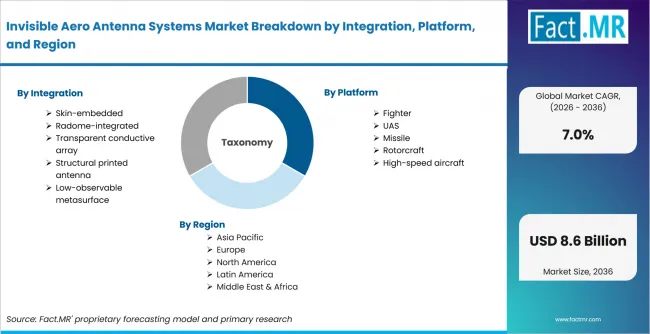
Invisible Aero Antenna Systems Market Breakdown By Integration, Platform, And Region | Source: Fact.MR
| Attribute | Details |
|---|---|
| Quantitative Units | USD billion |
| Market Definition | Airborne antenna systems designed to reduce visible protrusions or RF-signature penalties by integrating radiating elements into aircraft skins, radomes, structures, conductive surfaces, or low-observable apertures. |
| Fit | Skin-embedded; Radome-integrated; Transparent conductive array; Structural printed antenna; Low-observable metasurface |
| Platform | Fighter; UAS; Missile; Rotorcraft; High-speed aircraft |
| Function | Radar; EW; SATCOM; Data link; Navigation |
| Signature Constraint | Low radar cross-section; Flush airflow; Thermal tolerance; Broadband stealth; Multifunction aperture |
| Regions Covered | North America; Latin America; Western Europe; Eastern Europe; East Asia; South Asia & Pacific; Middle East & Africa |
| Countries Covered | United States; United Kingdom; Germany; Japan; France |
| Key Companies Profiled | RTX; Northrop Grumman; L3Harris; Thales; Leonardo |
| Forecast Period | 2026 to 2036 |
| Approach | Hybrid top-down and bottom-up assessment using combat-air activity, airborne RF architecture, platform fit needs, country programs, segment shares, and provider portfolio review. |
Source: Fact.MR analysis. Updated Oct 6, 2026
How is the market segmented?
-
By Integration:
- Skin-embedded
- Radome-integrated
- Transparent conductive array
- Structural printed antenna
- Low-observable metasurface
-
By Platform:
- Fighter
- UAS
- Missile
- Rotorcraft
- High-speed aircraft
-
By Function:
- Radar
- EW
- SATCOM
- Data link
- Navigation
-
By Signature Constraint:
- Low radar cross-section
- Flush airflow
- Thermal tolerance
- Broadband stealth
- Multifunction aperture
-
By Region:
- North America
- Latin America
- Western Europe
- Eastern Europe
- East Asia
- South Asia & Pacific
- Middle East & Africa
Frequently Asked Questions
How big is the invisible aero antenna systems market in 2026?
What is the CAGR of the invisible aero antenna systems market from 2026 to 2036?
Which platform leads the invisible aero antenna systems market?
Which function leads the invisible aero antenna systems market?
Which companies are profiled in the invisible aero antenna systems market?
Who worked on this report


Preview the report firsthand - request a free sample
Free SampleGet the brochure for pricing and purchase details
Download PDF