- Base Value(2025): 11.2 Bn
- Estimated Value(2026): 11.7 Bn
- Forecast Value (2036): 17.4 Bn
- CAGR (2026 - 2036): 4.1%
Organic Cocoa Market Forecast and Outlook By Fact.MR
In 2025, the organic cocoa market was valued at USD 11.2 billion. Based on Fact.MR analysis, demand for organic cocoa is estimated to grow to USD 11.7 billion in 2026 and USD 17.4 billion by 2036. FACT.MR projects a CAGR of 4.1% during the forecast period.
During this period, the market is expected to generate USD 5.7 billion in new revenue opportunities. This incremental but sustained expansion reflects rising certified organic cocoa procurement by confectionery multinationals, premium chocolate brand proliferation in developed markets, and personal care industry adoption of organic cocoa butter as a clean-label emollient ingredient. Growth is moderated by chronic undersupply of certified organic cocoa beans relative to demand, susceptibility of West African organic cocoa farms to climate-related yield volatility, and the two-to-three-year transition cost burden facing conventional cocoa farmers seeking organic certification.
Country growth reflects organic food market maturity, consumer clean-label preference, and certified organic retail channel penetration. India leads at 7.0% CAGR driven by domestic organic food market expansion and rising chocolate consumption among the urban middle class. Germany follows at 6.6% supported by strong Bio-label consumer demand and statutory organic food certification standards. The United States posts 6.0% driven by premium organic chocolate brand growth and organic bakery ingredient procurement. Japan grows at 5.8% through premium confectionery adoption and organic personal care ingredient demand. Thailand advances at 5.4%, the most active Southeast Asian market, through export-oriented organic cocoa processing and growing domestic premium confectionery adoption, constrained by limited certified organic cocoa bean domestic supply requiring imports from West Africa and Latin America.
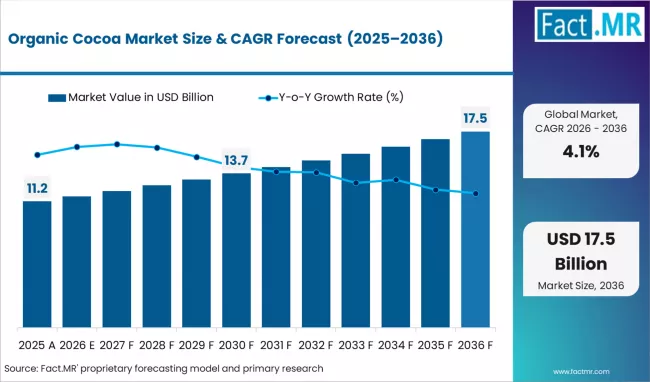
Organic Cocoa Market Market Value Analysis | Source: Fact.MR
| Metric | Value |
|---|---|
| Estimated Value in 2026 | USD 11.7 billion |
| Forecast Value in 2036 | USD 17.4 billion |
| Forecast CAGR (2026 to 2036) | 4.1% |
Source: Fact.MR analysis. Updated Mar 17, 2026
Organic Cocoa Market Definition
The organic cocoa market includes cocoa beans, butter, liquor, and powder produced under certified organic farming standards without synthetic chemicals and verified by recognised certification bodies.
Market Inclusions
Includes global and regional market forecasts from 2026 to 2036 by form and end-use application. Covers certified organic cocoa ingredients supplied to food, confectionery, personal care, and pharmaceutical industries.
Market Exclusions
Excludes conventional cocoa, Rainforest Alliance or UTZ cocoa without organic certification, finished chocolate products, retail cocoa packaging, and agricultural equipment markets.
Research Methodology
- Primary Research: Interviews with organic cocoa traders, confectionery procurement managers, organic food product developers, personal care ingredient buyers, and certification organisations.
- Desk Research: Analysis of USDA organic programme data, EU organic regulation reports, ICCO production statistics, organic food association reports, and company sustainability disclosures.
- Market Sizing and Forecasting: Hybrid model using certified organic cocoa production volumes, price premium analysis, end-use demand forecasts, and organic food market growth trends.
- Data Validation and Update Cycle: Forecasts validated with ICCO reports, USDA certification data, brand sustainability disclosures, and interviews with cocoa traders and procurement managers.
Summary of Organic Cocoa Market
- Market Definition
- The organic cocoa market includes certified organic cocoa butter, liquor, and powder used by chocolate, bakery, personal care, and pharmaceutical manufacturers.
- Demand Drivers
- Global confectionery companies are increasing organic cocoa sourcing to meet sustainability and clean-label product requirements.
- EU organic regulation and strong Bio-label retail demand in Germany are boosting organic cocoa ingredient procurement.
- Personal care brands are adopting organic cocoa butter for natural cosmetic formulations.
- Key Segments Analysed
- By Form: Cocoa powder leads with about 38% share in 2026 due to its wide use in bakery, beverages, and confectionery products.
- By End Use Application: Bakery and confectionery lead with about 40% share in 2026 due to strong demand from organic chocolate and bakery brands.
- By Geography: Europe leads global revenue due to strong organic food consumption and strict certification standards.
- Analyst Opinion at FACT.MR
- Shambhu Nath Jha, Principal Consultant at Fact.MR notes that direct-trade organic cocoa sourcing, cooperative partnerships, and certified supply chains offer the strongest long-term growth opportunities.
- Strategic Implications
- Companies should secure long-term supply contracts with certified cocoa cooperatives to ensure stable organic ingredient supply.
- Food brands should obtain both USDA and EU organic certifications to expand premium retail access.
- Personal care companies should use COSMOS-certified organic cocoa butter to qualify for premium natural cosmetics markets.
- Methodology
- Market sizing used certified organic cocoa production volumes and price premium data validated with ICCO and USDA statistics.
- Organic market reports, sustainability disclosures, and industry data supported regional demand analysis.
- Forecasts incorporated organic food growth trends, clean-label confectionery demand, and interviews with cocoa traders.
Segmental Analysis
Organic Cocoa Market Analysis by Form
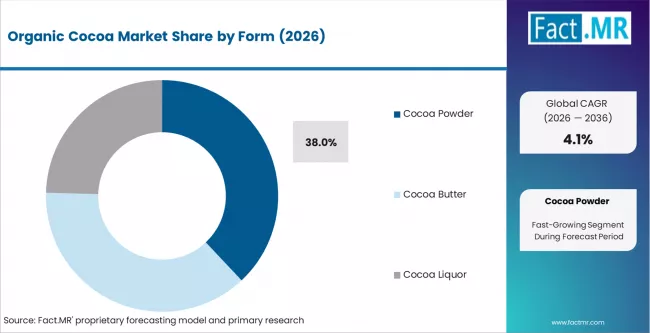
Organic Cocoa Market Analysis By Form | Source: Fact.MR
Cocoa powder is projected to hold about 38% share in 2026 due to its wide use in bakery, beverages, and confectionery applications.
- Olam Cocoa Supply Investment: Olam Food Ingredients expanded organic cocoa processing capacity in Côte d'Ivoire to meet rising demand from European chocolate manufacturers. [5]
- Barry Callebaut Liquor Technology: Barry Callebaut introduced a certified organic cocoa liquor range for premium chocolate producers in Europe. [6]
- Cocoa Butter Personal Care Trend: Organic cocoa butter demand increased among natural cosmetics brands seeking certified plant-based emollients. [7]
Organic Cocoa Market Analysis by End Use Application
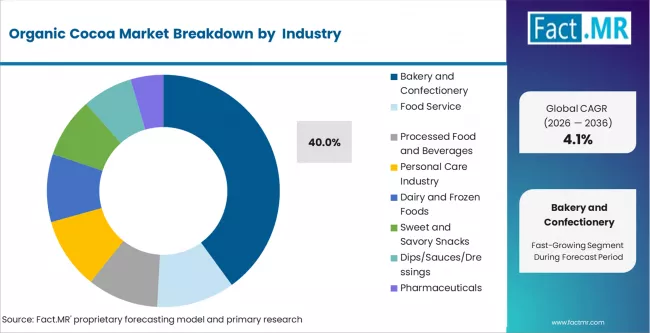
Organic Cocoa Market Analysis By End Use | Source: Fact.MR
Bakery and confectionery applications are expected to hold about 40% share in 2026 due to strong demand from organic chocolate manufacturers.
- Blommer Chocolate Investment: Blommer Chocolate expanded organic chocolate production capacity to supply bakery and confectionery manufacturers. [8]
- Cargill Confectionery Technology: Cargill launched an organic gourmet chocolate range targeting premium bakery and pastry markets. [9]
- Personal Care Application Trend: Organic cocoa butter usage increased in cosmetic products as brands shift to certified natural ingredients. [10]
Drivers, Restraints, and Opportunities
FACT.MR analysts observe that the organic cocoa market has grown steadily as certified organic cocoa supply chains expanded across West Africa, Latin America, and Southeast Asia. Rising organic food consumption in Europe and North America has strengthened demand for certified cocoa ingredients. Organic cocoa typically carries a 15-30% price premium over conventional cocoa, encouraging farmers to pursue certification despite the multi-year transition process.
Demand for certified organic cocoa is increasing faster than supply. Premium chocolate brands and bean-to-bar manufacturers are expanding quickly, creating sourcing pressure on certified organic cocoa cooperatives. At the same time, organic cocoa butter and liquor are replacing conventional cocoa ingredients in personal care and pharmaceutical formulations that require certified natural inputs.
- EU Organic Regulation Enforcement: The EU strengthened organic regulation enforcement and traceability requirements, increasing compliance costs and favouring established certified cocoa traders. [2]
- India Organic Market Expansion: India expanded its National Programme for Organic Production, improving organic cocoa certification and increasing demand for certified cocoa ingredients. [3]
- West Africa Supply Constraint: ICCO reported that organic cocoa represents less than 1% of global cocoa output, creating supply shortages and higher price premiums. [4]
Regional Analysis
The organic cocoa market is analysed across Asia Pacific, Europe, North America, Latin America, and Middle East and Africa, covering 40+ countries with distinct demand profiles shaped by organic food certification standards, retail channel maturity, confectionery industry structure, and consumer clean-label preference intensity. The full report offers market attractiveness analysis based on organic food market growth trajectories, certification regulation stringency, and confectionery procurement sustainability commitment benchmarks.
.webp "Top Country Growth Comparison Organic Cocoa Market Cagr (2026 2036)")
Top Country Growth Comparison Organic Cocoa Market Cagr (2026 2036) | Source: Fact.MR
| Country | CAGR (2026-2036) |
|---|---|
| India | 7.0% |
| Germany | 6.6% |
| United States | 6.0% |
| Japan | 5.8% |
| Thailand | 5.4% |
Source: Fact.MR analysis. Updated Mar 17, 2026
Source: Fact.MR (FACT.MR) analysis, based on proprietary forecasting model and primary research
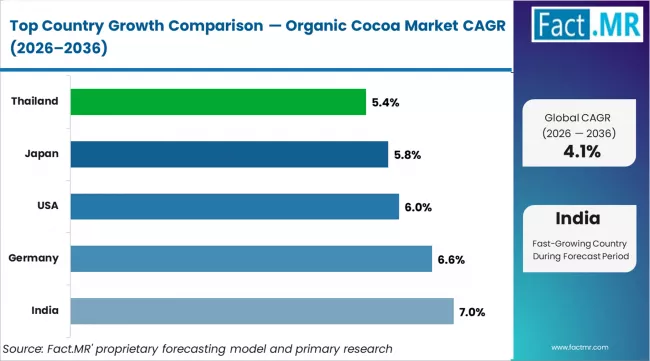
Organic Cocoa Market Cagr Analysis By Country | Source: Fact.MR
Asia Pacific Organic Cocoa Market Analysis
Asia Pacific is emerging as a high-growth region for organic cocoa consumption due to expanding organic food retail and premium confectionery demand. India’s growing organic product market and Thailand’s specialty cocoa processing sector are strengthening regional demand for certified organic cocoa ingredients.
- India: In India, organic cocoa demand is expected to grow at a CAGR of 7.0% through 2036. Expansion of the National Programme for Organic Production has strengthened certification frameworks and supported organic ingredient sourcing by domestic chocolate manufacturers. Major dairy and confectionery brands such as Amul have introduced new organic chocolate products targeting urban premium grocery consumers. Retail brands like Fabindia have also expanded their organic cocoa-based offerings, reflecting rising demand for certified organic food products among Indian consumers.
- Thailand: Thailand’s organic cocoa market is projected to expand at a CAGR of 5.4% through 2036. The government updated certification guidelines for organic cocoa processing facilities to align with export standards required by European and Japanese markets. This policy shift has encouraged domestic cocoa processors to invest in organic cocoa fermentation and processing capacity. Companies such as Doi Chaang Coffee and Cocoa have increased organic cocoa output to meet export demand from premium European chocolate manufacturers seeking alternative organic cocoa sources.
- Japan: Japan’s organic cocoa market is expected to grow at a CAGR of 5.8% through 2036. Updated JAS Organic certification standards introduced stricter documentation requirements for imported organic cocoa ingredients, increasing quality compliance expectations among suppliers. Premium confectionery companies such as Meiji have expanded their organic chocolate offerings to meet demand from consumers seeking high-quality and traceable ingredients.
FACT.MR’s assessment of the organic cocoa market in Asia Pacific includes country-level analysis for India, Thailand, Japan, China, ASEAN, Australia and New Zealand, and the rest of South Asia and Pacific.
Europe Organic Cocoa Market Analysis
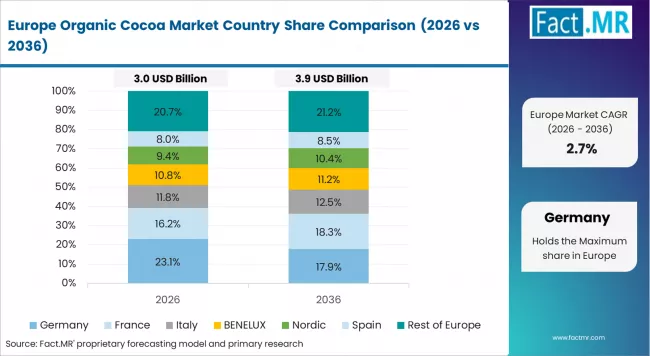
Organic Cocoa Market Europe Country Market Share Analysis, 2026 & 2036 | Source: Fact.MR
Europe remains the largest consumer market for certified organic cocoa due to strong organic food retail infrastructure and strict regulatory frameworks supporting organic certification. High demand from premium chocolate manufacturers and bakery producers continues to drive organic cocoa ingredient imports across the region.
- Germany: Germany’s organic cocoa market is forecast to grow at a CAGR of 6.6% through 2036. The country maintains the largest organic food retail sector in Europe, with organic chocolate and cocoa products representing a key growth category. Leading chocolate manufacturer Ritter Sport has increased its share of certified organic cocoa sourcing through direct partnerships with Latin American cocoa farmers. Additionally, German organic farming associations continue to promote traceable cocoa supply chains to support premium organic confectionery manufacturing.
FACT.MR’s analysis of the organic cocoa market in Europe covers Germany, France, the United Kingdom, Italy, Spain, Nordic countries, BENELUX, and the rest of Western Europe.
North America Organic Cocoa Market Analysis
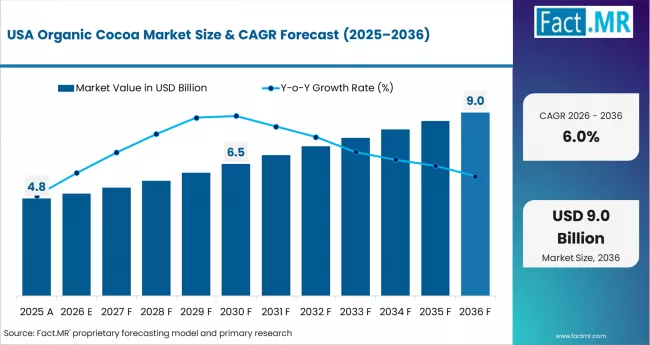
Organic Cocoa Market Country Value Analysis | Source: Fact.MR
North America represents a mature and high-value market for organic cocoa, supported by strong demand for clean-label confectionery, premium chocolate brands, and expanding organic food retail channels. Established certification systems and growing consumer awareness of sustainable sourcing continue to drive steady demand for certified organic cocoa ingredients across food and personal care industries.
- United States: In United States, the organic cocoa market is expected to grow at a CAGR of 6.0% through 2036. Updated USDA organic residue testing and traceability requirements have strengthened compliance standards for imported organic cocoa ingredients. Premium chocolate companies such as Theo Chocolate have expanded direct-trade sourcing partnerships to secure consistent certified organic cocoa supply.
FACT.MR’s analysis of the organic cocoa market in North America includes country-level assessment for the United States, Canada, and Mexico, covering organic certification compliance, confectionery industry procurement trends, and organic ingredient demand across food and personal care applications.
Competitive Aligners for Market Players
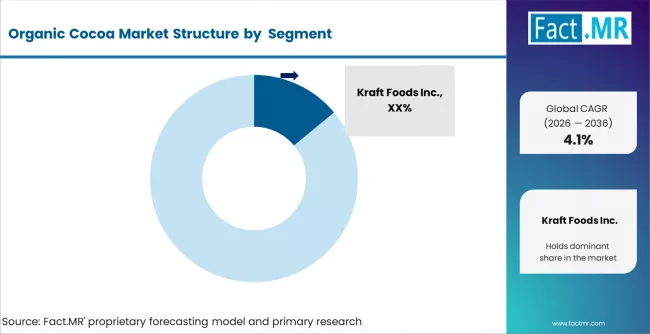
Organic Cocoa Market Analysis By Company | Source: Fact.MR
The global organic cocoa market is moderately concentrated at the ingredient supply level, where a few large traders manage significant volumes of certified organic cocoa beans and processed ingredients. Companies such as Barry Callebaut, Cargill (including Olam Food Ingredients), and Tradin Organic Agriculture play major roles because they operate vertically integrated supply chains that connect certified organic cocoa cooperatives in West Africa and Latin America with chocolate manufacturers in Europe and North America. However, at the finished chocolate level the market is far more fragmented, with numerous premium and craft brands competing based on origin transparency, ethical sourcing, and flavour differentiation. In this industry, the key competitive factor for suppliers is the ability to provide fully traceable and certified organic cocoa from farm to final ingredient.
Barry Callebaut holds a strong competitive position due to long-term partnerships with certified organic cocoa cooperatives across Côte d'Ivoire, Ghana, Peru, and Ecuador. These partnerships allow the company to secure reliable supply volumes and provide large food brands with stable long-term sourcing agreements. Tradin Organic Agriculture focuses entirely on organic supply networks across dozens of producing regions, giving it flexibility to source from alternative origins during crop disruptions. Because organic cocoa supply remains limited, suppliers with long-term farmer relationships often maintain stronger pricing power in the market.
Key Players
- Kraft Foods Inc.
- Cargill Incorporated
- Barry Callebaut
- Tradin Organic Agriculture
- Olam Cocoa
- Ciranda
- PASCHA Company
- InterNatural Foods
- Blommer Chocolate Company
- Ecom Agroindustrial Corp.
- Theo Chocolate
- Divine Chocolate
Bibliography
- [1] European Commission. (2022). EU Organic Regulation (EU) 2018/848 Implementation: Import Traceability Documentation Requirements, Residue Testing Intensification for Organic Cocoa, and Enforcement Action Framework for Imported Organic Ingredients. ec. europa.eu/agriculture/organic
- [2] Agricultural and Processed Food Products Export Development Authority, Government of India. (2024). National Programme for Organic Production 2024-2025 Annual Implementation Plan: Organic Export Support Programme, Cocoa Processing Quality Standards, and Certified Organic Ingredient Import Specification Framework. October 2024. apeda.gov.in
- [3] International Cocoa Organization. (2024). ICCO Annual Report 2024: Certified Organic Cocoa Bean Production Share of Global Output, El Nino Yield Impact on West African Certified Organic Volumes, and Organic Premium Price Data. October 2024. icco.org/statistics
- [4] Olam Food Ingredients. (2024). Press Release: San Pedro Certified Organic Cocoa Processing Capacity Expansion - Organic Powder and Butter Production Throughput Increase for European Confectionery Client Supply Agreements. September 2024. olamgroup.com/news
- [5] Barry Callebaut AG. (2024). Product Launch Press Release: Finest Belgian Organic Cocoa Liquor Range from Certified Organic West African Beans - Wieze Belgium Facility Production for Premium European Chocolate Manufacturers. October 2024. barry-callebaut.com/newsroom
- [6] Soil Association. (2024). Organic Beauty and Wellbeing Market Report 2024: Certified Organic Emollient Ingredient Adoption by UK Natural Cosmetics Brands, Cocoa Butter COSMOS Certification Demand Growth Data. September 2024. soilassociation.org/organic-living/beauty-wellbeing
- [7] Blommer Chocolate Company. (2024). Facility Expansion Announcement: Chicago Certified Organic Chocolate Couverture Manufacturing Line Addition for US Bakery and Confectionery Brand USDA Organic Ingredient Demand. November 2024. blommer.com/news
- [8] Cargill Incorporated. (2024). Product Launch: Veliche Gourmet Organic Chocolate Range for Professional Pastry and Confectionery from Rainforest Alliance and Certified Organic Traceable Cocoa Supply. August 2024. cargill.com/food-beverage/news
- [9] Euromonitor International. (2024). Natural Ingredients in Cosmetics 2024: Certified Organic Cocoa Butter Volume Adoption in European Skin and Lip Care, COSMOS Organic Certification Brand Reformulation Trend Data. September 2024. euromonitor.com/research
This Report Addresses
- Strategic intelligence on EU Organic Regulation 2018/848 enforcement and import traceability requirements, USDA NOP residue testing updates, India APEDA organic export support programme, Japan JAS Organic certification standard updates, and Thailand ACFS organic cocoa processing facility standards shaping global certified organic cocoa demand through 2036.
- Market forecast from USD 11.7 billion in 2026 to USD 17.4 billion by 2036 at 4.1% CAGR, segmented by form and end-use application.
- Growth opportunity mapping across India's urban premium organic chocolate retail expansion, Germany's Bio-label confectionery category growth, US USDA Organic premium chocolate brand proliferation, Japan's JAS-certified premium confectionery and personal care market, and Thailand's export-oriented certified organic cocoa processing investment.
- Country CAGR outlook for India 7.0%, Germany 6.6%, United States 6.0%, Japan 5.8%, and Thailand 5.4%, with organic food market maturity, certification regulation stringency, and confectionery brand organic sourcing commitment drivers per country.
- Competitive analysis of Barry Callebaut, Cargill, Olam Cocoa, Tradin Organic Agriculture, Blommer Chocolate, Ecom Agroindustrial, Theo Chocolate, and Divine Chocolate covering supply chain integration depth, cooperative sourcing partnership models, and COSMOS and USDA Organic certification portfolio positioning.
- Technology tracking including fermentation optimisation for certified organic cocoa quality improvement, COSMOS Organic cocoa butter emollient processing, bean-to-bar single-origin organic traceability platforms, blockchain-based organic supply chain documentation, and low-pesticide organic buffer zone farming innovations.
- Regulatory analysis covering EU Organic Regulation 2018/848 import traceability requirements, USDA NOP residue testing guidance updates, Codex Alimentarius organic cocoa processing standards, India NPOP export certification support, and Japan JAS Organic processed food ingredient certification requirements.
- Report delivered in PDF, Excel datasets, PowerPoint summary, and dashboard formats supported by ICCO production statistics, USDA NOP certification data, organic food association market reports, and primary research interviews with certified organic cocoa traders.
Segmentation
Scope of Report
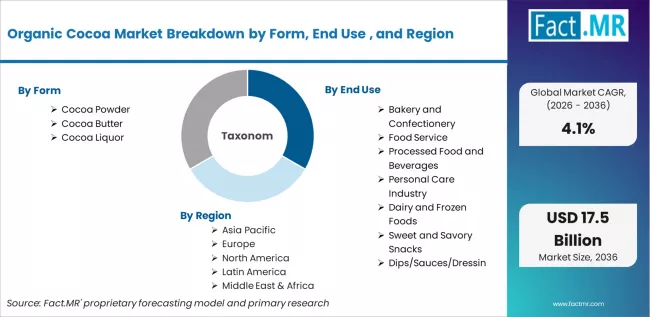
Organic Cocoa Market Breakdown By Form, End Use , And Region | Source: Fact.MR
| Attribute | Details |
|---|---|
| Quantitative Units | USD 11.7 billion (2026) to USD 17.4 billion (2036), at a CAGR of 4.1% |
| Market Definition | Certified organic cocoa beans, cocoa butter, cocoa liquor, and cocoa powder produced without synthetic agrochemicals and verified by recognised organic certification bodies for use in food, beverage, and personal care manufacturing. |
| Form Segmentation | Cocoa Butter, Cocoa Liquor, Cocoa Powder |
| End Use Application Segmentation | Bakery and Confectionery, Food Service, Processed Food and Beverages, Personal Care Industry, Dairy and Frozen Foods, Sweet and Savory Snacks, Dips/Sauces/Dressings, Pharmaceuticals |
| Application Coverage | Organic chocolate manufacturing, organic premium biscuits and cakes, plant-based dairy alternatives, organic personal care emollients, nutraceutical and supplement formulations, and certified organic foodservice ingredients. |
| Regions Covered | Asia Pacific, Europe, North America, Latin America, Middle East and Africa |
| Countries Covered | China, Japan, South Korea, India, Thailand, Australia and New Zealand, ASEAN, Germany, UK, France, Italy, Spain, Nordic, BENELUX, Rest of Western Europe, USA, Canada, Mexico, Brazil, Ecuador, Rest of Latin America, Saudi Arabia, GCC, Turkey, South Africa, Rest of MEA |
| Key Companies Profiled | Kraft Foods Inc., Cargill Incorporated, Barry Callebaut, Tradin Organic Agriculture, Olam Cocoa, Ciranda, PASCHA Company, InterNatural Foods, Blommer Chocolate Company, Ecom Agroindustrial Corp. |
| Forecast Period | 2026 to 2036 |
| Approach | Hybrid top-down and bottom-up model using certified organic cocoa bean production volumes, average premiums over conventional cocoa, end-use application demand benchmarks, and primary interviews with organic cocoa traders and confectionery procurement leads. |
Source: Fact.MR analysis. Updated Mar 17, 2026
Frequently Asked Questions
How large is the organic cocoa market in 2025?
What will the market size be in 2026?
What is the projected market size by 2036?
What is the expected CAGR?
Which form segment leads the market?
Which end use application holds the largest share?
Which country shows the fastest growth?
What is the organic cocoa market?
Why is demand for organic cocoa increasing?
What is the main difference between organic and conventional cocoa?
Which region leads consumption of organic cocoa?
Who worked on this report


Preview the report firsthand - request a free sample
Free SampleGet the brochure for pricing and purchase details
Download PDF