- Market Value (2025): USD 1.2 Bn
- Estimated Value (2026): USD 1.3 Bn
- Forecast Value (2036): USD 2.5 Bn
- CAGR (2026-2036): 6.8%
What is the Pouch Sterilizers Market forecast to be worth by 2036?
USD 1.3 billion in 2026 to USD 2.5 billion by 2036, at 6.8% CAGR.
- The Pouch Sterilizers Market crossed a valuation of USD 1.2 billion in 2025.
- Demand is projected to increase from USD 1.3 billion in 2026 to USD 2.5 billion by 2036.
- The market is forecast to record 6.8% CAGR from 2026 to 2036 as prepared-food processors and pet-food plants expand pouch formats for ambient shelves.
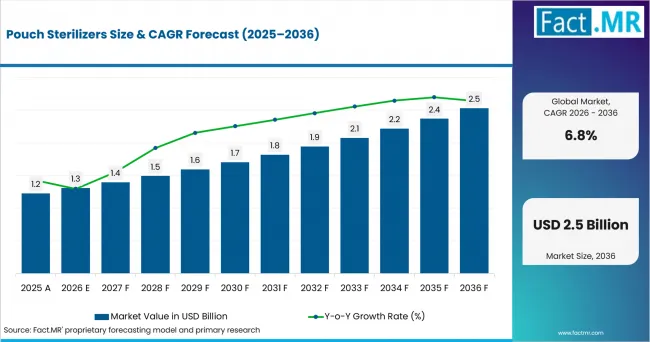
Pouch Sterilizers Value Analysis | Source: Fact.MR
What are the defining numbers behind Pouch Sterilizers Market growth?
USD 1.2 billion absolute opportunity by 2036, led by retort / steam, retort pouch and ready meals.
- Demand Drivers in the Market
- Food processors need repeatable thermal lethality for retort pouches because seal strength and heat penetration determine shelf stability.
- Ready-meal manufacturers need flexible retort capacity for recipes with sauces, starches and proteins that heat at different rates.
- Pet-food producers need basket handling and pouch support that protect thin laminates during heating and cooling cycles.
- U.S. packaged-food capacity provides a large equipment base. The USDA Economic Research Service reported in June 2026 that total U.S. food spending reached USD 2.51 trillion in 2025.
- Key Segments Analyzed
- By Sterilization Method: Retort / steam is expected to hold 34.0% share in 2026 because it matches established low-acid food validation practice.
- By Pouch Type: Retort pouch is projected to account for 39.0% share in 2026 owing to use in meals, sauces and pet food.
- By Food Application: Ready meals are anticipated to capture 28.0% share in 2026 supported by ambient meal formats and retail convenience.
- By System Format: Batch retort is estimated to represent 36.0% share in 2026 since processors use it for varied recipes and shorter production runs.
- Analyst Opinion at Fact.MR
- Shambhu Nath Jha, Principal Consultant at Fact.MR, states, "Pouch sterilizers draw attention because the equipment must protect a flexible pack while delivering a validated thermal process. Demand is expected to move toward systems that combine repeatable heat transfer with careful pouch handling. Suppliers should pair retort design, loading control and process documentation so food plants reduce validation friction."
- Strategic Implications
- Equipment vendors should document heat distribution, pouch movement and seal integrity across retort pouch sizes.
- Food manufacturers should align pouch laminate selection with retort cycle design before scaling ready-meal output.
- System integrators should connect filling, pouch loading and sterilization timing so product waits less between sealing and heat treatment.
- Plant engineering teams should compare steam use and water recovery when replacing older batch retorts. JBT Marel said in June 2025 that Hi2Flex reduces steam and water use by recovering energy across cycles.
The UK is projected to record 8.4% CAGR through 2036 supported by prepared-meal output and food manufacturing scale. France is expected to post 7.9% CAGR owing to its large agri-food processing base. Japan is forecast to advance at 6.6% CAGR with shelf-stable food applications and strict import oversight. The USA is anticipated to hold 6.1% CAGR due to food spending and retort filing requirements. Germany is estimated to record 5.8% CAGR driven by ready-meal output and replacement demand for efficient retort systems.
How does the Pouch Sterilizers Market break down by segment?
Retort pouch leads at 39.0%; batch retort leads at 36.0%.
Which Sterilization Method dominates?
Retort / steam holds 34.0% share in 2026.
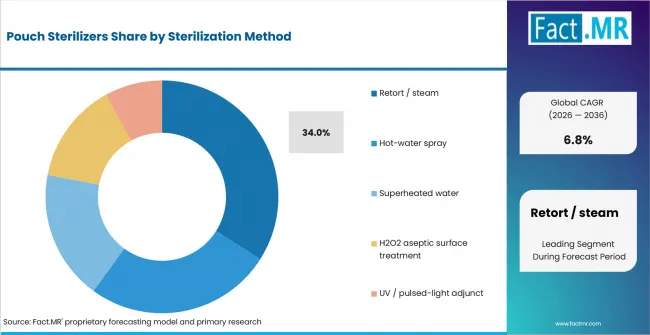
Pouch Sterilizers Analysis By Sterilization Method | Source: Fact.MR
Retort / steam leads because it is familiar to processors handling low-acid pouch foods. Operators can validate time and temperature combinations with established equipment practice. The method suits ambient ready meals where shelf stability depends on controlled heat transfer after sealing.
The FDA maintains process filing requirements for low-acid foods in hermetically sealed containers, including container type and processing method. That rule keeps thermal validation central to pouch sterilizer selection in the USA.
What leads the Pouch Type segment?
Retort pouch accounts for 39.0% share in 2026.
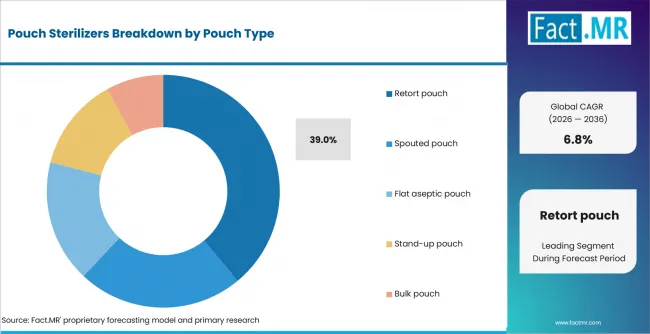
Pouch Sterilizers Analysis By Pouch Type | Source: Fact.MR
Retort pouch accounts for the largest stated share because it handles meals, sauces and wet pet foods in a compact pack. The format places higher demand on loading systems because pouch corners and seals need support during heating.
Flexible pouches also connect sterilization equipment to form fill and sealing equipment choices. Plants that change pouch sizes need basket designs and process records that move cleanly across stock keeping units.
How does Food Application shape demand?
Ready meals lead with 28.0% share in 2026.
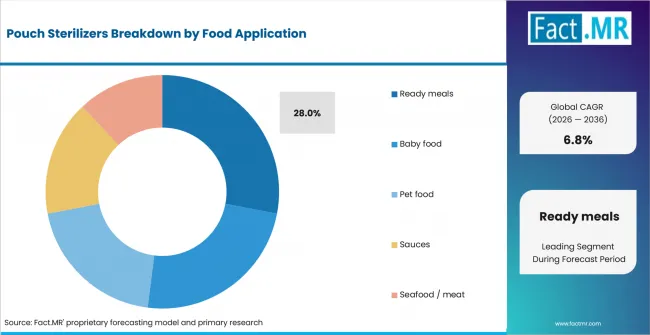
Pouch Sterilizers Analysis By Food Application | Source: Fact.MR
Ready meals lead food application demand because processors need a shelf-stable pack that protects texture after heating. The Office for National Statistics reported in July 2026 that UK manufacturers’ sales of meat-based prepared meals reached GBP 3.0 billion in 2025.
Ready-meal lines are linked to pre-packaged food and retail meal formats where package convenience influences repeat purchases. Retort systems remain central when processors target room-temperature storage.
What supports Batch Retort within System Format?
Batch retort represents 36.0% share in 2026.
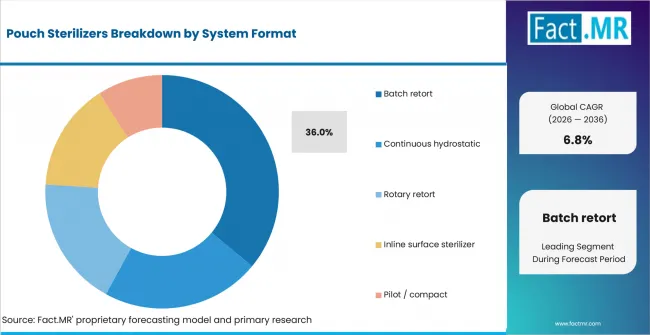
Pouch Sterilizers Analysis By System Format | Source: Fact.MR
Batch retort leads system format because it supports frequent recipe changes and smaller production campaigns. Plants can process retort pouches, spouted formats and trays without committing every product to continuous output.
Surdry’s 2026 Continuous Sterilizer page says steam consumption is reduced up to 50% compared with batch retorts. The claim raises the efficiency benchmark for batch systems, which must compete through flexibility and lower changeover burden.
What is accelerating Pouch Sterilizers Market adoption, and what is holding it back?
Demand is expected to rise through ready meals, pet-food pouches and aseptic format control. Growth is paced by validation cost, utilities and laminate sensitivity.
Drivers Impact Analysis
| DRIVER | (~) % IMPACT ON CAGR | GEOGRAPHIC RELEVANCE | IMPACT TIMELINE |
|---|---|---|---|
| Shelf-stable ready meal output | +1.3% | Western Europe, North America | Short term (<= 2 years) |
| Wet pet-food pouch conversion | +1.1% | USA, Western Europe, Japan | Medium term (2-4 years) |
| Aseptic pouch and spouted format use | +0.9% | Global | Medium term (2-4 years) |
| Energy and water efficiency upgrades | +0.7% | Europe, Japan | Long term (>= 4 years) |
Source: Fact.MR analysis. Updated Sep 16, 2026
Opportunity Impact Analysis
| OPPORTUNITY | (~) % IMPACT ON CAGR | GEOGRAPHIC RELEVANCE | IMPACT TIMELINE |
|---|---|---|---|
| Pilot and compact retorts for new pouches | +0.8% | Japan, France, UK | Short term (<= 2 years) |
| Integrated pouch loading systems | +0.7% | USA, Germany | Medium term (2-4 years) |
| Continuous sterilizer adoption | +0.6% | Europe, North America | Long term (>= 4 years) |
Source: Fact.MR analysis. Updated Sep 16, 2026
Restraints Impact Analysis
| RESTRAINT | (~) % IMPACT ON CAGR | GEOGRAPHIC RELEVANCE | IMPACT TIMELINE |
|---|---|---|---|
| Process validation burden | -0.5% | USA, Japan, Europe | Short term (<= 2 years) |
| Utility and floor-space limits | -0.4% | Urban plants, Japan, UK | Medium term (2-4 years) |
| Pouch laminate deformation risk | -0.3% | Global | Medium term (2-4 years) |
Source: Fact.MR analysis. Updated Sep 16, 2026
Which countries are scaling the Pouch Sterilizers Market through 2036?
- The country comparison spans 2.6 percentage points and forms three practical growth bands across the forecast period.
- The UK remains 0.5 percentage point above France through prepared-meal output and food manufacturing scale.
- France remains 1.3 percentage points above Japan because its agri-food processing base is broad and export exposed.
- Japan remains 0.5 percentage point above the USA as shelf-stable foods align with compact retail formats.
- The USA remains 0.3 percentage point above Germany due to food spending and process filing requirements.
- Germany closes the displayed range through ready-meal output and replacement demand for efficient retort systems.
Comparable CAGRs create different entry conditions due to food-processing scale, shelf-stable meal habits, utilities and validation practice. Full report coverage includes North America, Latin America, Western Europe, Eastern Europe, East Asia, South Asia & Pacific, Middle East & Africa.
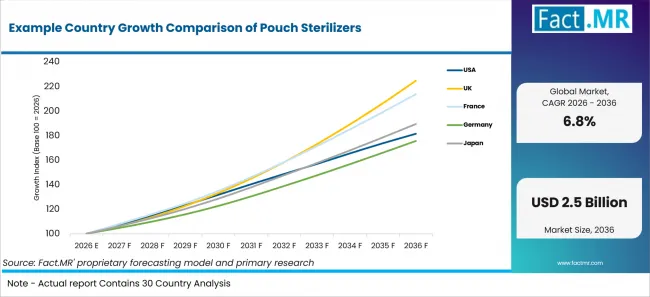
Example Country Growth Comparison Of Pouch Sterilizers | Source: Fact.MR
| Country | CAGR (2026-2036) |
|---|---|
| UK | 8.4% |
| France | 7.9% |
| Japan | 6.6% |
| USA | 6.1% |
| Germany | 5.8% |
Source: Fact.MR analysis. Updated Sep 16, 2026
What supports the UK adoption?
8.4% CAGR, supported by prepared-meal output and food manufacturing scale.
Food processors in the UK are expected to invest in pouch sterilizers where ready-meal formats move from chilled displays into ambient shelves. ONS reported in July 2026 that food represented 22.9% of total UK manufacturers’ sales in 2025. Defra reported in December 2025 that food manufacturing recorded a 4.9% vacancy rate in Q3 2025. That labor constraint raises interest in batch retorts with reliable loading routines and clear validation records.
How is France scaling demand?
7.9% CAGR, driven by agri-food scale and flexible shelf-stable applications.
France is expected to scale pouch sterilizer demand through ready meals, sauces and seafood pouches that need validated heat treatment. Agreste reported that France’s agri-food industries included nearly 22,900 enterprises in 2023. INSEE reported in July 2026 that the production value of food-product manufacturing reached EUR 177,560 million in 2024. Local retort expertise from Steriflow and Lagarde Autoclaves supports replacement and testing projects for pouch foods.
How does Japan perform?
6.6% CAGR, led by shelf-stable food use and strict food safety controls.
Japan’s compact retail network is expected to favor pouch formats that store safely at room temperature. USDA Japan reported in April 2026 that Japan’s food processing sector contracted by 3% in 2025 to USD 174 billion. MHLW set about 100,000 monitoring inspections in its FY2025 imported food plan. That compliance setting favors sterilizers with careful process records, repeatable temperature control and strong pack handling.
What supports USA adoption?
6.1% CAGR, supported by food-spending scale and process filing requirements.
The USA is expected to remain a large replacement market for retort pouch sterilizers. The Census Bureau reported in September 2026 that U.S. food manufacturing generated USD 1,054.3 billion in value of shipments in 2024. FDA guidance for acidified and low-acid canned foods covers scheduled processes for hermetically sealed containers. That regulatory context makes documentation, process authority review and container-specific filing central to equipment selection.
What supports Germany’s adoption?
5.8% CAGR, shaped by ready-meal output and energy-efficient retort replacement.
Germany is expected to adopt pouch sterilizers through ready meals and pet-food lines that need stable heating performance. Destatis reported in January 2026 that German industry produced 1.7 million tonnes of ready meals in 2024. BMWE reported in January 2026 that Germany’s annual average inflation was 2.2% in 2025. That cost setting supports retort replacement where steam recovery and water use improve operating economics.
Who leads the Pouch Sterilizers Market?
JBT Marel is an active provider of pouch sterilization through in-container retort systems and pouch-focused wet pet-food processing solutions. The company opened a Global Production Center in Pune in September 2025 to expand food-processing equipment production capabilities and support customers across India and the wider Asia region.
Steriflow competes through steam- and water-based sterilization systems and rotary retorts for pouches, sauces and pet-food applications. Allpax adds depth through retort systems, dedicated pouch loaders and separate fragile-container handling systems. Surdry strengthens the field with continuous sterilization and Steam Water Spray systems for packaged food and beverage applications. Lagarde Autoclaves remains relevant through food-industry retort systems used for thermal processing across rigid and flexible packaging formats.
Competition is expected to center on validation support, pouch handling, utility savings and the ability to process multiple package formats. Suppliers that combine retort performance with after-sales service are better placed for food plants adding pouch lines.
Which companies are the key providers?
Key companies include JBT Marel; Steriflow; Allpax; Surdry; and Lagarde Autoclaves.
- JBT Marel
- Steriflow
- Allpax
- Surdry
- Lagarde Autoclaves
How is the market segmented?
-
By Sterilization Method:
- Retort / steam
- Hot-water spray
- Superheated water
- H2O2 aseptic surface treatment
- UV / pulsed-light adjunct
-
By Pouch Type:
- Retort pouch
- Spouted pouch
- Flat aseptic pouch
- Stand-up pouch
- Bulk pouch
-
By Food Application:
- Ready meals
- Baby food
- Pet food
- Sauces
- Seafood / meat
-
By System Format:
- Batch retort
- Continuous hydrostatic
- Rotary retort
- Inline surface sterilizer
- Pilot / compact
-
By Region:
- North America
- Latin America
- Western Europe
- Eastern Europe
- East Asia
- South Asia & Pacific
- Middle East & Africa
Bibliography
- Aoki, S. (2026, April 1). Food processing ingredients annual (GAIN Report No. JA2026-0012). U.S. Department of Agriculture, Foreign Agricultural Service.
- Department for Environment, Food & Rural Affairs. (2025, December 11). United Kingdom Food Security Digest 2025.
- Federal Ministry for Economic Affairs and Energy. (2026, January 15). The economic situation in the Federal Republic of Germany in January 2026.
- Institut national de la statistique et des études économiques. (2026, July 21). Indicateurs macroéconomiques de l’industrie agroalimentaire: Données annuelles de 2010 à 2024.
- JBT Marel. (2025a, June 9). Energy-efficient sterilization for wet pet food in pouches.
- JBT Marel. (2025b, September 24). JBT Marel inaugurates Global Production Center in India to strengthen food processing innovation.
- Mercier, S. (2025, November 4). Les industries agroalimentaires en 2023 : résultats économiques nationaux (Chiffres et données No. 2025-15). Agreste.
- Ministry of Health, Labour and Welfare. (2025, March 28). Imported Foods Monitoring Plan for FY 2025.
- Office for National Statistics. (2026, July 24). UK manufacturers' sales by product: 2025.
- Statistisches Bundesamt. (2026, January 14). Produktion von Fertiggerichten binnen fünf Jahren mengenmäßig um 25,6 % gestiegen.
- Surdry North America. (2025, February 20). Surdry presents game-changing sterilization solutions at Pack Expo Atlanta.
- U.S. Census Bureau. (2026, September 3). Census Bureau releases new Annual Integrated Economic Survey data.
- Zeballos, E., & Sinclair, W. (2026, June 11). Total U.S. food spending reached $2.51 trillion in 2025. U.S. Department of Agriculture, Economic Research Service.
This Report Answers
- The report explains where pouch sterilizers are used across sterilization method and pouch type. It also covers food application and system format.
- Segment analysis identifies the leading subsegments and the operational reasons food processors prioritize them.
- Country analysis examines the listed markets and the processing, regulatory and labor conditions supporting pouch sterilizer adoption.
- Competitive analysis reviews current providers across batch retort, hot-water spray, rotary retort and continuous sterilization approaches.
- Application analysis assesses how ready meals, pet food, sauces and seafood pouches influence equipment selection.
What does the Pouch Sterilizers Market cover?
The Pouch Sterilizers Market covers equipment that sterilizes filled or prepared pouch formats for shelf-stable food applications. It includes food industry heat processing equipment used after sealing and surface sterilization systems used before aseptic filling.
The assessment covers retort / steam, hot-water spray, superheated water and H2O2 aseptic surface treatment. It also tracks batch retorts, continuous systems and pilot equipment used across food processing and handling equipment lines. Adjacent sterilization formats include plasma food sterilizers where nonthermal processes serve different product needs.
What is included in the scope?
The scope includes new equipment, replacement retorts and integrated systems that handle pouches used in ready meals, baby food, sauces and wet pet food. It includes basket systems and inline surface sterilizers where sterilization is the core equipment function.
The scope also includes pouch-focused retort systems linked with microwave packaging and retail ready packaging when thermal processing determines the commercial shelf-life claim. It covers equipment suppliers serving food plants and contract processors.
What is excluded from the scope?
The scope excludes pouch films sold without sterilization equipment, filling machines sold alone and general packaging materials used outside thermal or aseptic processing. Broader high-recyclability mono-material flexible packaging is covered only when sterilizer compatibility shapes equipment demand.
The scope excludes cold-chain packaging and fresh-food packs where sterilization is outside the process. Non-pouch autoclave work is outside the main boundary unless the same retort platform is configured for flexible pouches.
How Was the Analysis Built?
The analysis draws on 120+ sources, 35+ company portfolios, 25+ countries, and more than 20 industry interviews.
- Primary Research: Primary research includes discussions with manufacturers, technology developers, distributors, food processors and subject-matter experts. These conversations examine purchasing priorities, validation work, product adoption, operational limits and factors that influence wider market acceptance.
- Desk Research: Desk research covers government statistics, regulatory publications, company filings, technical studies, food safety policy, equipment portfolios and authoritative sources. Every source used in the analysis is documented in the bibliography.
- Market Sizing and Forecasting: Market estimates combine historical performance, demand indicators, pricing and volume trends, segment shares, company participation, country growth, adoption patterns and barriers to expansion.
- Data Validation and Update Cycle: Findings are validated by comparing primary interviews with public data, company activity, regulatory changes and industry developments. Regular updates review launches, capacity changes, partnerships, approvals and commercial adoption.
Segmentation
What is the report’s scope and coverage?
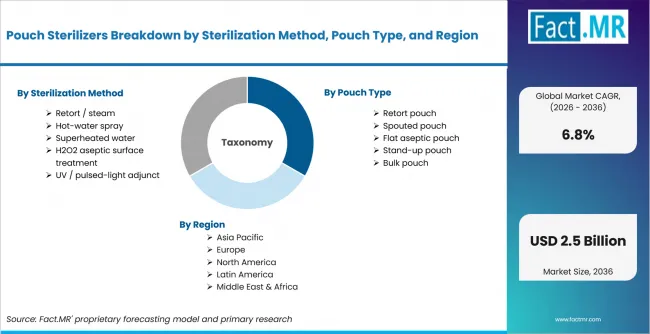
Pouch Sterilizers Breakdown By Sterilization Method, Pouch Type, And Region | Source: Fact.MR
| Attribute | Details |
|---|---|
| Quantitative Units | USD billion |
| Market Definition | Equipment used to sterilize filled or surface-treated food pouches through retort steam, hot-water spray, superheated water, aseptic surface treatment and related systems. |
| Sterilization Method | Retort / steam; Hot-water spray; Superheated water; H2O2 aseptic surface treatment; UV / pulsed-light adjunct |
| Pouch Type | Retort pouch; Spouted pouch; Flat aseptic pouch; Stand-up pouch; Bulk pouch |
| Food Application | Ready meals; Baby food; Pet food; Sauces; Seafood / meat |
| System Format | Batch retort; Continuous hydrostatic; Rotary retort; Inline surface sterilizer; Pilot / compact |
| Regions Covered | North America; Latin America; Western Europe; Eastern Europe; East Asia; South Asia & Pacific; Middle East & Africa |
| Countries Covered | USA; UK; France; Germany; Japan |
| Key Companies Profiled | JBT Marel; Steriflow; Allpax; Surdry; Lagarde Autoclaves |
| Forecast Period | 2026 to 2036 |
| Approach | Hybrid top-down and bottom-up approach using food-processing output, pouch format adoption, installed retort base, country demand, supplier portfolios and application review. |
Source: Fact.MR analysis. Updated Sep 16, 2026
Frequently Asked Questions
How big is the pouch sterilizers market in 2026?
What is the CAGR of the pouch sterilizers market from 2026 to 2036?
Which sterilization method leads the pouch sterilizers market?
Which pouch type leads the pouch sterilizers market?
Who are the leading companies in the pouch sterilizers market?
Who worked on this report


Preview the report firsthand - request a free sample
Free SampleGet the brochure for pricing and purchase details
Download PDF