Orthodontics Implant Market

Orthodontics Implant Market Size and Share Forecast Outlook 2025 to 2035

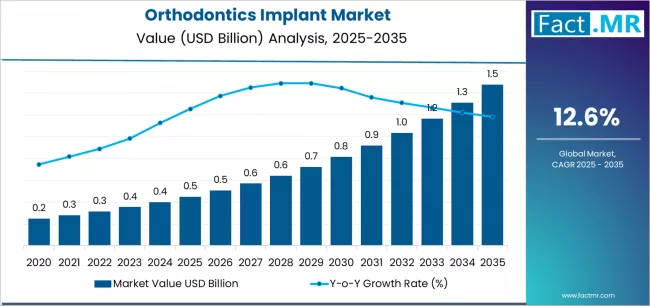
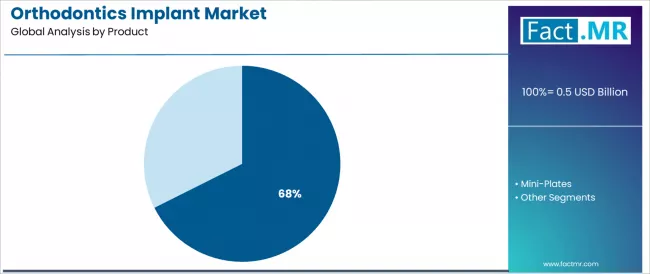
Orthodontics implant market is projected to grow from USD 0.5 billion in 2025 to USD 1.5 billion by 2035, at a CAGR of 12.6%. Mini-Implants (TADs) will dominate with a 67.6% market share, while adults will lead the age group segment with a 52.5% share.

Orthodontics Implant Market Forecast and Outlook 2025 to 2035

The global orthodontics implant market is projected to reach USD 1.48 billion by 2035, recording an absolute increase of USD 1.03 billion over the forecast period. The market is valued at USD 0.45 billion in 2025 and is set to rise at a CAGR of 12.6% during the assessment period.

Sales of orthodontic implants are expected to grow by approximately 3.3 times during the same period, supported by increasing prevalence of malocclusion and dental misalignment conditions worldwide, driving demand for advanced orthodontic anchorage solutions and increasing investments in minimally invasive dental procedures with clinical efficacy across temporary anchorage and skeletal support applications globally.

Quick Stats for Orthodontics Implant Market

  • Orthodontics Implant Market Value (2025): USD 0.45 billion
  • Orthodontics Implant Market Forecast Value (2035): USD 1.48 billion
  • Orthodontics Implant Market Forecast CAGR: 12.6%
  • Leading Product in Orthodontics Implant Market: Mini-Implants (TADs) (67.6%)
  • Key Growth Regions in Orthodontics Implant Market: North America, Europe, and Asia Pacific
  • Top Players in Orthodontics Implant Market: S.K. Surgicals, Dentos, GDT Dental Implants, AO American Orthodontics, Tita-Link, Straumann, Medical Precision Implants, Osteonic Co., Ltd., Metro Orthodontics, Morelli

Orthodontics Implant Market Market Value Analysis

Orthodontic patients face mounting pressure to achieve optimal tooth movement while minimizing treatment duration and invasive procedures, with modern orthodontics implants providing documented clinical benefits including enhanced anchorage control, predictable tooth movement patterns, and reduced need for complex appliances compared to conventional orthodontic techniques alone.

Rising awareness about aesthetic dentistry and expanding dental tourism infrastructure enabling accessible orthodontic treatment create substantial opportunities for implant manufacturers and dental practice partners. However, high treatment costs and limited insurance coverage may pose obstacles to widespread patient adoption.

The mini-implants segment dominates market activity, driven by extensive clinical applications supporting temporary anchorage device requirements and versatile placement options across diverse orthodontic treatment scenarios worldwide. Orthodontists increasingly recognize the therapeutic benefits of temporary anchorage devices, with typical mini-implant products providing effective skeletal anchorage and precise biomechanical control at accessible price points through established dental supply networks.

The mini-plates segment demonstrates meaningful presence, supported by complex skeletal correction requirements and orthognathic surgery applications in modern orthodontic practice. Adults emerge as the dominant age group category, reflecting increasing orthodontic treatment acceptance among adult populations and growing aesthetic dentistry demand across professional demographics.

Regional dynamics show North America maintaining market leadership, supported by high dental care expenditure and established orthodontic practice infrastructure. Asia Pacific demonstrates strong growth trajectory driven by increasing disposable incomes and expanding dental aesthetics awareness, while Europe emphasizes aging population dental care and prosthetic dentistry integration.

USA leads country-level growth through extensive dental workforce and strong private healthcare spending, followed by China supported by rising middle-class consumption and dental aesthetics adoption. The competitive landscape features moderate concentration with S.K. Surgicals maintaining market leadership position, while established dental implant companies including Straumann, Dentos, and GDT Dental Implants compete through advanced product portfolios and comprehensive clinical education programs across diverse orthodontic applications.

Orthodontics Implant Market Year-over-Year Forecast 2025 to 2035

Between 2025 and 2029, the orthodontics implant market is projected to expand from USD 0.45 billion to USD 0.72 billion, resulting in a value increase of USD 0.27 billion, which represents 26.7% of the total forecast growth for the period. This phase of development will be shaped by rising demand for temporary anchorage devices and minimally invasive orthodontic procedures addressing complex tooth movement requirements, product innovation in self-drilling mini-implant designs with enhanced primary stability and insertion characteristics, as well as expanding integration with digital orthodontic treatment planning and three-dimensional imaging systems. Companies are establishing competitive positions through investment in clinical research partnerships, advanced surface treatment technologies, and strategic market expansion across orthodontic specialty practices, dental school training programs, and emerging market dental infrastructure.

From 2029 to 2035, the market is forecast to grow from USD 0.72 billion to USD 1.48 billion, adding another USD 0.76 billion, which constitutes 73.3% of the overall expansion. This period is expected to be characterized by the expansion of specialized implant applications, including customized mini-implant systems and bioactive surface coatings tailored for accelerated osseointegration, strategic collaborations between implant manufacturers and orthodontic aligner companies, and an enhanced focus on patient comfort optimization and simplified insertion protocols. The growing emphasis on adult orthodontics and rising adoption of combination treatment approaches integrating fixed appliances with skeletal anchorage will drive demand for comprehensive orthodontic implant solutions across diverse patient populations.

Orthodontics Implant Market Key Takeaways

Metric Value
Market Value (2025) USD 0.45 billion
Market Forecast Value (2035) USD 1.48 billion
Forecast CAGR (2025-2035) 12.6%

Why is the Orthodontics Implant Market Growing?

The orthodontics implant market grows by enabling orthodontists to achieve complex tooth movements and skeletal corrections while addressing treatment efficiency requirements and patient comfort priorities without exclusive reliance on conventional anchorage methods. Orthodontic patients face mounting pressure to complete treatment within reasonable timeframes and avoid extractions or orthognathic surgery while achieving optimal occlusal outcomes and facial aesthetics, with modern orthodontic implants typically providing targeted biomechanical advantages including absolute skeletal anchorage for intrusion movements, enhanced treatment predictability for asymmetric corrections, and simplified mechanics for distalization procedures compared to traditional anchorage alone, making temporary anchorage devices essential for comprehensive orthodontic treatment planning. The orthodontic specialty's need for reliable anchorage solutions creates demand for implant products that can provide stable skeletal support, enable complex biomechanics, and support treatment efficiency without compromising patient acceptance or safety profiles.

Orthodontist adoption and clinical evidence supporting implant efficacy drive utilization in specialty orthodontic practices, academic dental centers, and comprehensive dental care facilities, where treatment outcomes directly impact patient satisfaction and clinical efficiency. The increasing prevalence of malocclusion globally, affecting significant proportions of pediatric and adult populations, creates expanding treatment populations requiring advanced orthodontic interventions. Rising awareness about adult orthodontics and aesthetic treatment options enables informed patient decisions and acceptance of implant-supported orthodontic approaches. However, technical skill requirements and placement complications may limit widespread adoption and treatment success rates among diverse orthodontic practitioner populations with varying surgical training backgrounds.

Segmental Analysis

The market is segmented by product, age group, and region. By product, the market is divided into mini-implants (TADs) and mini-plates. Based on age group, the market is categorized into adults, teens, and elderly. Regionally, the market is divided into North America, Europe, Asia Pacific, Latin America, and Middle East & Africa.

By Product, Which Segment Accounts for the Dominant Market Share?

Orthodontics Implant Market Analysis By Product

The mini-implants segment represents the dominant force in the orthodontics implant market, capturing 67.6% of total market share in 2025. This established product category encompasses solutions featuring temporary anchorage device designs and self-drilling screw configurations, including advanced formulations combining titanium alloy materials, self-tapping thread geometries, and removable placement options that enable superior clinical versatility and simplified insertion procedures across intrusion, retraction, and distalization orthodontic applications worldwide.

The mini-implants segment's market leadership stems from its comprehensive clinical applicability, with solutions capable of providing reliable temporary skeletal anchorage in various intraoral locations including palatal, buccal, and retromolar sites while maintaining excellent biocompatibility and straightforward removal characteristics following treatment completion.

Within the mini-implants category, self-drilling temporary anchorage devices demonstrate dominant utilization, driven by simplified insertion protocols eliminating pilot drilling requirements and reduced chair time during placement procedures. These devices provide essential anchorage for orthodontic cases requiring absolute skeletal support without reciprocal tooth movement.

The mini-plates segment maintains substantial market share at 32.4%, serving orthodontists requiring more substantial skeletal anchorage for severe malocclusion corrections and orthognathic surgery applications. These plate-based systems offer enhanced stability for high-magnitude force applications and extended treatment durations in complex skeletal discrepancy cases.

Key performance advantages driving the mini-implants segment include:

  • Versatile placement capabilities with multiple anatomical site options enabling customized anchorage positioning for diverse biomechanical requirements
  • Simplified insertion procedures allowing chairside placement without extensive surgical protocols or flap elevation in most clinical scenarios
  • Enhanced treatment efficiency characteristics enabling direct force application and accelerated tooth movement compared to conventional anchorage methods
  • Superior patient acceptance providing minimally invasive temporary anchorage with straightforward removal procedures following orthodontic treatment completion

By Age Group, Which Segment Accounts for the Largest Market Share?

Orthodontics Implant Market Analysis By Age Group

Adults dominate the orthodontics implant age group landscape with a 52.45% market share in 2025, reflecting the critical role of adult orthodontic treatment in supporting growing aesthetic dentistry demand and professional appearance considerations across working-age populations. The adults segment's market leadership is reinforced by increasing social acceptance of adult orthodontics, comprehensive treatment expectations, and willingness to invest in advanced treatment modalities including implant-supported mechanics.

Within this segment, young professionals and middle-aged adults represent substantial treatment utilization, driven by career advancement considerations and personal aesthetics priorities. These patients benefit from sophisticated treatment approaches combining clear aligners with skeletal anchorage and minimally visible appliance systems.

The teens segment represents an important age category with 33.0% market share, demonstrating steady demand through traditional orthodontic treatment timing and growth modification opportunities. Teenage patients benefit from active skeletal growth periods enabling comprehensive orthopedic corrections combined with dental alignment.

The elderly segment maintains meaningful presence at 14.6% through specialized requirements for combined orthodontic-prosthetic rehabilitation and implant site preparation procedures. This demographic benefits from orthodontic alignment preceding dental implant placement or supporting comprehensive occlusal reconstruction.

Key market dynamics supporting age group segmentation include:

  • Adult orthodontics expansion driven by aesthetic awareness and professional appearance considerations
  • Teenage treatment emphasis requiring growth modification and comprehensive malocclusion correction
  • Integration of geriatric orthodontics supporting prosthetic rehabilitation and dental implant site development
  • Growing emphasis on age-appropriate treatment planning and patient-specific biomechanical approaches

What is the Outlook for Mini-plates Orthodontics Implants?

Mini-plates emerge as a significant product segment in the orthodontics implant market with a 32.4% market share in 2025, reflecting specialized applications requiring enhanced skeletal anchorage stability and load-bearing capacity for severe malocclusion corrections. The mini-plates segment demonstrates consistent demand driven by complex orthognathic surgery support, severe anteroposterior discrepancy management, and sustained high-force application requirements.

The segment's market strength stems from superior stability for extended treatment durations and high-magnitude force applications exceeding mini-implant load capacity. Mini-plate systems provide rigid skeletal fixation through multiple screw attachments and cortical bone engagement supporting predictable biomechanical outcomes.

Within mini-plates applications, zygomatic and infrazygomatic placement demonstrates adoption for maxillary protraction and vertical dimension control. Mandibular body and symphysis placement maintains presence through applications requiring posterior tooth intrusion or asymmetry correction with substantial force requirements.

Key segment characteristics include:

  • Enhanced stability requirements addressing high-force biomechanical applications beyond mini-implant capacity
  • Surgical placement protocols requiring flap elevation and visualization for precise positioning
  • Extended treatment duration support maintaining anchorage integrity throughout lengthy correction periods
  • Integration with orthognathic surgery planning enabling combined surgical-orthodontic treatment approaches

Why are Orthodontics Implants being Administered to Teens?

Teens represent an important segment in the orthodontics implant market with a 33.0% market share in 2025, reflecting traditional orthodontic treatment timing during permanent dentition development and growth modification opportunity windows. The teens segment demonstrates steady demand driven by comprehensive malocclusion correction during optimal treatment periods and parent-initiated orthodontic care.

Within teenage applications, skeletal anchorage for distalization demonstrates significant adoption through non-extraction treatment approaches and space creation requirements. Growth modification support maintains presence through maxillary protraction and mandibular growth redirection applications during active skeletal development periods.

The segment benefits from active growth periods enabling combined orthopedic-orthodontic corrections and comprehensive treatment outcomes. Temporary anchorage devices support efficient tooth movement while minimizing patient compliance requirements compared to removable appliances.

Key age group dynamics include:

  • Growth modification opportunities enabling comprehensive skeletal corrections during active development
  • Non-extraction treatment emphasis driving distalization and space creation anchorage requirements
  • Compliance advantages through skeletal anchorage eliminating headgear and elastic wear dependencies
  • Comprehensive correction goals addressing both dental alignment and skeletal relationships during optimal timing

What are the Drivers, Restraints, and Key Trends of the Orthodontics Implant Market?

The market is driven by three concrete demand factors tied to orthodontic treatment advancement. First, increasing adult orthodontic treatment demand creates expanding patient populations seeking aesthetic correction options, with skeletal anchorage representing critical solutions enabling non-extraction approaches and efficient treatment mechanics, requiring widespread orthodontic practice integration. Second, growing emphasis on treatment efficiency and duration reduction drives adoption of temporary anchorage devices, with skeletal anchorage demonstrating accelerated tooth movement and simplified mechanics compared to conventional methods by 2030. Third, advancing digital orthodontics integration and three-dimensional treatment planning enable precise implant placement protocols that optimize biomechanical outcomes while enhancing treatment predictability and patient communication.

Market restraints include technical skill requirements and surgical training needs that can challenge implant placement success and clinical adoption, particularly among general dentists and orthodontists with limited minor oral surgery experience. Implant failure rates and soft tissue complications pose another significant obstacle, as orthodontic mini-implants depend on adequate primary stability and infection prevention, potentially affecting treatment continuity and patient acceptance. Limited insurance coverage and out-of-pocket costs create additional barriers for patient accessibility, demanding comprehensive treatment value communication and flexible payment arrangements addressing cost sensitivity among diverse socioeconomic populations.

Key trends indicate accelerated digital workflow integration in developed markets, particularly North America and Europe, where orthodontic practices demonstrate increasing adoption of cone beam computed tomography-guided implant placement and computer-aided surgical guide fabrication. Surface treatment innovation trends toward bioactive coatings and accelerated osseointegration technologies enable enhanced primary stability and reduced healing periods supporting immediate loading protocols. However, the market thesis could face disruption if significant advances in aligner biomechanics or breakthrough skeletal anchorage alternatives substantially reduce conventional mini-implant utilization in orthodontic treatment approaches.

Analysis of the Orthodontics Implant Market by Key Countries

Orthodontics Implant Market Cagr Analysis By Country

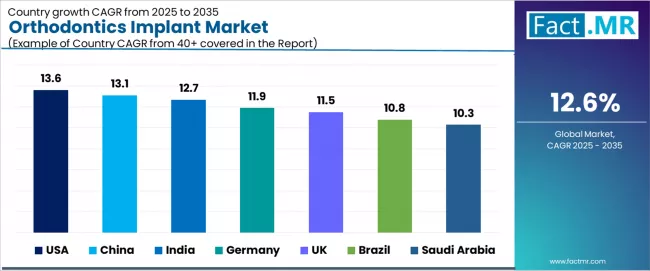
Country CAGR (2025-2035)
USA 13.6%
China 13.1%
India 12.7%
Germany 11.9%
UK 11.5%
Brazil 10.8%
Saudi Arabia 10.3%

The global orthodontics implant market is expanding rapidly, with USA leading at a 13.6% CAGR through 2035, driven by high dental workforce density, strong private healthcare spending, and established orthodontic specialty infrastructure. China follows at 13.1%, supported by rising disposable incomes, growing dental aesthetics awareness, and expanding private dental clinic networks. India records 12.7%, reflecting growing middle-class populations, dental tourism development, and increasing orthodontic treatment accessibility.

Germany advances at 11.9%, leveraging aging population dental care requirements and prosthetic dentistry integration. UK posts 11.5%, focusing on private implant-based dentistry growth and aesthetic treatment demand, while Brazil grows steadily at 10.8%, anchored by expanding orthodontic clinic networks and urban dental care infrastructure. Saudi Arabia demonstrates 10.3% growth, driven by cosmetic dentistry demand and healthcare infrastructure expansion initiatives.

How is USA Leading Global Market Expansion?

Orthodontics Implant Market Country Value Analysis

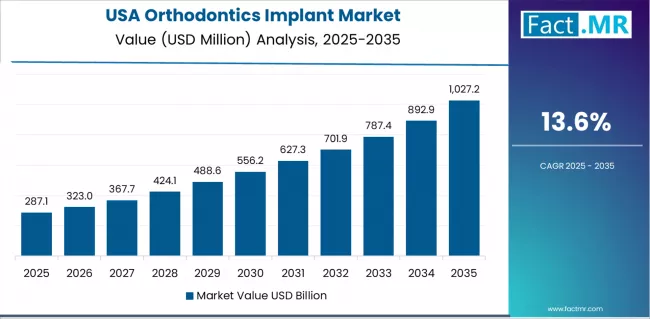
USA demonstrates the strongest growth potential in the orthodontics implant market with a CAGR of 13.6% through 2035. The country's leadership position stems from extensive orthodontic specialist workforce, high per-capita dental care expenditure, and comprehensive private dental insurance coverage supporting advanced treatment modalities.

Growth is concentrated in major metropolitan areas and suburban communities, including New York, Los Angeles, Chicago, Houston, and Dallas-Fort Worth, where orthodontic practices are increasingly integrating temporary anchorage devices into standard treatment protocols.

Distribution channels through dental supply distributors, direct manufacturer relationships, and orthodontic specialty suppliers expand product accessibility across practice networks. The country's established continuing education infrastructure provides strong momentum for clinical skill development, including comprehensive training through specialty conferences and hands-on workshop programs.

Key market factors:

  • Orthodontic specialist density with approximately 12,000 practicing orthodontists supporting widespread implant adoption
  • Adult orthodontics growth through aesthetic treatment demand and professional appearance considerations
  • Comprehensive training infrastructure featuring residency programs and continuing education supporting clinical skill development
  • Private practice economics enabling investment in advanced treatment modalities and premium service positioning

Why is China Emerging as a High-Growth Market?

In major urban centers including Beijing, Shanghai, Shenzhen, and Guangzhou, the adoption of orthodontic implants is accelerating across private dental clinics and specialty orthodontic practices, driven by rising middle-class disposable incomes and growing dental aesthetics consciousness. The market demonstrates strong growth momentum with a CAGR of 13.1% through 2035, linked to urbanization patterns and increasing social acceptance of aesthetic dentistry.

Patients are seeking advanced orthodontic treatments and investing in comprehensive dental care to enhance facial aesthetics while meeting growing expectations in professional and social environments. The country's expanding private dental sector creates ongoing demand for advanced treatment technologies, while increasing international education of Chinese dentists drives adoption of contemporary orthodontic techniques.

Key development areas:

  • Urban middle-class expansion leading orthodontic treatment demand with emphasis on aesthetic outcomes
  • Private dental clinic proliferation establishing comprehensive orthodontic service availability
  • International training adoption through overseas education and global clinical technique integration
  • Growing preference for non-extraction treatments driving temporary anchorage device utilization

What drives USA’s Market Leadership?

USA’s market expansion is driven by established orthodontic specialty infrastructure, comprehensive insurance coverage supporting orthodontic treatment, and continuous innovation in implant technologies and placement protocols. The country demonstrates robust growth potential with a CAGR of 13.6% through 2035, supported by strong adult orthodontic market growth and increasing treatment complexity acceptance.

American orthodontists face implementation opportunities related to digital workflow integration, cone beam computed tomography adoption, and evidence-based treatment planning supporting optimal implant utilization. However, established specialty practice models and high treatment standards create stable baseline demand for orthodontic implants, particularly among board-certified specialists where advanced anchorage techniques represent standard care approaches for complex malocclusion management.

Market characteristics:

  • Specialty orthodontic practice dominance with approximately 90% of orthodontic treatment delivered by specialists
  • Adult treatment segment showing robust growth with patients aged 18-50 representing increasing proportion of case starts
  • Technology integration emphasizing digital treatment planning and three-dimensional imaging supporting precise implant placement
  • Evidence-based practice culture driving adoption of clinically validated anchorage protocols and outcome documentation

How does Germany Demonstrate Aging Population Focus?

The market in Germany demonstrates strong orthodontic implant adoption based on aging population dental care requirements and comprehensive prosthetic rehabilitation approaches integrating orthodontic alignment. The country shows meaningful potential with a CAGR of 11.9% through 2035, driven by demographic trends and interdisciplinary dental treatment planning in major regions.

Dental practitioners are integrating orthodontic implants in combined orthodontic-prosthetic rehabilitation protocols and implant site preparation procedures for aging patients requiring comprehensive dental reconstruction. The country's emphasis on evidence-based dentistry and quality standards supports systematic implant utilization in appropriate clinical scenarios.

Leading market segments:

  • Geriatric orthodontics applications addressing prosthetic rehabilitation and dental implant site development
  • Interdisciplinary treatment planning integrating orthodontists with prosthodontists and oral surgeons
  • Quality assurance emphasis requiring documented training and clinical competency verification
  • Insurance coverage frameworks supporting medically necessary orthodontic-prosthetic combined treatments

What positions UK for Private Practice Growth?

In England, Scotland, Wales, and Northern Ireland, orthodontic implant adoption is expanding through private dental practices and specialist orthodontic clinics emphasizing aesthetic treatment options. The market shows steady growth potential with a CAGR of 11.5% through 2035, linked to private dentistry growth and patient willingness to invest in advanced orthodontic treatments.

Orthodontists in the UK are implementing temporary anchorage devices in adult orthodontic cases and complex malocclusion corrections requiring skeletal anchorage. The country's mixed public-private dental system creates opportunities for premium treatment positioning in private practice settings.

Market development factors:

  • Private orthodontic practice expansion offering comprehensive treatment options beyond National Health Service provision
  • Adult orthodontics emphasis driving demand for aesthetic treatment approaches and efficient mechanics
  • Specialist training programs incorporating temporary anchorage device education in postgraduate curricula
  • Patient awareness growth through marketing and social media exposure to advanced treatment possibilities

How does India Show Dental Tourism Development?

In major cities including Mumbai, Delhi, Bangalore, Chennai, and Hyderabad, orthodontic implant adoption is expanding across private dental clinics and specialty orthodontic practices, driven by growing middle-class populations and dental tourism development. The market demonstrates meaningful growth potential with a CAGR of 12.7% through 2035, linked to healthcare infrastructure investment and increasing orthodontic treatment awareness.

Indian dental practitioners are implementing temporary anchorage devices in comprehensive treatment approaches and training through international education exposure. The country's cost-competitive dental services create ongoing opportunities for international patient attraction while serving expanding domestic demand.

Key development areas:

  • Middle-class expansion supporting private dental care expenditure and orthodontic treatment investment
  • Dental tourism infrastructure development attracting international patients seeking cost-effective treatment
  • Orthodontic education advancement through specialty training programs and international collaboration
  • Urban clinic establishment featuring advanced equipment and contemporary treatment methodologies

What characterizes Brazil's Market Development?

In major metropolitan centers including São Paulo, Rio de Janeiro, Brasília, and Belo Horizonte, orthodontic implant adoption is expanding across private orthodontic clinics and dental specialty centers, driven by urbanization and growing aesthetic dentistry awareness. The market demonstrates solid growth potential with a CAGR of 10.8% through 2035, linked to expanding middle-class populations and increasing orthodontic treatment accessibility.

Brazilian orthodontists are implementing temporary anchorage devices in non-extraction treatment approaches and complex correction cases. The country's established orthodontic specialty infrastructure creates ongoing demand for advanced treatment technologies.

Key development areas:

  • Urban orthodontic clinic expansion establishing comprehensive specialty care availability
  • Non-extraction treatment emphasis driving skeletal anchorage adoption for space creation
  • Professional education programs incorporating temporary anchorage device training in specialty curricula
  • Growing aesthetic awareness supporting patient acceptance of advanced treatment investments

What Drives Healthcare Transformation in Saudi Arabia?

In major cities including Riyadh, Jeddah, Dammam, and Mecca, orthodontic implant adoption is expanding through private dental clinics and cosmetic dentistry centers, driven by Vision 2030 healthcare infrastructure investment and growing aesthetic treatment demand.

The market demonstrates meaningful growth potential with a CAGR of 10.3% through 2035, linked to healthcare sector modernization and increasing dental tourism development. Saudi dental practitioners are implementing advanced orthodontic techniques and investing in contemporary treatment technologies. The country's economic development creates ongoing opportunities for premium dental service establishment.

Key development areas:

  • Healthcare infrastructure investment supporting dental clinic establishment and equipment modernization
  • Cosmetic dentistry emphasis driving patient demand for aesthetic orthodontic treatments
  • International practitioner recruitment bringing advanced clinical skills and contemporary techniques
  • Medical tourism development positioning Saudi Arabia as regional healthcare destination

Europe Market Split by Country

Orthodontics Implant Market Europe Country Market Share Analysis, 2025 & 2035

The orthodontics implant market in Europe is projected to grow from USD 127.5 million in 2025 to USD 418.5 million by 2035, registering a CAGR of 12.6% over the forecast period. Germany is expected to maintain its leadership position with a 29.8% market share in 2025, adjusting to 29.4% by 2035, supported by its extensive dental specialist infrastructure, comprehensive prosthetic dentistry integration, and established orthodontic training programs serving major European markets.

UK follows with a 23.1% share in 2025, projected to reach 23.6% by 2035, driven by private orthodontic practice growth and adult aesthetic treatment demand. France holds a 18.4% share in 2025, expected to maintain 18.7% by 2035 through ongoing development of specialty orthodontic practices and interdisciplinary dental care.

Italy commands a 14.2% share, while Spain accounts for 10.1% in 2025. The rest of Europe region is anticipated to gain momentum, expanding its collective share from 4.4% to 4.8% by 2035, attributed to increasing orthodontic specialty development in Nordic countries and emerging practice establishment in Eastern European markets implementing contemporary treatment approaches.

Competitive Landscape of the Orthodontics Implant Market

Orthodontics Implant Market Analysis By Company

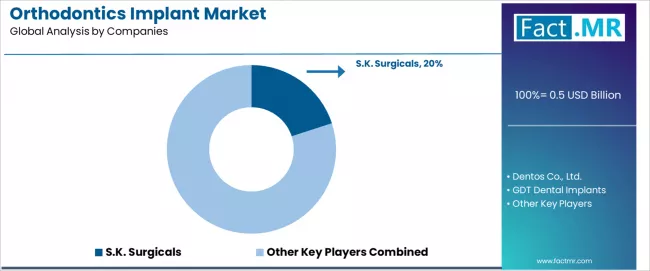
The orthodontics implant market features approximately 15-18 meaningful players with moderate concentration, where the top three companies control roughly 22-28% of global market share through established product portfolios, comprehensive clinical education programs, and extensive distribution networks across orthodontic specialty channels. Competition centers on product innovation, clinical evidence generation, and practitioner training support rather than price competition alone.

Market leaders include S.K. Surgicals, Straumann, and Dentos, which maintain competitive advantages through comprehensive orthodontic implant portfolios, advanced surface treatment technologies, and deep expertise in temporary anchorage device design, creating high practitioner confidence among orthodontists seeking reliable skeletal anchorage solutions.

These companies leverage ongoing research and development investments and strategic partnerships with orthodontic education institutions to defend market positions while expanding into digital workflow integration and customized implant solutions.

Challengers encompass established dental implant companies including GDT Dental Implants, AO American Orthodontics, and Tita-Link, which compete through specialized mini-implant designs and regional market strengths serving specific orthodontic segments through self-drilling innovations, varied diameter options, or surface modification technologies.

Specialty manufacturers, including Medical Precision Implants, Osteonic Co., Ltd., and Metro Orthodontics, focus on specific geographic markets or niche product categories, offering differentiated capabilities in cost-competitive production, customized solutions, or integrated orthodontic systems.

Emerging orthodontic companies and regional manufacturers create competitive pressure through innovative insertion protocols and practitioner-friendly designs, particularly in high-growth markets including China and India, where expanding orthodontic practice networks provide opportunities for local distribution partnerships and clinical training programs.

Market dynamics favor companies that combine proven clinical performance with comprehensive practitioner education addressing the complete treatment workflow from case selection through implant placement and force application.

Strategic emphasis on simplified insertion protocols, enhanced primary stability, and digital planning integration enables differentiation in increasingly sophisticated orthodontic implant markets across developed and emerging regions.

Global Orthodontics Implant Market - Stakeholder Contribution Framework

Orthodontics implants represent a critical dental device category that enables orthodontists to deliver complex tooth movements and skeletal corrections while addressing treatment efficiency requirements and patient comfort priorities without exclusive reliance on conventional anchorage, typically providing skeletal anchorage including absolute stability for intrusion mechanics, predictable biomechanical control for asymmetry correction, and simplified force systems for distalization compared to traditional methods alone while ensuring improved treatment outcomes and comprehensive patient satisfaction.

With the market projected to grow from USD 0.45 billion in 2025 to USD 1.48 billion by 2035 at a 12.6% CAGR, these solutions offer compelling advantages for adult orthodontics applications, complex malocclusion treatment, and diverse patient populations seeking efficient orthodontic care. Scaling clinical adoption and practitioner competency requires coordinated action across dental education, clinical training standards, implant manufacturers, orthodontic practitioners, and patient awareness initiatives.

How Could Governments Spur Local Development and Adoption?

  • Dental Education Enhancement: Include orthodontic implant training in dental school curricula, provide targeted support for specialty residency program development, and support continuing education infrastructure through funding and accreditation frameworks.
  • Healthcare Coverage Expansion: Implement coverage provisions for orthodontic treatment including skeletal anchorage devices, provide clear reimbursement guidelines for implant-assisted orthodontics, and establish medical necessity criteria supporting appropriate utilization.
  • Regulatory Framework Development: Create streamlined approval pathways for orthodontic implant devices, establish clear safety and efficacy standards, and develop harmonized regional frameworks facilitating international product registration.
  • Research & Innovation Support: Fund clinical research on orthodontic biomechanics and skeletal anchorage outcomes, support academic-industry collaborations investigating optimal placement protocols, and establish evidence repositories supporting treatment planning decisions.
  • Public Awareness Programs: Fund oral health education campaigns including orthodontic treatment benefits, support school-based dental screening programs identifying malocclusion, and promote preventive orthodontic care through public health initiatives.

How Could Industry Bodies Support Market Development?

  • Clinical Practice Guidelines: Define evidence-based protocols for temporary anchorage device selection and placement, establish standardized training curricula for orthodontic implant procedures, and create outcome benchmarks supporting quality assessment.
  • Education & Training Standards: Develop comprehensive certification programs for orthodontic implant placement, establish competency assessment frameworks, and create educational resources supporting practitioner skill development.
  • Quality Assurance Standards: Define manufacturing quality requirements for orthodontic implants, establish biocompatibility and mechanical testing protocols, and create performance standards supporting clinical reliability.
  • Professional Development: Run hands-on training workshops for orthodontic implant placement techniques, provide clinical case management guidance, and support peer learning through specialty society platforms.

How Could Manufacturers and Technology Players Strengthen the Ecosystem?

  • Product Innovation: Develop next-generation mini-implant designs with enhanced primary stability, simplified insertion characteristics, and bioactive surface treatments that accelerate osseointegration while maintaining straightforward removal protocols.
  • Clinical Education Programs: Provide comprehensive practitioner training including placement technique workshops, biomechanical planning guidance, and troubleshooting support that enhance clinical success rates and practitioner confidence.
  • Digital Integration: Offer cone beam computed tomography planning software, surgical guide fabrication services, and biomechanical simulation tools that support precise implant positioning and optimal treatment outcomes.
  • Clinical Evidence Generation: Build comprehensive research programs, sponsor clinical trials documenting treatment outcomes, and publish evidence supporting optimal utilization protocols across diverse malocclusion types.

How Could Orthodontic Practitioners Navigate the Market?

  • Clinical Skill Development: Pursue comprehensive training in orthodontic implant placement techniques, develop proficiency through supervised case experience, and maintain competency through continuing education participation.
  • Patient Communication Excellence: Establish clear treatment planning discussions addressing skeletal anchorage benefits, explain implant placement procedures and comfort considerations, and set realistic outcome expectations through optimized consultation frameworks.
  • Evidence-Based Treatment Planning: Incorporate orthodontic implants in appropriate clinical scenarios, select optimal implant locations based on biomechanical requirements, and monitor implant stability through systematic follow-up protocols.
  • Quality Assurance Implementation: Develop systematic placement protocols ensuring consistent technique, establish infection control standards, and implement outcome tracking supporting continuous clinical improvement.

How Could Investors and Financial Enablers Unlock Value?

  • Innovation Investment: Back companies developing breakthrough implant technologies including bioactive surfaces, smart monitoring systems, and customized design platforms that enhance clinical performance and patient outcomes.
  • Manufacturing Capacity Financing: Finance production facility establishment in strategic markets, support quality infrastructure development, and invest in advanced manufacturing technologies ensuring product consistency.
  • Education Platform Development: Fund digital education platforms supporting orthodontic training, invest in virtual reality simulation systems for placement technique practice, and support online learning resources expanding access to clinical education.
  • Market Access Programs: Support distribution network establishment in emerging markets, finance clinical training programs supporting market development, and back practice management systems facilitating treatment workflow integration.

Key Players in the Orthodontics Implant Market

  • S.K. Surgicals
  • Dentos Co., Ltd.
  • GDT Dental Implants
  • American Orthodontics
  • Tita-Link Ltd.
  • Institut Straumann AG
  • Medical Precision Implants SA
  • Osteonic Co., Ltd.
  • Metro Orthodontics
  • Morelli Ortodontia Ltda.

Scope of the Report

Items Values
Quantitative Units USD 0.45 billion
Product Mini-Implants (TADs), Mini-Plates
Age Group Adults, Teens, Elderly
Regions Covered North America, Europe, Asia Pacific, Latin America, Middle East & Africa
Country Covered USA, China, India, Germany, UK, Brazil, Saudi Arabia, and 40+ countries
Key Companies Profiled S.K. Surgicals, Dentos, GDT Dental Implants, AO American Orthodontics, Tita-Link, Straumann, Medical Precision Implants, Osteonic Co., Ltd., Metro Orthodontics, Morelli
Additional Attributes Dollar sales by product and age group categories, regional adoption trends across North America, Europe, and Asia Pacific, competitive landscape with orthodontic implant manufacturers and dental device companies, implant specification requirements and placement protocols, integration with digital orthodontic treatment planning and three-dimensional imaging systems, innovations in surface treatment technologies and self-drilling designs, and development of specialized applications with biomechanical optimization capabilities and minimally invasive placement techniques.

Orthodontics Implant Market by Segments

  • Product :

    • Mini-Implants (TADs)
    • Mini-Plates
  • Age Group :

    • Adults
    • Teens
    • Elderly
  • Region :

    • North America
      • USA
      • Canada
      • Mexico
    • Europe
      • Germany
      • UK
      • France
      • Italy
      • Spain
      • Denmark
      • Sweden
      • Norway
      • Rest of Europe
    • Asia Pacific
      • China
      • Japan
      • South Korea
      • India
      • Australia
      • Thailand
      • Rest of Asia Pacific
    • Latin America
      • Brazil
      • Argentina
      • Rest of Latin America
    • Middle East & Africa
      • South Africa
      • Saudi Arabia
      • UAE
      • Kuwait
      • Rest of Middle East & Africa

Table of Content

  1. Executive Summary
    • Global Market Outlook
    • Demand to side Trends
    • Supply to side Trends
    • Technology Roadmap Analysis
    • Analysis and Recommendations
  2. Market Overview
    • Market Coverage / Taxonomy
    • Market Definition / Scope / Limitations
  3. Market Background
    • Market Dynamics
      • Drivers
      • Restraints
      • Opportunity
      • Trends
    • Scenario Forecast
      • Demand in Optimistic Scenario
      • Demand in Likely Scenario
      • Demand in Conservative Scenario
    • Opportunity Map Analysis
    • Product Life Cycle Analysis
    • Supply Chain Analysis
    • Investment Feasibility Matrix
    • Value Chain Analysis
    • PESTLE and Porter’s Analysis
    • Regulatory Landscape
    • Regional Parent Market Outlook
    • Production and Consumption Statistics
    • Import and Export Statistics
  4. Global Market Analysis 2020 to 2024 and Forecast, 2025 to 2035
    • Historical Market Size Value (USD Million) Analysis, 2020 to 2024
    • Current and Future Market Size Value (USD Million) Projections, 2025 to 2035
      • Y to o to Y Growth Trend Analysis
      • Absolute $ Opportunity Analysis
  5. Global Market Pricing Analysis 2020 to 2024 and Forecast 2025 to 2035
  6. Global Market Analysis 2020 to 2024 and Forecast 2025 to 2035, By Product
    • Introduction / Key Findings
    • Historical Market Size Value (USD Million) Analysis By Product, 2020 to 2024
    • Current and Future Market Size Value (USD Million) Analysis and Forecast By Product, 2025 to 2035
      • Mini-Implants (TADs)
      • Mini-Plates
    • Y to o to Y Growth Trend Analysis By Product, 2020 to 2024
    • Absolute $ Opportunity Analysis By Product, 2025 to 2035
  7. Global Market Analysis 2020 to 2024 and Forecast 2025 to 2035, By Age Group
    • Introduction / Key Findings
    • Historical Market Size Value (USD Million) Analysis By Age Group, 2020 to 2024
    • Current and Future Market Size Value (USD Million) Analysis and Forecast By Age Group, 2025 to 2035
      • Adults
      • Teens
      • Elderly
    • Y to o to Y Growth Trend Analysis By Age Group, 2020 to 2024
    • Absolute $ Opportunity Analysis By Age Group, 2025 to 2035
  8. Global Market Analysis 2020 to 2024 and Forecast 2025 to 2035, By Region
    • Introduction
    • Historical Market Size Value (USD Million) Analysis By Region, 2020 to 2024
    • Current Market Size Value (USD Million) Analysis and Forecast By Region, 2025 to 2035
      • North America
      • Latin America
      • Western Europe
      • Eastern Europe
      • East Asia
      • South Asia and Pacific
      • Middle East & Africa
    • Market Attractiveness Analysis By Region
  9. North America Market Analysis 2020 to 2024 and Forecast 2025 to 2035, By Country
    • Historical Market Size Value (USD Million) Trend Analysis By Market Taxonomy, 2020 to 2024
    • Market Size Value (USD Million) Forecast By Market Taxonomy, 2025 to 2035
      • By Country
        • USA
        • Canada
        • Mexico
      • By Product
      • By Age Group
    • Market Attractiveness Analysis
      • By Country
      • By Product
      • By Age Group
    • Key Takeaways
  10. Latin America Market Analysis 2020 to 2024 and Forecast 2025 to 2035, By Country
    • Historical Market Size Value (USD Million) Trend Analysis By Market Taxonomy, 2020 to 2024
    • Market Size Value (USD Million) Forecast By Market Taxonomy, 2025 to 2035
      • By Country
        • Brazil
        • Chile
        • Rest of Latin America
      • By Product
      • By Age Group
    • Market Attractiveness Analysis
      • By Country
      • By Product
      • By Age Group
    • Key Takeaways
  11. Western Europe Market Analysis 2020 to 2024 and Forecast 2025 to 2035, By Country
    • Historical Market Size Value (USD Million) Trend Analysis By Market Taxonomy, 2020 to 2024
    • Market Size Value (USD Million) Forecast By Market Taxonomy, 2025 to 2035
      • By Country
        • Germany
        • UK
        • Italy
        • Spain
        • France
        • Nordic
        • BENELUX
        • Rest of Western Europe
      • By Product
      • By Age Group
    • Market Attractiveness Analysis
      • By Country
      • By Product
      • By Age Group
    • Key Takeaways
  12. Eastern Europe Market Analysis 2020 to 2024 and Forecast 2025 to 2035, By Country
    • Historical Market Size Value (USD Million) Trend Analysis By Market Taxonomy, 2020 to 2024
    • Market Size Value (USD Million) Forecast By Market Taxonomy, 2025 to 2035
      • By Country
        • Russia
        • Poland
        • Hungary
        • Balkan & Baltic
        • Rest of Eastern Europe
      • By Product
      • By Age Group
    • Market Attractiveness Analysis
      • By Country
      • By Product
      • By Age Group
    • Key Takeaways
  13. East Asia Market Analysis 2020 to 2024 and Forecast 2025 to 2035, By Country
    • Historical Market Size Value (USD Million) Trend Analysis By Market Taxonomy, 2020 to 2024
    • Market Size Value (USD Million) Forecast By Market Taxonomy, 2025 to 2035
      • By Country
        • China
        • Japan
        • South Korea
      • By Product
      • By Age Group
    • Market Attractiveness Analysis
      • By Country
      • By Product
      • By Age Group
    • Key Takeaways
  14. South Asia and Pacific Market Analysis 2020 to 2024 and Forecast 2025 to 2035, By Country
    • Historical Market Size Value (USD Million) Trend Analysis By Market Taxonomy, 2020 to 2024
    • Market Size Value (USD Million) Forecast By Market Taxonomy, 2025 to 2035
      • By Country
        • India
        • ASEAN
        • Australia & New Zealand
        • Rest of South Asia and Pacific
      • By Product
      • By Age Group
    • Market Attractiveness Analysis
      • By Country
      • By Product
      • By Age Group
    • Key Takeaways
  15. Middle East & Africa Market Analysis 2020 to 2024 and Forecast 2025 to 2035, By Country
    • Historical Market Size Value (USD Million) Trend Analysis By Market Taxonomy, 2020 to 2024
    • Market Size Value (USD Million) Forecast By Market Taxonomy, 2025 to 2035
      • By Country
        • Kingdom of Saudi Arabia
        • Other GCC Countries
        • Turkiye
        • South Africa
        • Other African Union
        • Rest of Middle East & Africa
      • By Product
      • By Age Group
    • Market Attractiveness Analysis
      • By Country
      • By Product
      • By Age Group
    • Key Takeaways
  16. Key Countries Market Analysis
    • USA
      • Pricing Analysis
      • Market Share Analysis, 2024
        • By Product
        • By Age Group
    • Canada
      • Pricing Analysis
      • Market Share Analysis, 2024
        • By Product
        • By Age Group
    • Mexico
      • Pricing Analysis
      • Market Share Analysis, 2024
        • By Product
        • By Age Group
    • Brazil
      • Pricing Analysis
      • Market Share Analysis, 2024
        • By Product
        • By Age Group
    • Chile
      • Pricing Analysis
      • Market Share Analysis, 2024
        • By Product
        • By Age Group
    • Germany
      • Pricing Analysis
      • Market Share Analysis, 2024
        • By Product
        • By Age Group
    • UK
      • Pricing Analysis
      • Market Share Analysis, 2024
        • By Product
        • By Age Group
    • Italy
      • Pricing Analysis
      • Market Share Analysis, 2024
        • By Product
        • By Age Group
    • Spain
      • Pricing Analysis
      • Market Share Analysis, 2024
        • By Product
        • By Age Group
    • France
      • Pricing Analysis
      • Market Share Analysis, 2024
        • By Product
        • By Age Group
    • India
      • Pricing Analysis
      • Market Share Analysis, 2024
        • By Product
        • By Age Group
    • ASEAN
      • Pricing Analysis
      • Market Share Analysis, 2024
        • By Product
        • By Age Group
    • Australia & New Zealand
      • Pricing Analysis
      • Market Share Analysis, 2024
        • By Product
        • By Age Group
    • China
      • Pricing Analysis
      • Market Share Analysis, 2024
        • By Product
        • By Age Group
    • Japan
      • Pricing Analysis
      • Market Share Analysis, 2024
        • By Product
        • By Age Group
    • South Korea
      • Pricing Analysis
      • Market Share Analysis, 2024
        • By Product
        • By Age Group
    • Russia
      • Pricing Analysis
      • Market Share Analysis, 2024
        • By Product
        • By Age Group
    • Poland
      • Pricing Analysis
      • Market Share Analysis, 2024
        • By Product
        • By Age Group
    • Hungary
      • Pricing Analysis
      • Market Share Analysis, 2024
        • By Product
        • By Age Group
    • Kingdom of Saudi Arabia
      • Pricing Analysis
      • Market Share Analysis, 2024
        • By Product
        • By Age Group
    • Turkiye
      • Pricing Analysis
      • Market Share Analysis, 2024
        • By Product
        • By Age Group
    • South Africa
      • Pricing Analysis
      • Market Share Analysis, 2024
        • By Product
        • By Age Group
  17. Market Structure Analysis
    • Competition Dashboard
    • Competition Benchmarking
    • Market Share Analysis of Top Players
      • By Regional
      • By Product
      • By Age Group
  18. Competition Analysis
    • Competition Deep Dive
      • S.K. Surgicals
        • Overview
        • Product Portfolio
        • Profitability by Market Segments (Product/Age /Sales Channel/Region)
        • Sales Footprint
        • Strategy Overview
          • Marketing Strategy
          • Product Strategy
          • Channel Strategy
      • Dentos Co., Ltd.
      • GDT Dental Implants
      • American Orthodontics
      • Tita-Link Ltd.
      • Institut Straumann AG
      • Medical Precision Implants SA
      • Osteonic Co., Ltd.
      • Metro Orthodontics
      • Morelli Ortodontia Ltda.
  19. Assumptions & Acronyms Used
  20. Research Methodology

List Of Table

  • Table 1: Global Market Value (USD Million) Forecast by Region, 2020 to 2035
  • Table 2: Global Market Value (USD Million) Forecast by Product, 2020 to 2035
  • Table 3: Global Market Value (USD Million) Forecast by Age Group, 2020 to 2035
  • Table 4: North America Market Value (USD Million) Forecast by Country, 2020 to 2035
  • Table 5: North America Market Value (USD Million) Forecast by Product, 2020 to 2035
  • Table 6: North America Market Value (USD Million) Forecast by Age Group, 2020 to 2035
  • Table 7: Latin America Market Value (USD Million) Forecast by Country, 2020 to 2035
  • Table 8: Latin America Market Value (USD Million) Forecast by Product, 2020 to 2035
  • Table 9: Latin America Market Value (USD Million) Forecast by Age Group, 2020 to 2035
  • Table 10: Western Europe Market Value (USD Million) Forecast by Country, 2020 to 2035
  • Table 11: Western Europe Market Value (USD Million) Forecast by Product, 2020 to 2035
  • Table 12: Western Europe Market Value (USD Million) Forecast by Age Group, 2020 to 2035
  • Table 13: Eastern Europe Market Value (USD Million) Forecast by Country, 2020 to 2035
  • Table 14: Eastern Europe Market Value (USD Million) Forecast by Product, 2020 to 2035
  • Table 15: Eastern Europe Market Value (USD Million) Forecast by Age Group, 2020 to 2035
  • Table 16: East Asia Market Value (USD Million) Forecast by Country, 2020 to 2035
  • Table 17: East Asia Market Value (USD Million) Forecast by Product, 2020 to 2035
  • Table 18: East Asia Market Value (USD Million) Forecast by Age Group, 2020 to 2035
  • Table 19: South Asia and Pacific Market Value (USD Million) Forecast by Country, 2020 to 2035
  • Table 20: South Asia and Pacific Market Value (USD Million) Forecast by Product, 2020 to 2035
  • Table 21: South Asia and Pacific Market Value (USD Million) Forecast by Age Group, 2020 to 2035
  • Table 22: Middle East & Africa Market Value (USD Million) Forecast by Country, 2020 to 2035
  • Table 23: Middle East & Africa Market Value (USD Million) Forecast by Product, 2020 to 2035
  • Table 24: Middle East & Africa Market Value (USD Million) Forecast by Age Group, 2020 to 2035

List Of Figures

  • Figure 1: Global Market Pricing Analysis
  • Figure 2: Global Market Value (USD Million) Forecast 2020 to 2035
  • Figure 3: Global Market Value Share and BPS Analysis by Product, 2025 and 2035
  • Figure 4: Global Market Y to o to Y Growth Comparison by Product, 2025 to 2035
  • Figure 5: Global Market Attractiveness Analysis by Product
  • Figure 6: Global Market Value Share and BPS Analysis by Age Group, 2025 and 2035
  • Figure 7: Global Market Y to o to Y Growth Comparison by Age Group, 2025 to 2035
  • Figure 8: Global Market Attractiveness Analysis by Age Group
  • Figure 9: Global Market Value (USD Million) Share and BPS Analysis by Region, 2025 and 2035
  • Figure 10: Global Market Y to o to Y Growth Comparison by Region, 2025 to 2035
  • Figure 11: Global Market Attractiveness Analysis by Region
  • Figure 12: North America Market Incremental Dollar Opportunity, 2025 to 2035
  • Figure 13: Latin America Market Incremental Dollar Opportunity, 2025 to 2035
  • Figure 14: Western Europe Market Incremental Dollar Opportunity, 2025 to 2035
  • Figure 15: Eastern Europe Market Incremental Dollar Opportunity, 2025 to 2035
  • Figure 16: East Asia Market Incremental Dollar Opportunity, 2025 to 2035
  • Figure 17: South Asia and Pacific Market Incremental Dollar Opportunity, 2025 to 2035
  • Figure 18: Middle East & Africa Market Incremental Dollar Opportunity, 2025 to 2035
  • Figure 19: North America Market Value Share and BPS Analysis by Country, 2025 and 2035
  • Figure 20: North America Market Value Share and BPS Analysis by Product, 2025 and 2035
  • Figure 21: North America Market Y to o to Y Growth Comparison by Product, 2025 to 2035
  • Figure 22: North America Market Attractiveness Analysis by Product
  • Figure 23: North America Market Value Share and BPS Analysis by Age Group, 2025 and 2035
  • Figure 24: North America Market Y to o to Y Growth Comparison by Age Group, 2025 to 2035
  • Figure 25: North America Market Attractiveness Analysis by Age Group
  • Figure 26: Latin America Market Value Share and BPS Analysis by Country, 2025 and 2035
  • Figure 27: Latin America Market Value Share and BPS Analysis by Product, 2025 and 2035
  • Figure 28: Latin America Market Y to o to Y Growth Comparison by Product, 2025 to 2035
  • Figure 29: Latin America Market Attractiveness Analysis by Product
  • Figure 30: Latin America Market Value Share and BPS Analysis by Age Group, 2025 and 2035
  • Figure 31: Latin America Market Y to o to Y Growth Comparison by Age Group, 2025 to 2035
  • Figure 32: Latin America Market Attractiveness Analysis by Age Group
  • Figure 33: Western Europe Market Value Share and BPS Analysis by Country, 2025 and 2035
  • Figure 34: Western Europe Market Value Share and BPS Analysis by Product, 2025 and 2035
  • Figure 35: Western Europe Market Y to o to Y Growth Comparison by Product, 2025 to 2035
  • Figure 36: Western Europe Market Attractiveness Analysis by Product
  • Figure 37: Western Europe Market Value Share and BPS Analysis by Age Group, 2025 and 2035
  • Figure 38: Western Europe Market Y to o to Y Growth Comparison by Age Group, 2025 to 2035
  • Figure 39: Western Europe Market Attractiveness Analysis by Age Group
  • Figure 40: Eastern Europe Market Value Share and BPS Analysis by Country, 2025 and 2035
  • Figure 41: Eastern Europe Market Value Share and BPS Analysis by Product, 2025 and 2035
  • Figure 42: Eastern Europe Market Y to o to Y Growth Comparison by Product, 2025 to 2035
  • Figure 43: Eastern Europe Market Attractiveness Analysis by Product
  • Figure 44: Eastern Europe Market Value Share and BPS Analysis by Age Group, 2025 and 2035
  • Figure 45: Eastern Europe Market Y to o to Y Growth Comparison by Age Group, 2025 to 2035
  • Figure 46: Eastern Europe Market Attractiveness Analysis by Age Group
  • Figure 47: East Asia Market Value Share and BPS Analysis by Country, 2025 and 2035
  • Figure 48: East Asia Market Value Share and BPS Analysis by Product, 2025 and 2035
  • Figure 49: East Asia Market Y to o to Y Growth Comparison by Product, 2025 to 2035
  • Figure 50: East Asia Market Attractiveness Analysis by Product
  • Figure 51: East Asia Market Value Share and BPS Analysis by Age Group, 2025 and 2035
  • Figure 52: East Asia Market Y to o to Y Growth Comparison by Age Group, 2025 to 2035
  • Figure 53: East Asia Market Attractiveness Analysis by Age Group
  • Figure 54: South Asia and Pacific Market Value Share and BPS Analysis by Country, 2025 and 2035
  • Figure 55: South Asia and Pacific Market Value Share and BPS Analysis by Product, 2025 and 2035
  • Figure 56: South Asia and Pacific Market Y to o to Y Growth Comparison by Product, 2025 to 2035
  • Figure 57: South Asia and Pacific Market Attractiveness Analysis by Product
  • Figure 58: South Asia and Pacific Market Value Share and BPS Analysis by Age Group, 2025 and 2035
  • Figure 59: South Asia and Pacific Market Y to o to Y Growth Comparison by Age Group, 2025 to 2035
  • Figure 60: South Asia and Pacific Market Attractiveness Analysis by Age Group
  • Figure 61: Middle East & Africa Market Value Share and BPS Analysis by Country, 2025 and 2035
  • Figure 62: Middle East & Africa Market Value Share and BPS Analysis by Product, 2025 and 2035
  • Figure 63: Middle East & Africa Market Y to o to Y Growth Comparison by Product, 2025 to 2035
  • Figure 64: Middle East & Africa Market Attractiveness Analysis by Product
  • Figure 65: Middle East & Africa Market Value Share and BPS Analysis by Age Group, 2025 and 2035
  • Figure 66: Middle East & Africa Market Y to o to Y Growth Comparison by Age Group, 2025 to 2035
  • Figure 67: Middle East & Africa Market Attractiveness Analysis by Age Group
  • Figure 68: Global Market - Tier Structure Analysis
  • Figure 69: Global Market - Company Share Analysis

- FAQs -

How big is the orthodontics implant market in 2025?

The global orthodontics implant market is estimated to be valued at USD 0.5 billion in 2025.

What will be the size of orthodontics implant market in 2035?

The market size for the orthodontics implant market is projected to reach USD 1.5 billion by 2035.

How much will be the orthodontics implant market growth between 2025 and 2035?

The orthodontics implant market is expected to grow at a 12.6% CAGR between 2025 and 2035.

What are the key product types in the orthodontics implant market?

The key product types in orthodontics implant market are mini-implants (tads) and mini-plates.

Which age group segment to contribute significant share in the orthodontics implant market in 2025?

In terms of age group, adults segment to command 52.5% share in the orthodontics implant market in 2025.

Orthodontics Implant Market