- Base Value(2025): 4.0 Bn
- Forecast Value (2035): 5.4 Bn
- CAGR (2035): 3.0%
Benzodiazepine Drugs Market Size and Share Forecast Outlook 2025 to 2035
The global benzodiazepine drugs market is projected to increase from USD 4.0 billion in 2025 to USD 5.4 billion by 2035, with a CAGR of 3.0% during the forecast period.
Rising prevalence of mental health disorders such as anxiety, insomnia, and depression is boosting demand for benzodiazepine drugs. Growing geriatric population with higher susceptibility to neurological and sleep disorders is driving market growth.
Quick Stats of Benzodiazepine Drugs Market
- Benzodiazepine Drugs Market Size (2025): USD 4.0 billion
- Projected Benzodiazepine Drugs Market Size (2035): USD 5.4 billion
- Forecast CAGR of Benzodiazepine Drugs Market (2025 to 2035): 3.0%
- Leading Product Segment of Benzodiazepine Drugs Market: Alprazolam
- Leading Time of Action Segment of Benzodiazepine Drugs Market: Short Acting
- Key Growth Regions of Benzodiazepine Drugs Market: India, Germany, Japan
- Prominent Players in the Benzodiazepine Drugs Market: Pfizer Inc.; Akorn Inc; Hikma; Hameln Pharmaceutical; Accord; Others.
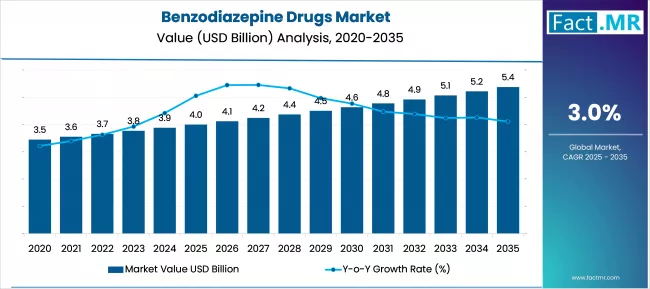
Benzodiazepine Drugs Market Market Value Analysis | Source: Fact.MR
| Metric | Value |
|---|---|
| Industry Size (2025E) | USD 4.0 billion |
| Industry Size (2035F) | USD 5.4 billion |
| CAGR (2025-2035) | 3.0% |
Source: Fact.MR analysis. Updated Sep 29, 2025
The global benzodiazepine drugs market is forecast to expand from USD 4.0 billion in 2025 to USD 5.4 billion by 2035 at a CAGR of 3.0%. Growth begins with relatively modest value creation in 2025 and 2026. The benzodiazepine drugs market has followed a steady but modest growth path over the past decade.
Demand remains consistent due to their wide use in treating anxiety, insomnia, seizures, and for hospital sedation. The market size is valued in the low-to-mid billions (USD) and continues to expand gradually, supported by the persistent global burden of mental health disorders and increasing diagnosis rates.
From 2024 to 2026, the market is projected to grow at a low single-digit CAGR, with some estimates going slightly higher depending on scope. Rising stress-related conditions, an ageing population more prone to neurological and sleep disorders, and increased accessibility in emerging markets are expected to maintain steady demand. Widespread generic availability limits revenue expansion despite stable prescription volumes.
By 2030, the trajectory suggests slow but sustained growth, with Asia-Pacific and Latin America expected to see the highest gains due to expanding healthcare access and awareness. Markets such as North America and Europe will maintain large shares, but growth will likely be constrained by strict prescribing guidelines, deprescribing initiatives, and regulatory warnings around dependence and side effects.
Key Market Dynamics
Rising Prevalence of Mental Health Disorders
The increasing incidence of anxiety, depression, insomnia, and panic disorders is a key growth driver for the benzodiazepine market. Modern lifestyles characterized by high stress, long working hours, and social pressures have led to a surge in mental health conditions globally.
Post-pandemic aftereffects have also amplified the demand for psychiatric medications. Patients experiencing sleep disturbances, post-traumatic stress, or pandemic-related anxiety have further expanded the patient pool.
In hospitals, benzodiazepines continue to play a central role in managing acute agitation, seizure emergencies, and pre-surgical sedation. This versatility ensures that the demand remains steady across both outpatient and inpatient settings.
Ageing Global Population
The world’s geriatric population is rapidly expanding, and older adults are more prone to insomnia, anxiety, and neurological disorders. With rising life expectancy, the proportion of elderly patients continues to grow, creating a consistent demand for benzodiazepines.
In many regions, sleep disorders in the elderly are underdiagnosed, but as awareness grows, prescriptions are expected to rise. Benzodiazepines are often prescribed as a first-line option for short-term management, particularly when symptoms are severe.
Even though guidelines caution against prolonged use in older populations, the immediate efficacy of benzodiazepines makes them a commonly chosen option, sustaining their role in this demographic.
Growing Healthcare Access and Awareness in Emerging Markets
Emerging economies, particularly in Asia-Pacific and Latin America, are seeing rapid improvements in healthcare infrastructure. As more people gain access to mental health services, demand for affordable therapeutic options like benzodiazepines is increasing.
Public awareness of mental health has improved significantly in these regions, reducing stigma and encouraging treatment-seeking behavior. Combined with expanding insurance coverage and government health initiatives, this creates fertile ground for benzodiazepine adoption.
Because benzodiazepines are relatively low-cost and widely available, they are often prescribed as first-line therapies in these markets, fueling sustained volume growth compared to developed regions.
Rising Concerns Over Dependence and Withdrawal Risks
One of the most significant restraints is the strong association of benzodiazepines with tolerance, dependence, and withdrawal. Long-term users often require higher doses to achieve the same effect, increasing the risk of misuse.
Healthcare providers are becoming increasingly cautious about prescribing these drugs beyond the short term. Awareness campaigns and professional training highlight the risks, leading to stricter prescribing patterns.
Patients themselves are also more informed about potential side effects and risks, which can lead to reluctance in starting or continuing benzodiazepine therapy.
Regulatory Restrictions and Deprescribing Initiatives
Governments and regulatory agencies are tightening controls around benzodiazepine prescriptions. Measures include stricter labeling requirements, prescription monitoring programs, and limited prescription durations to prevent misuse.
In North America and Europe, deprescribing guidelines are actively promoted to taper patients off long-term use. Healthcare systems encourage safer alternatives to reduce the public health burden of dependence and overdose.
These regulations directly impact market growth by lowering chronic prescription rates and limiting revenue potential, especially in mature markets where oversight is strictest.
Competition From Alternative Therapies
Another major restraint is the growing competition from both pharmacological and non-pharmacological alternatives. SSRIs, SNRIs, and non-benzodiazepine hypnotics (“Z-drugs”) are now widely prescribed due to their favorable long-term safety profiles.
At the same time, cognitive-behavioral therapy for insomnia (CBT-I) and other behavioral interventions are increasingly adopted, particularly in markets with strong mental health support infrastructure.
Pharmaceutical companies are also investing heavily in developing innovative therapies for anxiety and sleep disorders, further reducing reliance on benzodiazepines in the long run.
Country-Wise Outlook
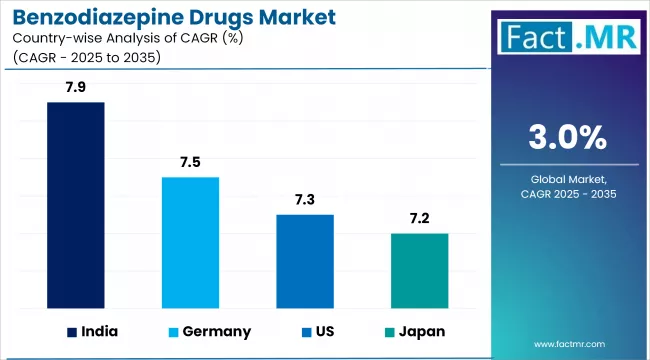
Benzodiazepine Drugs Market Cagr Analysis By Country | Source: Fact.MR
| Country | CAGR (2025-35) |
|---|---|
| India | 7.9% |
| Germany | 7.5% |
| Japan | 7.2% |
Source: Fact.MR analysis. Updated Sep 29, 2025
India Strengthens Benzodiazepine Drugs Market through Growing Burden of Insomnia, Anxiety, and Other Stress-Related Disorders
The benzodiazepine drugs market in India is expanding steadily, driven by the country’s growing burden of insomnia, anxiety, and other stress-related disorders. With urbanization, long working hours, and rising lifestyle stress, more patients are seeking medical support for sleep disturbances and anxiety. Benzodiazepines remain the largest and fastest-growing segment within India’s insomnia therapeutics market, reflecting their strong role in first-line treatment.
Rising awareness and access to mental healthcare have further boosted demand. Initiatives in telepsychiatry, public health campaigns, and reduced stigma are encouraging patients to seek treatment, particularly in semi-urban and urban centers. India’s robust generic drug manufacturing industry also ensures that benzodiazepines remain affordable and accessible, strengthening their adoption across a wide demographic base.
Looking forward, the market is expected to continue its moderate growth trajectory, supported by demand from urban populations and an increasing focus on mental health inclusion in healthcare policy. Nonetheless, balancing clinical need with safe prescribing practices will shape the pace of expansion.
- Benzodiazepines are the largest and fastest-growing drug type in India’s insomnia therapeutics market.
- Telepsychiatry and generics are expanding access and affordability across urban and semi-urban regions.
- Regulatory tightening and alternatives will limit long-term prescription growth despite strong short-term demand.
Germany's Benzodiazepine Drugs Market Thrives on Rising Cases of Insomnia
The benzodiazepine drugs market in Germany shows steady growth, supported by rising cases of insomnia, anxiety, and related disorders. Benzodiazepines remain the largest and fastest-growing drug type, continuing to dominate over antidepressants and non-benzodiazepine hypnotics.
Despite this growth, prescription patterns are shaped by strict regulations and clinical caution. Germany has witnessed a long-term decline in benzodiazepine prescriptions through statutory health insurance, largely due to awareness of dependence risks and guideline restrictions. However, private prescriptions now account for a significant share of usage, reflecting ongoing demand outside public insurance frameworks.
A key concern in Germany is the persistence of long-term use, which often exceeds clinical recommendations. Studies suggest that about 20% of benzodiazepine prescriptions last longer than guidelines allow, particularly among older adults. This raises public health concerns around dependence, withdrawal, and misuse, placing pressure on healthcare systems to tighten monitoring and expand alternative therapies.
- Private prescriptions account for nearly 40% of benzodiazepine/Z-drug use.
- Around 20% of prescriptions exceed guideline durations, especially in older adults.
Japan Advances in Benzodiazepine Drugs Market with Focus on Country’s Demographic Profile and Lifestyle Patterns
The benzodiazepine drugs market in Japan is experiencing steady growth, largely fueled by the country’s demographic profile and lifestyle patterns. Japan’s ageing population, among the largest in the world, has a high prevalence of sleep disturbances, anxiety, and stress-related disorders, all of which are key conditions treated with benzodiazepines.
Urbanization, demanding work culture, and rising stress levels further contribute to the market’s expansion. Sleep disorders are increasingly being diagnosed across younger and middle-aged populations, driven by long working hours, high screen usage, and lifestyle pressures. At the same time, greater awareness of mental health and better diagnostic practices are encouraging more individuals to seek medical intervention, with benzodiazepines often serving as the first line of treatment for acute cases.
Looking ahead, Japan’s benzodiazepine market is set to grow moderately but sustainably, supported by strong demand from its elderly population and the ongoing prioritization of mental health. However, growth will be tempered by regulatory restraints and increasing competition from innovative and non-pharmacological solutions.
- Elderly patients drive the bulk of demand, given the high prevalence of insomnia and anxiety in this group.
- Digital therapeutics and non-benzodiazepine drugs are emerging as strong competitors in Japan.
Category-wise Analysis
Alprazolam to Exhibit Leading Share by Product
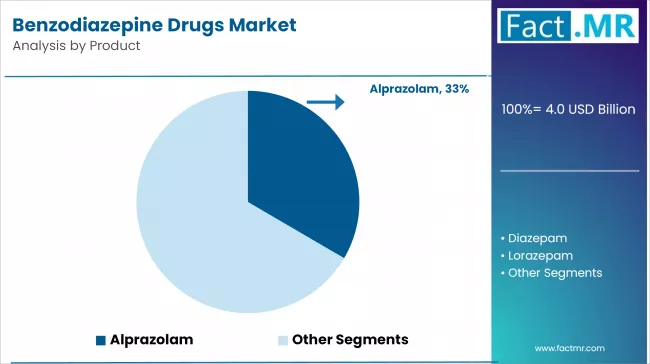
Benzodiazepine Drugs Market Analysis By Product | Source: Fact.MR
The dominating product segment in the benzodiazepine drugs market is Alprazolam, owing to its widespread use in the management of anxiety disorders, panic disorders, and depression-associated anxiety. Alprazolam is preferred by healthcare providers due to its rapid onset of action, high efficacy in short-term anxiety relief, and broad acceptance across both developed and emerging markets.
Its strong prescription rates are further supported by rising cases of generalized anxiety disorder (GAD) and panic disorders globally, as well as its relatively lower cost compared to some newer alternatives. The drug’s dominance is reinforced by its inclusion in several treatment guidelines and its availability in generic form, which enhances affordability and accessibility.
The fastest-growing segment is Clonazepam, primarily driven by its increasing adoption in the treatment of seizure disorders, epilepsy, and panic attacks. Unlike some other benzodiazepines, Clonazepam offers dual benefits, addressing both neurological and psychiatric conditions, which broadens its application base. Rising global prevalence of epilepsy, coupled with growing awareness about neurological health, is fueling higher demand.
Short-Acting Benzodiazepines to Exhibit Leading by Time of Action
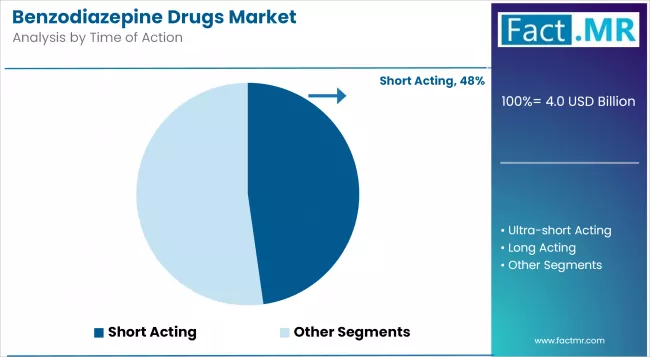
Benzodiazepine Drugs Market Analysis By Time Of Action | Source: Fact.MR
The dominating segment in the benzodiazepine drugs market is the short-acting benzodiazepines, as they are widely prescribed for anxiety, panic disorders, and insomnia where rapid symptom relief is essential. Drugs like Alprazolam and Lorazepam fall into this category and are favored because of their quick onset and effectiveness in acute management of anxiety and sleep disturbances. Their popularity is further driven by physician preference for short-term prescriptions to reduce dependency risks, coupled with strong availability of generic formulations that ensure affordability and accessibility.
The fastest-growing segment is the long-acting benzodiazepines, owing to their increasing use in chronic conditions such as epilepsy, muscle spasms, and long-term management of anxiety disorders. Drugs like Diazepam and Clonazepam provide extended symptom control with less frequent dosing, making them especially beneficial for patients with recurrent seizures or generalized anxiety.
The rising prevalence of neurological disorders, combined with the need for sustained therapeutic effect and reduced dosing frequency, is fueling demand for this segment, leading to its faster growth compared to ultra-short or short-acting types.
Competitive Analysis
The benzodiazepine drugs market is highly fragmented, with competition primarily driven by the dominance of generic manufacturers. Since most benzodiazepines have long been off-patent, a large share of the market consists of cost-effective generics offered by companies across North America, Europe, and Asia-Pacific.
Price competition is a key factor, and companies leverage extensive distribution networks to maximize accessibility in both hospital and retail pharmacies. Leading players often compete through brand reputation, physician trust, and consistent product availability rather than innovation.
Major global pharmaceutical companies, such as Pfizer, Roche, Novartis, and Teva, hold a strong presence due to their established product portfolios and distribution reach. Regional players, particularly in India and China, play a crucial role in supplying low-cost generics, enhancing their competitiveness in emerging markets.
Competition is also influenced by regulatory frameworks and prescribing guidelines. Stringent restrictions on long-term benzodiazepine use in North America and Europe have pushed companies to diversify toward alternative therapeutics such as SSRIs and non-benzodiazepine hypnotics.
This shift creates an indirect competitive environment, where benzodiazepines compete not only among themselves but also with safer alternatives and behavioral therapies. Moreover, increasing deprescribing initiatives and public health campaigns are intensifying competition for market share.
Key Players in the Market
- Pfizer Inc.
- Akorn Inc
- Hikma
- Hameln Pharmaceutical
- Accord
- troylab
- Amneal Pharmaceuticals LLC
- Apotex Inc.
Recent Developments
- In April 2025, the U.S. FDA approved an expansion of the indication for diazepam nasal spray (Valtoco) to include treatment of seizure clusters in children aged 2 to 5 years. Prior to this, the drug was only approved for those aged 6 and older. This reflects an effort to provide more accessible, faster rescue therapies for younger pediatric populations in seizures.
Segmentation
Segmentation of Benzodiazepine Drugs Market
-
By Product :
- Alprazolam
- Clonazepam
- Diazepam
- Lorazepam
- Others
-
By Time of Action :
- Ultra-short Acting
- Short Acting
- Long Acting
-
By Application :
- Anxiety
- Insomnia
- Alcohol Withdrawal
- Seizures
- Others
-
By Distribution Channel :
- Hospital Pharmacies
- Retail Pharmacies
- Others
-
By Region :
- North America
- Latin America
- Western Europe
- Eastern Europe
- East Asia
- South Asia & Pacific
- Middle East & Africa
Frequently Asked Questions
What is the Global Benzodiazepine Drugs Market size in 2025?
Who are the Major Players Operating in the Benzodiazepine Drugs Market?
What is the Estimated Valuation of the Benzodiazepine Drugs Market by 2035?
What Value CAGR Did the Benzodiazepine Drugs Market Exhibit over the Last Five Years?
Who worked on this report


Preview the report firsthand - request a free sample
Free SampleGet the brochure for pricing and purchase details
Download PDF