- Market Value (2025): USD 1.2 Bn
- Estimated Value (2026): USD 1.4 Bn
- Forecast Value (2036): USD 4.1 Bn
- CAGR (2026-2036): 11.4%
What is the Particle-Engineered Probiotic Stabilizers Market forecast to be worth by 2036?
USD 1.4 billion in 2026 to USD 4.1 billion by 2036, at 11.4% CAGR.
- The Particle-Engineered Probiotic Stabilizers Market reached USD 1.2 billion in 2025.
- Demand is projected to increase from USD 1.4 billion in 2026 to USD 4.1 billion by 2036.
- The market is forecast to record 11.4% CAGR from 2026 to 2036, supported by capsule brands, functional-food developers and probiotic manufacturers seeking dependable live-cell delivery.
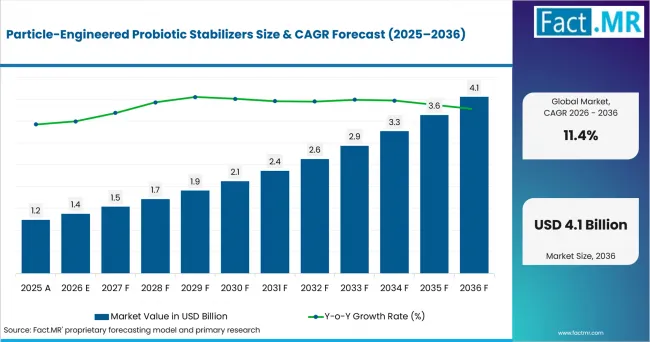
Particle Engineered Probiotic Stabilizers Value Analysis | Source: Fact.MR
What are the defining numbers behind Particle-Engineered Probiotic Stabilizers Market growth?
An absolute opportunity of USD 2.7 billion is expected between 2026 and 2036.
- Demand Drivers in the Market
- Supplement formulators need predictable CFU retention for label claims. FDA announced in March 2026 a public meeting on innovation and ingredient scope for dietary supplement ingredients.
- Food and beverage developers need particles that survive processing and ambient distribution. In March 2026, the U.S. Census Bureau reported that seasonally adjusted food-product shipments reached USD 89,802 million in January 2026.
- Capsule and sachet manufacturers need moisture-controlled carriers. Protective sugars reduce drying stress and support stable powder handling through distribution.
- Probiotic ingredient makers need strain-specific stabilization. Formulators choose matrix systems after the strain, target format and shelf-life claim are fixed.
- Key Segments Analyzed
- By Excipient Type: Protective sugars are expected to hold 37.0% share in 2026, supported by glassy matrices that limit moisture stress after drying.
- By Stabilization Stage: Freeze drying is projected to account for 33.0% share in 2026, owing to its role in converting live cultures into shelf-stable powders.
- By Dosage Form: Capsules are anticipated to capture 34.0% share in 2026, reflecting clearer dose control and lower water exposure than many food matrices.
- By Performance: Shelf-life CFU retention is estimated to represent 31.0% share in 2026, due to brand focus on viable-count claims at the end of storage.
- Analyst Opinion at Fact.MR
- Shambhu Nath Jha, Principal Consultant at Fact.MR, states, “Probiotic stabilization is now a supplier-selection issue. Buyers ask how an excipient protects each strain during drying, filling and storage. The market is projected to favor suppliers that pair particle design with clear CFU-retention data.”
- Strategic Implications
- Excipient suppliers should document water activity, glass transition behavior and CFU retention by strain so formulators have evidence before scale-up.
- Probiotic manufacturers should connect stabilization choices with label-claim targets since overage alone raises cost and leaves process damage unresolved.
- Capsule brands should validate humidity exposure during filling and storage. Moisture-sensitive probiotic formats need excipients that maintain powder flow and live-cell retention.
- Food application teams should test protective matrices under real process conditions.
China is expected to record 13.0% CAGR through 2036, supported by health-literacy gains and regulated probiotic health-food filing. The USA is projected to post 12.5% CAGR owing to supplement use and a large food spending base. Japan is anticipated to advance at 11.4% CAGR through functional-food evidence systems. France is estimated to hold 11.0% CAGR due to supplement declaration activity. Germany is forecast to record 10.4% CAGR, shaped by supplement use and online purchasing.
How does the Particle-Engineered Probiotic Stabilizers Market break down by segment?
Protective sugars lead Excipient Type at 37.0%; Freeze drying leads Stabilization Stage at 33.0%.
Which Excipient Type leads?
Protective sugars are expected to hold 37.0% share in 2026.
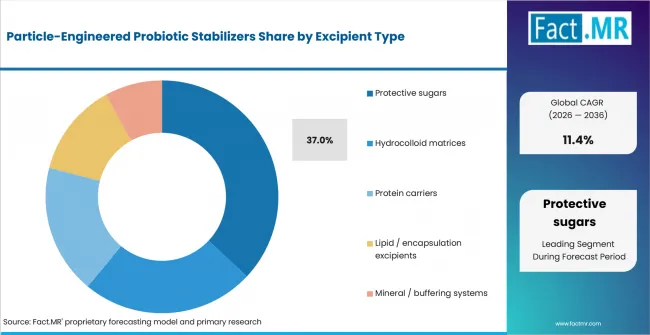
Particle Engineered Probiotic Stabilizers Analysis By Excipient Type | Source: Fact.MR
Protective sugars lead by helping create a dry matrix around probiotic cells. The matrix reduces freeze-drying damage and controls moisture after filling. Capsules and sachets need this protection through distribution.
Particle-level microencapsulation surrounds probiotic cells with a protective formulation matrix. The design supports shelf stability, acid survival and consistent CFU delivery.
What leads the Stabilization Stage segment?
Freeze drying is projected to account for 33.0% share in 2026.
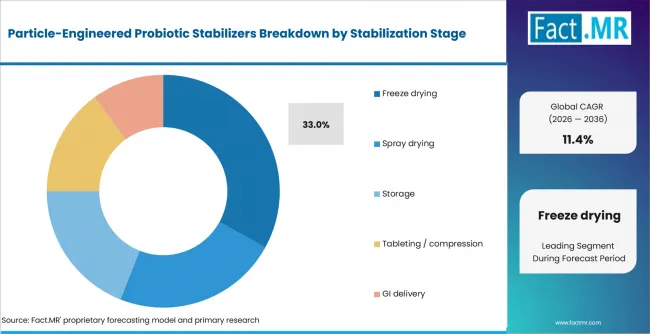
Particle Engineered Probiotic Stabilizers Analysis By Stabilization Stage | Source: Fact.MR
Freeze drying leads by converting live cells into dry powder for capsules, sachets and tablets. Cryoprotective agents and drying profiles influence survival, overage cost and batch variation.
Lallemand Health Solutions stated in February 2026 that its Saint-Simon expansion project includes a new formulation and blending area and a new encapsulation line. The site produces more than 80 million sachets each year.
How does Dosage Form shape demand?
Capsules are anticipated to capture 34.0% share in 2026.
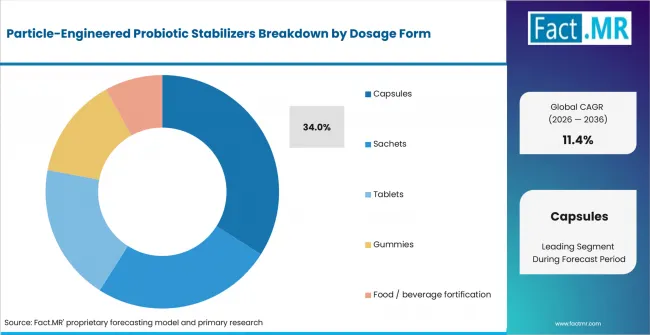
Particle Engineered Probiotic Stabilizers Analysis By Dosage Form | Source: Fact.MR
Capsules lead because they provide clear dosing while limiting probiotic exposure to moisture and complex food matrices. By keeping probiotic cells separate from ingredients that can increase water activity, the format supports stability, convenient handling and consistent delivery across supplement and functional nutrition applications markets.
What supports Shelf-life CFU retention within Performance?
Shelf-life CFU retention is estimated to represent 31.0% share in 2026.
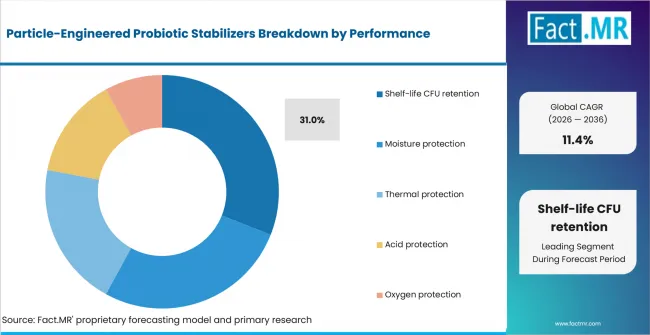
Particle Engineered Probiotic Stabilizers Analysis By Performance | Source: Fact.MR
Shelf-life CFU retention leads since probiotic value depends on viable cells at consumption. Formulators test oxygen exposure, water activity and compression before commercial release.
Roquette’s October 2025 CPHI release highlighted excipients and capsules for moisture-sensitive formulations. The release identifies Quali-V® HPMC capsules for moisture-sensitive formulations and PEARLITOL® mannitol as a non-hygroscopic filler that supports the stability of sensitive APIs.
What is accelerating Particle-Engineered Probiotic Stabilizers Market adoption, and what is holding it back?
Demand is expected to rise through CFU-retention needs and format expansion. Growth is restrained by claim scrutiny, heat sensitivity and strain variability.
Drivers Impact Analysis
| DRIVER | (~) % IMPACT ON CAGR | GEOGRAPHIC RELEVANCE | IMPACT TIMELINE |
|---|---|---|---|
| End-of-shelf-life CFU claim pressure | +1.6% | Global | Short term (<= 2 years) |
| Expansion of capsule and sachet formats | +1.2% | North America, Europe, East Asia | Medium term (2-4 years) |
| Food and beverage fortification trials | +0.9% | Global | Long term (>= 4 years) |
| Application-specific particle engineering | +0.8% | Global | Medium term (2-4 years) |
Opportunity Impact Analysis
| OPPORTUNITY | (~) % IMPACT ON CAGR | GEOGRAPHIC RELEVANCE | IMPACT TIMELINE |
|---|---|---|---|
| Low-water-activity tableting excipients | +1.1% | Europe, North America | Short term (<= 2 years) |
| Regulated functional-food claims | +0.8% | Japan, France, China | Medium term (2-4 years) |
| Stability packages for contract manufacturers | +0.7% | Global | Long term (>= 4 years) |
Restraints Impact Analysis
| RESTRAINT | (~) % IMPACT ON CAGR | GEOGRAPHIC RELEVANCE | IMPACT TIMELINE |
|---|---|---|---|
| Label and claim enforcement risk | -0.6% | USA, Europe, Japan | Short term (<= 2 years) |
| Heat and compression sensitivity | -0.5% | Global | Medium term (2-4 years) |
| Strain-to-strain variability | -0.4% | Global | Long term (>= 4 years) |
Which countries are scaling the Particle-Engineered Probiotic Stabilizers Market through 2036?
- The country comparison spans 2.6 percentage points across the forecast period.
- China remains 0.5 percentage point above the USA through health-literacy gains and regulated probiotic raw-material expectations.
- The USA remains 1.1 percentage points above Japan through supplement use and food spending scale.
- Japan remains 0.4 percentage point above France through functional-food evidence systems and e-commerce access.
- France remains 0.6 percentage point above Germany through supplement declaration activity and agri-food manufacturing depth.
- Germany closes the displayed range through consumer supplement use and active EU microbial-safety review.
Comparable CAGRs create different entry conditions due to supplement behavior, food processing depth, regulatory review and channel structure. Full report coverage includes North America, Latin America, Western Europe, Eastern Europe, East Asia, South Asia and Pacific, Middle East and Africa.
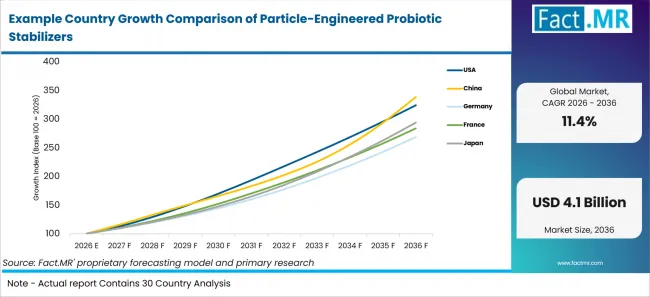
Example Country Growth Comparison Of Particle Engineered Probiotic Stabilizers | Source: Fact.MR
| Country | CAGR (2026-2036) |
|---|---|
| China | 13.0% |
| United States | 12.5% |
| Japan | 11.4% |
| France | 11.0% |
| Germany | 10.4% |
What supports China adoption?
13.0% CAGR, supported by health-literacy gains and probiotic health-food filing needs.
China’s demand base is shaped by wellness education and digital retail access. The National Health Commission reported in January 2026 that China’s health-literacy rate reached 33.69% in 2025. The National Bureau of Statistics reported in February 2026 that online retail sales of physical goods reached CNY 13,092.3 billion in 2025. Separately, SAMR issued a draft on July 24, 2026, covering the registration and filing of health foods using probiotic raw materials; the draft requires registered products to maintain a total viable bacterial count of at least 10⁷ CFU/mL(g) throughout shelf life.
What supports USA adoption?
12.5% CAGR, led by supplement use and a large food spending base.
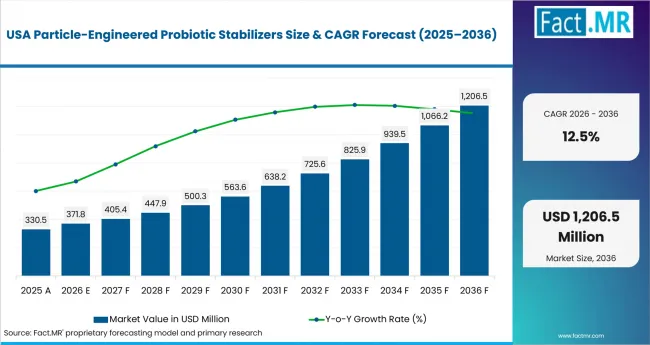
Particle Engineered Probiotic Stabilizers Country Value Analysis | Source: Fact.MR
U.S. adoption is linked to supplement use and shelf-stable food applications. CDC NCHS reported in May 2026 that 60.2% of U.S. adults age 20 and older used any dietary supplement in the past 30 days during August 2021–August 2023. USDA ERS reported in June 2026 that inflation-adjusted U.S. food spending reached USD 2.51 trillion in 2025, expressed in 2025 dollars.
What supports Japan adoption?
11.4% CAGR, driven by functional-food evidence systems and capsule-format demand.
Japan’s market is shaped by formal evidence review and organized e-commerce channels. The Consumer Affairs Agency reported in October 2025 that it reviewed analytical-method documentation for 98 Foods with Function Claims notifications and requested additional documentation in 69 cases. METI reported in August 2025 that Japan’s B-to-C e-commerce market for cosmetics and pharmaceuticals reached JPY 1.015 trillion in 2024.
What supports France adoption?
11.0% CAGR, backed by supplement declarations and agri-food manufacturing depth.
France has a steady supplement review channel and a large food-manufacturing base. The agriculture ministry states in its 2026 guidance that more than 1,600 dietary supplement declarations are received each month. INSEE reported in July 2026 that French agri-food industry production value reached EUR 203,464 million in 2024.
What supports Germany adoption?
10.4% CAGR, shaped by supplement use and online supplement purchasing.
Germany’s adoption path is shaped by consumer supplement use and EU microbial safety expectations. The German Federal Institute for Risk Assessment reported in 2025 that more than three-quarters of surveyed respondents had consumed a food supplement within the previous 12 months. Destatis reported on March 11, 2025, that 21% of Germany’s population aged 16 to 74 said they had bought medicines or dietary supplements online in 2024. EFSA states that its QPS list and list of microbiological agents notified to EFSA are updated every six months as part of its ongoing safety assessment process.
Who leads the Particle-Engineered Probiotic Stabilizers Market?
IFF is active in probiotic formulation development and matrix microencapsulation, using strain-specific stability data to support probiotic viability and CFU delivery through shelf life. Lallemand Health Solutions participates through probiotic production capabilities that include fermentation, freeze-drying, formulation and encapsulation.
Kerry Group contributes through BC30™ probiotic research, including a September 2025 report on a clinical study in healthy Chinese adults.
Which companies are the key providers?
IFF, JRS Pharma, Lallemand, Kerry Group, Roquette and LONZA / CAPSUGEL.
- IFF
- JRS Pharma
- Lallemand
- Kerry Group
- Roquette
- LONZA / CAPSUGEL
Bibliography
- EFSA Panel on Biological Hazards (BIOHAZ). (2026, July 6). Update of the list of qualified presumption of safety (QPS) recommended microbiological agents intentionally added to food or feed as notified to EFSA 24: Suitability of taxonomic units notified to EFSA until March 2026. EFSA Journal, 24(7), e10155.
- German Federal Institute for Risk Assessment. (2025, July 18). Between hype and misconception: Common misunderstandings about food supplements.
- IFF. (2026, May 8). From lab to shelf: How IFF designs stability into probiotics.
- Institut national de la statistique et des études économiques. (2026, July 21). Indicateurs macroéconomiques de l’industrie agroalimentaire : Données annuelles de 2010 à 2024.
- Lallemand Health Solutions. (2026, February 11). The Saint-Simon production plant continues to invest.
- Millette, M. (2025, September 12). How BC30™ supports gut health in Chinese adults. Kerry.
- Ministère de l’Agriculture, de l’Agro-alimentaire et de la Souveraineté alimentaire. (2026, January 21). Qu'est ce qu'un complément alimentaire ?
- Ministry of Economy, Trade and Industry. (2025, August 26). Results of FY2024 E-Commerce Market Survey compiled.
- National Bureau of Statistics of China. (2026, February 28). Statistical communiqué of the People’s Republic of China on the 2025 national economic and social development.
- Office for National Statistics. (2026, July 24). UK manufacturers’ sales by product: 2025.
- Roquette. (2025, October 14). Roquette marks new chapter at CPHI 2025 after key acquisitions.
- Statistisches Bundesamt. (2025, March 11). 21 % der 16- bis 74-Jährigen kaufen Arzneimittel oder Nahrungsergänzungsmittel online.
- Stierman, B., Couch, C. A., Gahche, J. J., & Mishra, S. (2026, May 21). Dietary supplement use: United States, August 2021–August 2023 (NCHS Data Brief No. 561). National Center for Health Statistics.
- U.S. Census Bureau. (2026, March 18). Monthly full report on manufacturers’ shipments, inventories and orders: January 2026 (Release No. CB 26-38 M3-2 (26)-01).
- U.S. Food and Drug Administration. (2026, March 3). FDA announces public meeting on dietary supplement innovation and the scope of dietary ingredients.
- Xinhua. (2026, January 8). China reports steady growth of health literacy. National Health Commission of the People’s Republic of China.
- Zeballos, E., & Sinclair, W. (2026, June 11). Total U.S. food spending reached $2.51 trillion in 2025. U.S. Department of Agriculture, Economic Research Service.
This Report Answers
- The report explains where particle-engineered probiotic stabilizers are used across excipient type, stabilization stage and dosage form.
- Segment analysis identifies the leading subsegments and the formulation reasons behind protective-sugar, freeze-drying, capsule and CFU-retention shares.
- Country analysis examines China, the USA, Japan, France and Germany through supplement behavior, official control systems and functional-food documentation.
- Competitive analysis reviews current providers across matrix microencapsulation, probiotic manufacturing, direct-compression excipients and biotic capsule design.
- Application analysis assesses how humidity, drying loss, compaction, acid exposure and oxygen sensitivity influence supplier selection.
What does the Particle-Engineered Probiotic Stabilizers Market cover?
The probiotics field uses live microorganisms whose commercial value depends on survival through production and use. The assessment covers stabilizers that protect probiotic cells before the consumer receives the product.
The market covers excipients and particle systems related to microencapsulated food ingredients when those systems are used to protect live probiotic organisms. Ordinary fillers are covered only when they perform a stabilization function.
What is included in the scope?
The scope includes protective sugars, hydrocolloids, protein carriers, lipid systems and buffering minerals that form engineered particles around probiotic cells. It includes food ingredient encapsulation systems when the encapsulation target is a viable probiotic strain.
It covers use in capsules, sachets, tablets, gummies and food or beverage fortification. Coverage extends to fermented ingredient categories when stabilization supports live probiotic delivery. Finished-product applications include natural health supplements and blended wellness formats. Coverage includes nutritional blends when probiotic stability is a defined product requirement.
What is excluded from the scope?
The scope excludes probiotic strains sold alone, finished supplement brands and ordinary capsule shells sold only as containers. The scope excludes immune health supplements that rely on non-probiotic active ingredients.
Packaging materials are excluded unless they directly control probiotic stability as part of a combined system. Broader nutraceutical packaging is outside the scope when the package is sold separately from the stabilizer.
How Was the Analysis Built?
The analysis draws on 120+ sources, 35+ company portfolios, 25+ countries and more than 20 interviews.
- Primary Research: Primary research includes discussions with ingredient manufacturers, probiotic culture producers, formulation specialists, contract manufacturers, supplement brands and food developers. These conversations examine purchasing priorities, adoption, operational challenges, approval requirements and market acceptance.
- Desk Research: Desk research covers government statistics, regulatory publications, company releases, technical studies, standards and public policy. Every source used in the analysis is documented in the bibliography.
- Market Sizing and Forecasting: Market estimates combine historical performance, demand indicators, excipient use, dosage-form trends, segment shares, country-level growth, investment activity and barriers.
- Data Validation and Update Cycle: Findings are validated by comparing interviews with public data, company activity, regulatory changes and manufacturing patterns. Updates review launches, capacity changes, partnerships, approvals and adoption shifts.
What is the report’s scope and coverage?
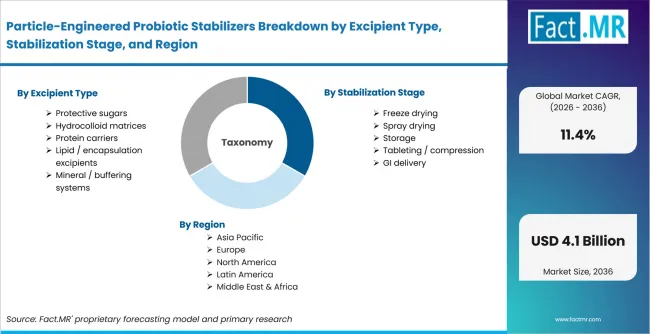
Particle Engineered Probiotic Stabilizers Breakdown By Excipient Type, Stabilization Stage, And Region | Source: Fact.MR
| Attribute | Details |
|---|---|
| Quantitative Units | USD billion in 2026 to USD billion by 2036 at CAGR |
| Market Definition | Particle-engineered excipients, carriers and protective matrices used to stabilize live probiotic cells during drying, storage, tableting, capsule filling, digestion and food or beverage fortification. |
| Excipient Type | Protective sugars; Hydrocolloid matrices; Protein carriers; Lipid encapsulation excipients; Mineral buffering systems |
| Stabilization Stage | Freeze drying; Spray drying; Storage; Tableting/compression; GI delivery |
| Dosage Form | Capsules; Sachets; Tablets; Gummies; Food/beverage fortification |
| Performance | Shelf-life CFU retention; Moisture protection; Thermal protection; Acid protection; Oxygen protection |
| Regions Covered | North America; Latin America; Western Europe; Eastern Europe; East Asia; South Asia and Pacific; Middle East and Africa |
| Countries Covered | China; United States; Japan; France; Germany |
| Key Companies Profiled | IFF; JRS Pharma; Lallemand; Kerry Group; Roquette; LONZA / CAPSUGEL |
| Forecast Period | 2026 to 2036 |
| Approach | Hybrid top-down and bottom-up approach using probiotic dosage formats; excipient use; stabilization-stage mix; country demand indicators; company portfolio review; and formulation evidence. |
How is the market segmented?
-
By Excipient Type
- Protective sugars
- Hydrocolloid matrices
- Protein carriers
- Lipid encapsulation excipients
- Mineral buffering systems
-
By Stabilization Stage
- Freeze drying
- Spray drying
- Storage
- Tableting/compression
- GI delivery
-
By Dosage Form
- Capsules
- Sachets
- Tablets
- Gummies
- Food/beverage fortification
-
By Performance
- Shelf-life CFU retention
- Moisture protection
- Thermal protection
- Acid protection
- Oxygen protection
-
By Region
- North America
- Latin America
- Western Europe
- Eastern Europe
- East Asia
- South Asia and Pacific
- Middle East and Africa