- Market Value (2025): USD 164.6 Mn
- Estimated Value (2026): USD 184 Mn
- Forecast Value (2036): USD 560 Mn
- CAGR (2026-2036): 11.8%
What is the PCB Chemistry Control Market forecast to be worth by 2036?
USD 184 million in 2026 to USD 560 million by 2036, at 11.8% CAGR.
- The PCB chemistry control market reached USD 164.6 million in 2025.
- Demand is projected to increase from USD 184 million in 2026 to USD 560 million by 2036.
- The market is forecast to record 11.8% CAGR from 2026 to 2036 as fabricators tighten bath control across plating and final finish.
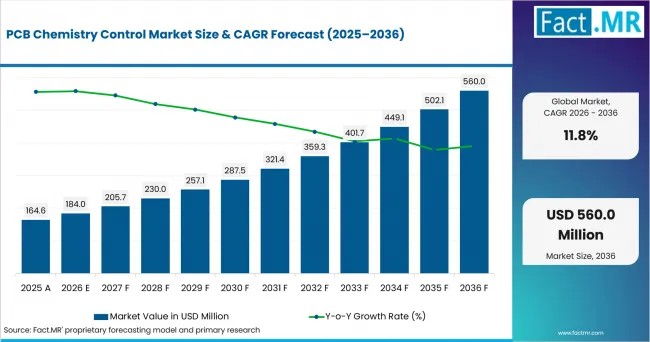
Pcb Chemistry Control Market Value Analysis | Source: Fact.MR
What are the defining numbers behind PCB Chemistry Control Market growth?
USD 376 million absolute opportunity by 2036, led by automated titration/analysis, electroplating and PCB fabricators.
- Demand Drivers in the Market
- PCB fabricators need repeatable bath analysis because electroplating chemicals leave little tolerance for metal drift.
- Substrate makers need closed-loop dosing so build-up layers receive stable replenishment.
- Chemical suppliers need line records to prove additives stay within qualified ranges.
- Plant teams need sensor alarms and chemical metering pumps as PFAS and waste reviews raise documentation pressure.
- Key Segments Analyzed
- By Control Type: Automated titration/analysis is anticipated to hold 35.0% share in 2026 because it gives repeatable chemical surface treatment checks.
- By Process Bath: Electroplating is projected to account for 31.0% share in 2026 due to its link with copper thickness and metal finishing chemicals.
- By Deployment: Line-integrated systems are estimated to represent 58.0% share in 2026 owing to faster feedback on plating and etch lines.
- By End User: PCB fabricators are forecast to capture 49.0% share in 2026 as plant owners responsible for bath uptime and process release.
- Analyst Opinion at Fact.MR
- Shambhu Nath Jha, Principal Consultant at Fact.MR, states, "Chemistry control is becoming a production discipline, not only a lab check. The market is expected to expand as fabricators connect bath data with yield control. Suppliers that combine analyzers, dosing logic and chemistry knowledge are better placed than instrument-only vendors."
- Strategic Implications
- Analyzer vendors should shorten calibration steps so production teams use fewer manual workarounds.
- Equipment builders should expose bath-control data to MES and quality systems by panel lot.
- PCB manufacturers should qualify control logic by process bath because scrap risks differ.
France is projected to record 14.6% CAGR through 2036, supported by electronics policy. Germany is anticipated to post 13.0% CAGR as electrical exports support tighter bath control. The USA is forecast to advance at 11.8% CAGR as printed circuit boards face compliance pressure. South Korea is estimated to reach 11.3% CAGR while AI server boards keep substrate work active. The UK is projected to hold 10.1% CAGR through specialized manufacturing. Japan is anticipated to record 8.5% CAGR as mature electronics production favors careful validation.
How does the PCB Chemistry Control Market break down by segment?
Automated titration/analysis leads Control Type at 35.0%; line-integrated leads Deployment at 58.0%.
Which Control Type dominates?
Automated titration/analysis holds 35.0% share in 2026.
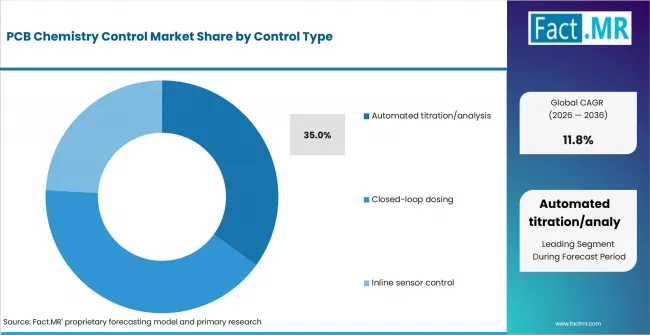
Pcb Chemistry Control Market Analysis By Control Type | Source: Fact.MR
Automated titration and analysis is expected to lead because it gives repeatable bath measurements. Closed-loop dosing remains relevant where high purity chemicals must stay within a qualified bath window. Inline sensor control supports faster response where lab sampling is slow. Metrohm AG stated in June 2025 that its OMNIS data-management version supports client/server networks for up to 1,000 clients.
What leads the Process Bath segment?
Electroplating accounts for 31.0% share in 2026.
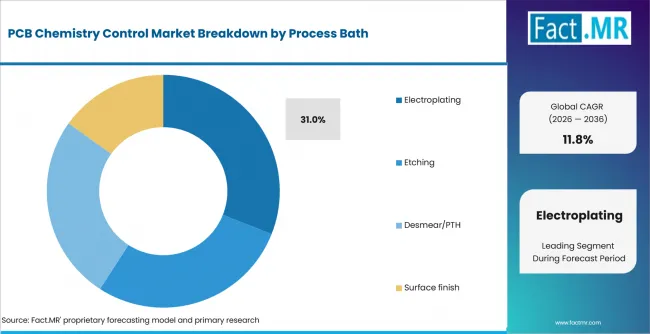
Pcb Chemistry Control Market Analysis By Process Bath | Source: Fact.MR
Electroplating is projected to lead because copper thickness directly affects vias and signal reliability. Etching needs control where trace widths are tight. In PCB primary metallization, desmear is followed by conditioning and activation before electroless copper deposition, with reliable activation supporting copper coverage in PTH processing. Technic's TechniPad portfolio includes ENIG and ENEPIG final-finish processes for PCB fabrication; its ENEPIG process uses electroless nickel, electroless palladium, and immersion gold.
How does Deployment shape demand?
Line-integrated systems represent 58.0% share in 2026.
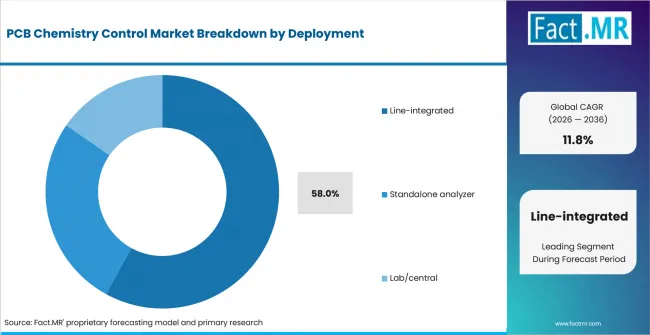
Pcb Chemistry Control Market Analysis By Deployment | Source: Fact.MR
Line-integrated deployment is estimated to lead because production teams need chemistry alarms near the bath. Standalone analyzers remain useful for periodic verification. Lab or central deployment suits plants that run fewer baths. The U.S. Census Bureau reported in July 2026 that computer and electronic product orders rose 3.1% in June 2026 to USD 31.1 billion.
What supports PCB fabricators within End User?
PCB fabricators capture 49.0% share in 2026.
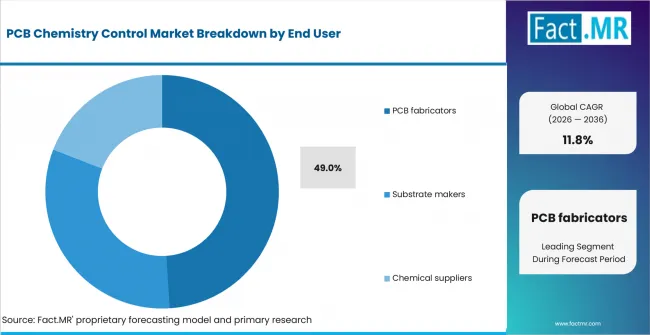
Pcb Chemistry Control Market Analysis By End User | Source: Fact.MR
PCB fabricators are forecast to lead because they own wet lines and scrap risk. Substrate makers follow as advanced boards require tighter copper control. Chemical suppliers use analyzers to defend replenishment recommendations.
What is accelerating PCB Chemistry Control Market adoption, and what is holding it back?
Bath stability drives it; qualification cost restrains it.
Drivers Impact Analysis
| Driver | (~) % Impact on CAGR | Geographic Relevance | Impact Timeline |
|---|---|---|---|
| Electroplating repeatability for HDI and substrates | +1.8% | North America, Europe, East Asia | Short term (<= 2 years) |
| Line-integrated dosing and analyzer feedback | +1.4% | Global | Medium term (2-4 years) |
| Audit records for chemistry use and bath changes | +1.1% | USA, UK, EU | Medium term (2-4 years) |
| Advanced PCB and package-substrate production | +0.9% | USA, South Korea, Japan | Long term (>= 4 years) |
| Supplier service models around chemistry uptime | +0.7% | Global | Short term (<= 2 years) |
- Electroplating repeatability for HDI and substrates: Fine-line boards need stable copper chemistry across many panels. Automated analysis is expected to reduce late corrections after defects form.
- Line-integrated dosing and analyzer feedback: Fabricators want control loops close to the bath. Adoption is projected to favor vendors that integrate sensors, pumps and dosing logic.
- Audit records for chemistry use and bath changes: Customer audits require traceable bath records. EPA added nine PFAS to TRI reporting for reporting year 2025.
- Supplier service models around chemistry uptime: Chemical suppliers are using analyzers and technical service to protect bath performance. That approach is anticipated to improve retention where fabricators prefer a single accountable partner for chemistry and controls.
Opportunity Impact Analysis
| Opportunity | (~) % Impact on CAGR | Geographic Relevance | Impact Timeline |
|---|---|---|---|
| Closed-loop dosing for electroplating baths | +1.2% | Global | Short term (<= 2 years) |
| Data links between analyzers and factory systems | +0.9% | USA, Europe, East Asia | Medium term (2-4 years) |
| Water and waste reporting support | +0.7% | USA, France, UK | Medium term (2-4 years) |
| Service contracts for mixed wet-process lines | +0.6% | Global | Long term (>= 4 years) |
- Closed-loop dosing for electroplating baths: Dosing tied to measured chemistry reduces manual correction and missed replenishment cycles. Electroplating offers the clearest value case because deposit quality is directly visible in reliability checks.
- Data links between analyzers and factory systems: MES connectivity gives operators a single history for panels, baths and process changes. Vendors with open data interfaces are expected to gain attention where audits require fast traceability.
- Water and waste reporting support: Wet-process lines are under tighter environmental review. Chemistry-control tools are likely to gain value when they help plants show where chemicals were consumed, diluted or treated.
- Service contracts for mixed wet-process lines: Many plants run plating, etching and final finish in the same facility. Service contracts that cover multiple baths can reduce downtime and simplify support responsibility.
Restraints Impact Analysis
| Restraint | (~) % Impact on CAGR | Geographic Relevance | Impact Timeline |
|---|---|---|---|
| Validation cost before production release | -0.6% | Global | Short term (<= 2 years) |
| Operator training and calibration discipline | -0.5% | Global | Medium term (2-4 years) |
| Integration limits in older wet lines | -0.4% | Europe, Japan, UK | Medium term (2-4 years) |
| Chemistry-specific method differences | -0.3% | Global | Long term (>= 4 years) |
- Validation cost before production release: Plants need proof that a control system improves yield without false corrections. Qualification work can delay rollouts by bath type.
- Operator training and calibration discipline: Analyzers need controlled reagents, electrodes and calibration steps. Facilities with limited analytical staff are expected to adopt more slowly.
- Integration limits in older wet lines: Brownfield PCB plants can lack sensor ports or data links. Standalone analyzers remain practical where line changes are costly.
- Chemistry-specific method differences: Electroplating, etching and surface-finish baths behave differently. Vendors must tune methods by bath during scale-up.
Which countries are scaling the PCB Chemistry Control Market through 2036?
- The country comparison spans 6.10 percentage points across six profiled markets.
- France remains 1.53 percentage points above Germany through electronics policy and printed-circuit resilience.
- Germany remains 1.19 percentage points above the USA through export-oriented electronics demand.
- The USA remains 0.50 percentage point above South Korea as compliance supports analyzer use.
- South Korea remains 1.21 percentage points above the UK through ICT export intensity.
- The UK remains 1.67 percentage points above Japan through specialized manufacturing.
- Japan closes the displayed range as mature electronics lines favor proven analyzer methods.
Comparable CAGRs create different entry conditions due to PCB cluster depth, electronics output, environmental reporting and local service coverage. Full report coverage includes North America, Latin America, Western Europe, Eastern Europe, East Asia, South Asia & Pacific, Middle East & Africa.
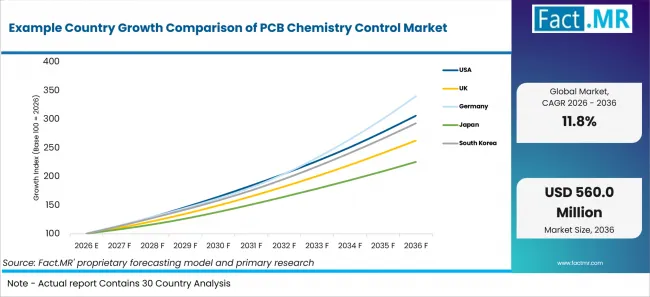
Example Country Growth Comparison Of Pcb Chemistry Control Market | Source: Fact.MR
| Country | CAGR (2026-2036) |
|---|---|
| France | 14.6% |
| Germany | 13.0% |
| USA | 11.8% |
| South Korea | 11.3% |
| UK | 10.1% |
| Japan | 8.5% |
What supports France adoption?
14.6% CAGR through 2036, supported by electronics policy and printed-circuit resilience.
France’s growth is supported by its electronics manufacturing base and increasing demand for documented wet-process control. DGE reported in July 2025 that the French electronics sector had overall revenue of nearly EUR 18 billion and included printed circuits among its activities, while Insee reported in February 2026 that output of computer, electronic and optical products was 0.7% higher in the fourth quarter of 2025 than in the fourth quarter of 2024. Fabricators are expected to use bath records to demonstrate plating and surface-finish stability.
How is Germany scaling demand?
13.0% CAGR through 2036, driven by export-oriented electronics and process documentation.
Germany’s growth reflects its large electro-digital export base and strong emphasis on documented manufacturing processes. ZVEI reported that German electro and digital exports increased 5.1% to EUR 257.5 billion in 2025, while Destatis reported that computer, electronic and optical product orders rose 14.4% month over month in March 2026. PCB plants are expected to favor analyzers that maintain detailed bath histories and support regulated customers.
What supports USA adoption?
11.8% CAGR through 2036, supported by electronics orders and environmental reporting.
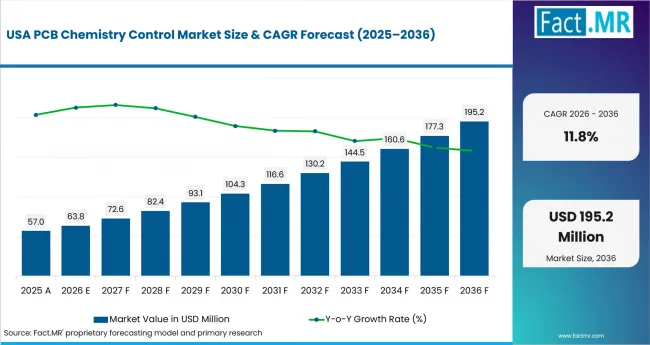
Pcb Chemistry Control Market Country Value Analysis | Source: Fact.MR
The USA’s growth is supported by electronics manufacturing activity and tighter environmental reporting requirements. The U.S. Census Bureau reported that computer and electronic product orders increased 3.1% to USD 31.1 billion in June 2026, while EPA TRI rules added nine PFAS for reporting year 2025. Fabricators are expected to connect bath-control data with lot-level traceability and local technical service.
How does South Korea build momentum?
11.3% CAGR through 2036, driven by ICT exports and substrate production.
South Korea’s growth is supported by its large ICT and semiconductor manufacturing base. MOTIR and MSIT reported that Korea’s ICT exports reached USD 264.3 billion in 2025, while ICT semiconductor exports increased 22.1% to a record USD 173.4 billion. Substrate manufacturers are expected to value integrated analysis for tighter copper control, plating stability and qualification records.
What supports UK growth?
10.1% CAGR through 2036, supported by specialized manufacturing and quality control.
The UK’s growth reflects specialized electronics manufacturing and demand for documented quality control. ONS reported that UK manufacturers’ product sales totaled GBP 452.0 billion in 2025, while computer, electronic and optical manufacturing increased 5.6% in December 2025. Demand is expected to center on specialized plants requiring wet-process records for audits, with standalone analyzers remaining relevant for smaller facilities.
How does Japan perform?
8.5% CAGR through 2036, led by mature electronics production and cautious qualification.
Japan’s growth reflects its mature electronics manufacturing base and strong emphasis on process qualification. The Cabinet Office reported that manufacturing production was forecast to rise 9.3% in January 2026, while METI expected production to increase 2.1% in April and 2.2% in May 2026. Producers are expected to adopt controls where documentation protects established bath qualifications, supported by suppliers such as Uyemura International Corporation in PCB final-finish chemistries.
Which companies are active in the PCB Chemistry Control Market?
Atotech, an MKS brand, is active through chemistry, equipment, software and service support for electroless plating, electrolytic plating and automotive printed circuit boards. Its public portfolio spans process chemistry, equipment, software and services for PCB and package-substrate manufacturing.
Uyemura International Corporation and Technic participate through plating and final-finish chemistries where bath control affects solderability and contact performance.
RENA Technologies is relevant through wet-processing equipment, including its July 2025 glass-core substrate facility in Germany. Metrohm AG supports the analyzer side through titration, wet-chemistry platforms and data tools.
Which companies are profiled in the PCB Chemistry Control Market?
Key companies include Atotech, an MKS brand, Qnity Electronics, Inc., Uyemura International Corporation, Technic, RENA Technologies, Metrohm AG.
- Atotech, an MKS brand
- Qnity Electronics, Inc.
- Uyemura International Corporation
- Technic
- RENA Technologies
- Metrohm AG
Bibliography
- Direction générale des Entreprises. (2025, July 7). Signature du contrat stratégique de la filière (CSF) Électronique pour 2025-2028.
- Federal Ministry for Economic Affairs and Energy. (2026, March 19). The economic situation in the Federal Republic of Germany in March 2026.
- Federal Statistical Office (Destatis). (2026, May 7). New orders in manufacturing in March 2026: +5.0% on the previous month.
- Global Electronics Association. (2026, February 26). PCB market enters 2026 with diverging signals: Shipments rise, bookings contract.
- Institut national de la statistique et des études économiques. (2026, February 5). In December 2025, manufacturing output fell back sharply (-0.8%) (Informations Rapides No. 33).
- Ministry of Economy, Trade and Industry. (2026, April 30). Indices of Industrial Production: Preliminary report for March 2026.
- Ministry of Trade, Industry and Resources. (2026, January 2). Korea’s annual exports reach new highs in 2025.
- Ministry of Trade, Industry and Resources, & Ministry of Science and ICT. (2026, January 15). ICT exports post record annual performance in 2025.
- MKS Inc. (2025, August 6). MKS showcases next-generation PCB manufacturing solutions at the Thailand Electronics Circuit Asia 2025.
- RENA Technologies GmbH. (2025, July 15). RENA Technologies commissions high-tech-processing facility for TGV glass substrates.
- Service des données et études statistiques. (2026, March 27). Industrie et environnement en France - État des connaissances en 2025.
- U.S. Census Bureau. (2026, July 27). Monthly advance report on durable goods manufacturers' shipments, inventories and orders.
- U.S. Environmental Protection Agency. (2026, June 11). TRI laws and regulatory activities.
This Report Answers
- The report explains where PCB chemistry control is used across control type, process bath, deployment and end user.
- Segment analysis identifies why automated titration, electroplating and line-integrated systems carry the main 2026 shares.
- Country analysis reviews France, Germany, the USA, South Korea, the UK and Japan, with attention to electronics output, policy support and compliance pressure.
- Competitive analysis reviews active providers across process chemistry, wet-processing equipment and analytical instrumentation.
- Application analysis assesses how bath drift and lot traceability influence purchase decisions in printed circuit boards and substrates.
What does the PCB Chemistry Control Market cover?
The PCB Chemistry Control Market covers systems used to keep wet-process baths within qualified ranges. It includes tools for plating, etching, desmear and surface finish in PCB and substrate manufacturing. Adjacent demand is tied to chemistry purity and repeatability.
The assessment covers automated titration, closed-loop dosing and inline sensor control across fabricators, substrate makers and chemical suppliers.
What is included in the scope?
The scope includes analyzers, dosing controllers, inline sensors, software interfaces and service support used to control PCB wet-chemistry baths.
It includes equipment and services for electroplating, etching, desmear, plated through-hole preparation and final surface finish.
What is excluded from the scope?
The scope excludes base PCB chemistry sold without control, raw copper foil, laminates, solder mask and general wastewater treatment systems.
General factory automation software is excluded when it does not measure wet-process chemistry. Adjacent categories count only when they create demand for tighter bath control.
How Was the Analysis Built?
The analysis draws on 120+ sources, 35+ company portfolios, 25+ countries and 20+ interviews.
- Primary Research: Interviews with suppliers, fabricators, substrate makers and procurement teams examine bath-control priorities and validation steps.
- Desk Research: Desk research covers government statistics, company filings, trade data, standards and public policy.
- Market Sizing and Forecasting: Estimates combine historical performance, segment shares, country growth, adoption patterns and barriers.
- Data Validation and Update Cycle: Findings are validated against public data, company activity and regulation. Updates review launches and procurement shifts.
What is the report’s scope and coverage?
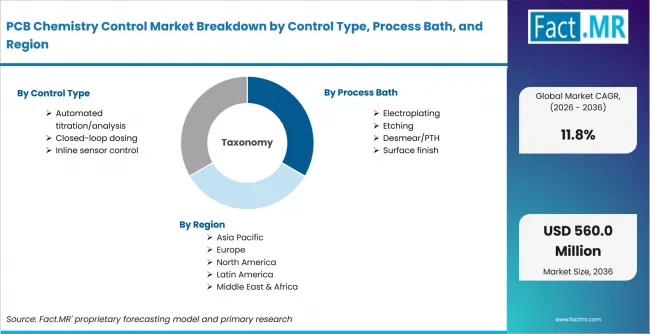
Pcb Chemistry Control Market Breakdown By Control Type, Process Bath, And Region | Source: Fact.MR
| Attribute | Details |
|---|---|
| Quantitative Units | USD million in 2026 to USD million by 2036 at a CAGR |
| Market Definition | Analyzers, sensors, dosing controls and software used to control PCB wet-process baths. |
| Control Type | Automated titration/analysis; Closed-loop dosing; Inline sensor control |
| Process Bath | Electroplating; Etching; Desmear/PTH; Surface finish |
| Deployment | Line-integrated; Standalone analyzer; Lab/central |
| End User | PCB fabricators; Substrate makers; Chemical suppliers |
| Regions Covered | North America; Latin America; Western Europe; Eastern Europe; East Asia; South Asia & Pacific; Middle East & Africa |
| Countries Covered | USA; UK; Germany; Japan; South Korea; France |
| Key Companies Profiled | Atotech, an MKS brand, Qnity Electronics, Inc., Uyemura International Corporation, Technic, RENA Technologies, Metrohm AG |
| Forecast Period | 2026 to 2036 |
| Approach | Hybrid top-down and bottom-up approach using wet-line count, bath-control spend and provider portfolio review. |
How is the market segmented?
-
By Control Type
- Automated titration/analysis
- Closed-loop dosing
- Inline sensor control
-
By Process Bath
- Electroplating
- Etching
- Desmear/PTH
- Surface finish
-
By Deployment
- Line-integrated
- Standalone analyzer
- Lab/central
-
By End User
- PCB fabricators
- Substrate makers
- Chemical suppliers
-
By Region
- North America
- Latin America
- Western Europe
- Eastern Europe
- East Asia
- South Asia & Pacific
- Middle East & Africa