- Forecast Value (2036): 2.9 Bn
- CAGR (2036): 14.9%
PDLC Film Market Forecast and Outlook 2026 to 2036
Global market valuation for PDLC film market stands at 0.74 billion USD in 2026, establishing a foundation for sustained growth reaching 2.9 billion USD by 2036 at a CAGR of 14.9%. This trajectory reflects fundamental shifts occurring across multiple sectors where intelligent glass technologies transition from premium architectural features toward mainstream specifications addressing energy conservation, occupant comfort, and operational efficiency objectives that conventional static glazing cannot adequately support in increasingly automated built environments.
Key Takeaways from the PDLC Film Market
- PDLC Film Market Value (2026): USD 0.74 billion
- PDLC Film Market Forecast Value (2036): USD 2.9 billion
- PDLC Film Market Forecast CAGR (2026-2036): 14.9%
- Leading Application Sector: Smart Windows (46%)
- Key Market Participants: Nitto Denko, 3M, Covestro, Eastman
- Key Growth Regions: Asia Pacific, North America, Europe, Latin America
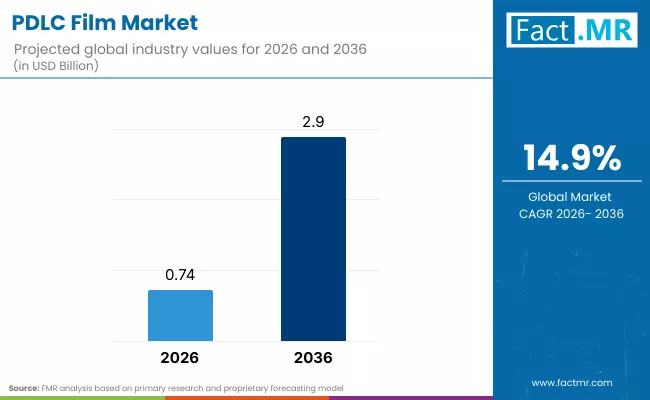
Pdlc Film Market By Industry | Source: Fact.MR
As Eyal Peso notes, “Smart glass is no longer just about visibility control, it is a platform for reducing energy consumption, improving comfort, and enhancing safety across mobility and built environments. By combining measurable performance gains with scalable, technology-driven innovation, solutions like Gauzy’s demonstrate how materials can deliver both commercial value and real-world impact”. This convergence of sustainability, efficiency, and user experience is expected to define the next phase of adoption, positioning smart glass as essential infrastructure rather than an optional enhancement.
PDLC Film Market
| Metric | Value |
|---|---|
| Estimated Value in (2026E) | USD 0.74 billion |
| Forecast Value in (2036F) | USD 2.9 billion |
| Forecast CAGR (2026 to 2036) | 14.9 % |
Source: Fact.MR analysis. Updated Feb 5, 2026
Category
| Category | Segments |
|---|---|
| Application Sector | Smart Windows, Display Optics, Automotive Glazing, Architectural Facades |
| Film Function | Light Modulation Films, Privacy Control Films, UV-Filtering Films, Decorative Films |
| Polymer System | PET-Based Multilayer, Polycarbonate, TPU Laminates, Acrylic Films |
| Region | United States; Germany; China; India; Japan |
Source: Fact.MR analysis. Updated Feb 5, 2026
Segmental Analysis
How is building automation integration positioning smart windows as the leading application in the PDLC film market?
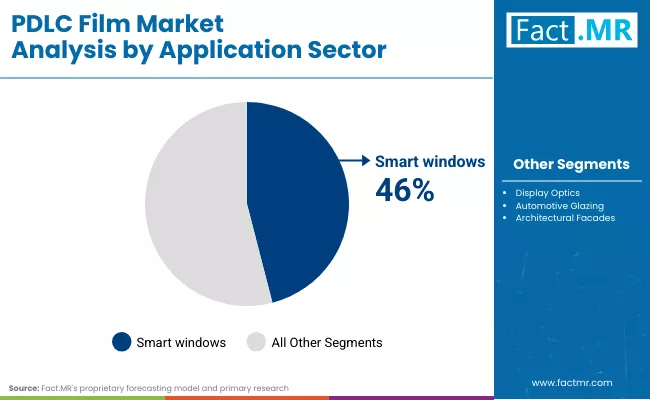
Pdlc Film Market By Application Sector | Source: Fact.MR
Smart windows account for 46% of the PDLC film market because they directly support energy-efficient building design. They dynamically manage solar heat gain, glare, and visual privacy based on real-time conditions. Automation allows transparency to adjust automatically with sunlight, occupancy, and time of day. Commercial offices, hotels, and institutional buildings increasingly specify PDLC glazing as a standard feature rather than a premium option. Building management systems now control windows alongside HVAC, lighting, and security. Energy savings from reduced cooling loads often deliver payback within five years. Smart windows also support green building certifications by improving energy performance and occupant comfort.
Why does light modulation dominance reshape performance priorities in PDLC applications?
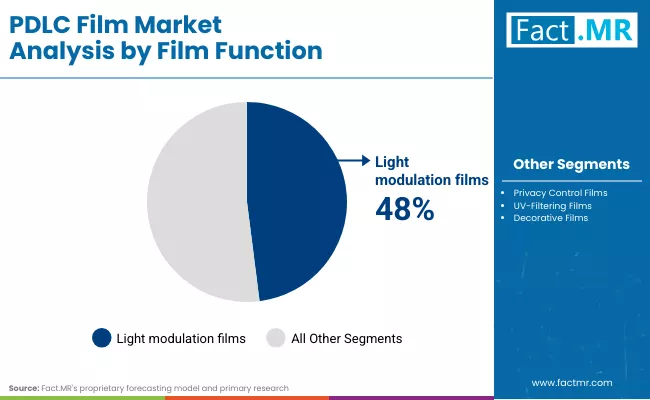
Pdlc Film Market By Film Function | Source: Fact.MR
Light modulation films hold 48% market share because they deliver measurable energy savings while preserving natural daylight. Unlike static tinted glass, PDLC films adapt continuously to changing sun angles and seasons. Buildings can increase light transmission during cloudy conditions and reduce solar heat during peak sunlight. This improves comfort without blocking exterior views, which supports productivity and well-being. Automotive applications value fast switching to prevent cabin overheating. Modern PDLC films switch in under three seconds and support wide transparency ranges, enabling both full privacy and maximum daylight when needed.
PDLC Film Market-Drivers, Restraints & Trends
- Drivers: A major driver of PDLC adoption is electric vehicle range optimization. Large glass areas increase solar heat gain, forcing air conditioning systems to work harder. This significantly reduces battery range. High-performance PDLC films reduce cabin heat load and can extend driving range by up to 30%. The benefit is especially strong in hot climates, where cooling can consume more than half of available battery power on short trips. As a result, automotive manufacturers increasingly specify switchable glazing in premium electric vehicles to improve comfort and efficiency.
- Restraints: High upfront costs remain a key barrier. PDLC systems typically cost three to five times more than conventional glazing. Added expenses for controls and power infrastructure further increase installation costs. Payback periods can exceed acceptable limits for cost-sensitive projects. Technical challenges also remain. Haze levels in transparent mode and limits on maximum panel size restrict some architectural uses. Continuous power requirements add operational costs and complicate retrofits in older buildings without suitable electrical infrastructure.
- Trend: IoT integration and building management systems IoT connectivity has become a baseline requirement. Building operators expect PDLC systems to integrate seamlessly with automation platforms. Transparency can now adjust automatically using occupancy sensors, daylight algorithms, and scheduling tools. This coordination improves energy efficiency by aligning glazing behavior with lighting and HVAC systems. Automated control reduces manual intervention and improves user experience across commercial spaces.
- Trend: healthcare sterile environment applications Healthcare adoption is accelerating due to infection control benefits. PDLC glass replaces fabric privacy curtains that trap pathogens and are difficult to sanitize. Hospitals increasingly use switchable glass in intensive care units and elderly care facilities. Smooth, non-porous surfaces support strict cleaning protocols. At the same time, staff retain visual access when privacy is not required. This supports infection prevention goals while improving patient monitoring and care quality.
PDLC Film Market by Analysis by Key Country
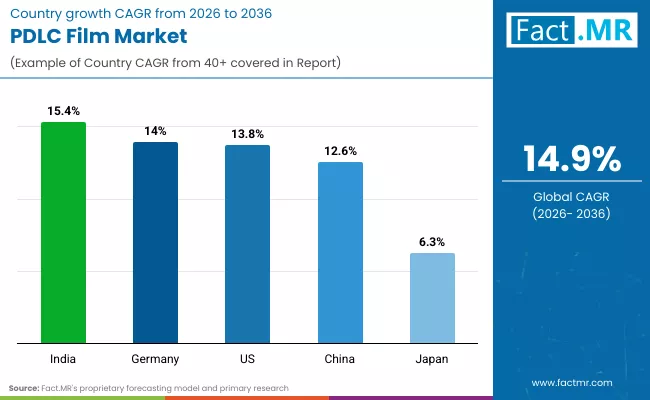
Pdlc Film Market By Country | Source: Fact.MR
| Country | CAGR (2026-2036) |
|---|---|
| India | 15.4% |
| Germany | 14.0% |
| US | 13.8% |
| China | 12.6% |
| Japan | 6.3% |
Source: Fact.MR analysis. Updated Feb 5, 2026
What building certification catalyst is accelerating PDLC adoption in India?
India shows the fastest growth at 15.4% CAGR, driven by green building codes requiring LEED and IGBC certification in Tier-1 cities. These rules encourage adoption of energy-efficient glazing in new construction and retrofits. Retrofit projects dominate the market. About 58% of installations use self-adhesive PDLC films that upgrade existing windows without full glass replacement. This lowers cost barriers and speeds deployment. Jindal Aluminium supports adoption through traceability systems that ensure installation quality across diverse regions. Fast installation aligns well with India’s rapid commercial development timelines.
What regulatory framework is shaping PDLC film standards in Germany?
Germany is growing at 14.0% CAGR, supported by strict enforcement of EU energy performance directives. From 2026, all non-residential buildings must meet zero-emission targets. This regulation is pushing developers toward smart glazing and partition systems that integrate PDLC films with building automation. Transparency is increasingly controlled through IoT-enabled building management systems that respond to occupancy, daylight, and thermal conditions. Gauzy expanded PDLC and SPD production capacity in Germany to meet rising demand. Advanced automation infrastructure and strong engineering expertise allow seamless coordination between glazing, HVAC, lighting, and security systems.
What is driving PDLC film demand in the United States market?
The United States PDLC film market is projected to grow at 13.8% CAGR, driven largely by electric vehicle range anxiety. High solar exposure in states such as California and Texas highlights the limits of conventional automotive glass. Excess cabin heat forces air conditioning systems to work harder, reducing driving range. PDLC films block up to 99% of UV radiation and can reduce HVAC energy use by as much as 30%. This performance makes them attractive to EV manufacturers and consumers alike. In parallel, Polytronix has launched low-power PDLC variants for commercial buildings. These products lower energy consumption while maintaining optical clarity, helping developers meet green building standards and earn LEED credits.
How is automotive industry transformation driving China’s PDLC film market expansion?
China’s PDLC film market grows at 12.6% CAGR, driven by rapid adoption of panoramic sunroofs and large glass areas in new energy vehicles. By early 2025-2026, panoramic glazing penetration reached 22.4%, increasing cabin heat gain challenges. Automakers require fast-switching PDLC films to manage heat without draining battery power. OEMs such as BYD now offer PDLC-dimmable side windows on premium models like the Yangwang U8L. Local suppliers support this growth with large-format film production near vehicle assembly hubs, enabling faster collaboration and customized solutions.
What demographic factor influences PDLC adoption in Japanese healthcare facilities?
Japan’s PDLC market grows at 6.3% CAGR, influenced by its rapidly aging population. Hospitals and elderly care facilities require privacy solutions that are easy to clean and support infection control. PDLC glass replaces fabric curtains that trap pathogens and are difficult to disinfect. Smooth, non-porous surfaces meet strict hygiene standards while allowing instant privacy control. Toppan Printing developed instant-switch PDLC films with sub-second response times. These solutions support clinical workflows and reflect Japan’s preference for clean, minimalist design.
Competitive Landscape for the PDLC Film Market
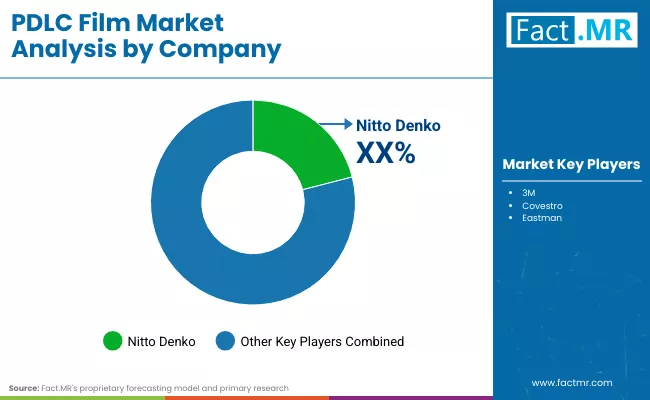
Pdlc Film Market By Company | Source: Fact.MR
Competition in the PDLC film market has changed significantly. The focus has moved beyond supplying film materials alone. Customers now expect complete solutions that combine PDLC films, control electronics, and installation support. These integrated offerings are required across architectural, automotive, and display applications, where performance and system compatibility matter. Leading companies are differentiating through vertical integration. Many control polymer development, film production, electrode patterning, and system integration. This allows them to support projects from early design through installation and ongoing operation. Nitto Denko maintains a strong position through advanced polymer chemistry and precision coating technologies. Its product range spans architectural glazing, automotive lamination, and specialty display films.
Since 2025, IoT compatibility has become a defining competitive factor. Companies without automation and connectivity capabilities risk being commoditized. 3M has leveraged optical materials expertise to develop PDLC films with high clarity and fast switching speeds. Its global manufacturing scale supports competitive pricing for large architectural and automotive programs.
Covestro contributes advanced polycarbonate and polyurethane technologies that improve durability under extreme temperatures and mechanical stress. Eastman supports innovation through specialty polymer systems that balance optical performance with efficient manufacturing. Thus, success in the PDLC film market now depends on integrated capabilities. Material science, optical engineering, electronics, and software must work together to support smart buildings and advanced automotive interfaces.
Key Players in PDLC Film Market
- Nitto Denko
- 3M
- Covestro
- Eastman
Bibliography
- Gauzy Ltd. 2025. Smart glass technologies and PDLC film innovations for architectural and automotive applications. Official company website and press releases.
- Polytronix, Inc. 2026. Low-power PDLC film solutions for commercial buildings and retrofit applications. Corporate product announcements and technical documentation.
- Nitto Denko Corporation. 2025. Advanced polymer films and optical materials for smart glazing systems. Corporate sustainability and technology reports.
- Packaging Europe. 2025. Energy-efficient glazing, smart window adoption, and EU building performance regulations. Industry trade publication.
- European Commission. 2026. Energy Performance of Buildings Directive (EPBD): Zero-emission requirements and smart building technologies. Brussels: European Union.
- Journal of Materials Science and Engineering. 2025. Polymer-dispersed liquid crystal films: Performance optimization, durability, and energy efficiency. Academic journal publication.
Segmentation
Scope of Report
| Items | Values |
|---|---|
| Quantitative Units (2026) | USD 0.74 Billion |
| Application Sector | Smart Windows, Display Optics, Automotive Glazing, Architectural Facades |
| Film Function | Light Modulation Films, Privacy Control Films, UV-Filtering Films, Decorative Films |
| Polymer System | PET-Based Multilayer, Polycarbonate, TPU Laminates, Acrylic Films |
| Regions Covered | North America, Europe, Asia Pacific, Latin America, Middle East & Africa |
| Countries Covered | U.S., Canada, Germany, Italy, UK, France, Japan, Australia, and other countries |
| Key Companies Profiled | Nitto Denko, 3M, Covestro, Eastman |
| Additional Attributes | Dollar revenue in the PDLC film market is segmented by application (smart windows, automotive glazing, interior partitions, display and privacy panels), technology type (PDLC, SPD, electrochromic hybrids), polymer platform (PET-based multilayer systems, polycarbonate substrates, specialty composite films), end-use sector (commercial buildings, residential buildings, automotive, healthcare), and region. |
Source: Fact.MR analysis. Updated Feb 5, 2026
PDLC Film Market by Segments
-
Application Sector :
- Smart Windows
- Display Optics
- Automotive Glazing
- Architectural Facades
-
Film Function :
- Light Modulation Films
- Privacy Control Films
- UV-Filtering Films
- Decorative Films
-
Polymer System :
- PET-Based Multilayer
- Polycarbonate
- TPU Laminates
- Acrylic Films
-
Region :
-
Asia Pacific
- China
- India
- Japan
- South Korea
- Australia
- Rest of Asia Pacific
-
North America
- United States
- Canada
- Mexico
-
Europe
- Germany
- France
- UK
- Italy
- Spain
- Rest of Europe
-
Latin America
- Brazil
- Mexico
- Argentina
- Rest of Latin America
-
Frequently Asked Questions
How big is the global PDLC film market in 2026?
What will be the size of the PDLC film market by 2036?
How fast will the PDLC film market grow during the forecast period?
Which application dominates the PDLC film market?
Which technology segment holds the largest share in the PDLC film market?
Who worked on this report


Preview the report firsthand - request a free sample
Free SampleGet the brochure for pricing and purchase details
Download PDF