- Market Value (2025): USD 2.8 Bn
- Estimated Value (2026): USD 3.1 Bn
- Forecast Value (2036): USD 8.7 Bn
- CAGR (2026-2036): 10.9%
What is the Pet Cameras Market forecast to be worth by 2036?
USD 3.1 billion in 2026 to USD 8.7 billion by 2036 at a 10.9% CAGR.
- The market stood at USD 2.8 billion in 2025.
- Demand is projected to increase from USD 3.1 billion in 2026 to USD 8.7 billion by 2036.
- The 2026 to 2036 forecast CAGR is 10.9%.
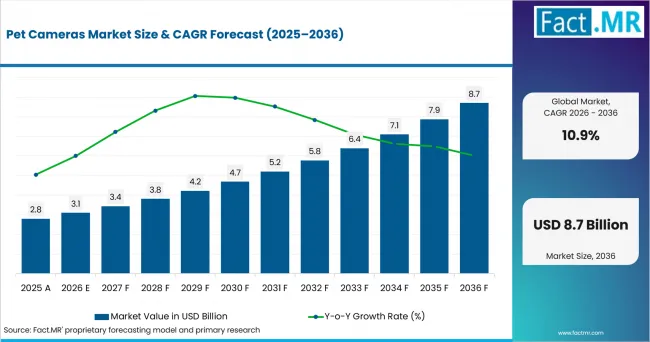
Pet Cameras Market Value Analysis | Source: Fact.MR
What are the defining numbers behind Pet Cameras Market growth?
The market is projected to add USD 5.6 billion in value between 2026 and 2036. Germany records the highest listed country CAGR at 12.5%, while Online Retail Channels account for 79.1% of Distribution Channel in 2026.
- Demand Drivers in the Market
- Remote supervision is becoming a routine pet-care workflow: owners increasingly want visual confirmation that an animal is resting, eating, moving normally, or staying out of restricted areas while the household is away. APPA reported 95 million U.S. households with at least one pet in 2025, while UK Pet Food estimated that 62% of UK households owned a pet in 2026. This creates a broad addressable base for cameras that reduce the information gap between in-person care periods. The same behavior supports adjacent pet sitting services where owners value remote updates and continuity of care.
- Interactive hardware converts observation into action: treat dispensing, two-way audio, auto tracking, laser or play functions, and real-time alerts give owners a reason to choose a pet-specific camera instead of a basic indoor camera. Furbo currently combines 360-degree viewing, treat tossing, two-way audio, auto tracking, and subscription-based alerts, while Petcube combines pan-tilt video, two-way audio, night vision, and AI recognition. This capability overlap with smart cameras raises feature expectations across the category.
- AI alerts increase the value of unattended monitoring: computer vision can distinguish pets, people, motion, barking, meowing, and selected behavior events, shifting the product from a live-view device toward an event-monitoring service. Buyers can review a smaller set of relevant events instead of watching continuous video, which supports AI-enabled hardware and subscription services. Similar sensing and analytics trends are visible in pet wearables, where owners use connected devices to extend pet monitoring beyond direct observation.
- Connected-home adoption lowers the setup barrier: pet cameras increasingly use the same Wi-Fi, smartphone apps, cloud storage, voice assistants, and multi-device controls already present in smart households. Brazil illustrates the enabling infrastructure: IBGE reported that 20.2% of internet-connected households had an internet-accessible smart device in 2025, up from 14.3% in 2022. Pet cameras can therefore enter homes as part of a broader connected home purchasing pattern rather than as an isolated pet accessory.
- Key Segments Analyzed
- Interactive Pet Cameras account for 44.8% of Product in 2026 because treat dispensing and play functions give owners a reason to interact with pets rather than only watch them.
- Remote Pet Monitoring accounts for 73.6% of Application in 2026 because real-time observation and activity checks address the core need to know what a pet is doing while the owner is away.
- Residential Pet Owners account for 67.9% of End Use in 2026 as households purchase cameras for daily supervision, reassurance, behavior checks, and remote interaction.
- AI & Computer Vision Technology accounts for 36.2% of Technology in 2026 because recognition and behavior analytics reduce continuous viewing and convert video into actionable alerts.
- Standalone Camera Systems account for 58.7% of Formulation in 2026 because a single camera offers a lower-friction entry point than a broader cloud or multi-device ecosystem.
- Online Retail Channels account for 79.1% of Distribution Channel in 2026 because buyers can compare camera resolution, interaction features, subscription requirements, reviews, and direct-brand offers in one purchase flow.
- Analyst Opinion at Fact.MR
- Shambhu Nath Jha, Sr. Consultant, Fact.MR says, “Pet cameras are moving from passive viewing toward event-led pet care. Products that combine reliable video with a clear action layer, such as talking to the pet, dispensing a reward, receiving a behavior alert, or reviewing recorded activity, can support more active use. The commercial challenge is that every added cloud or AI function also raises expectations around privacy, software support, alert accuracy, and subscription value.”
- Strategic Implications
- Hardware suppliers should separate free core functions from subscription features clearly. Buyers need to understand which alerts, video history, cloud storage, AI recognition, or health-related summaries remain available after the initial purchase.
- Privacy controls need to be visible product features. Physical privacy modes, encryption, account security, update policies, and clear recording indicators can influence conversion because the device operates inside the home.
- Manufacturers should design around pet behavior rather than simply adapting a security camera. Camera angle, chew-resistant power design, speaker quality, treat compatibility, pet-safe play functions, and false-alert reduction affect daily usability.
- Smart-home integration can broaden use beyond pet monitoring, but it also increases cybersecurity obligations and competitive overlap with home security systems that already offer indoor video and two-way communication.
How does the Pet Cameras Market break down by segment?
The market is segmented by Product, Application, End Use, Technology, Formulation, and Distribution Channel.
Why do Interactive Pet Cameras lead Product?
Interactive Pet Cameras account for 44.8% of the Product segment in 2026.
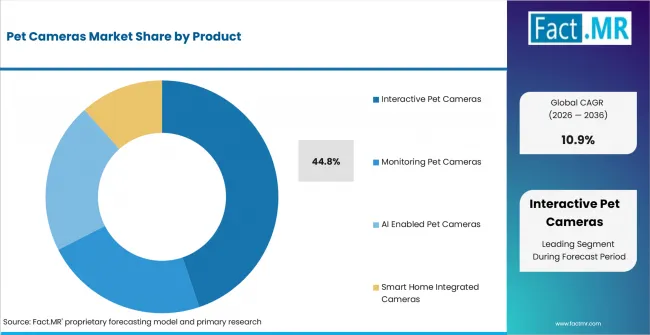
Pet Cameras Market Analysis By Product | Source: Fact.MR
The segment leads because it adds a controllable action to remote video. Treat dispensing, laser play, two-way audio, and automated tracking give the owner a way to reward, redirect, or engage a pet after observing behavior. This creates more frequent use than a camera designed only for passive viewing.
Furbo and Petcube illustrate the workflow. Current models combine wide or rotating views with audio, alerts, and interactive or subscription functions. Buyers therefore compare the camera as a pet-care device rather than only on image resolution.
Why does Remote Pet Monitoring lead Application?
Remote Pet Monitoring accounts for 73.6% of the Application segment in 2026.
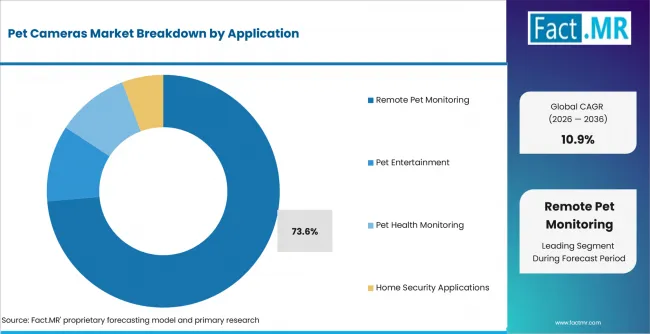
Pet Cameras Market Analysis By Application | Source: Fact.MR
The primary purchase question is whether the owner can check the pet when nobody is physically present. Real-time observation, activity tracking, night vision, motion alerts, and video history help owners confirm routine behavior and identify events that may need a response.
This use case also fits multi-person households and pet-care handoffs. A shared app view can let family members or caregivers verify feeding, rest, movement, and room access without requiring a continuous call or in-person visit.
Why do Residential Pet Owners lead End Use?
Residential Pet Owners account for 67.9% of the End Use segment in 2026.
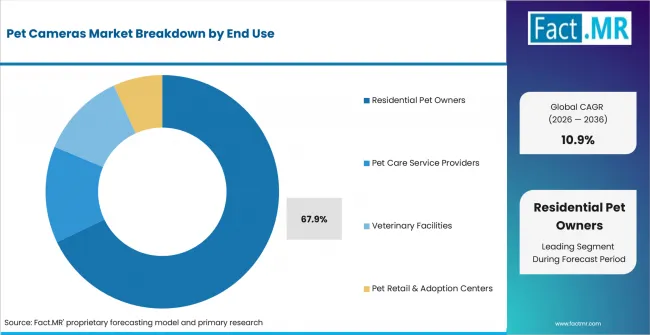
Pet Cameras Market Analysis By End Use | Source: Fact.MR
Households purchase pet cameras for recurring daily situations: work hours, errands, travel, separation from a pet, or supervision of an animal recovering from a routine procedure. The product is therefore bought as a household device, with pet boarding facilities, veterinary sites, and adoption centers representing more specialized use cases.
Large pet-owning household bases support this pattern. Germany reported pets in 43% of households in 2025, while APPA reported 95 million pet-owning U.S. households in the same year. A residential device can be adopted without changes to the care organization or facility infrastructure.
Why does AI & Computer Vision Technology lead Technology?
AI & Computer Vision Technology accounts for 36.2% of the Technology segment in 2026.
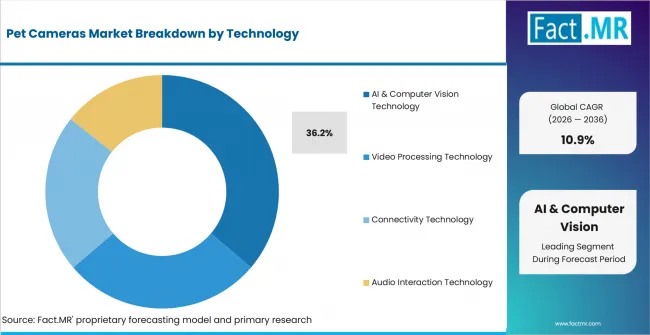
Pet Cameras Market Analysis By Technology | Source: Fact.MR
Recognition and behavior analytics make camera output easier to act on. Instead of treating every movement as the same event, software can identify pets, people, barking, meowing, activity, or selected behavior patterns and then send a more specific notification.
This shifts value toward software quality and model performance. It also supports subscription revenue because event classification, cloud history, diaries, and advanced alerts can continue after the hardware sale. Buyers increasingly judge the usefulness of the alert stream rather than the camera sensor alone.
Why do Standalone Camera Systems lead Formulation?
Standalone Camera Systems account for 58.7% of the Formulation segment in 2026.
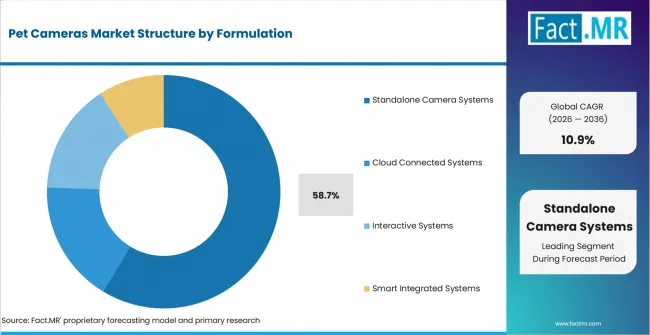
Pet Cameras Market Analysis By Formulation | Source: Fact.MR
A standalone system lets a buyer install one device, connect it to Wi-Fi, and begin monitoring without purchasing a broader smart-home bundle. That lowers the initial cost and reduces configuration complexity for first-time users.
Standalone does not mean isolated. Current devices can still use cloud recording, smartphone access, voice assistants, or optional subscriptions. The distinction is that the camera remains the primary purchase rather than one component in a multi-device ecosystem.
Why do Online Retail Channels lead Distribution Channel?
Online Retail Channels account for 79.1% of the Distribution Channel segment in 2026.
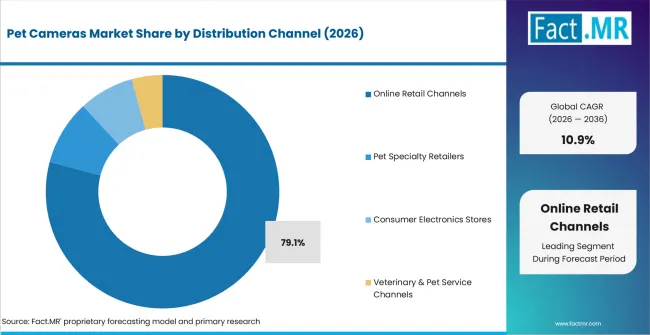
Pet Cameras Market Analysis By Distribution Channel | Source: Fact.MR
Pet cameras are specification-led consumer electronics. Buyers compare resolution, field of view, night vision, treat capacity, app compatibility, subscription terms, alert types, warranty, and user reviews before purchase. Online retail makes these comparisons easier than shelf-based buying.
Direct-brand platforms also allow suppliers to bundle cameras with subscriptions, multi-camera packs, replacement accessories, or introductory service trials. This supports online conversion while giving manufacturers a direct route to software-service revenue after the device sale.
What is accelerating Pet Cameras Market adoption, and what is holding it back?
Adoption is being accelerated by large pet-owning household bases, connected-home infrastructure, AI event recognition, and products that combine monitoring with interaction. The main friction points are privacy and cybersecurity concerns, recurring subscription costs, dependence on stable Wi-Fi and cloud services, and substitution by general indoor security cameras that already provide remote video and two-way audio.
Regulation is making security a product requirement rather than a background issue. The UK consumer connectable product security regime requires baseline controls such as protections against easily guessable passwords, vulnerability-reporting information, and disclosure of minimum security-update periods. The EU Cyber Resilience Act is adding lifecycle cybersecurity obligations for products with digital elements, with reporting obligations beginning in September 2026 and broader obligations applying later.
Drivers Impact Analysis
| Factor | (~) % Impact on CAGR | Geographic Relevance | Impact Timeline |
|---|---|---|---|
| Remote monitoring across pet-owning households | 2.9% | USA; UK; Germany; Japan | Near to mid term |
| AI recognition and behavior alerts | 2.5% | Global; USA; Germany; UK | Near to mid term |
| Interactive treat, audio, and play functions | 2.1% | Global | Near term |
| Connected-home and smartphone integration | 1.8% | Germany; USA; UK; Brazil; Japan | Mid term |
Opportunity Impact Analysis
| Factor | (~) % Impact on CAGR | Geographic Relevance | Impact Timeline |
|---|---|---|---|
| Subscription-based AI and video-history services | 2.4% | USA; Germany; UK; Japan | Near to mid term |
| Behavior and wellness monitoring functions | 2.0% | USA; Japan; Germany | Mid term |
| Multi-camera and smart-home ecosystem integration | 1.7% | USA; UK; Germany; Brazil | Mid term |
| Veterinary, daycare, boarding, and service-channel adoption | 1.3% | Global | Mid to long term |
Restraints Impact Analysis
| Factor | (~) % Impact on CAGR | Geographic Relevance | Impact Timeline |
|---|---|---|---|
| Privacy and cybersecurity concerns in indoor connected cameras | -1.7% | UK; European Union; USA; Global | Near to long term |
| Subscription cost and feature paywalls | -1.3% | Global | Near term |
| Dependence on Wi-Fi, power, apps, and cloud availability | -1.0% | Global | Near to mid term |
| Substitution by general indoor security cameras | -0.8% | USA; UK; Germany; Japan | Mid term |
Which countries are scaling the Pet Cameras Market through 2036?
- Germany: a large pet-owning household base, high connected-device adoption, and tighter cybersecurity requirements support demand for cameras that combine pet-specific functions with documented software support and security controls.
- Brazil: widespread pet ownership and expanding smart-device penetration create room for online-led camera adoption, especially in urban households already using connected cameras, speakers, lighting, or other app-controlled devices.
- USA: 95 million pet-owning households in 2025 create a broad consumer base, while direct-to-consumer brands and subscription services make advanced monitoring and interaction features easy to purchase and renew.
- UK: pet ownership is widespread and smart-device security rules are already in force, so product trust, software-update transparency, and secure account design can influence purchasing alongside video and interaction features.
- Japan: a stable base of dog and cat owners, multi-pet households, premium pet-care behavior, and demand for compact indoor solutions support cameras used for observation and communication when owners are away.
Country CAGR (2026-2036)
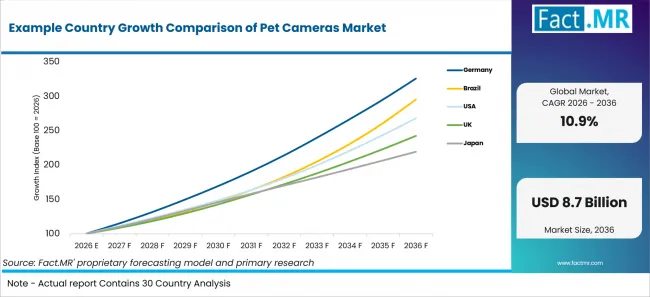
Example Country Growth Comparison Of Pet Cameras Market | Source: Fact.MR
| Country | CAGR (2026-2036) |
|---|---|
| Germany | 12.5% |
| Brazil | 11.5% |
| USA | 10.4% |
| UK | 9.3% |
| Japan | 8.2% |
What is driving Germany’s growth through 2036?
Germany is forecast to expand at a 12.5% CAGR from 2026 to 2036.
Germany had at least one pet in 43% of households in 2025, with 33.4 million dogs, cats, small mammals, and pet birds living in households according to ZZF and IVH. This creates a substantial installed household base for connected pet-care devices, including cameras used during work hours, travel, and other periods when the owner is away.
Cybersecurity is also becoming part of product competitiveness. The EU Cyber Resilience Act applies to products with digital elements and requires manufacturers to manage security across design, development, and maintenance. Pet-camera suppliers selling connected devices in Germany therefore need to compete on software support and vulnerability handling alongside pet-specific functionality.
What is driving Brazil’s growth through 2036?
Brazil is forecast to expand at an 11.5% CAGR from 2026 to 2036.
Brazil combines a high companion-animal presence with a growing base of connected homes. ABEMPET reports an average of 1.8 pets per residence. IBGE reported that 15.4 million internet-connected households, or 20.2%, had an internet-accessible smart device in 2025, up from 14.3% in 2022.
This matters because pet cameras use the same household infrastructure as other connected devices: broadband, Wi-Fi, smartphones, and app-based control. As more homes become comfortable with internet-connected cameras and other smart products, the technical barrier to adding a pet-specific device declines.
What is driving USA’s growth through 2036?
The USA is forecast to expand at a 10.4% CAGR from 2026 to 2036.
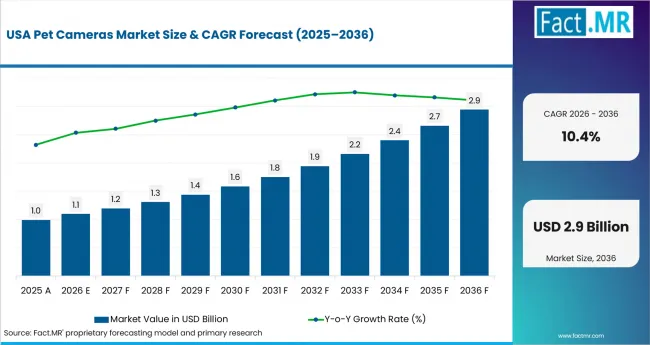
Pet Cameras Market Country Value Analysis | Source: Fact.MR
APPA reported 95 million U.S. households owning at least one pet in 2025. That scale supports multiple product tiers, from basic indoor monitoring to interactive cameras with treat dispensing, AI alerts, video history, and subscription services.
The market also benefits from direct digital distribution. Furbo and Petcube sell cameras and service plans online, allowing the initial hardware purchase to be followed by recurring cloud, alert, or video-history revenue. This encourages suppliers to keep improving software features after launch rather than competing only on camera hardware.
What is driving UK’s growth through 2036?
The UK is forecast to expand at a 9.3% CAGR from 2026 to 2036.
UK Pet Food estimated that 62% of households owned one of the country’s 36.5 million pets in 2026, including about 15.5 million dogs and 13 million cats. The household base supports monitoring demand across working owners, multi-pet homes, and periods when pets are left with sitters or family members.
Connected-device security is a direct commercial consideration. The UK consumer connectable product security regime has applied since 29 April 2024 and requires baseline measures around passwords, vulnerability reporting, and minimum security-update periods. For indoor pet cameras, compliance and clear support policies can reduce buyer concern about putting a networked camera inside the home.
What is driving Japan’s growth through 2036?
Japan is forecast to expand at an 8.2% CAGR from 2026 to 2036.
The Japan Pet Food Association estimated about 6.82 million dogs and 8.847 million cats in 2025. The association also reported that dog numbers had stabilized and that multi-pet ownership remained meaningful, supporting continued spending on products that help owners manage companion animals in the home.
Pet cameras fit households that need compact supervision tools rather than additional human presence. Real-time viewing, audio, recognition alerts, and recorded events can help owners monitor animals during work or travel while avoiding the space requirements of larger pet-care equipment.
Who Leads the Pet Cameras Market?
Furbo leads the Pet Cameras Market.
Furbo competes through pet-specific interaction and a software-service layer. Its current camera range includes rotating views, two-way audio, treat dispensing, auto tracking, barking or meowing alerts, video history, and AI-powered Furbo Nanny functions. Petcube competes with pan-tilt monitoring, night vision, two-way audio, AI alerts, and subscription-based video services. Pawbo adds treat and play functionality and has operated within Acer following Acer’s acquisition of the company.
SafeWise currently operates as a home-safety research and product-review publisher rather than a dedicated pet-camera manufacturer. Direct device competition is shaped by camera hardware, app reliability, AI alert quality, subscription economics, privacy controls, and after-sale software support.
Which companies are the key providers?
Key companies include Furbo; Petcube; Safewise; Petchartz; Pawbo; Vimtag; Ezviz; and Cleverdog.
- Furbo
- Petcube
- Safewise
- Petchartz
- Pawbo
- Vimtag
- Ezviz
- Cleverdog
Bibliography
- American Pet Products Association. (2026). 2026 State of the Industry Report. American Pet Products Association.
- ZZF and IVH. (2026). Der Deutsche Heimtiermarkt 2025. Zentralverband Zoologischer Fachbetriebe Deutschlands and Industrieverband Heimtierbedarf.
- UK Pet Food. (2026). UK Pet Population 2026. UK Pet Food.
- Instituto Brasileiro de Geografia e Estatística. (2026). Internet chega a 95% de domicílios do país em 2025. IBGE.
- ABEMPET. (2026). Informações Gerais do Setor. Associação Brasileira das Empresas do Setor de Animais de Estimação.
- Pet Food Association of Japan. (2026). 2025 dog and cat ownership survey summary and chairman’s industry statement. Pet Food Association of Japan.
- Furbo. (2026). Compare Furbo Cameras and Furbo Nanny features. Furbo.
- Petcube. (2024). Introducing the Petcube Cam 360. Petcube.
- Department for Science, Innovation and Technology. (2025). Regulations: consumer connectable product security. UK Government.
- European Commission. (2026). Cyber Resilience Act: summary and implementation guidance. European Commission.
- SafeWise. (2026). About SafeWise: home safety and security research and product testing. SafeWise.
- Acer. (2016). Pawbo+ lets owners interact with their pets from afar. Acer.
This Report Answers
- Which pet-camera products and interaction formats are included in the market?
- Why are remote monitoring and interactive functions central to purchase decisions?
- How are AI recognition and cloud services changing the camera value proposition?
- Why do residential owners hold the leading share of demand?
- How do cybersecurity, subscriptions, and connectivity affect adoption?
- Which country-specific pet ownership and connected-device trends support demand?
- How do dedicated pet-camera brands differ from adjacent home-security products?
What does the Pet Cameras Market cover?
The market covers pet-oriented camera systems across Product, Application, End Use, Technology, Formulation, and Distribution Channel. It includes devices used for remote observation, interaction, behavior monitoring, pet entertainment, wellness-related monitoring, and pet-linked home security when the commercial product is positioned within the pet-camera scope.
What is included in the scope?
- Products: Interactive Pet Cameras, Monitoring Pet Cameras, AI Enabled Pet Cameras, and Smart Home Integrated Cameras, including the listed subsegments.
- Applications: Remote Pet Monitoring, Pet Entertainment, Pet Health Monitoring, and Home Security Applications, including the listed subsegments.
- End Use: Residential Pet Owners, Pet Care Service Providers, Veterinary Facilities, and Pet Retail & Adoption Centers, including the listed subsegments.
- Technology: AI & Computer Vision Technology, Video Processing Technology, Connectivity Technology, and Audio Interaction Technology, including the listed subsegments.
- Formulation: Standalone Camera Systems, Cloud Connected Systems, Interactive Systems, and Smart Integrated Systems, including the listed subsegments.
- Distribution Channel: Online Retail Channels, Pet Specialty Retailers, Consumer Electronics Stores, and Veterinary & Pet Service Channels, including the listed subsegments.
- Geographic detail: Global market sizing with country analysis for Germany, Brazil, USA, UK, and Japan.
What is excluded from the scope?
- General-purpose security cameras are excluded when they are sold only for home or property surveillance without a pet-oriented positioning or pet-specific commercial use case.
- Pet wearables, GPS collars, feeders, litter systems, and other connected pet devices are excluded when no camera is part of the product offering within scope.
- Veterinary diagnosis, tele-veterinary consultation, boarding, grooming, or pet-sitting service revenue is excluded when the camera is only an enabling tool rather than the product being sold.
- Standalone cloud storage, broadband connectivity, or smart-home subscription revenue is excluded unless it is bundled directly with the pet-camera commercial offering.
How Was the Analysis Built?
The analysis maps pet-camera demand to the household and service workflows that cause users to purchase a connected camera: unattended pet observation, remote interaction, behavior alerts, entertainment, wellness checks, and pet-linked security. Product, application, end use, technology, formulation, distribution, country demand, and company positioning are cross-checked so that forecast logic reflects pet-camera usage rather than the broader surveillance-camera market.
- Primary Research
- Relevant respondent groups include pet-camera manufacturers, consumer-electronics distributors, pet specialty retailers, e-commerce sellers, pet boarding and daycare operators, veterinary facility managers, connected-home specialists, app and cloud-service teams, and pet owners using remote monitoring products.
- Desk Research
- Desk research uses pet ownership and household data, connected-device adoption statistics, consumer IoT cybersecurity requirements, product specifications, company portfolio information, and pet-care industry publications. These sources support demand mechanisms, technology adoption, cybersecurity requirements and current company status.
- Market Sizing and Forecasting
- Sizing links pet-owning households and service locations with camera adoption, replacement cycles, average selling prices, interactive-feature mix, subscription attachment, online channel penetration, and multi-camera purchasing. Forecasting considers pet ownership, connected-home adoption, AI feature development, e-commerce access, software-service monetization, cybersecurity requirements, and substitution from general indoor cameras.
- Data Validation and Update Cycle
- Assumptions are checked against current product functions, country pet populations, connected-device indicators, software-service models, security requirements, and corporate or brand relationships. Updates focus on changes that can alter device adoption, feature mix, channel behavior, subscription use, or supplier positioning.
What is the report's scope and coverage?
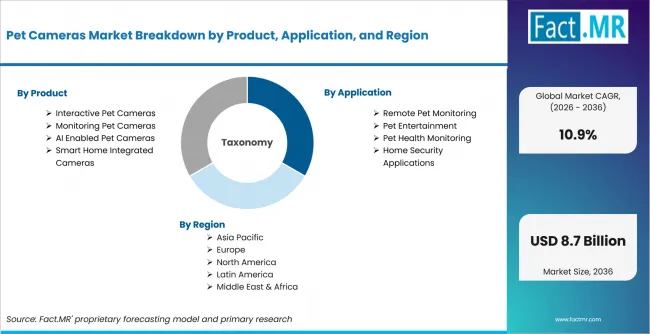
Pet Cameras Market Breakdown By Product, Application, And Region | Source: Fact.MR
| Attribute | Details |
|---|---|
| Quantitative Units | USD Billion |
| Market Definition | Pet-oriented connected camera systems used for remote monitoring, interaction, behavior observation, entertainment, wellness-related monitoring, and pet-linked security. |
| Segments Covered | Product; Application; End Use; Technology; Formulation; Distribution Channel |
| Regions Covered | Global analysis with detailed country coverage for the listed markets. |
| Countries Covered | Germany; Brazil; USA; UK; Japan |
| Key Companies Profiled | Furbo; Petcube; Safewise; Petchartz; Pawbo; Vimtag; Ezviz; Cleverdog |
| Forecast Period | 2026-2036 |
| Base Year | 2026 |
| Market Value, 2026 | USD 3.1 billion |
| Market Value, 2036 | USD 8.7 billion |
| CAGR, 2026-2036 | 10.9% |
| Absolute Opportunity | USD 5.6 billion |
How is the market segmented?
-
By Product:
- Interactive Pet Cameras
- Treat Dispensing Cameras
- Laser Play Cameras
- Monitoring Pet Cameras
- Indoor Monitoring Cameras
- Outdoor Monitoring Cameras
- AI Enabled Pet Cameras
- Behavior Analysis Cameras
- Recognition Cameras
- Smart Home Integrated Cameras
- Voice Assistant Compatible Cameras
- Home Security Integrated Cameras
- Interactive Pet Cameras
-
By Application:
- Remote Pet Monitoring
- Real Time Observation
- Activity Tracking
- Pet Entertainment
- Interactive Play Applications
- Reward Based Applications
- Pet Health Monitoring
- Behavior Monitoring Applications
- Wellness Tracking Applications
- Home Security Applications
- Pet Linked Security Monitoring
- Property Surveillance Applications
- Remote Pet Monitoring
-
By End Use:
- Residential Pet Owners
- Single Pet Households
- Multi Pet Households
- Pet Care Service Providers
- Pet Boarding Facilities
- Pet Daycare Centers
- Veterinary Facilities
- Veterinary Clinics
- Animal Hospitals
- Pet Retail & Adoption Centers
- Pet Stores
- Animal Shelters
- Residential Pet Owners
-
By Technology:
- AI & Computer Vision Technology
- Recognition Systems
- Behavior Analytics Systems
- Video Processing Technology
- HD Video Systems
- Night Vision Systems
- Connectivity Technology
- Wireless Communication Systems
- Cloud Connectivity Systems
- Audio Interaction Technology
- Two Way Communication Systems
- Voice Control Systems
- AI & Computer Vision Technology
-
By Formulation:
- Standalone Camera Systems
- Basic Monitoring Systems
- Advanced Monitoring Systems
- Cloud Connected Systems
- Subscription Based Systems
- Hybrid Storage Systems
- Interactive Systems
- Reward Based Systems
- Play Based Systems
- Smart Integrated Systems
- Smart Home Ecosystems
- Multi Device Ecosystems
- Standalone Camera Systems
-
By Distribution Channel:
- Online Retail Channels
- E Commerce Marketplaces
- Brand Direct Platforms
- Pet Specialty Retailers
- Independent Pet Stores
- Large Pet Retail Chains
- Consumer Electronics Stores
- Physical Electronics Retailers
- Omnichannel Electronics Retailers
- Veterinary & Pet Service Channels
- Veterinary Distribution Channels
- Pet Service Providers
- Online Retail Channels