- Market Value (2025): USD 623.8 Mn
- Estimated Value (2026): USD 686.0 Mn
- Forecast Value (2036): USD 1776.1 Mn
- CAGR (2026-2036): 10.0%
What is the PFAS-Free Odor Capture Additives Market forecast to be worth by 2036?
USD 686.0 million in 2026 to USD 1776.1 million by 2036 at a 10.0% CAGR.
- The PFAS-Free Odor Capture Additives Market was valued at USD 623.8 million in 2025.
- Demand is projected to increase from USD 686.0 million in 2026 to USD 1776.1 million by 2036.
- The market is forecast to record a 10.0% CAGR from 2026 to 2036 as compounders and brand owners move toward PFAS-free odor systems for recycled polymers and vehicle interiors.
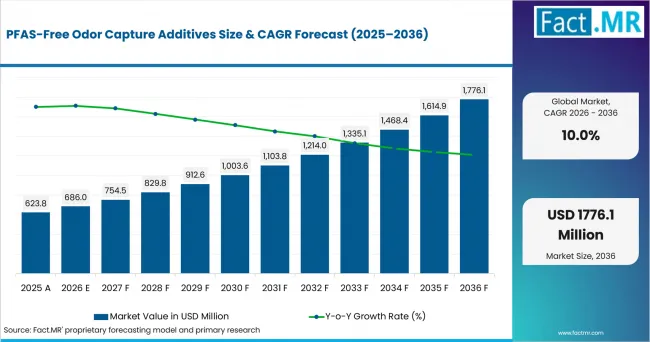
Pfas Free Odor Capture Additives Value Analysis | Source: Fact.MR
What are the defining numbers behind PFAS-Free Odor Capture Additives Market growth?
USD 1,090.1 million absolute opportunity by 2036, led by mineral adsorbents, VOC / aldehyde control and automotive interiors.
- Demand Drivers in the Market
- Automotive material teams need low-odor PP and TPO compounds since cabin trim, mats and HVAC-adjacent parts face tighter smell and fogging checks.
- Packaging converters need odor-neutralizing masterbatches because recycled PE and PP can carry food, detergent and organic smells into finished packs.
- EPA added nine PFAS to the Toxics Release Inventory for Reporting Year 2025, bringing the total number of PFAS subject to TRI reporting to 205 and increasing reporting considerations for covered facilities using these substances.
- Film and sheet producers serving food-contact packaging applications face tighter PFAS requirements under the EU Packaging and Packaging Waste Regulation. From August 12, 2026, food-contact packaging placed on the EU market must comply with specified PFAS concentration limits, increasing the relevance of non-fluorinated processing and additive solutions.
- Key Segments Analyzed
- By Odor-Control Chemistry: Mineral adsorbent is projected to hold 30.0% share in 2026 because porous systems fit masterbatch dosing and broad odor capture.
- By Target Odor: VOC / aldehyde is anticipated to account for 28.0% share in 2026, supported by automotive interior and recycled-polymer odor targets.
- By Polymer: PP is estimated to represent 36.0% share in 2026 owing to use in molded vehicle parts, rigid packaging and reusable consumer products.
- By Application: Automotive interiors are forecast to capture 42.0% share in 2026 because cabin material approvals place direct weight on odor and emissions behavior.
- Analyst Opinion at Fact.MR
- Shambhu Nath Jha, Principal Consultant at Fact.MR, states, "The commercial test for this market is odor control after heat history and part storage. Suppliers are expected to gain confidence when PFAS-free chemistry is backed by polymer fit and application testing. Winning formulations need clean sensory results, narrow dosage guidance and documentation that survives customer review."
- Strategic Implications
- Additive suppliers should publish polymer-specific odor data for PP, PE, TPO and PA compounds so material teams can compare systems with less trial work.
- Masterbatch producers should connect dosage guidance with VOC / aldehyde testing because converters need a clear route from lab batches to line trials.
- VDA reported that approximately 4.15 million passenger cars were produced in Germany in 2025, highlighting the scale of the country’s automotive manufacturing base.
- Eurostat reported that the EU generated an average of 35.3 kg of plastic packaging waste per person in 2023, of which 14.8 kg per person was recycled. The scale of plastic packaging waste and recycling provides relevant context for converters evaluating recycled-content formulations and associated performance requirements.
France is projected to record 12.8% CAGR through 2036 due to PFAS restrictions in consumer-facing materials. Japan is anticipated to post 12.3% CAGR, supported by packaging quality needs and molded-polymer use. The USA is estimated to advance at 9.8% CAGR as PFAS reporting expands chemical transparency. Germany is forecast to hold 8.9% CAGR, reinforced by vehicle-interior material programs. Switzerland is projected to reach 7.1% CAGR, shaped by chemical-risk controls and premium material screening.
How does the PFAS-Free Odor Capture Additives Market break down by segment?
Mineral adsorbent leads at 30.0%; Automotive interiors lead at 42.0%.
Which odor-control chemistry leads?
Mineral adsorbent holds 30.0% share in 2026.
Mineral adsorbents lead because zeolite and silica-type structures give compounders a practical route to trap odor molecules during resin processing. These systems suit odor-scavenging masterbatches where the additive must disperse through recycled PE, PP or TPO without changing the base resin route.
Porous mineral systems are also familiar to plastics processors, which helps line teams manage dosing and heat exposure. Reactive odor neutralizers are expected to gain use in targeted applications, but mineral adsorbents remain easier to trial across broad odor mixes.
What leads the Target Odor segment?
VOC / aldehyde accounts for 28.0% share in 2026.
VOC / aldehyde odor leads because these compounds are central to cabin-air perception and recycled-polymer quality. Automotive interior teams test smell after heat aging, while packaging converters review whether a recycled resin carries enough odor to affect packed goods.
The segment is also supported by adjacent demand for polyolefin odor neutralizers in PP and PE applications. Amine and sulfur-compound capture remains relevant where recycled streams include personal care, household or food-contact residues.
How does Polymer shape demand?
PP represents 36.0% share in 2026.
PP leads the polymer segment because it is common in automotive trim, rigid packaging and molded consumer products. The resin tolerates masterbatch dosing well, and its frequent use with recycled content creates a clear need for odor control during qualification.
Material teams working with automotive polypropylene laminates and molded PP parts value odor systems that keep color and surface feel stable. PE remains close behind because packaging film and bottle applications face repeated sensory checks.
What supports Automotive interiors within Application?
Automotive interiors capture 42.0% share in 2026.
Automotive interiors hold the application lead because passengers notice odor in enclosed cabins before many other material defects. Low-odor additives are therefore evaluated with fogging, VOC behavior and surface appearance during interior-part approval.
Demand is linked to automotive interior materials where polymers are used across trim, flooring and soft-touch surfaces. Packaging and consumer goods remain material opportunities as recycled content grows and sensory quality becomes a brand-screening issue.
What is accelerating PFAS-Free Odor Capture Additives Market adoption, and what is holding it back?
Demand rises through PFAS-free substitution and recycled-polymer odor control; adoption is constrained by validation cost and formulation sensitivity.
| DRIVER | (~) % IMPACT ON CAGR | GEOGRAPHIC RELEVANCE | IMPACT TIMELINE |
|---|---|---|---|
| PFAS reporting and restriction pressure | +1.5% | North America, Europe | Short term (<= 2 years) |
| Recycled polymer odor management | +1.2% | Global | Medium term (2-4 years) |
| Automotive cabin material approval | +1.0% | USA, Germany, Japan | Medium term (2-4 years) |
| Packaging sensory quality control | +0.8% | Europe, East Asia | Long term (>= 4 years) |
Opportunity Impact Analysis
| OPPORTUNITY | (~) % IMPACT ON CAGR | GEOGRAPHIC RELEVANCE | IMPACT TIMELINE |
|---|---|---|---|
| PFAS-free masterbatch lines for PCR packaging | +1.1% | Europe, USA | Short term (<= 2 years) |
| Low-odor PP and TPO for vehicle cabins | +0.9% | Germany, Japan, USA | Medium term (2-4 years) |
| Bio-based odor scavenger systems | +0.6% | France, Switzerland | Long term (>= 4 years) |
Restraint Impact Analysis
| RESTRAINT | (~) % IMPACT ON CAGR | GEOGRAPHIC RELEVANCE | IMPACT TIMELINE |
|---|---|---|---|
| Odor test variability across recycled resin streams | -0.6% | Global | Short term (<= 2 years) |
| Dose sensitivity in thin-wall packaging | -0.4% | Europe, USA | Medium term (2-4 years) |
| Evidence burden for PFAS-free claims | -0.3% | Europe, North America | Long term (>= 4 years) |
Which countries are scaling the PFAS-Free Odor Capture Additives Market through 2036?
- The country comparison spans 5.7 percentage points and forms three practical growth bands across the forecast period.
- France remains 0.5 percentage point above Japan because PFAS restrictions are moving earlier in consumer-facing material categories.
- Japan remains 2.5 percentage points above the USA as packaging quality and automotive polymer screening support odor-control trials.
- The USA remains 0.9 percentage point above Germany through PFAS reporting expansion and large plastics conversion capacity.
- Germany remains 1.8 percentage points above Switzerland as vehicle-cabin programs support low-odor PP and TPO compounds.
- Switzerland closes the displayed range through strict chemical-risk controls and premium material screening.
Comparable CAGRs create different entry conditions due to PFAS rules, recycled-polymer quality, automotive validation and packaging sensory checks. Full report coverage includes North America, Latin America, Western Europe, Eastern Europe, East Asia, South Asia & Pacific, Middle East & Africa.
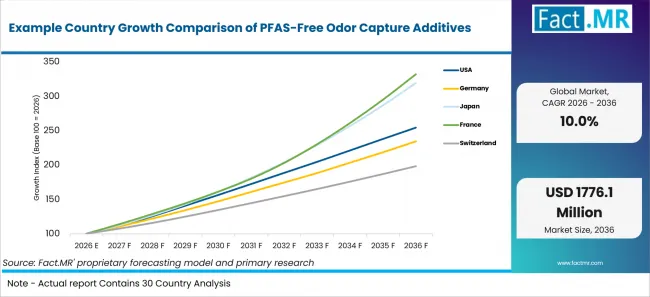
Example Country Growth Comparison Of Pfas Free Odor Capture Additives | Source: Fact.MR
| Country | CAGR (2026-2036) |
|---|---|
| France | 12.8% |
| Japan | 12.3% |
| USA | 9.8% |
| Germany | 8.9% |
| Switzerland | 7.1% |
What supports France adoption?
12.8% CAGR, supported by PFAS restrictions and recycled-plastic odor control.
France’s Law No. 2025-188 prohibits, from January 1, 2026, the manufacture, import, export and placing on the market of PFAS-containing cosmetics, ski wax, consumer clothing textiles, footwear and waterproofing agents for clothing textiles and footwear, subject to specified exceptions, including certain products designed for protection and safety. Eurostat reported that France recycled 25.7% of generated plastic packaging waste in 2023.
How is Japan scaling demand?
12.3% CAGR, led by packaging quality and automotive polymer use.
The Japan Packaging Institute estimates packaging materials and container shipments at JPY 6,136 billion in 2025. This substantial packaging base supports demand for advanced polymer additives and materials where converters prioritize surface quality, processing consistency and performance, while automotive applications create additional requirements for durable interior and technical polymer components.
What supports USA adoption?
9.8% CAGR, supported by PFAS reporting expansion and large plastics conversion.
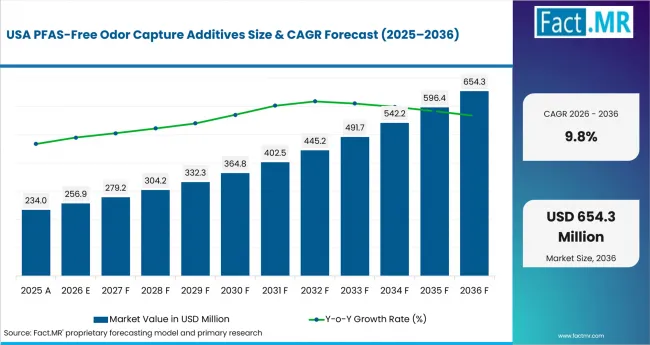
Pfas Free Odor Capture Additives Country Value Analysis | Source: Fact.MR
EPA added nine PFAS to the TRI for Reporting Year 2025, bringing the total number subject to reporting to 205. Expanded reporting requirements increase attention to alternative material systems, while the scale of U.S. plastics conversion supports demand for additives that combine processing performance with clearer chemical compliance positioning.
What is supporting Germany’s adoption?
8.9% CAGR, reinforced by automotive interiors and EU chemical controls.
VDA reported that 4.15 million passenger cars were produced in Germany in 2025. This automotive manufacturing scale supports demand for technical polymer materials used across interior and functional components, while EU chemical controls encourage suppliers to demonstrate consistent material performance, qualification support and compliance across demanding industrial applications.
How does Switzerland perform?
7.1% CAGR, shaped by chemical-risk rules and premium material screening.
FOEN states that the manufacture and placing on the market of PFHxA and its precursors have been regulated for certain uses in Switzerland since December 2025. Affected preparations and articles may contain a maximum of 0.025 ppm PFHxA or 1 ppm of the sum of its precursors, with transitional periods applying to certain preparations and articles.
Who leads the PFAS-Free Odor Capture Additives Market?
Ampacet markets OdorClear odor-absorbing masterbatches for post-consumer recycled materials. Evonik offers TEGO Sorb PY 50 PE and PP masterbatches for odor control in plastics, including recycled polyolefins. Tosaf markets odor-scavenger masterbatches designed to absorb and reduce unwanted odors in virgin and recycled materials.
Tosaf announced a 5,500 sqm masterbatch production facility in Olkusz, Poland, scheduled to become operational in the second quarter of 2026, with an initial production capacity of 3,000 tonnes per year. Tosaf states that the site is intended to provide shorter lead times, increased flexibility and closer technical support to customers in the region.
Which companies are the key providers?
Companies profiled in the competitive landscape include BYK (ALTANA); STRUKTOL COMPANY OF AMERICA; Nexam Chemical; Ampacet Corporation; Evonik Industries AG; and Tosaf Compounds Ltd.
- BYK (ALTANA)
- STRUKTOL COMPANY OF AMERICA
- Nexam Chemical
- Ampacet Corporation
- Evonik Industries AG
- Tosaf Compounds Ltd.
Bibliography
- U.S. Environmental Protection Agency. (2025, January 17). Implementation of statutory addition of nine PFAS to the TRI beginning with reporting year 2025.
- U.S. Environmental Protection Agency. (2026, April 16). TSCA Section 8(a)(7) reporting and recordkeeping requirements for perfluoroalkyl and polyfluoroalkyl substances.
- European Parliament, & Council of the European Union. (2025, January 22). Regulation (EU) 2025/40 of the European Parliament and of the Council of 19 December 2024 on packaging and packaging waste, amending Regulation (EU) 2019/1020 and Directive (EU) 2019/904, and repealing Directive 94/62/EC. Official Journal of the European Union.
- Eurostat. (2025, October 22). Plastic packaging waste in the EU: 35.3 kg per person.
- France. (2025, February 27). Loi n° 2025-188 du 27 février 2025 visant à protéger la population des risques liés aux substances perfluoroalkylées et polyfluoroalkylées. Journal officiel de la République française, No. 0050, Text No. 1.
- Verband der Automobilindustrie. (2026, January 5). Passenger car production in 2025 slightly above previous year's level.
- Statistisches Bundesamt. (2026, February 6). Production in December 2025: -1.9% on the previous month.
- Federal Office for the Environment. (2025, January 31). Per- and polyfluoroalkyl substances (PFASs).
- Tosaf. (2026, April 16). Tosaf expands its European footprint with a new masterbatch facility in Poland.
This Report Addresses
- The report explains where PFAS-free odor capture additives are used across odor-control chemistry and target odor. It also covers polymer and application demand.
- Segment analysis identifies the leading subsegments and the operating reasons converters prioritize them.
- Country analysis examines the listed markets and the policy or manufacturing mechanisms supporting additive adoption.
- Competitive analysis reviews current providers across polymer additives, masterbatch systems and odor-control sorbents.
- Application analysis assesses how odor, VOC / aldehyde behavior and recycled-content quality influence purchase decisions.
What does the PFAS-Free Odor Capture Additives Market cover?
The PFAS-Free Odor Capture Additives Market covers additives designed to capture, absorb or neutralize odor inside polymer systems. Coverage includes mineral adsorbents, cyclodextrin systems, porous polymer additives, bio-based scavengers and reactive odor neutralizers used in PCR-compatible masterbatches.
The assessment covers PP, PE, TPO, PA / engineering polymers and recycled polymer blends across automotive interiors, packaging, consumer goods, nonwovens and industrial plastics. It connects with adjacent recycled polymer odor scavenging additives where odor capture improves the use of post-consumer resin.
What is included in the scope?
The scope includes additive concentrates, masterbatch forms, powder additives and compound-ready systems used during extrusion, compounding, injection molding and film conversion. It also includes odor-control packages used with masterbatch systems for recycled-content and virgin resin applications.
Included applications cover automotive interior parts, rigid packaging, flexible packaging, consumer goods, nonwovens and industrial plastic parts. Related coverage includes additive masterbatch use where color, processing and odor functions are combined.
What is excluded from the scope?
The scope excludes fragrances used only to mask smell, household air fresheners, finished deodorizing consumer products and general cleaning chemicals. It also excludes PFAS-containing processing aids when the additive package falls outside PFAS-free positioning for plastics.
The scope excludes base resin production, polymer recycling equipment and raw adsorbent minerals sold without formulation into polymer additive systems. Related plastic markets such as odor-neutralizing additives in PCR plastics are covered only where the additive function overlaps with PFAS-free odor capture.
Automotive materials are treated as downstream applications, so full trim or seat systems remain outside the market boundary. Adjacent references to automotive upholstery and automotive interior materials are used only to frame odor-sensitive end use.
How Was the Analysis Built?
The analysis draws on 120+ sources, 35+ company portfolios, 25+ countries, and more than 20 industry interviews.
- Primary Research: Primary research includes discussions with additive manufacturers, compounders, polymer processors, distributors, converters and end users. These conversations examine material approval, odor testing, dosing practice, regulatory documentation and wider market acceptance.
- Desk Research: Desk research covers government statistics, regulatory publications, company filings, technical studies, industry associations, standards, public policy and other authoritative sources. Selected public references used in this summary are documented in the bibliography.
- Market Sizing and Forecasting: Market estimates combine historical performance, demand indicators, pricing trends, segment shares, country-level growth, adoption patterns, product launches and barriers to market expansion.
- Data Validation and Update Cycle: Findings are validated by comparing primary interviews with public data, company activity, regulatory changes, trade patterns and industry developments. Regular updates review new product launches, capacity changes, partnerships, approvals and shifts in commercial adoption.
What is the report’s scope and coverage?
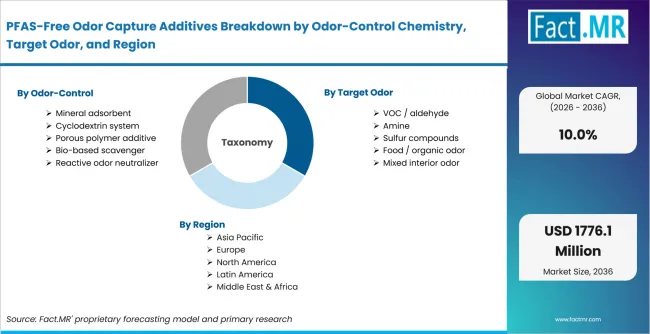
Pfas Free Odor Capture Additives Breakdown By Odor Control Chemistry, Target Odor, And Region | Source: Fact.MR
| Attribute | Details |
|---|---|
| Quantitative Units | USD million |
| Market Definition | PFAS-free additives used to capture, absorb or neutralize odor in polymer compounds, recycled resins, films, molded parts and nonwoven materials. |
| Odor-Control Chemistry | Mineral adsorbent; Cyclodextrin system; Porous polymer additive; Bio-based scavenger; Reactive odor neutralizer |
| Target Odor | VOC / aldehyde; Amine; Sulfur compounds; Food / organic odor; Mixed interior odor |
| Polymer | PP; PE; TPO; PA / engineering polymer; Recycled polymer blends |
| Application | Automotive interiors; Packaging; Consumer goods; Nonwovens; Industrial plastics |
| Regions Covered | North America; Latin America; Western Europe; Eastern Europe; East Asia; South Asia & Pacific; Middle East & Africa |
| Countries Covered | USA; Germany; Japan; France; Switzerland |
| Key Companies Profiled | BYK (ALTANA); STRUKTOL COMPANY OF AMERICA; Nexam Chemical; Ampacet Corporation; Evonik Industries AG; Tosaf Compounds Ltd. |
| Forecast Period | 2026 to 2036 |
| Approach | Hybrid top-down and bottom-up approach using additive chemistry, polymer fit, odor target, application demand, country rules and provider portfolio review. |
How is the market segmented?
-
By Odor-Control Chemistry
- Mineral adsorbent
- Cyclodextrin system
- Porous polymer additive
- Bio-based scavenger
- Reactive odor neutralizer
-
By Target Odor
- VOC / aldehyde
- Amine
- Sulfur compounds
- Food / organic odor
- Mixed interior odor
-
By Polymer
- PP
- PE
- TPO
- PA / engineering polymer
- Recycled polymer blends
-
By Application
- Automotive interiors
- Packaging
- Consumer goods
- Nonwovens
- Industrial plastics
-
By Region
- North America
- Latin America
- Western Europe
- Eastern Europe
- East Asia
- South Asia & Pacific
- Middle East & Africa