- Base Value(2025): 15.7 Bn
- Estimated Value(2026): 16.8 Bn
- Forecast Value (2036): 34.0 Bn
- CAGR (2026 - 2036): 7.3%
Pigeon Pea Market Forecast and Outlook By Fact.MR
In 2025, the pigeon pea market was valued at USD 15.7 billion. Based on Fact MR analysis, demand for pigeon pea is estimated to grow to USD 16.8 billion in 2026 and USD 34.0 billion by 2036. FMR projects a CAGR of 7.3% during the forecast period.
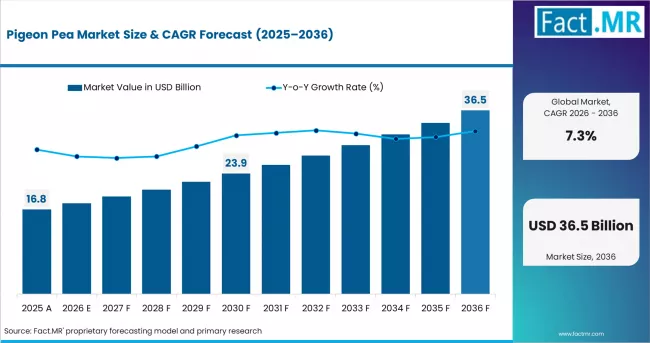
Pigeon Pea Market Market Value Analysis | Source: Fact.MR
Pigeon Pea Market
| Metric | Details |
|---|---|
| Industry Size (2026E) | USD 16.8 billion |
| Industry Value (2036F) | USD 34.0 billion |
| CAGR (2026 to 2036) | 7.3% |
Source: Fact.MR analysis. Updated Apr 16, 2026
Summary of the Pigeon Pea Market
- Market Definition
- The market includes cultivation, processing, and commercialization of pigeon pea as a protein rich pulse used across household consumption, packaged food production, and ingredient supply chains. Pigeon pea is utilized in whole, split, dried, and processed formats to support dietary protein intake and staple food consumption across multiple regions.
- Demand Drivers
- Stable consumption of pulses as an affordable plant protein source across developing economies
- Expansion of packaged pulse products supporting retail distribution and food processing applications
- Increasing inclusion of pulse ingredients in plant based food formulations and ready meal products
- Government support programs encouraging pulse cultivation to improve food security and crop diversification
- Key Segments Analyzed
- End User: Food and beverages segment leads with approximately 70% share supported by staple dietary consumption
- Form: Dried pigeon pea holds nearly 60% share due to long shelf life and compatibility with commodity trade systems
- Distribution Channel: Grocery stores and supermarkets represent key sales channels supporting retail pulse demand
- Geography: South Asia remains a high consumption region, while Europe shows gradual increase in plant protein usage
- Analyst Opinion at Fact MR
- Shambhu Nath Jha, Principal Consultant, Fact MR, opines, "In this updated edition of the Pigeon Pea Market report, industry participants will observe consistent demand linked to staple dietary consumption patterns and agricultural production cycles. Pigeon pea continues to function as a primary plant protein source across multiple regional food systems. Companies that strengthen procurement networks, crop quality standardization, and processing efficiency are expected to maintain competitive positioning through 2036."
- Strategic Implications/Executive Takeaways
- Strengthen sourcing partnerships with pulse growers to ensure supply continuity and quality consistency
- Expand processing capabilities including grading, splitting, and packaging to support retail demand
- Monitor commodity price volatility linked to climatic variability and agricultural yield patterns
- Develop value added pulse products aligned with packaged food and plant protein ingredient applications
- Methodology
- Primary interviews conducted with pulse producers, food processors, distributors, and agricultural stakeholders
- Desk research based on agricultural publications, government crop statistics, trade data, and company reports
- Market sizing derived using a hybrid approach combining bottom up production analysis with top down consumption assessment
- Data validation performed through cross verification with agricultural datasets and internal peer review aligned with Fact MR standards
A CAGR of 7.3% indicates moderately stable expansion with periodic variability linked to monsoon dependence, yield fluctuations, and acreage shifts across major producing countries. Growth remains supported by steady dietary demand for plant protein and staple pulse consumption, while volatility persists due to commodity price sensitivity, trade policy adjustments, and substitution dynamics with other pulses such as chickpeas and lentils.
India leads with a projected CAGR of 8.2%, supported by strong domestic consumption of pulses as a primary protein source and stable cultivation acreage. China follows with a CAGR of 6.8%, driven by increasing use of pulse ingredients in processed food and plant protein formulations. Germany records a CAGR of 6.7%, reflecting gradual expansion of plant based protein applications in packaged food products. The United Kingdom shows a CAGR of 6.5%, supported by steady demand for pulses within ready meal and health focused product categories. The United States records the slowest growth at 6.1%, reflecting a mature market where demand is largely tied to replacement consumption patterns within established pulse categories. Mature markets generate a significant share of replacement demand as consumption volumes remain stable and growth depends on product reformulation and dietary substitution trends across plant protein applications.
Segmental Analysis
Pigeon Pea Market Analysis by End User
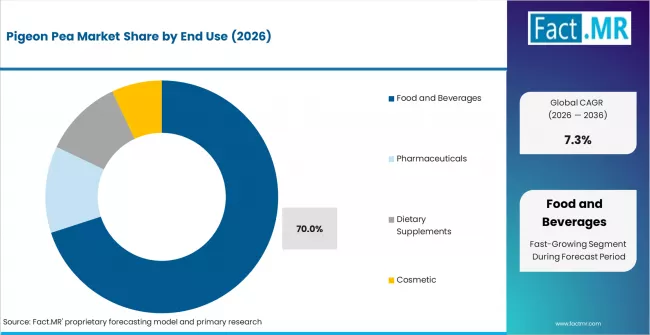
Pigeon Pea Market Analysis By End Use | Source: Fact.MR
- Market Overview: Based on Fact MR assessment, food and beverage applications are projected to account for 70% share of the pigeon pea market in 2026. Consumption is driven by staple dietary inclusion across South Asia, East Africa, and Caribbean food systems where pigeon pea functions as a primary plant protein source. Split pigeon pea and whole grain variants are incorporated into traditional meal preparations requiring extended cooking stability and consistent grain texture performance. Demand concentration is observed across household consumption, institutional catering, and packaged pulse product manufacturers supplying retail grocery distribution channels.
- Demand Drivers:
- Protein Intake Requirements: Pigeon pea is incorporated into dietary formulations providing plant-derived amino acid profile supporting daily protein consumption across cereal-based diets.
- Crop Storage Stability: Dried pulse format demonstrates resistance to rapid spoilage, supporting long duration storage across wholesale grain supply chains and government food distribution programs.
- Processing Adaptability: Milling, splitting, and grading processes enable standardized pulse quality suitable for packaged food distribution and bulk commodity trade systems.
Pigeon Pea Market Analysis by Form
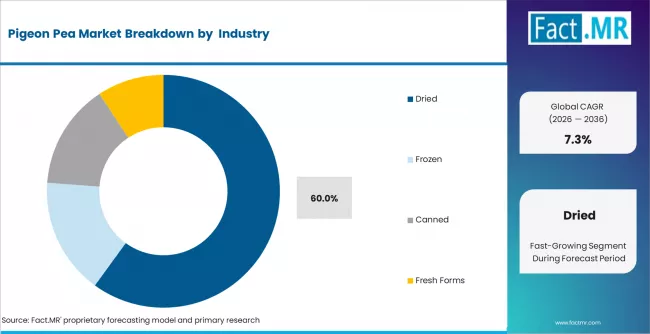
Pigeon Pea Market Analysis By Form | Source: Fact.MR
- Market Overview: Dried pigeon pea is estimated to hold 60% share of the pigeon pea market in 2026, supported by established trade infrastructure and storage compatibility across bulk agricultural commodities. Low moisture content supports extended shelf stability and reduced transportation loss exposure across inter-regional pulse trade routes. Dried grain format is preferred across retail packaging formats and foodservice procurement channels due to predictable hydration performance during thermal preparation stages.
- Demand Drivers:
- Shelf Stability Characteristics: Reduced water activity in dried pigeon pea supports preservation of grain quality during long distance transportation and warehousing cycles.
- Bulk Trade Compatibility: Commodity trading systems are structured around standardized moisture thresholds facilitating uniform grading and pricing benchmarks.
- Cooking Performance Consistency: Dried pulse format provides predictable soaking behavior and uniform softening profile during boiling and pressure cooking preparation methods.
Key Dynamics
Pigeon Pea Market Drivers, Restraints, and Opportunities
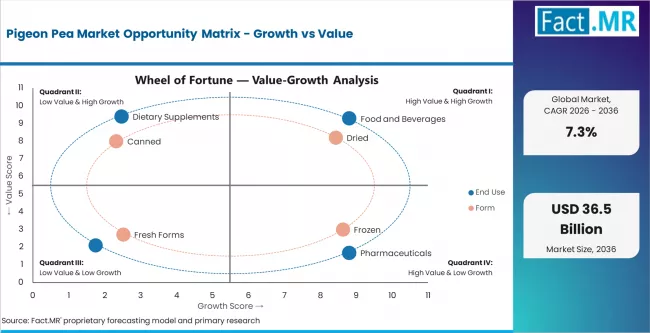
Pigeon Pea Market Opportunity Matrix Growth Vs Value | Source: Fact.MR
Fact MR analysis indicates that the pigeon pea market developed from traditional pulse cultivation systems used as a protein source in tropical and subtropical agricultural regions. Early production was concentrated in smallholder farming systems where pigeon pea served as a staple ingredient in regional diets. The current market valuation reflects continued demand for pigeon pea as a dietary protein source used in processed foods, packaged pulses, and ready-to-cook products. Demand persists because pigeon pea supports food security objectives and provides plant-based protein within cost-sensitive food markets.
A structural shift is occurring as traditional bulk pulse consumption transitions toward packaged and processed pulse-based food products. Conventional loose grain distribution remains widely practiced in local markets where price sensitivity remains high. Food manufacturers increasingly introduce cleaned, packaged, and value-added pigeon pea products designed for retail distribution and export markets. These products require grading, processing, and packaging systems that increase production costs relative to raw pulse distribution. Even with stable cultivation volumes, higher pricing associated with processed and packaged pulse products supports gradual market value expansion.
- Protein Based Staple Demand: Pigeon pea remains widely consumed as a plant protein source used in household cooking and processed pulse-based food products.
- Food Quality Standards: Regulatory frameworks such as Codex Alimentarius pulse quality standards influence grading, labeling, and safety requirements in international trade.
- Asia Pulse Production: India, Myanmar, and Tanzania maintain significant pigeon pea cultivation that supports domestic consumption and export supply chains.
Regional Analysis
The Pigeon Pea Market is assessed across North America, Europe, Asia Pacific, Latin America, and Middle East & Africa, segmented by country-level pulse consumption patterns, agricultural production capacity, and trade dynamics. Regional demand reflects dietary protein consumption, crop cultivation practices, and food processing usage. The full report offers market attractiveness analysis.
.webp "Top Country Growth Comparison Pigeon Pea Market Cagr (2026 2036)")
Top Country Growth Comparison Pigeon Pea Market Cagr (2026 2036) | Source: Fact.MR
CAGR Table
| Country | CAGR (2026–2036) |
|---|---|
| China | 6.8% |
| India | 8.2% |
| USA | 6.1% |
| UK | 6.5% |
| Germany | 6.7% |
Source: Fact.MR analysis. Updated Apr 16, 2026
Source: Fact MR analysis, based on proprietary forecasting model and primary research
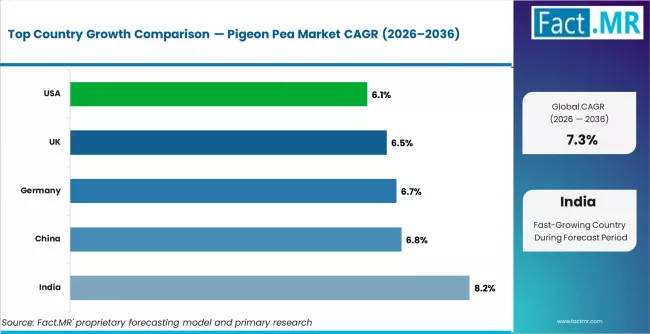
Pigeon Pea Market Cagr Analysis By Country | Source: Fact.MR
North America
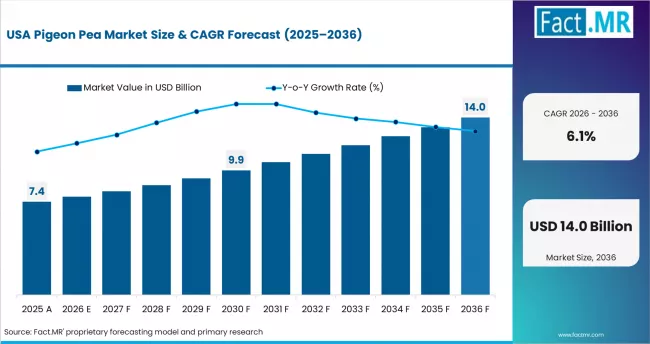
Pigeon Pea Market Country Value Analysis | Source: Fact.MR
North America functions as the plant protein consumption and specialty pulse distribution hub, supported by growing demand for legume-based ingredients. Archer Daniels Midland Company maintains a strong position in pulse processing. Cargill, Incorporated supports global supply chain distribution. Bunge Global SA expands pulse ingredient offerings.
- USA: Demand for pigeon pea in USA is projected to rise at 6.1% CAGR through 2036. Growth is supported by USDA pulse crop programs (U.S. Department of Agriculture, ongoing), encouraging diversified protein sources. Archer Daniels Midland Company expanded pulse processing operations (March 2023), supporting supply availability.
Europe
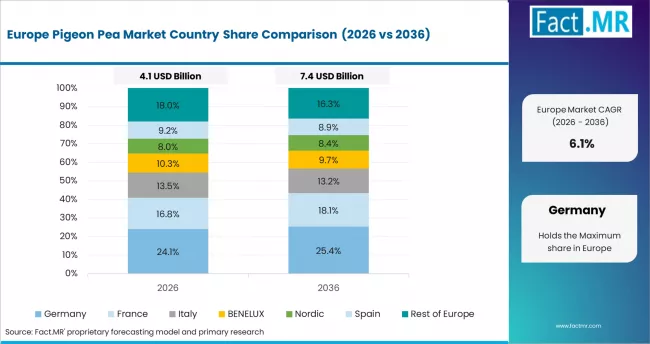
Pigeon Pea Market Europe Country Market Share Analysis, 2026 & 2036 | Source: Fact.MR
Europe operates as the specialty pulse consumption and alternative protein ingredient base, shaped by dietary diversification and food processing demand. Roquette Frères S.A. supports pulse ingredient processing. Bühler Group advances grain processing systems. Ebro Foods, S.A. expands packaged pulse product offerings.
- UK: Demand for pigeon pea in UK is projected to rise at 6.5% CAGR through 2036. The UK National Food Strategy (updated 2021) supports diversified plant protein consumption. Ebro Foods, S.A. expanded packaged pulse product lines (February 2023), supporting demand.
- Germany: Demand for pigeon pea in Germany is projected to rise at 6.7% CAGR through 2036. EU Common Agricultural Policy reforms (European Commission, updated 2021) support legume cultivation. Bühler Group expanded pulse processing technologies (January 2023), supporting market growth.
Asia Pacific
Asia Pacific serves as the high-volume pulse cultivation and consumption market, supported by strong agricultural production and dietary reliance on legumes. ITC Limited strengthens pulse procurement networks. Olam Group Limited expands global pulse supply chains. COFCO Corporation supports grain and pulse distribution.
- China: Demand for pigeon pea in China is projected to rise at 6.8% CAGR through 2036. The National Agricultural Modernization Plan (Ministry of Agriculture and Rural Affairs, updated 2021) supports pulse production diversification. COFCO Corporation expanded pulse sourcing and distribution networks (April 2023), supporting supply.
- India: Demand for pigeon pea in India is projected to rise at 8.2% CAGR through 2036. The National Food Security Mission (Ministry of Agriculture, ongoing) supports pulse crop productivity. ITC Limited expanded pulse procurement and processing capabilities (May 2023), supporting domestic availability.
Fact MR's analysis of pigeon pea market in global regions consists of country-wise assessment that includes China, India, USA, UK, and Germany. Readers can find pulse consumption trends, agricultural production patterns, trade dynamics, and competitive positioning across key markets.
Competitive Landscape
Competitive Structure and Buyer Dynamics in the Pigeon Pea Market
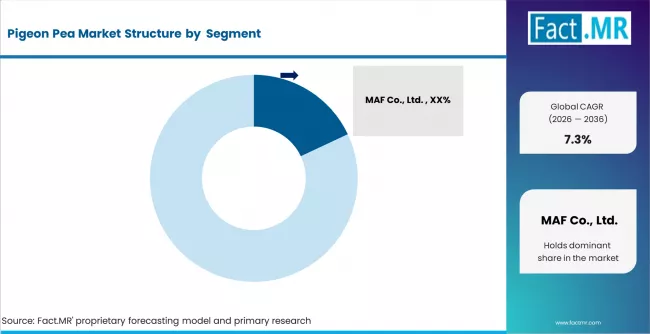
Pigeon Pea Market Analysis By Company | Source: Fact.MR
The competitive structure of the Pigeon Pea Market is moderately fragmented, with agricultural exporters, regional processors, and commodity trading firms participating across the value chain. Companies such as Interamsa Agroindustrial S.A.C., Taj Foods Limited, Unitex Tanzania Limited, and Pulses Splitting & Processing Industry Pvt. Ltd. maintain notable positions through sourcing networks and processing capabilities in key pulse producing regions. Additional participants including Sun Impex International Foods LLC, A.B. Agro Company, Arvind Limited, Akyürek Kardeşler Tarım Ürünleri Mak. San. ve Tic. Ltd. Şti., and MAF Co., Ltd. contribute through export distribution and regional supply operations. Competition is primarily influenced by crop quality, grain size uniformity, processing efficiency, and supply consistency. Seasonal production variability and logistics efficiency also affect supplier positioning within international trade channels.
Several companies maintain structural advantages through direct relationships with farmers and integrated processing infrastructure. Firms such as Pulses Splitting & Processing Industry Pvt. Ltd. and Unitex Tanzania Limited benefit from proximity to cultivation regions, enabling better supply stability and cost control. Export oriented traders maintain advantages through established logistics networks and international buyer relationships. Food manufacturers and wholesale distributors often diversify sourcing strategies to reduce dependence on a single origin and manage supply fluctuations. Procurement decisions evaluate suppliers based on crop quality consistency, certification standards, and delivery reliability. This purchasing behavior moderates supplier pricing leverage across the market. Producers with stable sourcing networks and efficient processing capabilities retain moderate negotiating influence within long term pulse supply agreements.
Key Players of the Pigeon Pea Market
- MAF Co., Ltd.
- Sun Impex International Foods LLC
- Interamsa Agroindustrial S.A.C.
- A.B. Agro Company
- Arvind Limited
- Akyürek Kardeşler Tarım Ürünleri Mak. San. ve Tic. Ltd. Şti.
- Taj Foods Limited
- Pulses Splitting & Processing Industry Pvt. Ltd.
- Unitex Tanzania Limited
Bibliographies
- [1] Nutrition and You. (2023). Pigeon peas (Red gram) nutrition facts and health benefits. Nutrition and You. Retrieved March 23, 2026.
- [2] Food and Agriculture Organization of the United Nations (FAO). (2024). Agricultural Outlook: Global pulse production targets and pigeon pea role in food-security strategies. FAO. Retrieved March 23, 2026.
- [3] Centre for the Promotion of Imports from developing countries (CBI). (2025, November 12). Entering the European market for pigeon peas: Quality, safety, and labeling requirements. CBI Market Intelligence. Retrieved March 23, 2026.
- [4] International Crops Research Institute for the Semi-Arid Tropics (ICRISAT). (2025, June). ICPV 25444: The world’s first heat-tolerant pigeon pea variety. ICRISAT. Retrieved March 23, 2026.
- [5] International Institute of Tropical Agriculture (IITA) / Food and Pulse Safety Consortium. (2023). Codex standard for certain pulses (including pigeon pea): Quality, mycotoxin, and hygiene requirements. Codex Alimentarius Commission. Retrieved March 23, 2026.
This Report Addresses
- Market size estimation and revenue forecasts for the Pigeon Pea Market from 2026 to 2036, supported by pulse consumption trends and plant protein demand benchmarks across staple food categories.
- Growth opportunity mapping across dried, fresh, frozen, and canned pigeon pea forms, reflecting demand for shelf stable pulse ingredients and processed legume products.
- Segment and regional revenue forecasts covering price ranges, forms, distribution channels, end use industries, and key markets including India, China, Germany, United Kingdom, and United States.
- Competition strategy assessment of leading companies such as Interamsa Agroindustrial S.A.C., Taj Foods Limited, Pulses Splitting & Processing Industry Pvt. Ltd., Unitex Tanzania Limited, and Sun Impex International Foods LLC, including sourcing capability and processing efficiency benchmarking.
- Regulatory impact analysis covering Codex Alimentarius pulse quality standards, agricultural trade policies, and food safety compliance frameworks influencing international pulse trade and product distribution.
- Market report delivery in PDF, Excel, PPT, and interactive dashboard formats designed for commodity sourcing, agricultural trade evaluation, and supply chain planning.
- Supply chain vulnerability assessments examining monsoon dependence, crop yield variability, trade policy shifts, and substitution pressure from alternative pulses such as chickpeas and lentils impacting market stability.
Pigeon Pea Market Definition
The Pigeon Pea Market includes the cultivation, processing, and trade of pigeon pea, a legume widely consumed as a protein rich food ingredient. Pigeon pea is commonly used in whole, split, or processed forms in various culinary preparations. It is valued for its nutritional content, including protein, dietary fiber, and essential minerals. The crop is widely grown in tropical and subtropical regions and is used in household cooking, packaged food production, and food service applications. The primary function of pigeon pea is to serve as a plant based protein source and staple food ingredient in many regional diets.
Pigeon Pea Market Inclusions
This report covers global and regional market sizes for pigeon pea with forecast analysis for the study period. The market is segmented by product type including whole pigeon pea, split pigeon pea, and processed pigeon pea products. Application segments include household consumption, packaged food manufacturing, and food service usage. End users include retail consumers, food processing companies, and food service providers. The report also evaluates pricing trends, production patterns, and selected trade flow analysis across major pulse producing and consuming regions.
Pigeon Pea Market Exclusions
The report excludes other pulses such as chickpeas, lentils, and beans that belong to separate crop categories. Agricultural inputs such as seeds, fertilizers, and pesticides used in pigeon pea cultivation are not included. The scope also excludes finished ready to eat meals that contain pigeon pea as a minor ingredient. Livestock feed products using pulse derivatives are outside the defined market scope, as the analysis focuses strictly on pigeon pea as a food crop and ingredient.
Pigeon Pea Research Methodology
- Primary Research: Interviews were conducted with pulse producers, agricultural suppliers, food processors, and distribution stakeholders.
- Desk Research: Public information was collected from agricultural publications, government crop statistics, company reports, and international trade data.
- Market-Sizing and Forecasting: A hybrid model combining bottom up production analysis with top down consumption assessment across pulse markets was applied.
- Data Validation and Update Cycle: Findings were cross verified using multiple agricultural data sources and expert inputs, with periodic updates conducted as new production and trade data becomes available.
Segmentation
Report Scope
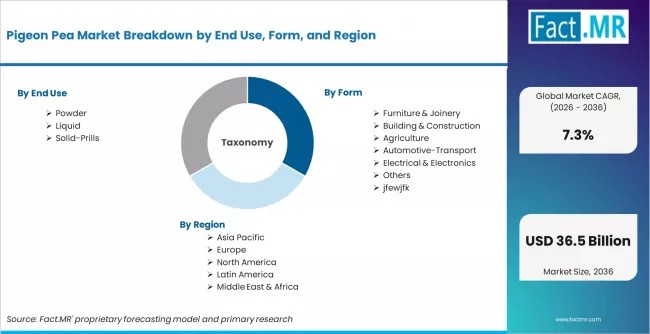
Pigeon Pea Market Breakdown By End Use, Form, And Region | Source: Fact.MR
| Metric | Value |
|---|---|
| Quantitative Units | USD 16.8 billion (2026) to USD 34.0 billion (2036), at a CAGR of 7.3% |
| Market Definition | The pigeon pea market includes the cultivation, processing, distribution, and commercialization of pigeon peas used as a protein rich legume ingredient across food, pharmaceutical, cosmetic, and dietary supplement applications in global agricultural supply chains. |
| Price Range Segmentation | Premium, Mid, Low |
| Form Segmentation | Frozen, Dried, Canned, Fresh Forms |
| Distribution Channel Segmentation | Supermarkets, Direct Stores, Online, Grocery Store |
| End User Segmentation | Pharmaceuticals, Food and Beverages, Dietary Supplements, Cosmetic |
| Regions Covered | North America, Latin America, Europe, East Asia, South Asia, Oceania, Middle East and Africa |
| Countries Covered | United States, Canada, Mexico, Brazil, Germany, United Kingdom, France, Italy, Spain, China, India, Japan, South Korea, Australia, and 40+ countries |
| Key Companies Profiled | MAF Co., Ltd., Sun Impex International Foods LLC, Interamsa Agroindustrial S.A.C., A.B. Agro Company, Arvind Limited, Akyürek Kardeşler Tarım Ürünleri Mak. San. ve Tic. Ltd. Şti., Taj Foods Limited, Pulses Splitting and Processing Industry Pvt. Ltd., Unitex Tanzania Limited |
| Forecast Period | 2026 to 2036 |
| Approach | Hybrid top-down and bottom-up market modeling supported by pulse production analysis, agricultural trade assessment, consumption pattern evaluation, and validation through interviews with growers, processors, distributors, and industry participants. |
Source: Fact.MR analysis. Updated Apr 16, 2026
Pigeon Pea Market Key Segments
-
Price Range:
- Premium
- Mid
- Low
-
Form:
- Frozen
- Dried
- Canned
- Fresh Forms
-
Distribution Channel:
- Supermarkets
- Direct Stores
- Online
- Grocery Store
-
End User:
- Pharmaceuticals
- Food and Beverages
- Dietary Supplements
- Cosmetic
-
Region:
- North America
- USA
- Canada
- Mexico
- Europe
- Germany
- UK
- France
- Italy
- Spain
- Nordic Countries
- BENELUX
- Rest of Europe
- Asia Pacific
- China
- Japan
- South Korea
- India
- Australia
- Rest of Asia Pacific
- Latin America
- Brazil
- Argentina
- Rest of Latin America
- Middle East and Africa
- Kingdom of Saudi Arabia
- United Arab Emirates
- South Africa
- Rest of Middle East and Africa
- Other Regions
- Oceania
- Central Asia
- Other Markets
- North America
Frequently Asked Questions
How large is the demand for Pigeon Pea in the global market in 2026?
What will be the market size of Pigeon Pea in the global market by 2036?
What is the expected demand growth for Pigeon Pea in the global market between 2026 and 2036?
Which End User Segment is poised to lead global demand by 2026?
Which Company is Identified as a Leading Participant in the Pigeon Pea Market?
What is Driving Pigeon Pea Demand in the United States?
What is the United States Growth Outlook in this Report?
Why is China an Important Market for Pigeon Pea?
What is the China Growth Outlook in this Report?
What Factors Support Pigeon Pea Demand in India?
What is the India Growth Outlook in this Report?
What Factors Support Pigeon Pea Adoption in the United Kingdom?
What is the United Kingdom Growth Outlook in this Report?
Why is Germany Considered an Important Market for Pigeon Pea in Europe?
What is the Germany Growth Outlook in this Report?
What is Pigeon Pea and What is It Mainly Used For?
What does Pigeon Pea Market Mean in this Report?
What is Included in the Scope of this Pigeon Pea Market Report?
What is Excluded from the Scope of this Report?
What does Market Forecast Mean on this Page?
How is the Pigeon Pea Market Forecast Developed in this Report?
Who worked on this report


Preview the report firsthand - request a free sample
Free SampleGet the brochure for pricing and purchase details
Download PDF