- Base Value(2026): 310.00 Mn
- Estimated Value(2026): 310.0 Mn
- Forecast Value (2036): 760.0 Mn
- CAGR (2026 - 2036): 9.4%
Serialized Closure and Seal Components for Traceable Packaging Market Forecast and Outlook 2026 to 2036
The global serialized closure and seal components for traceable packaging market is valued at USD 310.00 million in 2026 and is projected to reach USD 760.00 million by 2036, expanding at a CAGR of 9.4% over the decade. In 2026, the pharmaceuticals & nutraceuticals application segment is estimated to hold a 40% share, while tamper-evident caps & seals constitute 45% by packaging format and HDPE/PP+ security additives leads material adoption with a 50% share.
Key Takeaways from the Serialized Closure and Seal Components for Traceable Packaging Market Report
- Market Value (2026): USD 310.00 Million
- Market Forecast Value (2036): USD 760.00 Million
- Forecast CAGR (2026-2036): 9.4%
- Leading Application Segment: Pharmaceuticals & nutraceuticals (40%)
- Leading Packaging Format/Type: Tamper-evident caps & seals (45%)
- Leading Material: HDPE/PP + security additives (50%)
- Leading Technology: Laser coding + microtext serialization (55%)
- Key Growth Regions: North America, Latin America, Europe, Asia Pacific, MEA
- Key Players: Aptar plc., Huhtamaki Oyj, Shantou Closures, UFLEX Limited, Tetra Pak Caps, Tokan Kogyo, Silgan Holdings Inc., Berry Global Group Inc.
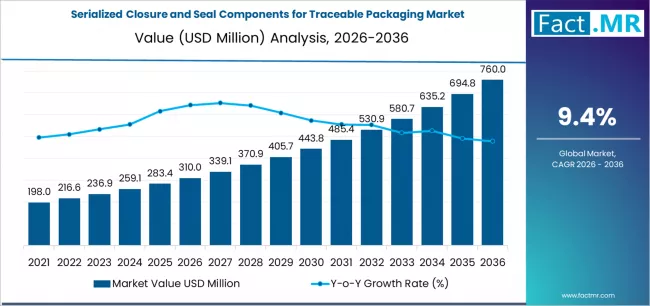
Serialized Closure And Seal Components For Traceable Packaging Market Market Value Analysis | Source: Fact.MR
The global fight against counterfeiting and stringent serialization mandates in regulated industries are the primary drivers of market growth. Regulations such as the EU Falsified Medicines Directive (FMD) and the U.S. Drug Supply Chain Security Act (DSCSA) require unique item-level identification, making the closure, a critical locus for security and traceability. Serialized components transform passive closures into active data carriers, enabling authentication, ensuring integrity, and providing a physical-digital link for supply chain visibility. This shift elevates closures from simple sealing functions to intelligent, connected components essential for patient safety, brand protection, and regulatory compliance.
Advancements in marking and material technologies are critical to market expansion. Innovations in laser coding, microtext engraving, and the integration of QR codes directly onto seals and liners allow for secure, permanent serialization that survives distribution and handling. Concurrently, the use of security additives and complex multi-layer structures enhances tamper-evidence, making cloning or reuse virtually impossible. These technological enhancements are vital for securing high-value, high-risk products across global, often fragmented, supply chains.
Serialized Closure and Seal Components for Traceable Packaging Market
| Metric | Value |
|---|---|
| Estimated Value in (2026E) | USD 310.00 Million |
| Forecast Value in (2036F) | USD 760.00 Million |
| Forecast CAGR (2026 to 2036) | 9.4% |
Source: Fact.MR analysis. Updated Dec 20, 2025
Category
| Category | Segments |
|---|---|
| End-use/Application | Pharmaceuticals & nutraceuticals, Premium food & beverages, FMCG & OTC pharma, Ayurveda & pharma, Food oils & beverages, Others |
| Packaging Format/Type | Tamper-evident caps & seals, Induction seals, Flip-top caps & liners, Induction liners, Others |
| Material | HDPE/PP + security additives, Multi-layer foil/PP, PP blends, PE/foil composites, Others |
| Technology | Laser coding + microtext serialization, Serialized foil seals, QR-enabled seal coding, Low-cost serialization, Others |
| Region | North America, Europe, Asia Pacific, Latin America, MEA |
Source: Fact.MR analysis. Updated Dec 20, 2025
Segmental Analysis
Why is the Pharmaceuticals & Nutraceuticals Sector the Leading Application Segment?
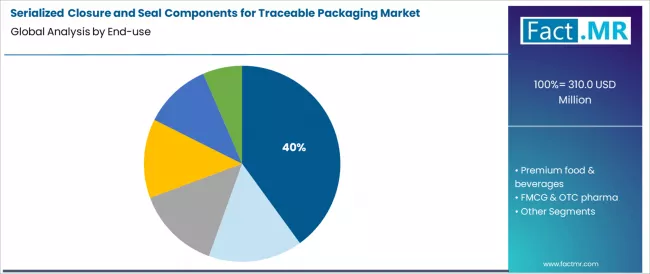
Serialized Closure And Seal Components For Traceable Packaging Market Analysis By End Use | Source: Fact.MR
Pharmaceuticals & nutraceuticals will command a 40% share, as this sector operates under the most rigorous global track-and-trace regulations designed to ensure patient safety. Serialized closures are a fundamental component of the unit-level identity mandated by laws like the FMD and DSCSA.
They provide the final, user-visible point of authentication and tamper-evidence, allowing pharmacists, healthcare providers, and even patients to verify legitimacy. For manufacturers, they are a non-negotiable compliance cost and a vital tool in protecting brand equity and revenue from counterfeit incursion.
- The high value and critical nature of pharmaceutical products justify the investment in advanced serialization technologies at the component level, such as covert microtext or layered security inks.
- Serialization on closures integrates with bottle and carton serialization to create a multi-layered, redundant security system that is extremely difficult to compromise.
What establishes Tamper-evident Caps & Seals as the Dominant Packaging Format?
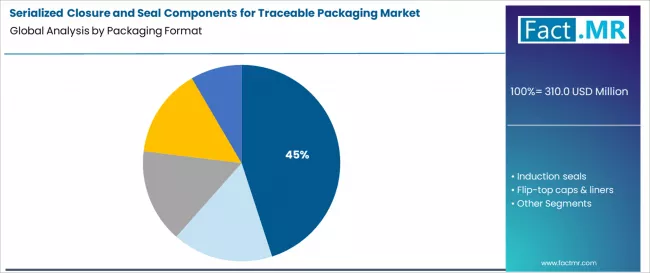
Serialized Closure And Seal Components For Traceable Packaging Market Analysis By Packaging Format | Source: Fact.MR
Tamper-evident caps & seals hold a 45% share because they provide the most direct and consumer-recognizable assurance of product integrity. These components are engineered to break or show visible signs of interference upon first opening. Adding serialization, through laser coding or embedded tags, to these features creates a powerful two-fold solution. It proves the item is authentic (via the serial number) and proves it has not been opened or tampered with since leaving the factory.
- This format is crucial for over-the-counter (OTC) pharmaceuticals, nutraceuticals, and premium foods, where consumer trust is paramount.
- Innovation focuses on improving the user-friendliness of tamper-evidence while making the breakage mechanism even more secure and difficult to replicate fraudulently.
Why are HDPE/PP + Security Additives the preferred Material choice?
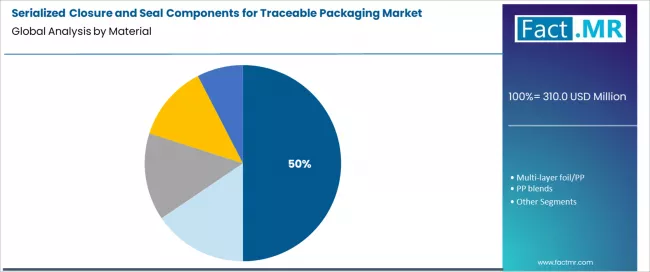
Serialized Closure And Seal Components For Traceable Packaging Market Analysis By Material | Source: Fact.MR
HDPE/PP + security additives leads with a 50% share, as high-density polyethylene (HDPE) and polypropylene (PP) are the standard polymers for closure manufacturing, offering excellent chemical resistance, durability, and cost-effectiveness. The addition of security additives, such as UV tracers, unique pigment blends, or molecular taggants, transforms these common materials into covert authentication platforms. These additives can be verified with specialized scanners, providing a hidden layer of security beyond the visible serial number.
- This approach allows for mass production of standard-looking closures that carry a sophisticated, difficult-to-counterfeit security feature, balancing cost and effectiveness.
- Material science is focused on developing additives that are compatible with recycling streams to avoid disrupting the circular economy goals of packaging.
What are the Drivers, Restraints, and Key Trends in the Serialized Closure and Seal Components Market?
The market is driven by hard regulatory deadlines for pharmaceutical serialization and the escalating economic threat of counterfeiting across FMCG, food, and luxury goods. Brand protection is a top priority, with serialized closures offering a direct way to combat illicit trade and safeguard reputation.
A primary restraint is the significant per-unit cost increase compared to standard closures, encompassing both the component cost and the integration of high-speed vision inspection and coding systems on packaging lines. Complexity in managing the associated serial number databases and ensuring interoperability across supply chain partners also poses a challenge.
The market is trending towards multi-technology convergence, combining overt covert and forensic features in a single component for layered security. Furthermore, integration with IoT platforms is emerging, where scanned closure data automatically updates cloud-based track-and-trace systems, enabling real-time supply chain visibility and consumer engagement.
Analysis of the Market by Key Countries
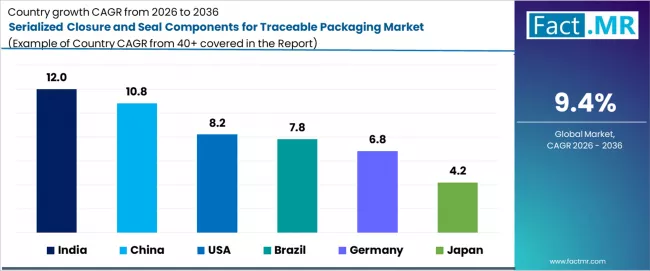
Serialized Closure And Seal Components For Traceable Packaging Market Cagr Analysis By Country | Source: Fact.MR
| Country | CAGR (2026-2036) |
|---|---|
| USA | 8.20% |
| Germany | 6.80% |
| China | 10.80% |
| India | 12.00% |
| Brazil | 7.80% |
| Japan | 4.20% |
Source: Fact.MR analysis. Updated Dec 20, 2025
What underpins adoption in the USA's market?
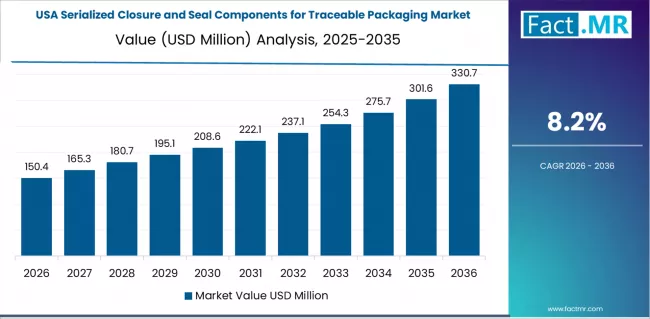
Serialized Closure And Seal Components For Traceable Packaging Market Country Value Analysis | Source: Fact.MR
Growth in the USA at an 8.20% CAGR is driven by full enforcement of the DSCSA for pharmaceuticals, strong anti-counterfeiting efforts in agriculture (e.g., seeds, pesticides), and brand protection in premium beverages. The market demands high-reliability serialization technologies that integrate with complex logistics and reimbursement systems.
How does Germany's regulatory framework shape its market?
Germany's 6.80% CAGR reflects its strict adherence to EU FMD regulations and high standards for engineering. The market is characterized by demand for precision-engineered closures with advanced, often laser-based, serialization that meets stringent technical and data integrity requirements for the pharmaceutical and chemical sectors.
What factors propel China's rapid expansion?
China's 10.80% CAGR is fueled by government-led initiatives to combat counterfeit goods, particularly in pharmaceuticals and export-oriented premium foods. As a global manufacturing hub, domestic closure producers are scaling up to provide cost-effective serialized solutions for both local compliance and to meet the traceability requirements of international brand owners sourcing from China.
Why does India exhibit the highest growth trajectory?
India leads with a 12.00% CAGR, driven by its massive and growing domestic pharmaceutical industry complying with traceability regulations, the fight against counterfeit FMCG and OTC drugs, and the formalization of the Ayurveda & nutraceuticals sector. Demand is for highly cost-optimized serialization, such as QR-enabled seal coding, that can be deployed at immense scale.
How does Brazil's market develop?
Brazil's 7.80% CAGR is supported by regulations from ANVISA (health regulatory agency) for pharmaceutical traceability and the need to protect branded food and beverage products. The market leverages local manufacturing for closures and focuses on solutions that balance security with cost-effectiveness for regional market dynamics.
What Characterizes Japan's Mature Market Approach?
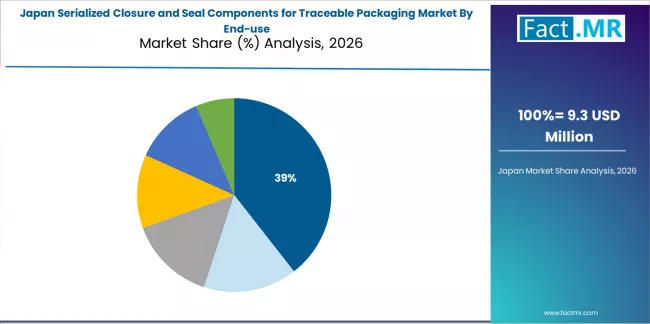
Serialized Closure And Seal Components For Traceable Packaging Market Japan Market Share Analysis By End Use | Source: Fact.MR
Japan's mature market grows at a measured 4.20% CAGR, focusing on ultra-high-quality, precision serialization for high-value food oils, beverages, and pharmaceuticals. The emphasis is on miniaturized, aesthetically perfect coding and advanced material technologies that meet Japan's exceptional standards for quality and consumer trust.
Competitive Landscape
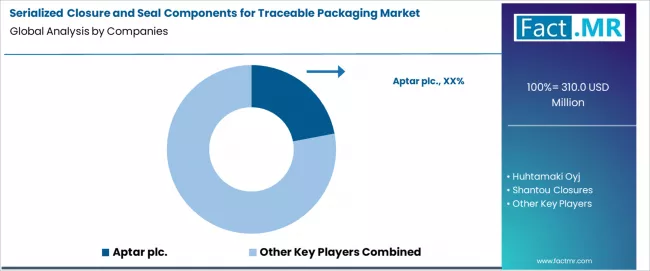
Serialized Closure And Seal Components For Traceable Packaging Market Analysis By Company | Source: Fact.MR
Global closure giants and specialized security solution providers define the competitive landscape. Integrated players like Aptar, Silgan, and Berry Global compete by offering comprehensive systems that include closure design, security feature integration, and serialization technology. Specialized material and technology firms collaborate with closure manufacturers to embed advanced authentication features.
Competition hinges on providing global supply chain support, achieving regulatory certifications for specific markets such as FDA or EMA, and offering a scalable portfolio of solutions from high-security pharma to cost-sensitive FMCG applications.
Key Players Profiled in the Serialized Closure and Seal Components for Traceable Packaging Market
- Aptar plc.
- Huhtamaki Oyj
- Shantou Closures
- UFLEX Limited
- Tetra Pak Caps
- Tokan Kogyo
- Silgan Holdings Inc.
- Berry Global Group Inc.
Segmentation
Scope of the Report
| Items | Values |
|---|---|
| Quantitative Units (2026) | USD 310.00 Million |
| End-use/Application | Pharmaceuticals & nutraceuticals, Premium food & beverages, FMCG & OTC pharma, Ayurveda & pharma, Food oils & beverages, Others |
| Packaging Format/Type | Tamper-evident caps & seals, Induction seals, Flip-top caps & liners, Induction liners, Others |
| Material | HDPE/PP + security additives, Multi-layer foil/PP, PP blends, PE/foil composites, Others |
| Technology | Laser coding + microtext serialization, Serialized foil seals, QR-enabled seal coding, Low-cost serialization, Others |
| Regions Covered | North America, Europe, Asia Pacific, Latin America, Middle East & Africa |
| Key Companies Profiled | Aptar plc., Huhtamaki Oyj, Shantou Closures, UFLEX Limited, Tetra Pak Caps, Tokan Kogyo, Silgan Holdings Inc., Berry Global Group Inc. |
| Additional Attributes | Cost analysis of security feature integration, regulatory compliance roadmap by region, anti-counterfeiting case studies, analysis of database management and aggregation services. |
Source: Fact.MR analysis. Updated Dec 20, 2025
Serialized Closure and Seal Components for Traceable Packaging Market by Segments
-
By End-use/Application :
- Pharmaceuticals & Nutraceuticals
- Premium Food & Beverages
- FMCG & OTC Pharma
- Ayurveda & Pharma
- Food Oils & Beverages
- Others
-
By Packaging Format/Type :
- Tamper-evident Caps & Seals
- Induction Seals
- Flip-top Caps & Liners
- Induction Liners
- Others
-
By Material :
- HDPE/PP + Security Additives
- Multi-layer foil/PP
- PP Blends
- PE/Foil Composites
- Others
-
By Technology :
- Laser Coding + Microtext Serialization
- Serialized Foil Seals
- QR-enabled Seal Coding
- Low-cost Serialization
- Others
-
By Region :
-
North America
- USA
- Canada
- Mexico
-
Europe
- Germany
- UK
- France
- Italy
- Spain
- Nordic Countries
- BENELUX
- Rest of Europe
-
Asia Pacific
- China
- India
- Japan
- South Korea
- Australia
- Rest of Asia Pacific
-
Latin America
- Brazil
- Argentina
- Rest of Latin America
-
MEA
- Saudi Arabia
- UAE
- South Africa
- Rest of MEA
-
Frequently Asked Questions
How big is the serialized closure and seal components for traceable packaging market in 2026?
What will be the size of serialized closure and seal components for traceable packaging market in 2036?
How much will be the serialized closure and seal components for traceable packaging market growth between 2026 and 2036?
What are the key product types in the serialized closure and seal components for traceable packaging market?
Which packaging format segment to contribute significant share in the serialized closure and seal components for traceable packaging market in 2026?
Who worked on this report


Preview the report firsthand - request a free sample
Free SampleGet the brochure for pricing and purchase details
Download PDF