- Base Value(2025): 21.1 Bn
- Estimated Value(2026): 22.0 Bn
- Forecast Value (2036): 35.5 Bn
- CAGR (2026 - 2036): 4.9%
Private Investigation Services Market Size, Market Forecast and Outlook by Fact.MR
- The private investigation services market was valued at USD 21.1 billion in 2025.
- Demand is set to reach USD 22.0 billion in 2026 at a CAGR of 4.9% during the forecast period.
- Sustained investigation demand takes the valuation to USD 35.5 billion through 2036 as corporates, insurers, and legal clients rely on verified evidence before making risk decisions.
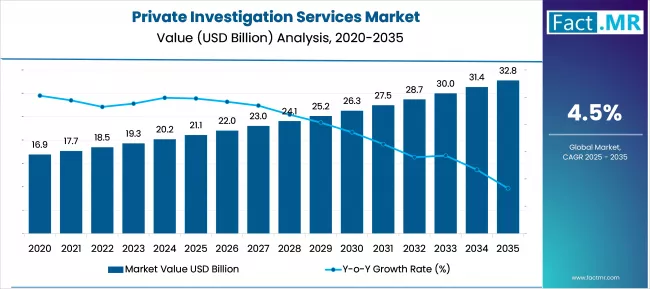
Private Investigation Services Market Market Value Analysis | Source: Fact.MR
| Metric | Details |
|---|---|
| Industry Size (2026) | USD 22.0 billion |
| Industry Value (2036) | USD 35.5 billion |
| CAGR (2026 to 2036) | 4.9% |
Source: Fact.MR analysis. Updated May 18, 2026
Summary of Private Investigation Services Market
- Market Definition
- Private investigation services cover professional evidence gathering used in corporate, legal, insurance, personal, and public-sector cases. Scope is defined by lawful investigation activity, evidence documentation, client confidentiality, and case-specific fact verification.
- Demand Drivers in the Market
- Corporate security heads need verified findings before acting on fraud or misconduct cases.
- Insurance claims managers need investigation support to validate disputed claims.
- Law firm partners require admissible evidence and witness tracing for litigation support.
- Key Segments Analyzed
- Corporate Services: Corporate services are expected to lead by service type as businesses need fraud checks, employee verification, and vendor due diligence.
- Fraud Investigation: Fraud investigation is projected to account for 31.0% share in 2026 because financial and workplace misconduct cases need documented evidence.
- Corporates: Corporates are estimated to hold 42.0% share in 2026 due to recurring demand for risk checks and internal investigations.
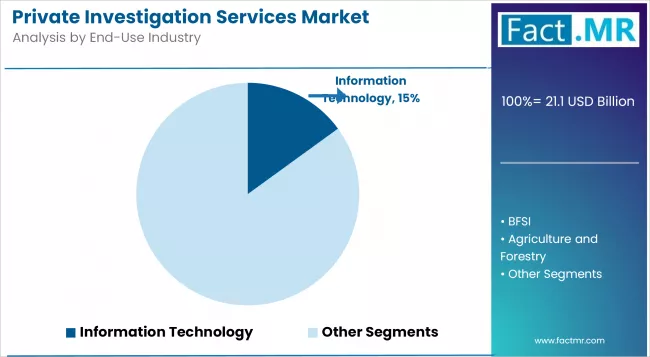
- Information Technology: Information technology is likely to capture 28.0% share in 2026 as cyber forensics and insider-risk checks expand.
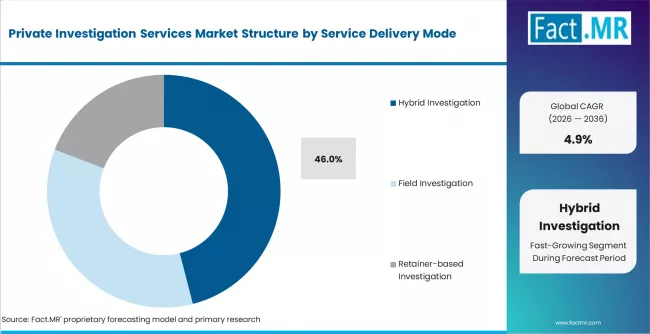
- Hybrid Investigation: Hybrid investigation is projected to hold 46.0% share in 2026 as cases increasingly combine fieldwork with digital evidence review.
- Geography: China is forecast to grow at 5.7% CAGR through 2036, supported by corporate due diligence and online fraud investigation needs.
- Analyst Opinion at Fact.MR
- Shambhu Nath Jha, Senior Analyst at Fact.MR, states, “Private investigation is moving from discreet surveillance to evidence-led risk support. Corporate clients now want lawful findings that can support internal action, insurance review, or litigation. Investigation firms will gain where they combine field discipline, digital forensics, and strong client-screening practices.”
- Strategic Implications
- Corporate security heads must standardize evidence handling before escalating internal misconduct cases.
- Insurance claims managers should use investigation support where claim patterns require field validation.
- Investigation firms need stronger client-vetting controls to avoid legal and national security exposure.
- Methodology
- Fact.MR interviews investigation agency owners, legal clients, insurers, corporate security leaders, and compliance managers.
- Research reviews cybercrime reports, fraud data, AML rules, licensing guidance, and corporate investigation practices.
- Estimates use case volume, service pricing, fraud exposure, digital evidence demand, and regional client maturity.
- Forecasts are validated through service provider checks, buyer interviews, public data review, and regional risk assessment.
Corporate security heads are being pushed to decide between informal checks and professional investigations that can stand up to legal review. This shift is visible in fraud verification and employee background cases. FBI’s 2024 Internet Crime Report recorded 859,532 internet crime complaints and reported significant losses, which strengthens the need for digital investigation support. A practical point often missed is that technology alone cannot replace investigator judgment. Clients still need evidence handling, interview discipline, and lawful case documentation.
The main inflection point arrives when investigation reports become part of compliance and legal decision records. Corporate clients trigger this shift by requiring documented evidence trails and stronger client vetting. Once this happens, private investigation services move from reactive fact-finding to formal risk-control support.
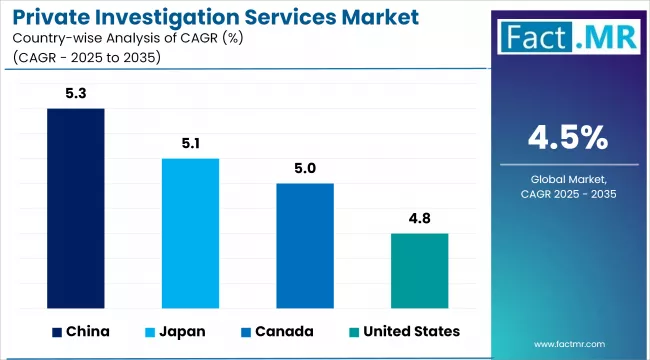
China is projected to record 5.7% CAGR through 2036 as corporate due diligence and cyber-related investigation demand expand. Japan is likely to grow at 5.4% through corporate compliance and digital forensics needs. The United States is forecast to post 5.0% CAGR as legal, insurance, and workplace investigation demand remains steady. India is expected to grow at 4.9%, the UK at 4.6%, Germany at 4.4%, and Brazil at 4.2%. Country variation depends on fraud exposure, licensing rules, and corporate risk practices.
Segmental Analysis
Private Investigation Services Market Analysis by Service Type
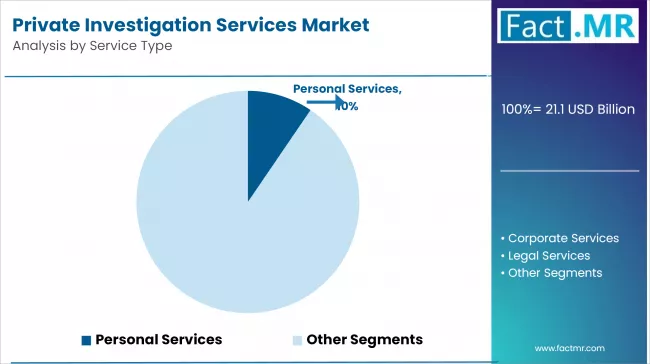
Private Investigation Services Market Analysis By Service Type | Source: Fact.MR
Corporate services is anticipated to account for 45% share as companies need verified evidence before acting on sensitive internal and external risks. Employee misconduct, vendor fraud, intellectual property leaks, and asset tracing require formal case handling. Corporate services are expected to remain the leading service type because businesses use investigators to support legal and compliance decisions. Personal services remain important in matrimonial and missing person cases. Legal services support litigation, witness tracing, and asset search. Other services include record search and theft investigation.
- Evidence Discipline: Corporate investigations require findings that support internal action and legal review.
- Confidential Handling: Sensitive cases need controlled communication and secure file management.
- Case Continuity: Recurring corporate risk creates long-term client relationships for agencies.
Private Investigation Services Market Analysis by Investigation Focus
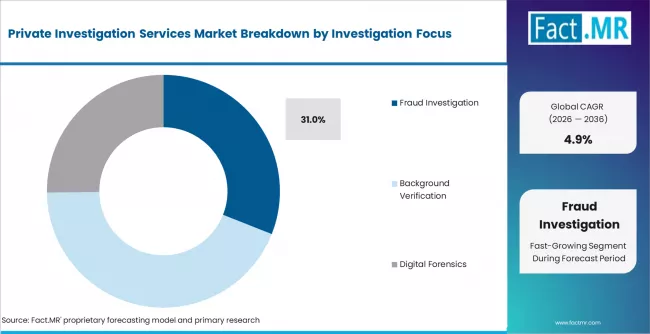
Private Investigation Services Market Analysis By Investigation Focus | Source: Fact.MR
Fraud investigation is moving to the center of private investigation demand as financial and digital misconduct becomes harder to verify through internal checks alone. The ACFE 2024 Report to the Nations is based on 1,921 occupational fraud cases across 138 countries and territories, showing why organizations keep investing in fraud investigation capacity. [2] Fraud investigation is projected to account for 31.0% share in 2026 because clients need proof before making disciplinary, legal, or insurance decisions. Background verification remains important for employment and vendor screening. Digital forensics is growing as more evidence sits in devices and online accounts. Surveillance and asset search support legal and insurance cases.
- Fraud Proof: Investigators help clients move from suspicion to documented findings.
- Digital Trail: Device and online evidence make forensic capability more important.
- Asset Visibility: Asset search supports litigation, recovery, and claim validation work.
Private Investigation Services Market Analysis by Client Type
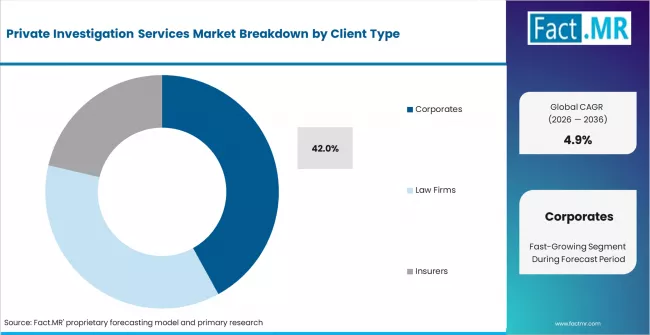
Private Investigation Services Market Analysis By Client Type | Source: Fact.MR
Corporates are the largest client group because they face recurring risk across hiring, vendors, workplace conduct, and fraud exposure. These clients need evidence that can support legal review and internal action. Fact.MR estimates corporates to hold 42.0% share in 2026 as risk teams use investigators for due diligence and misconduct cases. Law firms rely on investigators for witness tracing and case support. Insurers use private investigation for disputed claims. Individuals use services for personal verification and family matters. Government and public agencies may use external support in select due diligence contexts. Client type shapes confidentiality needs and reporting standards.
- Corporate Risk: Businesses use investigators for fraud, misconduct, and vendor checks.
- Legal Support: Law firms need traceable evidence and witness information.
- Claim Review: Insurers rely on investigation support for suspicious or disputed claims.
Private Investigation Services Market Analysis by End-use Industry
Private Investigation Services Market Analysis By End Use Industry | Source: Fact.MR
Information technology is expected to account for 36% share because digital businesses face insider risk, data theft, and vendor verification needs. Remote work and cloud-based operations create more points where evidence can sit outside physical offices. The FBI’s 2024 Internet Crime Report shows reported cyber-enabled crime losses above USD 16.0 billion, which supports rising demand for digital investigation and cyber forensics. [1] BFSI remains a major user because fraud, AML checks, and insurance claims require evidence support. Manufacturing uses investigations for theft, counterfeiting, and supplier due diligence. Retail trade uses services for internal loss and organized fraud cases. Public administration needs lawful screening and compliance checks.
- Digital Exposure: IT clients need investigation support for data leaks and insider-risk cases.
- Financial Control: BFSI users require fraud checks and compliance-linked verification.
- Supply Risk: Manufacturing clients use investigators for vendor and counterfeit concerns.
Private Investigation Services Market Analysis by Service Delivery Mode
Private Investigation Services Market Analysis By Service Delivery Mode | Source: Fact.MR
Investigation delivery is moving toward hybrid work because many cases now begin online but still need field verification. Digital review can identify leads, but surveillance, interviews, and site checks often complete the evidence picture. Hybrid investigation is projected to hold 46.0% share in 2026 as clients need both digital forensics and physical verification. Field investigation remains essential for surveillance, asset search, and witness checks. Digital investigation is growing through OSINT, cybercrime support, and device analysis. Retainer-based investigation is used by corporates and law firms with repeated case needs. Delivery choice affects cost, speed, and legal defensibility.
- Mixed Evidence: Hybrid models connect online findings with field confirmation.
- Field Value: Physical checks remain critical in surveillance and asset tracing.
- Retainer Need: Repeat corporate cases support ongoing investigation contracts.
Private Investigation Services Market Drivers, Restraints, and Opportunities
Private Investigation Services Market Opportunity Matrix Growth Vs Value | Source: Fact.MR
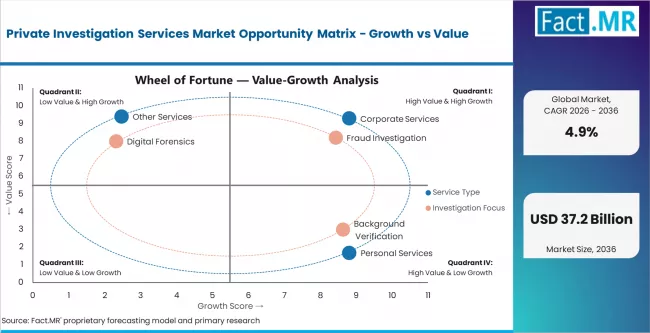
Fraud, cybercrime, and identity misuse are the main demand anchors for private investigation services. The FTC’s 2024 Consumer Sentinel Network Data Book received 6.5 million consumer reports covering fraud, identity theft, and related issues. [3] FBI IC3 data reinforces the financial scale of cyber-enabled crime. Corporate clients need investigators where internal teams cannot independently verify misconduct, digital activity, or claim disputes. Legal clients need evidence that can be used in case strategy. These conditions support steady demand for corporate services and digital investigation.
Legal exposure remains the main restraint. Surveillance, data access, and background checks must comply with privacy and licensing rules. GDPR keeps personal data handling central to European investigation work. [4] The UK warning to security consultants under the National Security Act 2023 shows that investigators can face legal risk if client vetting is weak. [5] Smaller agencies may struggle with compliance training and secure evidence handling. This limits scaling and favors firms with documented procedures.
Opportunities in the Private Investigation Services Market
- Digital Forensics: Agencies can expand by building device review and online evidence capability.
- Corporate Retainers: Investigation firms can secure recurring revenue through fraud and due diligence contracts.
- Client Vetting: Providers can differentiate by screening clients before accepting sensitive surveillance work.
Regional Analysis
Based on the regional analysis, the private investigation services market is segmented into North America, Latin America, Western Europe, Eastern Europe, East Asia, South Asia and Pacific, and Middle East and Africa across 40 plus countries.
.webp "Top Country Growth Comparison Private Investigation Services Market Cagr (2026 2036)")
Top Country Growth Comparison Private Investigation Services Market Cagr (2026 2036) | Source: Fact.MR
| Country | CAGR (2026 to 2036) |
|---|---|
| China | 5.7% |
| Japan | 5.4% |
| United States | 5.0% |
| India | 4.9% |
| UK | 4.6% |
| Germany | 4.4% |
| Brazil | 4.2% |
Source: Fact.MR analysis. Updated May 18, 2026
Source: Fact.MR analysis, based on proprietary forecasting model and primary research
Private Investigation Services Market Cagr Analysis By Country | Source: Fact.MR
East Asia Private Investigation Services Market Analysis
East Asia shows steady growth as corporates invest in due diligence, cyber investigation, and intellectual property protection. China and Japan differ in market structure, but both show demand for professional evidence gathering. Corporate clients need investigators for vendor verification and fraud checks. Digital platforms have increased online scam exposure and identity misuse.
- China: Corporate due diligence and cyber-related investigation needs support market expansion. China is projected to record 5.7% CAGR from 2026 to 2036 as businesses seek vendor checks and IP-related evidence. Digital fraud and online scams increase demand for OSINT and cyber investigation. Investigators must work carefully within data and cybersecurity rules. Agencies with corporate case experience and compliance discipline can gain stronger client trust.
- Japan: Corporate compliance and digital forensics support investigation demand in Japan. Businesses use investigators for vendor verification and employee-related misconduct checks. Mature corporate governance practices make evidence quality important. Demand in Japan is likely to grow at 5.4% CAGR through 2036. Agencies gain when they can support discreet investigations and legally defensible reporting. Weak documentation can reduce case usefulness for corporate clients.
North America Private Investigation Services Market Analysis
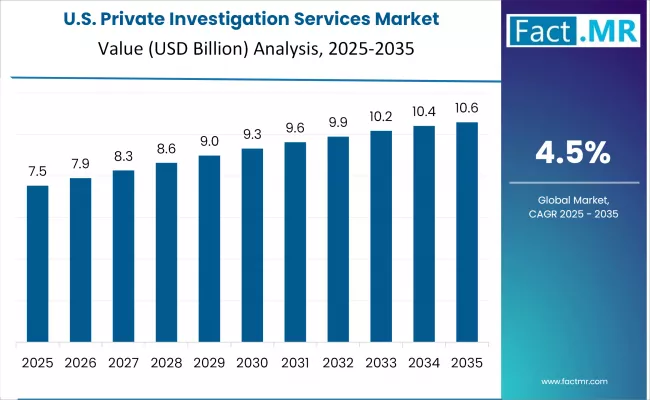
Private Investigation Services Market Country Value Analysis | Source: Fact.MR
North America remains a major demand base because legal, corporate, insurance, and cyber cases support recurring investigation work. The United States has a large ecosystem of law firms, insurers, corporates, and licensed investigators. FBI and FTC data show sustained cybercrime and fraud reporting, which supports demand for digital evidence work. Clients in this region often require admissible evidence, chain-of-custody discipline, and clear reporting. Service providers compete through licensing, specialization, and technology capability.
- United States: Corporate, legal, insurance, and cyber cases create broad demand for investigation services. The United States is forecast to post 5.0% CAGR over the assessment period as fraud and digital evidence needs remain steady. Insurers use investigators for suspicious claims. Law firms rely on investigators for litigation support. Corporate clients need internal misconduct and vendor checks. Agencies with digital forensics and strong reporting standards can defend premium work.
South Asia and Pacific Private Investigation Services Market Analysis
South Asia and Pacific is expanding as corporate risk awareness and digital activity increase. India shows demand for employee verification, vendor checks, matrimonial investigations, and online fraud support. The region contains both formal corporate investigation demand and highly fragmented local services. Fact.MR analysis suggests that buyers increasingly prefer agencies that can verify findings and protect confidentiality. Digital evidence capability is becoming more important as fraud and identity misuse move online. Growth remains tied to urbanization, corporate hiring, and legal awareness.
- India: India is expected to grow at 4.9% CAGR by 2036 as corporate verification and personal investigation demand expand. Employers use background checks and employee verification. Individuals seek help in matrimonial, fraud, and missing person cases. Online scam exposure raises the need for digital evidence support. Agencies with reliable documentation and local field networks can gain broader acceptance.
Western Europe Private Investigation Services Market Analysis
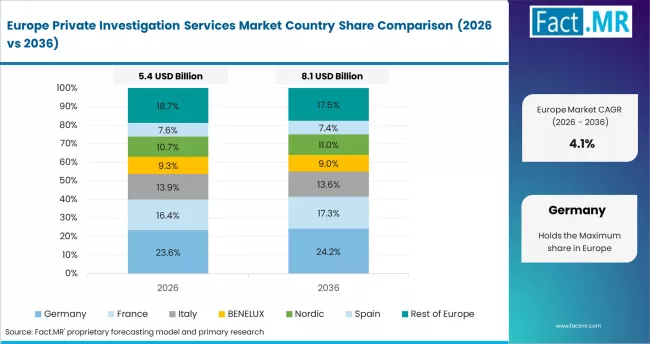
Private Investigation Services Market Europe Country Market Share Analysis, 2026 & 2036 | Source: Fact.MR
Western Europe is shaped by privacy rules, licensing conditions, and corporate compliance needs. Investigation agencies must balance client demand with strict data handling expectations. GDPR keeps personal data processing central to investigation planning. Corporate clients use investigators for due diligence, fraud checks, and litigation support. The UK’s National Security Act risk discussion also places more attention on client vetting for security professionals. Agencies that can show lawful processes and secure evidence handling are better positioned.
- UK: The UK market is supported by legal work, corporate due diligence, insurance checks, and cyber investigation. Demand in the UK is forecast to expand at 4.6% CAGR during 2026 to 2036. Security professionals face greater scrutiny around hostile-state exposure and client screening. Law firms and corporates need investigators with lawful methods and clear documentation. Client vetting will become more important for sensitive surveillance cases.
- Germany: Germany’s demand is linked with corporate compliance, insurance investigation, and fraud verification. Businesses operate under strict privacy expectations, making lawful evidence handling central to service delivery. Germany is estimated to grow at 4.4% CAGR over the study period. Agencies with strong documentation and data protection discipline can win corporate accounts. Growth remains steady because buyers need risk verification without breaching privacy rules.
Latin America Private Investigation Services Market Analysis
Latin America demand is supported by corporate due diligence, asset tracing, insurance checks, and fraud investigations. Brazil has the largest regional base because corporates and insurers need evidence support across complex operating environments. Service quality varies widely by city and agency maturity. Clients value local field networks because many cases require physical verification. Digital investigation is gaining relevance as scams and identity misuse grow online.
- Brazil: Brazil is projected to record 4.2% CAGR from 2026 to 2036. Corporate fraud, insurance claim checks, and asset tracing support recurring demand. Investigators need field access and local knowledge to verify cases. Digital evidence work is gaining importance in urban markets. Agencies with documented methods and corporate relationships can build stronger repeat demand.
Competitive Aligners for Market Players
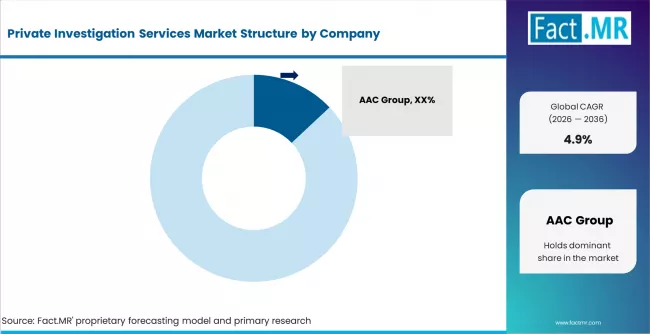
Private Investigation Services Market Analysis By Company | Source: Fact.MR
The private investigation services market is highly fragmented because licensing, local networks, and jurisdictional rules limit easy scaling. Many agencies operate at city or regional level. Larger investigation firms compete through corporate accounts and legal referral networks. Specialized providers gain share where they offer digital forensics or fraud investigation capability.
Competitive advantage depends on lawful methods and evidence quality. ACFE’s 2024 occupational fraud research shows the continued need for professional fraud detection and investigation expertise. FTC and FBI data show that fraud and cybercrime remain major public and business concerns. These indicators support demand for agencies that can work across digital and field evidence.
Client screening is becoming a competitive requirement. UK security-sector warnings under the National Security Act show the risks linked with unknowingly supporting hostile-state activity. Agencies that build client-vetting processes and secure evidence handling will be better placed for corporate and legal work. Smaller firms may compete on local knowledge, but higher-value accounts will favor providers with compliance discipline.
Key Players in Private Investigation Services Market
- AAC Group
- ACES Private Investigations Houston
- AMX Detectives
- Apple Investigations
- Bill Robison Investigations
- Bobby Dean Investigations
- Canadian Special Investigations
- Cunningham Investigations
- Detective International
- Foglight Investigations
- Global Threat Solutions
- Golden Shield Security Services
- IBM Investigations LLC
Bibliography
- [1]. Federal Bureau of Investigation. (2025, April). 2024 IC3 annual report. Internet Crime Complaint Center.
- [2]. Association of Certified Fraud Examiners. (2024). Occupational fraud 2024: A report to the nations. Association of Certified Fraud Examiners.
- [3]. Federal Trade Commission. (2025). Consumer Sentinel Network Data Book 2024. Federal Trade Commission.
- [4]. European Commission. (2025). Data protection under GDPR. European Commission.
- [5]. Professional Security. (2025, January 21). Consultants warned over National Security Act. Professional Security Magazine.
This Report Addresses
- Strategic intelligence on private investigation services demand across corporate investigations, legal support, insurance claim checks, digital forensics, and personal investigations globally.
- Market forecast from USD 22.0 billion in 2026 to USD 35.5 billion by 2036 at a CAGR of 4.9%.
- Growth opportunity mapping across China due diligence demand, Japan corporate compliance, United States legal and insurance cases, India verification demand, and UK client-vetting needs.
- Segment analysis by service type, investigation focus, client type, end-use industry, and service delivery mode.
- Regional outlook covering East Asia corporate risk checks, North America cyber and insurance investigations, South Asia verification demand, and Western Europe privacy-led service discipline.
- Competitive analysis of AAC Group, ACES Private Investigations Houston, AMX Detectives, Apple Investigations, Bill Robison Investigations, and Global Threat Solutions.
- Service assessment covering corporate services, digital forensics, fraud investigation, field surveillance, asset search, and hybrid investigation models.
- Report delivered through PDF, Excel datasets, and presentation formats, supported by primary interviews, fraud data review, cybercrime indicators, licensing checks, and service buyer validation.
Private Investigation Services Market Definition
The private investigation services market covers professional investigation work conducted for corporates, legal clients, insurers, individuals, and public agencies. The market is defined by evidence gathering, surveillance, background verification, fraud investigation, digital forensics, and lawful information collection. It differs from general security services because the output is usually a verified finding, case file, or evidence record rather than physical guarding or routine monitoring.
Private Investigation Services Market Inclusions
The scope includes corporate investigations, employee verification, vendor due diligence, insurance claim checks, legal support, surveillance, asset search, digital footprint review, cyber investigation support, missing person tracing, matrimonial investigation, and background checks. Services delivered through licensed investigators, specialist agencies, legal support firms, and digital investigation providers are included when they involve professional case-based evidence gathering.
Private Investigation Services Market Exclusions
The scope excludes armed security services, general guarding, police investigations, cybersecurity software sold without investigation support, debt collection without evidence work, and routine HR screening platforms without investigator involvement. Legal advisory services are excluded unless linked to investigation support. Pure compliance software is outside scope unless used directly in investigation workflow or evidence verification.
Private Investigation Services Market Research Methodology
- Primary Research:Interviews with corporate security heads, insurance claims managers, law firm partners, compliance officers, and licensed investigation agency owners.
- Desk Research:Review of fraud reports, cybercrime data, licensing rules, AML guidance, insurance claim trends, and investigation service portfolios.
- Market-Sizing and Forecasting:Forecasting uses case volume, average service intensity, corporate risk spending, insurance claim checks, and digital investigation demand.
- Data Validation and Update Cycle:Forecasts are validated through investigator interviews, legal service buyer checks, insurer feedback, and country-level fraud exposure indicators.
Segmentation
Scope of the Report
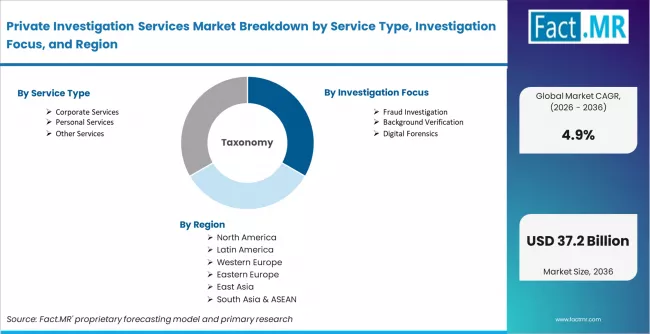
Private Investigation Services Market Breakdown By Service Type, Investigation Focus, And Region | Source: Fact.MR
| Attribute | Details |
|---|---|
| Quantitative Units | USD 22.0 billion in 2026 to USD 35.5 billion by 2036, at a CAGR of 4.9% |
| Market Definition | Professional investigation services used for corporate risk checks, legal support, fraud verification, insurance claim review, personal investigations, digital forensics, and evidence gathering. |
| Service Type | Personal Services, Corporate Services, Legal Services, Other Services |
| Investigation Focus | Fraud Investigation, Background Verification, Digital Forensics, Surveillance and Shadowing, Asset Search |
| Client Type | Corporates, Law Firms, Insurers, Individuals, Government and Public Agencies |
| End-use Industry | BFSI, Information Technology, Manufacturing, Retail Trade, Public Administration |
| Service Delivery Mode | Field Investigation, Digital Investigation, Hybrid Investigation, Retainer-based Investigation |
| Regions Covered | North America, Latin America, Western Europe, Eastern Europe, East Asia, South Asia and Pacific, Middle East and Africa |
| Countries Covered | China, Japan, United States, India, UK, Germany, Brazil, and 40 plus countries |
| Key Companies Profiled | AAC Group, ACES Private Investigations Houston, AMX Detectives, Apple Investigations, Bill Robison Investigations, Bobby Dean Investigations, Canadian Special Investigations, Cunningham Investigations, Detective International, Foglight Investigations, Global Threat Solutions, Golden Shield Security Services, IBM Investigations LLC |
| Forecast Period | 2026 to 2036 |
| Approach | Hybrid top-down and bottom-up model using case volume, investigation service pricing, corporate risk spending, insurance claim review demand, digital forensics adoption, and primary interviews with service buyers. |
Source: Fact.MR analysis. Updated May 18, 2026
Private Investigation Services Market Analysis by Segments
-
By Service Type:
- Personal Services
- Corporate Services
- Legal Services
- Other Services
-
By Investigation Focus:
- Fraud Investigation
- Background Verification
- Digital Forensics
- Surveillance and Shadowing
- Asset Search
-
By Client Type:
- Corporates
- Law Firms
- Insurers
- Individuals
- Government and Public Agencies
-
By End-use Industry:
- BFSI
- Information Technology
- Manufacturing
- Retail Trade
- Public Administration
-
By Service Delivery Mode:
- Field Investigation
- Digital Investigation
- Hybrid Investigation
- Retainer-based Investigation
-
By Region:
- North America
- United States
- Canada
- Latin America
- Brazil
- Mexico
- Western Europe
- Germany
- UK
- France
- Eastern Europe
- Poland
- Russia
- East Asia
- China
- Japan
- South Korea
- South Asia and Pacific
- India
- ASEAN
- Australia and New Zealand
- Middle East and Africa
- GCC
- South Africa
- North America
Frequently Asked Questions
How large is the private investigation services market in 2025?
What is the expected value in 2026?
What is the forecast value by 2036?
What CAGR is projected for 2026 to 2036?
Which service type leads demand?
Which investigation focus accounts for the highest share?
Which client type drives the largest demand?
Which end-use industry leads demand?
Which service delivery mode leads the market?
Which country shows the fastest growth?
Why do corporate services lead?
Why is fraud investigation important?
Why is digital forensics gaining demand?
What is the main restraint in this market?
How does GDPR affect investigation services?
Why is the United States a major market?
What supports demand in China?
What supports demand in Japan?
Why is India growing in this market?
What defines competition in this market?
Why is client vetting important for investigators?
Who are the leading companies?
Who worked on this report


Preview the report firsthand - request a free sample
Free SampleGet the brochure for pricing and purchase details
Download PDF