- Market Value (2025): USD 2.08 Bn
- Estimated Value (2026): USD 2.26 Bn
- Forecast Value (2036): USD 5.26 Bn
- CAGR (2026-2036): 8.8%
What is the Pre-Crash Seatbelt Market forecast to be worth by 2036?
USD 2.3 billion in 2026 to USD 5.3 billion by 2036, at an 8.8% CAGR.
- The pre-crash seatbelt market was valued at USD 2.08 billion in 2025.
- Demand will increase from USD 2.26 billion in 2036 to USD 5.26 billion by 2036 as carmakers specify occupant restraint functions before vehicle launch.
- The market carries an 8.8% CAGR from 2026 to 2036, reflecting wider use of electronically coordinated occupant protection.
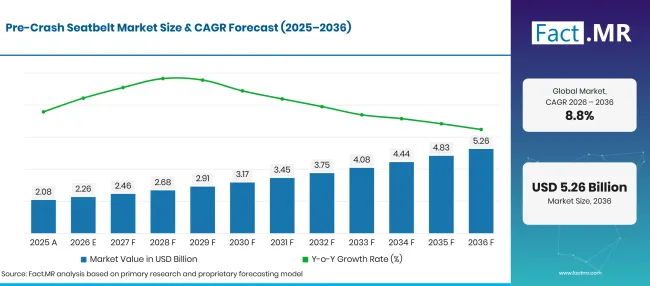
Pre Crash Seatbelt Market Forecast Global | Source: Fact.MR
| Year | Basis | Market Value (USD billion) |
|---|---|---|
| 2025 | Historical estimate | 2.08 |
| 2026 | Estimate | 2.26 |
| 2036 | Forecast | 5.26 |
| CAGR 2026 to 2036 | Forecast period | 8.8% |
Source: Fact.MR analysis. Updated Oct 24, 2026
What are the defining numbers behind Pre-Crash Seatbelt Market growth?
USD 3.0 billion in additional annual value by 2036; passive seatbelts and passenger cars form the main base.
- Demand Drivers in the Market
- Automotive restraint engineers require seatbelt systems that work alongside collision sensors and can manage belt slack before a possible impact. Integration decisions are made early because the belt system must fit the seat and vehicle electrical design.
- Euro NCAP announced its revised 2026 vehicle assessment approach in November 2025, covering crash protection alongside crash avoidance [2]. Carmakers therefore have a clear reason to examine how protective systems work together during vehicle development.
- Automakers face continuing road-safety concerns despite improvements in driving outcomes.
- Component engineering teams compare resettable belt-tightening mechanisms with single-use crash devices. Systems that activate on a warning and return to regular comfort settings create a different design task from traditional crash-only tensioning.
- Key Segments Analyzed
- By Technology: Passive Seatbelts represent 63.5% share in 2026, reflecting the broad base of conventional belt restraint installations.
- By Vehicle Type: Passenger Cars account for 65.1% share in 2026 as new model development sets restraint specifications.
- By Sales Channel: OEM represents 76.4% share in 2026 since original vehicle integration determines belt control and mounting arrangements.
- By End-User: Automotive account for 95.4% share in 2026, reflecting the application focus of occupant restraints.
- Analyst Opinion at Fact.MR
- Shambhu Nath Jha, Principal Consultant at Fact.MR, states, “Pre-crash seatbelt design is defined by the moment at which a warning becomes an instruction to tighten the belt. Engineers need dependable signal timing and a familiar fit for occupants. Future sales are likely to favour systems that integrate with other vehicle safety controls while keeping comfort complaints and installation complexity manageable.”
- Strategic Implications
- Vehicle manufacturers must assess belt-tightening behavior while they test crash-avoidance sensors, so repeated false activations do not reduce driver confidence.
- Restraint suppliers should document actuator response and reset behavior across seat positions before approaching carmakers for a new platform.
- Component makers must plan motor and belt-retractor supplies around vehicle launches because late part changes can disrupt restraint approval.
- Repair networks should distinguish a reusable pre-crash activation from a crash event that requires inspection and replacement of restraint parts.
The United Kingdom carries an 11.4% CAGR outlook through 2036. Brazil follows at 8.9% and the United States at 7.5%. Japan is forecast at 6.8%, while Germany is at 6.3%. Different vehicle production bases and model-change schedules shape the opportunities for integrating pre-crash restraints.
How does the Pre-Crash Seatbelt Market break down by segment?
Passive Seatbelts 63.5%; Passenger Cars 65.1%; OEM 76.4%; Automotive 95.4% in 2026.
Which Technology segment dominates?
Passive Seatbelts account for 63.5% share in 2026.
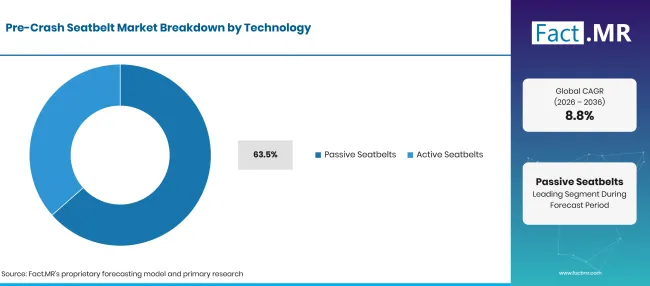
Pre Crash Seatbelt Market Breakdown Technology | Source: Fact.MR
| Segment | Share (2026) |
|---|---|
| Passive Seatbelts (Leading segment) | 63.5% |
| Other segments combined | 36.5%* |
| Total | 100.0% |
Source: Fact.MR analysis. Updated Oct 24, 2026
Passive configurations represent the wider belt equipment base, while active systems add a powered adjustment before a suspected collision. Pre-crash designs rely on correctly timed activation and controlled return to the normal wearing position. Engineers check whether warning signals are dependable and how the belt feels during ordinary travel. Conventional restraints remain relevant even where active functions are introduced, so the distinction between the two technologies must be clear in product specifications.
What leads the Vehicle Type segment?
Passenger Cars lead with 65.1% share in 2026.
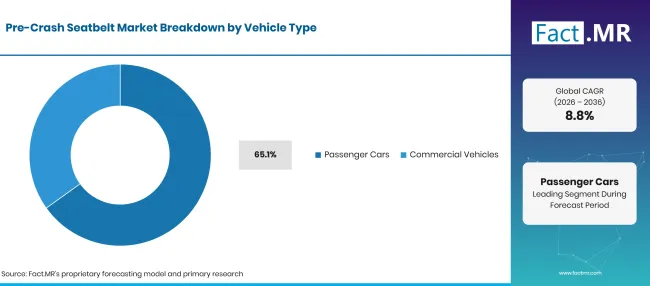
Pre Crash Seatbelt Market Breakdown Vehicle Type | Source: Fact.MR
| Segment | Share (2026) |
|---|---|
| Passenger Cars (Leading segment) | 65.1% |
| Other segments combined | 34.9%* |
| Total | 100.0% |
Source: Fact.MR analysis. Updated Oct 24, 2026
Passenger car programs offer repeated chances to specify electronically coordinated seatbelt systems when models are refreshed. Belt routing and seat positions vary between vehicles, requiring testing before the final restraint package is approved. Commercial vehicles present separate challenges because cab layouts and driver operating conditions differ from passenger cars. Suppliers must demonstrate fit and repeatable operation for each vehicle family rather than assuming a common installation works across the range. Seat geometry also links restraint planning with automotive seat tracksautomotive seat tracks during vehicle platform design.
How does Sales Channel influence purchasing?
OEM captures 76.4% share in 2026.
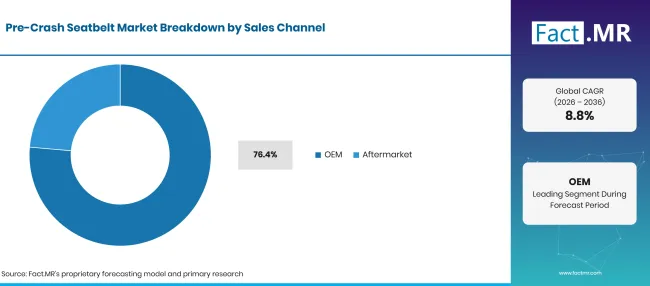
Pre Crash Seatbelt Market Breakdown Sales Channel | Source: Fact.MR
| Segment | Share (2026) |
|---|---|
| OEM (Leading segment) | 76.4% |
| Other segments combined | 23.6%* |
| Total | 100.0% |
Source: Fact.MR analysis. Updated Oct 24, 2026
OEM integration takes place when carmakers finalize safety specifications and electrical connections. An aftermarket supplier faces compatibility challenges because an ordinary belt system cannot gain pre-crash functions through a simple replacement. Service parts therefore depend on the original vehicle configuration. Seat-mounted components are reviewed alongside automotive seat control modulesautomotive seat control modules during cabin electrical design
Which End-User accounts for most sales?
Automotive represents 95.4% share in 2026.
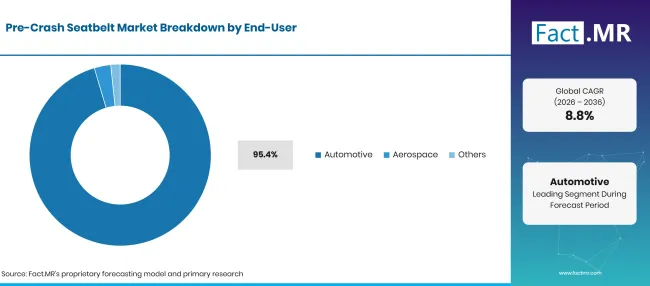
Pre Crash Seatbelt Market Breakdown End User | Source: Fact.MR
| Segment | Share (2026) |
|---|---|
| Automotive (Leading segment) | 95.4% |
| Other segments combined | 4.6%* |
| Total | 100.0% |
Source: Fact.MR analysis. Updated Oct 24, 2026
Passenger and commercial vehicle occupant protection defines the main end use of pre-crash seatbelt components. Automotive engineering teams review the entire safety response before confirming the restraint design for production. Aerospace uses require their own installation and qualification processes, so they should be assessed separately from automotive platforms. Customers in other applications face different operating conditions that limit direct transfer of a road-vehicle restraint design.
What is accelerating Pre-Crash Seatbelt Market adoption, and what is holding it back?
Sensor-linked restraint preparation supports adoption; validation cost and complex integration slow broader use.
Drivers Impact Analysis
| DRIVER | (~) % IMPACT ON CAGR | GEOGRAPHIC RELEVANCE | IMPACT TIMELINE |
|---|---|---|---|
| Crash protection integration | +1.0% | Global | Medium term (2–4 years) |
| New passenger-car platforms | +0.8% | Europe, Asia | Medium term (2–4 years) |
| Sensor-based warning systems | +0.7% | Global | Long term (>= 4 years) |
| Occupant comfort control | +0.5% | Europe, Japan | Medium term (2–4 years) |
| Seatbelt actuator refinement | +0.4% | Global | Long term (>= 4 years) |
Source: Fact.MR analysis. Updated Oct 24, 2026
Opportunity Impact Analysis
| OPPORTUNITY | (~) % IMPACT ON CAGR | GEOGRAPHIC RELEVANCE | IMPACT TIMELINE |
|---|---|---|---|
| Reusable pre-tensioning modules | +0.8% | Global | Medium term (2–4 years) |
| Platform-wide restraint designs | +0.6% | Europe, USA | Long term (>= 4 years) |
| Commercial vehicle safety upgrades | +0.5% | Americas | Medium term (2–4 years) |
| Service replacement parts | +0.4% | Global | Long term (>= 4 years) |
Source: Fact.MR analysis. Updated Oct 24, 2026
Restraints Impact Analysis
| RESTRAINT | (~) % IMPACT ON CAGR | GEOGRAPHIC RELEVANCE | IMPACT TIMELINE |
|---|---|---|---|
| System validation expense | -0.8% | Global | Short term (<= 2 years) |
| Packaging and motor cost | -0.6% | Global | Medium term (2–4 years) |
| Electronic interface differences | -0.5% | Global | Medium term (2–4 years) |
| Aftermarket compatibility | -0.4% | Global | Long term (>= 4 years) |
Source: Fact.MR analysis. Updated Oct 24, 2026
Which countries are scaling the Pre-Crash Seatbelt Market through 2036?
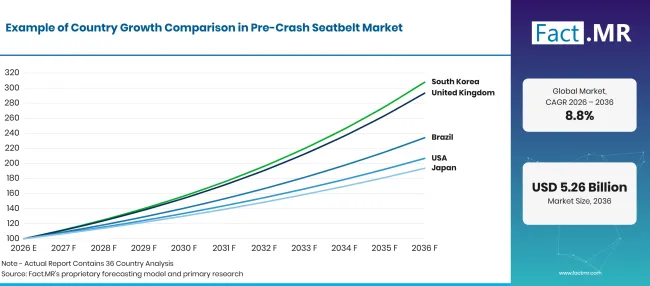
Pre Crash Seatbelt Market Growth Index | Source: Fact.MR
| Country | CAGR (2026–2036) |
|---|---|
| United Kingdom | 11.4% |
| Brazil | 8.9% |
| United States | 7.5% |
| Japan | 6.8% |
| Germany | 6.3% |
Source: Fact.MR analysis. Updated Oct 24, 2026
What shapes pre-crash seatbelt sales in United Kingdom?
11.4% CAGR through 2036, linked to British vehicle assembly and safety evaluation.
The United Kingdom has a vehicle engineering base where suppliers can introduce motorized belt retractors during model updates. SMMT reported production of 764,715 vehicles in January 2026 for the 2025 calendar year [5]. The Department for Transport reported in July 2026 that around one-quarter of car occupant fatalities with known belt status involved occupants who were not wearing seatbelts [6].
What shapes pre-crash seatbelt sales in Brazil?
8.9% CAGR through 2036, linked to domestic car assembly and model localization.
Brazilian vehicle plants offer a local assembly route for integrating pre-crash seatbelt systems into passenger-car programs. Anfavea reported in January 2026 that the country produced 2.644 million vehicles during 2025 [4]. The association also recorded a 2.1% rise in registrations during 2025. Vehicle engineering teams are expected to consider active belt-tightening equipment when updating restraint specifications for locally assembled cars.
What shapes pre-crash seatbelt sales in United States?
7.5% CAGR through 2036, linked to occupant protection requirements and model design.
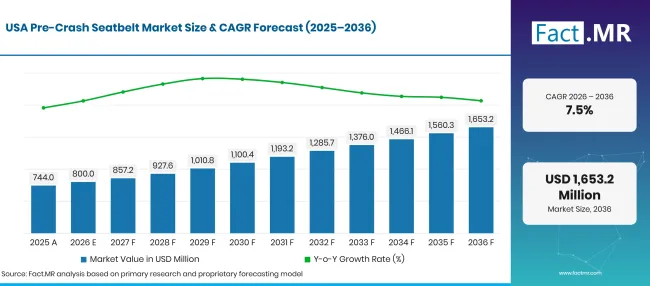
Pre Crash Seatbelt Market Forecast Usa | Source: Fact.MR
Seatbelt engineering in the United States is shaped by a large base of passenger vehicles and established occupant protection requirements. NHTSA reported a 91.3% national seatbelt use rate for 2025 [8]. In April 2026 the agency estimated 36,640 traffic fatalities for 2025 [1]. Vehicle manufacturers are expected to examine pre-crash tightening alongside other restraint functions during platform development.
What shapes pre-crash seatbelt sales in Japan?
6.8% CAGR through 2036, linked to precision vehicle integration and established restraint sourcing.
Japanese restraint suppliers work within tightly integrated vehicle designs where belt movement must suit the sensor signals and the position of each occupant. VDA published February 2026 production figures that placed Japanese passenger-car output at 7,207,127 vehicles in 2025 [9]. That manufacturing base creates opportunities for approved belt assemblies to be installed across repeat vehicle programs.
What shapes pre-crash seatbelt sales in Germany?
6.3% CAGR through 2036, linked to large-scale vehicle engineering and model renewal.
Germany has an established vehicle engineering and automotive supplier base for integrating pre-crash restraints during the development of new models. VDA reported in January 2026 that the country manufactured about 4.15 million passenger cars in 2025 [3]. The same industry body reported approximately 2.86 million new passenger-car registrations in 2025. Carmakers are expected to assess motorized belt equipment as part of broader occupant protection design.
Who leads the Pre-Crash Seatbelt Market?
Autoliv and Joyson Safety Systems have direct occupant-restraint relevance; other vehicle electronics suppliers support related functions.
Autoliv develops occupant safety products and has disclosed work involving pre-pretensioner electronics [7]. Joyson Safety Systems is an occupant safety supplier with seatbelt and airbag activity. Product selection depends on the precise belt mechanism and its approved application, so broad safety-system portfolios are not interchangeable with verified pre-crash seatbelt product lines.
Robert Bosch is relevant to wider vehicle electronics, while Hyundai Mobis supplies automotive safety components. Toyoda Gosei and Tokai Rika have broader component portfolios. Each company’s role in pre-crash belt assemblies differs, so a vehicle-safety portfolio alone does not establish direct product coverage.
Which companies are the key providers?
Key companies include Autoliv Inc.; ZF LIFETEC; Robert Bosch GmbH; Joyson Safety Systems; Hyundai Mobis Co. Ltd.; Toyoda Gosei Co. Ltd.; Tokai Rika Co. Ltd.
- Autoliv Inc.
- ZF LIFETEC
- Robert Bosch GmbH
- Joyson Safety Systems
- Hyundai Mobis Co. Ltd.
- Toyoda Gosei Co. Ltd.
- Tokai Rika Co. Ltd.
Bibliography
- [1] National Highway Traffic Safety Administration. (2026, April 1). Trump’s Transportation Department announces record-low traffic deaths & fatality rates in 2025.
- [2] European New Car Assessment Programme. (2025, November 26). Euro NCAP announces 2026 protocol changes to tackle modern driving risks.
- [3] Verband der Automobilindustrie. (2026, January 5). Pkw-Produktion 2025 leicht über Vorjahresniveau.
- [4] Associação Nacional dos Fabricantes de Veículos Automotores. (2026, January 15). Produção e venda de autoveículos crescem em 2025 e Anfavea projeta nova alta em 2026.
- [5] Society of Motor Manufacturers and Traders. (2026, January 29). Tough year for auto but new models and Industrial Strategy can deliver growth.
- [6] Department for Transport. (2026, July 30). RRCGB 2025: Risk behaviours and circumstances.
- [7] Autoliv. (2025, October 9). Autoliv and HSAE: New strategic joint venture to advance automotive safety electronics.
- [8] National Highway Traffic Safety Administration. (n.d.). Seat belts.
- [9] Verband der Automobilindustrie. (2026, February 16). Automobile production.
This Report Answers
- The forecast compares market value between 2026 and 2036.
- Technology analysis separates passive restraint equipment from active pre-collision belt adjustment.
- Passenger-car analysis examines where vehicle platform development influences restraint selection.
- Sales-channel analysis distinguishes OEM installation from model-specific service replacement.
- Country comparisons cover the United Kingdom, Brazil, United States, Japan and Germany.
- The competitive discussion separates restraint suppliers from adjacent component businesses.
What does the Pre-Crash Seatbelt Market cover?
The market covers belt assemblies designed to prepare occupants before a possible collision. Related component markets include automotive seating systemsautomotive seating systems and automotive seat control modulesautomotive seat control modules, which share vehicle-platform integration requirements with belt assemblies.
What is included in the scope?
The scope includes pre-crash restraint components fitted through original vehicle programs. Passive seatbelts remain a separate comparison category. Suppliers are assessed for their relationship to anticipatory belt functions.
What is excluded from the scope?
Airbags and automatic braking units remain separate products. Ordinary replacement belts without an active pre-crash function are excluded from active-function sales. Aerospace restraints are considered only within the aerospace end-user segment.
How Was the Analysis Built?
The analysis draws on 120+ sources, 35+ company portfolios, 25+ countries, and more than 20 industry interviews.
- Primary Research: Primary research includes discussions with manufacturers, service providers, technology developers, distributors, end users, and subject-matter experts. These conversations examine purchasing priorities, product adoption, operational challenges, approval requirements, competitive positioning, and the factors that influence wider market acceptance.
- Desk Research: Desk research covers government statistics, regulatory publications, company filings, trade data, technical studies, industry associations, standards, public policy, and other authoritative sources. Every source used in the analysis is documented in the bibliography.
- Market Sizing and Forecasting: Market estimates combine historical performance, demand indicators, pricing and volume trends, segment shares, company participation, country-level growth, adoption patterns, investment activity, and barriers to market expansion.
- Data Validation and Update Cycle: Findings are validated by comparing primary interviews with public data, company activity, regulatory changes, trade patterns, and industry developments. Regular updates review new product launches, capacity changes, partnerships, approvals, and shifts in commercial adoption.
Segmentation
What is the report’s scope and coverage?
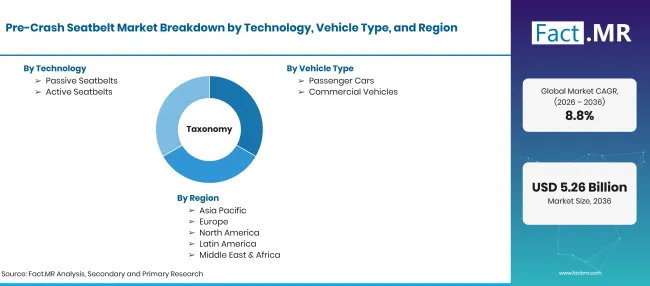
Pre Crash Seatbelt Market Taxonomy | Source: Fact.MR
| Attribute | Details |
|---|---|
| Quantitative Units | USD billion in 2026 and 2036; CAGR from 2026 to 2036 |
| Market Definition | Seatbelt restraint components and systems designed to prepare or adjust belt tension in anticipation of a possible vehicle collision. |
| Technology | Passive Seatbelts; Active Seatbelts |
| Vehicle Type | Passenger Cars; Commercial Vehicles |
| Sales Channel | OEM; Aftermarket |
| End-User | Automotive; Aerospace; Others |
| Regions Covered | North America; Latin America; Western Europe; Eastern Europe; East Asia; South Asia & Pacific; Middle East & Africa |
| Countries Covered | Germany; Brazil; United States; United Kingdom; Japan |
| Companies Profiled | Autoliv Inc.; ZF LIFETEC; Robert Bosch GmbH; Joyson Safety Systems; Hyundai Mobis Co. Ltd.; Toyoda Gosei Co. Ltd.; Tokai Rika Co. Ltd. |
| Forecast Period | 2026 to 2036 |
| Approach | Vehicle restraint applications, public road-safety information, supplier statements and forecast scenario review |
Source: Fact.MR analysis. Updated Oct 24, 2026
How is the market segmented?
-
By Technology
- Passive Seatbelts
- Active Seatbelts
-
By Vehicle Type
- Passenger Cars
- Commercial Vehicles
-
By Sales Channel
- OEM
- Aftermarket
-
By End-User
- Automotive
- Aerospace
- Others
-
By Region
- North America
- Latin America
- Western Europe
- Eastern Europe
- East Asia
- South Asia & Pacific
- Middle East & Africa
Frequently Asked Questions
How big is the Pre-Crash Seatbelt Market in 2026?
What is the CAGR of the Pre-Crash Seatbelt Market from 2026 to 2036?
Which technology leads the Pre-Crash Seatbelt Market?
Which vehicle type leads the Pre-Crash Seatbelt Market?
Who are the leading companies in the Pre-Crash Seatbelt Market?
Who worked on this report


Preview the report firsthand - request a free sample
Free SampleGet the brochure for pricing and purchase details
Download PDF