- Market size in 2025: USD 417.8 million
- Estimated market size in 2026: USD 445.0 million
- Projected market size by 2036: USD 1150 million
- CAGR (2026-2036): 10.0% CAGR
What is the prebiotic scalp mists market forecast to be worth by 2036?
USD 445.0 million in 2026 to USD 1,150 million by 2036, at 10.0% CAGR.
- The prebiotic scalp mists market crossed a valuation of USD 417.8 million in 2025.
- Demand is expected to increase from USD 445.0 million in 2026 to USD 1,150 million by 2036.
- The market is forecast to record 10.0% CAGR from 2026 to 2036 as scalp-first routines move into leave-in mist formats.
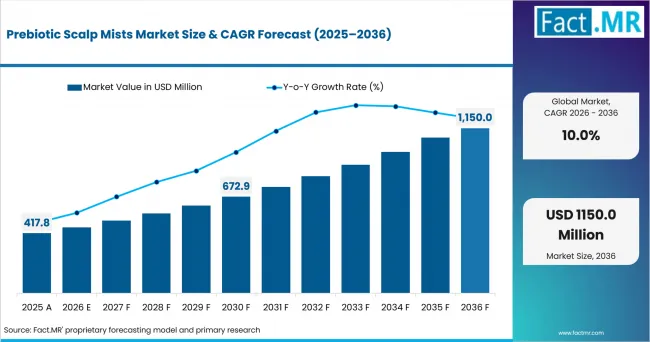
Prebiotic Scalp Mists Market Market Value Analysis | Source: Fact.MR
What are the defining numbers behind prebiotic scalp mists growth?
USD 709.2 million absolute opportunity by 2036, led by South Korea and China.
- Demand Drivers in the Market
- Prestige buyers are adding scalp mists because consumers already understand leave-in facial mist routines and light treatment layers.
- Dermocosmetic retailers use barrier repair language to separate treatment mists from fragrance-led hair refreshers on shelves.
- Salon brands use scalp diagnostics and stylist advice to support repeat purchase after color, repair and density services.
- DTC brands build subscription logic around light daily application and visible scalp comfort claims between wash days.
- Key Segments Analyzed
- By Prebiotic Base: Inulin-Based Mists account for 34.0% share in 2026 because ingredient familiarity supports buyer confidence.
- By Active Base: Ceramide Blends hold 28.0% share in 2026 because barrier repair claims need a skin-care style anchor.
- By Hair Concern: Barrier Repair captures 31.0% share in 2026 as dryness and sensitivity move scalp care beyond dandruff control.
- By Channel: Prestige Beauty holds 36.0% share in 2026 because premium shoppers already buy treatment-led haircare.
- By Positioning: Scalp-First Routines account for 38.0% share in 2026 because brands frame the scalp as skin.
- By Geography: South Korea records 12.4% CAGR through 2036 as K-beauty retail favors light treatment textures.
- Analyst Opinion at Fact.MR
- Shambhu Nath Jha, Senior Analyst at Fact.MR, states, “Prebiotic scalp mists sit between scalp serum and hair fragrance. I see the strongest opening where brands prove comfort and reduce residue. Daily scalp use needs to feel normal before the format scales.”
- Strategic Implications
- Brands should connect prebiotic claims with one clear scalp concern instead of covering every hair problem.
- Retailers should place prebiotic scalp mists beside treatment serums because the purchase logic is closer to skin care.
- Ingredient suppliers can gain specification access by offering scalp-friendly evidence for inulin, ferments and ceramide blends.
- Salon channels need sampling programs because texture feel decides whether shoppers accept leave-in scalp use.
Testing and product-positioning evidence form the core of this market because prebiotic scalp mists sit between hair fragrance and scalp treatment. This supports demand for claims discipline before products enter prestige, salon and dermocosmetic retail channels.
South Korea is projected to record 12.4% CAGR through 2036 as K-beauty retailers accept light scalp treatment textures. China is expected to expand at 11.8% CAGR because online beauty discovery supports scalp-treatment trial. The United States is forecast to grow at 10.8% CAGR as DTC education and cosmetic listing transparency shape claims review.
How does the prebiotic scalp mists market break down by segment?
Inulin-Based Mists lead at 34.0%; Prestige Beauty leads channels at 36.0%.
Which prebiotic base dominates?
Inulin-Based Mists hold 34.0% share in 2026.
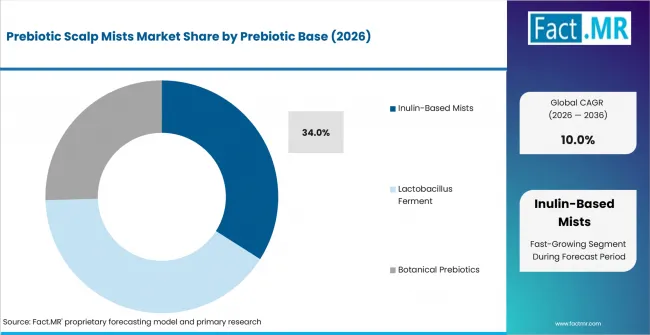
Prebiotic Scalp Mists Market Analysis By Prebiotic Base | Source: Fact.MR
Inulin is familiar to ingredient suppliers and beauty formulators, which makes the inulin base easier to explain in scalp comfort products. Buyers also associate prebiotic ingredients with microbiome support, which helps suppliers position mists beyond fragrance refreshment.
Which active base dominates?
Ceramide Blends account for 28.0% share in 2026.
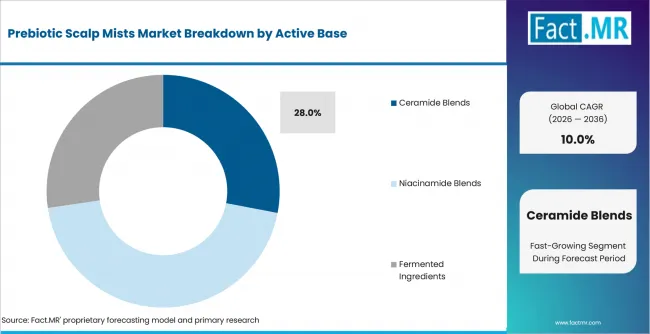
Prebiotic Scalp Mists Market Analysis By Active Base | Source: Fact.MR
Ceramide blends lead because scalp-barrier claims need a recognizable skin-care active. Brands use ceramides with niacinamide or peptides to make scalp comfort easier to understand. This supports treatment-led pricing when the mist leaves minimal residue and works under styling products.
Which hair concern dominates?
Barrier Repair holds 31.0% share in 2026.
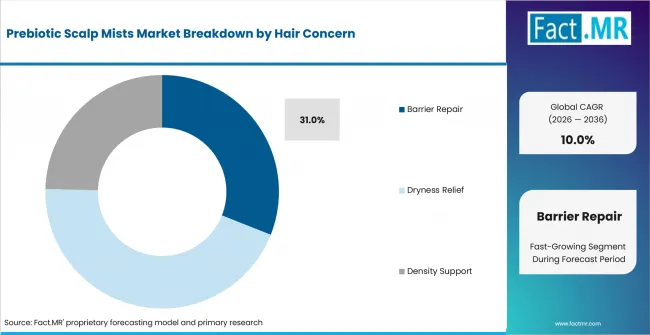
Prebiotic Scalp Mists Market Analysis By Hair Concern | Source: Fact.MR
Barrier repair leads because dryness and sensitivity are easy for consumers to identify between wash days. The link with skin microbiome positioning helps brands explain why the scalp needs leave-in support. This concern also supports repeat use because comfort benefits need continuous application.
Which channel dominates?
Prestige Beauty leads with 36.0% share in 2026.
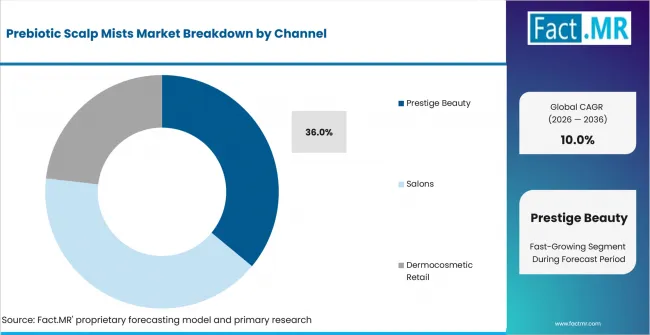
Prebiotic Scalp Mists Market Analysis By Channel | Source: Fact.MR
Prestige beauty leads because treatment-led buyers already accept higher prices for scalp serums and leave-ins. The channel also gives brands room to explain premium beauty products through education, sampling and ingredient storytelling. Marketplaces remain important, but they often require clearer review evidence before repeat purchase improves.
Which positioning dominates?
Scalp-First Routines hold 38.0% share in 2026.
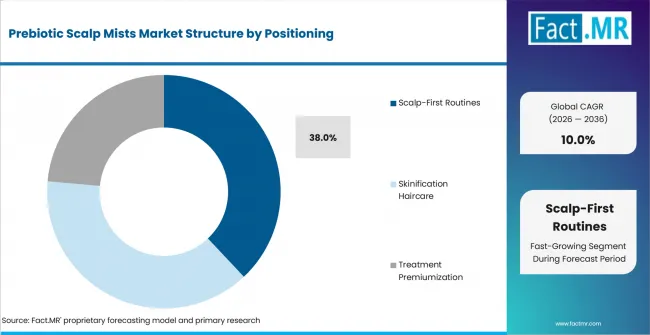
Prebiotic Scalp Mists Market Analysis By Positioning | Source: Fact.MR
Scalp-first routines lead because brands are reframing scalp care as part of daily skin maintenance. This supports softer language around sensitivity, flakes and sebum balance. The positioning also lets brands borrow cues from skin care products without claiming medical treatment.
What is accelerating prebiotic scalp mist adoption, and what is holding it back?
Scalp-first beauty routines and barrier repair positioning drive it, while claim scrutiny and residue concerns restrain wider adoption.
Drivers Impact Analysis
| DRIVER | (~) % IMPACT ON CAGR |
GEOGRAPHIC RELEVANCE | IMPACT TIMELINE |
|---|---|---|---|
| Scalp-first beauty routines | +2.6% | Global, strongest in South Korea and United States | Short term (≤ 2 years) |
| Barrier repair product language | +2.1% | North America, Western Europe and Japan | Medium term (2-4 years) |
| DTC education and sampling | +1.8% | United States, United Kingdom and China | Short term (≤ 2 years) |
| Salon scalp diagnosis support | +1.4% | South Korea, Japan and Germany | Medium term (2-4 years) |
| Mist texture convenience | +1.2% | Global prestige beauty channels | Long term (≥ 4 years) |
Scalp-first beauty routines
Scalp care is moving into daily beauty routines because shoppers now compare scalp comfort with facial-skin comfort. The United States Food and Drug Administration listed over 1.1 million active cosmetic product listings as of March 2026. That registration scale raises the need for clear product positioning when scalp mists compete for shelf space. Scalp health treatment language gives prebiotic mists a cleaner role than fragrance refreshment.
Barrier repair product language
Barrier repair claims are becoming more useful because shoppers can connect dryness and sensitivity with a repeat treatment habit. Living Proof reports that its dry scalp treatment uses a vitamin B3-based microbiome balancing complex for comfort positioning. This type of claim supports mists that need daily or weekly use without heavy residue. Suppliers that show mildness and scalp feel evidence gain better access to dermocosmetic buyers.
DTC education and sampling
Online education helps brands explain why a scalp mist should be used after washing and between wash days. The United States Census Bureau reported that nonstore retail sales increased 12.2% in May 2026.
That channel shift matters because DTC brands can teach application steps before consumers compare formulas. The same online shelf also exposes weak claims quickly through reviews and repeat-purchase data.
Opportunity Impact Analysis
| OPPORTUNITY | (~) % IMPACT ON CAGR |
GEOGRAPHIC RELEVANCE | IMPACT TIMELINE |
|---|---|---|---|
| Dermocosmetic scalp mist lines | +2.4% | United States, Germany and France | Medium term (2-4 years) |
| K-beauty microbiome formats | +2.0% | South Korea, China and Japan | Short term (≤ 2 years) |
| Salon sampling programs | +1.6% | Japan, Germany and United Kingdom | Medium term (2-4 years) |
| Sensitive-scalp claims | +1.3% | Europe and North America | Short term (≤ 2 years) |
| Preservative-safe refills | +0.9% | Western Europe and United States | Long term (≥ 4 years) |
Dermocosmetic scalp mist lines
Dermocosmetic retailers can convert scalp mists into a treatment aisle product when claims are narrow and testable. That retail base gives ingredient suppliers a broad formulation audience for prebiotic scalp formats.
Preservative design remains important because water-based mists need safety support before scaling. Brands also compare cosmetic preservatives when mildness claims and refill logic intersect.
K-beauty microbiome formats
South Korean beauty exporters are well placed because light textures and scalp essences fit existing retail routines. The opportunity is concentrated in mists that feel clean under styling products and do not flatten hair.
Microbiome skincare products give Korean brands a nearby proof point when they extend facial-skin credibility into scalp formats. Supplier access improves when claims are translated into simple scalp comfort benefits that retailers can explain quickly.
Salon sampling programs
Salons can help prebiotic scalp mists because stylists can show where and how the product is applied. L’Oréal said its Professional Products division passed the EUR 5 billion sales landmark in 2025. That channel scale shows why salon education still matters for premium scalp products. Brands with stylist training can reduce misuse and support repeat purchase after the first trial.
Restraints Impact Analysis
| RESTRAINT | (~) % IMPACT ON CAGR |
GEOGRAPHIC RELEVANCE | IMPACT TIMELINE |
|---|---|---|---|
| Claim substantiation burden | -1.8% | United States and European Union | Short term (≤ 2 years) |
| Mist residue complaints | -1.3% | Global premium channels | Medium term (2-4 years) |
| Ingredient sensitivity risk | -1.1% | Japan, Germany and France | Medium term (2-4 years) |
| Preservative reformulation cost | -0.9% | Europe and North America | Long term (≥ 4 years) |
| Crowded scalp shelves | -0.8% | United States, China and United Kingdom | Short term (≤ 2 years) |
Claim substantiation burden
Prebiotic scalp mists receive tighter scrutiny when brands imply microbiome or barrier effects without clear support. That compliance context makes vague scalp claims harder to defend in premium channels. Brands can reduce risk by pairing simple use claims with ingredient evidence and safety records.
Mist residue complaints
Leave-in scalp products can disappoint buyers when the formula feels sticky or interferes with styling. This limits adoption among fine-hair users and shoppers who wash less often during the week. The constraint is strongest when leave-in products borrow too much from styling spray logic without scalp-care proof.
Buyers also compare personal care active ingredients when scalp claims promise comfort or density support. Texture performance remains a purchase barrier because natural language cannot replace feel and stability evidence.
Ingredient sensitivity risk
Scalp sensitivity can restrict active loading because irritated users may react to acids, fragrance or strong botanicals. Japan Cosmetic Industry Association data showed hair care made up 28.0% of Japanese cosmetic shipments in 2023. That category weight supports opportunity, but it also raises expectations for mildness and clear instructions. Halal hair care positioning adds another check in Muslim consumer segments where ingredient origin matters.
Which countries are scaling prebiotic scalp mists fastest?
South Korea 12.4%, China 11.8%, United States 10.8%, United Kingdom 10.2%, Germany 9.8%, France 9.6%, Japan 9.4%.
Based on regional analysis, the prebiotic scalp mists market is segmented into North America, Latin America, Western Europe, Eastern Europe, East Asia, South Asia and Pacific, and Middle East and Africa.
| Country | CAGR |
|---|---|
| South Korea | 12.4% |
| China | 11.8% |
| United States | 10.8% |
| United Kingdom | 10.2% |
| Germany | 9.8% |
| France | 9.6% |
| Japan | 9.4% |
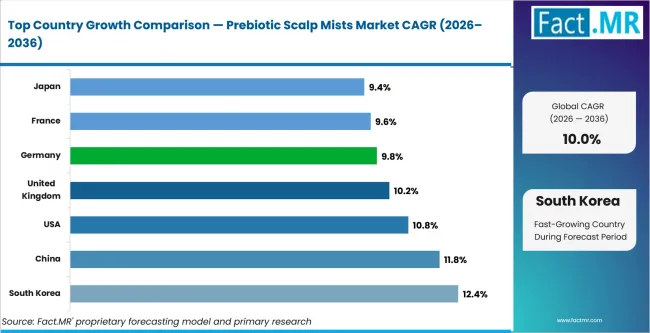
Prebiotic Scalp Mists Market Cagr Analysis By Country | Source: Fact.MR
What is powering South Korea’s lead?
12.4% CAGR, supported by K-beauty texture systems and scalp-microbiome retail language.
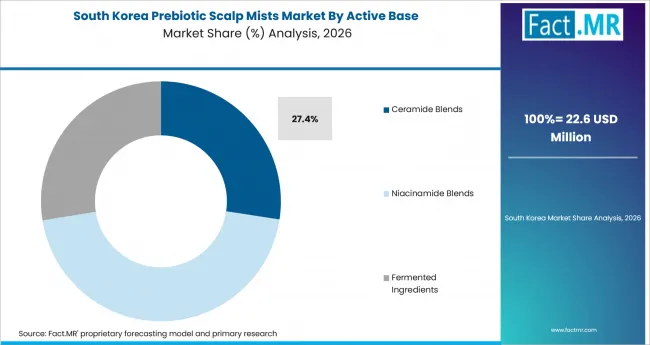
Prebiotic Scalp Mists Market South Korea Market Share Analysis By Active Base | Source: Fact.MR
South Korea benefits from beauty retail habits that already accept essences, ampoules and light treatment layers. South Korea is projected to record a 12.4% CAGR through 2036, supported by K-beauty texture systems and scalp-microbiome claims. Prebiotic scalp mists fit this environment because the format offers a light step between wash care and styling. Suppliers that combine quick-dry feel with narrow scalp comfort claims are better placed for Korean retail testing.
How is China scaling category demand?
11.8% CAGR, driven by online beauty retail and scalp treatment discovery.
Chinese beauty buyers discover scalp treatments through e-commerce content and ingredient comparison. The National Bureau of Statistics of China reported RMB 465.3 billion in cosmetic retail sales in 2025. China is expected to expand at 11.8% CAGR by 2036, supported by online beauty retail and scalp treatment discovery. Marketplace performance should favor mists with simple routines and review-friendly residue claims.
What supports the United States outlook?
10.8% CAGR, backed by DTC education and cosmetic registration transparency.
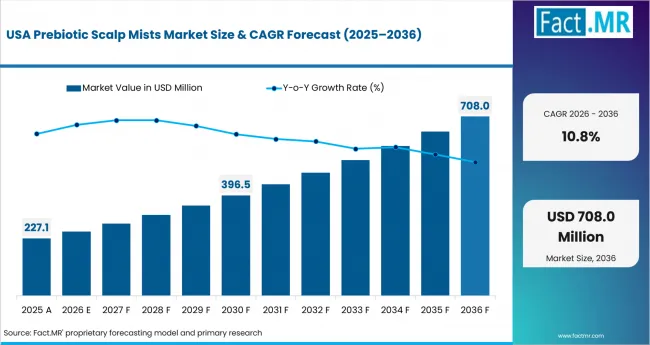
Prebiotic Scalp Mists Market Country Value Analysis | Source: Fact.MR
United States buyers compare scalp mists through claims, reviews and ingredient lists before paying premium prices. The market is forecast to grow at 10.8% CAGR from 2026 to 2036, supported by DTC education and cosmetic registration transparency. FDA product listing scale increases the need for cleaner category labels and more disciplined claims. Brands that explain prebiotic purpose in one use case can reduce shopper confusion at checkout.
Why does the United Kingdom matter?
10.2% CAGR, due to prestige beauty retail and treatment-led haircare buying.
United Kingdom shoppers have high exposure to prestige retailers and salon-backed scalp education. Cosmetics Europe valued the United Kingdom beauty and personal care market at EUR 14.7 billion in 2025. The United Kingdom is expected to advance at 10.2% CAGR by 2036, supported by prestige beauty retail and treatment-led haircare buying. Channel access should depend on residue control, fragrance restraint and clear scalp-comfort language.
What underpins Germany’s growth?
9.8% CAGR, owing to dermocosmetic discipline and pharmacy-linked scalp care.
German buyers place more weight on tolerability, ingredient discipline and pharmacy credibility than on sensory claims alone. Germany is projected to rise at 9.8% CAGR through 2036, supported by dermocosmetic discipline and pharmacy-linked scalp care. Suppliers need mildness support and clear labeling before German retail buyers expand shelf space.
Why is France important for premium positioning?
9.6% CAGR, supported by dermocosmetic heritage and scalp-sensitive formulations.
French beauty retail gives scalp mists an opening when products connect sensorial use with tolerance claims. France is forecast at 9.6% CAGR from 2026 to 2036, supported by dermocosmetic heritage and scalp-sensitive formulations. Cosmetics Europe valued France beauty and personal care sales at EUR 14.5 billion in 2025. Premium suppliers can win by presenting prebiotic mists as a careful scalp step instead of hair perfume.
Why is Japan an important scalp mist market?
9.4% CAGR, driven by high hair-care category weight and conservative product testing.
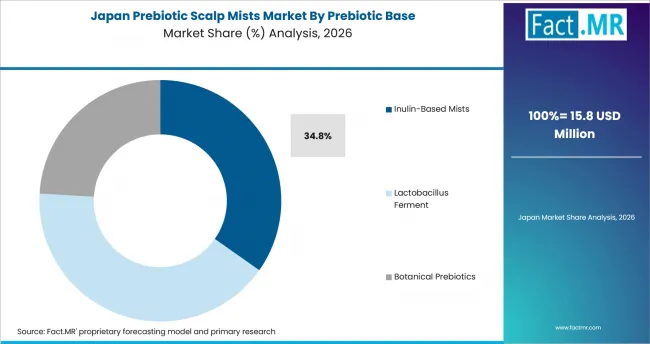
Prebiotic Scalp Mists Market Japan Market Share Analysis By Prebiotic Base | Source: Fact.MR
Japan has a large hair-care base and a buyer culture that rewards mildness and routine fit. Japan is expected to post 9.4% CAGR by 2036, supported by high hair-care category weight and conservative product testing. Japan Cosmetic Industry Association data showed hair care at 28.0% of cosmetic shipments in 2023. Adoption is constrained by careful claim review, so suppliers need clear instructions and low-residue textures.
Who leads the prebiotic scalp mists landscape?
Kérastase and Gallinée lead through salon reach and ingredient-led specialty beauty positioning, while Act+Acre and Akasha Superfoods strengthen DTC scalp education.
Kérastase and Gallinéeshape premium scalp-treatment language through salon and specialty beauty channels. Act+Acre and Akasha Superfoodsadd DTC-led scalp education. Kérastase benefits from L’Oréal Professional Products access to salon education and premium scalp routines.
Act+Acre and Akasha Superfoodscompete through scalp comfort and barrier positioning. Living Proof and STRAANDadd density support, while Deconstructadd exfoliation or scalp serum angles. Smaller brands can win early trial when they explain why the mist belongs on the scalp and not only on hair lengths.
Competition through 2036 depends on residue control and claim discipline. Retail education and repeat-use evidence also shape supplier selection.
Which companies are the key players?
Kérastase, Gallinée, Act+Acre, Akasha Superfoods, Living Proof, STRAAND, Deconstruct
- Kérastase
- Gallinée
- Act+Acre
- Akasha Superfoods
- Living Proof
- STRAAND
- Deconstruct
Bibliography
- United States Food and Drug Administration. (2026, April 14). Registration and listing of cosmetic product facilities and products. U.S. Department of Health and Human Services.
- Cosmetics Europe. (2025, July). Socio-economic contribution of the European cosmetics and personal care industry. Cosmetics Europe.
- U.S. Census Bureau. (2026, June 17). Advance monthly sales for retail and food services, May 2026. U.S. Department of Commerce.
- National Bureau of Statistics of China. (2026, January 20). Total retail sales of consumer goods in December 2025. National Bureau of Statistics of China.
- Japan Cosmetic Industry Association. (2024, October 11). Statistics: Cosmetic shipments. Japan Cosmetic Industry Association.
- Living Proof. (2026). Scalp Care Dry Scalp Treatment. Living Proof.
- The Estée Lauder Companies Inc. (2024, June 3). The Estée Lauder Companies completes acquisition of DECIEM Beauty Group Inc. The Estée Lauder Companies Inc.
- L’Oréal Groupe. (2026). L’Oréal Professional Products: Strategy & performance 2025. L’Oréal Groupe.
This Report Addresses
- Strategic intelligence on prebiotic scalp mists across prebiotic base, active base, hair concern, channel and positioning.
- Segment analysis covering Inulin-Based Mists, Ceramide Blends, Barrier Repair, Prestige Beauty and Scalp-First Routines.
- Regional outlook covering South Korea, China, United States, United Kingdom, Germany, France and Japan.
- Competitive analysis of Kérastase, Gallinée, Act+Acre, Akasha Superfoods, Living Proof, STRAAND, Deconstruct.
- Product assessment covering leave-in scalp mist formats, microbiome-friendly positioning and barrier repair claims.
- Channel assessment covering prestige beauty, salons, dermocosmetic retail, DTC and marketplace pathways.
- Primary checks, official source review, company page review and retail logic support the forecast.
What does the prebiotic scalp mists market cover?
Leave-in scalp mist products using prebiotic or microbiome-friendly positioning for scalp comfort.
The prebiotic scalp mists market covers finished leave-in scalp mist products that use prebiotic or microbiome-friendly positioning for scalp comfort and barrier support. It includes inulin-based mists, lactobacillus ferment formats and botanical prebiotic formulations sold through prestige beauty, salon, dermocosmetic retail, DTC and marketplace channels.
What is included in the scope?
Prebiotic scalp mists for barrier repair, dryness, flakes, sebum control and sensitivity.
The scope includes finished prebiotic scalp mist products sold for barrier repair, dryness, flake control, sebum management and scalp sensitivity. It covers scalp mists that combine prebiotic bases with ceramides, niacinamide, peptides, fermented ingredients or sunscreen blends when used in leave-in scalp formats.
What is excluded from the scope?
Shampoos, conditioners, oils, masks and supplements without a leave-in scalp mist format.
The scope excludes shampoos, conditioners, oils, masks and general hair perfumes unless they are sold as leave-in scalp mists. It also excludes probiotic dietary supplements, prescription scalp treatments and professional devices that do not include a finished mist formulation.
How was the analysis built?
120+ sources, 45+ brand portfolios, 25+ countries, 20+ validation checks.
- Primary Research: Primary research reflects interviews with beauty retailers, salon operators, ingredient suppliers and formulation specialists. These checks helped validate how scalp mist buyers compare texture, claims and repeat-use logic.
- Desk Research: Desk research reviews cosmetic registration requirements, beauty retail data, company product pages and official category disclosures. It also compares scalp health, premium beauty and microbiome skin-care adjacencies.
- Market-Sizing and Forecasting: Forecasting uses premium scalp-care retail signals, brand portfolio counts and channel price assumptions. The forecast was reconciled against the scalp health parent category and leave-in treatment adoption.
- Data Validation and Update Cycle: Forecasts were validated through source checks, provider review and company activity tracking. Cosmetic listing updates and category launches help confirm market direction.
Segmentation
What is the report’s scope and coverage?
| Attribute | Details |
|---|---|
| Quantitative Units |
USD Million in 2026 to USD Million by 2036 at CAGR |
| Market Definition | Leave-in scalp mists using prebiotic or microbiome-friendly positioning for scalp comfort and barrier support |
| Prebiotic Base | Inulin-Based Mists, Lactobacillus Ferment, Botanical Prebiotics, Microbiome-Friendly Mists |
| Active Base | Ceramide Blends, Niacinamide Blends, Peptide Blends, Fermented Ingredients, Sunscreen Blends |
| Hair Concern | Barrier Repair, Dryness Relief, Flake Control, Sebum Control, Density Support, Scalp Sensitivity, UV Exposure |
| Channel | Prestige Beauty, Salons, Dermocosmetic Retail, DTC, Marketplaces |
| Positioning | Scalp-First Routines, Skinification Haircare, Treatment Premiumization, Microbiome-Friendly Care |
| Regions Covered | North America, Latin America, Western Europe, Eastern Europe, East Asia, South Asia and Pacific, Middle East and Africa |
| Countries Covered |
South Korea, China, United States, United Kingdom, Germany, France and Japan |
| Key Companies Profiled |
Kérastase, Gallinée, Act+Acre, Akasha Superfoods, Living Proof, STRAAND, Deconstruct |
| Forecast Period | 2026 to 2036 |
| Approach | Hybrid top-down and bottom-up approach using premium scalp-care retail signals, brand portfolio counts, channel checks and provider validation |
How is the market segmented?
-
By Prebiotic Base:
- Inulin-Based Mists
- Lactobacillus Ferment
- Botanical Prebiotics
- Microbiome-Friendly Mists
-
By Active Base:
- Ceramide Blends
- Niacinamide Blends
- Peptide Blends
- Fermented Ingredients
- Sunscreen Blends
-
By Hair Concern:
- Barrier Repair
- Dryness Relief
- Flake Control
- Sebum Control
- Density Support
- Scalp Sensitivity
- UV Exposure
-
By Channel:
- Prestige Beauty
- Salons
- Dermocosmetic Retail
- DTC
- Marketplaces
-
By Positioning:
- Scalp-First Routines
- Skinification Haircare
- Treatment Premiumization
- Microbiome-Friendly Care
-
By Region
- North America
- United States
- Canada
- Mexico
- Latin America
- Brazil
- Argentina
- Rest of Latin America
- Europe
- Germany
- United Kingdom
- France
- Italy
- Spain
- Rest of Europe
- Asia Pacific
- China
- India
- Japan
- South Korea
- ASEAN
- Middle East & Africa
- GCC Countries
- South Africa
- UAE
- Rest of Middle East & Africa
- North America
Frequently Asked Questions
Which prebiotic base leads the market?
Which channel is the largest?
Which country grows the fastest?
Who are the leading companies?
What restrains wider adoption?
Who worked on this report


Preview the report firsthand - request a free sample
Free SampleGet the brochure for pricing and purchase details
Download PDF