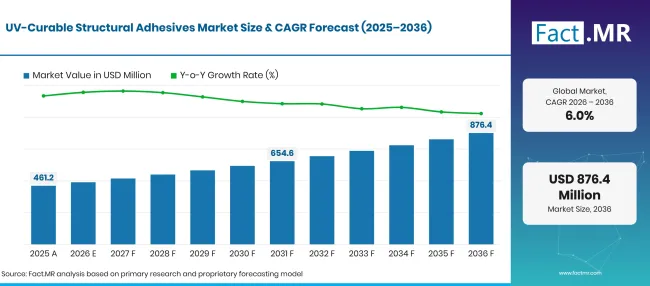
- Market Value (2025): USD 461.2 Mn
- Estimated Value (2026): USD 488.9 Mn
- Forecast Value (2036): USD 876.4 Mn
- CAGR (2026-2036): 6.0%
UV-Curable Structural Adhesives Market Forecast and Outlook 2026 to 2036
The UV-Curable Structural Adhesives Market was valued at USD 461.23 million in 2025 and is projected to grow from USD 488.9 million in 2026 to USD 876.4 million by 2036. Demand for UV-curable structural adhesives is likely to grow at a CAGR of 6.0% over the forecast period.
Adoption of UV-curable structural adhesives is increasing as manufacturers seek reliable bonding solutions that deliver high mechanical strength and faster production cycles. Electronics, automotive and industrial equipment manufacturers are incorporating UV-curable and dual-cure formulations into assembly processes to bond dissimilar substrates and support compact product designs. Suppliers are strengthening their specialty acrylate portfolios and developing customized curing systems to meet growing requirements for durable adhesion and consistent manufacturing performance.
Key Takeaways from the UV-Curable Structural Adhesives Market
- UV-Curable Structural Adhesives Market Value (2025): USD 461.2 million
- UV-Curable Structural Adhesives Market Value (2026): USD 488.9 million
- UV-Curable Structural Adhesives Market Forecast Value (2036): USD 876.4 million
- UV-Curable Structural Adhesives Market Forecast CAGR (2026–2036): 6.0%
- 2025 Market Value: USD 461.23 million
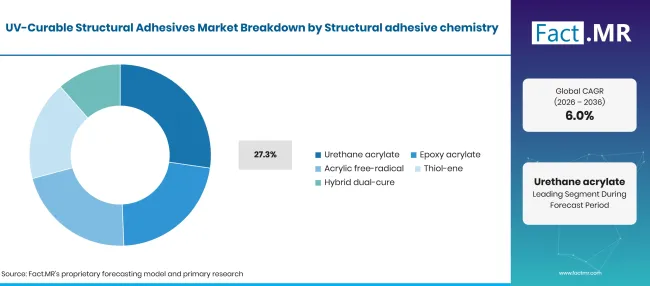
- Leading Structural Adhesive Chemistry: Urethane acrylate (27.3%)
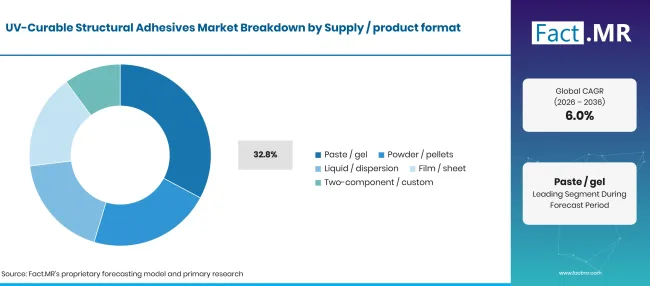
- Leading Supply / Product Format: Paste / gel (32.8%)
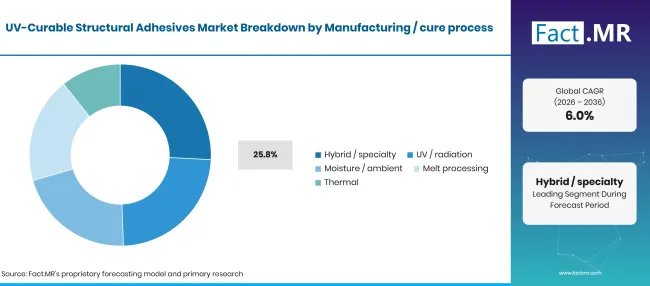
- Leading Manufacturing / Cure Process: Hybrid / specialty (25.8%)
- Leading Industrial End Use: Electronics (33.5%)
- Key Market Participants: Henkel AG & Co. KGaA, 3M Company, H.B. Fuller Company, Arkema S.A. (Bostik), Dymax Corporation, DELO Industrial Adhesives
- Key Growth Regions: China, United States, Germany, Japan and India
Adoption of UV-curable structural adhesives is increasing as electronics manufacturers require precision bonding solutions for semiconductor components, optical assemblies and compact electronic devices. South Korea’s Ministry of Trade, Industry and Resources reported semiconductor exports of approximately USD 60.3 billion in September 2026, up 262.8% year over year. This is a semiconductor-industry indicator rather than a direct measure of adhesive demand. In Taiwan, the Ministry of Economic Affairs reported a 26.89% annual increase in manufacturing production in July 2026, supported by strong electronic component and computer equipment output. Meanwhile, France's INSEE reported that computer, electronic and optical product manufacturing increased 5.1% year on year in September 2026. These developments are creating opportunities for UV-curable adhesives in precision assembly and advanced electronics manufacturing.
UV-Curable Structural Adhesives Market
| Metric | Value |
|---|---|
| Estimated Value (2026) | USD 488.9 million |
| Forecast Value (2036) | USD 876.37 million |
| Forecast CAGR (2026 to 2036) | 6.0% |
Source: Fact.MR analysis. Updated Nov 18, 2026
Source: Fact.MR analysis.
Uv Curable Structural Adhesives Forecast Global | Source: Fact.MR
Category
| Category | Segments |
|---|---|
| Structural Adhesive Chemistry | Urethane acrylate, Epoxy acrylate, Acrylic free-radical, Thiol-ene, Hybrid dual-cure |
| Supply / Product Format | Paste / gel, Powder / pellets, Liquid / dispersion, Film / sheet, Two-component / custom |
| Manufacturing / Cure Process | Hybrid / specialty, UV / radiation, Moisture / ambient, Melt processing, Thermal |
| Industrial End Use | Electronics, Automotive, Construction, Industrial equipment, Packaging / infrastructure |
| Region | China, United States, Germany, Japan, India |
Source: Fact.MR analysis. Updated Nov 18, 2026
Segmental Analysis
How is urethane acrylate positioning itself as the leading chemistry in the UV-Curable Structural Adhesives Market?
Uv Curable Structural Adhesives Breakdown Structural Adhesive Chemistry | Source: Fact.MR
Demand for urethane acrylate accounts for 27.3% of structural adhesive chemistry revenue in 2026, about USD 133.5 million. Its position is supported by the need for adhesive formulations that combine flexibility, impact resistance, adhesion strength and resistance to mechanical stress. These characteristics make urethane acrylate suitable for bonding applications involving electronics, automotive components and industrial assemblies. Suppliers are developing modified acrylate systems to improve adhesion across different substrates while maintaining rapid curing and reliable bond performance. Similar formulation improvements are projected to sustain urethane acrylate demand through 2036.
Why does paste and gel lead supply and product formats in the UV-Curable Structural Adhesives Market?
Uv Curable Structural Adhesives Breakdown Supply Product Format | Source: Fact.MR
Sales of paste and gel formulations represent 32.8% of supply and product format revenue in 2026, about USD 160.4 million. Their ability to remain in place during assembly makes them suitable for applications involving uneven surfaces and complex component geometries. Electronics and industrial equipment manufacturers use these formats to control adhesive placement and maintain consistent bond-line thickness. Growing adoption of automated dispensing systems is further encouraging suppliers to develop high-viscosity formulations that support precise application and reduce material movement before curing.
What supports the dominance of the hybrid and specialty processing in the UV-Curable Structural Adhesives Market?
Uv Curable Structural Adhesives Breakdown Manufacturing Cure Process | Source: Fact.MR
On September 30, 2026, Dymax introduced 9208-W electronic coating and 9209-W reworkable encapsulant for wearable electronics; both combine UV/visible light curing with secondary moisture curing. These are protective electronics materials rather than directly evidenced structural-bonding adhesives. This development highlights the importance of hybrid curing technologies in applications where light exposure may be restricted by component geometry. Hybrid and specialty processes account for 25.8% of manufacturing and cure process revenue in 2026, about USD 126.1 million. Manufacturers are adopting these systems to achieve rapid initial curing while ensuring reliable bonding in shadowed areas and complex assemblies. Their application flexibility is expected to support wider adoption across electronics and industrial manufacturing.
Why does electronics lead industrial end-use demand in the UV-Curable Structural Adhesives Market?
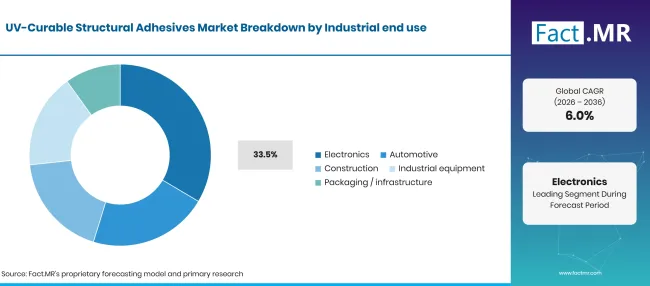
Uv Curable Structural Adhesives Breakdown Industrial End Use | Source: Fact.MR
Electronics accounts for 33.5% of industrial end-use revenue in 2026, about USD 163.8 million. Demand is supported by increasing requirements for precision bonding in smartphones, wearable devices, electronic displays, sensors, circuit boards and optical components. Manufacturers require adhesives that provide accurate dispensing, fast production cycles and reliable bonding across glass, metal and plastic substrates. In March 2026, DELO reported a UV-curing structural adhesive development intended to support mass production of panoramic head-up displays. Such applications demonstrate how specialty adhesive formulations are being integrated into advanced electronic and automotive display assemblies. Similar developments are projected to drive sales of UV-curable structural adhesives in electronics manufacturing.
UV-Curable Structural Adhesives Market – Drivers, Restraints & Trends
Driver:
Increasing Demand for Precision Bonding in Electronics Manufacturing. Demand for UV-curable structural adhesives is rising as electronics manufacturers require reliable bonding solutions for compact devices, circuit assemblies, optical components and wearable electronics. These adhesives support controlled dispensing, rapid curing and reduced assembly time. For example, China's electronic information manufacturing sector recorded 10.6% growth in industrial value added in 2025, while combined operating revenue reached CNY 17.4 trillion. The expansion of electronics production is projected to increase demand for specialty bonding materials. Suppliers are developing UV-curable and dual-cure formulations for increasingly complex electronic assemblies.
Restraint:
Limitations of Light Penetration and Substrate Compatibility. Sales of UV-curable structural adhesives faces limitations when bonding opaque materials, complex assemblies and components with inaccessible bonding surfaces. UV curing requires sufficient light exposure to initiate polymerization, making shadowed regions difficult to cure using conventional UV-only formulations. Differences in substrate surface energy, thermal sensitivity and chemical compatibility can also affect bond performance. Manufacturers may need secondary moisture, thermal or other curing mechanisms to achieve complete bonding. These requirements can increase formulation complexity, equipment costs and process-validation time, potentially slowing adoption among cost-sensitive manufacturers.
Opportunity:
Development of Dual-Cure and Hybrid Adhesive Formulations. In 2026, adhesive manufacturers are expanding formulations that combine light curing with secondary curing mechanisms. Demand is increasing because manufacturers need rapid initial bond strength while maintaining reliable curing in areas where UV light cannot reach. In April 2026, DELO received IATF 16949 certification, confirming its automotive quality management standards. Similar product developments are projected to drive sales of hybrid dual-cure structural adhesives.
Trend:
UV-Curing Solutions for Advanced Automotive Displays and Electronics. Demand for UV-curable adhesives is expanding as automotive manufacturers integrate larger displays, optical systems, sensors and electronic interfaces into vehicles. In March 2026, DELO highlighted a UV-curing structural adhesive designed to support mass production of panoramic head-up displays. In May 2026, the company also introduced LiDAR adhesive technology that achieves handling strength in minutes rather than hours. Similar product innovations are projected to drive sales of UV-curable structural adhesives in automotive electronics and optical assembly applications.
UV-Curable Structural Adhesives Market by Analysis by Key Country
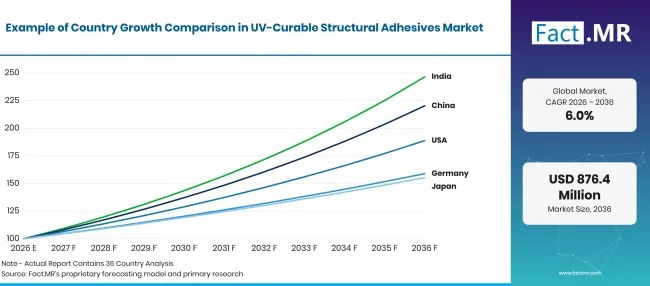
Uv Curable Structural Adhesives Growth Index | Source: Fact.MR
| Country | CAGR (2026–2036) |
|---|---|
| China | 8.2% |
| United States | 6.6% |
| Germany | 4.7% |
| Japan | 4.5% |
| India | 9.4% |
Source: Fact.MR analysis. Updated Nov 18, 2026
Source: Fact.MR analysis.
What is driving UV-Curable Structural Adhesives Market demand in China?
Sales of UV-curable structural adhesives in China are projected to grow at an 8.2% CAGR as the country's large electronics manufacturing ecosystem supports demand for precision bonding materials.
In January 2026, China's Ministry of Industry and Information Technology reported that industrial value added in the electronic information manufacturing sector increased 10.6% in 2025. Production reached 1.27 billion smartphones and 484.3 billion integrated circuits during the year. Demand for UV-curable structural adhesives is projected to increase as manufacturers require specialized bonding solutions for electronic components, optical assemblies and compact devices. Suppliers are expanding product portfolios for high-volume electronics production.
How is electronics manufacturing supporting UV-Curable Structural Adhesives Market growth in the United States?
Demand for UV-curable structural adhesives in the United States is projected to hold 6.6% CAGR as electronics, automotive and industrial equipment manufacturers increasingly require high-performance bonding materials.
The country's established electronics manufacturing ecosystem supports demand for adhesives used in circuit assemblies, sensors, displays and precision components. Suppliers are positioning UV-curable and hybrid formulations for applications requiring rapid processing, accurate dispensing and dependable adhesion. Growth in advanced electronics manufacturing and automation is projected to sustain demand for specialty structural adhesives in the United States through 2036.
What is shaping UV-Curable Structural Adhesives Market demand in Germany?
Germany's UV-Curable Structural Adhesives Market is forecast to expand at a 4.7% CAGR through 2036, with automotive engineering and industrial manufacturing providing important demand channels.
According to the German Association of the Automotive Industry, domestic passenger car production reached approximately 4.15 million units in 2025, increasing 2% from 2024. Automotive displays, optical components and electronic assemblies require adhesives that deliver precise bonding and consistent performance during production. DELO's development of UV-curing structural adhesives for panoramic head-up displays illustrates the relevance of these technologies to advanced automotive applications. Germany's established automotive supplier network and industrial engineering capabilities are expected to sustain adoption.
What is driving UV-Curable Structural Adhesives Market growth in Japan?
Demand for UV-curable structural adhesives in Japan holds 4.5% CAGR as the country's electronics and industrial equipment manufacturers require advanced bonding materials for precision assemblies.
According to the Japan Electronics and Information Technology Industries Association, Japanese industrial electronic equipment production reached approximately JPY 3.42 trillion in 2025, increasing 1.5% year on year. Demand for UV-curable structural adhesives is supported by applications in communications equipment, computers, electronic measuring instruments and industrial components. Suppliers are focusing on formulations that deliver consistent adhesion, rapid curing and process reliability. Similar requirements are projected to sustain demand in Japan's established electronics manufacturing industry.
Why is India the fastest-growing market for UV-Curable Structural Adhesives?
India is projected to register a 9.4% CAGR in UV-curable structural adhesive sales through 2036, outpacing the other countries covered in this analysis.
According to India's Press Information Bureau, electronics production increased from approximately INR 11.32 lakh crore in FY 2024–25 to INR 13.11 lakh crore in FY 2025–26, representing 15.8% year-on-year growth. Expanding mobile phone manufacturing and domestic electronics assembly are increasing the need for precision bonding materials used in displays, sensors and electronic components. Investments in manufacturing infrastructure and localization are further broadening the addressable market for specialty adhesives. This expansion gives adhesive manufacturers opportunities to establish stronger relationships with India's electronics producers and component suppliers.
Competitive Landscape for UV-Curable Structural Adhesives Market
Competition in the UV-Curable Structural Adhesives Market is shaped by global adhesive manufacturers and specialized light-curing technology suppliers. Henkel AG & Co. KGaA, 3M Company, H.B. Fuller Company, Arkema S.A. through Bostik compete through broad industrial adhesive portfolios, formulation expertise and established customer relationships. Dymax Corporation and DELO Industrial Adhesives strengthen the competitive landscape through specialized light-curable adhesive technologies, dual-cure formulations and application-specific bonding solutions.
From 2025 onward, competition has increasingly focused on curing efficiency, substrate compatibility, product customization and suitability for automated manufacturing. DELO's 2026 developments in panoramic head-up displays and LiDAR bonding demonstrate the importance of application-specific UV-curing technologies. Dymax's introduction of dual-curable products for wearable electronics further illustrates the shift toward formulations that address shadowed bonding areas. Suppliers with specialized formulation capabilities, technical application support and established relationships with electronics and automotive manufacturers are positioned to strengthen their market presence.
Recent Developments
- On September 30, 2026, Dymax introduced 9208-W electronic coating and 9209-W reworkable encapsulant for wearable electronics. Both formulations combine UV/visible light curing with secondary moisture curing.
- In August 2026, DELO introduced a new generation of super-low-temperature curing adhesives capable of supporting bonding at temperatures as low as 45°C.
Key Players in UV-Curable Structural Adhesives Market
Key companies profiled include Henkel AG & Co. KGaA; 3M Company; H.B. Fuller Company; Arkema S.A. (Bostik); Dymax Corporation; and DELO Industrial Adhesives.
- Henkel AG & Co. KGaA
- 3M Company
- H.B. Fuller Company
- Arkema S.A. (Bostik)
- Dymax Corporation
- DELO Industrial Adhesives
Bibliography
- DELO Industrial Adhesives. (2026). DELO News.
- DELO Industrial Adhesives. (2026, September 30). Liquid tape for gas diffusion layer fixation in fuel cells.
- Dymax Corporation. (2026, September 30). Dymax expands light-curable product portfolio for consumer wearable assembly.
- Government of India, Press Information Bureau. (2026, August 14). Manufacturing momentum: Building a self-reliant India.
- Government of India, Press Information Bureau. (2026, September 17). Electronics Components Manufacturing Scheme: Building India’s electronics backbone.
- Japan Electronics and Information Technology Industries Association. (2026, March 19). December 2025 production by the Japanese electronics industry.
- Ministry of Industry and Information Technology of the People’s Republic of China. (2026, January 30). 2025[Operation of the electronic information manufacturing industry in 2025].
- Ministry of Trade, Industry and Resources. (2026, October 1). September exports reach record $120.9 billion, trade surplus hits record $49.9 billion.
- Verband der Automobilindustrie. (2026, January 5). Passenger car production in 2025 slightly above previous year’s level.
Segmentation
Scope of Report
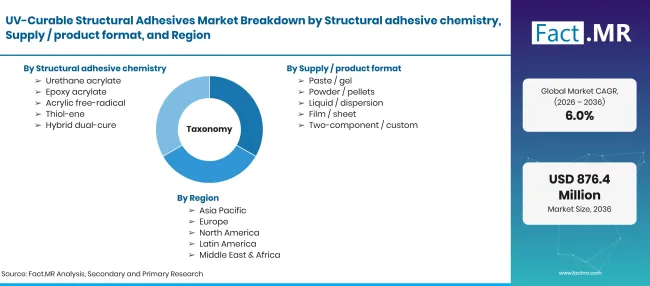
Uv Curable Structural Adhesives Taxonomy | Source: Fact.MR
| Items | Values |
|---|---|
| Quantitative Units (2026) | USD 488.9 Million |
| Structural Adhesive Chemistry | Urethane acrylate, Epoxy acrylate, Acrylic free-radical, Thiol-ene, Hybrid dual-cure |
| Supply / Product Format | Paste / gel, Powder / pellets, Liquid / dispersion, Film / sheet, Two-component / custom |
| Manufacturing / Cure Process | Hybrid / specialty, UV / radiation, Moisture / ambient, Melt processing, Thermal |
| Industrial End Use | Electronics, Automotive, Construction, Industrial equipment, Packaging / infrastructure |
| Regions Covered | North America, Latin America, Europe, East Asia, South Asia and Pacific, Middle East & Africa |
| Countries Covered | China, United States, Germany, Japan, India, and other countries |
| Key Companies Profiled | Henkel AG & Co. KGaA, 3M Company, H.B. Fuller Company, Arkema S.A. (Bostik), Dymax Corporation, DELO Industrial Adhesives |
| Additional Attributes | Dollar revenue in the UV-Curable Structural Adhesives Market is segmented by structural adhesive chemistry, supply and product format, manufacturing and cure process, industrial end use and region. |
Source: Fact.MR analysis. Updated Nov 18, 2026
UV-Curable Structural Adhesives Market by Segments
-
Structural Adhesive Chemistry
- Urethane acrylate
- Epoxy acrylate
- Acrylic free-radical
- Thiol-ene
- Hybrid dual-cure
-
Supply / Product Format
- Paste / gel
- Powder / pellets
- Liquid / dispersion
- Film / sheet
- Two-component / custom
-
Manufacturing / Cure Process
- Hybrid / specialty
- UV / radiation
- Moisture / ambient
- Melt processing
- Thermal
-
Industrial End Use
- Electronics
- Automotive
- Construction
- Industrial equipment
- Packaging / infrastructure
-
Region
- North America
- United States
- Canada
- Mexico
- Europe
- Germany
- United Kingdom
- France
- Italy
- Spain
- Rest of Europe
- Asia Pacific
- China
- India
- Japan
- South Korea
- Australia
- Rest of Asia Pacific
- Latin America
- Brazil
- Mexico
- Argentina
- Rest of Latin America
- Middle East & Africa
- GCC Countries
- South Africa
- Rest of Middle East & Africa
- North America
Frequently Asked Questions
How big is the global UV-Curable Structural Adhesives Market in 2026?
What was the size of the UV-Curable Structural Adhesives Market in 2025?
What will be the size of the UV-Curable Structural Adhesives Market by 2036?
How fast will the UV-Curable Structural Adhesives Market grow during the forecast period?
Which structural adhesive chemistry holds the largest share of the UV-Curable Structural Adhesives Market?
Which supply and product format leads the UV-Curable Structural Adhesives Market?
Which manufacturing and cure process holds the largest market share?
Which industrial end use dominates the UV-Curable Structural Adhesives Market?
Which country is projected to experience the fastest growth in the UV-Curable Structural Adhesives Market?
Who are the key players in the UV-Curable Structural Adhesives Market?
Who worked on this report


Preview the report firsthand - request a free sample
Free SampleGet the brochure for pricing and purchase details
Download PDF