Public EV Charging Queue and Reservation Hardware Market (2026 - 2036)

Public EV Charging Queue and Reservation Hardware Market is segmented by Hardware Type (Queue Display Units, Reservation Kiosks/Terminals, Barrier/Access Control Units, and Others), Site Type (Highway DC Hubs, Urban Public Chargers, Fleet Depots, and Others), Connectivity (Cellular-Connected, Ethernet/Wired, Wi-Fi/Short-Range, and Others), Sales Channel (Charging Network Operators, Infrastructure EPCs, Municipal Procurement, and Others), and Region. Forecast for 2026 to 2036.

Core Findings

    Public EV Charging Queue and Reservation Hardware Market Forecast 2026 to 2036

    In 2025, the public EV charging queue and reservation hardware market was valued at USD 320 million. Based on FMR’s analysis, demand for this specialized hardware is estimated to grow to USD 367 million in 2026 and USD 1,433 million by 2036. FMR projects a CAGR of 14.6% during the forecast period. This reflects an absolute dollar growth of USD 1,066 million, marking a transformational shift from simple "first-come, first-served" kiosks to high-capacity reservation terminals and barrier access units. Growth is driven by the urgent need to manage "charging anxiety" at busy DC fast-charging hubs, though it remains hindered by regulatory costs and substitution pressure from software-only mobile apps that bypass physical on-site reservation terminals.

    Industry leaders highlight that hardware integration is key to delivering the premium experience users expect. As Pasquale Romano, CEO of ChargePoint, noted regarding the necessity of seamless driver tools, 'ChargePoint remains committed to enabling the simplicity that drivers expect and the charging speed they need for all vehicles whenever and wherever drivers want' [1]. This focus on reliability and accessibility is pushing the deployment of dedicated physical interfaces and barrier controls to ensure reserved stalls remain available for authorized users.

    On a global scale, India leads with a 16.0% CAGR, fueled by rapid urban infrastructure development, followed by China (15.1%), USA (13.2%), and South Korea (12.4%). In contrast, Germany (12.6%), the UK (11.8%), France (11.2%), and Japan (9.9%) represent mature markets where growth is primarily centered on replacement demand rather than new installations. A significant structural constraint for these mature groups is interoperability lag, as older charging station architectures often require expensive modifications to integrate with modern, multi-network reservation hardware.
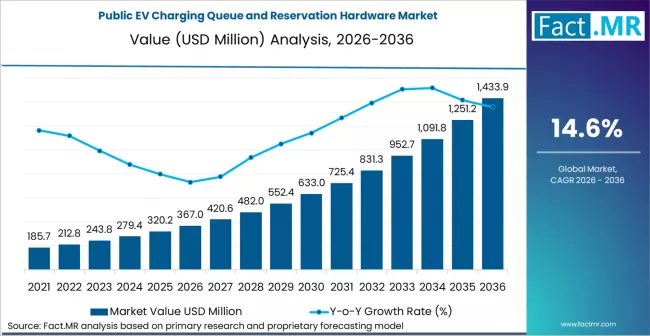
    Public Ev Charging Queue And Reservation Hardware Market Market Value Analysis

    Public EV Charging Queue and Reservation Hardware Market

    This market involves physical systems like digital displays, reservation kiosks, and smart barriers used to organize vehicle flow at charging stations. These devices perform the primary industrial function of congestion management and site optimization, ensuring orderly access to high-demand chargers. The key end-use is in high-traffic urban hubs and highway corridors, where they provide a physical interface for drivers to secure charging slots and reduce wait-time uncertainty.

    What the Report Covers

    The report details global and regional market sizes for the 2026-2036 forecast period. It segments the industry by product type (LED displays, barriers, kiosks), connectivity, and end-user. Analytical dimensions include regional pricing benchmarks and installation cost analysis, tracking how smart-infrastructure components move across major global manufacturing hubs.

    What the Report Does Not Cover

    The scope excludes software-only apps that lack onsite hardware. It also omits the charging stations themselves and downstream vehicle components. Niche applications, such as private residential chargers or non-public fleet depots, are excluded to focus strictly on physical queue-management hardware in public environments.

    • Primary Research: We interviewed charging network operators and smart-city planners to capture data on hardware durability and site integration.
    • Desk Research: Analysts reviewed municipal procurement records, patent filings for automated barriers, and financial disclosures from display technology firms.
    • Market-Sizing and Forecasting: A hybrid model was used, combining top-down public infrastructure growth rates with bottom-up sales data from hardware manufacturers.

    Data Validation and Update Cycle

    Outputs are cross-verified against regional infrastructure budgets and updated semi-annually to reflect rapid shifts in EVSE regulations.

    Public EV Charging Queue and Reservation Hardware Market Definition:

    The market includes physical systems such as digital displays, reservation kiosks, and smart barriers designed to manage and optimize queues and reservations at public EV charging stations. These devices help reduce wait times and ensure orderly access to chargers at high-traffic locations.

    Demand Drivers in the Market:

    • Rising EV Adoption: Growing numbers of electric vehicles increase the need for efficient queue and reservation management at public charging stations.
    • Charging Anxiety Management: The need to reduce wait times and uncertainty at busy DC fast-charging hubs is driving demand.
    • Regulatory Push: Increasing regulations require the integration of reservation systems to improve charging accessibility and user experience.

    Key Segments Analyzed in the Report:

    • Hardware Type: Queue Display Units, Reservation Kiosks/Terminals, Barrier/Access Control Units, Other.
    • Site Type: Highway DC Hubs (39% market share by 2026), Urban Public Chargers, Fleet Depots.
    • Connectivity: Cellular-Connected (47% market share by 2026), Ethernet/Wired, Wi-Fi/Short-Range, Other.
    • Sales Channel: Charging Network Operators, Infrastructure EPCs, Municipal Procurement, Other.

    Analyst Opinion at FMI:

    The market is transitioning to a predictive-access ecosystem where reservation hardware is no longer just a tool, but a crucial component for improving infrastructure ROI and fleet electrification, especially in high-demand areas.

    Strategic Implications/Executive Takeaways:

    • Focus on Hardware Integration: Seamless hardware integration is crucial for creating the optimal charging experience.
    • Regulatory Compliance: Companies must adapt to evolving standards, such as the SAE J 2954 protocol and local mandates for reservation systems.
    • Regional Strategy: The market presents strong growth opportunities in emerging markets like India and China, while mature markets focus more on replacement demand.

    Methodology:

    Validated through primary research with charging network operators and smart-city planners. Market forecasts are based on a hybrid top-down and bottom-up modeling approach, with insights from patent filings and municipal procurement records.

    Segmental Analysis

    Public EV Charging Queue and Reservation Hardware Market Analysis by Connectivity
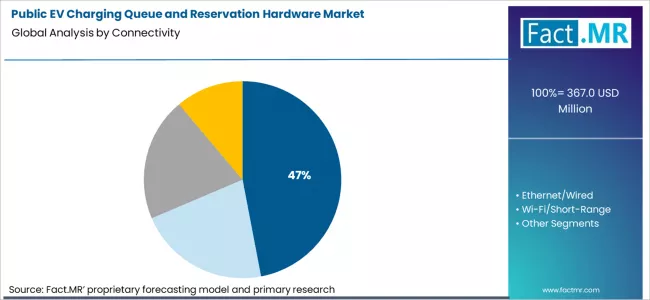
    Public Ev Charging Queue And Reservation Hardware Market Analysis By Connectivity

    • Market Overview: Cellular-connected systems are projected to hold 47% of the public EV charging queue and reservation hardware market by 2026. These systems enable real-time, mobile connectivity for managing EV charging reservations and queues. Cellular connectivity allows for seamless communication between users and charging stations, facilitating efficient reservation management, queue tracking, and remote monitoring.
    • Demand Drivers:
      • Real-Time Data Access: Cellular-connected systems provide EV owners with instant access to information regarding charging station availability, reducing wait times and improving user experience.
      • Wide Coverage: Cellular connectivity ensures that charging stations, even in remote areas, can maintain communication with central systems, enabling a broader and more reliable charging network.
      • Increased EV Adoption: As the number of electric vehicles grows, the demand for efficient queue management and reservation systems is driving the shift towards cellular-connected hardware, especially in areas with high EV traffic.

    Public EV Charging Queue and Reservation Hardware Market Analysis by Site Type
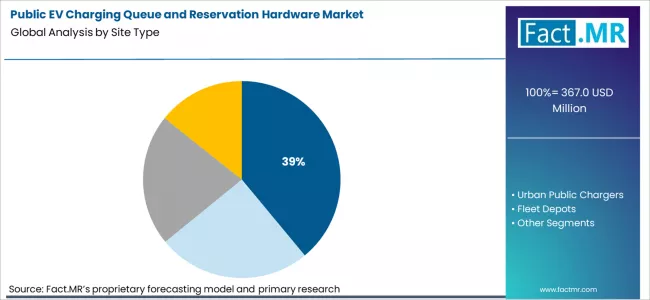
    Public Ev Charging Queue And Reservation Hardware Market Analysis By Site Type

    • Market Overview: Highway DC hubs are expected to account for 39% of the market share by 2026. These hubs, located along major highways and corridors, are critical for long-distance EV travel, offering high-speed DC fast charging capabilities. The need for effective queue management and reservation systems is particularly important at these hubs, where high traffic and long wait times are common.
    • Demand Drivers:
      • High-Speed Charging Demand: As EVs become more common, the demand for fast charging stations at strategic locations such as highways increases. Effective reservation and queue management systems help optimize the user experience at these hubs, particularly for long-distance travelers.
      • Urban Expansion: Urban public chargers and fleet depots also contribute to the market, with growing installations in cities and commercial centers to accommodate the rising number of EVs.
      • Infrastructure Development: Government initiatives and investments in EV infrastructure, such as the installation of charging hubs along highways, are fueling the growth of reservation and queue management solutions in high-traffic areas.

    Public EV Charging Queue and Reservation Hardware Market Drivers, Restraints, and Opportunities

    FMR analysts observe that the public EV charging queue and reservation hardware market is in a growth‑transition phase shaped by rapid expansion of public charging infrastructure and increasing EV adoption. Historically, unmanaged queues and inconsistent charger access created user frustration, prompting demand for hardware and systems that organize and reserve charging slots. The 2026 valuation reflects this transition from ad hoc signage and software overlays toward dedicated queue displays, reservation kiosks, and integrated status hardware as charging networks scale.

    While demand for simple indicator signage and manual queue systems is declining, more advanced reservation hardware that integrates with network software and payment systems carries higher per‑unit pricing. This dynamic leads to net value growth even where unit volumes for basic systems fall. The market exists at its current size because operators and local authorities need to improve user experience, manage congestion at high‑traffic hubs, and support growing utilization without proportionate increases in physical chargers.

    • Network Utilization Optimization: Operators of high‑traffic charging stations are investing in dedicated queue and reservation hardware to reduce congestion and improve throughput, driven by utilization challenges as EV volumes rise.
    • Regulatory Mandates: Standards such as the SAE J‑2954 communications protocol and regional policies requiring accessible reservation systems at public chargers are encouraging adoption of compliant hardware, shifting the market toward integrated reservation solutions.
    • Regional Adoption Differences: In Europe and parts of North America, where public charging density and policy support are high, demand for advanced reservation hardware is stronger, while in many Asia‑Pacific markets the focus remains on basic queue indicators tied to rapid charger rollouts.

    Regional Analysis

    The global public EV charging queue and reservation hardware market is segmented by geography into North America, Europe, Asia-Pacific, and the Rest of the World. Each territory exhibits unique growth dynamics influenced by local electrification targets, urbanization density, and the evolving regulatory requirements for smart infrastructure and interoperable user systems.
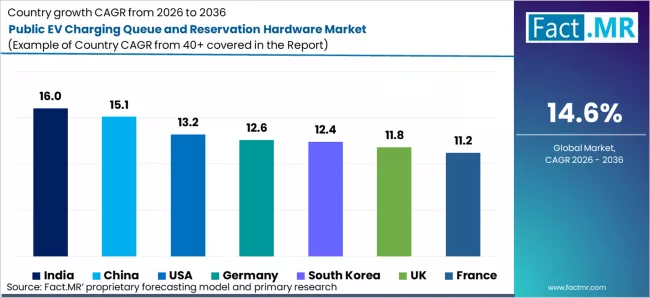
    Public Ev Charging Queue And Reservation Hardware Market Cagr Analysis By Country

    Country CAGR (%)
    China 15.1%
    India 16.0%
    USA 13.2%
    Germany 12.6%
    UK 11.8%
    France 11.2%
    South Korea 12.4%
    Japan 9.9%

    Source: Fact MR (FMR) analysis, based on proprietary forecasting model and primary research

    North America Public EV Charging Queue and Reservation Hardware Market Analysis

    North America is characterized by a "green recovery," where increasing investments in EV infrastructure and stringent environmental standards are driving demand for efficient charging solutions. The expansion of EV charging stations and the need for reliable queue management and reservation systems are driving demand for advanced hardware solutions. Key regional players include ABB E-mobility, Schneider Electric, and Teld New Energy, who are providing integrated solutions for public charging networks.

    • United States: Demand for public EV charging queue and reservation hardware in the United States is projected to rise at 13.2% CAGR through 2034. Growth is supported by federal funding for interstate charging networks, especially following the NEVI Formula Program rules issued by the Federal Highway Administration (FHWA) in February 2023. Additionally, the California Energy Commission (CEC) launched the GFO-22-604 program in January 2023 to fund charging stations with advanced reservation capabilities, boosting the market for reservation hardware.

    FMR’s report includes a detailed analysis of growth in the North American region, with a country-wise assessment that includes the U.S. and Canada. Readers can find regional trends, regulations, and market growth based on different segments in the North American market.

    Asia Pacific Public EV Charging Queue and Reservation Hardware Market Analysis

    Asia Pacific remains the global production epicenter, with rapid urbanization and government support for expanding EV infrastructure. The region is seeing a massive increase in public charging stations, driving demand for smart charging hardware, including queue management and reservation systems. Leading regional players like Teld New Energy dominate the market with smart hardware solutions for real-time mobile app reservations.

    • China: Demand for public EV charging queue and reservation hardware in China is projected to rise at 15.1% CAGR through 2034. The market is driven by large-scale urbanization and the government’s push for high-quality charging services. For example, the China Quality Certification Center (CQC) released the CQC-C2501-2025 guideline in March 2025 to standardize hardware safety and connectivity. Moreover, the National Energy Administration (NEA) issued guidelines in June 2023 to promote the development of smart, interconnected charging hubs to reduce urban congestion.
    • India: Demand for public EV charging queue and reservation hardware in India is projected to rise at 16.0% CAGR through 2034. The rapid expansion of charging networks under national mobility schemes is fueling growth. The Ministry of Heavy Industries introduced the PM E-DRIVE scheme in October 2024 to accelerate infrastructure deployment, especially along high-traffic corridors. In addition, NITI Aayog updated its Handbook for EV Charging Infrastructure in March 2023, recommending integrated hardware solutions for better queue management in urban areas.
    • South Korea: Demand for public EV charging queue and reservation hardware in South Korea is projected to rise at 12.4% CAGR through 2034. The country’s dense urban landscape necessitates sophisticated queue management and high-power hardware. The Ministry of Environment released updated guidelines in August 2023 to improve fire safety and monitoring at charging stations. In January 2024, the Korea Environment Corporation (K-eco) launched a public subsidy program targeting chargers with real-time booking features.
    • Japan: Demand for public EV charging queue and reservation hardware in Japan is projected to rise at 9.9% CAGR through 2034. Strategic targets for high-power charging along highways are increasing demand for hardware solutions that manage queues effectively. The Ministry of Economy, Trade and Industry (METI) updated its Green Growth Strategy in August 2023, significantly increasing targets for highway charging points. Additionally, e-Mobility Power (eMP) announced a partnership in May 2024 to upgrade hardware at expressway rest areas with improved reservation syncing.

    FMR’s analysis of the Public EV Charging Queue and Reservation Hardware market in Asia Pacific consists of country-wise assessments that include China, India, South Korea, and Japan. Readers can find detailed insights into regional trends, government policies, infrastructure growth, and key investments that are driving the demand for queue and reservation hardware solutions in these countries.

    Europe Public EV Charging Queue and Reservation Hardware Market Analysis

    Europe serves as the global regulatory laboratory, where strict environmental regulations and sustainability goals are driving the demand for EV infrastructure and related hardware. With an emphasis on consumer experience and hardware interoperability, the market is growing rapidly in response to government initiatives and private sector investments in EV charging networks.

    • Germany: Demand for public EV charging queue and reservation hardware in Germany is projected to rise at 12.6% CAGR through 2034. The Federal Ministry for Digital and Transport (BMDV) enacted an amendment to the Charging Point Ordinance (LSV) in May 2023, requiring contactless payment hardware by July 2024. Moreover, the DeutschlandNetz project awarded tenders in September 2023 for 9,000 fast chargers with mandatory reservation interfaces.
    • United Kingdom: Demand for public EV charging queue and reservation hardware in the United Kingdom is projected to rise at 11.8% CAGR through 2034. The Department for Transport (DfT) implemented the Public Charge Point Regulations in November 2023 to ensure 99% reliability and open data sharing. In February 2024, the Office for Zero Emission Vehicles (OZEV) allocated new funds to support the installation of regional charging hubs, promoting the adoption of reservation-enabled hardware.
    • France: Demand for public EV charging queue and reservation hardware in France is projected to rise at 11.2% CAGR through 2034. France’s Advenir program, extended by the Ministry for the Ecological Transition in December 2023, is providing further subsidies for the installation of smart charging hardware. Additionally, AVERE-France published new quality standards in April 2024 for station reservations, enhancing hardware interoperability across networks.

    FMR’s analysis of the Public EV Charging Queue and Reservation Hardware market in Europe consists of country-wise assessments that include Germany, the United Kingdom, and France. Readers can find detailed insights into regional trends, government policies, infrastructure growth, and key investments driving the demand for public EV charging queue and reservation hardware in these markets.

    How Are Key Players Competing in the Public EV Charging Queue and Reservation Hardware Market?
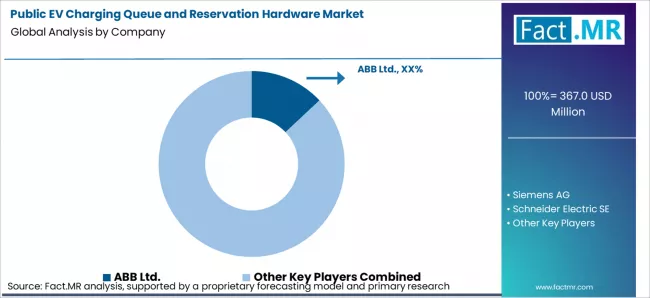
    Public Ev Charging Queue And Reservation Hardware Market Analysis By Company

    The public EV charging queue and reservation hardware market is becoming increasingly competitive, with companies like ABB Ltd., Siemens AG, and Schneider Electric SE leading the charge. These industry giants focus on offering solutions that optimize the public charging experience by integrating reservation systems and queue management features. ChargePoint Holdings, Inc. and EVBox B.V. are enhancing their offerings with user-friendly apps and real-time availability tracking, ensuring seamless charging for customers. Alfen N.V. and Tritium DCFC Limited are focusing on high-speed charging solutions while minimizing wait times. Newer players like Kempower Corporation and Ekoenergetyka-Polska S.A. are pushing innovative designs to meet growing demand, making EV charging more efficient and accessible to users worldwide.

    Recent Industry Development

    • Patent - EV charging queue management with walk-up and reservation queues (Published Jul 1, 2023): This granted patent describes a cloud-controlled charging station system that operates separate real-time and scheduled reservation queues to coordinate driver access. [2]
    • Patent - Reserving a charging bay using predicted availability (Published Jan 14, 2025): Toyota’s patent describes reserving a charging station for a vehicle at an expected arrival time based on predicted charger availability to reduce physical waiting. [3]
    • Platform Launch - ChargePoint “Waitlist” virtual queuing (Announced Nov 13, 2025): ChargePoint announced a platform update adding “Waitlist” virtual queues that notify drivers when a connector becomes available to reduce congestion and improve utilization. [4]

    Report Scope

    Metric Value
    Quantitative Units USD 367 million (2026) to USD 1,433 million (2036), at a CAGR of 14.6%
    Market Definition The Public EV Charging Queue and Reservation Hardware Market includes hardware systems used to manage and optimize the queueing and reservation process for public electric vehicle charging stations.
    By Hardware Type Queue Display Units, Reservation Kiosks/Terminals, Barrier/Access Control Units, Other
    By Site Type Highway DC Hubs, Urban Public Chargers, Fleet Depots, Other
    By Connectivity Cellular-Connected, Ethernet/Wired, Wi-Fi/Short-Range, Other
    By Sales Channel Charging Network Operators, Infrastructure EPCs, Municipal Procurement, Other
    Key Companies Profiled ABB Ltd., Siemens AG, Schneider Electric SE, Delta Electronics, Inc., Alfen N.V., ChargePoint Holdings, Inc., EVBox B.V., Tritium DCFC Limited, Kempower Corporation, Ekoenergetyka-Polska S.A.
    Forecast Period 2026 to 2036
    Approach Hybrid top-down and bottom-up market modeling validated through primary interviews with manufacturers and supported by trade data benchmarking and market research.

    Public EV Charging Queue and Reservation Hardware Market Key Segments

    • By Hardware Type :

      • Queue Display Units
      • Reservation Kiosks/Terminals
      • Barrier/Access Control Units
      • Other
    • By Site Type :

      • Highway DC Hubs
      • Urban Public Chargers
      • Fleet Depots
      • Other
    • By Connectivity :

      • Cellular-Connected
      • Ethernet/Wired
      • Wi-Fi/Short-Range
      • Other
    • By Sales Channel :

      • Charging Network Operators
      • Infrastructure EPCs
      • Municipal Procurement
      • Other
    • Region :

      • North America
        • USA
        • Canada
        • Mexico
      • Europe
        • Germany
        • UK
        • France
        • Italy
        • Spain
        • Nordic Countries
        • BENELUX
        • Rest of Europe
      • Asia Pacific
        • China
        • Japan
        • South Korea
        • India
        • Australia
        • Rest of Asia Pacific
      • Latin America
        • Brazil
        • Argentina
        • Rest of Latin America
      • Middle East and Africa
        • Kingdom of Saudi Arabia
        • United Arab Emirates
        • South Africa
        • Rest of Middle East and Africa
      • Other Regions
        • Oceania
        • Central Asia
        • Other Markets

    Bibliographies

    • Pasquale Romano Statement: Romano, P. (2025, November 13). The necessity of seamless driver tools for EV charging. ChargePoint. [1]
    • Patent - EV Charging Queue Management with Walk-Up and Reservation Queues: U.S. Patent No. 11,652,346. (2023, July 1). EV charging queue management with walk-up and reservation queues. United States Patent and Trademark Office. [2]
    • Patent - Reserving a Charging Bay Using Predicted Availability: U.S. Patent No. 11,831,911. (2025, January 14). Reserving a charging bay using predicted availability. United States Patent and Trademark Office. [3]
    • Platform Launch - ChargePoint "Waitlist" Virtual Queuing: ChargePoint. (2025, November 13). ChargePoint launches "Waitlist" virtual queuing platform. ChargePoint. [4]

    Table of Content

    1. Executive Summary
      • Global Market Outlook
      • Demand to side Trends
      • Supply to side Trends
      • Technology Roadmap Analysis
      • Analysis and Recommendations
    2. Market Overview
      • Market Coverage / Taxonomy
      • Market Definition / Scope / Limitations
    3. Research Methodology
      • Chapter Orientation
      • Analytical Lens and Working Hypotheses
        • Market Structure, Signals, and Trend Drivers
        • Benchmarking and Cross-market Comparability
        • Market Sizing, Forecasting, and Opportunity Mapping
      • Research Design and Evidence Framework
        • Desk Research Programme (Secondary Evidence)
          • Company Annual and Sustainability Reports
          • Peer-reviewed Journals and Academic Literature
          • Corporate Websites, Product Literature, and Technical Notes
          • Earnings Decks and Investor Briefings
          • Statutory Filings and Regulatory Disclosures
          • Technical White Papers and Standards Notes
          • Trade Journals, Industry Magazines, and Analyst Briefs
          • Conference Proceedings, Webinars, and Seminar Materials
          • Government Statistics Portals and Public Data Releases
          • Press Releases and Reputable Media Coverage
          • Specialist Newsletters and Curated Briefings
          • Sector Databases and Reference Repositories
          • FMR Internal Proprietary Databases and Historical Market Datasets
          • Subscription Datasets and Paid Sources
          • Social Channels, Communities, and Digital Listening Inputs
          • Additional Desk Sources
        • Expert Input and Fieldwork (Primary Evidence)
          • Primary Modes
            • Qualitative Interviews and Expert Elicitation
            • Quantitative Surveys and Structured Data Capture
            • Blended Approach
          • Why Primary Evidence is Used
          • Field Techniques
            • Interviews
            • Surveys
            • Focus Groups
            • Observational and In-context Research
            • Social and Community Interactions
          • Stakeholder Universe Engaged
            • C-suite Leaders
            • Board Members
            • Presidents and Vice Presidents
            • R&D and Innovation Heads
            • Technical Specialists
            • Domain Subject-matter Experts
            • Scientists
            • Physicians and Other Healthcare Professionals
          • Governance, Ethics, and Data Stewardship
            • Research Ethics
            • Data Integrity and Handling
        • Tooling, Models, and Reference Databases
      • Data Engineering and Model Build
        • Data Acquisition and Ingestion
        • Cleaning, Normalisation, and Verification
        • Synthesis, Triangulation, and Analysis
      • Quality Assurance and Audit Trail
    4. Market Background
      • Market Dynamics
        • Drivers
        • Restraints
        • Opportunity
        • Trends
      • Scenario Forecast
        • Demand in Optimistic Scenario
        • Demand in Likely Scenario
        • Demand in Conservative Scenario
      • Opportunity Map Analysis
      • Product Life Cycle Analysis
      • Supply Chain Analysis
      • Investment Feasibility Matrix
      • Value Chain Analysis
      • PESTLE and Porter’s Analysis
      • Regulatory Landscape
      • Regional Parent Market Outlook
      • Production and Consumption Statistics
      • Import and Export Statistics
    5. Global Market Analysis 2021 to 2025 and Forecast, 2026 to 2036
      • Historical Market Size Value (USD Million) Analysis, 2021 to 2025
      • Current and Future Market Size Value (USD Million) Projections, 2026 to 2036
        • Y to o to Y Growth Trend Analysis
        • Absolute $ Opportunity Analysis
    6. Global Market Pricing Analysis 2021 to 2025 and Forecast 2026 to 2036
    7. Global Market Analysis 2021 to 2025 and Forecast 2026 to 2036, By Connectivity
      • Introduction / Key Findings
      • Historical Market Size Value (USD Million) Analysis By Connectivity , 2021 to 2025
      • Current and Future Market Size Value (USD Million) Analysis and Forecast By Connectivity , 2026 to 2036
        • Cellular-Connected
        • Ethernet/Wired
        • Wi-Fi/Short-Range
        • Other
      • Y to o to Y Growth Trend Analysis By Connectivity , 2021 to 2025
      • Absolute $ Opportunity Analysis By Connectivity , 2026 to 2036
    8. Global Market Analysis 2021 to 2025 and Forecast 2026 to 2036, By Site Type
      • Introduction / Key Findings
      • Historical Market Size Value (USD Million) Analysis By Site Type, 2021 to 2025
      • Current and Future Market Size Value (USD Million) Analysis and Forecast By Site Type, 2026 to 2036
        • Highway DC Hubs
        • Urban Public Chargers
        • Fleet Depots
        • Other
      • Y to o to Y Growth Trend Analysis By Site Type, 2021 to 2025
      • Absolute $ Opportunity Analysis By Site Type, 2026 to 2036
    9. Global Market Analysis 2021 to 2025 and Forecast 2026 to 2036, By Region
      • Introduction
      • Historical Market Size Value (USD Million) Analysis By Region, 2021 to 2025
      • Current Market Size Value (USD Million) Analysis and Forecast By Region, 2026 to 2036
        • North America
        • Latin America
        • Western Europe
        • Eastern Europe
        • East Asia
        • South Asia and Pacific
        • Middle East & Africa
      • Market Attractiveness Analysis By Region
    10. North America Market Analysis 2021 to 2025 and Forecast 2026 to 2036, By Country
      • Historical Market Size Value (USD Million) Trend Analysis By Market Taxonomy, 2021 to 2025
      • Market Size Value (USD Million) Forecast By Market Taxonomy, 2026 to 2036
        • By Country
          • USA
          • Canada
          • Mexico
        • By Connectivity
        • By Site Type
      • Market Attractiveness Analysis
        • By Country
        • By Connectivity
        • By Site Type
      • Key Takeaways
    11. Latin America Market Analysis 2021 to 2025 and Forecast 2026 to 2036, By Country
      • Historical Market Size Value (USD Million) Trend Analysis By Market Taxonomy, 2021 to 2025
      • Market Size Value (USD Million) Forecast By Market Taxonomy, 2026 to 2036
        • By Country
          • Brazil
          • Chile
          • Rest of Latin America
        • By Connectivity
        • By Site Type
      • Market Attractiveness Analysis
        • By Country
        • By Connectivity
        • By Site Type
      • Key Takeaways
    12. Western Europe Market Analysis 2021 to 2025 and Forecast 2026 to 2036, By Country
      • Historical Market Size Value (USD Million) Trend Analysis By Market Taxonomy, 2021 to 2025
      • Market Size Value (USD Million) Forecast By Market Taxonomy, 2026 to 2036
        • By Country
          • Germany
          • UK
          • Italy
          • Spain
          • France
          • Nordic
          • BENELUX
          • Rest of Western Europe
        • By Connectivity
        • By Site Type
      • Market Attractiveness Analysis
        • By Country
        • By Connectivity
        • By Site Type
      • Key Takeaways
    13. Eastern Europe Market Analysis 2021 to 2025 and Forecast 2026 to 2036, By Country
      • Historical Market Size Value (USD Million) Trend Analysis By Market Taxonomy, 2021 to 2025
      • Market Size Value (USD Million) Forecast By Market Taxonomy, 2026 to 2036
        • By Country
          • Russia
          • Poland
          • Hungary
          • Balkan & Baltic
          • Rest of Eastern Europe
        • By Connectivity
        • By Site Type
      • Market Attractiveness Analysis
        • By Country
        • By Connectivity
        • By Site Type
      • Key Takeaways
    14. East Asia Market Analysis 2021 to 2025 and Forecast 2026 to 2036, By Country
      • Historical Market Size Value (USD Million) Trend Analysis By Market Taxonomy, 2021 to 2025
      • Market Size Value (USD Million) Forecast By Market Taxonomy, 2026 to 2036
        • By Country
          • China
          • Japan
          • South Korea
        • By Connectivity
        • By Site Type
      • Market Attractiveness Analysis
        • By Country
        • By Connectivity
        • By Site Type
      • Key Takeaways
    15. South Asia and Pacific Market Analysis 2021 to 2025 and Forecast 2026 to 2036, By Country
      • Historical Market Size Value (USD Million) Trend Analysis By Market Taxonomy, 2021 to 2025
      • Market Size Value (USD Million) Forecast By Market Taxonomy, 2026 to 2036
        • By Country
          • India
          • ASEAN
          • Australia & New Zealand
          • Rest of South Asia and Pacific
        • By Connectivity
        • By Site Type
      • Market Attractiveness Analysis
        • By Country
        • By Connectivity
        • By Site Type
      • Key Takeaways
    16. Middle East & Africa Market Analysis 2021 to 2025 and Forecast 2026 to 2036, By Country
      • Historical Market Size Value (USD Million) Trend Analysis By Market Taxonomy, 2021 to 2025
      • Market Size Value (USD Million) Forecast By Market Taxonomy, 2026 to 2036
        • By Country
          • Kingdom of Saudi Arabia
          • Other GCC Countries
          • Turkiye
          • South Africa
          • Other African Union
          • Rest of Middle East & Africa
        • By Connectivity
        • By Site Type
      • Market Attractiveness Analysis
        • By Country
        • By Connectivity
        • By Site Type
      • Key Takeaways
    17. Key Countries Market Analysis
      • USA
        • Pricing Analysis
        • Market Share Analysis, 2025
          • By Connectivity
          • By Site Type
      • Canada
        • Pricing Analysis
        • Market Share Analysis, 2025
          • By Connectivity
          • By Site Type
      • Mexico
        • Pricing Analysis
        • Market Share Analysis, 2025
          • By Connectivity
          • By Site Type
      • Brazil
        • Pricing Analysis
        • Market Share Analysis, 2025
          • By Connectivity
          • By Site Type
      • Chile
        • Pricing Analysis
        • Market Share Analysis, 2025
          • By Connectivity
          • By Site Type
      • Germany
        • Pricing Analysis
        • Market Share Analysis, 2025
          • By Connectivity
          • By Site Type
      • UK
        • Pricing Analysis
        • Market Share Analysis, 2025
          • By Connectivity
          • By Site Type
      • Italy
        • Pricing Analysis
        • Market Share Analysis, 2025
          • By Connectivity
          • By Site Type
      • Spain
        • Pricing Analysis
        • Market Share Analysis, 2025
          • By Connectivity
          • By Site Type
      • France
        • Pricing Analysis
        • Market Share Analysis, 2025
          • By Connectivity
          • By Site Type
      • India
        • Pricing Analysis
        • Market Share Analysis, 2025
          • By Connectivity
          • By Site Type
      • ASEAN
        • Pricing Analysis
        • Market Share Analysis, 2025
          • By Connectivity
          • By Site Type
      • Australia & New Zealand
        • Pricing Analysis
        • Market Share Analysis, 2025
          • By Connectivity
          • By Site Type
      • China
        • Pricing Analysis
        • Market Share Analysis, 2025
          • By Connectivity
          • By Site Type
      • Japan
        • Pricing Analysis
        • Market Share Analysis, 2025
          • By Connectivity
          • By Site Type
      • South Korea
        • Pricing Analysis
        • Market Share Analysis, 2025
          • By Connectivity
          • By Site Type
      • Russia
        • Pricing Analysis
        • Market Share Analysis, 2025
          • By Connectivity
          • By Site Type
      • Poland
        • Pricing Analysis
        • Market Share Analysis, 2025
          • By Connectivity
          • By Site Type
      • Hungary
        • Pricing Analysis
        • Market Share Analysis, 2025
          • By Connectivity
          • By Site Type
      • Kingdom of Saudi Arabia
        • Pricing Analysis
        • Market Share Analysis, 2025
          • By Connectivity
          • By Site Type
      • Turkiye
        • Pricing Analysis
        • Market Share Analysis, 2025
          • By Connectivity
          • By Site Type
      • South Africa
        • Pricing Analysis
        • Market Share Analysis, 2025
          • By Connectivity
          • By Site Type
    18. Market Structure Analysis
      • Competition Dashboard
      • Competition Benchmarking
      • Market Share Analysis of Top Players
        • By Regional
        • By Connectivity
        • By Site Type
    19. Competition Analysis
      • Competition Deep Dive
        • ABB Ltd.
          • Overview
          • Product Portfolio
          • Profitability by Market Segments (Product/Age /Sales Channel/Region)
          • Sales Footprint
          • Strategy Overview
            • Marketing Strategy
            • Product Strategy
            • Channel Strategy
        • Siemens AG
        • Schneider Electric SE
        • Delta Electronics Inc.
        • Alfen N.V.
        • ChargePoint Holdings Inc.
        • EVBox B.V.
        • Tritium DCFC Limited
        • Kempower Corporation
        • Ekoenergetyka-Polska S.A.
    20. Assumptions & Acronyms Used

    List Of Table

    • Table 1: Global Market Value (USD Million) Forecast by Region, 2021 to 2036
    • Table 2: Global Market Value (USD Million) Forecast by Connectivity, 2021 to 2036
    • Table 3: Global Market Value (USD Million) Forecast by Site Type, 2021 to 2036
    • Table 4: North America Market Value (USD Million) Forecast by Country, 2021 to 2036
    • Table 5: North America Market Value (USD Million) Forecast by Connectivity, 2021 to 2036
    • Table 6: North America Market Value (USD Million) Forecast by Site Type, 2021 to 2036
    • Table 7: Latin America Market Value (USD Million) Forecast by Country, 2021 to 2036
    • Table 8: Latin America Market Value (USD Million) Forecast by Connectivity, 2021 to 2036
    • Table 9: Latin America Market Value (USD Million) Forecast by Site Type, 2021 to 2036
    • Table 10: Western Europe Market Value (USD Million) Forecast by Country, 2021 to 2036
    • Table 11: Western Europe Market Value (USD Million) Forecast by Connectivity, 2021 to 2036
    • Table 12: Western Europe Market Value (USD Million) Forecast by Site Type, 2021 to 2036
    • Table 13: Eastern Europe Market Value (USD Million) Forecast by Country, 2021 to 2036
    • Table 14: Eastern Europe Market Value (USD Million) Forecast by Connectivity, 2021 to 2036
    • Table 15: Eastern Europe Market Value (USD Million) Forecast by Site Type, 2021 to 2036
    • Table 16: East Asia Market Value (USD Million) Forecast by Country, 2021 to 2036
    • Table 17: East Asia Market Value (USD Million) Forecast by Connectivity, 2021 to 2036
    • Table 18: East Asia Market Value (USD Million) Forecast by Site Type, 2021 to 2036
    • Table 19: South Asia and Pacific Market Value (USD Million) Forecast by Country, 2021 to 2036
    • Table 20: South Asia and Pacific Market Value (USD Million) Forecast by Connectivity, 2021 to 2036
    • Table 21: South Asia and Pacific Market Value (USD Million) Forecast by Site Type, 2021 to 2036
    • Table 22: Middle East & Africa Market Value (USD Million) Forecast by Country, 2021 to 2036
    • Table 23: Middle East & Africa Market Value (USD Million) Forecast by Connectivity, 2021 to 2036
    • Table 24: Middle East & Africa Market Value (USD Million) Forecast by Site Type, 2021 to 2036

    List Of Figures

    • Figure 1: Global Market Pricing Analysis
    • Figure 2: Global Market Value (USD Million) Forecast 2021 to 2036
    • Figure 3: Global Market Value Share and BPS Analysis by Connectivity, 2026 and 2036
    • Figure 4: Global Market Y to o to Y Growth Comparison by Connectivity, 2026 to 2036
    • Figure 5: Global Market Attractiveness Analysis by Connectivity
    • Figure 6: Global Market Value Share and BPS Analysis by Site Type, 2026 and 2036
    • Figure 7: Global Market Y to o to Y Growth Comparison by Site Type, 2026 to 2036
    • Figure 8: Global Market Attractiveness Analysis by Site Type
    • Figure 9: Global Market Value (USD Million) Share and BPS Analysis by Region, 2026 and 2036
    • Figure 10: Global Market Y to o to Y Growth Comparison by Region, 2026 to 2036
    • Figure 11: Global Market Attractiveness Analysis by Region
    • Figure 12: North America Market Incremental Dollar Opportunity, 2026 to 2036
    • Figure 13: Latin America Market Incremental Dollar Opportunity, 2026 to 2036
    • Figure 14: Western Europe Market Incremental Dollar Opportunity, 2026 to 2036
    • Figure 15: Eastern Europe Market Incremental Dollar Opportunity, 2026 to 2036
    • Figure 16: East Asia Market Incremental Dollar Opportunity, 2026 to 2036
    • Figure 17: South Asia and Pacific Market Incremental Dollar Opportunity, 2026 to 2036
    • Figure 18: Middle East & Africa Market Incremental Dollar Opportunity, 2026 to 2036
    • Figure 19: North America Market Value Share and BPS Analysis by Country, 2026 and 2036
    • Figure 20: North America Market Value Share and BPS Analysis by Connectivity, 2026 and 2036
    • Figure 21: North America Market Y to o to Y Growth Comparison by Connectivity, 2026 to 2036
    • Figure 22: North America Market Attractiveness Analysis by Connectivity
    • Figure 23: North America Market Value Share and BPS Analysis by Site Type, 2026 and 2036
    • Figure 24: North America Market Y to o to Y Growth Comparison by Site Type, 2026 to 2036
    • Figure 25: North America Market Attractiveness Analysis by Site Type
    • Figure 26: Latin America Market Value Share and BPS Analysis by Country, 2026 and 2036
    • Figure 27: Latin America Market Value Share and BPS Analysis by Connectivity, 2026 and 2036
    • Figure 28: Latin America Market Y to o to Y Growth Comparison by Connectivity, 2026 to 2036
    • Figure 29: Latin America Market Attractiveness Analysis by Connectivity
    • Figure 30: Latin America Market Value Share and BPS Analysis by Site Type, 2026 and 2036
    • Figure 31: Latin America Market Y to o to Y Growth Comparison by Site Type, 2026 to 2036
    • Figure 32: Latin America Market Attractiveness Analysis by Site Type
    • Figure 33: Western Europe Market Value Share and BPS Analysis by Country, 2026 and 2036
    • Figure 34: Western Europe Market Value Share and BPS Analysis by Connectivity, 2026 and 2036
    • Figure 35: Western Europe Market Y to o to Y Growth Comparison by Connectivity, 2026 to 2036
    • Figure 36: Western Europe Market Attractiveness Analysis by Connectivity
    • Figure 37: Western Europe Market Value Share and BPS Analysis by Site Type, 2026 and 2036
    • Figure 38: Western Europe Market Y to o to Y Growth Comparison by Site Type, 2026 to 2036
    • Figure 39: Western Europe Market Attractiveness Analysis by Site Type
    • Figure 40: Eastern Europe Market Value Share and BPS Analysis by Country, 2026 and 2036
    • Figure 41: Eastern Europe Market Value Share and BPS Analysis by Connectivity, 2026 and 2036
    • Figure 42: Eastern Europe Market Y to o to Y Growth Comparison by Connectivity, 2026 to 2036
    • Figure 43: Eastern Europe Market Attractiveness Analysis by Connectivity
    • Figure 44: Eastern Europe Market Value Share and BPS Analysis by Site Type, 2026 and 2036
    • Figure 45: Eastern Europe Market Y to o to Y Growth Comparison by Site Type, 2026 to 2036
    • Figure 46: Eastern Europe Market Attractiveness Analysis by Site Type
    • Figure 47: East Asia Market Value Share and BPS Analysis by Country, 2026 and 2036
    • Figure 48: East Asia Market Value Share and BPS Analysis by Connectivity, 2026 and 2036
    • Figure 49: East Asia Market Y to o to Y Growth Comparison by Connectivity, 2026 to 2036
    • Figure 50: East Asia Market Attractiveness Analysis by Connectivity
    • Figure 51: East Asia Market Value Share and BPS Analysis by Site Type, 2026 and 2036
    • Figure 52: East Asia Market Y to o to Y Growth Comparison by Site Type, 2026 to 2036
    • Figure 53: East Asia Market Attractiveness Analysis by Site Type
    • Figure 54: South Asia and Pacific Market Value Share and BPS Analysis by Country, 2026 and 2036
    • Figure 55: South Asia and Pacific Market Value Share and BPS Analysis by Connectivity, 2026 and 2036
    • Figure 56: South Asia and Pacific Market Y to o to Y Growth Comparison by Connectivity, 2026 to 2036
    • Figure 57: South Asia and Pacific Market Attractiveness Analysis by Connectivity
    • Figure 58: South Asia and Pacific Market Value Share and BPS Analysis by Site Type, 2026 and 2036
    • Figure 59: South Asia and Pacific Market Y to o to Y Growth Comparison by Site Type, 2026 to 2036
    • Figure 60: South Asia and Pacific Market Attractiveness Analysis by Site Type
    • Figure 61: Middle East & Africa Market Value Share and BPS Analysis by Country, 2026 and 2036
    • Figure 62: Middle East & Africa Market Value Share and BPS Analysis by Connectivity, 2026 and 2036
    • Figure 63: Middle East & Africa Market Y to o to Y Growth Comparison by Connectivity, 2026 to 2036
    • Figure 64: Middle East & Africa Market Attractiveness Analysis by Connectivity
    • Figure 65: Middle East & Africa Market Value Share and BPS Analysis by Site Type, 2026 and 2036
    • Figure 66: Middle East & Africa Market Y to o to Y Growth Comparison by Site Type, 2026 to 2036
    • Figure 67: Middle East & Africa Market Attractiveness Analysis by Site Type
    • Figure 68: Global Market - Tier Structure Analysis
    • Figure 69: Global Market - Company Share Analysis

    - FAQs -

    How large is the demand for Public EV Charging Queue and Reservation Hardware in the global market in 2026?

    Demand for Public EV Charging Queue and Reservation Hardware in the global market is estimated to be valued at USD 367 million in 2026.

    What will be the market size of Public EV Charging Queue and Reservation Hardware in the global market by 2036?

    The market size for Public EV Charging Queue and Reservation Hardware is projected to reach USD 1,433 million by 2036.

    What is the expected demand growth for Public EV Charging Queue and Reservation Hardware in the global market between 2026 and 2036?

    Demand for Public EV Charging Queue and Reservation Hardware in the global market is expected to grow at a CAGR of 14.6 between 2026 and 2036.

    Which region is expected to show the highest growth rate for Public EV Charging Queue and Reservation Hardware?

    India is projected to show the highest regional CAGR at 16.0% during the forecast period, driven by expanding EV infrastructure and increasing public charging demand.

    How significant is the growth outlook for China in this market?

    China is expected to grow at a CAGR of 15.1%, fueled by its aggressive EV adoption strategy and the need for optimized public charging infrastructure.

    What is the growth outlook for the United States in this report?

    The United States is anticipated to grow at a CAGR of 13.2% from 2026 to 2036, driven by increasing EV adoption, government initiatives, and the need to streamline public charging experiences.

    Which European markets are highlighted in this analysis?

    Germany and the United Kingdom are key European markets, with projected CAGRs of 12.6% and 11.8%, respectively, driven by governmental policies supporting EV adoption and public charging solutions.

    What is the growth forecast for France in the Public EV Charging Queue and Reservation Hardware market?

    France is expected to grow at a CAGR of 11.2%, supported by EV infrastructure expansion and demand for more efficient public charging networks.

    How does South Korea perform in this market?

    South Korea is projected to expand at a CAGR of 12.4%, reflecting a growing EV market and the need for efficient queue management in public charging stations.

    What is the expected growth rate for Japan in the forecast period?

    Japan is projected to grow at a CAGR of 9.9%, driven by steady EV market growth and efforts to optimize public charging experiences.

    Which company is identified as a leading player in the Public EV Charging Queue and Reservation Hardware market?

    ABB Ltd. is recognized as a leading company in the public EV charging queue and reservation hardware market, offering advanced solutions for managing public charging infrastructure.

    What is the leading segment in the Public EV Charging Queue and Reservation Hardware market?

    The charging network operators segment is expected to dominate the market, accounting for 57% of the market share in 2026, as they manage the majority of public charging stations globally.

    What is the role of Public EV Charging Queue and Reservation Hardware?

    Public EV Charging Queue and Reservation Hardware are used to manage charging station queues, enable reservations, and streamline the process for electric vehicle owners to access available charging points.

    What does the Public EV Charging Queue and Reservation Hardware market include in this report?

    The market scope includes hardware solutions for public charging infrastructure, focusing on queue management, reservation systems, and the technology that supports them.

    How is the market forecast developed in this report?

    The forecast is built using historical data on public EV charging adoption, regional infrastructure trends, technology developments, and insights from key industry players.

    What is meant by the Public EV Charging Queue and Reservation Hardware market in this report?

    The market refers to the global production, trade, and consumption of queue and reservation hardware specifically designed for public EV charging stations.

    Public EV Charging Queue and Reservation Hardware Market