Pyoderma Gangrenosum Therapeutics Market (2026 - 2036)
Pyoderma Gangrenosum Therapeutics Market is segmented by Therapy Class (Systemic Corticosteroids, Calcineurin Inhibitors, TNF-α Inhibitors, IL-Pathway Biologics, JAK Inhibitors, Adjunctive/Topical & Wound-Care), Route of Administration (Oral, IV Infusion, Subcutaneous, Topical), and End User (Hospitals, Specialty Clinics, Ambulatory Surgical Centers, and Others). Forecast for 2026 to 2036.
Core Findings
Pyoderma Gangrenosum Therapeutics Market Forecast 2026 to 2036
In 2025, the pyoderma gangrenosum therapeutics market was valued at USD 406.3 million. Based on Fact MR's analysis, demand for pyoderma gangrenosum therapeutics is estimated to grow to USD 420.4 million in 2026 and USD 571.5 million by 2036. FMR projects a CAGR of 3.5% during the forecast period.
The absolute dollar growth from 2026 to 2036 is USD 151.1 million. This growth is driven by the increasing prevalence of pyoderma gangrenosum, an inflammatory skin disorder, and the rising demand for targeted treatments. Advances in biologic therapies and improved diagnosis are expected to support this growth. However, challenges such as the high cost of biologics and a limited number of effective treatments may impact market expansion.
As Prof. Niels C. Riedemann, Chief Executive Officer and Founder of InflaRx N.V., noted regarding the development of vilobelimab for pyoderma gangrenosum, ‘We would like to thank the dedicated physicians and pyoderma gangrenosum patients for their participation in this pioneering study targeting a significant unmet need. While the outcome is not what we had hoped it would be, InflaRx remains committed to its goal of developing new therapies for underserved patients with chronic immune-dermatological conditions.’
China leads with a CAGR of 4.5%, driven by rising healthcare access and increasing awareness of rare skin conditions. India follows with a 4.2% CAGR, supported by improving healthcare infrastructure and growing dermatology awareness. Germany grows at 3.2%, driven by demand for advanced treatment options in the European market. Japan shows 3.0% growth, benefiting from strong healthcare systems and rising awareness. The USA experiences slower growth at 2.8%, reflecting a mature market but consistent demand for innovative therapeutics in dermatology.
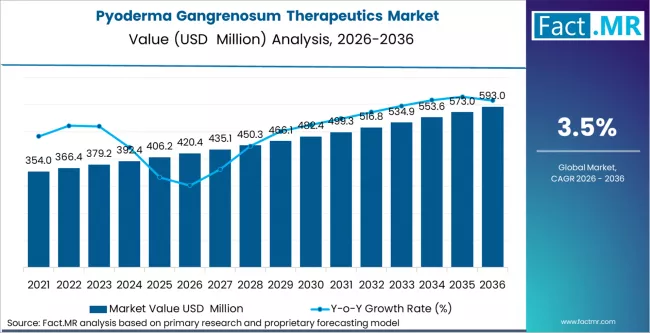
Pyoderma Gangrenosum Therapeutics Market
| Metric | Value |
|---|---|
| Estimated Value in (2026E) | USD 420.4 million |
| Forecast Value in (2036F) | USD 571.5 million |
| Forecast CAGR (2026 to 2036) | 3.5% |
Pyoderma Gangrenosum Therapeutics Market Definition
The Pyoderma Gangrenosum Therapeutics Market refers to the development and sale of pharmaceutical treatments used to manage and alleviate pyoderma gangrenosum-a rare, painful, inflammatory skin condition characterized by rapidly progressing ulcers-through immunosuppressants, biologics, and supportive therapies.
Market Inclusions
This report covers global and regional market sizes for pyoderma gangrenosum therapeutics over a defined forecast period, including drug classes (topical treatments, systemic immunosuppressants, biologics), key indications, and distribution channels.
Market Exclusions
The scope excludes treatments for other dermatological conditions without approved efficacy for pyoderma gangrenosum and diagnostic tools or devices. It also omits general wound care products not indicated for this condition.
Research Methodology
- Primary Research: Interviews were conducted with dermatologists, clinical pharmacologists, and industry experts.
- Desk Research: Data was sourced from clinical trial registries, regulatory filings, and industry reports.
- Market‑Sizing and Forecasting: A hybrid model combining top‑down disease prevalence forecasts with bottom‑up therapeutic sales data was used.
- Data Validation and Update Cycle: Findings were validated through expert review and aligned with recent treatment, approval, and usage data.
Summary of the Pyoderma Gangrenosum Therapeutics Market
- Market Definition
- The Pyoderma Gangrenosum Therapeutics Market includes the development and sale of pharmaceutical treatments for pyoderma gangrenosum, a rare and painful inflammatory skin condition. Treatments include immunosuppressants, biologics, and other supportive therapies aimed at controlling flare-ups and promoting healing.
- Demand Drivers
- Rising Prevalence: An increase in the prevalence of pyoderma gangrenosum, a rare and chronic condition, is driving the demand for effective therapeutics.
- Advancements in Biologics: New biologic therapies offer targeted treatment options, improving patient outcomes and driving market growth.
- Improved Diagnosis: Increased awareness and advances in diagnostics contribute to earlier detection, leading to greater demand for treatment.
- Key Segments Analyzed
- Therapy Class: Systemic corticosteroids are expected to capture 30% of the market share by 2026. These remain a mainstay in treatment due to their effectiveness in controlling inflammation and flare-ups.
- Route of Administration: Oral administration is projected to dominate, accounting for 40% of the market by 2026, owing to its ease of use and patient compliance.
- End User: Hospitals are expected to hold the largest share of the market, as they provide specialized care and treatment for pyoderma gangrenosum.
- Analyst Opinion at Fact MR
- "The pyoderma gangrenosum therapeutics market is expanding, driven by the rising awareness of the condition and the increasing availability of effective treatment options. Despite challenges like the high cost of biologics, the growing demand for targeted therapies is set to accelerate market growth."-Shambhu Nath Jha, Principal Consultant at Fact MR.
- Strategic Implications/Executive Takeaways
- Focus on Advanced Treatments: Given the complexity of pyoderma gangrenosum, the market for biologics and immunomodulators continues to expand, offering substantial opportunities for innovation.
- Investment in Clinical Trials: Further research into new treatment options, especially for refractory cases, will help address the unmet medical needs in the market.
- Geographic Expansion: Companies should focus on emerging markets such as India and China, where rising healthcare investments are increasing access to treatment.
- Methodology
- Primary research through interviews with dermatologists, clinical pharmacologists, and industry experts.
- Desk research based on clinical trial data, industry reports, and regulatory filings.
Segmental Analysis
Pyoderma Gangrenosum Therapeutics Market Analysis by Route of Administration
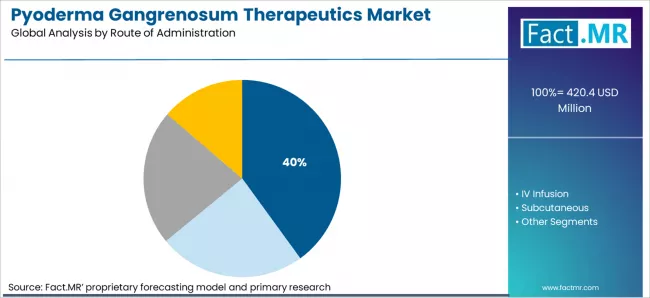
- Market Overview: Oral administration is expected to hold 40% of the pyoderma gangrenosum therapeutics market by 2026. Oral medications are commonly prescribed for pyoderma gangrenosum due to their ease of use, patient compliance, and the systemic treatment they provide, which is often necessary to manage the condition’s flare-ups and chronic symptoms.
- Demand Drivers:
- Ease of Use and Patient Compliance: Oral treatments are generally easier for patients to manage compared to other routes like IV infusion or subcutaneous injections. This ease of use contributes to higher patient adherence to prescribed therapies, making oral administration the preferred option.
- Systemic Effects: Oral medications offer systemic treatment, making them effective for managing the widespread symptoms of pyoderma gangrenosum, which often affect multiple areas of the body.
- Cost-Effectiveness and Accessibility: Oral therapies are often more affordable and accessible compared to IV or subcutaneous treatments, making them more attractive for patients and healthcare systems alike, especially in resource-limited settings.
Pyoderma Gangrenosum Therapeutics Market Analysis by Therapy Class
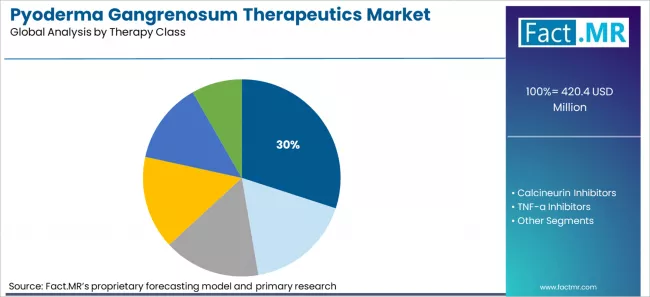
- Market Overview: Systemic corticosteroids are projected to capture 30% of the market share by 2026. These are commonly used to manage pyoderma gangrenosum due to their potent anti-inflammatory effects, which help control flare-ups and reduce symptoms of the condition.
- Demand Drivers:
- Efficacy in Inflammatory Conditions: Systemic corticosteroids are widely recognized for their effectiveness in treating inflammatory skin conditions, including pyoderma gangrenosum. Their ability to rapidly reduce inflammation and suppress the immune response makes them a cornerstone in therapy for many patients.
- Widespread Use in Autoimmune Disorders: Given that pyoderma gangrenosum is often linked to autoimmune or inflammatory diseases, corticosteroids are a standard treatment choice due to their broad immunosuppressive properties.
- Need for Rapid Symptom Control: As pyoderma gangrenosum can cause rapid and severe ulcerations, corticosteroids are favored for their ability to quickly reduce inflammation and prevent further tissue damage.
Pyoderma Gangrenosum Therapeutics Market Drivers, Restraints, and Opportunities
FMR analysts observe that the Pyoderma Gangrenosum therapeutics market is a growth‑aligned rare disease segment rooted in clinical need for effective management of painful, ulcerative skin lesions associated with this neutrophilic dermatosis. Standard treatments-systemic corticosteroids and cyclosporine-remain foundational, but limited approved therapies and variable patient responses sustain unmet needs that expand the market for advanced immunomodulators and biologics. The market is projected to grow from an estimated ~USD 402.3 million in 2025 to ~USD 567.5 million by 2035, reflecting broader adoption of targeted therapies and evolving clinical practice.
While traditional immunosuppressants continue to account for large share, newer biologics and emerging agents aimed at specific immune pathways are gaining traction. These advanced therapeutics carry higher per‑patient costs, contributing to net value growth even as overall patient numbers grow modestly due to the disease’s rarity. The market exists because clinicians increasingly integrate targeted interventions that improve outcomes where conventional broad‑spectrum agents fall short, and regulatory frameworks in major markets support adoption of innovative therapies.
- Targeted Immunotherapies: Uptake of biologic agents and immune modulators is rising as alternatives to conventional corticosteroids, improving management of severe or refractory cases.
- Regulatory & Clinical Standards: Evolving clinical guidelines and regulatory support for novel agents emphasize safety and efficacy in rare disease settings, encouraging adoption of newer therapeutics.
- Regional Market Dynamics: North America and Europe lead due to strong healthcare infrastructure and greater access to advanced therapies, while Asia‑Pacific markets are expanding as diagnosis rates and specialty care access grow.
Regional Analysis
The market analysis covers key global regions, including East Asia, South Asia, Western Europe, North America, and China. It is segmented geographically, with specific market dynamics for each region. The full report provides a detailed market attractiveness analysis.
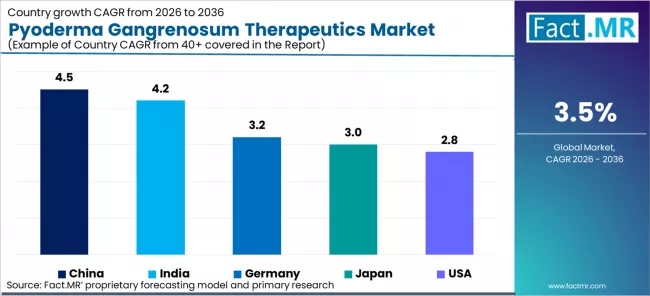
| Country | CAGR (%) |
|---|---|
| China | 4.5% |
| India | 4.2% |
| Germany | 3.2% |
| Japan | 3.0% |
| USA | 2.8% |
Source: Fact MR (FMR) analysis, based on proprietary forecasting model and primary research.
East Asia:
In East Asia, China and Japan are leading the demand for pyoderma gangrenosum therapeutics, driven by increasing awareness of the disease and growing healthcare investments.
- China: Demand for pyoderma gangrenosum therapeutics in China is projected to rise at 4.5% CAGR through 2036. China’s increasing healthcare infrastructure and focus on dermatological treatments contribute to the growing market for pyoderma gangrenosum therapeutics.
- Japan: Demand for pyoderma gangrenosum therapeutics in Japan is projected to rise at 3.0% CAGR through 2036. Japan’s advanced healthcare system and increasing awareness of rare dermatological conditions support steady market growth.
South Asia:
In South Asia, India is seeing growing demand for pyoderma gangrenosum therapeutics, supported by an increasing patient population and improved access to healthcare.
- India: Demand for pyoderma gangrenosum therapeutics in India is projected to rise at 4.2% CAGR through 2036. India’s expanding healthcare sector and increased focus on rare diseases and dermatology contribute to the rising demand for therapeutics.
Western Europe:
In Western Europe, Germany is a key market for pyoderma gangrenosum therapeutics, driven by the country's advanced healthcare infrastructure and the increasing need for specialized dermatological treatments.
- Germany: Demand for pyoderma gangrenosum therapeutics in Germany is projected to rise at 3.2% CAGR through 2036. Germany’s well-established healthcare system and growing focus on rare and complex skin disorders continue to support market growth.
North America:
In North America, the USA remains the leading market for pyoderma gangrenosum therapeutics, supported by increasing awareness of the condition and the availability of advanced treatment options.
- USA: Demand for pyoderma gangrenosum therapeutics in the U.S. is projected to rise at 2.8% CAGR through 2036. The growing prevalence of dermatological diseases and increased research into new therapeutic options continue to drive demand for pyoderma gangrenosum treatments.
Fact MR's analysis of the Pyoderma Gangrenosum Therapeutics Market in East Asia, South Asia, Western Europe, North America, and China consists of country-wise assessments that include China, India, Germany, Japan, and the USA. Readers can find detailed trends, regulatory updates, and company-specific investments shaping the market’s growth in these countries.
How Are Key Players Competing in the Pyoderma Gangrenosum Therapeutics Market?
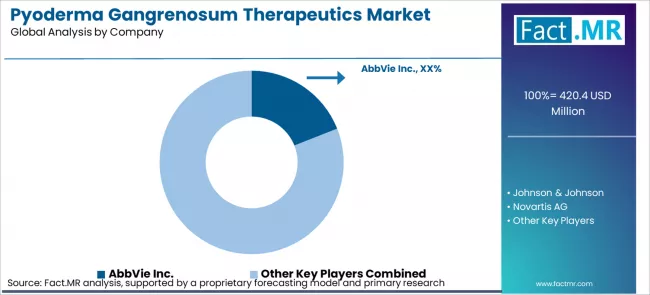
In the pyoderma gangrenosum therapeutics market, AbbVie Inc. and Johnson & Johnson lead with a strong portfolio of immunosuppressive treatments and biologics. Novartis AG and Pfizer Inc. are positioning themselves with cutting-edge therapies targeting autoimmune disorders, enhancing their reach in this niche market. Boehringer Ingelheim is focusing on developing novel biologics with a strong emphasis on inflammatory pathways, while InflaRx N.V. specializes in therapies targeting the complement system to address the underlying inflammatory mechanisms of pyoderma gangrenosum. UCB S.A. and Amgen Inc. contribute with targeted biologics and innovative treatments for chronic skin conditions. Eli Lilly and Company and Bristol Myers Squibb expand their pipeline with immune-modulating therapies designed for treating autoimmune diseases, thereby addressing the growing demand for effective pyoderma gangrenosum treatments. As the market continues to grow, key players are innovating and collaborating to advance novel treatment options for this complex and debilitating condition.
Recent Industry Developments
- Vilobelimab Phase 3 Trial Analysis: InflaRx reported a -45.4% change in target ulcer volume (p=0.0428) for vilobelimab over placebo in a 2025 post-hoc analysis.
- Spesolimab Phase 3 Clinical Trial: Boehringer Ingelheim initiated a Phase 3 study (NCT06624670) in February 2025 to evaluate spesolimab in adults with ulcerative Pyoderma Gangrenosum.
- Upadacitinib Clinical Case Documentation: A 2025 clinical report documented the successful treatment of facial Pyoderma Gangrenosum using the JAK inhibitor upadacitinib.
Key Players of the Pyoderma Gangrenosum Therapeutics Market
- AbbVie Inc.
- Johnson & Johnson
- Novartis AG
- Pfizer Inc.
- Boehringer Ingelheim
- InflaRx N.V.
- UCB S.A.
- Amgen Inc.
- Eli Lilly and Company
- Bristol Myers Squibb
Report Scope
| Metric | Value |
|---|---|
| Quantitative Units | USD 420.4 million (2026) to USD 571.5 million (2036), at a CAGR of 3.5% |
| Market Definition | The Pyoderma Gangrenosum Therapeutics Market includes treatments for pyoderma gangrenosum, a rare inflammatory skin disorder, targeting various therapy classes and routes of administration. |
| By Therapy Class | Systemic Corticosteroids, Calcineurin Inhibitors, TNF-α Inhibitors, IL-Pathway Biologics, JAK Inhibitors, Adjunctive/Topical & Wound-Care |
| By Route of Administration | Oral, IV Infusion, Subcutaneous, Topical |
| By End User | Hospitals, Specialty Clinics, Ambulatory Surgical Centers, Others |
| Regions Covered | North America, Latin America, Europe, East Asia, South Asia, Oceania, Middle East and Africa |
| Countries Covered | United States, Canada, Mexico, Brazil, Argentina, Germany, France, United Kingdom, Italy, Spain, China, India, Japan, South Korea, Indonesia, Australia, and 40+ countries |
| Key Companies Profiled | AbbVie Inc., Johnson & Johnson, Novartis AG, Pfizer Inc., Boehringer Ingelheim, InflaRx N.V., UCB S.A., Amgen Inc., Eli Lilly and Company, Bristol Myers Squibb |
| Forecast Period | 2026 to 2036 |
| Approach | Hybrid top-down and bottom-up market modeling validated through primary interviews with manufacturers and supported by trade data benchmarking and market research. |
Pyoderma Gangrenosum Therapeutics Market Key Segments
-
Therapy Class
- Systemic Corticosteroids
- Calcineurin Inhibitors
- TNF-α Inhibitors
- IL-Pathway Biologics
- JAK Inhibitors
- Adjunctive/Topical & Wound-Care
-
Route of Administration
- Oral
- IV Infusion
- Subcutaneous
- Topical
-
End-Use Industry
- Hospitals
- Specialty Clinics
- Ambulatory Surgical Centers
- Others
-
Region
- North America
- USA
- Canada
- Mexico
- Europe
- Germany
- UK
- France
- Italy
- Spain
- Nordic Countries
- BENELUX
- Rest of Europe
- Asia Pacific
- China
- Japan
- South Korea
- India
- Australia
- Rest of Asia Pacific
- Latin America
- Brazil
- Argentina
- Rest of Latin America
- Middle East and Africa
- Kingdom of Saudi Arabia
- United Arab Emirates
- South Africa
- Rest of Middle East and Africa
- Other Regions
- Oceania
- Central Asia
- Other Markets
- North America
Bibliographies
- InflaRx N.V.. (2025). Post-hoc analyses of Phase 3 trial data for vilobelimab in pyoderma gangrenosum [Press release]. InflaRx N.V.
- Boehringer Ingelheim International GmbH. (2025). A Phase 3 study evaluating spesolimab in adults with ulcerative pyoderma gangrenosum (ClinicalTrials.gov Identifier: NCT06624670). ClinicalTrials.gov.
- National Library of Medicine. (2025). Treatment of facial pyoderma gangrenosum with upadacitinib: A clinical case report. PubMed Central.
- National Organization for Rare Disorders. (2024). Pyoderma gangrenosum: Overview and emerging therapies. National Organization for Rare Disorders.
- Mayo Clinic. (2024). Pyoderma gangrenosum: Symptoms and causes. Mayo Clinic.
- DermNet New Zealand Trust. (2025). Pyoderma gangrenosum: Management and therapeutic options. DermNet New Zealand.
- InflaRx N.V.. (2024). Vilobelimab development program for pyoderma gangrenosum. InflaRx N.V.
- Pfizer Inc.. (2024). Biologic therapies in dermatology and immune-mediated skin diseases. Pfizer Inc.
This report addresses:
- Market intelligence enabling comprehensive assessment of leading countries and product segments across the Pyoderma Gangrenosum Therapeutics Market globally.
- Market volume (sales units) estimates and 10-year revenue forecasts from 2026 to 2036, validated through manufacturer shipment data, channel partner surveys, and country-level demand modeling.
- Growth opportunity mapping across therapy classes (Systemic Corticosteroids, Calcineurin Inhibitors, TNF-α Inhibitors, IL-Pathway Biologics, JAK Inhibitors, Adjunctive/Topical & Wound-Care), routes of administration (Oral, IV Infusion, Subcutaneous, Topical), and regions.
- Segment and regional revenue forecasts by therapy class, route of administration, and geography across 40+ countries.
- Competition strategy analysis covering dealer network structure, recent developments, product portfolio, USPs, and market share analysis.
- Product and regulatory compliance tracking aligned with dermatological and autoimmune disease treatment guidelines.
- Regulatory impact analysis addressing FDA approvals, clinical trials, and market access in major regions.
- Report delivery in PDF, Excel, PowerPoint, and interactive dashboard formats for executive, procurement, and operational planning use.
Table of Content
- Executive Summary
- Global Market Outlook
- Demand to side Trends
- Supply to side Trends
- Technology Roadmap Analysis
- Analysis and Recommendations
- Market Overview
- Market Coverage / Taxonomy
- Market Definition / Scope / Limitations
- Research Methodology
- Chapter Orientation
- Analytical Lens and Working Hypotheses
- Market Structure, Signals, and Trend Drivers
- Benchmarking and Cross-market Comparability
- Market Sizing, Forecasting, and Opportunity Mapping
- Research Design and Evidence Framework
- Desk Research Programme (Secondary Evidence)
- Company Annual and Sustainability Reports
- Peer-reviewed Journals and Academic Literature
- Corporate Websites, Product Literature, and Technical Notes
- Earnings Decks and Investor Briefings
- Statutory Filings and Regulatory Disclosures
- Technical White Papers and Standards Notes
- Trade Journals, Industry Magazines, and Analyst Briefs
- Conference Proceedings, Webinars, and Seminar Materials
- Government Statistics Portals and Public Data Releases
- Press Releases and Reputable Media Coverage
- Specialist Newsletters and Curated Briefings
- Sector Databases and Reference Repositories
- FMR Internal Proprietary Databases and Historical Market Datasets
- Subscription Datasets and Paid Sources
- Social Channels, Communities, and Digital Listening Inputs
- Additional Desk Sources
- Expert Input and Fieldwork (Primary Evidence)
- Primary Modes
- Qualitative Interviews and Expert Elicitation
- Quantitative Surveys and Structured Data Capture
- Blended Approach
- Why Primary Evidence is Used
- Field Techniques
- Interviews
- Surveys
- Focus Groups
- Observational and In-context Research
- Social and Community Interactions
- Stakeholder Universe Engaged
- C-suite Leaders
- Board Members
- Presidents and Vice Presidents
- R&D and Innovation Heads
- Technical Specialists
- Domain Subject-matter Experts
- Scientists
- Physicians and Other Healthcare Professionals
- Governance, Ethics, and Data Stewardship
- Research Ethics
- Data Integrity and Handling
- Primary Modes
- Tooling, Models, and Reference Databases
- Desk Research Programme (Secondary Evidence)
- Data Engineering and Model Build
- Data Acquisition and Ingestion
- Cleaning, Normalisation, and Verification
- Synthesis, Triangulation, and Analysis
- Quality Assurance and Audit Trail
- Market Background
- Market Dynamics
- Drivers
- Restraints
- Opportunity
- Trends
- Scenario Forecast
- Demand in Optimistic Scenario
- Demand in Likely Scenario
- Demand in Conservative Scenario
- Opportunity Map Analysis
- Product Life Cycle Analysis
- Supply Chain Analysis
- Investment Feasibility Matrix
- Value Chain Analysis
- PESTLE and Porter’s Analysis
- Regulatory Landscape
- Regional Parent Market Outlook
- Production and Consumption Statistics
- Import and Export Statistics
- Market Dynamics
- Global Market Analysis 2021 to 2025 and Forecast, 2026 to 2036
- Historical Market Size Value (USD Million) Analysis, 2021 to 2025
- Current and Future Market Size Value (USD Million) Projections, 2026 to 2036
- Y to o to Y Growth Trend Analysis
- Absolute $ Opportunity Analysis
- Global Market Pricing Analysis 2021 to 2025 and Forecast 2026 to 2036
- Global Market Analysis 2021 to 2025 and Forecast 2026 to 2036, By Route of Administration
- Introduction / Key Findings
- Historical Market Size Value (USD Million) Analysis By Route of Administration , 2021 to 2025
- Current and Future Market Size Value (USD Million) Analysis and Forecast By Route of Administration , 2026 to 2036
- Oral
- IV Infusion
- Subcutaneous
- Topical
- Oral
- Y to o to Y Growth Trend Analysis By Route of Administration , 2021 to 2025
- Absolute $ Opportunity Analysis By Route of Administration , 2026 to 2036
- Global Market Analysis 2021 to 2025 and Forecast 2026 to 2036, By Therapy Class
- Introduction / Key Findings
- Historical Market Size Value (USD Million) Analysis By Therapy Class, 2021 to 2025
- Current and Future Market Size Value (USD Million) Analysis and Forecast By Therapy Class, 2026 to 2036
- Systemic Corticosteroids
- Calcineurin Inhibitors
- TNF-a Inhibitors
- IL-Pathway Biologics
- JAK Inhibitors
- Adjunctive/Topical & Wound-Care
- Systemic Corticosteroids
- Y to o to Y Growth Trend Analysis By Therapy Class, 2021 to 2025
- Absolute $ Opportunity Analysis By Therapy Class, 2026 to 2036
- Global Market Analysis 2021 to 2025 and Forecast 2026 to 2036, By Region
- Introduction
- Historical Market Size Value (USD Million) Analysis By Region, 2021 to 2025
- Current Market Size Value (USD Million) Analysis and Forecast By Region, 2026 to 2036
- North America
- Latin America
- Western Europe
- Eastern Europe
- East Asia
- South Asia and Pacific
- Middle East & Africa
- Market Attractiveness Analysis By Region
- North America Market Analysis 2021 to 2025 and Forecast 2026 to 2036, By Country
- Historical Market Size Value (USD Million) Trend Analysis By Market Taxonomy, 2021 to 2025
- Market Size Value (USD Million) Forecast By Market Taxonomy, 2026 to 2036
- By Country
- USA
- Canada
- Mexico
- By Route of Administration
- By Therapy Class
- By Country
- Market Attractiveness Analysis
- By Country
- By Route of Administration
- By Therapy Class
- Key Takeaways
- Latin America Market Analysis 2021 to 2025 and Forecast 2026 to 2036, By Country
- Historical Market Size Value (USD Million) Trend Analysis By Market Taxonomy, 2021 to 2025
- Market Size Value (USD Million) Forecast By Market Taxonomy, 2026 to 2036
- By Country
- Brazil
- Chile
- Rest of Latin America
- By Route of Administration
- By Therapy Class
- By Country
- Market Attractiveness Analysis
- By Country
- By Route of Administration
- By Therapy Class
- Key Takeaways
- Western Europe Market Analysis 2021 to 2025 and Forecast 2026 to 2036, By Country
- Historical Market Size Value (USD Million) Trend Analysis By Market Taxonomy, 2021 to 2025
- Market Size Value (USD Million) Forecast By Market Taxonomy, 2026 to 2036
- By Country
- Germany
- UK
- Italy
- Spain
- France
- Nordic
- BENELUX
- Rest of Western Europe
- By Route of Administration
- By Therapy Class
- By Country
- Market Attractiveness Analysis
- By Country
- By Route of Administration
- By Therapy Class
- Key Takeaways
- Eastern Europe Market Analysis 2021 to 2025 and Forecast 2026 to 2036, By Country
- Historical Market Size Value (USD Million) Trend Analysis By Market Taxonomy, 2021 to 2025
- Market Size Value (USD Million) Forecast By Market Taxonomy, 2026 to 2036
- By Country
- Russia
- Poland
- Hungary
- Balkan & Baltic
- Rest of Eastern Europe
- By Route of Administration
- By Therapy Class
- By Country
- Market Attractiveness Analysis
- By Country
- By Route of Administration
- By Therapy Class
- Key Takeaways
- East Asia Market Analysis 2021 to 2025 and Forecast 2026 to 2036, By Country
- Historical Market Size Value (USD Million) Trend Analysis By Market Taxonomy, 2021 to 2025
- Market Size Value (USD Million) Forecast By Market Taxonomy, 2026 to 2036
- By Country
- China
- Japan
- South Korea
- By Route of Administration
- By Therapy Class
- By Country
- Market Attractiveness Analysis
- By Country
- By Route of Administration
- By Therapy Class
- Key Takeaways
- South Asia and Pacific Market Analysis 2021 to 2025 and Forecast 2026 to 2036, By Country
- Historical Market Size Value (USD Million) Trend Analysis By Market Taxonomy, 2021 to 2025
- Market Size Value (USD Million) Forecast By Market Taxonomy, 2026 to 2036
- By Country
- India
- ASEAN
- Australia & New Zealand
- Rest of South Asia and Pacific
- By Route of Administration
- By Therapy Class
- By Country
- Market Attractiveness Analysis
- By Country
- By Route of Administration
- By Therapy Class
- Key Takeaways
- Middle East & Africa Market Analysis 2021 to 2025 and Forecast 2026 to 2036, By Country
- Historical Market Size Value (USD Million) Trend Analysis By Market Taxonomy, 2021 to 2025
- Market Size Value (USD Million) Forecast By Market Taxonomy, 2026 to 2036
- By Country
- Kingdom of Saudi Arabia
- Other GCC Countries
- Turkiye
- South Africa
- Other African Union
- Rest of Middle East & Africa
- By Route of Administration
- By Therapy Class
- By Country
- Market Attractiveness Analysis
- By Country
- By Route of Administration
- By Therapy Class
- Key Takeaways
- Key Countries Market Analysis
- USA
- Pricing Analysis
- Market Share Analysis, 2025
- By Route of Administration
- By Therapy Class
- Canada
- Pricing Analysis
- Market Share Analysis, 2025
- By Route of Administration
- By Therapy Class
- Mexico
- Pricing Analysis
- Market Share Analysis, 2025
- By Route of Administration
- By Therapy Class
- Brazil
- Pricing Analysis
- Market Share Analysis, 2025
- By Route of Administration
- By Therapy Class
- Chile
- Pricing Analysis
- Market Share Analysis, 2025
- By Route of Administration
- By Therapy Class
- Germany
- Pricing Analysis
- Market Share Analysis, 2025
- By Route of Administration
- By Therapy Class
- UK
- Pricing Analysis
- Market Share Analysis, 2025
- By Route of Administration
- By Therapy Class
- Italy
- Pricing Analysis
- Market Share Analysis, 2025
- By Route of Administration
- By Therapy Class
- Spain
- Pricing Analysis
- Market Share Analysis, 2025
- By Route of Administration
- By Therapy Class
- France
- Pricing Analysis
- Market Share Analysis, 2025
- By Route of Administration
- By Therapy Class
- India
- Pricing Analysis
- Market Share Analysis, 2025
- By Route of Administration
- By Therapy Class
- ASEAN
- Pricing Analysis
- Market Share Analysis, 2025
- By Route of Administration
- By Therapy Class
- Australia & New Zealand
- Pricing Analysis
- Market Share Analysis, 2025
- By Route of Administration
- By Therapy Class
- China
- Pricing Analysis
- Market Share Analysis, 2025
- By Route of Administration
- By Therapy Class
- Japan
- Pricing Analysis
- Market Share Analysis, 2025
- By Route of Administration
- By Therapy Class
- South Korea
- Pricing Analysis
- Market Share Analysis, 2025
- By Route of Administration
- By Therapy Class
- Russia
- Pricing Analysis
- Market Share Analysis, 2025
- By Route of Administration
- By Therapy Class
- Poland
- Pricing Analysis
- Market Share Analysis, 2025
- By Route of Administration
- By Therapy Class
- Hungary
- Pricing Analysis
- Market Share Analysis, 2025
- By Route of Administration
- By Therapy Class
- Kingdom of Saudi Arabia
- Pricing Analysis
- Market Share Analysis, 2025
- By Route of Administration
- By Therapy Class
- Turkiye
- Pricing Analysis
- Market Share Analysis, 2025
- By Route of Administration
- By Therapy Class
- South Africa
- Pricing Analysis
- Market Share Analysis, 2025
- By Route of Administration
- By Therapy Class
- USA
- Market Structure Analysis
- Competition Dashboard
- Competition Benchmarking
- Market Share Analysis of Top Players
- By Regional
- By Route of Administration
- By Therapy Class
- Competition Analysis
- Competition Deep Dive
- AbbVie Inc.
- Overview
- Product Portfolio
- Profitability by Market Segments (Product/Age /Sales Channel/Region)
- Sales Footprint
- Strategy Overview
- Marketing Strategy
- Product Strategy
- Channel Strategy
- Johnson & Johnson
- Novartis AG
- Pfizer Inc.
- Boehringer Ingelheim
- InflaRx N.V.
- UCB S.A.
- Amgen Inc.
- Eli Lilly and Company
- Bristol Myers Squibb
- AbbVie Inc.
- Competition Deep Dive
- Assumptions & Acronyms Used
List Of Table
- Table 1: Global Market Value (USD Million) Forecast by Region, 2021 to 2036
- Table 2: Global Market Value (USD Million) Forecast by Route of Administration, 2021 to 2036
- Table 3: Global Market Value (USD Million) Forecast by Therapy Class, 2021 to 2036
- Table 4: North America Market Value (USD Million) Forecast by Country, 2021 to 2036
- Table 5: North America Market Value (USD Million) Forecast by Route of Administration, 2021 to 2036
- Table 6: North America Market Value (USD Million) Forecast by Therapy Class, 2021 to 2036
- Table 7: Latin America Market Value (USD Million) Forecast by Country, 2021 to 2036
- Table 8: Latin America Market Value (USD Million) Forecast by Route of Administration, 2021 to 2036
- Table 9: Latin America Market Value (USD Million) Forecast by Therapy Class, 2021 to 2036
- Table 10: Western Europe Market Value (USD Million) Forecast by Country, 2021 to 2036
- Table 11: Western Europe Market Value (USD Million) Forecast by Route of Administration, 2021 to 2036
- Table 12: Western Europe Market Value (USD Million) Forecast by Therapy Class, 2021 to 2036
- Table 13: Eastern Europe Market Value (USD Million) Forecast by Country, 2021 to 2036
- Table 14: Eastern Europe Market Value (USD Million) Forecast by Route of Administration, 2021 to 2036
- Table 15: Eastern Europe Market Value (USD Million) Forecast by Therapy Class, 2021 to 2036
- Table 16: East Asia Market Value (USD Million) Forecast by Country, 2021 to 2036
- Table 17: East Asia Market Value (USD Million) Forecast by Route of Administration, 2021 to 2036
- Table 18: East Asia Market Value (USD Million) Forecast by Therapy Class, 2021 to 2036
- Table 19: South Asia and Pacific Market Value (USD Million) Forecast by Country, 2021 to 2036
- Table 20: South Asia and Pacific Market Value (USD Million) Forecast by Route of Administration, 2021 to 2036
- Table 21: South Asia and Pacific Market Value (USD Million) Forecast by Therapy Class, 2021 to 2036
- Table 22: Middle East & Africa Market Value (USD Million) Forecast by Country, 2021 to 2036
- Table 23: Middle East & Africa Market Value (USD Million) Forecast by Route of Administration, 2021 to 2036
- Table 24: Middle East & Africa Market Value (USD Million) Forecast by Therapy Class, 2021 to 2036
List Of Figures
- Figure 1: Global Market Pricing Analysis
- Figure 2: Global Market Value (USD Million) Forecast 2021 to 2036
- Figure 3: Global Market Value Share and BPS Analysis by Route of Administration, 2026 and 2036
- Figure 4: Global Market Y to o to Y Growth Comparison by Route of Administration, 2026 to 2036
- Figure 5: Global Market Attractiveness Analysis by Route of Administration
- Figure 6: Global Market Value Share and BPS Analysis by Therapy Class, 2026 and 2036
- Figure 7: Global Market Y to o to Y Growth Comparison by Therapy Class, 2026 to 2036
- Figure 8: Global Market Attractiveness Analysis by Therapy Class
- Figure 9: Global Market Value (USD Million) Share and BPS Analysis by Region, 2026 and 2036
- Figure 10: Global Market Y to o to Y Growth Comparison by Region, 2026 to 2036
- Figure 11: Global Market Attractiveness Analysis by Region
- Figure 12: North America Market Incremental Dollar Opportunity, 2026 to 2036
- Figure 13: Latin America Market Incremental Dollar Opportunity, 2026 to 2036
- Figure 14: Western Europe Market Incremental Dollar Opportunity, 2026 to 2036
- Figure 15: Eastern Europe Market Incremental Dollar Opportunity, 2026 to 2036
- Figure 16: East Asia Market Incremental Dollar Opportunity, 2026 to 2036
- Figure 17: South Asia and Pacific Market Incremental Dollar Opportunity, 2026 to 2036
- Figure 18: Middle East & Africa Market Incremental Dollar Opportunity, 2026 to 2036
- Figure 19: North America Market Value Share and BPS Analysis by Country, 2026 and 2036
- Figure 20: North America Market Value Share and BPS Analysis by Route of Administration, 2026 and 2036
- Figure 21: North America Market Y to o to Y Growth Comparison by Route of Administration, 2026 to 2036
- Figure 22: North America Market Attractiveness Analysis by Route of Administration
- Figure 23: North America Market Value Share and BPS Analysis by Therapy Class, 2026 and 2036
- Figure 24: North America Market Y to o to Y Growth Comparison by Therapy Class, 2026 to 2036
- Figure 25: North America Market Attractiveness Analysis by Therapy Class
- Figure 26: Latin America Market Value Share and BPS Analysis by Country, 2026 and 2036
- Figure 27: Latin America Market Value Share and BPS Analysis by Route of Administration, 2026 and 2036
- Figure 28: Latin America Market Y to o to Y Growth Comparison by Route of Administration, 2026 to 2036
- Figure 29: Latin America Market Attractiveness Analysis by Route of Administration
- Figure 30: Latin America Market Value Share and BPS Analysis by Therapy Class, 2026 and 2036
- Figure 31: Latin America Market Y to o to Y Growth Comparison by Therapy Class, 2026 to 2036
- Figure 32: Latin America Market Attractiveness Analysis by Therapy Class
- Figure 33: Western Europe Market Value Share and BPS Analysis by Country, 2026 and 2036
- Figure 34: Western Europe Market Value Share and BPS Analysis by Route of Administration, 2026 and 2036
- Figure 35: Western Europe Market Y to o to Y Growth Comparison by Route of Administration, 2026 to 2036
- Figure 36: Western Europe Market Attractiveness Analysis by Route of Administration
- Figure 37: Western Europe Market Value Share and BPS Analysis by Therapy Class, 2026 and 2036
- Figure 38: Western Europe Market Y to o to Y Growth Comparison by Therapy Class, 2026 to 2036
- Figure 39: Western Europe Market Attractiveness Analysis by Therapy Class
- Figure 40: Eastern Europe Market Value Share and BPS Analysis by Country, 2026 and 2036
- Figure 41: Eastern Europe Market Value Share and BPS Analysis by Route of Administration, 2026 and 2036
- Figure 42: Eastern Europe Market Y to o to Y Growth Comparison by Route of Administration, 2026 to 2036
- Figure 43: Eastern Europe Market Attractiveness Analysis by Route of Administration
- Figure 44: Eastern Europe Market Value Share and BPS Analysis by Therapy Class, 2026 and 2036
- Figure 45: Eastern Europe Market Y to o to Y Growth Comparison by Therapy Class, 2026 to 2036
- Figure 46: Eastern Europe Market Attractiveness Analysis by Therapy Class
- Figure 47: East Asia Market Value Share and BPS Analysis by Country, 2026 and 2036
- Figure 48: East Asia Market Value Share and BPS Analysis by Route of Administration, 2026 and 2036
- Figure 49: East Asia Market Y to o to Y Growth Comparison by Route of Administration, 2026 to 2036
- Figure 50: East Asia Market Attractiveness Analysis by Route of Administration
- Figure 51: East Asia Market Value Share and BPS Analysis by Therapy Class, 2026 and 2036
- Figure 52: East Asia Market Y to o to Y Growth Comparison by Therapy Class, 2026 to 2036
- Figure 53: East Asia Market Attractiveness Analysis by Therapy Class
- Figure 54: South Asia and Pacific Market Value Share and BPS Analysis by Country, 2026 and 2036
- Figure 55: South Asia and Pacific Market Value Share and BPS Analysis by Route of Administration, 2026 and 2036
- Figure 56: South Asia and Pacific Market Y to o to Y Growth Comparison by Route of Administration, 2026 to 2036
- Figure 57: South Asia and Pacific Market Attractiveness Analysis by Route of Administration
- Figure 58: South Asia and Pacific Market Value Share and BPS Analysis by Therapy Class, 2026 and 2036
- Figure 59: South Asia and Pacific Market Y to o to Y Growth Comparison by Therapy Class, 2026 to 2036
- Figure 60: South Asia and Pacific Market Attractiveness Analysis by Therapy Class
- Figure 61: Middle East & Africa Market Value Share and BPS Analysis by Country, 2026 and 2036
- Figure 62: Middle East & Africa Market Value Share and BPS Analysis by Route of Administration, 2026 and 2036
- Figure 63: Middle East & Africa Market Y to o to Y Growth Comparison by Route of Administration, 2026 to 2036
- Figure 64: Middle East & Africa Market Attractiveness Analysis by Route of Administration
- Figure 65: Middle East & Africa Market Value Share and BPS Analysis by Therapy Class, 2026 and 2036
- Figure 66: Middle East & Africa Market Y to o to Y Growth Comparison by Therapy Class, 2026 to 2036
- Figure 67: Middle East & Africa Market Attractiveness Analysis by Therapy Class
- Figure 68: Global Market - Tier Structure Analysis
- Figure 69: Global Market - Company Share Analysis
- FAQs -
How large is the demand for Pyoderma Gangrenosum Therapeutics in the global market in 2026?
Demand for Pyoderma Gangrenosum Therapeutics in the global market is estimated to be valued at USD 420.4 million in 2026.
What will be the market size of Pyoderma Gangrenosum Therapeutics in the global market by 2036?
The market size for Pyoderma Gangrenosum Therapeutics is projected to reach USD 571.5 million by 2036.
What is the expected demand growth for Pyoderma Gangrenosum Therapeutics in the global market between 2026 and 2036?
Demand for Pyoderma Gangrenosum Therapeutics in the global market is expected to grow at a CAGR of 3.5% between 2026 and 2036.
Which end user is expected to dominate the market?
Hospitals are expected to dominate the market, accounting for 50% of the market share in 2026, as hospitals are the primary care setting for patients with Pyoderma Gangrenosum, requiring specialized therapeutics for treatment.
Which region is expected to show the highest growth rate for Pyoderma Gangrenosum Therapeutics?
China is projected to show the highest regional CAGR at 4.5% during the forecast period, driven by an increasing number of patients requiring specialized treatment for Pyoderma Gangrenosum, and growing healthcare infrastructure in the country.
How significant is the growth outlook for India in this market?
India is expected to grow at a CAGR of 4.2%, supported by the increasing prevalence of autoimmune diseases, improved healthcare access, and the growing availability of therapeutic options for rare skin conditions like Pyoderma Gangrenosum.
What is the growth outlook for Germany in the Pyoderma Gangrenosum Therapeutics market?
Germany is expected to grow at a CAGR of 3.2%, reflecting a steady demand for innovative therapies to treat rare skin diseases, as well as the country's advanced healthcare system.
What is the growth forecast for Japan in the Pyoderma Gangrenosum Therapeutics market?
Japan is expected to grow at a CAGR of 3.0%, driven by the country's aging population and increasing awareness of autoimmune and rare diseases, leading to greater demand for specialized therapeutics.
What is the growth forecast for the United States in the Pyoderma Gangrenosum Therapeutics market?
The United States is anticipated to grow at a CAGR of 2.8% from 2026 to 2036, supported by ongoing research in autoimmune diseases and increased patient access to therapies in both clinical and hospital settings.
Which company is identified as a leading player in the Pyoderma Gangrenosum Therapeutics market?
AbbVie Inc. is recognized as a leading player in this market, offering treatments and therapies for autoimmune-related conditions, including Pyoderma Gangrenosum.
What are Pyoderma Gangrenosum therapeutics used for?
Pyoderma Gangrenosum therapeutics are used to treat a rare and serious skin condition characterized by large, painful ulcers. These therapies, including immunosuppressive agents, biologics, and corticosteroids, help control inflammation and promote healing.
What does the Pyoderma Gangrenosum Therapeutics market include in this report?
The market scope includes various therapeutic options for treating Pyoderma Gangrenosum, with a focus on hospital-based treatments, including biologics, corticosteroids, and other specialized drugs designed to manage the symptoms and underlying causes of the condition.
How is the market forecast developed in this report?
The forecast is developed using historical data on the prevalence of Pyoderma Gangrenosum, trends in healthcare access, the development of new therapeutics, and insights from key industry players involved in the production and distribution of treatments for the condition.
What is meant by the Pyoderma Gangrenosum Therapeutics market in this report?
The market refers to the global production, trade, and consumption of therapeutics for Pyoderma Gangrenosum, particularly in hospital settings, where specialized treatments are required to manage this rare and severe skin disorder.