- Market Value (2025): USD 399.4 Mn
- Estimated Value (2026): USD 426.0 Mn
- Forecast Value (2036): USD 811.8 Mn
- CAGR (2026-2036): 6.7%
What is the Recyclable Foldable Barrier Coatings Market forecast to be worth by 2036?
USD 426.0 million in 2026 to USD 811.8 million by 2036 at a 6.7% CAGR.
- The Recyclable Foldable Barrier Coatings Market reached USD 399.4 million in 2025.
- Fact.MR noted that demand is projected to increase from USD 426.0 million in 2026 to USD 811.8 million by 2036.
- The market is forecast to record 6.7% CAGR from 2026 to 2036.
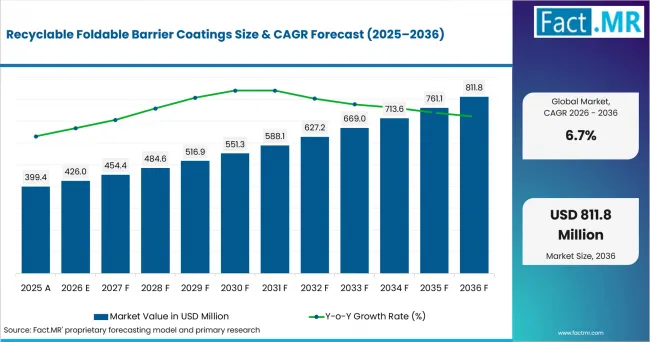
Recyclable Foldable Barrier Coatings Value Analysis | Source: Fact.MR
What are the defining numbers behind Recyclable Foldable Barrier Coatings Market growth?
An absolute opportunity of USD 385.7600 million is expected between 2026 and 2036.
- Demand Drivers in the Market
- Foodservice packs need strong protection from oil and grease after the pack is folded and sealed. Trays and cartons can definitely lose some protection around folded areas. According to the USDA Economic Research Service in June 2026, the U.S. spending on food away from home reached USD 1.41 trillion in 2025.
- Paperboard makers need coatings that protect food packs and still allow the paper to be recycled. This is increasing the use of coatings which is work with current paper recycling systems.
- In food packs the packaging companies are avoiding to use more plastic. This is more important as European rules focus on recycling and PFAS.
- Key Segments Analyzed
- By Coating Chemistry: Among all the sub-segment the water-based polymer dispersion is expected to hold 36.0% share in 2026.
- By Barrier Function: In 2026, the oil / grease holds 50.0% share in 2026 owing to foodservice packs that directly in contact with fried or oily foods.
- By Substrate: Paper is anticipated to capture 44.0% share in 2026 because coated paper can be used for wraps and light packs.
- By Application: Foodservice is estimated to represent 69.0% share in 2026.
- Analyst Opinion at Fact.MR
- Shambhu Nath Jha, Principal Consultant at Fact.MR states: “Product protection is main focus for pack makers. They also check how well the pack folds and how it recycles very easily.”
- Strategic Implications
- Coating suppliers need to test how the coating works after the pack is folded. This is important for cartons and trays.
- It is important for paper packaging makers to check the coated pack can be recycled before using it on a larger scale. In August 2026, the European Commission said all packaging will need to be recyclable from 2030.
- Food brands can choose barrier features based on what each pack actually needs, such as oil, moisture, or oxygen protection.
France is expected to grow at 8.6% CAGR through 2036, supported by recycling rules and wider use of paper packs. The USA is expected to grow at 7.8%, driven by foodservice demand and changes in PFAS use. Japan is expected to grow at 6.5% as paper packaging recycling continues. The Netherlands is expected to grow at 5.2%, followed by Germany at 4.6%.
How does the Recyclable Foldable Barrier Coatings Market break down by segment?
Oil / grease is projected to lead Barrier Function at 50.0% share in 2026; Foodservice is estimated to lead Application at 69.0% share.
Which Coating Chemistry dominates?
Water-based polymer dispersion is expected to hold 36.0% share in 2026.
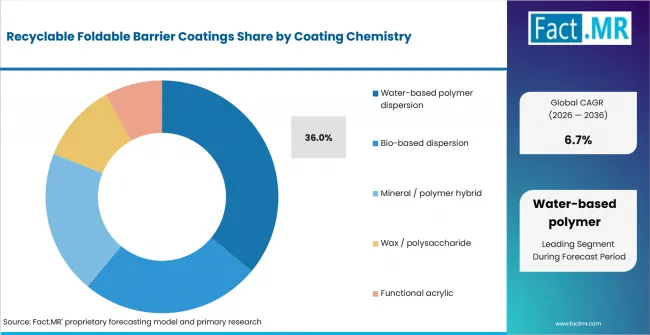
Recyclable Foldable Barrier Coatings Analysis By Coating Chemistry | Source: Fact.MR
Water-based coatings work well on paper and it can be changed depends on different paper types. Bio-based coatings are useful for brands that want to use more renewable materials. When the pack need specific type of protection mineral-polymer blends and acrylic coatings are more useful. In August 2025, Solenis said its coatings help protect paper-based packaging from hot and cold liquids, oil, grease and water vapor.
What leads the Barrier Function segment?
Oil / grease leads with 50.0% share in 2026.
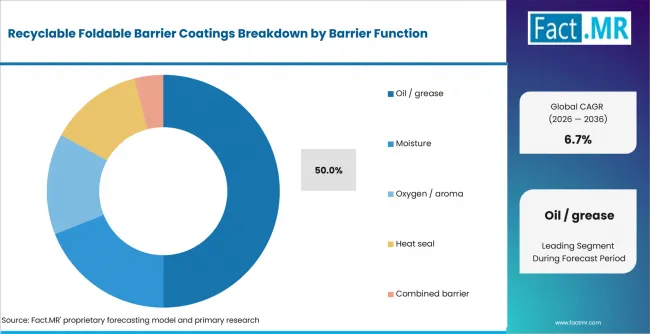
Recyclable Foldable Barrier Coatings Analysis By Barrier Function | Source: Fact.MR
Oil and grease protection will remain important because many food packs come in contact with oily foods. For cold and humid areas moisture barriers are helpful to keep the paper safe. Heat-seal coatings are often used in pouches and lids. At INTERPACK 2026, ACTEGA showed recyclable paper packs made with its ACTGreen barrier coatings.
How does Substrate shape demand?
Paper is anticipated to capture 44.0% share in 2026.
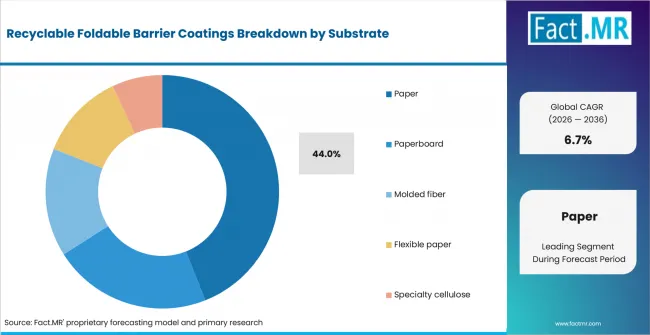
Recyclable Foldable Barrier Coatings Analysis By Substrate | Source: Fact.MR
Paper are important for wraps and liners. Paperboard is often used for cartons. Molded fiber works well for shaped packs. Flexible paper needs coatings that stay in place after folding.
What supports Foodservice within Application?
Foodservice accounts for 69.0% share in 2026.
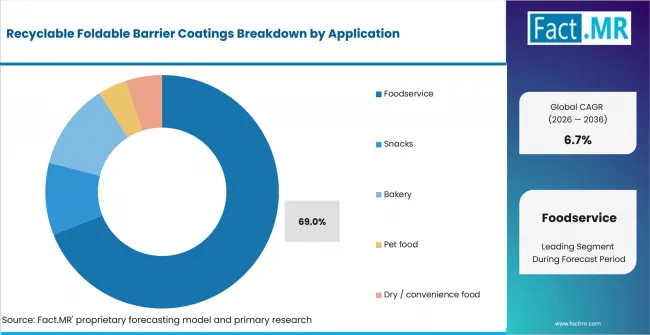
Recyclable Foldable Barrier Coatings Analysis By Application | Source: Fact.MR
Foodservice will see high demand because takeaway packs often hold oily food and it is important to fold this easily. Snack packs need protection from moisture and smell. Bakery packs mainly need protection from grease. In June 2026, USDA reported that food eaten away from home made up 56.3% of total U.S. food spending in 2025.
What is accelerating Recyclable Foldable Barrier Coatings Market adoption, and what is holding it back?
Demand is growing as brands move toward food-safe packaging that is easier to recycle. High costs and difficult coating processes can slow this growth.
Drivers Impact Analysis
| DRIVER | (~) % IMPACT ON CAGR | GEOGRAPHIC RELEVANCE | IMPACT TIMELINE |
|---|---|---|---|
| Shift from plastic laminates to recyclable paper barriers | +1.5% | North America, Europe | Medium term (2-4 years) |
| PFAS replacement in grease-resistant food packaging | +1.2% | North America, Europe | Short term (<= 2 years) |
| Foodservice use of coated fiber packaging | +1.0% | Global | Medium term (2-4 years) |
| Repulpability and recyclability qualification | +0.8% | Europe, North America | Long term (>= 4 years) |
Opportunity Impact Analysis
| OPPORTUNITY | (~) % IMPACT ON CAGR | GEOGRAPHIC RELEVANCE | IMPACT TIMELINE |
|---|---|---|---|
| Bio-based dispersion barriers for food-contact paper | +0.9% | Europe, North America | Medium term (2-4 years) |
| High-barrier flexible paper replacing mixed laminates | +0.7% | Europe, Japan | Long term (>= 4 years) |
| Molded-fiber barrier coatings for prepared foods | +0.5% | North America, Europe | Medium term (2-4 years) |
Restraints Impact Analysis
| RESTRAINT | (~) % IMPACT ON CAGR | GEOGRAPHIC RELEVANCE | IMPACT TIMELINE |
|---|---|---|---|
| Barrier loss at folds, scores and creases | -0.8% | Global | Short term (<= 2 years) |
| Trade-off between barrier strength and fiber recovery | -0.6% | Europe, North America | Medium term (2-4 years) |
| Drying and coat-weight limits on existing lines | -0.5% | Global | Medium term (2-4 years) |
Which countries are scaling the Recyclable Foldable Barrier Coatings Market through 2036?
- The growth rate gap between these countries is 4.0 percentage points. Growth differs based on recycling systems and changing packaging rules.
- France is 0.8 percentage point above the USA. Paper packaging recovery and EU recycling rules are supporting the use of recyclable barrier coatings.
- The USA is 1.3 percentage points above Japan. Foodservice demand and changes in PFAS rules are supporting market growth.
- Japan is 1.3 percentage points above the Netherlands. Paper packaging collection and food safety rules support the market.
- The Netherlands is 0.6 percentage point above Germany. The country has strong recycling and reuse targets for paper and cardboard packaging.
- Germany has the lowest growth rate in this group. The country already has a mature recycling system and clear packaging recovery rules.
CAGR alone does not show the full market picture. Foodservice demand and recycling systems also affect the use of barrier coatings.
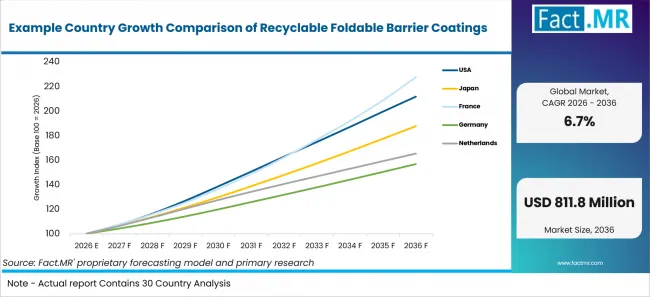
Example Country Growth Comparison Of Recyclable Foldable Barrier Coatings | Source: Fact.MR
| Country | CAGR (2026-2036) |
|---|---|
| United States | 7.8% |
| Japan | 6.5% |
| France | 8.6% |
| Germany | 4.6% |
| Netherlands | 5.2% |
What supports USA adoption?
7.8% CAGR, supported by foodservice scale and fluorine-free grease-barrier reformulation.
Demand for coated paper is strong in the U.S. for food wraps and cartons which is used in stores and foodservice. U.S. retail and foodservice sales reached USD 773.9 billion in August 2026, as reported by the U.S. Census Bureau in September 2026.
How is Japan scaling demand?
6.5% CAGR, shaped by paper collection and food-contact stock controls.
Japan has a strong system for collecting paper and clear rules for food packaging materials. In March 2026, the Ministry of the Environment reported that local councils collected 81,757 tonnes of paper packaging in fiscal 2024. Suppliers can see more demand if their coatings protect against grease and moisture.
What supports France growth?
8.6% CAGR, reinforced by food retail activity and recyclable fiber-pack design.
France uses foldable coated paper for bakery and ready-to-eat food packs. INSEE reported that specialist food shops and small food businesses made up 20.4% of food retail sales in France in 2025. These businesses use paper wraps and cartons that need to handle grease and look good when printed.
What is supporting Germany adoption?
4.6% CAGR, backed by mature pack recovery and detailed recycling fit checks.
Germany already has a strong paper recycling system. New coatings need to work well during recycling and protect the finished pack. Destatis reported that 4.291 million tonnes of paper and cardboard packaging were collected or returned in 2024. This makes recycling an important part of choosing coatings for paper packs.
How does the Netherlands perform?
5.2% CAGR, led by paper recovery and steady use of fiber-based food packs.
Dutch pack makers already have a good system for collecting used paper. They prefer packs that use paper carefully and create less waste. Statistics Netherlands reported in July 2026 that local councils collected 39 kilograms of old paper and cardboard per inhabitant in 2025.
Who leads the Recyclable Foldable Barrier Coatings Market?
Suppliers are making more coatings that help paper packs stay recyclable. Archroma discussed the use of its materials in recyclable paper packaging in March 2025.
Michelman launched Nuvita® Life 4002 and Nuvita® Life 4605 in April 2026. Both coatings are 100% bio-based in dry form and are made for paper packaging. Nuvita Life 4002 protects the pack from oil and grease and also supports heat sealing. Nuvita Life 4605 protects against oil, grease, water and moisture.
Solenis and Michelman also make coatings for paper packaging. ACTEGA offers ACTGreen® coatings for paper food packs. Depending on the product, these coatings can protect packs from oil, grease, water and moisture. Some also support heat sealing.
Which companies are the key providers?
Key companies include Solenis; Michelman; Archroma; and ACTEGA.
- Solenis
- Michelman
- Archroma
- ACTEGA
Bibliography
- Zeballos, E., & Sinclair, W. (2026, June 11). Total U.S. food spending reached $2.51 trillion in 2025. U.S. Department of Agriculture, Economic Research Service.
- U.S. Census Bureau. (2026, September 16). Advance monthly sales for retail and food services.
- U.S. Food and Drug Administration. (2025, January 3). FDA determines authorization for 35 food contact notifications related to PFAS are no longer effective.
- European Commission, Directorate-General for Environment. (2026, August 11). New EU packaging rules start to apply, including restrictions on PFAS in food-contact packaging.
- Insee. (2026, June 18). Parts de marché du commerce de détail selon la forme de vente: Données annuelles 2025 [Retail trade market shares by form of sale: 2025 annual data].
- Umweltbundesamt & Zentrale Stelle Verpackungsregister. (2026, January 27). Mit Fakten gegen Mythen: Das Recycling von Verpackungsabfällen in Deutschland funktioniert [Facts against myths: Packaging waste recycling in Germany works].
- Statistics Netherlands. (2026, July 16). 6 kilo minder afval per inwoner in 2025 [6 kilograms less waste per inhabitant in 2025].
- Solenis. (2025, August 13). Solenis to showcase sustainable paper and packaging solutions at FACHPACK 2025 and PACK EXPO Las Vegas 2025.
- Michelman. (2026, April 30). Michelman introduces Nuvita® Life 4002 & Nuvita® Life 4605: Bio-based barrier coatings for paper packaging applications.
- Archroma. (2025, March 26). From pulp to package, package to pulp (and back again).
- ACTEGA. (2026, June 1). ACTEGA reflects on a successful INTERPACK 2026.
This Report Answers
- The report compares recyclable foldable structures with adjacent paper barrier coatings used for grease and moisture control. High-performance molded fiber is reviewed for shaped food packs that need surface protection after forming.
- Application coverage follows foodservice packaging formats where fold lines and direct oil contact shape barrier needs. Material substitution is assessed alongside sustainable packaging rules and fiber-recovery needs.
- Flexible formats are compared with paper-based wraparound packaging where folding and line speed influence stock choice. Barrier analysis also covers grease barrier systems used in direct food-contact formats.
- Bio-based chemistry is reviewed beside PHA paper coatings and fiber-recovery goals. Substrate choices are compared with paper packaging materials used across cartons and wraps.
What does the Recyclable Foldable Barrier Coatings Market cover?
The Recyclable Foldable Barrier Coatings Market covers barrier coats on foldable fiber packs that provide grease, moisture or heat-seal control while supporting paper recovery. Coverage also follows next-generation paper and fiber packaging when barrier coats form part of the fiber pack.
Coverage spans paper and paperboard alongside molded fiber. Flexible paper and specialty cellulose are included across foodservice and fresh food packaging uses. Analysis considers coat chemistry and folding results together with food-contact rules and recycling fit.
What is included in the scope?
The scope includes water-based polymer dispersions and bio-based dispersions. Mineral / polymer hybrids are covered alongside wax / polysaccharides and functional acrylics. Combined systems are included when one coat or coordinated layers provide more than one barrier function.
Included formats cover wraps and cartons alongside liners. Flexible paper and molded fiber are included when they directly support recyclable fiber packs.
What is excluded from the scope?
The scope is limited to barrier coats used on foldable fiber packs. Standalone plastic films and rigid plastic containers fall outside this boundary. Metal and glass packs are outside the same scope.
The scope focuses on fiber packs designed around a recyclable-paper route. Printing inks, adhesives and surface treatments enter the assessment only when they provide a defined barrier function.
How Was the Analysis Built?
The analysis draws on 120+ sources, 35+ company portfolios, 25+ countries, and more than 20 industry interviews.
- Primary Research: Primary research includes discussions with manufacturers, service providers, technology developers, distributors, end users, and subject-matter experts. These conversations examine purchasing priorities, product adoption, operational challenges, approval requirements, competitive positioning, and the factors that influence wider market acceptance.
- Desk Research: Desk research covers government statistics, regulatory publications, company filings, trade data, technical studies, industry associations, standards, public policy, and other authoritative sources. Every source used in the analysis is documented in the bibliography.
- Market Sizing and Forecasting: Market estimates combine historical performance, demand indicators, pricing and volume trends, segment shares, company participation, country-level growth, adoption patterns, investment activity, and barriers to market expansion.
- Data Validation and Update Cycle: Findings are validated by comparing primary interviews with public data, company activity, regulatory changes, trade patterns, and industry developments. Regular updates review new product launches, capacity changes, partnerships, approvals, and shifts in commercial adoption.
What is the report’s scope and coverage?
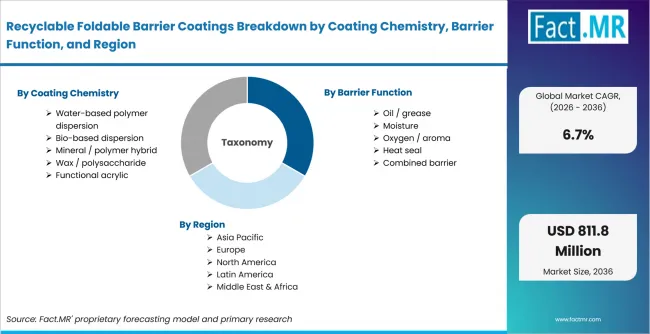
Recyclable Foldable Barrier Coatings Breakdown By Coating Chemistry, Barrier Function, And Region | Source: Fact.MR
| Attribute | Details |
|---|---|
| Quantitative Units | USD Million |
| Market Definition | Coatings applied to foldable paper, paperboard, molded fiber or flexible paper packaging to provide oil, grease, moisture, oxygen, aroma or heat-seal performance while supporting a recyclable fiber-based structure. |
| Coating Chemistry | Water-based polymer dispersion; Bio-based dispersion; Mineral / polymer hybrid; Wax / polysaccharide; Functional acrylic |
| Barrier Function | Oil / grease; Moisture; Oxygen / aroma; Heat seal; Combined barrier |
| Substrate | Paper; Paperboard; Molded fiber; Flexible paper; Specialty cellulose |
| Application | Foodservice; Snacks; Bakery; Pet food; Dry / convenience food |
| Regions Covered | North America; Latin America; Western Europe; Eastern Europe; East Asia; South Asia & Pacific; Middle East & Africa |
| Countries Covered | United States; Japan; France; Germany; Netherlands |
| Key Companies Profiled | Solenis; Michelman; Archroma; ACTEGA |
| Forecast Period | 2026 to 2036 |
| Approach | Hybrid top-down and bottom-up approach using coating consumption, coated-fiber packaging output, foodservice demand, substrate conversion, country regulation and verified provider portfolios. |
How is the market segmented?
-
By Coating Chemistry:
- Water-based polymer dispersion
- Bio-based dispersion
- Mineral / polymer hybrid
- Wax / polysaccharide
- Functional acrylic
-
By Barrier Function:
- Oil / grease
- Moisture
- Oxygen / aroma
- Heat seal
- Combined barrier
-
By Substrate:
- Paper
- Paperboard
- Molded fiber
- Flexible paper
- Specialty cellulose
-
By Application:
- Foodservice
- Snacks
- Bakery
- Pet food
- Dry / convenience food
-
By Region:
- North America
- Latin America
- Western Europe
- Eastern Europe
- East Asia
- South Asia & Pacific
- Middle East & Africa