- Market Value (2025): USD 1.5 Bn
- Estimated Value (2026): USD 1.6 Bn
- Forecast Value (2036): USD 2.8 Bn
- CAGR (2026-2036): 5.7%
What is the Recyclable Wraparound Packaging Market forecast to be worth by 2036?
USD 1.6 billion in 2026 to USD 2.8 billion by 2036, recording a 5.7% CAGR.
- The market reached USD 1.5 billion in 2025 primarily because brand programs funded redesign and qualification.
- Market value is expected to increase from USD 1.6 billion in 2026 to USD 2.8 billion by 2036.
- The market is forecast to record a 5.7% CAGR as plants replace selected film bundles through 2036.
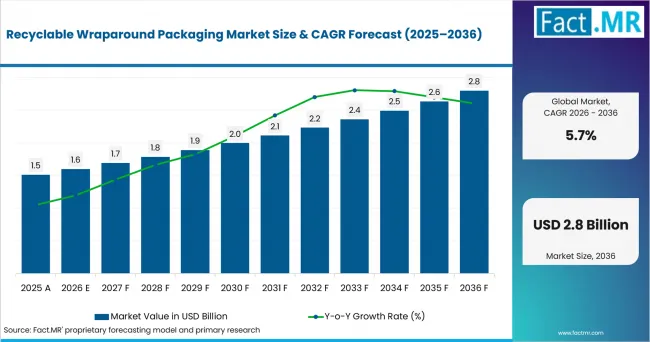
Recyclable Wraparound Packaging Market Value Analysis | Source: Fact.MR
What are the defining numbers behind Recyclable Wraparound Packaging Market growth?
USD 1.2 billion absolute opportunity by 2036 led by paperboard and wraparound cases.
- Demand Drivers in the Market
- Brand teams require recyclable formats because producer-responsibility rules connect material choices with documented recovery outcomes.
- Beverage engineers need close-fitting blanks and trials so automated lines preserve speed and pallet stability.
- Food manufacturers need printable fiber structures combining transport protection with retail presentation across frequent product changes.
- Plant engineers need local trials because adhesive sensitivity and moisture exposure disrupt commercial packing performance.
- Key Segments Analyzed
- By material: Recyclable paperboard is expected to hold 56.0% share in 2026 due to established recovery routes.
- By product type: Wraparound cases are projected to account for 43.0% share in 2026 owing to automation compatibility.
- By reusability: Single-use recyclable is anticipated to capture 64.0% share in 2026 driven by one-way distribution.
- By application: Beverages are estimated to represent 33.0% share in 2026 attributable to standardized production loads.
- By end use: Food & beverage is forecast to garner 62.0% share in 2026 reinforced by frequent shipments.
- By sales channel: Direct - brand OEM is expected to record 51.0% share in 2026 shaped by qualification.
- Analyst Opinion at Fact.MR
- Shambhu Nath Jha is a Principal Consultant at Fact.MR and states: “Recyclable wraparound packaging has become a line-engineering decision. Adoption is expected to favor converters proving compression and moisture control at production speed while brand teams select partners combining recyclability records with local trials.”
- Strategic Implications
- Brand teams should define recyclability and line-performance requirements together before approving material changes across production sites.
- Plant engineers should test blank tolerances and adhesive control at commercial speed before releasing redesigned formats.
- Converters should pair lightweight structures with tooling support and traceable specifications that reduce qualification risk.
- Retail teams should compare opening methods and shelf presentation before replacing established trays or film bundles.
- Large promotions require coordinated package design across several high-output packing sites and regional filling locations. In July 2026 Smurfit Westrock and Coca-Cola China introduced paperboard World Cup multipacks for promotional formats.
Brazil is projected to expand at a CAGR of 6.1%, ahead of Germany at a CAGR of 5.4% and the United Kingdom at a CAGR of 5.3%, supported by rising adoption of sustainable packaging formats.
How does the Recyclable Wraparound Packaging Market break down by segment?
Recyclable paperboard is projected at 56.0% share while wraparound cases are estimated at 43.0%.
Which Material dominates?
Recyclable paperboard is projected at 56.0% share in 2026
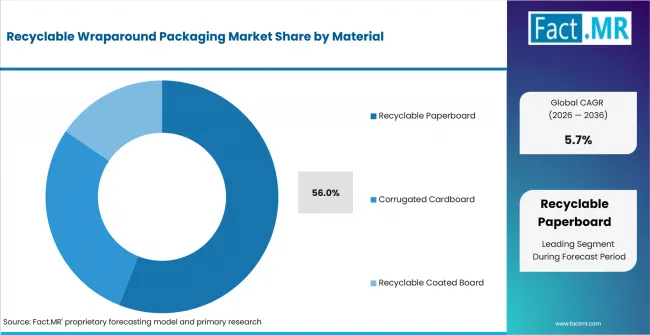
Recyclable Wraparound Packaging Market Analysis By Material | Source: Fact.MR
Based on material, recyclable paperboard is projected to account for 56.0% in 2026 due to established recovery. Heavier loads use corrugated packaging while coated paper packaging materials address moisture across demanding routes. Graphic Packaging reported 880 million plastic packs replaced during 2025 across large programs with stable conversion. The reported scale connects paperboard graphics with qualified output across recurring high-volume brand programs worldwide.
What leads the Product Type segment?
Wraparound cases are projected to record 43.0% share in 2026
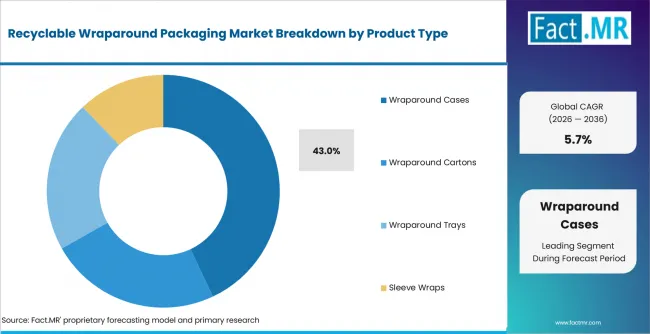
Recyclable Wraparound Packaging Market Analysis By Product Type | Source: Fact.MR
By product type, wraparound cases are estimated to hold 43.0% in 2026 owing to tight geometry and reliable stacking. Cartons improve graphics while trays support shelf access across commercial programs using case packing machines. Mondi introduced TrayWrap with Meurer in May 2024 using adhesive dots on adapted packing equipment. The development paired paper wrapping with existing folding carton packaging equipment and reduced retrofit complexity.
How does Reusability shape demand?
Single-use recyclable is anticipated at 64.0% share in 2026
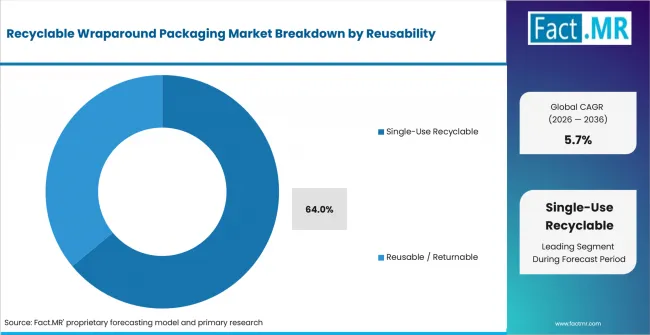
Recyclable Wraparound Packaging Market Analysis By Reusability | Source: Fact.MR
In 2026, single-use recyclable is expected to lead reusability with 64.0% share because open retail routes rarely support returns. Reusable formats fit closed loops while policy increasingly favors design-for-recycling formats before commercial release decisions. Regulation (EU) 2025-40 generally applies from August 2026 and introduces recyclability grades from 2030 onward. The rules support fiber-based packaging programs without adding return logistics across open retail distribution systems.
What supports Beverages within Application?
Beverages are anticipated to hold 33.0% share in 2026
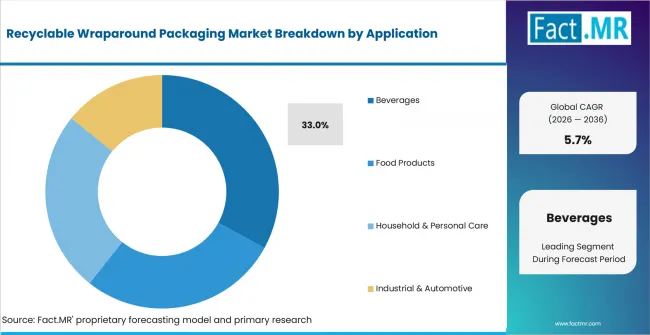
Recyclable Wraparound Packaging Market Analysis By Application | Source: Fact.MR
By application, beverages are forecast to represent 33.0% in 2026 driven by repeatable can and bottle loads. Beverage lines use ready-to-drink packaging while household applications value printed multipacks across regional retail distribution channels. Graphic Packaging introduced two multipack formats in September 2025 and reported one design using 25% less board. The development linked material reduction with practical packaging automation on existing high-speed beverage lines worldwide.
What leads the End Use segment?
Food & beverage is expected at 62.0% share in 2026
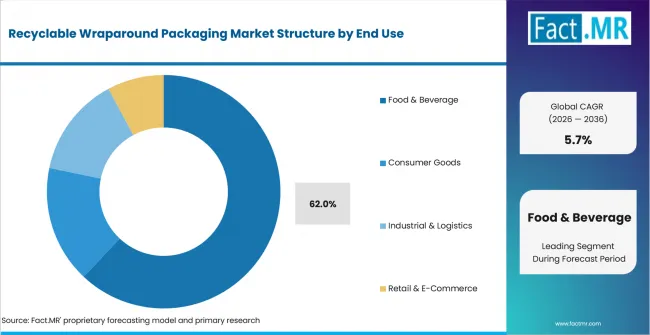
Recyclable Wraparound Packaging Market Analysis By End Use | Source: Fact.MR
Food & beverage is projected to hold 62.0% share in 2026 owing to frequent shipments and broad multipack portfolios. Consumer goods need graphics while retail-ready packaging requires clean opening and dependable stacking after transport. Stora Enso started its Oulu consumer-board line in March 2025 with annual capacity of 750,000 tonnes. Added capacity supports consistent board supply across repeated food and beverage multipack redesign programs worldwide.
What leads the Sales Channel segment?
Direct - brand OEM is estimated at 51.0% share in 2026 shaped by customized trials.
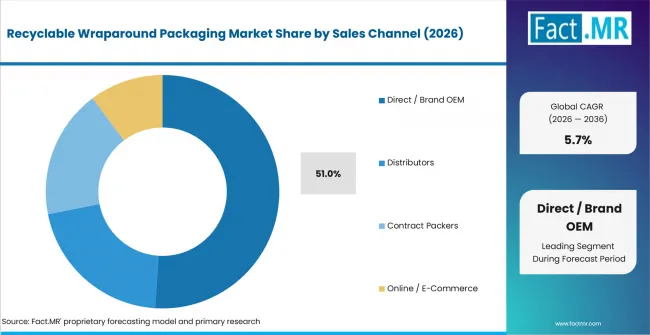
Recyclable Wraparound Packaging Market Analysis By Sales Channel | Source: Fact.MR
The sales channel is forecast to be led by direct - brand OEM at 51.0% in 2026 due to qualification responsibility. Distributors support regional orders while contract packers combine filling with packaging services for brand programs. Smurfit Westrock renamed Victory Packaging in January 2025 and combined design with automation and logistics support. Integrated service strengthens recyclable packaging strategies across qualified plants and repeated customer qualification programs worldwide.
What is accelerating Recyclable Wraparound Packaging Market adoption, and what is holding it back?
Plastic-reduction programs drive adoption while line-qualification risk restrains commercial conversion.
Drivers Impact Analysis
| DRIVER | (~) % IMPACT ON CAGR | GEOGRAPHIC RELEVANCE | IMPACT TIMELINE |
|---|---|---|---|
| Producer-responsibility rules | +0.7% | Europe and North America | Medium (2-4 years) |
| Film replacement | +0.6% | Europe and Asia Pacific | Medium (2-4 years) |
| Automated-line redesign | +0.4% | North America and Europe | Medium (2-4 years) |
| Fiber lightweighting | +0.3% | Global | Long (>= 4 years) |
| Converter-machine coordination | +0.3% | China, India and Europe | Long (>= 4 years) |
Source: Fact.MR analysis. Updated Aug 1, 2026
- Producer-responsibility rules: Brand teams need recovery documentation before approving fiber structures under funded compliance programs.
- Film replacement programs: Brands change selected bundles after paperboard formats pass moisture and pallet trials.
- Automated-line redesign: Close-fitting blanks reduce material use but require precise dimensions and controlled adhesive application.
- Lightweight fiber engineering: Reduced board area lowers weight while compression trials prevent damage during humid distribution.
Opportunity Impact Analysis
| OPPORTUNITY | (~) % IMPACT ON CAGR | GEOGRAPHIC RELEVANCE | IMPACT TIMELINE |
|---|---|---|---|
| Paperboard wraps | +0.4% | Europe and North America | Medium (2-4 years) |
| Retail-ready cases | +0.3% | Asia Pacific and Latin America | Medium (2-4 years) |
| Paper-wrap retrofits | +0.3% | Europe and Asia Pacific | Short (<= 2 years) |
| Recyclability documentation | +0.2% | Germany, United Kingdom and USA | Medium (2-4 years) |
Source: Fact.MR analysis. Updated Aug 1, 2026
- Lightweight paperboard wraps: Standard multipacks permit tighter geometry after converters prove compression under realistic moisture exposure.
- Corrugated retail-ready cases: Tear features improve shelf replenishment while regional conversion shortens routes for repeat programs.
- Paper-wrap line retrofits: Adapted equipment limits disruption after machinery partners document settings and train operators.
- Recyclability documentation services: Material declarations and calculations create technical work that shortens customer approval cycles.
Restraints Impact Analysis
| RESTRAINT | (~) % IMPACT ON CAGR | GEOGRAPHIC RELEVANCE | IMPACT TIMELINE |
|---|---|---|---|
| Line qualification | -0.5% | Global | Medium (2-4 years) |
| Moisture variability | -0.4% | India, Latin America and Asia Pacific | Medium (2-4 years) |
| Material and tooling cost | -0.3% | Global | Short (<= 2 years) |
| Return-logistics limits | -0.2% | Global | Long (>= 4 years) |
Source: Fact.MR analysis. Updated Aug 1, 2026
- Line qualification risk: Dimensional or adhesive variation reduces packing speed and delays release across several plants.
- Moisture and compression variability: Humid storage weakens board performance and erases savings through added safety margins.
- Material and tooling cost: Precise die-cutting and forming parts increase expense during smaller production runs.
Which countries are scaling Recyclable Wraparound Packaging Market fastest?
India 8.1%, China 7.3%, Brazil 6.1%, Germany 5.4%, United Kingdom 5.3%.
Regional analysis covers North America, Latin America, Europe, Asia Pacific, and the Middle East and Africa.
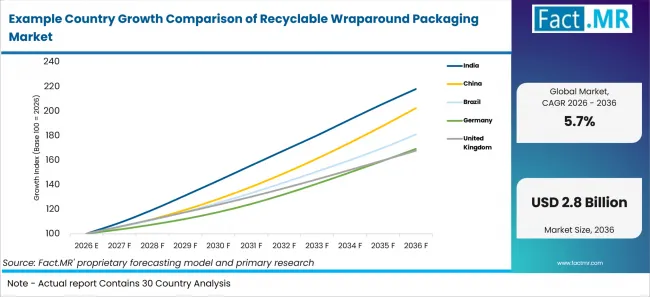
Example Country Growth Comparison Of Recyclable Wraparound Packaging Market | Source: Fact.MR
| COUNTRY | CAGR |
|---|---|
| Brazil | 6.1% |
| Germany | 5.4% |
| United Kingdom | 5.3% |
Source: Fact.MR analysis. Updated Aug 1, 2026
What supports Brazil’s outlook through 2036?
6.1% CAGR, owing to regional food production and packaging recovery programs.
Brazilian producers serve long transport routes that increase the value of regional board supply and dependable compression performance. The market is anticipated to advance at a 6.1% CAGR through 2036, aided by expanding food production and packaging recovery initiatives that support regional conversion activity.
How is Germany developing Recyclable Wraparound Packaging demand?
5.4% CAGR, reinforced by formal recyclability tests and precise technical documentation.
German brand teams require detailed material specifications and verified line performance before approving packaging changes across national product portfolios. Demand is forecast to register a 5.4% CAGR through 2036 because formal recyclability testing supports documented fiber-based packaging decisions. ZSVR revised its minimum standard, increasing the need for precise evidence while coating complexity continues to lengthen technical qualification programs.
What shapes the United Kingdom market outlook?
5.3% CAGR, attributable to producer-responsibility fees and centralized retail specifications.
United Kingdom retailers manage packaging specifications across national product ranges and distribution networks that require consistent material documentation. The market is estimated to expand at a 5.3% CAGR through 2036 as producer-responsibility fees influence packaging design and material selection. PackUK linked fees with reported tonnage and recyclability performance.
Who leads the Recyclable Wraparound Packaging Market?
Graphic Packaging International and Smurfit Westrock lead direct coverage while Mondi and International Paper broaden conversion capabilities.
Competition combines integrated fiber groups with converters operating local design networks across major customer regions. Specialists enter through qualified product families while national programs favor tooling and responsive line support.
Graphic Packaging International and Smurfit Westrock span beverage and corrugated programs across major brand accounts. Mondi combines paper-wrap design with machinery collaboration while International Paper includes DS Smith and Stora Enso adds capacity.
Which companies are the key providers?
Providers include Graphic Packaging International, Smurfit Westrock, Mondi, International Paper, and Stora Enso.
- Providers include Graphic Packaging International
- Smurfit Westrock
- Mondi
- International Paper,
- Stora Enso.
Bibliography
- European Parliament and Council of the European Union. (2025, January 22). Regulation (EU) 2025-40 on packaging and packaging waste. EUR-Lex.
- Government of Goiás. (2024, September 23). Logística reversa: meta para reciclagem de embalagens sobe para 30%. Agência Cora Coralina de Notícias.
- Graphic Packaging International. (2025, September 10). Graphic Packaging debuts duo of beverage multipack innovations at drinktec 2025.
- Graphic Packaging Holding Company. (2026, June 30). Graphic Packaging releases 2025 impact report highlighting 880 million plastic packages replaced with paperboard innovations in 2025.
- International Paper. (2025, January 31). About the IP and DS Smith combination.
- Ministry of Environment, Forest and Climate Change. (2024, July 25). Compulsory ban on polythene bags. Press Information Bureau.
- Mondi. (2024, May 21). Mondi and Meurer wake up coffee wrapping with new paper solution.
- PackUK. (2025, June 30). Extended producer responsibility for packaging: 2025 base fees. GOV.UK.
- Shanghai Municipal People’s Government. (2026, April 28). Shanghai on path to becoming zero-waste city.
- Smurfit Westrock. (2025, January 13). Victory Packaging becomes Smurfit Westrock Packaging Solutions.
- Smurfit Westrock. (2026, July 7). Smurfit Westrock partners with Coca-Cola on World Cup packaging to capture spike in consumer demand.
- Stora Enso. (2025, March 19). Stora Enso’s new consumer board line at the Oulu site in Finland has started operations.
- Zentrale Stelle Verpackungsregister. (2025, August 29). 2025 minimum standard published.
This Report Addresses
- Analysis compares Material and Product Type choices across the Recyclable Wraparound Packaging market.
- Segment positions assess Application demand alongside End Use qualification needs.
- India, China, Brazil, Germany, and United Kingdom outlooks provide the regional comparison base.
- Provider reviews compare conversion capabilities with customer approval requirements in Recyclable Wraparound Packaging.
- Commercial assessment links Sales Channel conditions to buyer purchasing behavior.
- Forecast inputs combine published indicators with interview-based checks for Recyclable Wraparound Packaging.
What does the Recyclable Wraparound Packaging Market cover?
Paperboard and corrugated structures wrapped around grouped products for transport, retail display, or bundled sale.
The market covers converted fiber packs formed around grouped products for transport protection and retail handling.
Commercial value includes converted blanks and design work while primary containers and shipping boxes remain outside scope.
What is included in the scope?
Converted recyclable cases, cartons, trays, and sleeves sold through direct or intermediary commercial purchasing routes.
Coverage includes fiber structures for beverages and food products across commercial packing and distribution systems. Consumer and industrial products remain included when the pack provides grouped transport or retail handling.
What is excluded from the scope?
Primary containers, plastic-only shrink bundles, generic shipping boxes, and unconverted board materials remain outside the defined scope.
The scope excludes primary containers and shipping formats that lack a distinct commercial wraparound function.
How Was the Analysis Built?
The analysis draws on 120+ sources, 35+ company portfolios, 25+ countries, and more than 20 industry interviews.
- Primary Research: Primary research includes discussions with manufacturers, service providers, technology developers, distributors, end users, procurement teams, and subject-matter experts. These conversations examine purchasing priorities, product adoption, operational challenges, approval requirements, competitive positioning, and the factors that influence wider market acceptance.
- Desk Research: Desk research covers government statistics, regulatory publications, company filings, trade data, technical studies, industry associations, standards, public policy, and other authoritative sources. Every source used in the analysis is documented in the bibliography.
- Market Sizing and Forecasting: Market estimates combine historical performance, demand indicators, pricing and volume trends, segment shares, company participation, country-level growth, adoption patterns, investment activity, and barriers to market expansion.
- Data Validation and Update Cycle: Findings are validated by comparing primary interviews with public data, company activity, regulatory changes, trade patterns, and industry developments. Regular updates review new product launches, capacity changes, partnerships, approvals, procurement trends, and shifts in commercial adoption.
Segmentation
What is the report’s scope and coverage?
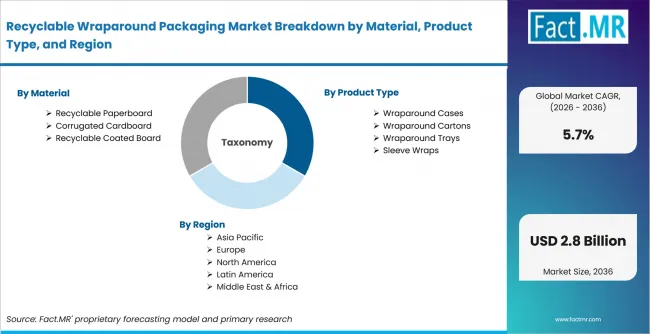
Recyclable Wraparound Packaging Market Breakdown By Material, Product Type, And Region | Source: Fact.MR
| Coverage field | Report scope |
|---|---|
| Quantitative Units | USD Billion |
| Market Definition | Converted recyclable fiber structures wrapped around grouped primary packs for transport or retail handling. |
| Material | Recyclable Paperboard, Corrugated Cardboard, Recyclable Coated Board |
| Product Type | Wraparound Cases, Wraparound Cartons, Wraparound Trays, Sleeve Wraps, Reusability: Single-Use Recyclable, Reusable - Returnable |
| Application | Beverages, Food Products, Household & Personal Care, Industrial & Automotive |
| End Use | Food & Beverage, Consumer Goods, Industrial & Logistics, Retail & E-Commerce |
| Sales Channel | Direct - Brand OEM, Distributors, Contract Packers, Online - E-Commerce |
| Regions Covered | North America, Latin America, Western Europe, Eastern Europe, East Asia, South Asia and Pacific, Middle East and Africa |
| Countries Covered | USA, Canada, Brazil, Mexico, Argentina, Germany, UK, France, Italy, Spain, Poland, Japan, South Korea, India, GCC, South Africa |
| Key Companies Profiled | Graphic Packaging International, Smurfit Westrock, Mondi Group, International Paper, Stora Enso |
| Forecast Period | 2026 to 2036 |
| Approach | Bottom-up modelling using policy evidence, company activity, segment structure, and country conditions. |
Source: Fact.MR analysis. Updated Aug 1, 2026
How is the market segmented?
-
By Material
- Recyclable Paperboard
- Corrugated Cardboard
- Recyclable Coated Board
-
By Product Type
- Wraparound Cases
- Wraparound Cartons
- Wraparound Trays
- Sleeve Wraps
-
By Reusability
- Single-Use Recyclable
- Reusable - Returnable
- By Application
- Beverages
- Food Products
- Household & Personal Care
- Industrial & Automotive
-
By End Use
- Food & Beverage
- Consumer Goods
- Industrial & Logistics
- Retail & E-Commerce
-
By Sales Channel
- Direct - Brand OEM
- Distributors
- Contract Packers
- Online - E-Commerce
-
By Region
- North America
- USA
- Canada
- Latin America
- Brazil
- Mexico
- Argentina
- Western Europe
- Germany
- UK
- France
- Italy
- Spain
- BENELUX
- Nordic
- Eastern Europe
- Poland
- Russia
- Czech Republic
- Romania
- East Asia
- China
- Japan
- South Korea
- South Asia and Pacific
- India
- ASEAN
- Oceania
- Middle East and Africa
- GCC
- South Africa
- North Africa
- Turkey
- North America
Frequently Asked Questions
Which Material leads the Recyclable Wraparound Packaging Market?
Which Product Type leads the Recyclable Wraparound Packaging Market?
Which Reusability format leads the Recyclable Wraparound Packaging Market?
Which Application leads the Recyclable Wraparound Packaging Market?
Which End Use leads the Recyclable Wraparound Packaging Market?
Which Sales Channel leads the Recyclable Wraparound Packaging Market?
Which country has the 8.1% profiled CAGR?
What is the main restraint in the Recyclable Wraparound Packaging Market?
Who worked on this report


Preview the report firsthand - request a free sample
Free SampleGet the brochure for pricing and purchase details
Download PDF