- Base Value(2025): 38.0 Bn
- Estimated Value(2026): 39.9 Bn
- Forecast Value (2036): 64.9 Bn
- CAGR (2026 - 2036): 5.0%
Renewable Heating Fuels Market Forecast and Outlook 2026 to 2036
In 2025, the renewable heating fuels market was valued at USD 38.0 billion. Based on Fact.MR analysis, demand for renewable heating fuels is estimated to grow to USD 39.9 billion in 2026 and USD 64.9 billion by 2036. FACT.MR projects a CAGR of 5.0% during the forecast period.
The absolute dollar growth from 2026 to 2036 represents an incremental gain of USD 25.0 billion. This reflects steady expansion driven by building decarbonization mandates and fossil fuel phase-out policies, yet constrained by feedstock availability bottlenecks and capital intensity of advanced biofuel production infrastructure. Growth remains measured rather than exponential as renewable heating fuels compete against electrification alternatives heat pumps, electric resistance heating-where lifecycle cost advantages vary significantly by regional electricity carbon intensity and natural gas price differentials.
As Matti Lievonen, President and Chief Executive Officer of Neste Corporation, stated in the Q3 2024 earnings call, 'The heating market represents our fastest-growing renewable fuels segment, with HVO demand from European commercial heating customers increasing 180% year-over-year as building owners monetize carbon credit values exceeding EUR 15 per gigajoule through renewable fuel obligation compliance' [1].
Country-level growth shows clear policy divergence in renewable heating adoption. China leads at 6.2% CAGR due to coal-to-biomass conversion mandates and clean heating programs, followed by Brazil at 5.8% CAGR supported by biogas integration and tax incentives. Europe grows at 4.8% CAGR under RED III sustainability rules and fossil heating bans. The United States and United Kingdom each post 4.7% CAGR driven by building decarbonization policies, while Germany records 4.6% CAGR amid heat pump competition but steady industrial demand. South Korea reaches 4.2% CAGR through district heating expansion, and Japan trails at 3.5% CAGR due to import reliance and strict sustainability standards.
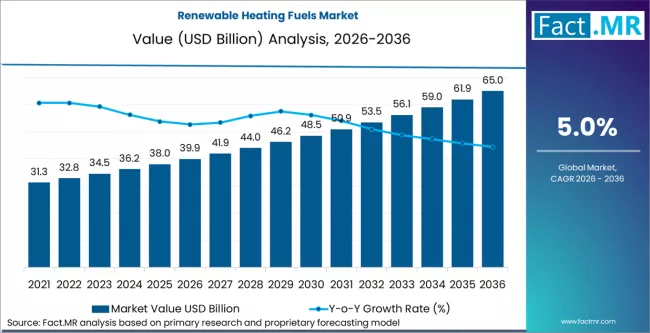
Renewable Heating Fuels Market Market Value Analysis | Source: Fact.MR
Market Definition
Renewable heating fuels encompass solid, liquid, and gaseous energy carriers derived from biomass, waste, or renewable electricity that substitute fossil fuels in space heating, water heating, and industrial process heat applications. These fuels include wood pellets and chips for biomass boilers, hydrotreated vegetable oil (HVO) and bio-heating oil for oil-fired furnaces, biogas and renewable natural gas for gas heating systems, and green hydrogen for fuel cells and hydrogen-ready boilers. The market serves residential buildings, commercial facilities, manufacturing plants, and district heating networks seeking to reduce greenhouse gas emissions and comply with building decarbonization mandates while maintaining compatibility with existing heating infrastructure or achieving drop-in fuel substitution without equipment replacement.
Market Inclusions
The report covers global and regional renewable heating fuels market sizes from 2026 to 2036, with detailed segment breakdowns by fuel type (biomass pellets, biogas and renewable methane, hydrotreated vegetable oil and bio-heating oil, hydrogen and power-to-X electro-fuels), end-use application (residential heating, commercial building heating, industrial process heat, district heating networks), production pathway (thermochemical conversion including pyrolysis and torrefaction, biochemical processes including anaerobic digestion and fermentation, fossil fuel co-processing in refineries, electro-fuel synthesis via power-to-gas and power-to-liquid), and geography. Analysis includes landed cost structures, carbon intensity certification systems, and feedstock availability constraints.
Market Exclusions
The scope excludes renewable electricity generation for direct electric heating including heat pumps, electric resistance heaters, and induction systems, as these compete with but do not constitute renewable heating fuels. It also omits heating equipment and boiler hardware, focusing strictly on the fuel commodities consumed. Traditional firewood and charcoal used in non-commercial residential heating without sustainability certification are excluded. Solar thermal systems and geothermal heat extraction are outside scope, as these are heat sources rather than combustible or oxidizable fuel molecules. The report does not cover carbon offset credits or renewable energy certificates traded separately from physical fuel delivery.
Research Methodology
- Primary Research: Primary research involved structured interviews with biomass pellet producers, HVO refiners, biogas plant operators, district heating utility managers, and commercial building energy procurement officers across North America, Europe, and Asia-Pacific.
- Desk Research: Desk research synthesized data from national renewable energy statistics, biomass trade flow databases, carbon intensity certification registries including ISCC and RSB, and government building decarbonization policy documents.
- Market-Sizing and Forecasting: Market sizing employed a hybrid approach, triangulating renewable heating fuel production capacity data with end-use consumption statistics from building heating surveys and industrial energy audits, calibrated to disclosed revenues from major suppliers.
Data Validation and Update Cycle
Outputs were cross-validated against sustainability certification issuance volumes from ISCC and RSB systems, and reconciled quarterly with renewable fuel obligation compliance reports from European and North American regulatory authorities.
Key Takeaways
Market Definition
- Renewable heating fuels comprise biomass-derived and electro-synthesized energy carriers substituting fossil fuels in residential, commercial, industrial, and district heating applications globally.
Demand Drivers
- Building decarbonization mandates in Europe and emerging markets requiring fossil heating phase-outs by 2030-2040 create compliance-driven baseline demand for drop-in renewable fuel alternatives compatible with existing heating infrastructure.
- Carbon pricing mechanisms and renewable fuel obligation credits monetize greenhouse gas intensity reductions, enabling renewable heating fuels priced at 20-40% premiums over fossil equivalents to achieve lifecycle cost parity through regulatory credit values.
- Industrial process heat applications in food processing, chemicals, and pulp and paper sectors require high-temperature thermal energy incompatible with electrification, sustaining demand for renewable biogas and HVO as natural gas and heating oil substitutes.
Key Segments Analyzed
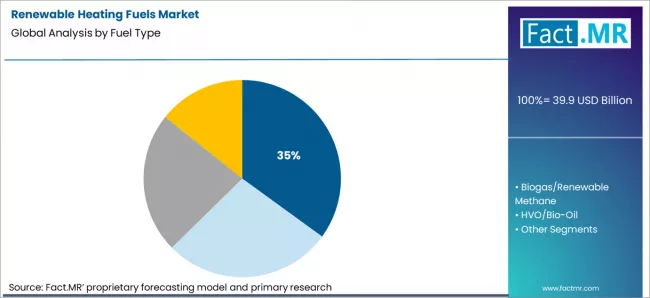
- By Fuel Type, Biomass Pellets command 35% share, reflecting established supply chains, standardized product specifications under ENplus certification, and broad compatibility with residential and district heating boiler infrastructure across European and North American markets.
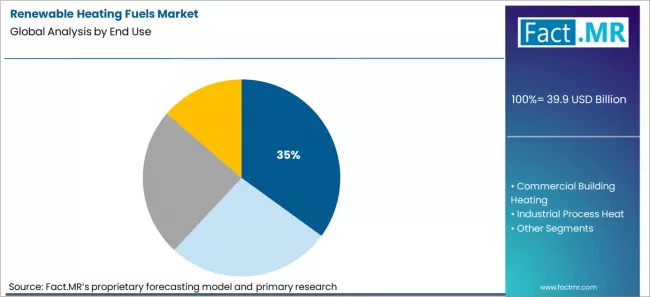
- By End Use, Residential and Industrial applications each hold significant shares at 35% and 30% respectively, representing distinct value propositions where residential prioritizes convenience and air quality while industrial emphasizes process integration and carbon credit monetization.
- By Region, Europe leads with 33% share, driven by EU Renewable Energy Directive mandates, national fossil heating bans, and mature biomass pellet distribution networks serving both residential and district heating sectors.
Analyst Opinion at FACT.MR
- Shambhu Nath Jha, Principal Consultant at Fact.MR, opines, 'CXOs will find this report valuable for understanding which fuel types biomass pellets versus HVO versus hydrogen-are capturing investment capital based on regional policy frameworks, and how production pathway economics determine which renewable heating fuels can scale beyond niche applications into mainstream fossil fuel displacement.'
Strategic Implications / Executive Takeaways
- Renewable fuel producers should prioritize sustainability certification under ISCC CORSIA or RSB systems to access premium markets in aviation and maritime biofuels that generate higher margins than heating fuel commodity sales, using heating applications as base-load demand stabilizers.
- Building owners and facility managers must evaluate total cost of ownership comparing renewable fuel retrofits versus heat pump electrification, as optimal pathways diverge based on existing heating system age, building thermal envelope quality, and regional electricity carbon intensity.
- Industrial energy buyers should secure long-term renewable biogas and HVO supply contracts with price floors and ceilings indexed to fossil fuel equivalents plus carbon credit values, as feedstock availability constraints create supply-demand imbalances favoring suppliers in spot markets.
Methodology
- Market sizing triangulated renewable heating fuel production capacity from national energy statistics with consumption data from building heating surveys and industrial energy audits, calibrated to disclosed revenues from Neste, Enviva, and Drax.
- Feedstock availability constraints and sustainability certification bottlenecks validated through ISCC and RSB certification issuance volumes, cross-referenced with forest residue and agricultural waste generation statistics.
- Regional policy impact assessments based on renewable fuel obligation compliance reports from UK Department for Transport, German Federal Environment Agency, and California Low Carbon Fuel Standard quarterly filings.
Segmental Analysis
Renewable Heating Fuels Market Analysis by Fuel Type
Renewable Heating Fuels Market Analysis By Fuel Type | Source: Fact.MR
Based on FACT.MR's renewable heating fuels market report, Biomass Pellets are estimated to hold 35% share in 2025. Pellets dominate due to established production, ENplus and PFI certification, and compatibility with existing solid fuel systems, avoiding capital-intensive heating replacements.
- Enviva capacity expansion: USD 250 million investment adding 1.0 million tons’ capacity with torrefied pellets reducing shipping costs by 22% [5].
- ENplus certification growth: Certified capacity reached 22 million tons with 94% A1-grade adoption ensuring standardized quality [6].
- Baltic-Black Sea logistics: Riga handled 2.8 million tons’ exports, with Baltic producers delivering EUR 15-20 per ton cost advantage [7].
Renewable Heating Fuels Market Analysis by End Use
Renewable Heating Fuels Market Analysis By End Use | Source: Fact.MR
Based on FACT.MR's renewable heating fuels market report, Residential applications are estimated to hold 35% share in 2025. Approximately 180-200 million fossil heating systems across Europe and North America create large replacement potential, with households accepting 15-25% fuel premiums over USD 8,000-15,000 heat pump installations.
- German BEG subsidy: EUR 890 million supported 87,000 biomass installations with 35% cost coverage up to EUR 10,500 [8].
- Neste renewable diesel heating: USD 0.40-0.60 per gallon premium product targets 5.5 million U.S. oil-heated homes [9].
- UK Renewable Heat Incentive: Supported 36,000 installations with GBP 0.088 per kWh payments; closures reduced installations by 62% post-2022 [10].
Renewable Heating Fuels Market Drivers, Restraints, And Opportunities
Fact.MR analysis indicates the renewable heating fuels market is primarily policy-driven rather than cost-competitive. Biomass pellets, biogas, and bio-heating oil’s typically cost 20-60% more per gigajoule than fossil alternatives, sustaining the USD 38-40 billion market through mandates, carbon pricing, and subsidies. Without regulatory intervention, renewable fuels would hold under 5% share versus the current 12-15% penetration in regulated regions.
The central constraint is feedstock-limited supply versus accelerating policy demand. European pellet capacity stands at 20 million tons, expandable only to 23-25 million tons by 2030 without imports. Global HVO capacity of 8 million tons faces feedstock bottlenecks of 4-5 million tons from waste oils, driving price premiums of 30-80% over fossil fuels. Low-carbon HVO and biogas command EUR 150-200 per ton premiums, while commodity pellets depend on EUR 30-50 subsidy-supported spreads.
- EU Renewable Energy Directive III: Mandates 42.5% renewable energy by 2030 with 49% renewable heating targets, requiring 40-50 million tons’ additional renewable fuels while tightening sustainability criteria [2].
- China Clean Winter Heating: Targets 18 million household coal conversions, with 40% allocated to biomass, generating 25-30 million tons’ incremental pellet demand [3].
- Hydrogen blending limits: UK caps blending at 20% volumetric (7% energy), restricting heating market penetration below 2% through 2030 [4].
Regional Analysis
Based on regional assessment, renewable heating fuels market is analyzed across North America, Latin America, Europe, Asia Pacific spanning more than 40+ countries. The report offers detailed market attractiveness analysis comparing regulatory frameworks, carbon pricing structures, and sustainable biomass certification requirements across regional heating markets.
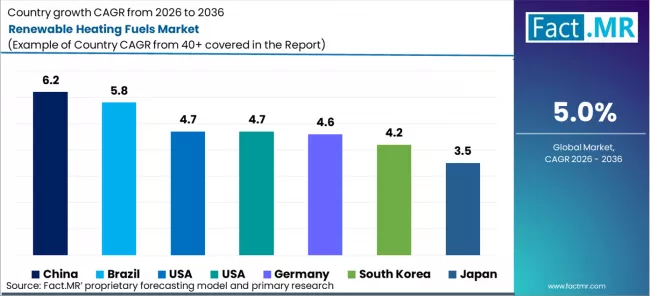
Renewable Heating Fuels Market Cagr Analysis By Country | Source: Fact.MR
| Country | CAGR (2026-2036) |
|---|---|
| China | 6.2% |
| Brazil | 5.8% |
| United States | 4.7% |
| United Kingdom | 4.7% |
| Germany | 4.6% |
| South Korea | 4.2% |
| Japan | 3.5% |
Source: Fact.MR analysis. Updated Feb 18, 2026
Source: Fact.MR (FACT.MR) analysis, based on proprietary forecasting model and primary research
North America Renewable Heating Fuels Market Analysis
North America functions primarily as a feedstock supply basin for global renewable heating fuel markets, with large-scale wood pellet exports from the U.S. Gulf Coast and Canadian Pacific terminals serving European and Asian demand. Domestic heating remains dominated by natural gas and oil, limiting large-scale substitution. Renewable heating adoption is concentrated in niche segments including off-grid properties, district heating campuses, and industrial users monetizing state-level low carbon fuel credits.
- United States: Demand for renewable heating fuels in the United States is projected to rise at 4.7% CAGR through 2036. Growth is supported by state-level fossil heating phase-out mandates, renewable diesel blending in Northeastern oil-heated homes, USDA biomass feedstock programs, and renewable natural gas injection supported by Low Carbon Fuel Standard credits, according to Fact.MR.
FACT.MR's analysis of renewable heating fuels market in North America consists of country-wise assessment including the United States and Canada, covering pellet exports, renewable diesel blending volumes, and renewable gas pipeline injection capacity trends.
Europe Renewable Heating Fuels Market Analysis
Europe operates as the global demand epicenter for renewable heating fuels, driven by Renewable Energy Directive III, fossil heating bans, and building energy performance regulations. Mature district heating networks and aggressive decarbonization mandates sustain structural demand for biomass, biomethane, and HVO. Growth is contingent on certified sustainable biomass supply and evolving carbon accounting standards.
- Germany: Demand for renewable heating fuels in Germany is projected to rise at 4.6% CAGR through 2036. Expansion is supported by EUR 13 billion BEG subsidies, renewable heating installation mandates under the Building Energy Act, and biomethane blending targets requiring continued pellet imports alongside domestic residue utilization.
- United Kingdom: Demand for renewable heating fuels in the United Kingdom is projected to rise at 4.7% CAGR through 2036. Growth is linked to clean heat market quotas, biomass heating grants for off-grid properties, and renewable obligation certificate incentives sustaining commercial-scale biomass and district heating economics.
FACT.MR’s analysis of renewable heating fuels market in Europe includes Germany, United Kingdom, France, Netherlands, Italy, and Nordic markets, detailing RED III compliance pathways, fossil heating phase-out timelines, and district heating biomass capacity additions.
Asia-Pacific Renewable Heating Fuels Market Analysis
Asia-Pacific represents the volume growth frontier, driven by coal-to-clean heating transitions in China and industrial decarbonization mandates in Japan and South Korea. Regional markets remain price-sensitive, favoring agricultural residue pellets and biomethane, while sustainability certification influences export competitiveness. Limited domestic biomass resources in advanced economies necessitate imports from Southeast Asia and North America.
- China: Demand for renewable heating fuels in China is projected to rise at 6.2% CAGR through 2036. Growth is supported by biomass household heating subsidies, crop residue pelletization programs, large-scale biomethane investments, and HVO deployment in commercial heating systems.
- Japan: Demand for renewable heating fuels in Japan is projected to rise at 3.5% CAGR through 2036. Uptake is sustained by biomass CHP incentives, domestic forestry residue mobilization, and pellet import infrastructure expansion, based on Fact.MR analysis.
- South Korea: Demand for renewable heating fuels in South Korea is projected to rise at 4.2% CAGR through 2036. Expansion is linked to biomass district heating conversions, renewable gas blending mandates, and hydrogen heating pilots supported by government subsidies.
FACT.MR's analysis of renewable heating fuels market in Asia-Pacific includes China, Japan, South Korea, India, and Southeast Asian economies, covering biomass import dependency ratios, renewable gas injection infrastructure, and feedstock mobilization economics.
Latin America Renewable Heating Fuels Market Analysis
Latin America operates as a bioenergy-integrated heating market where industrial biomass combustion and biogas upgrading dominate demand. Expansion is closely linked to agricultural residue utilization and carbon credit monetization frameworks.
- Brazil: Demand for renewable heating fuels in Brazil is projected to rise at 5.8% CAGR through 2036. Growth is supported by RenovaBio heating credit extension, biomethane expansion from sugarcane distilleries, and industrial biomass substitution for fuel oil under carbon border adjustment pressures.
FACT.MR’s analysis of renewable heating fuels market in Latin America centers on Brazil, detailing biomass residue availability, industrial heating decarbonization strategies, and carbon credit-linked fuel substitution economics.
Competitive Aligners for Market Players
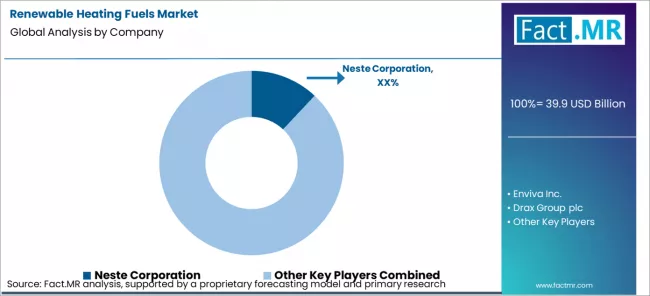
Renewable Heating Fuels Market Analysis By Company | Source: Fact.MR
The renewable heating fuels market is regionally fragmented but concentrated within specific fuel categories. Wood pellet exports are led by Enviva, Drax Biomass, and Pinnacle Renewable Energy, contribute maximum share of global trade, while domestic markets rely on regional producers. HVO supply is more concentrated, with Neste renewable diesel capacity applicable to heating, followed by Total Energies and Shell. Biogas and biomethane remain fragmented across thousands of digesters, though industrial aggregators consolidate volumes for grid injection. Feedstock access remains the primary competitive lever, as margins range from EUR 5-15 per gigajoule in commodity segments to EUR 25-40 for low-carbon fuels earning regulatory credits.
Vertically integrated players benefit from control over sourcing, conversion, and logistics. Companies combining pellet production, shipping, refining technology, or district heating integration secure cost advantages and demand stability. Large district heating utilities negotiate long-term contracts with carbon intensity guarantees, while residential buyers accept premiums below 25%, enabling retail margin flexibility alongside industrial volume competition.
Buyer behavior reflects asymmetric market power between large district heating utilities and fragmented residential consumers. Copenhagen Energy, Vattenfall, and E. ON negotiate multi-year framework contracts for millions of tons of wood pellets and HVO, leveraging scale to demand feedstock transparency, carbon intensity guarantees, and price caps indexed to fossil fuel equivalents plus fixed premiums.
Recent Development
- In 2025, Enviva Inc. announced a USD 300 million expansion project at its U.S. Southeastern wood pellet facilities, adding 1.2 million tons of annual capacity aimed at supplying European and Asian renewable heating demand.
- In 2025, Neste entered a strategic supply and distribution partnership with global energy trader Vitol, agreeing to jointly market Neste MY Renewable Diesel and renewable heating oil blends across North America and Northern Europe.
Key Players
- Neste Corporation
- Enviva Inc.
- Drax Group plc
- TotalEnergies SE
- Shell plc
- Fortum Oyj
- Ørsted A/S
- Enel S.p.A.
- Engie SA
- Verbio Vereinigte BioEnergie AG
This Report Addresses
- Market intelligence for strategic planning: comprehensive analysis of renewable heating fuel production economics, feedstock availability constraints, and policy-driven demand trajectories across building decarbonization and industrial heat applications.
- Market size and forecast: global renewable heating fuels market valued at USD 39.9 billion in 2026, projected to reach USD 64.9 billion by 2036 at 5.0% CAGR, with segment-level sizing by fuel type, end use, and production pathway.
- Growth opportunity mapping: identification of high-value subsegments including HVO for premium heating oil displacement, renewable natural gas for existing gas grid injection, and green hydrogen for industrial process heat where electrification remains technically constrained.
- Segment and regional forecasts: country-level CAGR analysis for China, Brazil, United States, Germany, United Kingdom, and 12+ additional markets, with fuel type and end-use breakdowns revealing policy-driven versus economics-driven adoption patterns.
- Competition strategy assessment: competitive positioning analysis of Neste, Enviva, Drax, Total Energies, and integrated energy majors, including vertical integration advantages, feedstock procurement strategies, and sustainability certification compliance capabilities.
- Product and compliance tracking: regulatory impact analysis of EU Renewable Energy Directive III sustainability criteria, national fossil heating phase-out timelines, and renewable fuel obligation credit mechanisms determining market access and pricing dynamics.
- Feedstock supply chain analysis: assessment of sustainable biomass availability, used cooking oil and animal fat collection infrastructure, and renewable electricity curtailment patterns for power-to-X electro-fuel production economics.
- Report delivery formats: Excel data tables with segment-level forecasts and carbon intensity benchmarking, PowerPoint executive summary with policy roadmap visualizations, and PDF comprehensive report with verifiable source citations.
Bibliography
- [1] Neste Corporation. (2024, October). Q3 2024 Earnings Call Transcript.
- [2] European Parliament. (2023, October). Directive (EU) 2023/2413 - Renewable Energy Directive III. Official Journal of the European Union.
- [3] People's Republic of China Ministry of Ecology and Environment. (2024, February). Clean Winter Heating Plan 2024-2026 Implementation Guidelines.
- [4] UK Health and Safety Executive. (2024, June). Hydrogen Blending in Gas Distribution Networks - Safety Assessment. HSE Research Report.
- [5] Enviva Inc. (2024, September). Epes Facility Expansion and Torrefaction Technology Deployment. Press Release.
- [6] ENplus. (2024, July). ENplus Certification Program Annual Statistics 2024.
- [7] Freeport of Riga Authority. (2024, May). Cargo Statistics Report - Wood Pellets Export Volumes.
- [8] Federal Ministry for Economic Affairs and Climate Action (Germany). (2024, March). Federal Funding for Efficient Buildings (BEG) Annual Report 2024.
- [9] Neste Corporation. (2024, March). Neste MY Renewable Diesel Residential Heating Market Launch. Press Release.
- [10] UK Department for Energy Security and Net Zero. (2024, August). Renewable Heat Incentive Final Statistics.
Segmentation
Scope of the Report
| Metric | Value |
|---|---|
| Quantitative Units | USD 39.9 billion (2026) to USD 64.9 billion (2036), at a CAGR of 5.0% |
| Market Definition | Renewable heating fuels comprise biomass-derived and electro-synthesized energy carriers substituting fossil fuels in residential, commercial, industrial, and district heating applications globally. |
| Fuel Type | Biomass Pellets, Biogas/Renewable Methane, HVO/Bio-Oil, Hydrogen/PtX |
| End Use | Residential, Commercial, Industrial, District Heating |
| Production Pathway | Thermochemical, Biochemical, Co-Processing, Electro-fuels |
| Regions Covered | Asia Pacific, Europe, North America, Latin America, Middle East & Africa |
| Countries Covered | India, China, Japan, South Korea, Indonesia, Australia & New Zealand, ASEAN, Rest of Asia Pacific, Germany, Italy, France, United Kingdom, Spain, Benelux, Nordics, Central & Eastern Europe, Rest of Europe, United States, Canada, Mexico, Brazil, Argentina, Chile, Rest of Latin America, Kingdom of Saudi Arabia, United Arab Emirates, South Africa, Turkey, Rest of Middle East & Africa |
| Key Companies Profiled | Neste, Enviva, Drax, TotalEnergies, Shell, Fortum, Ørsted, Enel, Engie Verbio |
| Forecast Period | 2026 to 2036 |
| Approach | Top-down and bottom-up market modeling validated through primary interviews with biomass pellet producers, HVO refiners, biomethane suppliers, district heating operators, industrial fuel buyers, and residential distributors, supported by RED III and national renewable heat mandates, carbon pricing benchmarks, feedstock availability assessments, trade flow analysis, and government subsidy allocation data. |
Source: Fact.MR analysis. Updated Feb 18, 2026
Renewable Heating Fuels Market by Segments
-
By Fuel Type :
- Biomass Pellets
- Biogas/Renewable Methane
- HVO/Bio-Oil
- Hydrogen/PtX
-
By End Use :
- Residential Heating
- Commercial Building Heating
- Industrial Process Heat
- District Heating Networks
-
By Production Pathway :
- Thermochemical (Pyrolysis, Torrefaction, Gasification)
- Biochemical (Anaerobic Digestion, Fermentation)
- Co-Processing (Fossil Refinery Integration)
- Electro-fuels (Power-to-Gas, Power-to-Liquid)
-
Region :
- Asia Pacific
- India
- China
- Japan
- South Korea
- Indonesia
- Australia & New Zealand
- ASEAN
- Rest of Asia Pacific
- Europe
- Germany
- Italy
- France
- United Kingdom
- Spain
- Benelux
- Nordics
- Central & Eastern Europe
- Rest of Europe
- North America
- United States
- Canada
- Mexico
- Latin America
- Brazil
- Argentina
- Chile
- Rest of Latin America
- Middle East & Africa
- Kingdom of Saudi Arabia
- United Arab Emirates
- South Africa
- Turkey
- Rest of Middle East & Africa
- Asia Pacific
Frequently Asked Questions
How large is the renewable heating fuels market in 2025?
What will the market size be in 2036?
What is the expected CAGR for the forecast period?
Which fuel type segment is poised to lead?
How significant is the HVO/Bio-Oil segment?
What is the market value estimated for 2026?
Which end-use segment dominates demand?
What is driving growth in the Asia-Pacific region?
How do thermochemical production pathways contribute?
How significant is the biogas/renewable methane segment?
How does hydrogen/PtX compare in market share?
What is the industrial process heat end-use share?
Which region leads in renewable heating fuels adoption?
Who worked on this report


Preview the report firsthand - request a free sample
Free SampleGet the brochure for pricing and purchase details
Download PDF