- Base Value(2025): 36 Mn
- Estimated Value(2026): 42 Mn
- Forecast Value (2036): 185 Mn
- CAGR (2026 - 2036): 16.0%
Renewable Muconic Acid Market Forecast and Outlook 2026 to 2036
In 2025, the renewable muconic acid market was valued at USD 36 million. Based on Fact.MR analysis, demand for renewable muconic acid is estimated to reach USD 42 million in 2026 and USD 185 million by 2036. Fact.MR projects a CAGR of 16.0% during the forecast period. Market growth reflects increasing interest in bio-based routes to adipic acid, terephthalic acid, and caprolactam, where muconic acid serves as a platform intermediate with potential to displace petrochemical pathways.
The market adds approximately USD 149 million in value over the forecast window, indicating scale-up driven expansion rather than incremental substitution. Early-period growth is supported by fermentation-based production, which accounts for the majority of capacity as developers prioritize biological routes compatible with sugar and lignocellulosic feedstocks. Mid-period growth aligns with expanded pilot-to-commercial transitions for adipic acid precursors. In the later years, value realization is increasingly tied to long-term offtake agreements and integration into polymer value chains as conversion yields and cost structures stabilize.
The United States leads growth at 15.8% CAGR, supported by bio-manufacturing investments and polymer intermediate development. Germany follows at 14.2%, driven by chemical industry interest in renewable nylon and polyester intermediates. China records 12.5%, reflecting downstream polymer demand and process scale-up activity, while Japan posts 11.2%, supported by specialty chemical applications and technology-led adoption.
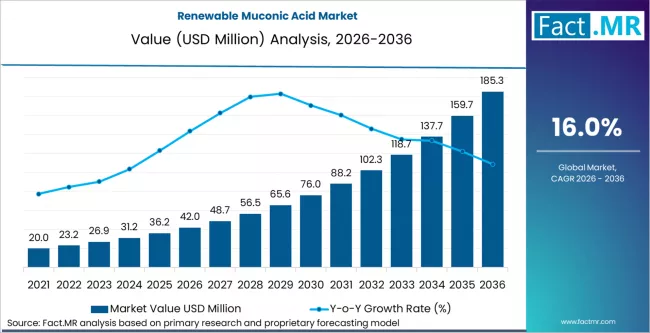
Renewable Muconic Acid Market Market Value Analysis | Source: Fact.MR
Renewable Muconic Acid Market Definition
The renewable muconic acid market covers the production and sale of muconic acid manufactured from renewable biological feedstocks rather than petroleum derived sources. Renewable muconic acid is used as a chemical intermediate for producing adipic acid, terephthalic acid substitutes, and performance polymers. It is typically produced through microbial fermentation or bio catalytic conversion of sugars and biomass derived aromatics. Chemical substance safety, industrial handling, and environmental compliance for muconic acid and related intermediates are governed under chemical regulatory frameworks administered by the US Environmental Protection Agency and industrial bio manufacturing programs overseen by the US Department of Energy.[1]
Renewable Muconic Acid Market Inclusions
The report covers global and regional market size estimates in volume and value terms with a forecast period from 2026 to 2036. Segmentation includes production route such as fermentation based and bio catalytic pathways, application across polymer intermediates and specialty chemicals, and end use industries including chemicals, plastics, and materials manufacturing. The scope also includes regional demand patterns, pricing benchmarks, and international trade flows for renewable chemical intermediates.
Renewable Muconic Acid Market Exclusions
The scope excludes petrochemical based muconic acid produced entirely from fossil feedstocks. Downstream finished polymers, fibers, resins, and consumer products manufactured using muconic acid are not included. Other renewable diacids and aromatic intermediates are excluded unless traded specifically as muconic acid. Laboratory scale research production, pilot plants without commercial output, processing equipment, and contract manufacturing services are also outside the scope.
Renewable Muconic Acid Market Research Methodology
- Primary Research: Primary research involved interviews with renewable chemical producers, fermentation technology developers, process engineers, and downstream polymer manufacturers.
- Desk Research: Desk research used chemical substance documentation and risk evaluation materials issued by the US Environmental Protection Agency and bio manufacturing and feedstock data published by the US Department of Energy, along with company annual reports and regulatory filings.
- Market Sizing and Forecasting: Market sizing applied a hybrid top down and bottom up model using reported fermentation capacity, biomass conversion yields, and demand indicators from polymer and materials production.
- Data Validation and Update Cycle: Outputs were cross checked against regulatory registrations, trade statistics, company disclosures, and publicly available chemical production data, with updates applied when verified public sources issue revisions.
Summary of renewable muconic acid market
-
Market definition
- The renewable muconic acid market covers muconic acid produced from biological feedstocks through fermentation or bio-catalytic routes and used as an intermediate for adipic acid, terephthalic acid substitutes, and polymer precursors in large-volume chemical value chains.
-
Demand drivers
- Demand is driven by polymer producers evaluating renewable pathways for adipic acid and nylon intermediates, where muconic acid enables drop-in conversion without redesigning downstream polymer assets. Commercial uptake is influenced by chemical compliance and reporting requirements under frameworks which shape qualification, scaling, and producer readiness in regulated markets. Interest in bio-manufacturing platforms supported by industrial bioenergy programs, including,[2] underpins pilot-to-commercial transitions for fermentation-based muconic acid production.
-
Key segments analyzed
- Technical grade renewable muconic acid leads with about 50% share, reflecting suitability for bulk catalytic upgrading into adipic acid without high purification costs. Adipic acid production accounts for roughly 45% of demand, as nylon and engineering polymer supply chains represent the largest downstream outlet. Growth is concentrated in the United States, Germany, China, and Japan, where polymer integration, bio-manufacturing investment, and specialty chemical development pipelines are active.
-
Analyst opinion at Fact.MR
- Shambhu Nath Jha, Principal Consultant at Fact.MR, opines, ‘CXOs will find this report useful for understanding how downstream polymer qualification, conversion economics, and long-term offtake structures are shaping the commercial trajectory of renewable muconic acid.’
-
Strategic implications / executive takeaways
- Producers should prioritize technical grade output aligned with adipic acid conversion pathways to accelerate scale adoption. Securing long-term offtake agreements with polymer manufacturers is critical to de-risk fermentation scale-up investments. Alignment with regulatory reporting and industrial bio-manufacturing programs strengthens commercialization timelines.
-
Methodology
- Market sizing is based on fermentation capacity, biomass conversion yields, and downstream polymer demand indicators. Validation uses regulatory registrations, trade data, and public chemical production disclosures. Forecasts apply reproducible top-down and bottom-up models grounded in verified industrial benchmarks.
Segmental Analysis
Renewable Muconic Acid Market Analysis by Grade
Renewable Muconic Acid Market Analysis By Grade | Source: Fact.MR
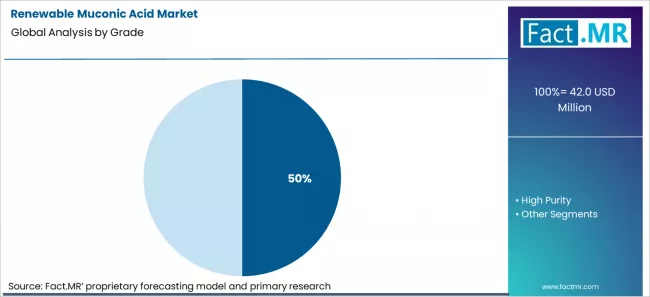
Based on Fact.MR analysis, consumption of technical grade renewable muconic acid is estimated to hold 50% share of the global market. Fact.MR analysts note this grade leads because it supports downstream chemical conversion without requiring purification levels associated with specialty applications. As per Fact.MR, technical grade material addresses manufacturer priorities for process compatibility, cost management, and integration into catalytic upgrading systems used to produce bulk intermediates such as adipic acid and related polymers across industrial production environments worldwide today serving commercial plants and scale-up facilities.
- Bio-based chemical support: Government bioenergy and bioproduct programs promote development of renewable chemical intermediates. [3]
- Process suitability: Fact.MR analysts note technical grade material aligns with bulk catalytic conversion processes.
- Scale economics: Technical grade output enables higher volume manufacturing at reduced purification cost.
Renewable Muconic Acid Market Analysis by Application
Renewable Muconic Acid Market Analysis By Application | Source: Fact.MR
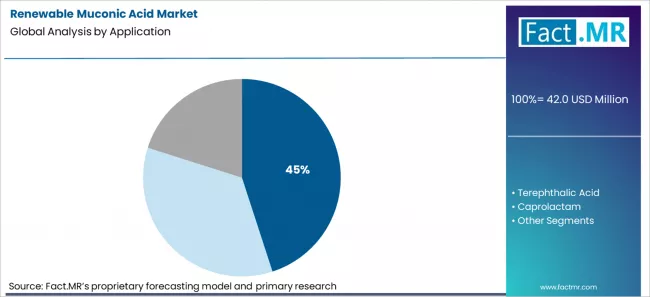
Based on Fact.MR analysis, consumption of renewable muconic acid for adipic acid production is estimated to hold 45% share of the global market. Fact.MR analysts note this application leads because adipic acid is a major precursor for nylon and engineering polymers. As per Fact.MR, muconic acid provides a renewable pathway for adipic acid synthesis, addressing industry objectives related to feedstock diversification and integration with established polymer manufacturing systems across large-scale chemical production networks worldwide today in existing facilities.
- Industrial framework: Chemical manufacturing reporting and environmental oversight apply to adipic acid and related intermediates.[4]
- Downstream demand: Fact.MR analysts note nylon production sustains adipic acid consumption.
- Conversion pathway: Muconic acid can be catalytically upgraded into adipic acid.
Renewable Muconic Acid Market Drivers, Restraints, And Opportunities
Fact.MR analysis indicates that the renewable muconic acid market exists as a bio-derived chemical intermediate segment within polymers, coatings, and nylon precursor value chains, where shifted supply chains seek renewable substitutes for petrochemical feedstocks. As per Fact.MR assessment, muconic acid can be produced via fermentation pathways using lignocellulosic sugars and can serve as a building block for adipic acid and terephthalic acid precursors, but its commercial deployment is influenced by chemical compliance and listing obligations such as the U.S. Environmental Protection Agency (EPA) Toxic Substances Control Act (TSCA) inventory, which governs reporting, manufacture, and import requirements for industrial chemicals in the United States.[5] Fact.MR analysts observe that the current market size reflects early-stage production capacity and selective adoption where downstream polymer producers evaluate renewable feedstocks against cost and performance benchmarks.
Fact.MR is of the opinion that the market is transitioning between legacy petrochemical intermediates and renewable muconic acid where sustainable route economics align with manufacturing requirements. Based on Fact.MR assessment, conventional adipic acid and benzene-derived intermediates continue to dominate volume demand due to established supply networks and cost structures, while renewable muconic acid grows in niches where bio-based certification and supply chain traceability are specified. Renewable muconic acid intermediates generally carry higher per-unit pricing because of fermentation and downstream separation costs, which can support realised market value growth even where shipment volumes increase at a measured pace. Fact.MR analysis suggests that this balance between moderate adoption and premium unit placement defines near-term market behaviour.
- Chemical registration requirements: Fact.MR analysts note that inclusion in frameworks such as the U.S. EPA TSCA inventory influences how renewable muconic acid is listed, reported, and managed in regulated markets, shaping producer planning and regulatory compliance strategy.
- Bio-based polymer precursor trends: Based on Fact.MR assessment, interest in renewable intermediates such as muconic acid increases where sustainability procurement criteria and corporate environment goals encourage substitution of petrochemical feedstocks.
- EU regulatory landscape influence: Fact.MR opines that compliance with chemical control frameworks such as the European Union REACH regulation affects registration, data requirements, and importer responsibilities for renewable muconic acid in European markets.
Regional Analysis
Based on regional assessment, the renewable muconic acid sector is analyzed across North America, Europe, East Asia, and other major bio-based chemical markets, spanning more than 40 countries. Regional performance varies according to investment in renewable chemical pathways, availability of biomass feedstocks, and demand from downstream polymers, resins, and specialty chemical applications. The analysis also presents a comparative market attractiveness evaluation grounded in region-specific demand trends.
Renewable Muconic Acid Market CAGR Analysis by Country (2026-2036)
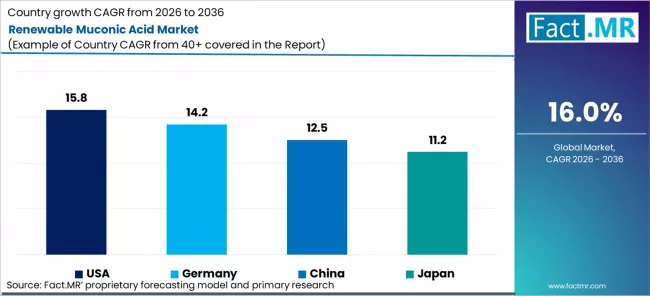
Renewable Muconic Acid Market Cagr Analysis By Country | Source: Fact.MR
| Country | CAGR |
|---|---|
| United States | 15.8% |
| Germany | 14.2% |
| China | 12.5% |
| Japan | 11.2% |
Source: Fact.MR analysis. Updated Feb 23, 2026
Source: Fact.MR analysis, based on proprietary forecasting models and primary research.
Asia Pacific Renewable Muconic Acid Market Analysis
Asia Pacific operates as a scale up oriented bio based chemicals region for renewable muconic acid supported by fermentation research downstream polymer interest and pilot investments. Activity focuses on microbial pathways purification and integration toward adipic acid and nylon intermediates. Adoption concentrates in China and Japan where producers connect bioprocess development with existing chemical assets. Growth reflects demonstration plants feedstock sourcing partnerships and customer qualification for polymers resins and performance materials across established industrial clusters in the region today widely.
- China: Demand for renewable muconic acid in China is projected to rise at 12.5% CAGR through 2036. Activity is linked to pilot scale fermentation programs and downstream interest from polymer and chemical intermediate producers, as per Fact.MR.
- Japan: Demand for renewable muconic acid in Japan is projected to rise at 11.2% CAGR through 2036. Usage reflects research driven production and integration with specialty chemical and polymer development pathways, according to Fact.MR.
Fact.MR’s analysis of the Renewable Muconic Acid Market in Asia Pacific consists of country-wise assessment that includes China and Japan. Readers can find pilot scaling trends and downstream polymer application references.
North America Renewable Muconic Acid Market Analysis
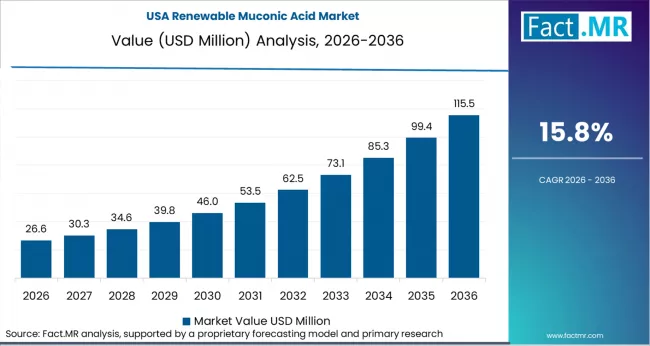
Renewable Muconic Acid Market Country Value Analysis | Source: Fact.MR
North America functions as a commercialization focused renewable muconic acid region driven by industrial biotechnology ecosystems and polymer market pull. Activity centers on process scale up licensing and conversion toward adipic acid precursors. Adoption concentrates in the United States where producers align pilots with specialty polymers and fibers. Growth reflects venture funding offtake discussions regulatory readiness and integration with existing chemical infrastructure across Gulf Coast and Midwest manufacturing networks supporting early commercial demand nationally today for emerging applications widely now.
- United States: Demand for renewable muconic acid in the United States is projected to rise at 15.8% CAGR through 2036. Activity reflects fermentation scale up and early commercial integration with polymer and specialty chemical value chains, as per Fact.MR.
Fact.MR’s analysis of the Renewable Muconic Acid Market in North America consists of country-wise assessment that includes the United States. Readers can find commercialization pathways and polymer demand insights.
Europe Renewable Muconic Acid Market Analysis
Europe operates as a regulation aligned innovation driven renewable muconic acid region shaped by bioeconomy programs and polymer decarbonization goals. Activity emphasizes demonstration facilities customer qualification and conversion toward nylon intermediates. Adoption centers in Germany where producers integrate bioprocess routes within specialty chemical assets. Growth reflects public private funding technical validation and supply agreements supporting gradual scale up across Western European chemical clusters and export oriented value chains for specialty polymers and materials in regional markets today widely now overall.
- Germany: Demand for renewable muconic acid in Germany is projected to rise at 14.2% CAGR through 2036. Usage reflects demonstration scale production and integration within specialty polymer and chemical intermediate development programs, according to Fact.MR.
Fact.MR’s analysis of the Renewable Muconic Acid Market in Europe consists of country-wise assessment that includes Germany. Readers can find bioeconomy alignment trends and demonstration project references.
Competitive Landscape of Renewable Muconic Acid Market
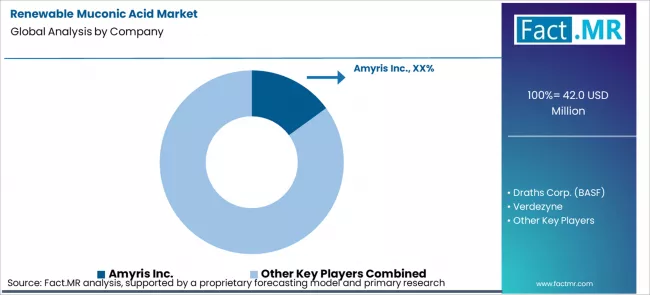
Renewable Muconic Acid Market Analysis By Company | Source: Fact.MR
As per Fact.MR analysis, the 2026 renewable muconic acid market is defined by validated production efficiency, feedstock flexibility, and regulatory compliance, which determine competitive advantage. Amyris Inc. and Draths Corp. (BASF) lead with engineered microbial fermentation and optimized bioconversion pathways, which strengthens adoption in bioplastics, coatings, and polymer intermediates. Verdezyne focuses on high-yield fermentation with documented purity and scalability, which improves consistency and reduces production costs for downstream applications. Covestro AG and Braskem S.A. emphasize multi-feedstock flexibility and validated process performance, which supports global adoption and regulatory compliance. Other smaller players provide specialty muconic acid products with verified chemical and material properties, which address niche industrial applications. Across the market, validated production performance, scalable feedstock utilization, and adherence to multi-region regulatory standards form enduring competitive moats, reducing reliance on price competition or isolated technological advantages while supporting long-term industrial adoption.
Recent Industry Developments
- Scaling of Lignocellulosic Feedstocks (Jan 2026): A major shift occurred as production moved beyond first-generation sugars (glucose) to lignin-derived aromatics. Research published in early 2026 confirmed that engineered E. coli and Pseudomonas putida strains have reached titers of 47-50 g/L using corn stover and wheat bran. This transition is vital for achieving cost parity with petroleum-based adipic acid, which is now projected to drop as low as $2.60/kg via the muconic pathway. [6]
- Breakthrough in "In-Situ" Product Recovery (ISPR): One of the historical hurdles for muconic acid has been "product inhibition" (where the acid kills the microbes producing it). New 2025-2026 commercial processes have successfully implemented continuous extraction using biocompatible organic phases (like canola oil mixtures). This has improved peak productivity by over 180%, making 150-liter scale bioreactors a standard for specialty chemical startups. [7]
Key Players in Renewable Muconic Acid Market
- Amyris Inc.
- Draths Corp. (BASF)
- Verdezyne
- Covestro AG
- Braskem S.A.
- Others
Bibliography
- [1] U.S. Environmental Protection Agency. (2024). Chemical research and chemical substance safety programs. U.S. Environmental Protection Agency; U.S. Department of Energy. (2024). Bioenergy Technologies Office: Industrial bio-manufacturing and renewable chemical pathways. Office of Energy Efficiency and Renewable Energy, U.S. Department of Energy.
- [2] U.S. Department of Energy. (2024). Bioenergy Technologies Office: Bio-based chemicals and bioproducts. Office of Energy Efficiency and Renewable Energy, U.S. Department of Energy.
- [3] U.S. Department of Energy. (2024). Bioenergy Technologies Office overview. Office of Energy Efficiency and Renewable Energy, U.S. Department of Energy.
- [4] U.S. Environmental Protection Agency. (2024). Chemical Data Reporting (CDR) under the Toxic Substances Control Act. U.S. Environmental Protection Agency.
- [5] U.S. Environmental Protection Agency. (2024). Toxic Substances Control Act (TSCA) inventory. U.S. Environmental Protection Agency.
- [6] National Renewable Energy Laboratory. (2026). Advances in lignocellulosic fermentation pathways for muconic acid production. National Renewable Energy Laboratory; Royal Society of Chemistry. (2026). Renewable muconic acid from lignin-derived aromatics. Green Chemistry.
- [7] Elsevier. (2025). In-situ product recovery strategies for organic acid fermentation. Biochemical Engineering Journal.
Segmentation
Scope of the Report
| Metric | Value |
|---|---|
| Quantitative Units | USD 42 million (2026) to USD 185 million (2036), CAGR 16.0% |
| Market Definition | The renewable muconic acid market covers muconic acid manufactured from renewable feedstocks instead of petroleum-derived sources. It functions as a bio-based intermediate for producing adipic acid, terephthalic acid, caprolactam, and other polymers. Production is primarily via microbial fermentation or bio-catalytic conversion of sugars and lignocellulosic aromatics. Regulatory oversight follows US EPA and DOE bio-manufacturing frameworks. |
| Grade Segmentation | Technical Grade, High Purity, Others |
| Application Segmentation | Adipic Acid Production, Terephthalic Acid, Caprolactam, Others |
| Production Method Segmentation | Fermentation-Based, Catalytic Conversion |
| Regions Covered | Asia Pacific, Europe, North America, Latin America, Middle East & Africa |
| Countries Covered | India, China, Japan, South Korea, Indonesia, Australia & New Zealand, ASEAN, Rest of Asia Pacific, Germany, Italy, France, United Kingdom, Spain, Benelux, Nordics, Central & Eastern Europe, Rest of Europe, United States, Canada, Mexico, Brazil, Argentina, Chile, Rest of Latin America, Kingdom of Saudi Arabia, United Arab Emirates, South Africa, Turkey, Rest of Middle East & Africa |
| Key Companies Profiled | Amyris Inc., Draths Corp. (BASF), Verdezyne, Covestro AG, Braskem S.A., Others |
| Forecast Period | 2026 to 2036 |
| Approach | Hybrid top-down and bottom-up modeling validated through interviews with renewable chemical producers, fermentation developers, process engineers, and polymer manufacturers. Market sizing supported by fermentation capacity, biomass feedstock availability, conversion yields, and downstream polymer and chemical intermediate demand indicators. |
Source: Fact.MR analysis. Updated Feb 23, 2026
Renewable Muconic Acid Market Analysis by Segments
-
By Grade :
- Technical Grade
- High Purity
- Others
-
By Application :
- Adipic Acid Production
- Terephthalic Acid
- Caprolactam
- Others
-
By Production Method :
- Fermentation-Based
- Catalytic Conversion
-
Region :
- Asia Pacific
- India
- China
- Japan
- South Korea
- Indonesia
- Australia & New Zealand
- ASEAN
- Rest of Asia Pacific
- Europe
- Germany
- Italy
- France
- United Kingdom
- Spain
- Benelux
- Nordics
- Central & Eastern Europe
- Rest of Europe
- North America
- United States
- Canada
- Mexico
- Latin America
- Brazil
- Argentina
- Chile
- Rest of Latin America
- Middle East & Africa
- Kingdom of Saudi Arabia
- United Arab Emirates
- South Africa
- Turkey
- Rest of Middle East & Africa
- Asia Pacific
Frequently Asked Questions
How large is the renewable muconic acid market in 2026?
What will the global market size be by 2036?
What is the expected CAGR for the renewable muconic acid market during 2026–2036?
How much absolute value is the market expected to add over the forecast window?
What is driving growth in the renewable muconic acid market?
Which grade segment leads the renewable muconic acid market?
Why does technical grade muconic acid dominate demand?
Which application accounts for the largest share of renewable muconic acid demand?
Why is adipic acid production the primary application for renewable muconic acid?
How important is fermentation-based production to early market growth?
Which country is expected to grow the fastest in this market?
What factors are supporting strong growth in the United States?
How does Germany compare in terms of growth outlook?
What is the projected growth rate for China?
What is driving adoption of renewable muconic acid in China?
How fast is the renewable muconic acid market expected to grow in Japan?
What role do long-term offtake agreements play in later-stage market growth?
Why is renewable muconic acid considered a platform intermediate?
How do conversion economics influence adoption of renewable muconic acid?
What are the key priorities for producers entering the renewable muconic acid market?
Who worked on this report


Preview the report firsthand - request a free sample
Free SampleGet the brochure for pricing and purchase details
Download PDF