- Base Value(2025): 0.4 Bn
- Forecast Value (2036): 1.4 Bn
- CAGR (2036): 10.8%
What is the RFID pharma labels market forecast to be worth by 2036?
USD 0.5 billion in 2026 to USD 1.4 billion by 2036 at 10.8% CAGR.
- The RFID Pharma Labels Market was valued at USD 0.4 billion in 2025.
- The market is estimated at USD 0.5 billion in 2026 and is projected to reach USD 1.4 billion by 2036.
- The market is forecast to expand at 10.8% CAGR during the forecast period as pharmaceutical serialization, cold-chain monitoring and anti-counterfeit regulations continue supporting RFID adoption.
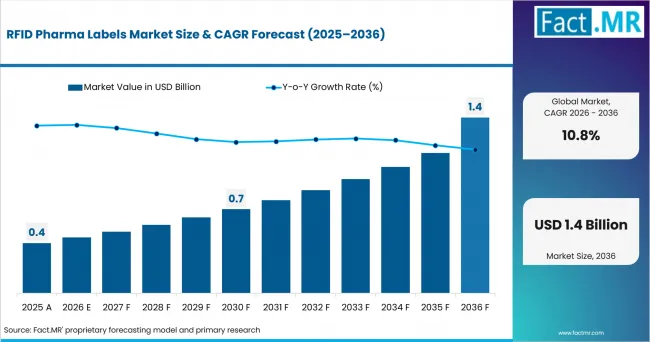
Rfid Pharma Labels Market Market Value Analysis | Source: Fact.MR
What are the defining numbers behind RFID pharma label growth?
USD 0.9 billion absolute opportunity by 2036 led by the United States, Germany and China.
- Demand Drivers in the Market
- Pharmaceutical serialization regulations continue supporting RFID label adoption.
- Counterfeit medicine prevention is increasing investment in smart labeling technologies.
- Hospital pharmacies are improving inventory automation.
- Cold-chain monitoring requirements continue expanding across biologics and vaccines.
- Key Segments Analyzed
- By Label Type: Passive RFID Labels are expected to hold 38.0% share in 2026 due to lower cost and wide adoption across pharmaceutical packaging.
- By Packaging Level: Unit Pack is projected to account for 36.0% share in 2026 because item-level traceability continues expanding.
- By Use Case: Anti-Counterfeit is expected to hold 30.0% share in 2026 due to growing focus on medicine authentication.
- By End User: Pharma Manufacturers are projected to account for 41.0% share in 2026 because they lead serialization and product tracking initiatives.
- By Geography: The United States is projected to record 11.6% CAGR through 2036.
- Analyst Opinion at Fact.MR
- Shambhu Nath Jha, Senior Analyst at Fact.MR, states, "RFID pharma labels are becoming an essential part of pharmaceutical traceability strategies. Companies are investing in smart labeling solutions that improve supply chain visibility, strengthen regulatory compliance and reduce counterfeit risks."
- Strategic Implications
- Expand RFID labeling solutions for serialized pharmaceutical products.
- Invest in cold-chain monitoring and smart packaging technologies.
- Strengthen partnerships with pharmaceutical manufacturers and hospital pharmacies.
- Develop RFID labels that integrate with digital healthcare and inventory management platforms.
RFID pharma labels enable automatic product identification, authentication and tracking throughout pharmaceutical supply chains. These labels improve inventory accuracy while supporting regulatory compliance and patient safety.
The United States is projected to record 11.6% CAGR through 2036, supported by pharmaceutical manufacturing, healthcare digitization and serialization requirements. Germany is expected to expand at 11.2% CAGR due to strong pharmaceutical production and traceability regulations. China is forecast to grow at 10.9% CAGR as healthcare logistics and pharmaceutical manufacturing expand. Japan is projected to advance at 10.4% CAGR through increasing hospital automation and medicine traceability initiatives. India is expected to register 10.1% CAGR through 2036 due to expanding pharmaceutical exports and supply chain modernization.
How does the RFID pharma labels market break down by segment?
Passive RFID Labels lead at 38.0%; Pharma Manufacturers lead at 41.0%.
Which label type dominates?
Passive RFID Labels hold 38.0% share in 2026.
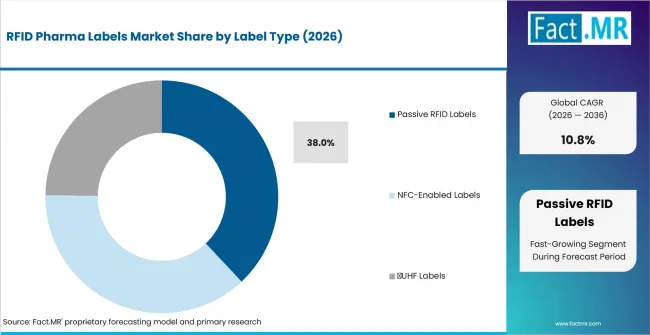
Rfid Pharma Labels Market Analysis By Label Type | Source: Fact.MR
Passive RFID labels lead because they provide reliable product identification without requiring an internal power source. They offer lower costs than active RFID labels while supporting high-volume pharmaceutical packaging. Pharmaceutical companies prefer passive RFID labels because they improve inventory visibility and support serialization programs. These labels also integrate easily into existing packaging lines. Avery Dennison announced it would showcase the BD iDFill™ Individual Prefillable Syringe Identification solution at Pharmapack 2025. The system embeds RFID tags into the syringe needle shield, giving each pre-filled syringe a unique digital identity.
Which packaging level dominates?
Unit Pack accounts for 36.0% share in 2026.
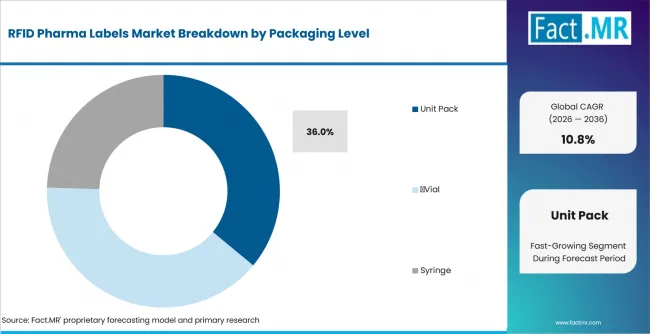
Rfid Pharma Labels Market Analysis By Packaging Level | Source: Fact.MR
Unit packs lead because item-level identification improves product traceability throughout the supply chain. Individual labeling also supports authentication at hospitals and pharmacies. Manufacturers are increasing RFID deployment at the unit level to reduce counterfeit risks and improve product recalls. Regulatory requirements continue supporting adoption. Growth is strongest across high-value medicines and biologic products.
Which use case dominates?
Anti-Counterfeit holds 30.0% share in 2026.
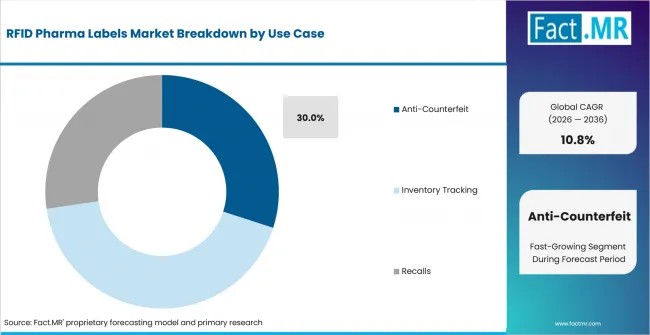
Rfid Pharma Labels Market Analysis By Use Case | Source: Fact.MR
Anti-counterfeit applications lead because pharmaceutical companies continue strengthening product authentication programs. Counterfeit medicines remain a major challenge across global healthcare markets. RFID labels help verify product authenticity throughout manufacturing, distribution and dispensing. They also improve supply chain transparency and patient safety. Demand continues rising as governments strengthen pharmaceutical traceability regulations. The solution replaced barcode-based processes with RFID-enabled identification, allowing products to be tagged at manufacturing and tracked throughout their lifecycle.
Which end user dominates?
Pharma Manufacturers lead with 41.0% share in 2026.
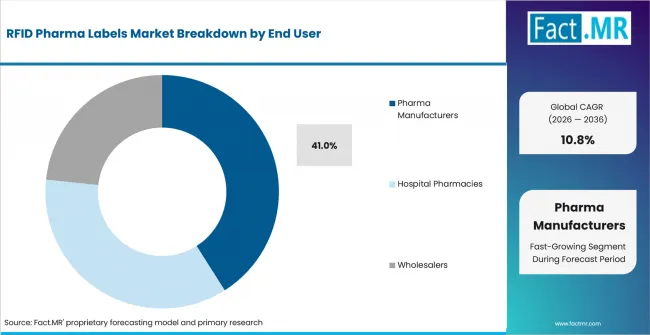
Rfid Pharma Labels Market Analysis By End User | Source: Fact.MR
Pharma manufacturers lead because they manage product serialization and regulatory compliance before medicines enter distribution channels. RFID labeling improves production control and shipment visibility. Large pharmaceutical companies continue investing in digital packaging technologies that improve operational efficiency. Integration with enterprise systems also supports inventory management. Avery Dennison launched the AD Minidose U9XM, a high-memory UHF RFID inlay specifically designed for small pharmaceutical and healthcare products such as syringes, vials, and compact packaging formats. The RFID solution supports source tagging, end-to-end traceability, product authentication, and storage of batch and expiry information directly on the tag, strengthening pharmaceutical supply chain visibility.
What is accelerating RFID pharma label demand and what is holding it back?
Drug traceability regulations drive demand while implementation costs restrain adoption.
The primary growth driver is increasing regulatory focus on pharmaceutical traceability and serialization. Governments are strengthening requirements to improve medicine safety and reduce counterfeit products. Hospital pharmacies and wholesalers are also investing in RFID systems to improve inventory accuracy and automate stock management. Cold-chain monitoring is creating additional demand for RFID-enabled labels. Schreiner MediPharm announced a new RFID-enabled pharmaceutical label featuring a digital first-opening indication and seal function. The RFID label enables unique identification of individual medicine containers, supports end-to-end pharmaceutical supply-chain tracking, and automatically records container integrity after opening.
Healthcare digitization continues supporting wider adoption across pharmaceutical supply chains. The primary restraint is higher implementation cost compared with conventional barcode labeling. RFID deployment requires specialized readers, software and infrastructure investments.Smaller manufacturers may delay adoption because of equipment costs and system integration requirements. Data management and interoperability also remain important implementation challenges.
Where do the biggest RFID pharma label opportunities sit?
- Pharmaceutical Serialization
- Manufacturers continue expanding item-level traceability programs to comply with global regulations.
- Cold-Chain Monitoring
- Temperature-sensitive medicines require RFID labels that improve shipment visibility and environmental monitoring.
- Hospital Pharmacy Automation
- Healthcare providers are investing in RFID systems that improve medicine tracking and inventory management.
- Clinical Trial Supply Chains
- RFID labels help improve product identification and shipment tracking across clinical research programs.
- Pharmaceutical Logistics
- Logistics providers are adopting RFID technologies to improve shipment accuracy and reduce handling errors.
Which countries are scaling RFID pharma label adoption fastest?
United States 11.6%, Germany 11.2%, China 10.9%, Japan 10.4%, India 10.1%.
Based on regional analysis, the RFID pharma labels market is segmented into North America, Western Europe, Asia Pacific, Latin America and Middle East & Africa.
| Country | CAGR (2026-2036) |
|---|---|
| United States | 11.6% |
| Germany | 11.2% |
| China | 10.9% |
| Japan | 10.4% |
| India | 10.1% |
Source: Fact.MR analysis. Updated Jun 26, 2026
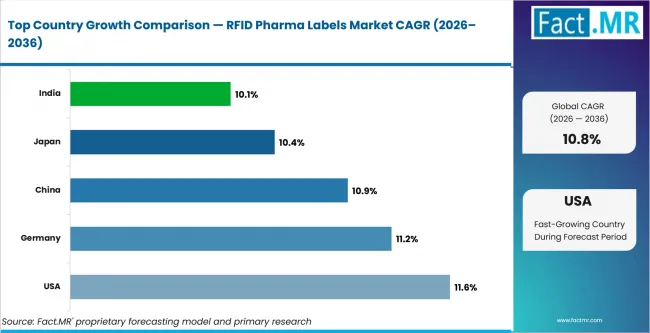
Rfid Pharma Labels Market Cagr Analysis By Country | Source: Fact.MR
Why is the United States leading the RFID pharma labels market?
11.6% CAGR, supported by pharmaceutical serialization and healthcare digitization
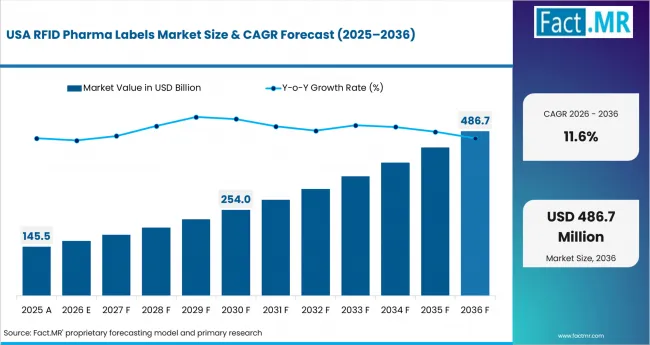
Rfid Pharma Labels Market Country Value Analysis | Source: Fact.MR
The United States is projected to record 11.6% CAGR through 2036 due to strong pharmaceutical manufacturing and widespread adoption of product serialization. Drug manufacturers are investing in RFID labels to improve traceability and comply with regulatory requirements. Hospitals and wholesalers are expanding RFID-enabled inventory systems to improve medicine tracking and reduce dispensing errors. Demand is also supported by growth in biologics and specialty pharmaceuticals that require secure supply chain monitoring.
What is driving growth in Germany?
11.2% CAGR, driven by pharmaceutical manufacturing and traceability regulations
Germany is expected to post 11.2% CAGR by 2036 as pharmaceutical companies strengthen product authentication and supply chain visibility. Advanced manufacturing facilities continue adopting RFID technologies to improve operational efficiency. The country benefits from strong healthcare infrastructure and increasing investment in smart packaging solutions. RFID deployment is also expanding across pharmaceutical distribution networks. Demand remains supported by high-value medicine production and export activity.
How is China expanding adoption?
10.9% CAGR, supported by healthcare modernization and pharmaceutical production
China is forecast to advance at 10.9% CAGR through 2036 due to expanding pharmaceutical manufacturing and healthcare infrastructure. Companies are adopting RFID labels to improve inventory control and strengthen medicine authentication. Government efforts to improve healthcare quality and supply chain transparency continue supporting adoption. Export-oriented pharmaceutical manufacturers are also investing in advanced labeling technologies.
What supports demand in Japan?
10.4% CAGR, driven by hospital automation and precision healthcare
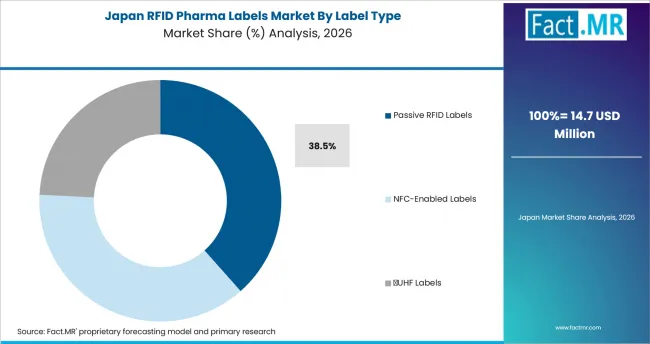
Rfid Pharma Labels Market Japan Market Share Analysis By Label Type | Source: Fact.MR
Japan is expected to register 10.4% CAGR by 2036 due to increasing adoption of automated hospital pharmacy systems and advanced healthcare technologies. RFID labels help improve medicine tracking and inventory accuracy. Pharmaceutical companies are investing in smart packaging solutions that improve patient safety and supply chain efficiency. Growth is also supported by rising demand for temperature-sensitive medicines. Healthcare digitalization continues creating new opportunities across the market.
Why is India an important market?
10.1% CAGR, supported by pharmaceutical exports and supply chain modernization
India is projected to grow at 10.1% CAGR through 2036 as pharmaceutical manufacturers expand exports and strengthen compliance with international traceability standards. RFID labels improve shipment visibility and product authentication across global supply chains. Large-scale medicine production and increasing investment in digital packaging technologies continue supporting market growth. Cold-chain logistics for vaccines and biologics are also creating additional demand. The country is expected to remain an important manufacturing hub for RFID-enabled pharmaceutical packaging. Avery Dennison opened its first RFID inlays and labels manufacturing facility in India. The company highlighted pharmaceuticals among the key industries served by the new RFID label production operation, expanding local supply of RFID labels and inlays. [4]
Who leads the RFID pharma labels landscape?
Avery Dennison, CCL Industries, Paragon ID, Schreiner MediPharm lead through smart labeling expertise and pharmaceutical traceability capabilities.
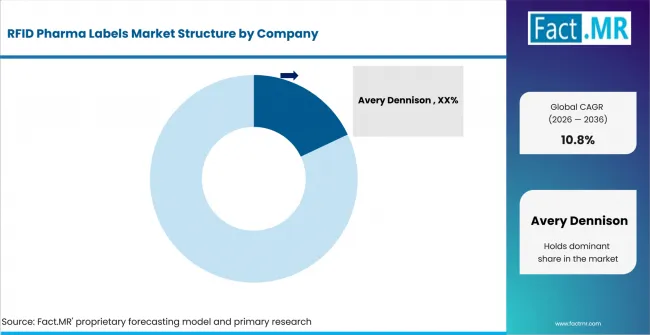
Rfid Pharma Labels Market Analysis By Company | Source: Fact.MR
The market is characterized by competition focused on label reliability, data accuracy and regulatory compliance. Suppliers continue developing RFID labels that improve inventory visibility, product authentication and supply chain efficiency while meeting pharmaceutical packaging standards. Pharmaceutical manufacturers remain the largest opportunity for leading participants. Companies are also expanding across hospital pharmacies, wholesalers, clinical trial suppliers and healthcare logistics providers where real-time product tracking is becoming increasingly important.
Cold-chain monitoring and anti-counterfeit protection are becoming major purchasing priorities. End users increasingly prefer RFID labels that integrate with serialization systems, warehouse management platforms and hospital inventory software. Avery Dennison and CCL Industries maintain strong positions through their global pharmaceutical labeling capabilities. Paragon ID, Schreiner MediPharm, Zebra Technologies, Tageos and Checkpoint Systems continue investing in RFID innovation that supports healthcare automation and product traceability.
Competition will depend on label performance, system integration and compliance with global pharmaceutical regulations. Companies offering reliable RFID solutions, secure data management and scalable deployment capabilities are expected to strengthen their market position.
Which companies are the key players?
Avery Dennison, CCL Industries, Paragon ID, Schreiner MediPharm,
- Avery Dennison
- CCL Industries
- Paragon ID
- Schreiner MediPharm
- Tageos
- Checkpoint Systems
Bibliography
- [1] Avery Dennison Corporation. (2025, January 16). Avery Dennison and partners to showcase RFID-enabled Digital ID solution for pre-filled syringe traceability at Pharmapack 2025. Avery Dennison Corporation.
- [2] Avery Dennison Corporation. (2024, August 27). Avery Dennison launches AD Minidose™ U9XM with high memory capability to help ensure authenticity and traceability of smaller medical items. Avery Dennison Corporation.
- [3] Avery Dennison Corporation. (2025, April 24). Avery Dennison opens its first India-based RFID production facility. Avery Dennison Corporation.
- [4] Schreiner Group. (2024, October 2). Schreiner MediPharm to present at CPHI 2024. Schreiner Group.
This Report Addresses
- Strategic intelligence on RFID-enabled pharmaceutical labeling technologies.
- Segment analysis covering label types, packaging levels, use cases and end users.
- Regional outlook covering the United States, Germany, China, Japan and India.
- Competitive assessment of Avery Dennison, CCL Industries, Paragon ID and other leading RFID solution providers.
- Analysis of pharmaceutical serialization, traceability and anti-counterfeit trends.
- Evaluation of cold-chain monitoring and smart pharmaceutical packaging technologies.
- Assessment of hospital pharmacy automation and inventory management requirements.
- Primary interviews, supplier benchmarking and industry validation supporting forecast development.
- Analysis of RFID integration with pharmaceutical logistics and healthcare systems.
- Evaluation of opportunities linked to pharmaceutical digitization and regulatory compliance.
What does the RFID pharma labels market cover?
RFID-enabled labels used for pharmaceutical identification, authentication and supply chain tracking.
The market covers RFID label materials, embedded RFID inlays, and encoding technologies used across pharmaceutical packaging and distribution. Remove software-enabled tracking solutions unless bundled with RFID label deployments.
What is included in the scope?
RFID pharmaceutical labeling technologies and smart traceability solutions.
The scope includes passive RFID labels, NFC-enabled labels, UHF labels, cold-chain labels and on-metal RFID labels.
What is excluded from the scope?
Conventional barcode labels and non-electronic pharmaceutical labeling systems.
The scope excludes printed barcode labels, QR code labels without RFID functionality and non-digital identification technologies.
How was the analysis built?
100+ sources, 30+ pharmaceutical packaging assessments, 25+ countries and industry interviews.
- Primary Research:
- Interviews with pharmaceutical manufacturers, packaging suppliers, RFID technology providers and healthcare logistics specialists.
- Desk Research:
- Analysis of pharmaceutical regulations, serialization programs, healthcare digitization and cold-chain logistics.
- Market Sizing and Forecasting:
- Estimates based on pharmaceutical packaging volumes, RFID deployments and healthcare supply chain investments.
- Data Validation and Update Cycle:
- Forecasts validated through supplier benchmarking, regulatory analysis and industry interviews.
Segmentation
What is the report's scope and coverage?
| Attribute | Details |
|---|---|
| Quantitative Units | USD Billion in 2026 to USD Billion by 2036 |
| Market Definition | Covers RFID-enabled labels used for pharmaceutical identification, authentication and supply chain traceability |
| Label Types Covered | Passive RFID Labels, NFC-Enabled Labels, UHF Labels, Cold-Chain Labels, On-Metal Labels |
| Packaging Levels Covered | Unit Pack, Vial, Syringe, Carton, Case, Pallet |
| Use Cases Covered | Anti-Counterfeit, Inventory Tracking, Recalls, Temperature Logging, Hospital Pharmacy Automation |
| End Users Covered | Pharma Manufacturers, Hospital Pharmacies, Wholesalers, Clinical Trial Suppliers, Logistics Providers |
| Regions Covered | North America, Western Europe, Asia Pacific, Latin America, Middle East & Africa |
| Key Countries Covered | United States, Germany, China, Japan, India |
| Companies Covered | Avery Dennison, CCL Industries, Paragon ID, Schreiner MediPharm, Tageos, Checkpoint Systems |
| Forecast Period | 2026 to 2036 |
| Approach | Hybrid top-down and bottom-up methodology using pharmaceutical packaging volumes, RFID deployments, serialization programs and healthcare logistics investments |
Source: Fact.MR analysis. Updated Jun 26, 2026
How is market segmented?
-
By Label Type
- Passive RFID Labels
- NFC-Enabled Labels
- UHF Labels
- Cold-Chain Labels
- On-Metal Labels
-
By Packaging Level
- Unit Pack
- Vial
- Syringe
- Carton
- Case
- Pallet
-
By Use Case
- Anti-Counterfeit
- Inventory Tracking
- Recalls
- Temperature Logging
- Hospital Pharmacy Automation
-
By End User
- Pharma Manufacturers
- Hospital Pharmacies
- Wholesalers
- Clinical Trial Suppliers
- Logistics Providers
-
Region:
- North America
- United States
- Canada
- Europe
- Germany
- United Kingdom
- France
- Italy
- Spain
- Asia Pacific
- China
- Japan
- South Korea
- India
- Singapore
- Latin America
- Brazil
- Mexico
- Argentina
- Middle East & Africa
- GCC Countries
- South Africa
- Israel
- North America
Frequently Asked Questions
Which label type leads the market?
Which packaging level accounts for the largest share?
What is driving demand for RFID pharma labels?
Which country is growing the fastest?
What is the primary challenge facing the market?
Which end user accounts for the largest share?
What opportunities exist for suppliers?
Why are pharmaceutical companies adopting RFID labels?
Which use case generates the highest demand?
Who worked on this report


Preview the report firsthand - request a free sample
Free SampleGet the brochure for pricing and purchase details
Download PDF