- Market Value (2025): USD 213.2 Mn
- Estimated Value (2026): USD 223.1 Mn
- Forecast Value (2036): USD 351.1 Mn
- CAGR (2026-2036): 4.6%
What is the River Rafts Market forecast to be worth by 2036?
USD 223.1 million in 2026 to USD 351.1 million by 2036 at a 4.6% CAGR.
- The river rafts market was valued at USD 213.2 million in 2025, with inflatable craft for leisure trips making up most of that base.
- By 2036 revenue will reach USD 351.1 million, up from USD 223.1 million in 2026, as outfitters add boats and more private paddlers buy their own.
- Annual growth will average 4.6% CAGR from 2026 to 2036, since guided whitewater trips and rescue fleets keep drawing in new buyers.
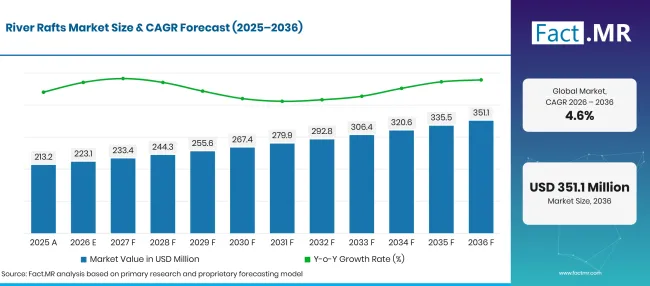
Factmr River Rafts Market Forecast Global | Source: Fact.MR
| Year | Basis | Market Value (USD million) |
|---|---|---|
| 2025 | Actual | 213.2 |
| 2026 | Estimate | 223.1 |
| 2036 | Forecast | 351.1 |
| CAGR 2026 to 2036 | Forecast period | 4.6% |
Source: Fact.MR analysis. Updated Oct 22, 2026
What are the defining numbers behind River Rafts Market growth?
The 2026 to 2036 period will add USD 128.0 million in new value, led by inflatable craft bought for leisure paddling.
- Demand Drivers in the Market
- Travel volumes are back above earlier peaks, which fills guided river trips. UN Tourism counted about 1.52 billion international tourist arrivals in 2025, a 4% rise on 2024 [1]. Half-day rafting trips draw many of these visitors.
- Outdoor spending gives outfitters and dealers a wide revenue base. The U.S. Bureau of Economic Analysis reported that outdoor recreation added USD 696.7 billion, or 2.4% of GDP, in 2024, and boating and fishing was the biggest conventional activity at USD 38.4 billion [2].
- Flood response keeps public agencies buying inflatable boats. The National Weather Service recorded 230 flood deaths in the United States in 2025, of which 209 came from flash floods [3]. Rafts pack small, inflate fast and carry both crews and casualties across fast or shallow water.
- Outfitters run their boats hard from spring to autumn and retire worn hulls on a set cycle.
- Better fabrics and seams raise the value of each craft. Welded tubes, drop-stitch or I-beam floors and reinforced wear patches extend service life in rocky rapids and justify higher prices per unit.
- Key Segments Analyzed
- By Product Type: Inflatable Rafts will command 72.4% share in 2026, as air-filled tubes absorb rock strikes and fold down for transport in a single vehicle.
- By Material: PVC will take 46.8% share in 2026, given that welded PVC costs less per boat and patches quickly at the riverbank.
- By Application: Recreational will account for 54.2% share in 2026 on the back of family day trips, multi-day floats and fishing outings.
- By End-User: Adventure Sports Companies will capture 44.7% share in 2026 through bulk orders for commercial fleets that turn over every few seasons.
- By Distribution Channel: Offline will represent 61.6% share in 2026, since buyers want to check tube diameter, floor type and seam work in person.
- Analyst Opinion at Fact.MR
- Shambhu Nath Jha, Principal Consultant at Fact.MR, states, “A river raft is now judged on three things: how long the fabric lasts, how fast it drains and how easily a guide can fix it on a gravel bar. Outfitters and rescue agencies will pay more for a boat that stays in service all season, so material quality wins fleet contracts. Over the next decade, lighter abrasion-resistant fabrics and steady rescue-agency orders will favor builders with proven designs and dependable repair support.”
- Strategic Implications
- Raft builders should widen their range of self-bailing, field-repairable models in the 12 to 14 foot class, since outfitters compare boats on durability and serviceability first.
- Fabric suppliers should publish abrasion, UV and puncture test data for each coating grade, giving builders the records they need to back longer warranties.
- Outfitters should schedule fleet replacement outside the peak season and trial new materials on a few boats before committing a full fleet.
- Equipment dealers serving rescue agencies should bundle training, spare valves and repair kits with each craft, because public buyers weigh readiness and after-sales support alongside price.
Japan will lead the group at 6.0% CAGR, with record inbound travel feeding guided trips on rivers such as the Yoshino. The United States follows at 5.5% on a broad base of outdoor visitors and a dense outfitter network. For the United Kingdom, a 4.8% pace rests on activity centres and swift-water training by fire crews. Brazil reaches 4.4% as adventure towns in São Paulo state draw steady visitor numbers. Germany rounds out the set at 3.6%, where a mature paddling base buys mostly replacement craft.
How does the River Rafts Market break down by segment?
Inflatable Rafts will lead Product Type at 72.4%; PVC will head Material at 46.8%; Recreational will top Application at 54.2%; Adventure Sports Companies will hold first place in End-User at 44.7%; Offline will lead Distribution Channel at 61.6%.
Which Product Type leads?
Inflatable Rafts represent 72.4% of 2026 sales.
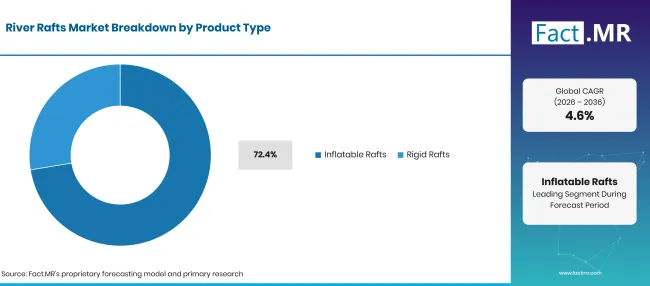
Factmr River Rafts Market Breakdown Product Type | Source: Fact.MR
| Product Type | Share (2026) |
|---|---|
| Inflatable Rafts (Leading segment) | 72.4% |
| Other segments combined | 27.6%* |
| Total | 100.0% |
Source: Fact.MR analysis. Updated Oct 22, 2026
Guides and private paddlers want a boat that bounces off rocks, deflates into a car trunk and survives a rough season with a few patches. Air-filled tubes meet all three needs. Many buyers come to rafting after owning inflatable boats for lakes and coasts. Rigid Rafts and other fixed-hull designs track well and resist punctures in shallow water. Their weight, storage needs and repair costs, though, confine them to specialized commercial and rescue tasks.
What leads the Material segment?
PVC takes 46.8% of 2026 sales.
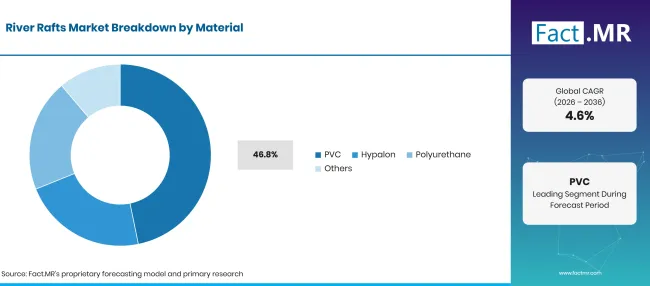
Factmr River Rafts Market Breakdown Material | Source: Fact.MR
| Material | Share (2026) |
|---|---|
| PVC (Leading segment) | 46.8% |
| Other segments combined | 53.2%* |
| Total | 100.0% |
Source: Fact.MR analysis. Updated Oct 22, 2026
Builders can weld or glue PVC into tubes at a lower cost than most coated alternatives, and common repair kits fix a puncture within an hour. The fabric comes in many weights and colours, which lets one builder serve budget leisure buyers and large outfitter fleets from the same line. Hypalon and polyurethane resist sunlight, abrasion and cold better, but their higher price limits them to premium and expedition craft. Polyurethane-coated fabric is lighter for its strength, so it suits long multi-day trips where weight on the frame adds up. Suppliers of coated textiles are working on thinner coatings that keep abrasion resistance while cutting tube weight.
What supports Recreational within Application?
Recreational accounts for 54.2% of 2026 revenue.
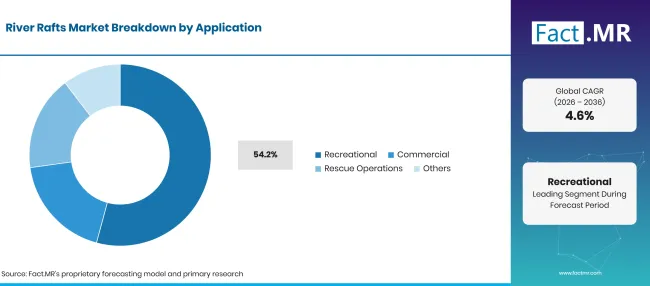
Factmr River Rafts Market Breakdown Application | Source: Fact.MR
| Application | Share (2026) |
|---|---|
| Recreational (Leading segment) | 54.2% |
| Other segments combined | 45.8%* |
| Total | 100.0% |
Source: Fact.MR analysis. Updated Oct 22, 2026
Leisure paddling reaches a far wider buyer pool than any professional use. Families, travellers and weekend groups take day trips, overnight floats and fishing outings, and guided parties fill outfitter boats all season. Some first-time rafters later buy recreational kayaks or a small raft. Inbound visitors add to that demand in popular river destinations. The Japan Tourism Agency put 2025 inbound travel spending at a record JPY 9.4559 trillion, up 16.4% year on year [4]. Commercial and rescue buyers work within fixed budgets and replacement cycles, so their orders rise more slowly.
How does End-User shape demand?
Adventure Sports Companies make up 44.7% of 2026 demand.
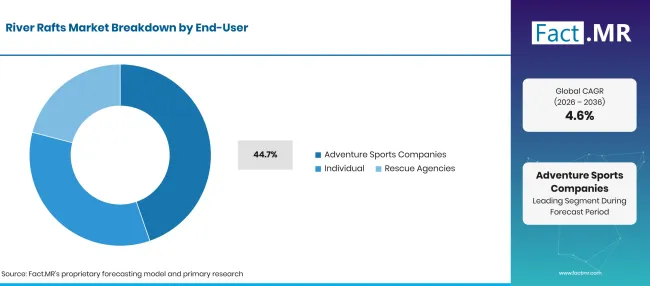
Factmr River Rafts Market Breakdown End User | Source: Fact.MR
| End-User | Share (2026) |
|---|---|
| Adventure Sports Companies (Leading segment) | 44.7% |
| Other segments combined | 55.3%* |
| Total | 100.0% |
Source: Fact.MR analysis. Updated Oct 22, 2026
Outfitters launch boats almost every day in season, so tubes, seams and floors wear quickly and fleets turn over on a regular cycle. They buy several units at once, often under direct supply terms, and favor proven designs with strong warranties because a boat out of service means lost bookings. Rescue agencies spend from public budgets and focus on safety kit as much as on the craft itself. The U.S. Coast Guard reported 556 recreational boating deaths in 2024, and 87% of drowning victims were not wearing a life jacket [5]. Individual buyers purchase a single raft at long intervals, which keeps their volume modest.
Which Distribution Channel leads?
Offline holds 61.6% of the 2026 market.
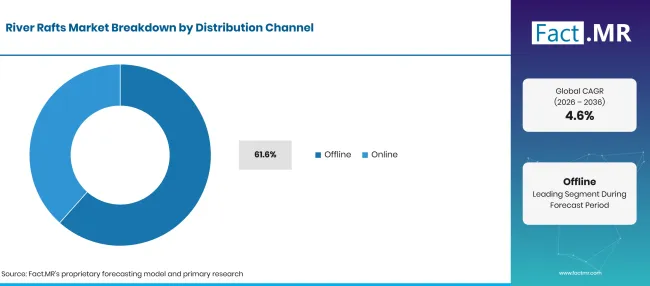
Factmr River Rafts Market Breakdown Distribution Channel | Source: Fact.MR
| Distribution Channel | Share (2026) |
|---|---|
| Offline (Leading segment) | 61.6% |
| Other segments combined | 38.4%* |
| Total | 100.0% |
Source: Fact.MR analysis. Updated Oct 22, 2026
A river raft is a costly purchase that most people want to see before paying. Tube diameter, floor design, seam quality and fabric weight are hard to judge from a product page, so buyers visit specialist dealers and outfitter shops for fitting advice and demo days. Outfitters and rescue agencies also agree specifications and delivery directly with builders. Online sales serve buyers who already know the model they want, along with oars, pumps and rafting equipment such as dry bags and throw ropes.
What is accelerating River Rafts Market adoption, and what is holding it back?
More travellers on guided trips, steady fleet turnover by outfitters and rescue work after floods keep orders moving toward durable, repairable inflatable craft. High prices for premium fabrics, short seasons and the cost of ownership slow buying among price-sensitive paddlers.
Drivers Impact Analysis
| DRIVER | (~) % IMPACT ON CAGR | GEOGRAPHIC RELEVANCE | IMPACT TIMELINE |
|---|---|---|---|
| Rising participation in adventure tourism and guided river trips | +1.2% | Global | Short term (<= 2 years) |
| Regular fleet renewal and expansion by outfitters | +1.0% | Global | Medium term (2-4 years) |
| Growing use of inflatable rafts in swift-water and flood rescue | +0.7% | North America, Western Europe, East Asia | Medium term (2-4 years) |
| Dealer and brand websites that let buyers configure and order complete rafts | +0.5% | Global | Short term (<= 2 years) |
Source: Fact.MR analysis. Updated Oct 22, 2026
Opportunity Impact Analysis
| OPPORTUNITY | (~) % IMPACT ON CAGR | GEOGRAPHIC RELEVANCE | IMPACT TIMELINE |
|---|---|---|---|
| Lighter, abrasion-resistant fabrics such as polyurethane for premium rafts | +0.7% | Global | Medium term (2-4 years) |
| Emerging river tourism destinations in Latin America and Asia | +0.5% | Latin America, South Asia & Pacific | Medium term (2-4 years) |
| Supply contracts with public rescue and emergency agencies | +0.3% | North America, Western Europe, East Asia | Long term (>= 4 years) |
| Direct-to-consumer and digital sales channels | +0.2% | North America, Western Europe | Short term (<= 2 years) |
Source: Fact.MR analysis. Updated Oct 22, 2026
Restraints Impact Analysis
| RESTRAINT | (~) % IMPACT ON CAGR | GEOGRAPHIC RELEVANCE | IMPACT TIMELINE |
|---|---|---|---|
| Volatility in premium fabric and raw-material costs | -0.3% | Global | Short term (<= 2 years) |
| Seasonal, weather-dependent demand | -0.1% | Global | Medium term (2-4 years) |
| Safety concerns and limits on river access | -0.1% | North America, Western Europe | Long term (>= 4 years) |
Source: Fact.MR analysis. Updated Oct 22, 2026
Which countries are scaling the River Rafts Market through 2036?
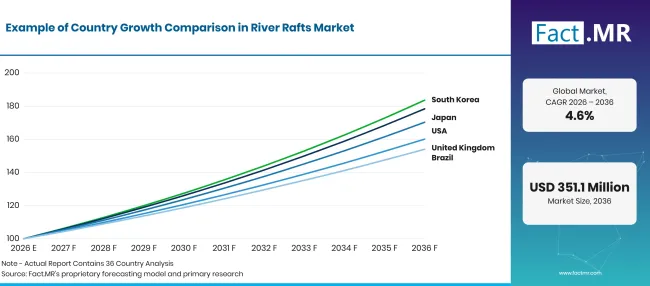
Factmr River Rafts Market Growth Index | Source: Fact.MR
| Country | CAGR (2026 to 2036) |
|---|---|
| Japan | 6.0% |
| United States | 5.5% |
| United Kingdom | 4.8% |
| Brazil | 4.4% |
| Germany | 3.6% |
Source: Fact.MR analysis. Updated Oct 22, 2026
What supports adoption in Japan?
6.0% CAGR, on the back of record inbound travel and guided trips on mountain rivers.
The Japan National Tourism Organization estimated 42.68 million visitor arrivals in 2025, up 15.8% from 2024 [6]. Rivers such as the Yoshino in Shikoku draw guided groups to grade IV rapids. Water work also shapes public demand. The Fire and Disaster Management Agency reported that water accidents made up 3.4% of 118,365 rescue dispatches in 2024 [7].
How does the United States perform?
5.5% CAGR, backed by heavy national park traffic and a dense network of outfitters and dealers.
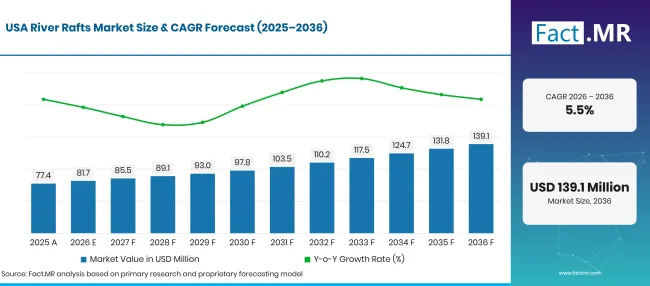
Factmr River Rafts Market Forecast Usa | Source: Fact.MR
The National Park Service counted 323.0 million recreation visits in 2025, and New River Gorge National Park and Preserve, a well-known rafting river, set a visitation record [8]. Outfitters on western and Appalachian rivers renew fleets on a regular cycle, which keeps dealers supplied with repeat orders.
What is supporting the United Kingdom’s adoption?
4.8% CAGR, helped by activity centres and swift-water training for emergency crews.
Natural England reported that 31% of adults in England visited rivers, lakes or canals in the month before being surveyed in 2025 to 2026 [9]. Fire and rescue services in England attended 1,946 rescue or evacuation from water incidents in the year ending March 2025 [10]. Centres such as Lee Valley White Water Centre serve both leisure rafting groups and crews training for flood work.
How is Brazil scaling demand?
4.4% CAGR, driven by adventure towns and long rivers suited to commercial trips.
São Paulo state reported in 2025 that Brotas, considered Brazil’s adventure tourism capital, receives about 350,000 visitors a year, generating around BRL 192.5 million annually [11]. Rafting on the Jacaré-Pepira River is among its main draws. Local operators add boats as bookings grow, though cost pressure leads most of them to choose PVC craft.
What is supporting Germany’s adoption?
3.6% CAGR, reflecting a settled paddling culture and steady replacement buying.
Destatis reported a record 169 million domestic multi-day trips in 2025, up 3.9% on 2024, and 60.2% of multi-day trips were made by car [12]. Car travel suits paddlers who carry a rolled raft to the river. Canoe clubs, rescue groups and rental bases buy mainly replacement craft, which keeps growth moderate.
Who leads the River Rafts Market?
The river raft field splits into premium builders that serve professional guides and rescue teams, and value-focused brands aimed at leisure buyers and smaller outfitters.
AIRE sells several self-bailing raft lines, including the Puma, R, D, DD and E series, plus the lower-priced Tributary range. NRS pairs its own Otter and Expedition rafts and the STAR raft lines with a deep catalog of paddling gear, so outfitters can source a complete package from one supplier. Hyside, based in Boulder, Colorado, builds Outfitter and Pro series rafts for commercial fleets, while SOTAR makes urethane rafts and catarafts in the United States. Maravia builds custom Wind and Voyageur rafts with urethane coatings. Rocky Mountain Rafts builds welded PVC rafts and Vanguard Inflatables offers self-bailing rafts for commercial use, both at lower price points. Fabric life, warranty terms and fast repair support through local dealers will separate the stronger builders from the rest.
Which companies are the key providers?
Leading companies include AIRE; NRS (Northwest River Supplies); Hyside Inflatables; SOTAR; Maravia; Rocky Mountain Rafts; and Vanguard Inflatables.
- AIRE
- NRS (Northwest River Supplies)
- Hyside Inflatables
- SOTAR
- Maravia
- Rocky Mountain Rafts
- Vanguard Inflatables
Bibliography
- [1] UN Tourism Regional Support Office for Asia and the Pacific. (2026, January 28). 世界観光指標(World Tourism Barometer)2026年1月号について [On the World Tourism Barometer, January 2026 issue].
- [2] U.S. Bureau of Economic Analysis. (2026, March 5). Outdoor Recreation Economic Statistics, U.S. and States, 2024.
- [3] National Weather Service. (2026, July). Summary of Natural Hazard Statistics for 2025 in the United States.
- [4] Japan Tourism Agency. (2026, January 21). インバウンド消費動向調査2025年暦年(速報)及び10-12月期(1次速報)の結果について [Results of the inbound consumption survey for calendar 2025 (preliminary) and October to December (first preliminary)].
- [5] U.S. Coast Guard. (2025, July 1). Coast Guard reports fewest boating fatalities in more than 50 years.
- [6] Japan National Tourism Organization. (2026, January 21). 訪日外客数(2025年12月推計値) [Visitor arrivals to Japan, December 2025 estimates].
- [7] Fire and Disaster Management Agency, Japan. (2026, January 20). 「令和7年版 救急・救助の現況」の公表 [Publication of the 2025 edition of the current status of emergency and rescue services].
- [8] National Park Service. (2026, March 13). Public Interest in National Parks Remains Strong as Visits Top 323 Million in 2025.
- [9] Natural England. (2026, September 9). Adults’ Year 6 Annual Report (April 2025 - March 2026).
- [10] Home Office. (2025, September 25). Detailed analysis of non-fire incidents: England, April 2024 to March 2025.
- [11] Agência SP, Governo do Estado de São Paulo. (2025, May 10). Turismo de aventura cresce em SP: veja opções para se divertir na natureza [Adventure tourism grows in SP: see options for fun in nature].
[12] Statistisches Bundesamt (Destatis). (2026, August 17). Weniger Reisen, aber Rekordwert bei mehrtägigen Inlandsreisen 2025 [Fewer trips, but a record for multi-day domestic trips in 2025]
This Report Answers
- River raft sales are split by product type, material, application, end-user and distribution channel.
- For each segment, readers learn which subsegment leads and which buyer needs shape its 2026 share.
- Inbound travel, outdoor participation and water rescue workload frame the five-country comparison.
- Profiles group premium and value raft builders by the customers they serve.
- Fabric choice, seam methods and floor designs are traced to show how buyers pick one boat over another.
What does the River Rafts Market cover?
Rafts built for river and whitewater travel form this market. Products include inflatable rafts, self-bailing rafts and rigid rafts made from PVC, Hypalon, polyurethane and other coated fabrics.
Inflatable and rigid designs are tracked across recreational, commercial and rescue use. Most hulls start as coated technical fabric that is bonded or welded into air chambers and floors.
What is included in the scope?
Complete rafts sold through offline and online channels count in both inflatable and rigid forms, including self-bailing, frame-ready and expedition designs. Sales to adventure sports companies, individuals and rescue agencies are recorded at the value of the craft.
When a raft ships with a standard floor, valves or a basic repair kit as part of the package, only the complete raft value is recorded. Outfitter boats bought for ecotourism operators on jungle and canyon rivers are included at the same craft value.
What is excluded from the scope?
Kayaks, canoes, stand-up paddleboards and other small paddle craft are left out, along with motorized boats and rigid-hulled powerboats. Oars, paddles, frames, life jackets, helmets and other accessories sold separately add nothing to market revenue.
Raw fabrics, adhesives and parts sold to builders are not counted, nor are used-raft resale and rental fees.
How Was the Analysis Built?
The analysis draws on 120+ sources, 35+ company portfolios, 25+ countries, and more than 20 industry interviews.
- Primary Research: Primary research includes discussions with manufacturers, service providers, technology developers, distributors, end users, and subject-matter experts. These conversations examine purchasing priorities, product adoption, operational challenges, approval requirements, competitive positioning, and the factors that influence wider market acceptance.
- Desk Research: Desk research covers government statistics, regulatory publications, company filings, trade data, technical studies, industry associations, standards, public policy, and other authoritative sources. Every source used in the analysis is documented in the bibliography.
- Market Sizing and Forecasting: Market estimates combine historical performance, demand indicators, pricing and volume trends, segment shares, company participation, country-level growth, adoption patterns, investment activity, and barriers to market expansion.
- Data Validation and Update Cycle: Findings are validated by comparing primary interviews with public data, company activity, regulatory changes, trade patterns, and industry developments. Regular updates review new product launches, capacity changes, partnerships, approvals, and shifts in commercial adoption.
Segmentation
What is the report’s scope and coverage?
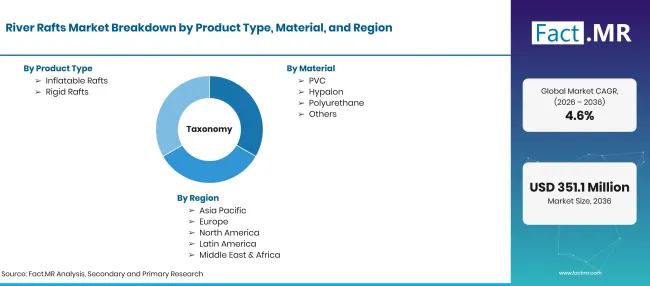
Factmr River Rafts Market Taxonomy | Source: Fact.MR
| Attribute | Details |
|---|---|
| Quantitative Units | USD million in 2026 to USD million by 2036 at CAGR |
| Market Definition | Complete rafts built for river and whitewater use, in inflatable and rigid designs made from PVC, Hypalon, polyurethane and other materials. The scope covers sales for recreational, commercial and rescue purposes. |
| Product Type | Inflatable Rafts; Rigid Rafts |
| Material | PVC; Hypalon; Polyurethane; Others |
| Application | Recreational; Commercial; Rescue Operations; Others |
| End-User | Adventure Sports Companies; Individual; Rescue Agencies |
| Distribution Channel | Offline; Online |
| Regions Covered | North America; Latin America; Western Europe; Eastern Europe; East Asia; South Asia & Pacific; Middle East & Africa |
| Countries Covered | Japan; United States; United Kingdom; Brazil; Germany |
| Companies Profiled | AIRE; NRS (Northwest River Supplies); Hyside Inflatables; SOTAR; Maravia; Rocky Mountain Rafts; Vanguard Inflatables |
| Forecast Period | 2026 to 2036 |
| Approach | Hybrid top-down and bottom-up approach using raft output by country; product type and material mix; outfitter fleet sizes and replacement cycles; rescue-agency purchasing; distribution channel mix; and builder portfolio review. |
Source: Fact.MR analysis. Updated Oct 22, 2026
How is the market segmented?
-
By Product Type
- Inflatable Rafts
- Rigid Rafts
-
By Material
- PVC
- Hypalon
- Polyurethane
- Others
-
By Application
- Recreational
- Commercial
- Rescue Operations
- Others
-
By End-User
- Adventure Sports Companies
- Individual
- Rescue Agencies
-
By Distribution Channel
- Offline
- Online
-
By Region
- North America
- Latin America
- Western Europe
- Eastern Europe
- East Asia
- South Asia & Pacific
- Middle East & Africa
Frequently Asked Questions
How large is the river rafts market in 2026?
What growth rate will the river rafts market record from 2026 to 2036?
Which product type leads the river rafts market?
Which material holds the greatest share of the river rafts market?
Which application contributes the most to the river rafts market?
Which end-user leads the river rafts market?
Which distribution channel leads the river rafts market?
Which country will record the strongest growth in the river rafts market?
Who are the main companies in the river rafts market?
Who worked on this report


Preview the report firsthand - request a free sample
Free SampleGet the brochure for pricing and purchase details
Download PDF