- Market Value (2025): USD 571.2 Mn
- Estimated Value (2026): USD 690.0 Mn
- Forecast Value (2036): USD 4566.0 Mn
- CAGR (2026-2036): 20.8 %
What is the Robotic Bin-Picking Systems Market forecast to be worth by 2036?
USD 690 million in 2026 to USD 4,566 million by 2036 at 20.8% CAGR.
- The robotic bin-picking systems market reached USD 571.2 million in 2025 as 3D vision and grasp-planning projects moved beyond pilot cells.
- Demand is projected to increase from USD 690 million in 2026 to USD 4,566 million by 2036.
- The market is forecast to record 20.8% CAGR from 2026 to 2036 as automotive plants and logistics operators automate random-part handling.
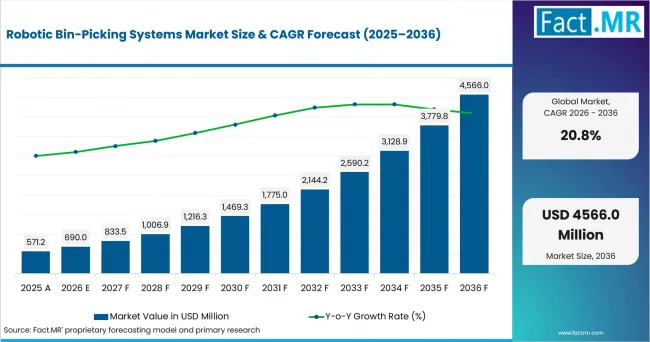
Robotic Bin Picking Systems Market Value Analysis | Source: Fact.MR
What are the defining numbers behind Robotic Bin-Picking Systems Market growth?
USD 3,876 million absolute opportunity by 2036, led by Structured-light 3D, 3D vision systems and Machine tending.
- Demand Drivers in the Market
- Automotive plant engineers need bin-picking cells that feed machine tools without manual part orientation. IFR reported 542,000 industrial robot installations worldwide in 2024.
- Warehouse automation teams require order-picking robots that can handle irregular items. Integrators are expected to document failed-pick recovery before warehouse trials move into daily use.
- Camera suppliers must prove performance on reflective and dark parts before integrators accept a cell. Validation requests now focus on repeatable depth capture at real working distances.
- System integrators are expected to prioritize part libraries and recovery routines because failed picks can stop a tending cell.
- Key Segments Analyzed
- By Vision Technology: Structured-light 3D is expected to hold 39.0% share in 2026 owing to dense point-cloud capture on mixed parts.
- By Component: 3D vision systems are projected to account for 44.0% share in 2026 supported by their role in object localization.
- By Application: Machine tending is anticipated to capture 30.0% share in 2026 due to repetitive loading and unloading needs.
- By End-Use Industry: Automotive is estimated to represent 28.0% share in 2026 shaped by high-volume parts flow.
- Analyst Opinion at Fact.MR
- Shambhu Nath Jha, Principal Consultant at Fact.MR states, “Robotic bin-picking systems are being evaluated on repeatable picking. Camera quality alone does not decide acceptance. Buyers are expected to compare vision behavior, grasp planning and recovery routines when parts overlap.”
- Strategic Implications
- Robot integrators should test actual customer parts before quoting cycle times because overlap and surface finish change pick success.
- Camera suppliers should document performance at different working distances before quoting cells. Depth stability is expected to carry more weight in large-bin applications.
- Manufacturers should reserve floor space for reject handling and recovery routines before the first robot cell is released.
- Software providers should show measured recovery logic for failed picks and multi-gripper routines. Integrators are expected to use this proof during acceptance trials.
South Korea is projected to record 23.0% CAGR through 2036 supported by electronics automation. The United States is forecast to post 21.8% as e-commerce and automotive cells qualify randomized picking. Italy is anticipated to advance at 21.5%. Germany is estimated to reach 21.4%, France records 21.1%, and Japan posts 20.8%.
How does the Robotic Bin-Picking Systems Market break down by segment?
Structured-light 3D leads Vision Technology at 39.0%; 3D vision systems lead Component at 44.0%.
Which vision technology dominates?
Structured-light 3D holds 39.0% share and USD 269 million in 2026.
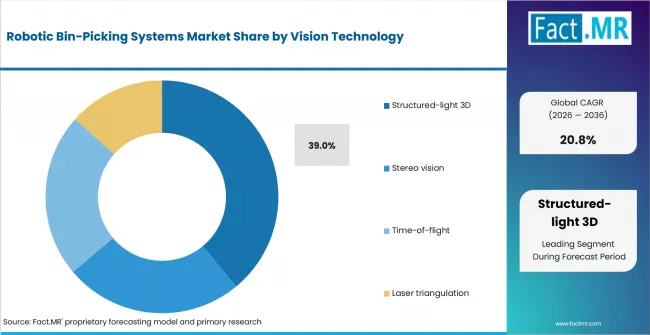
Robotic Bin Picking Systems Market Analysis By Vision Technology | Source: Fact.MR
Structured-light 3D leads Vision Technology because it captures dense surface data across uneven bins and supports accurate object localization. Its ability to handle irregular part positions strengthens robotic picking performance. IFR installation data provide broader factory-automation context for growing deployment of advanced robotic systems.
What leads the Component segment?
3D vision systems are projected to hold 44.0% share in 2026.
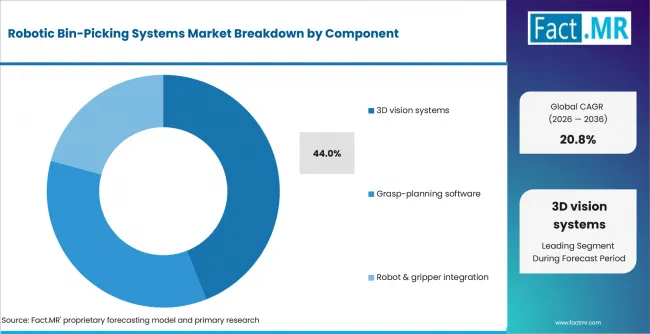
Robotic Bin Picking Systems Market Analysis By Component | Source: Fact.MR
3D vision systems lead the Component segment because reliable object localization is the first requirement for robotic bin-picking deployment. Hardware selection depends on scanning speed, surface characteristics and positioning accuracy, making robust vision systems central to identifying randomly arranged parts before grasp planning and robot movement begin.
How does Application shape demand?
Machine tending is anticipated to lead with 30.0% share in 2026.
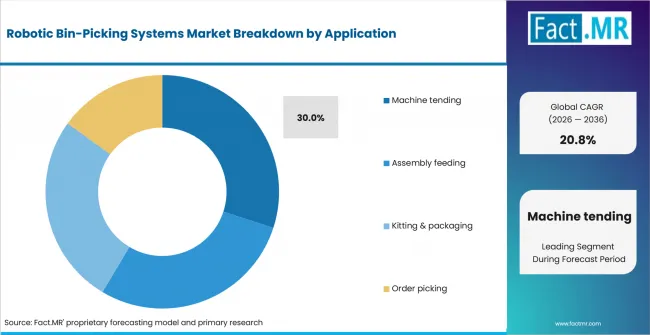
Robotic Bin Picking Systems Market Analysis By Application | Source: Fact.MR
Machine tending leads the Application segment because random-part loading reduces operator involvement around CNC machines and supports more consistent production flow. Vision-guided bin picking helps robots identify and retrieve irregularly positioned components, strengthening automation where manufacturers seek reliable unattended loading and reduced manual handling.
What supports Automotive within End-Use Industry?
Automotive is estimated to represent 28.0% share in 2026.
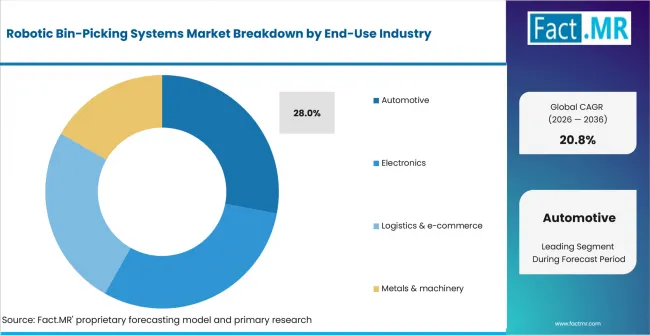
Robotic Bin Picking Systems Market Analysis By End Use Industry | Source: Fact.MR
Automotive leads the End-Use Industry segment because castings and machined components frequently arrive in bins with varying orientations. Vision-guided systems help robots identify, grasp and position these parts for downstream operations. High part variety keeps proof testing and reliable object recognition central to adoption.
What is accelerating Robotic Bin-Picking Systems Market adoption, and what is holding it back?
Random-part automation drives it; validation complexity restrains it.
Drivers Impact Analysis
| DRIVER | (~) % IMPACT ON CAGR | GEOGRAPHIC RELEVANCE | IMPACT TIMELINE |
|---|---|---|---|
| Machine tending labor relief | +4.8% | USA, Germany, Italy | Short term (<= 2 years) |
| 3D vision accuracy | +4.1% | Japan, South Korea, USA | Short term (<= 2 years) |
| E-commerce order picking | +3.6% | USA, South Korea, France | Medium term (2-4 years) |
| Simulation-led cell design | +2.8% | Japan, USA, Germany | Medium term (2-4 years) |
| End-of-line automation | +2.1% | Global manufacturing sites | Long term (>= 4 years) |
Source: Fact.MR analysis. Updated Aug 17, 2026
- 3D vision accuracy: Dense point clouds help robots choose the right grasp point. Structured-light systems are expected to gain where parts have uneven surfaces. Integrators still need sample-part trials.
- E-commerce order picking: Fulfillment sites need systems that handle changing item mixes. Software and gripper recovery are expected to decide whether pilots move into live operations.
- Simulation-led cell design: Offline testing is expected to shorten the move from trial to production. FANUC strengthened collaboration with NVIDIA in May 2026 around virtual robot operation and physics simulation.
- End-of-line automation: Depalletizing and pallet-adjacent picking are expected to expand the addressable cell base. Feed-in and feed-out areas create natural points for 3D localization.
Opportunity Impact Analysis
| OPPORTUNITY | (~) % IMPACT ON CAGR | GEOGRAPHIC RELEVANCE | IMPACT TIMELINE |
|---|---|---|---|
| Large-bin 3D camera upgrades | +2.0% | USA, Japan, Germany | Short term (<= 2 years) |
| Software-defined grasp libraries | +1.7% | South Korea and France | Medium term (2-4 years) |
| Automotive spare-parts cells | +1.3% | USA, Germany, Italy | Medium term (2-4 years) |
| Fulfillment item singulation | +1.0% | USA, France, South Korea | Long term (>= 4 years) |
Source: Fact.MR analysis. Updated Aug 17, 2026
- Large-bin 3D camera upgrades: Wider fields of view are expected to support pallet and deep-bin use. Larger robot envelopes are expected to push upgrades from short-range cameras.
- Automotive spare-parts cells: Part variety is expected to support flexible picking in service-part warehouses. Robots are expected to gain where bin contents change faster than fixtures can be built.
- Fulfillment item singulation: Parcel and carton handling is expected to create a logistics route for 3D perception. Repeatable singulation depends on item libraries and recovery routines.
Restraints Impact Analysis
| RESTRAINT | (~) % IMPACT ON CAGR | GEOGRAPHIC RELEVANCE | IMPACT TIMELINE |
|---|---|---|---|
| Part variability and lighting | -2.1% | Global | Short term (<= 2 years) |
| Safety and guarding checks | -1.7% | USA, Germany, Japan | Short term (<= 2 years) |
| Integration cost | -1.4% | Small and mid-sized plants | Medium term (2-4 years) |
| Data-library maintenance | -0.9% | Fulfillment and electronics sites | Long term (>= 4 years) |
Source: Fact.MR analysis. Updated Aug 17, 2026
- Part variability and lighting: Dark, shiny or transparent parts still require controlled testing. Poor imaging raises reject rates and slows approval. Suppliers need proof from real bins.
- Safety and guarding checks: Robot cells need guarding and recovery procedures. Plants are expected to delay approval when shared picking areas lack clear risk controls.
- Integration cost: Smaller manufacturers are expected to delay projects when fixtures, conveyors and grippers add to system cost. Commissioning still requires experienced integrators.
- Data-library maintenance: Mixed-item picking needs updated models and failure logic. Changes in packaging or part finish can reduce pick success.
Which countries are scaling Robotic Bin-Picking Systems Market fastest?
- The country comparison spans 2.20 percentage points and forms two practical growth bands across the forecast period.
- South Korea remains 1.22 percentage points above the United States as electronics automation and online fulfillment support 3D picking.
- The United States remains 0.28 percentage point above Italy because fulfillment centers and machine shops both qualify robotic cells.
- Italy remains 0.17 percentage point above Germany due to machine-tool automation and local integrator depth.
- Germany remains 0.26 percentage point above France as automotive and machinery plants support 3D picking trials.
- France remains 0.27 percentage point above Japan where domestic robot projects require careful production release.
Comparable CAGRs create different entry conditions due to installed robot base, safety checks and local engineering support. Full report coverage includes North America, Latin America, Europe, East Asia, South Asia and Pacific, Middle East and Africa.
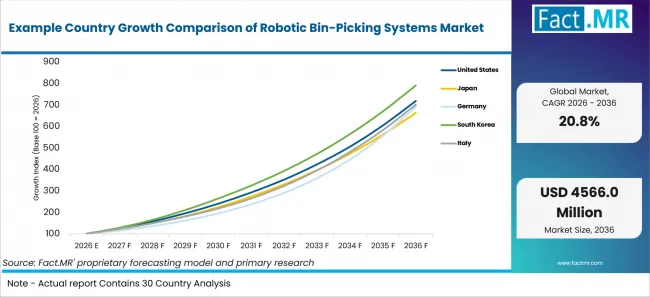
Example Country Growth Comparison Of Robotic Bin Picking Systems Market | Source: Fact.MR
| Country | CAGR (2026-2036) |
|---|---|
| South Korea | 23.0% |
| United States | 21.8% |
| Italy | 21.5% |
| Germany | 21.4% |
| France | 21.1% |
| Japan | 20.8% |
Source: Fact.MR analysis. Updated Aug 17, 2026
What supports South Korea adoption?
23.0% CAGR, supported by electronics automation and online fulfillment activity.
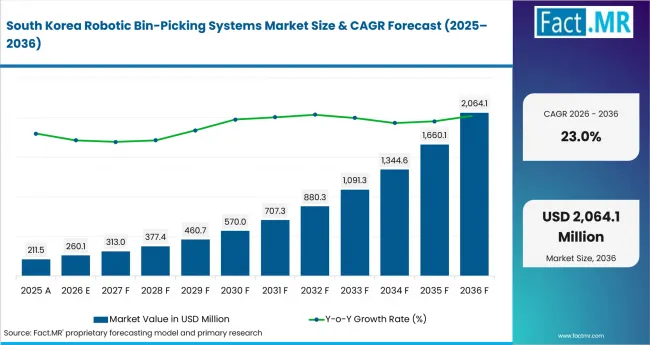
Robotic Bin Picking Systems Market Country Value Analysis | Source: Fact.MR
South Korea’s growth is reinforced by its large robotics base and electronics manufacturing strength. IFR reported that South Korea installed 30,600 industrial robots in 2024, while the country’s online shopping transaction value reached KRW 24.2904 trillion in December 2025. Electronics plants and warehouses benefit from 3D vision for mixed-part handling, although reflective components, long proof cycles and limited integrator availability can slow deployment.
How is the United States scaling demand?
21.8% CAGR, driven by fulfillment automation and machine-tending applications.
The United States benefits from broad factory automation and expanding e-commerce activity. IFR reported that the United States installed about 34,200 industrial robots in 2024, while seasonally adjusted U.S. retail e-commerce sales reached USD 326.7 billion in Q1 2026. Machine shops and automotive plants use bin picking for random-part feeding, although real-part testing, mixed-SKU variation and workplace-safety requirements can extend project qualification.
What supports Italy growth from 2026 to 2036?
21.5% CAGR, backed by machine-tool automation and strong integrator depth.
Italy’s outlook is shaped by machine-tool production, metalworking and flexible factory layouts. UCIMU reported that Italian production of machine tools, robots and automation systems reached EUR 6,391 million in 2025, while Istat reported that Italy’s online retail sales increased 3.1% year over year in December 2025. Compact bin-picking cells fit machining environments, although custom tooling, workplace-safety requirements and engineering intensity can restrain adoption among smaller manufacturers.
How is Germany developing demand?
21.4% CAGR, shaped by automotive, machinery and factory automation.
Germany’s growth reflects a highly automated manufacturing base and strong machinery activity. IFR reported that Germany had 449 operational industrial robots per 10,000 manufacturing employees in 2024, while Destatis reported that German new orders in manufacturing increased 6.4% month over month in December 2025 after revision. Structured-light systems suit complex castings and stamped parts, although phased capital spending, changing customer parts and commissioning complexity can delay projects.
What supports France adoption?
21.1% CAGR, supported by logistics infrastructure and manufacturing automation.
France benefits from extensive logistics infrastructure and widespread online purchasing. Bin-picking systems support mixed-part and parcel handling, although item-library preparation, shared-worker environments and weaker manufacturing output can slow deployment.
How does Japan perform?
20.8% CAGR, led by robot supply strength and established automation expertise.
Japan’s outlook is supported by its robotics industry and strong electronics and automotive manufacturing base. JARA reported that robot orders reached 218,987 units in Japan’s robot industry in 2025, up 20.0% year over year, while METI reported that Japan’s domestic B2C e-commerce market reached JPY 26.1 trillion in 2024. Established controller expertise supports precise bin picking, although compact factory layouts, reflective components and lengthy production trials can extend adoption cycles.
Who leads the Robotic Bin-Picking Systems Market?
Official company materials confirm directly relevant bin-picking, 3D-vision or robotic-picking offerings from FANUC, Zivid, Mujin, Photoneo, Keyence and Fizyr.
Official company materials show FANUC robot-vision capability, Zivid industrial 3D cameras for bin-picking, Mujin robot-control software, Photoneo bin-picking software and 3D sensing, Keyence 3D vision-guided robotic bin-picking, and Fizyr AI vision software. Fizyr also announced a June 2025 partnership with Yaskawa Europe and Bonetto Automation.
Which companies are the key providers?
Key companies include FANUC Corporation, Zivid AS, Mujin Corporation, Zebra Technologies (Photoneo), Keyence Corporation, and Fizyr B.V.
- FANUC Corporation
- Zivid AS
- Mujin Corporation
- Zebra Technologies (Photoneo)
- Keyence Corporation
- Fizyr B.V.
Bibliography
- U.S. Bureau of Labor Statistics. (2026, January 22). Employer-reported workplace injuries and illnesses, 2023–2024.
- U.S. Census Bureau. (2026, May 18). Quarterly retail e-commerce sales: 1st quarter 2026.
- Federal Statistical Office (Destatis). (2026, February 5). New orders in manufacturing in December 2025: +7.8% on the previous month.
- FANUC Corporation. (2026, May 15). FANUC strengthens collaboration with NVIDIA.
- Fizyr B.V. (2025, June 25). Fizyr and Yaskawa Europe announce new partnership with Bonetto Automation.
- Germany Trade & Invest. (2025, September 29). Germany is Europe’s leading robotics nation.
- Institut national de la statistique et des études économiques. (2025, December 2). Achat sur Internet selon l’âge [Internet purchases by age].
- Institut national de la statistique et des études économiques. (2026, February 5). In December 2025, manufacturing output fell back sharply (-0.8%).
- International Federation of Robotics. (2025, September 25). Global robot demand in factories doubles over 10 years.
- Istat. (2026, February 5). Retail trade – December 2025.
- Ministry of Data and Statistics. (2026, February 2). Online shopping in December 2025.
- Ministry of Economy, Trade and Industry. (2025, August 26). Results of FY2024 E-Commerce Market Survey compiled.
This Report Answers
- The report provides strategic intelligence on robotic bin-picking systems across manufacturing cells and logistics robots where randomized objects require 3D localization.
- Scope connects bin-picking cells with automated material handling where feed-in points and order-picking stations need flexible item movement.
- Technology assessment links random-part manipulation with factory robots used in machine tending and assembly feeding.
- Category context compares robotic cell coverage with bin picking systems where 3D vision and grasp planning define the random-part picking boundary.
- Component coverage connects 3D cameras and grippers with industrial robot components that shape cell performance.
- Control assessment includes robot control systems because grasp planning must translate image data into recoverable motion.
- Robot form-factor context references articulated robots used around bins, pallets and machining centers.
- Vision context includes robot vision systems where cameras and software decide object position before a pick.
- Depth-sensing coverage links structured-light and stereo systems with 3D machine vision used for surface and shape recognition.
- End-of-line context references automatic palletizer and depalletizer applications where large-bin camera range becomes relevant.
What does the Robotic Bin-Picking Systems Market cover?
Robotic bin-picking systems cover hardware and software that identify, plan and pick parts from bins without fixed orientation. Coverage includes 3D cameras, grasp-planning software, grippers and integration work. Systems are included when revenue is tied to random-part picking or cell integration.
What is included in the scope?
The scope includes structured-light 3D, stereo vision, time-of-flight and laser triangulation.
It includes 3D vision systems, grasp-planning software and robot-gripper integration. Application coverage spans machine tending, assembly feeding, kitting and packaging, and order picking.
What is excluded from the scope?
The scope excludes general industrial robots without bin-picking vision or random-part grasp planning.
It excludes warehouse software and fixed conveyor sortation unless revenue is tied to robotic bin-picking. Machine-vision inspection is excluded when it does not guide a robot pick.
How Was the Analysis Built?
The analysis draws on 120+ sources, 35+ company portfolios, 25+ countries, and more than 20 industry interviews.
- Primary Research: Primary research includes discussions with manufacturers, service providers, technology developers, distributors, end users, procurement teams, and subject-matter experts. These conversations examine purchasing priorities, product adoption, operational challenges, approval requirements, competitive positioning, and the factors that influence wider market acceptance.
- Desk Research: Desk research covers government statistics, regulatory publications, company filings, trade data, technical studies, industry associations, standards, public policy, and other authoritative sources. Every source used in the analysis is documented in the bibliography.
- Market Sizing and Forecasting: Market estimates combine historical performance, demand indicators, pricing and volume trends, segment shares, company participation, country-level growth, adoption patterns, investment activity, and barriers to market expansion.
- Data Validation and Update Cycle: Findings are validated by comparing primary interviews with public data, company activity, regulatory changes, trade patterns, and industry developments. Regular updates review new product launches, capacity changes, partnerships, approvals, procurement trends, and shifts in commercial adoption.
Segmentation
What is the report’s scope and coverage?
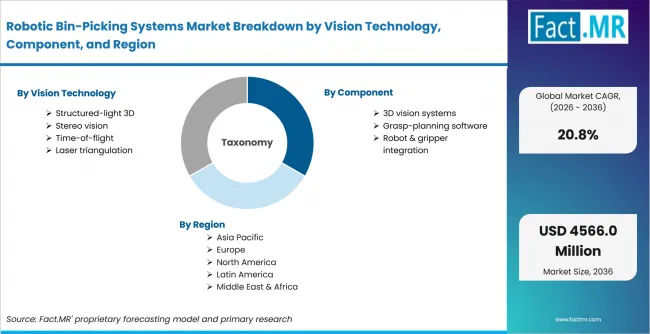
Robotic Bin Picking Systems Market Breakdown By Vision Technology Component And Region | Source: Fact.MR
| Attribute | Details |
|---|---|
| Quantitative Units | USD million |
| Market Definition | Robotic cells that combine 3D vision, grasp planning, robot motion, grippers and integration work to pick randomly arranged parts from bins |
| Vision Technology | Structured-light 3D; Stereo vision; Time-of-flight; Laser triangulation |
| Component | 3D vision systems; Grasp-planning software; Robot and gripper integration |
| Application | Machine tending; Assembly feeding; Kitting and packaging; Order picking |
| End-Use Industry | Automotive; Electronics; Logistics and e-commerce; Metals and machinery |
| Regions Covered | North America; Latin America; Europe; East Asia; South Asia and Pacific; Middle East and Africa |
| Countries Covered | United States; Japan; Germany; South Korea; Italy; France |
| Key Companies Profiled | FANUC Corporation; Zivid AS; Mujin Corporation; Zebra Technologies (Photoneo); Keyence Corporation; Fizyr B.V. |
| Forecast Period | 2026 to 2036 |
| Approach | Hybrid top-down and bottom-up approach using industrial robot installations; e-commerce activity; manufacturing indicators; 3D vision product developments; integrator activity; country adoption patterns; safety constraints and company portfolio review |
Source: Fact.MR analysis. Updated Aug 17, 2026
How is the market segmented?
-
By Vision Technology:
- Structured-light 3D
- Stereo vision
- Time-of-flight
- Laser triangulation
-
By Component:
- 3D vision systems
- Grasp-planning software
- Robot and gripper integration
-
By Application:
- Machine tending
- Assembly feeding
- Kitting and packaging
- Order picking
-
By End-Use Industry:
- Automotive
- Electronics
- Logistics and e-commerce
- Metals and machinery
-
By Region:
- North America
- Latin America
- Europe
- East Asia
- South Asia and Oceania
- Middle East and Africa
Frequently Asked Questions
How big is the robotic bin-picking systems market in 2026?
What is the CAGR of the robotic bin-picking systems market from 2026 to 2036?
Which vision technology leads the robotic bin-picking systems market?
Which component leads the robotic bin-picking systems market?
Who are the leading companies in the robotic bin-picking systems market?
Who worked on this report


Preview the report firsthand - request a free sample
Free SampleGet the brochure for pricing and purchase details
Download PDF