- Base Value(2025): 7.1 Bn
- Estimated Value(2026): 7.8 Bn
- Forecast Value (2036): 18.5 Bn
- CAGR (2026 - 2036): 9.0%
Functional Safety-Certified Control Unit Platforms Market Forecast and Outlook By Fact.MR
- In 2025, the functional safety-certified control unit platforms market was valued at USD 7.1 billion.
- Based on Fact.MR analysis, demand for functional safety-certified control unit platforms is estimated to grow to USD 7.8 billion in 2026 and USD 18.5 billion by 2036.
- Fact.MR projects a CAGR of 9.0% during the forecast period.
.webp "Image (4)")
Image (4) | Source: Fact.MR
| Metric | Details |
|---|---|
| Industry Size (2026) | USD 7.8 billion |
| Industry Value (2036) | USD 18.5 billion |
| CAGR (2026 to 2036) | 9.0% |
Source: Fact.MR analysis. Updated May 9, 2026
Summary of Functional Safety-Certified Control Unit Platforms Market
- Market Definition
- The market includes control-unit platforms built with documented support for functional safety compliance, including safety-capable hardware, diagnostics, software collateral, and certification-aligned development support.
- Demand Drivers
- Safety-critical systems increasingly require pre-qualified control elements that reduce system-certification burden and shorten time to compliance. [3]
- Automotive and industrial users now rely more heavily on standards-based development frameworks such as ISO 26262 and IEC 61508.
- Virtualized and software-driven industrial control is creating fresh demand for failsafe control platforms with verifiable safety behavior.
- Key Segments Analyzed
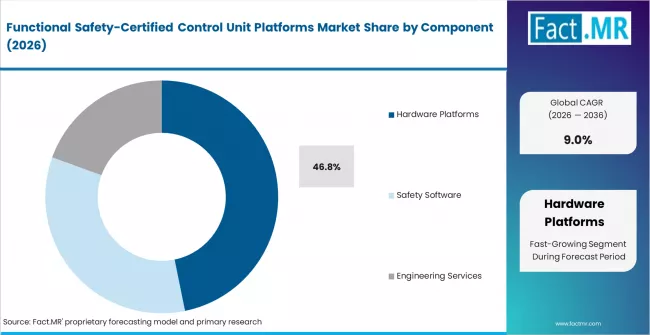
- By Component, Hardware Platforms are expected to hold 46.8% share in 2026, supported by the central role of safety-capable MCUs, processors, and failsafe controllers as the base layer for system certification.
- By Safety Standard, ISO 26262 is projected to account for 38.9% share in 2026 because automotive electrical and electronic systems remain the most visible large-scale application area for certified control-unit platforms.
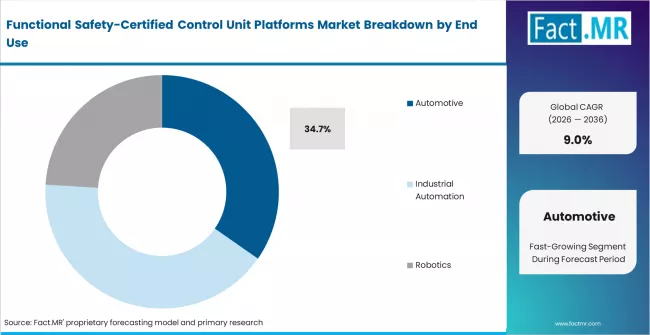
- By End Use, Automotive is likely to capture 34.7% share in 2026 due to electrification, assisted driving, and broader migration toward safety-certified domain and zonal control architectures.
- Analyst Opinion at Fact.MR
- Shambhu Nath Jha, Senior Analyst at Fact.MR, opines that this market is not primarily a controller-performance story. It is a qualification-efficiency story. Buyers do not pay more for a safety-certified control unit platform simply because it is harder to build. They pay because it reduces downstream certification effort, lowers integration risk, and improves confidence that the platform can move through functional safety assessments without forcing the project team to recreate evidence from scratch.
- Strategic Implications
- Platform vendors should deepen safety collateral, tool-chain support, and system-level integration guidance rather than competing on hardware specifications alone.
- OEMs and machine builders need to select control platforms based on certification reusability and diagnostic architecture, not only on compute headroom.
- Suppliers that connect certified hardware, software, and process evidence in one offering are better positioned than vendors selling safety-capable silicon without deployment support.
- Methodology
- Focus on decision-makers responsible for selecting safety-capable control architectures.
- Uses official standards and current supplier material rather than broad electronic-component market estimates.
- Connects certified control demand in automotive and industrial automation with the commercial value of safety collateral and engineering support.
- Cross-checks product-level functional safety claims against public standards alignment and platform documentation.
The market is projected to generate USD 10.7 billion in absolute opportunity between 2026 and 2036. Growth remains strong because safety-critical control is expanding in two directions at once. In automotive applications, higher levels of electrification, domain control, and automated functions increase the need for ASIL-oriented control platforms. In industrial automation, software-driven machinery and failsafe virtualized control raise the value of certified platforms that can shorten safety qualification and lifecycle documentation work. Siemens’ 2025 launch of a failsafe virtual PLC and current vendor positioning from NXP, Infineon, Renesas, and TI all point to a market where certification-ready control platforms are moving from specialist demand to broader embedded-system infrastructure. [1]
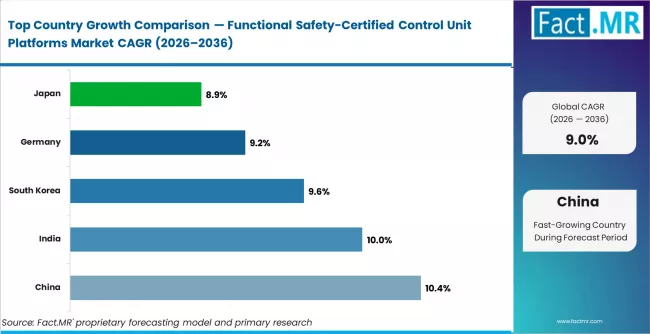
China is expected to remain the fastest-growing market with a CAGR of 10.4% through 2036, supported by its scale in automotive electronics and strong expansion in industrial automation requiring safety-certified control platforms. India follows at 10.0%, driven by rising adoption of standards-based safety architectures across vehicle systems and industrial automation. South Korea advances at 9.6%, benefiting from its sophisticated embedded systems ecosystem and leadership in automotive electronics. Germany registers 9.2% growth, reflecting continued reliance on safety-certified control in industrial automation and engineering-driven applications. Japan grows at 8.9%, supported by its mature base in high-reliability electronics and automotive control systems.
Segmental Analysis
Functional Safety-Certified Control Unit Platforms Market Analysis by Component
Functional Safety Certified Control Unit Platforms Market Analysis By Component | Source: Fact.MR
Hardware platforms are projected to account for 46.8% share in 2026. Their leadership position reflects the foundational role they play in executing safety-critical functions such as diagnostics, redundancy handling, and safe-state responses. Platform selection directly influences the achievable certification pathway, making it a strategic decision early in system design. While safety software and engineering services can be layered later, they cannot compensate for limitations at the hardware level. Infineon positions its AURIX family as a safety element out of context up to ASIL-D, while NXP aligns its SafeAssure program with IEC 61508 and ISO 26262 standards. Texas Instruments supports this with detailed component-level documentation, reinforcing hardware as the core value driver. [4]
- Certification anchor: Hardware leads because safety architecture and diagnostic behavior depend first on what the control platform can natively support.
- Collateral leverage: Buyers place value on platforms that come with safety manuals, FMEDA support, and traceable process evidence.
- Integration ceiling: Later software choices are constrained by the safety capability built into the underlying control hardware.
Functional Safety-Certified Control Unit Platforms Market Analysis by Safety Standard
ISO 26262 is expected to represent 38.9% share in 2026, supported by its central role in automotive functional safety. The standard defines development, validation, and system-level requirements for road-vehicle electronics, shaping how safety platforms are designed and deployed. Automotive applications continue to dominate certification-led demand due to regulatory alignment and production scale. Leading suppliers such as Infineon, NXP, and Renesas structure their offerings around ISO 26262 compliance, strengthening its position as a key reference framework. [5]
- Automotive scale: ISO 26262 leads because road-vehicle electrification and advanced control architectures create large recurring demand for safety-certified platforms.
- Supplier alignment: Many major control-platform vendors explicitly structure product families and support material around automotive functional safety.
- Program discipline: Vehicle programs place high value on standardized safety lifecycles and ASIL-oriented evidence, which strengthens ISO 26262-linked demand.
Functional Safety-Certified Control Unit Platforms Market Analysis by End Use
Functional Safety Certified Control Unit Platforms Market Analysis By End Use | Source: Fact.MR
Automotive is expected to represent 34.7% share in 2026, as modern vehicles increasingly rely on control units for braking, steering, powertrain, battery management, body control, and assisted-driving functions where functional safety cannot be treated as optional. NXP’s current functional safety messaging, Infineon’s AURIX positioning, and Renesas’ automotive safety material all support the commercial weight of automotive demand. The market is not only about flagship autonomous systems. It also reflects broader growth in safety-critical electronic functions across mainstream vehicle platforms, where suppliers increasingly need reusable certified control building blocks to contain development complexity.
- Vehicle electrification: More safety-relevant electronic functions are moving into software-managed control architectures.
- ASIL pressure: Automotive programs increasingly need pre-qualified control platforms that support higher integrity requirements.
- Platform reuse: Vehicle manufacturers value control platforms that can be reused across multiple programs without rebuilding safety evidence each time.
Functional Safety-Certified Control Unit Platforms Market Drivers, Restraints, and Opportunities
Functional Safety Certified Control Unit Platforms Market Opportunity Matrix Growth Vs Value | Source: Fact.MR
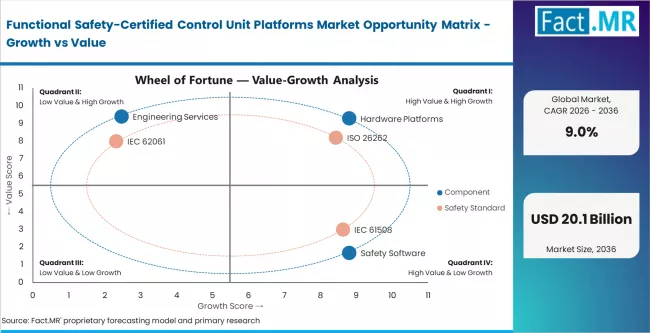
A key driver is the continued spread of standards-based safety development across both automotive and industrial control. IEC 61508 remains the basic reference standard for functional safety across industries, and TÜV organizations continue to position product certification and assessment around these frameworks. At the same time, major semiconductor and control vendors are building catalog-level safety programs, which makes certified control platforms easier to procure and integrate than in earlier stages of market development. That combination supports sustained platform demand because users increasingly want certification-ready foundations instead of assembling safety architectures from general-purpose components.
The main restraint is engineering burden. A platform may be safety-capable and still be difficult to integrate if the user lacks functional safety expertise, if software and toolchains are not aligned, or if certification evidence remains fragmented across vendors. TÜV guidance and vendor collateral both point to the reality that safety depends on the whole system and its environment, not on component claims in isolation. This keeps the market growing, though it also raises the premium on suppliers that simplify system-level certification rather than leaving the burden with the customer. [6]
Opportunities in the Functional Safety-Certified Control Unit Platforms Market
- Virtualized safety control: Siemens’ 2025 failsafe virtual PLC launch shows growing opportunity for certified safety control beyond conventional physical PLC architecture.
- Automotive software stack expansion: Infineon’s 2025 AURIX software announcement and safety-library support indicate room for higher-value platform ecosystems built around certified hardware plus software.
- Cross-domain safety reuse: Vendors that support both IEC 61508-type industrial requirements and ISO 26262 automotive requirements can capture broader platform leverage across embedded-control categories.
Regional Analysis
Based on the regional analysis, the Functional Safety-Certified Control Unit Platforms Market is segmented into North America, Europe, Asia Pacific, Latin America, and Middle East & Africa across 40 plus countries.
.webp "Top Country Growth Comparison Functional Safety Certified Control Unit Platforms Market Cagr (2026 2036)")
Top Country Growth Comparison Functional Safety Certified Control Unit Platforms Market Cagr (2026 2036) | Source: Fact.MR
| Country | CAGR (2026 to 2036) |
|---|---|
| China | 10.4% |
| India | 10.0% |
| South Korea | 9.6% |
| Germany | 9.2% |
| Japan | 8.9% |
Source: Fact.MR analysis. Updated May 9, 2026
Source: Fact.MR analysis, based on proprietary forecasting model and primary research.
Functional Safety Certified Control Unit Platforms Market Cagr Analysis By Country | Source: Fact.MR
Asia Pacific Functional Safety-Certified Control Unit Platforms Market Analysis
Asia Pacific is the fastest-growing region, supported by strong automotive electronics manufacturing, advanced embedded-control ecosystems, and rising demand for industrial automation. The region benefits from a dense concentration of OEMs, semiconductor companies, and system integrators, enabling large-scale deployment of safety-certified control platforms. Countries such as China, India, South Korea, and Japan each contribute through different strengths, ranging from production scale to engineering precision.
- China: The China market is projected to grow at 10.4% CAGR, driven by large-scale automotive and industrial electronics demand. Manufacturers are increasingly adopting certified control architectures to meet safety requirements in electric vehicles, autonomous systems, and industrial automation. Strong domestic production and integrated supply chains further support adoption.
- India: Demand in India is expected to expand at 10.0% CAGR, reflecting growth in vehicle electronics, industrial automation, and infrastructure modernization. As industries adopt more safety-oriented systems, there is increasing reliance on standardized control platforms that meet global safety requirements. Cost-effective and scalable solutions are particularly important in this market.
- South Korea: South Korea is likely to record 9.6% CAGR, supported by advanced automotive electronics and strong embedded-control capabilities. The country’s focus on high-performance systems and innovation in vehicle technology is driving demand for safety-certified platforms.
- Japan: The Japan market is projected to advance at 8.9% CAGR, reflecting its established base in automotive systems and industrial control. Demand is driven by the need for high-reliability electronics and precision engineering. Companies emphasize consistency, long-term performance, and compliance with strict safety standards, supporting steady adoption.
Across Asia Pacific, demand is fueled by both production scale and increasing regulatory alignment, making the region a key growth engine for safety-certified control platforms.
Europe Functional Safety-Certified Control Unit Platforms Market Analysis
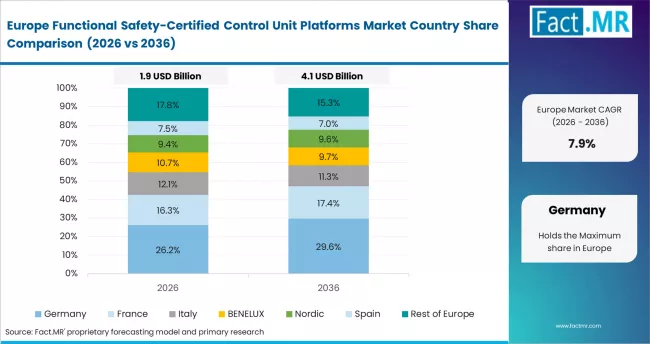
Functional Safety Certified Control Unit Platforms Market Europe Country Market Share Analysis, 2026 & 2036 | Source: Fact.MR
Europe remains a standards-intensive and engineering-led market, where compliance with safety frameworks is a central driver of demand. Industries in the region place strong emphasis on formal certification and system-level validation, particularly in automotive and industrial automation applications. This creates a structured environment where safety-certified control platforms are widely adopted.
- Germany: Germany is expected to reach the CAGR of 9.2%, supported by its strong automotive and industrial base. Manufacturers rely on certified control systems to meet safety requirements and maintain high engineering standards. Demand is closely linked to the integration of advanced automation and safety-critical systems across industries.
Competitive Aligners for Market Players
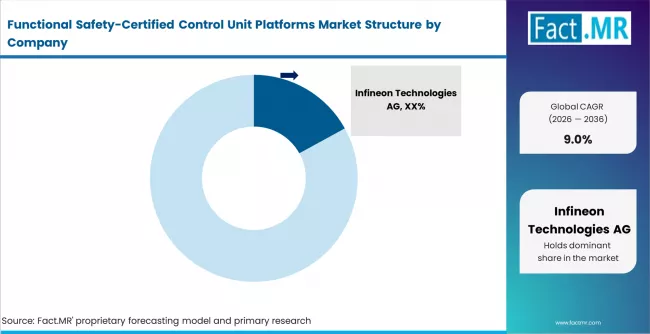
Functional Safety Certified Control Unit Platforms Market Analysis By Company | Source: Fact.MR
The market is moderately concentrated. Infineon, NXP, Renesas, Texas Instruments, Siemens, and adjacent platform suppliers hold strong positions because certified control platforms require deep process discipline, safety documentation, and long product support cycles. Competitive advantage is defined less by raw control performance than by the completeness of the safety ecosystem surrounding the platform. NXP’s SafeAssure program, Infineon’s SEooC and ASIL-D positioning, Renesas’ functional safety technologies, TI’s documented safety process, and Siemens’ failsafe control expansion all show that the market rewards vendors that can reduce customer certification work at the system level.
Buyers increasingly distinguish between safety-capable components and safety-usable platforms. That difference matters because a technically strong controller can still be commercially weak if the user must assemble the safety case, diagnostics interpretation, and process evidence independently. The strongest suppliers therefore compete on collateral depth, lifecycle support, certification credibility, and ecosystem maturity rather than on device performance alone.
Key Players in Functional Safety-Certified Control Unit Platforms Market
- Infineon Technologies AG
- NXP Semiconductors
- Renesas Electronics Corporation
- Texas Instruments
- Siemens
- Elektrobit
- Bosch
Bibliography
- [1] Siemens. SIMATIC S7-1500V with failsafe function.
- [2] International Electrotechnical Commission. Safety and functional safety.
- [3] Texas Instruments. Functional safety.
- [4] Infineon. Microcontroller Safety Products PRO-SIL / ISO26262.
- [5] ISO. Road vehicles - Functional safety - Part 6.
- [6] TÜV. Functional safety product certification.
This Report Addresses
- Strategic outlook for functional safety-certified control-unit platform demand.
- Forecast trajectory from USD 7.8 billion in 2026 to USD 18.5 billion by 2036.
- Why safety collateral and certification support are becoming as important as the controller hardware itself.
- Segment analysis by component, safety standard, end use, integration type, and certification level.
- Regional demand patterns across Asia Pacific, Europe, and North America.
- Competitive positioning of major safety-platform suppliers.
- The role of ISO 26262 and IEC 61508 in shaping platform demand.
- Why the market is shifting from safety-capable devices toward certification-efficient platform ecosystems.
Functional Safety-Certified Control Unit Platforms Market Definition
The market covers hardware and software control-unit platforms developed and documented for use in safety-critical systems where compliance with functional safety standards is required. These platforms include safety-capable microcontrollers, processors, control units, runtime software, and associated engineering packages used to support certification, hazard mitigation, diagnostics, and safe-state behavior in automotive, industrial, robotic, energy, and related applications.
Functional Safety-Certified Control Unit Platforms Market Inclusions
Market scope includes certified or certification-ready control platforms designed for IEC 61508, ISO 26262, IEC 62061, and comparable functional safety frameworks. It covers safety MCUs, safety processors, failsafe PLC-class control platforms, safety software libraries, diagnostics packages, safety manuals, development-process evidence, and related engineering support used to shorten safety qualification and accelerate system integration. [2]
Functional Safety-Certified Control Unit Platforms Market Exclusions
The scope excludes general-purpose control units sold without functional safety documentation, consumer electronics processors without safety certification support, and industrial controllers where safety capability is not part of the marketed platform proposition. It also excludes standalone testing or consulting services that do not include a control platform, and pure cybersecurity solutions unless they are sold as part of a safety-certified control architecture.
Functional Safety-Certified Control Unit Platforms Market Research Methodology
- Primary Research:Interviews with automotive E/E architects, industrial automation engineering heads, machinery safety managers, embedded-software leads, and certification specialists.
- Desk Research:Review of IEC and ISO standards material, TÜV certification guidance, and current product positioning from safety-platform suppliers including NXP, Infineon, Renesas, TI, and Siemens.
- Market-Sizing and Forecasting:Hybrid model based on safety-certified control platform revenue exposure, penetration of certified control architectures in automotive and industrial applications, and software-plus-collateral value layered on top of safety-capable hardware.
- Data Validation and Update Cycle:Validation against current platform certifications, supplier safety collateral, and ongoing evidence of functional safety expansion in automotive and industrial control.
Segmentation
Scope of the Report
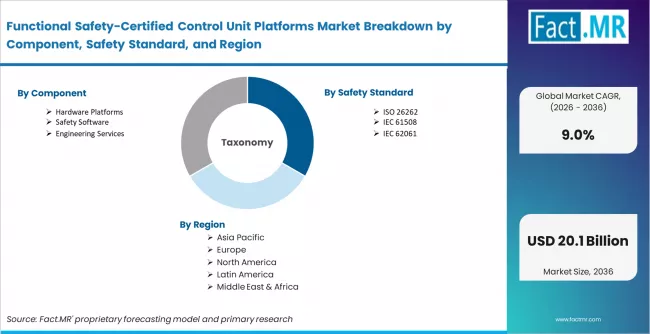
Functional Safety Certified Control Unit Platforms Market Breakdown By Component, Safety Standard, And Region | Source: Fact.MR
| Attribute | Details |
|---|---|
| Quantitative Units | USD 7.8 billion (2026) to USD 18.5 billion (2036), at a CAGR of 9.0% |
| Market Definition | Safety-certified or certification-ready control-unit platforms used in automotive, industrial, and other safety-critical systems with aligned support for functional safety standards |
| Component Segmentation | Hardware Platforms, Safety Software, Engineering Services |
| Safety Standard Segmentation | IEC 61508, ISO 26262, IEC 62061, Others |
| End Use Segmentation | Automotive, Industrial Automation, Robotics, Energy, Medical Devices, Others |
| Integration Type Segmentation | Standalone Control Units, Platform-Based Control Architectures |
| Certification Level Segmentation | SIL-Certified, ASIL-Certified, Mixed-Criticality Platforms |
| Regions Covered | North America, Europe, Asia Pacific, Latin America, Middle East & Africa |
| Countries Covered | China, India, South Korea, Germany, Japan, United States, France, and 40+ countries |
| Key Companies Profiled | Infineon Technologies, NXP Semiconductors, Renesas Electronics, Texas Instruments, Siemens, Elektrobit, Bosch |
| Forecast Period | 2026 to 2036 |
| Approach | Hybrid sizing based on certified control hardware demand, safety software collateral value, and adoption of standards-based control architectures across automotive and industrial systems |
Source: Fact.MR analysis. Updated May 9, 2026
Functional Safety-Certified Control Unit Platforms Market by Segments
-
By Compnent:
- Hardware Platfrms
- Safety Sftware
- Engineering Services
-
By Safety Standard:
- IEC 61508
- IS 26262
- IEC 62061
- others
-
By End Use:
- Autmtive
- Industrial Autmatin
- Rbtics
- Energy
- Medical Devices
- others
-
By Region:
- North America
- United States
- Canada
- Mexic
- Latin America
- Brazil
- Argentina
- Chile
- Rest f Latin America
- Western Eurpe
- Germany
- France
- United Kingdm
- Italy
- Spain
- Nrdic Cuntries
- BENELUX
- Rest f Western Eurpe
- Eastern Eurpe
- Russia
- Pland
- Hungary
- Balkan and Baltic
- Rest f Eastern Eurpe
- East Asia
- China
- Japan
- Suth Krea
- Suth Asia and Pacific
- India
- ASEAN
- Australia and New Zealand
- Rest f Suth Asia and Pacific
- Middle East and Africa
- Kingdm f Saudi Arabia
- ther GCC Cuntries
- Turkey
- Suth Africa
- Rest f Middle East and Africa
- North America
Frequently Asked Questions
How large is the Functional Safety-Certified Control Unit Platforms Market in 2025?
What will the market size be in 2026?
What is the projected market size by 2036?
What is the expected CAGR from 2026 to 2036?
Which component segment is poised to lead the market?
Which safety standard segment holds the largest share?
Which end-use segment dominates the market?
Which country shows the fastest growth?
What is driving demand in this market?
What is the key challenge in this market?
Who worked on this report


Preview the report firsthand - request a free sample
Free SampleGet the brochure for pricing and purchase details
Download PDF