- Market size in 2025: USD 322 million
- Estimated market size in 2026: USD 345 million
- Projected market size by 2036: USD 963 million
- CAGR (2026-2036): 10.8%
What is the scalp microbiome sprays market forecast to be worth by 2036?
USD 345 million in 2026 to USD 963 million by 2036, at 10.8% CAGR.
- The scalp microbiome sprays market reached a valuation of USD 322 million in 2025.
- Demand is expected to increase from USD 345 million in 2026 to USD 963 million by 2036.
- The market is forecast to record 10.8% CAGR during the forecast period as consumers adopt scalp care products designed to balance the scalp microbiome and strengthen the skin barrier.
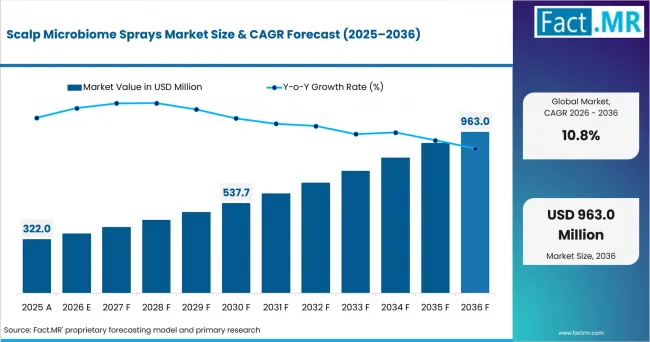
Scalp Microbiome Sprays Market Market Value Analysis | Source: Fact.MR
What are the defining numbers behind scalp microbiome sprays market growth?
USD 618 million absolute opportunity by 2036, led by microbiome balancing formulations and scalp first treatment routines.
- Demand Drivers in the Market
- Consumers increasingly seek products that maintain a healthy scalp microbiome and strengthen barrier function.
- Beauty brands continue expanding microbiome focused scalp care portfolios with advanced ingredients.
- Dermatologists increasingly recommend microbiome friendly scalp products for sensitive scalp conditions.
- Digital beauty platforms improve awareness of scalp first treatment routines.
- Key Segments Analyzed
- By Microbiome Mechanism: Prebiotic support is expected to hold 34.0% share in 2026 because it supports beneficial scalp microorganisms.
- By Active Base: Prebiotics are projected to capture 31.0% share in 2026 because they remain the leading microbiome supporting ingredient.
- By Hair Concern: Barrier repair is likely to account for 29.0% share in 2026 because consumers increasingly prioritize long term scalp health.
- By Channel: Prestige beauty leads because premium scalp treatments continue expanding through specialty beauty retailers. The segment is expected to hold 38.0% share in 2026.
- By Geography: The United States is projected to record 11.4% CAGR through 2036 as microbiome focused scalp care continues expanding.
- Analyst Opinion at Fact.MR
- Shambhu Nath Jha, Senior Analyst at Fact.MR, states, "Scalp microbiome sprays are becoming an important part of premium scalp care as consumers move toward prevention instead of symptom management. Companies that combine microbiome science with effective barrier repair ingredients will strengthen their competitive position."
- Strategic Implications
- Haircare companies should invest in microbiome friendly formulations supported by scientific research.
- Premium beauty brands should educate consumers about microbiome focused scalp care.
- Retailers should create dedicated scalp wellness sections for microbiome products.
- Manufacturers should combine microbiome supporting ingredients with barrier repair technologies to improve treatment performance.
Scalp microbiome sprays sit inside the wider premium haircare industry because they provide targeted scalp treatment instead of conventional cleansing. The category differs from traditional scalp tonics because these sprays focus on supporting beneficial microorganisms while improving scalp health through microbiome friendly ingredients.
Beauty brands continue introducing microbiome sprays formulated with prebiotics, postbiotics, fermented ingredients and barrier supporting actives. These products help improve scalp balance while addressing dryness, flakes and sensitivity. Growing awareness of scalp microbiome health continues supporting premium haircare product demand.
The United States is projected to record 11.4% CAGR through 2036 as consumers increasingly adopt microbiome focused scalp treatments. Germany is expected to post 11.1% CAGR through 2036 as dermocosmetic scalp care expands. Japan is likely to record 10.8% CAGR as scalp wellness routines become more common. China is forecast to advance at 10.5% CAGR as premium scalp care gains wider acceptance. India is set to record 10.2% CAGR as digital beauty platforms improve access to advanced scalp care products.
How does the scalp microbiome sprays market break down by segment?
Prebiotic support leads at 34.0%. Barrier repair leads at 29.0%.
Which microbiome mechanism dominates?
Prebiotic support holds 34.0% share in 2026.
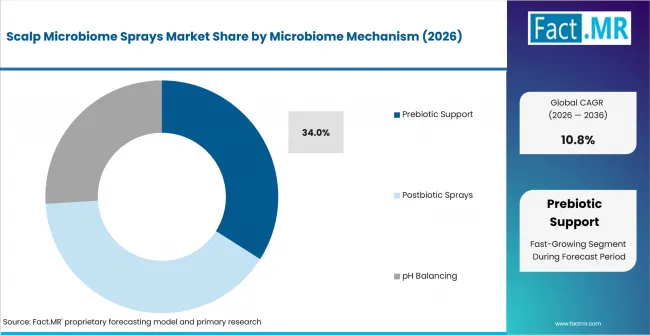
Scalp Microbiome Sprays Market Analysis By Microbiome Mechanism | Source: Fact.MR
Prebiotic support is expected to hold 34.0% share in 2026 because it helps maintain a balanced scalp microbiome by supporting beneficial microorganisms. Consumers increasingly prefer products that improve scalp health without disrupting the natural microbiome. Postbiotic sprays strengthen scalp comfort and hydration. pH balancing formulations help maintain healthy scalp conditions. Unilever's premium anti-dandruff brand CLEAR launched its ScalpCeuticals Pro Range globally at TANK Shanghai. The range includes a Scalp Massage Essence (a leave-on treatment, not strictly a spray) that helps repair the scalp barrier and create an invisible shield against dandruff. [1]
Which active base dominates?
Prebiotics dominate with 31.0%.
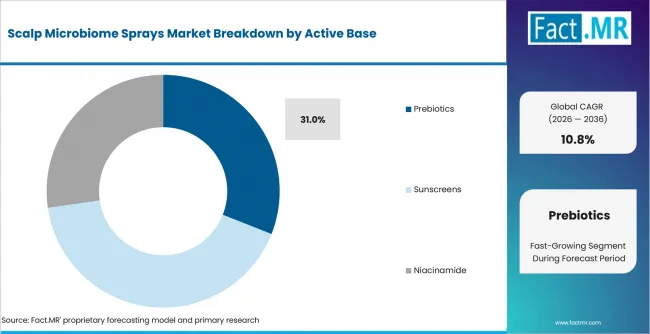
Scalp Microbiome Sprays Market Analysis By Active Base | Source: Fact.MR
Prebiotics are projected to capture 31.0% share in 2026 because they remain the most widely used microbiome supporting ingredient. Beauty brands increasingly combine prebiotics with complementary actives to improve scalp balance. Ceramides strengthen barrier repair. Niacinamide supports sebum control and scalp comfort. Peptides improve premium positioning. Sunscreens help protect the scalp from UV exposure. Fermented ingredients support microbiome diversity and hydration. Unilever launched the Dove DermaCare range in Mexico, developed with dermatologists and featuring glycerine (a known prebiotic) and niacinamide to promote a healthy scalp microbiome. The range includes scalp serums and treatments. [2]
Which hair concern dominates?
Barrier repair holds 29.0% share in 2026.
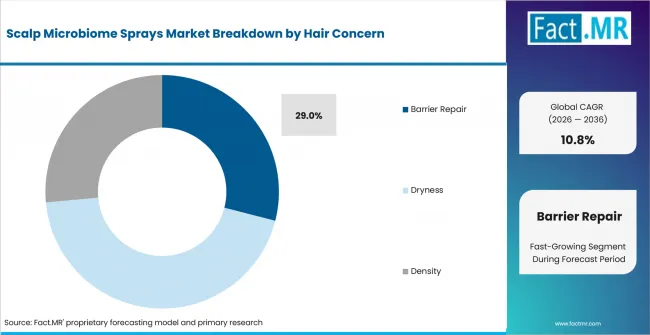
Scalp Microbiome Sprays Market Analysis By Hair Concern | Source: Fact.MR
Barrier repair leads because consumers increasingly recognize the importance of maintaining a healthy scalp ecosystem. The segment is expected to account for 29.0% share in 2026 as microbiome focused products move beyond symptom relief toward long term scalp health. Dryness remains another major concern. Flake control supports dermocosmetic scalp care. Sebum control attracts consumers with oily scalp conditions. OLAPLEX (NASDAQ: OLPX) launched its Pro Scalp Rebalancing Concentrate, a professional-only scalp treatment designed to rebalance the scalp's microbiome after chemical services. The formula features a Microbiome Balancing Prebiotic Blend Extracts, antioxidants, and the brand's proprietary Bond Building Technology. [3]
Which channel dominates?
Prestige beauty dominates with 38.0%.
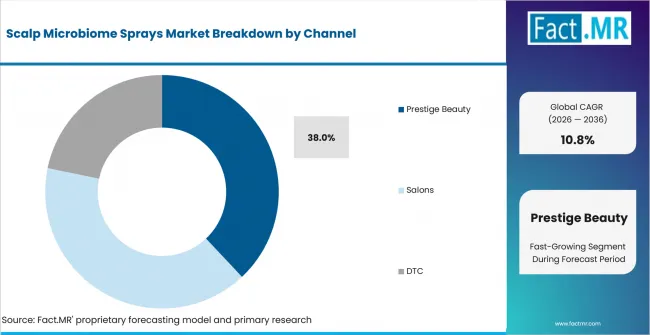
Scalp Microbiome Sprays Market Analysis By Channel | Source: Fact.MR
Prestige beauty leads because consumers increasingly purchase premium scalp treatments through specialty beauty retailers. The segment is expected to hold 38.0% share in 2026 as premium scalp wellness products expand across established beauty brands. Salons strengthen demand through professional recommendations. LG H&H (KRX: 051900) introduced the Microbiome BioExosome line under its Dr.Groot brand in South Korea. The line includes shampoo, conditioner, an ampoule treatment, and a hair tonic. The company claims the range helps manage scalp environment and targets root causes of hair loss. [4]
Which positioning dominates?
Skinification of haircare leads market with 45.0%.
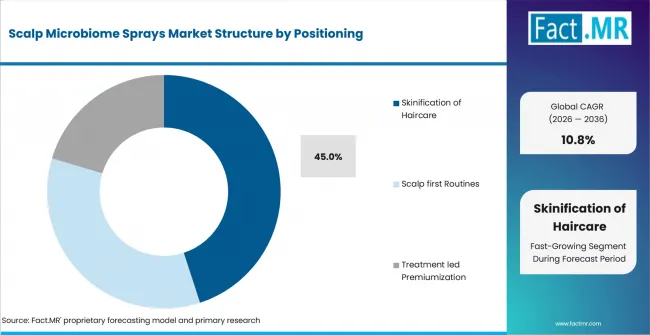
Scalp Microbiome Sprays Market Analysis By Positioning | Source: Fact.MR
Skinification of haircare is expected to account for 45.0% share in 2026 because consumers increasingly apply facial skincare principles to scalp care. Beauty brands position microbiome sprays as daily treatment products instead of occasional scalp refreshers. Scalp first routines encourage consistent product use. Treatment led premiumization supports higher value formulations with microbiome focused ingredients. Proya Cosmetics (SHA: 603605), through its functional hair care brand Awaken Seeds, released China's first Scalp Microbiome White Paper at the 30th Annual Meeting of Chinese Society of Dermatology (CSD2025). The research, based on a survey of 1,000 dermatology professionals, was the first worldwide to confirm the pathogenic mechanism of Malassezia restricta and Staphylococcus capitis in relation to dandruff. [5]
What is accelerating scalp microbiome spray adoption, and what is holding it back?
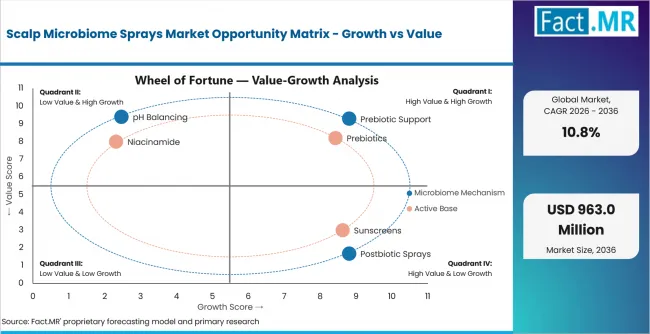
Scalp Microbiome Sprays Market Opportunity Matrix Growth Vs Value | Source: Fact.MR
Microbiome focused scalp care drives growth, while premium pricing and limited consumer awareness restrain adoption.
Drivers Impact Analysis
| DRIVER | (~) % IMPACT ON CAGR | GEOGRAPHIC RELEVANCE | IMPACT TIMELINE |
|---|---|---|---|
| Rising demand for microbiome friendly scalp care | +0.9% | North America, Europe, Japan | Medium term (2-4 years) |
| Growth of scalp first beauty routines | +0.8% | Global | Medium term (2-4 years) |
| Expansion of premium dermocosmetic scalp care | +0.7% | Europe, United States | Short term (≤2 years) |
| Increasing adoption of fermented and prebiotic ingredients | +0.6% | Global | Medium term (2-4 years) |
| Strong growth of prestige beauty retail | +0.4% | North America, Europe, China | Long term (≥4 years) |
Source: Fact.MR analysis. Updated Jun 30, 2026
- Microbiome friendly scalp care: Consumers increasingly choose products that support the natural scalp microbiome instead of harsh cleansing routines. This trend continues strengthening demand for microbiome sprays.
- Scalp first routines: Scalp care becomes a regular part of beauty routines as consumers seek healthier hair from the scalp upward. Daily spray application supports consistent product use.
- Premium dermocosmetic scalp care: Dermocosmetic brands continue introducing clinically inspired scalp treatments. Consumers increasingly value products developed with science based ingredients.
- Fermented and prebiotic ingredients: Beauty brands continue incorporating microbiome supporting ingredients into premium scalp formulations. These ingredients improve product differentiation and consumer confidence.
- Prestige beauty expansion: Prestige beauty retailers continue expanding premium scalp wellness products. Professional recommendations and better product education support category growth.
Opportunity Impact Analysis
| OPPORTUNITY | (~) % IMPACT ON CAGR | GEOGRAPHIC RELEVANCE | IMPACT TIMELINE |
|---|---|---|---|
| Multi active microbiome formulations | +0.7% | North America, Europe | Medium term (2-4 years) |
| Dermatologist recommended microbiome care | +0.6% | United States, Germany, Japan | Medium term (2-4 years) |
| Personalized scalp microbiome routines | +0.5% | Global | Long term (≥4 years) |
| Expansion through premium salon channels | +0.4% | Europe, Asia Pacific | Short term (≤2 years) |
Source: Fact.MR analysis. Updated Jun 30, 2026
- Multi active microbiome formulations: Brands can combine prebiotics with ceramides and peptides to improve scalp balance. Premium consumers increasingly seek complete scalp wellness solutions.
- Dermatologist recommendations: Professional recommendations improve consumer confidence in microbiome focused scalp care. Clinically inspired formulations strengthen premium positioning.
- Personalized microbiome care: Consumers increasingly expect products tailored to individual scalp conditions. Digital scalp analysis creates opportunities for premium treatment programs.
- Premium salon expansion: Professional salons continue recommending microbiome sprays within scalp treatment services. This channel supports premium pricing and stronger consumer loyalty.
Restraints Impact Analysis
| RESTRAINT | (~) % IMPACT ON CAGR | GEOGRAPHIC RELEVANCE | IMPACT TIMELINE |
|---|---|---|---|
| Premium product pricing | -0.6% | Emerging markets | Medium term (2-4 years) |
| Limited consumer awareness | -0.5% | Developing regions | Short term (≤2 years) |
| Competition from traditional scalp treatments | -0.3% | Asia Pacific | Medium term (2-4 years) |
| Intense premium brand competition | -0.2% | Global | Long term (≥4 years) |
Source: Fact.MR analysis. Updated Jun 30, 2026
- Premium pricing: Microbiome sprays often carry higher prices than conventional scalp products. Price sensitive consumers may delay adoption.
- Limited awareness: Many consumers remain unfamiliar with microbiome focused scalp care. Brands continue investing in education to improve category understanding.
- Traditional scalp treatments: Conventional scalp tonics and medicated products remain widely used across several markets. This limits adoption among first time buyers.
- Competitive intensity: Premium beauty brands continue expanding scalp wellness portfolios. Strong competition increases marketing costs and raises the need for product differentiation.
Which countries are scaling scalp microbiome sprays fastest?
United States 11.4%; Germany 11.1%; Japan 10.8%; China 10.5%; India 10.2%.
Based on regional analysis, the scalp microbiome sprays market is segmented into North America, Europe, East Asia, South Asia, Latin America and Middle East and Africa.
| Country | CAGR |
|---|---|
| United States | 11.4% |
| Germany | 11.1% |
| Japan | 10.8% |
| China | 10.5% |
| India | 10.2% |
Source: Fact.MR analysis. Updated Jun 30, 2026
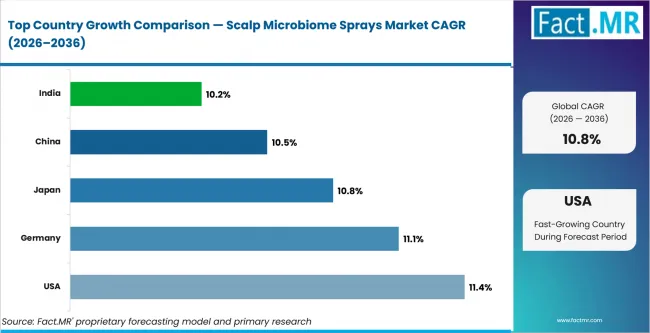
Scalp Microbiome Sprays Market Cagr Analysis By Country | Source: Fact.MR
What is powering the United States lead?
11.4% CAGR, driven by microbiome focused beauty innovation and premium scalp care demand.
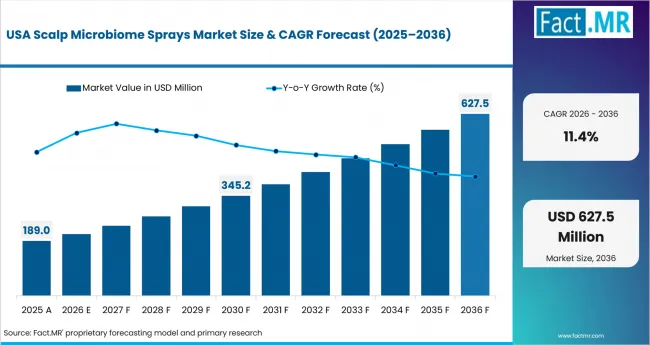
Scalp Microbiome Sprays Market Country Value Analysis | Source: Fact.MR
The United States is projected to record 11.4% CAGR from 2026 to 2036 as consumers increasingly adopt microbiome based scalp care products. Premium beauty brands continue introducing science backed scalp treatments supported by dermatologist recommendations. Direct to consumer brands and prestige beauty retailers strengthen product availability. Companies offering clinically inspired microbiome formulations are expected to benefit from sustained consumer demand.
How is Germany scaling scalp microbiome spray demand?
11.1% CAGR, supported by dermocosmetic scalp care and ingredient transparency.
Germany is expected to post 11.1% CAGR through 2036 as consumers increasingly prefer microbiome friendly scalp treatments. Dermocosmetic brands continue expanding premium scalp wellness portfolios through pharmacies and specialty retailers. Demand will favor companies emphasizing ingredient transparency and scientifically supported formulations.
What supports Japan's outlook?
10.8% CAGR, driven by advanced scalp wellness routines and preventive haircare.
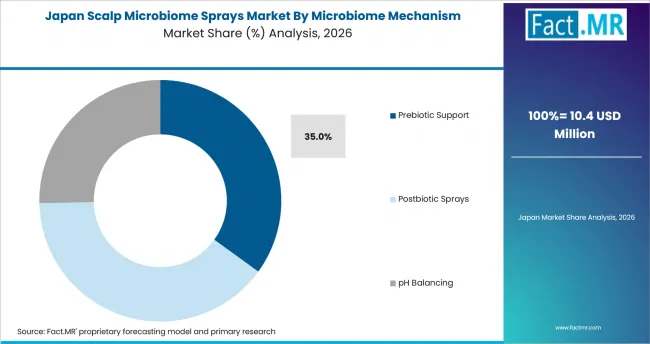
Scalp Microbiome Sprays Market Japan Market Share Analysis By Microbiome Mechanism | Source: Fact.MR
Japan is likely to record 10.8% CAGR through 2036 as consumers continue adopting preventive scalp care products. Microbiome sprays complement established beauty routines that emphasize long term scalp health. Products supporting barrier function and scalp balance will continue attracting demand.
What underpins China's growth?
10.5% CAGR, supported by premium beauty spending and digital retail expansion.
China is forecast to advance at 10.5% CAGR through 2036 as premium scalp care brands strengthen their presence across online beauty platforms. Consumers increasingly seek science based scalp wellness products with microbiome supporting ingredients. Local and international brands continue introducing premium scalp treatment collections.
How is India scaling scalp microbiome spray adoption?
10.2% CAGR, driven by growing scalp health awareness and premium beauty demand.
India is set to record 10.2% CAGR through 2036 as urban consumers increasingly invest in premium scalp care products. Beauty influencers and digital education continue improving awareness of microbiome based scalp wellness. Companies offering premium products through online retail channels are expected to strengthen market presence.
Who leads the scalp microbiome sprays market?
Kérastase and Living Proof lead through microbiome focused scalp care innovation and premium treatment portfolios.
The scalp microbiome sprays market includes prestige beauty companies, dermocosmetic brands and skincare inspired haircare manufacturers. Kérastase and Living Proof maintain strong market positions through premium scalp wellness portfolios, professional salon networks and continuous product innovation. Their formulations combine microbiome supporting ingredients with barrier repair technologies to improve long term scalp health.
Gallinéeand Jupiterstrengthen competition through ingredient focused formulations and transparent product positioning. Act+Acre and Vegamour continue expanding through scalp wellness programs and direct to consumer strategies. Briogeo and Schwarzkopf Professionaldevelop premium microbiome focused scalp products that align with skinification trends and clean beauty preferences.
Competition through 2036 will depend on microbiome research, ingredient innovation and premium brand positioning. Companies continue investing in prebiotics, postbiotics, fermented ingredients and microbiome friendly technologies to strengthen product performance. Digital education, dermatologist partnerships and scalp analysis tools are expected to improve consumer engagement. Brands that combine science backed formulations with strong retail presence and personalized scalp care solutions are expected to strengthen their competitive position.
Which companies are the key providers?
Kérastase and Living Proof are key providers. Gallinéeand Briogeo are also profiled. Act+Acre, Jupiter, Vegamour and Schwarzkopf Professionalcomplete the company set.
- Gallinée
- Act+Acre
- Briogeo
- Kérastase
- Living Proof
- Jupiter
- Vegamour
- Schwarzkopf Professional
Bibliography
- Unilever. (2025, December 1). The skinification of scalp care: Unilever’s expertise delivers on demand. Unilever.
- Premium Beauty News. (2026, April 6). Unilever expands Dove’s Derma scalp footprint worldwide. Premium Beauty News.
- Beauty Launchpad. (2025, July 22). OLAPLEX continues to innovate in scalp care with launch of Pro Scalp Rebalancing Concentrate. Beauty Launchpad.
- Dr.Groot. (2026, March 5). From Seoul to Sephora: Dr.Groot introduces K-beauty haircare’s next chapter. Dr.Groot.
- Proya Group. (2025, July 2). The first scalp microbiome white paper of Proya Group’s Off&Relax was released at CSD2025. Proya Group.
This Report Addresses
- Strategic intelligence on scalp microbiome sprays across microbiome technologies and premium scalp wellness positioning.
- Segment analysis covering Prebiotic Support and Barrier Repair.
- Regional outlook covering the United States, Germany, Japan, China, and India.
- Competitive analysis of Gallinée, Act+Acre, Briogeo, Kérastase, Living Proof, Jupiter, Vegamour and Schwarzkopf Professional.
- Technology assessment covering prebiotics, postbiotics, ceramides, peptides, fermented ingredients and microbiome balancing formulations.
- Use case assessment covering barrier repair, dryness, flakes, sebum control, density improvement, scalp sensitivity and UV exposure.
- Primary interviews, retail assessments and company portfolio reviews support the market forecast.
What does the scalp microbiome sprays market cover?
Topical scalp sprays formulated to support microbiome balance and improve scalp health.
The scalp microbiome sprays market covers leave on sprays formulated with prebiotics, postbiotics, ceramides, niacinamide, peptides, fermented ingredients and related microbiome supporting ingredients. These products are designed to improve scalp balance while supporting healthier hair conditions.
The market differs from broad scalp care coverage because the scope is limited to microbiome focused spray formulations. Conventional shampoos, conditioners and styling products are excluded unless sold as dedicated scalp microbiome sprays.
What is included in the scope?
Microbiome balancing scalp sprays developed for daily scalp care.
The scope includes sprays formulated with prebiotics, postbiotics, ceramides, niacinamide, peptides, fermented ingredients and barrier supporting ingredients. It includes products positioned for microbiome balance, barrier repair, pH support, anti-odor scalp care and scalp hydration.
The scope includes products sold through prestige beauty retailers, salons, dermocosmetic retail outlets, direct to consumer platforms and online marketplaces. It includes premium scalp treatments recommended for regular use.
What is excluded from the scope?
Conventional scalp products without microbiome positioning are outside the scope.
The scope excludes standard shampoos, conditioners and styling products without microbiome support claims. It also excludes oral supplements, prescription medicines and professional scalp procedures because they address scalp conditions through different treatment approaches.
How was the analysis built?
100+ sources, 40+ company portfolios, 25+ countries, 20+ interviews.
- Primary Research: Primary research includes interviews with dermatologists, trichologists, premium beauty manufacturers and specialty retailers. It includes input from salon professionals, formulation experts and beauty industry executives.
- Desk Research: Desk research reviews company product portfolios, dermatology publications, microbiome research and premium beauty market developments. It covers microbiome innovation and scalp treatment technologies.
- Market Sizing and Forecasting: Forecasting uses premium haircare sales, microbiome ingredient adoption, retail expansion and consumer purchasing trends across major markets.
- Data Validation and Update Cycle: Forecasts are validated through expert interviews, company portfolio reviews and retail assessments. Consumer adoption trends and product launches help confirm market direction.
Segmentation
What is the report’s scope and coverage?
| Attribute | Details |
|---|---|
| Quantitative Units | USD Million in 2026 to USD Million by 2036 at CAGR |
| Market Definition | Covers Leave on scalp sprays formulated to support scalp microbiome balance and improve scalp health |
| Microbiome Mechanism | Prebiotic support; postbiotic sprays; pH balancing; barrier repair; anti-odor scalp care |
| Active Base | Ceramides; niacinamide; peptides; prebiotics; sunscreens; fermented ingredients |
| Hair Concern | Barrier repair; dryness; flakes; sebum control; density; sensitivity; UV exposure |
| Channel | Prestige beauty; salons; dermocosmetic retail; DTC; marketplaces |
| Positioning | Skinification of haircare; scalp first routines; treatment led premiumization |
| Regions Covered | North America; Europe; East Asia; South Asia; Latin America; Middle East and Africa |
| Countries Covered | United States; Germany; Japan; China; India |
| Key Companies Profiled | Gallinée; Act+Acre; Briogeo; Kérastase; Living Proof; Jupiter; Vegamour; Schwarzkopf Professional |
| Forecast Period | 2026 to 2036 |
| Approach | Hybrid top-down and bottom-up approach using premium haircare sales, microbiome ingredient adoption, retail performance and expert validation |
Source: Fact.MR analysis. Updated Jun 30, 2026
How is the market segmented?
-
By Microbiome Mechanism:
- Prebiotic support
- Postbiotic sprays
- pH balancing
- Barrier repair
- Anti odor scalp care
-
By Active Base:
- Ceramides
- Niacinamide
- Peptides
- Prebiotics
- Sunscreens
- Fermented ingredients
-
By Hair Concern:
- Barrier repair
- Dryness
- Flakes
- Sebum control
- Density
- Sensitivity
- UV exposure
-
By Channel:
- Prestige beauty
- Salons
- Dermocosmetic retail
- DTC
- Marketplaces
-
By Positioning:
- Skinification of haircare
- Scalp first routines
- Treatment led premiumization
-
Region:
- North America
- United States
- Canada
- Europe
- Germany
- United Kingdom
- France
- Italy
- Spain
- Asia Pacific
- China
- Japan
- South Korea
- India
- Singapore
- Latin America
- Brazil
- Mexico
- Argentina
- Middle East & Africa
- GCC Countries
- South Africa
- Israel
- North America
Frequently Asked Questions
Which microbiome mechanism leads the Scalp Microbiome Sprays Market?
Which active base leads the Scalp Microbiome Sprays Market?
Which hair concern leads the Scalp Microbiome Sprays Market?
Which channel leads the Scalp Microbiome Sprays Market?
Which region leads the Scalp Microbiome Sprays Market?
Which country expands fastest in the Scalp Microbiome Sprays Market?
How does Germany perform in the Scalp Microbiome Sprays Market?
Who worked on this report


Preview the report firsthand - request a free sample
Free SampleGet the brochure for pricing and purchase details
Download PDF