- Market Value (2025): USD 354.4 Mn
- Estimated Value (2026): USD 378.0 Mn
- Forecast Value (2036): USD 720.0 Mn
- CAGR (2026-2036): 6.7%
What is the Scrubber Media Market forecast to be worth by 2036?
USD 378.0 million in 2026 to USD 720.0 million by 2036, at a 6.7% CAGR.
- The scrubber media market was valued at USD 354.4 million in 2025.
- Demand is projected to increase from USD 378.0 million in 2026 to USD 720.0 million by 2036.
- The market is forecast to record a 6.7% CAGR from 2026 to 2036 as plants replace worn media and specify lower-pressure-drop options for emissions control.
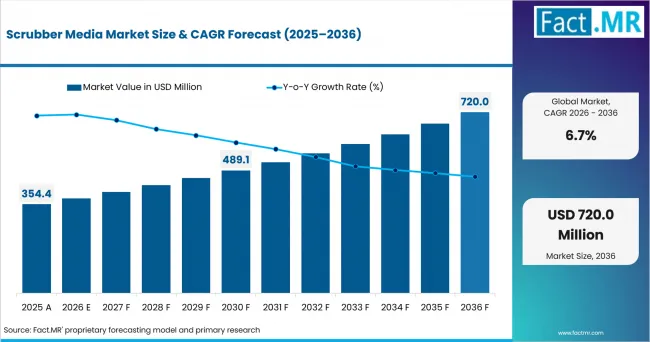
Scrubber Media Market Value Analysis | Source: Fact.MR
What are the defining numbers behind Scrubber Media Market growth?
USD 342.0 million absolute opportunity by 2036, led by Random packing media and Wet scrubbers alongside H2S/odor control and Water & wastewater facilities.
- Demand Drivers in the Market
- Plant operators need contact media that keeps removal performance stable during routine permit checks and neighborhood odor complaints.
- Replacement media lets an existing scrubber vessel regain contact area or reduce pressure drop without a full equipment rebuild.
- Wastewater headworks, sludge handling areas and food processing vents need media designed for hydrogen sulfide and mixed odor streams.
- Corrosion-resistant plastics, ceramics and treated carbon reduce replacement risk when acid gas or moisture exposure shortens service life.
- Key Segments Analyzed
- By Media Type: Random packing media is expected to hold 30.0% share in 2026 supported by low unit cost, easy replacement and wide use in packed towers.
- By Scrubber Type: Wet scrubbers are projected to account for 34.0% share in 2026 owing to broad use across acid gas, mist and odor duties.
- By Target Contaminant: H2S/odor is anticipated to capture 30.0% share in 2026 due to routine municipal and industrial odor-control requirements.
- By Material: Polypropylene/PVC media is estimated to represent 32.0% share in 2026 attributable to chemical resistance at a practical price point.
- By End User: Water & wastewater is forecast to hold 30.0% share in 2026 because treatment plants use packed towers, biofilters and carbon beds across several odor points.
- Analyst Opinion at Fact.MR
- Shambhu Nath Jha, Senior Analyst at Fact.MR, states, “Scrubber media buyers do not only compare price per cubic foot. I look first at pressure drop and contaminant chemistry. Replacement access also shapes operating cost after installation. The next round of growth is expected to favor suppliers that give plant teams clear media-life guidance and chemistry-specific proof.”
- Strategic Implications
- Plant operators can track the remaining life of packing and carbon beds so replacement work is planned before media failure causes an unplanned shutdown.
- Equipment companies should test chemical resistance against the actual gas stream because acid gases, caustic mist and wet odor service place different demands on the media.
- Facilities can compare pressure drop and fan energy use over the full service life instead of judging media only by purchase price.
- Distributors and service companies should keep standard sizes and replacement parts available so planned maintenance is not delayed by long delivery times.
In June 2024, Sulzer announced that it would launch MellapakEvo™ structured packing at ACHEMA 2024 in Frankfurt. Sulzer described the product as a new addition to its structured packing family with geometry designed to improve liquid spreading and surface renewal.
UAE is estimated to post a 7.4% CAGR from 2026 to 2036. USA is anticipated to advance at a 6.7% CAGR from 2026 to 2036. Japan is forecast to record a 6.6% CAGR from 2026 to 2036. UK is projected to post a 6.4% CAGR from 2026 to 2036. Germany is estimated to record a 6.1% CAGR from 2026 to 2036.
How does the Scrubber Media Market break down by segment?
Random packing media is expected to lead Media Type at 30.0% share in 2026. Wet scrubbers are projected to lead Scrubber Type at 34.0% share in 2026.
Which Media Type dominates?
Random packing media is estimated to hold 30.0% share in 2026.
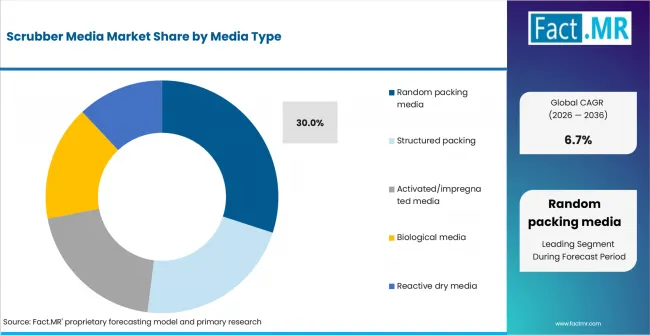
Scrubber Media Market Analysis By Media Type | Source: Fact.MR
Random packing media is used when a facility needs dependable gas-liquid contact without a custom internal design. Structured packing serves duties where pressure drop and distribution need tighter control. Activated/impregnated media fits dry adsorption or polishing. Biological media supports microbial growth in biofilters and biotrickling filters. Reactive dry media serves streams where a solid reagent is easier to manage than liquid circulation.
What leads the Scrubber Type segment?
Wet scrubbers are projected to account for 34.0% share in 2026.
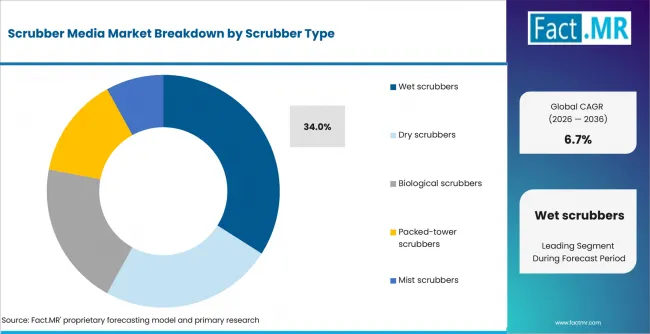
Scrubber Media Market Analysis By Scrubber Type | Source: Fact.MR
Wet scrubbers remain the practical base for many acid gas, mist and odor duties because the liquid phase gives operators a direct way to adjust pH and chemistry. Dry scrubbers fit lower-moisture streams or reagent-based treatment. Biological scrubbers are used where microorganisms handle odor or low-concentration VOC loads. Packed-tower scrubbers rely directly on media choice, while mist scrubbers depend on elements that capture droplets before exhaust reaches the stack.
How does Target Contaminant shape demand?
H2S/odor is anticipated to lead with 30.0% share in 2026.
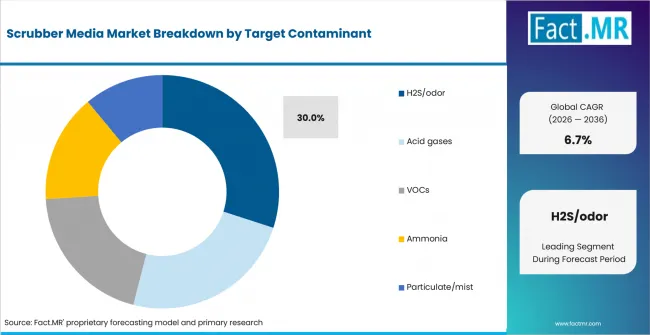
Scrubber Media Market Analysis By Target Contaminant | Source: Fact.MR
Hydrogen sulfide and mixed odors create visible operating pressure for wastewater and organic processing sites because complaints often arrive before a permit exceedance is formally recorded. Acid gases need materials that tolerate corrosive chemistry. VOC control depends on whether the stream is suited to absorption, adsorption or biological treatment. Ammonia service places higher weight on solubility and chemical adjustment. Particulate/mist removal depends on media geometry and droplet capture.
What supports Polypropylene/PVC media within Material?
Polypropylene/PVC media is forecast to represent 32.0% share in 2026.
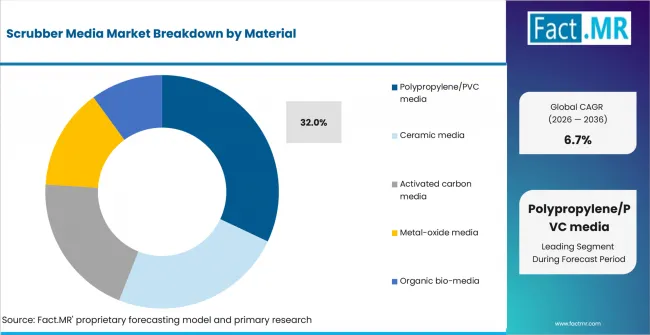
Scrubber Media Market Analysis By Material | Source: Fact.MR
Polypropylene and PVC media fit many wet scrubber duties because they resist common acid gases and stay light enough for practical changeouts. Ceramic media is used where heat or harsh chemistry makes plastic less suitable. Activated carbon media serves dry odor and VOC polishing. Metal-oxide media fits specific reactive duties. Organic bio-media is used where microbial attachment and moisture retention guide the design.
Why does Water & wastewater lead End User?
Water & wastewater is expected to hold 30.0% share in 2026.
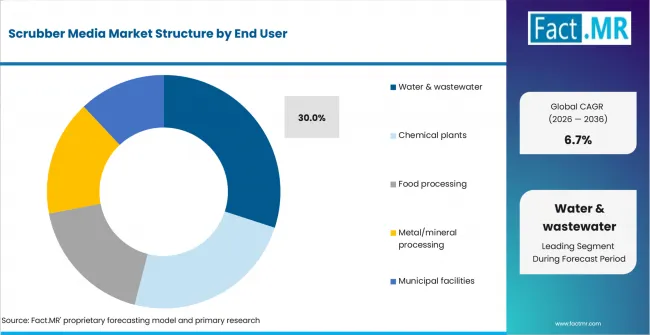
Scrubber Media Market Analysis By End User | Source: Fact.MR
Water and wastewater facilities use scrubber media at headworks and wet wells. Sludge handling areas and biosolids operations add more odor points. Chemical plants place more weight on acid gas and VOC chemistry. Food processing facilities need odor control near production and waste handling points. Metal and mineral processing sites use media under dust, mist and corrosive gas exposure. Municipal facilities add steady replacement demand through routine service budgets.
What is accelerating Scrubber Media Market adoption, and what is holding it back?
Air-emission control is expected to expand Scrubber Media Market demand, although fouling and channeling are anticipated to restrain performance gains.
Drivers Impact Analysis
| DRIVER | (~) % IMPACT ON CAGR | GEOGRAPHIC RELEVANCE | IMPACT TIMELINE |
|---|---|---|---|
| Air toxics enforcement focus | +1.9% | USA; chemical and industrial air sources | Short term (<= 2 years) |
| Wet scrubber retrofit cycle | +1.4% | USA; Germany; UK mature installed bases | Short term (<= 2 years) |
| Municipal odor-control pressure | +1.0% | China; UAE; water and wastewater facilities | Medium term (2-4 years) |
| Pressure-drop reduction in packed towers | +0.7% | Japan; Germany; process industries | Medium term (2-4 years) |
| Corrosion-specific media selection | +0.5% | Global acid gas and wet service sites | Long term (>= 4 years) |
Source: Fact.MR analysis. Updated Jul 22, 2026
- Air toxics enforcement focus: EPA reported 115 compliance monitoring activities under its FY 2025 Creating Cleaner Air for Communities initiative. That type of enforcement focus is expected to keep control equipment performance visible to plant teams.
- Wet scrubber retrofit cycle: Older packed towers often need media replacement before the vessel reaches end of life. Retrofit demand is expected to favor media that fits existing shells and improves liquid contact.
- Municipal odor-control pressure: Wastewater odor issues are practical and local. Media demand is projected to rise where headworks, sludge processing and collection-system vents need routine H2S control.
- Pressure-drop reduction in packed towers: Sulzer launched MellapakEvo™ at ACHEMA 2024 with geometry aimed at lower pressure drop and better liquid spreading. That direction supports premium media use where fan energy and tower capacity are closely watched.
- Corrosion-specific media selection: Acid gases and wet service shorten life when media is mismatched to the stream. Engineering teams are expected to specify polymer, ceramic or carbon media based on service chemistry.
Opportunity Impact Analysis
| OPPORTUNITY | (~) % IMPACT ON CAGR | GEOGRAPHIC RELEVANCE | IMPACT TIMELINE |
|---|---|---|---|
| Low-pressure-drop packing upgrades | +1.2% | China and Japan high-volume process streams | Short term (<= 2 years) |
| Activated carbon odor polishing | +0.9% | USA and UK wastewater facilities | Medium term (2-4 years) |
| Bio-scrubber support media | +0.7% | UAE; municipal and food processing sites | Medium term (2-4 years) |
| Service-linked media replacement programs | +0.6% | Germany; USA; mature installed bases | Long term (>= 4 years) |
Source: Fact.MR analysis. Updated Jul 22, 2026
- Low-pressure-drop packing upgrades: A lower pressure-drop media change gives operators a reason to upgrade during planned outages. This opportunity is strongest where gas volume is high and fan load is a visible cost.
- Activated carbon odor polishing: Xylem lists dry media and activated carbon odor-control systems for wastewater applications. That supports replacement demand when plants add polishing after wet or biological treatment.
- Bio-scrubber support media: Biological systems need stable surface area for microbial growth. Media designed for wetting and air flow is expected to gain use in municipal and food processing odor service.
- Service-linked media replacement programs: Planned changeouts reduce emergency downtime. Suppliers that pair media with inspection, bed-life review and quick logistics are expected to win recurring maintenance demand.
Restraints Impact Analysis
| RESTRAINT | (~) % IMPACT ON CAGR | GEOGRAPHIC RELEVANCE | IMPACT TIMELINE |
|---|---|---|---|
| Fouling and channeling | -1.1% | Water and wastewater; food processing | Short term (<= 2 years) |
| Commodity pricing in random packing | -0.8% | China; USA; distributor-led purchases | Short term (<= 2 years) |
| Uncertain media life in mixed streams | -0.7% | Chemical plants and metal/mineral processing | Medium term (2-4 years) |
| Shutdown access constraints | -0.5% | Germany; Japan; space-constrained plants | Medium term (2-4 years) |
Source: Fact.MR analysis. Updated Jul 22, 2026
- Fouling and channeling: Deposits reduce open area and create uneven gas paths. Operators often notice the issue through pressure drop, odor return or lower removal performance.
- Commodity pricing in random packing: Standard plastic random packing is easy to compare across suppliers. That keeps margins tight when the purchase is made through a short replacement bid.
- Uncertain media life in mixed streams: Mixed acid gases, moisture and particulates make service life hard to generalize. Conservative buyers are expected to ask for pilot data or local references before paying a premium.
- Shutdown access constraints: Some towers have awkward manways, limited hoist access or narrow changeout windows. Media that is technically better still loses ground if replacement labor becomes too disruptive.
Which countries are scaling Scrubber Media Market fastest?
The country comparison is shaped by several closely grouped markets instead of one wide gap across all six countries. UAE form the upper group, followed by the USA and Japan in the middle. The United Kingdom and Germany remain close at the lower end. The six countries are shown as examples, and their comparison helps explain how similar growth rates can come from different market conditions.
- The countries differ less by their CAGRs and more by the type of scrubber work supporting demand.
- China and the UAE lead for different reasons. China benefits from regular media replacement across factories and municipal treatment plants. The UAE depends more on new wastewater facilities and industrial areas where odor control systems must work under hot and humid conditions.
- The USA and Japan remain closely aligned in the middle. USA demand comes mainly from replacing media in an established scrubber base and meeting EPA requirements. Japan places greater attention on lower pressure loss, longer service life and media that fits compact sites without major vessel changes.
- The United Kingdom and Germany form another close group. UK demand comes from planned maintenance at wastewater and industrial sites near populated areas. Germany focuses more on media upgrades that meet EU emission rules, reduce pressure loss and fit existing packed towers.
- Markets with similar CAGRs can therefore follow different development paths. Project timing depends on shutdown schedules, replacement budgets, the type of contaminant and access to local service.
The full report examines these conditions for every market included in the study. It provides country-level CAGR analysis across North America, Latin America, Europe, East Asia, South Asia, Oceania and the Middle East and Africa.
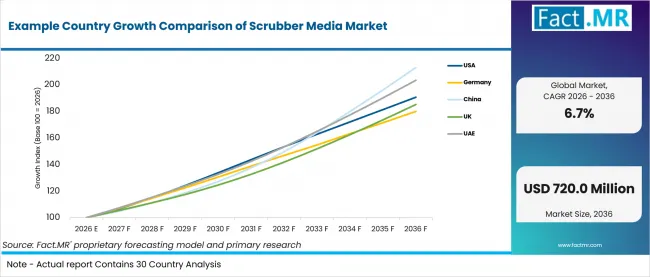
Example Country Growth Comparison Of Scrubber Media Market | Source: Fact.MR
| COUNTRY | CAGR from 2026 to 2036 |
|---|---|
| UAE | 7.4% |
| USA | 6.7% |
| Japan | 6.6% |
| UK | 6.4% |
| Germany | 6.1% |
Source: Fact.MR analysis. Updated Jul 22, 2026
How is the UAE scaling demand?
7.4% CAGR, driven by wastewater expansion and difficult operating conditions for odor-control media.
New treatment and industrial assets create more points where hydrogen sulfide and wet organic gases require control. High moisture and heat increase the importance of corrosion resistance and stable biological support surfaces. Media companies are likely to gain projects by proving service life under local conditions rather than relying on standard product claims.
What supports USA adoption?
6.7% CAGR, led by compliance monitoring across an established scrubber base.
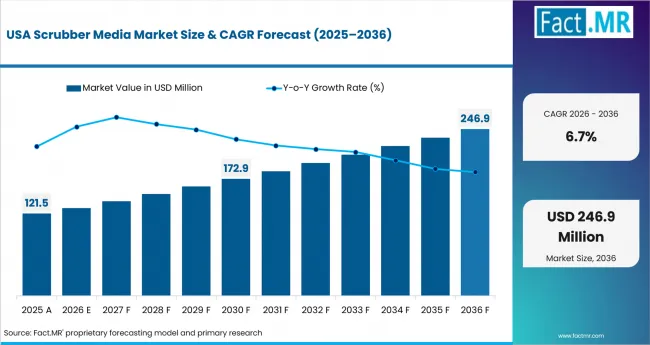
Scrubber Media Market Country Value Analysis | Source: Fact.MR
The USA does not depend mainly on new scrubber construction. EPA inspection and enforcement activity keeps hazardous air pollutants and volatile organic compounds under regular review. Facilities are therefore expected to replace media when operating records show weaker removal performance or rising pressure drop.
How does Japan perform?
6.6% CAGR, shaped by contaminant-specific odor rules and local operating limits.
Japan regulates odor from factories and other business sites through limits that may cover gases and wastewater. Ammonia and hydrogen sulfide are among the substances that influence media selection. Plant operators are expected to compare removal evidence for the actual contaminant instead of choosing packing only by size or material.
What shapes United Kingdom growth?
6.4% CAGR, backed by permit conditions and site-level odor management.
United Kingdom facilities must understand the chemistry and volume of odor released from permitted operations. Operators also keep records showing how control systems perform. This gives replacement programs greater value when media inspection and monitoring results are linked to a written odor-management plan.
How does Germany perform?
6.1% CAGR, driven by stricter permit reviews for existing industrial facilities.
Germany’s opportunity lies mainly in upgrading scrubbers that are already operating. Revised EU industrial-emissions rules place closer attention on emission limits and the use of proven control methods. Media changes are therefore expected to focus on lower pressure drop, chemical fit and installation during narrow maintenance windows.
Who leads the Scrubber Media Market?
Koch-Glitsch and Sulzer occupy the clearest positions in tower packing and gas-liquid contact media. RVT Process Equipment brings a broader mix of packing, mist-control and biological support products, while Evoqua adds a stronger odor-control route through carbon and dry media systems.
Koch-Glitsch is well placed in replacement and retrofit projects because its portfolio covers plastic, metal and structured packing for wet scrubbing duties. Sulzer competes more heavily where plants want lower pressure drop and improved liquid distribution inside existing towers. RVT Process Equipment serves a wider range of applications through random packing, structured packing, mist eliminators and biological carrier media. Evoqua supports wastewater and municipal odor control through activated carbon, dry media and vapor-phase treatment systems. Raschig USA adds established plastic packing formats for acid-gas and hydrogen-sulfide service, while MACH Engineering strengthens project coverage through tower internals and custom scrubber packing solutions.
Over the forecast period, purchasing decisions are expected to move beyond media price alone. Facilities are likely to compare pressure drop, chemical resistance, service life and the ease of changing media during planned shutdowns. Companies that support stream-specific selection and keep standard replacement sizes available are expected to secure more recurring maintenance work.
Which companies are the key providers?
Key companies include Koch-Glitsch; Sulzer; RVT Process Equipment; Evoqua (Xylem).
- Koch-Glitsch
- Sulzer
- RVT Process Equipment
- Evoqua (Xylem)
Bibliography
- U.S. Environmental Protection Agency. (2026, March 9). National Enforcement and Compliance Initiative: Creating Cleaner Air for Communities. U.S. Environmental Protection Agency.
- European Commission. (2024, August 2). Zero pollution: Modernised rules on industrial and livestock rearing emissions come into effect. European Commission.
- Environment Agency. (2025, December 3). Odor management: Comply with your environmental permit. GOV.UK.
This Report Answers
- The report provides strategic intelligence on scrubber media across Media Type and Scrubber Type choices that shape maintenance and retrofit decisions.
- Segment analysis covers Random packing media and Wet scrubbers as the leading 2026 positions in the market structure.
- Regional outlook evaluates UAE alongside USA and Japan. UK and Germany complete the growth comparison across the profiled markets.
- Competitive analysis profiles Koch-Glitsch and Sulzer alongside RVT Process Equipment and Evoqua. Additional active providers complete the company set.
- Use-case assessment covers H2S/odor and acid gases. VOCs, ammonia and particulate or mist streams complete the forecast view.
What does the Scrubber Media Market cover?
Scrubber media covers the replaceable material inside wet, dry and biological scrubber systems that gives gas streams contact area or reactive capacity. The scope includes packing and treated media. Carbon, biological support surfaces and reactive dry media are covered for odor and gas-control duties.
The market differs from complete scrubber equipment because value is tied to media replacement, media selection and performance inside an existing or new vessel. Fans and pumps remain outside the boundary. Vessels, ductwork and bulk reagents are excluded unless they are sold as part of a media-specific replacement service.
What is included in the scope?
The scope includes Media Type and Scrubber Type alongside Target Contaminant, Material and End User.
Coverage spans Random packing media and Structured packing. Activated/impregnated media and Biological media are included. Reactive dry media completes the media view. Wet scrubbers and Dry scrubbers are included when the media performs the gas-cleaning function. Biological scrubbers, Packed-tower scrubbers and Mist scrubbers follow the same rule.
What is excluded from the scope?
The scope excludes complete scrubber vessel capital spending and fan packages.
Recirculation pumps and ductwork remain outside the boundary. Reagent purchases and project engineering also remain outside the boundary. Those items affect media demand but they are not counted as scrubber media revenue. General filtration media outside gas scrubbing and wastewater liquid filtration cartridges also remain outside the market boundary.
How Was the Analysis Built?
The analysis draws on 120+ sources, 35+ company portfolios, 25+ countries, and more than 20 industry interviews.
- Primary Research: Primary research includes discussions with manufacturers, service providers, technology developers, distributors, end users, procurement teams, and subject-matter experts. These conversations examine purchasing priorities, product adoption, operational challenges, approval requirements, competitive positioning, and the factors that influence wider market acceptance.
- Desk Research: Desk research covers government statistics, regulatory publications, company filings, trade data, technical studies, industry associations, standards, public policy, and other authoritative sources. Every source used in the analysis is documented in the bibliography.
- Market Sizing and Forecasting: Market estimates combine historical performance, demand indicators, pricing and volume trends, segment shares, company participation, country-level growth, adoption patterns, investment activity, and barriers to market expansion.
- Data Validation and Update Cycle: Findings are validated by comparing primary interviews with public data, company activity, regulatory changes, trade patterns, and industry developments. Regular updates review new product launches, capacity changes, partnerships, approvals, procurement trends, and shifts in commercial adoption.
Segmentation
What is the report’s scope and coverage?
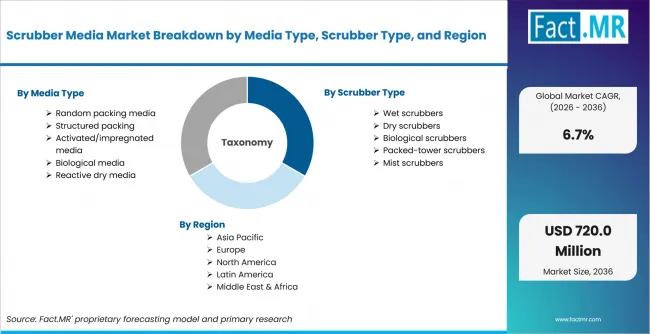
Scrubber Media Market Breakdown By Media Type, Scrubber Type, And Region | Source: Fact.MR
| Attribute | Details |
|---|---|
| Quantitative Units | USD million in 2026 to USD million by 2036 at a CAGR |
| Market Definition | Replaceable scrubber media used inside wet, dry and biological scrubbers to provide contact area, adsorption capacity, biological support or reactive treatment for gas-cleaning duties |
| Media Type | Random packing media; Structured packing; Activated/impregnated media; Biological media; Reactive dry media |
| Scrubber Type | Wet scrubbers; Dry scrubbers; Biological scrubbers; Packed-tower scrubbers; Mist scrubbers |
| Target Contaminant | H2S/odor; Acid gases; VOCs; Ammonia; Particulate/mist |
| Material | Polypropylene/PVC media; Ceramic media; Activated carbon media; Metal-oxide media; Organic bio-media |
| End User | Water & wastewater; Chemical plants; Food processing; Metal/mineral processing; Municipal facilities |
| Regions Covered | North America; Latin America; Western Europe; Eastern Europe; East Asia; South Asia and Pacific; Middle East and Africa |
| Countries Covered | UAE; USA; Japan; UK; Germany |
| Key Companies Profiled | Koch-Glitsch; Sulzer; RVT Process Equipment; Evoqua (Xylem) |
| Forecast Period | 2026 to 2036 |
| Approach | Hybrid top-down and bottom-up approach using scrubber installed base, media replacement cycles, contaminant duty mix, material selection, country regulation context, retrofit activity and company portfolio review |
Source: Fact.MR analysis. Updated Jul 22, 2026
How is the market segmented?
-
By Media Type:
- Random packing media
- Structured packing
- Activated/impregnated media
- Biological media
- Reactive dry media
-
By Scrubber Type:
- Wet scrubbers
- Dry scrubbers
- Biological scrubbers
- Packed-tower scrubbers
- Mist scrubbers
-
By Target Contaminant:
- H2S/odor
- Acid gases
- VOCs
- Ammonia
- Particulate/mist
-
By Material:
- Polypropylene/PVC media
- Ceramic media
- Activated carbon media
- Metal-oxide media
- Organic bio-media
-
By End User:
- Water & wastewater
- Chemical plants
- Food processing
- Metal/mineral processing
- Municipal facilities
-
By Region:
- North America
- Latin America
- Western Europe
- Eastern Europe
- East Asia
- South Asia and Pacific
- Middle East and Africa
Frequently Asked Questions
Which Media Type leads the Scrubber Media Market?
Which Scrubber Type leads the Scrubber Media Market?
Which Target Contaminant leads the Scrubber Media Market?
Which Material leads the Scrubber Media Market?
Which End User leads the Scrubber Media Market?
How does UAE perform in this market?
How does the USA perform in this market?
What is the primary driver in this market?
What is the main restraint in this market?
Who worked on this report


Preview the report firsthand - request a free sample
Free SampleGet the brochure for pricing and purchase details
Download PDF