- Base Value(2025): 46.6 Bn
- Estimated Value(2026): 49.2 Bn
- Forecast Value (2036): 84.0 Bn
- CAGR (2026 - 2036): 5.5%
Security Labels Market Forecast and Outlook By Fact.MR
In 2025, the security labels market was valued at USD 46.6 billion. Based on Fact.MR analysis, demand for security labels is estimated to grow to USD 49.2 billion in 2026 and USD 84.0 billion by 2036. FACT.MR projects a CAGR of 5.5% during the forecast period.
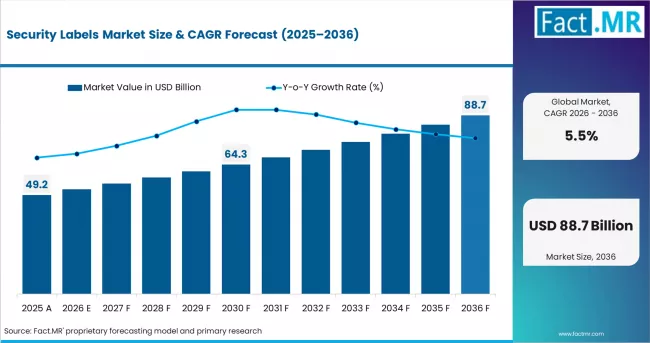
Security Labels Market Market Value Analysis | Source: Fact.MR
| Metric | Value |
|---|---|
| Estimated Value in 2026 | USD 49.2 billion |
| Forecast Value in 2036 | USD 84.0 billion |
| Forecast CAGR (2026 to 2036) | 5.5% |
Source: Fact.MR analysis. Updated Apr 20, 2026
Summary of Security Labels Market
- Market Definition
- The market includes tamper-evident, RFID, NFC, holographic, barcode, QR, EAS, and destructible security label products applied to pharmaceutical, retail, electronics, and luxury goods packaging to prevent counterfeiting, enable traceability, and deter theft globally.
- Demand Drivers
- Pharmaceutical manufacturers are adopting serialized RFID and barcode labels. This supports compliance with DSCSA and EU FMD mandates.
- Retailers are deploying EAS and RFID labels to reduce organised retail crime. Companies like Walmart and Target are enforcing supplier compliance.
- Luxury brands are investing in NFC and holographic labels. This helps combat counterfeiting in China, India, and the Middle East.
- Key Segments Analysed
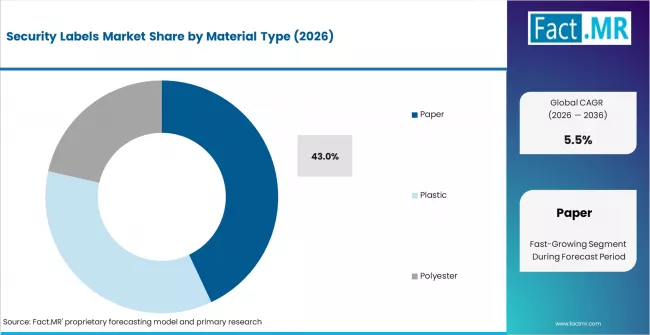
- By Material Type: Paper leads with 43% share in 2026. It offers low cost and wide compatibility across barcode, QR, and VOID labels.
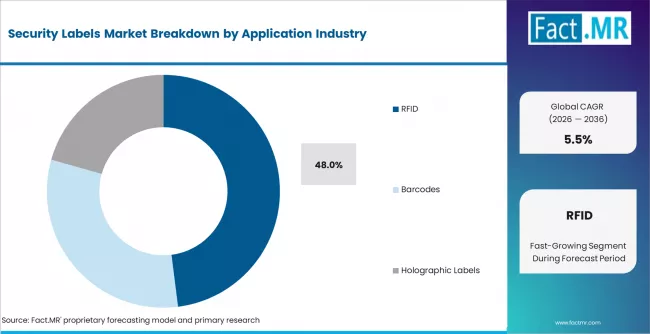
- By Product Type: RFID holds 48% share in 2026. Growth is driven by pharmaceutical mandates and retail inventory tracking needs.
- By Application: Boxes and cartons lead with 45% share in 2026. They are the primary packaging format across industries.
- Analyst Opinion at FACT.MR
- Shambhu Nath Jha, Senior Consultant at Fact.MR, states that manufacturers must adopt RFID and NFC capabilities by 2027. Failure to do so may result in loss of key customers to integrated solution providers.
- Strategic Implications
- Manufacturers should invest in RFID encoding and NFC integration. This is essential for pharmaceutical compliance contracts.
- Label converters should expand holographic and destructible label offerings. This targets luxury brand protection demand in Asia.
- Companies should develop GS1-compliant digital QR labels. This supports both consumer engagement and authentication use cases.
- Methodology
- Market sizing is based on shipment volumes, pricing by technology, and pharma procurement values. Data is validated using 2024–2025 manufacturer revenues.
- Analysis includes DSCSA data, EU FMD reports, China NMPA regulations, GS1 standards, and retail EAS statistics.
- Forecasts consider pharma timelines, RFID mandates, brand protection investments, and expert interviews.
Between 2026 and 2036, the market is expected to generate an absolute dollar opportunity of USD 34.8 billion. This indicates steady and sustained growth. Expansion is supported by pharmaceutical track-and-trace regulations. Rising organised retail crime is also driving demand for advanced EAS and RFID solutions. Additionally, the growth of e-commerce logistics is increasing the need for serialized shipment authentication labels. However, growth faces some constraints. Cost competition from commodity barcode suppliers remains a challenge. High capital investment for transitioning to smart label encoding formats also limits adoption.
Country growth varies by regulatory mandates, retail crime levels, and brand protection investments. China leads with 6.8% CAGR, driven by NMPA track-and-trace rules and expanding luxury and electronics markets. India follows at 6.5%, supported by CDSCO authentication programmes and pharma exports. The USA grows at 5.2% due to DSCSA enforcement and RFID adoption by major retailers. The UK records 4.5%, driven by FMD-aligned compliance and retail upgrades. France grows at 4.0%, supported by luxury authentication demand but limited by market maturity.
Segmental Analysis
Security Labels Market Analysis by Material Type
Security Labels Market Analysis By Material Type | Source: Fact.MR
Paper is expected to hold 43% share in 2026. It remains the most cost-effective and widely used substrate. It supports barcode, QR, and VOID label applications globally.
- Avery Dennison Paper Label Expansion: In September 2024, the company expanded paper label capacity in Europe and Asia. The focus is on pharma and retail applications. [4]
- UPM Raflatac NFC Label Development: In 2024, UPM launched NFC-enabled labels. These combine tamper evidence with digital engagement features. [5]
- Polyester RFID Substrate Trend: GS1 reported strong growth in polyester RFID labels. These offer better durability and performance in pharma environments. [6]
Security Labels Market Analysis by Product Type
Security Labels Market Analysis By Product Type | Source: Fact.MR
RFID labels are projected to hold 48% share in 2026. Growth is driven by regulatory mandates and retail adoption. They are widely used in pharma, electronics, and luxury goods.
- Honeywell RFID Label Investment: In October 2024, Honeywell expanded its RFID encoding solutions. These target pharma packaging lines globally. [7]
- 3M Holographic Label Technology: In 2024, 3M enhanced its holographic labels. These target luxury goods authentication in key markets. [8]
- NFC Authentication Adoption Trend: Brady Corporation reported a 34% rise in NFC label enquiries in FY2024. This reflects growing demand for consumer-facing authentication solutions. [9]
Drivers, Restraints, and Opportunities
Security Labels Market Opportunity Matrix Growth Vs Value | Source: Fact.MR
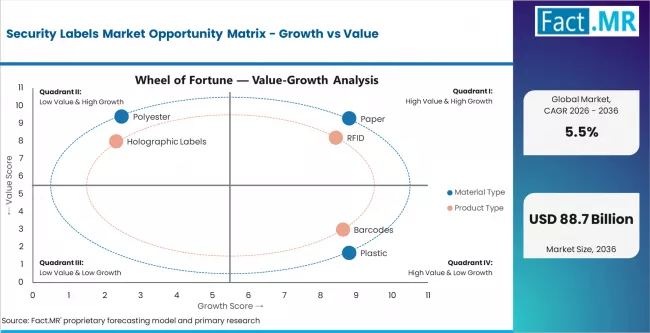
FACT.MR notes that security labels have evolved beyond commodity products. They are now critical for compliance and brand protection. Growth is driven by pharma regulations, retail crime, and counterfeit prevention investments.
The market is shifting toward smart labels. Traditional barcode and VOID labels face pricing pressure. RFID and NFC labels offer higher value and margins. These segments support revenue growth despite slower volume expansion.
- DSCSA Serialisation Enforcement: Full enforcement began in November 2023. FDA guidance in 2024 pushed electronic data exchange adoption. This drives continuous demand for serialized labels and infrastructure. [2]
- China NMPA Drug Track-and-Trace: China strengthened regulations in 2024. All drugs must carry encoded security labels linked to national systems. This supports a 6.8% CAGR in China. [3]
Walmart RFID Label Mandate: Walmart expanded RFID requirements in 2024. Suppliers must comply with GS1 EPC standards. This drives structured demand for RFID labels from major vendors. [1]
Regional Analysis
The security labels market is assessed across North America, Europe, Asia Pacific, Latin America, and Middle East and Africa, covering 40 or more countries with distinct demand profiles shaped by pharmaceutical serialisation mandates, retail organised crime levels, luxury goods brand protection investment, and supply chain track-and-trace infrastructure maturity. The full report provides market attractiveness analysis by region and country.
.webp "Top Country Growth Comparison Security Labels Market Cagr (2026 2036)")
Top Country Growth Comparison Security Labels Market Cagr (2026 2036) | Source: Fact.MR
Source: Fact.MR (FACT.MR) analysis, based on proprietary forecasting model and primary research
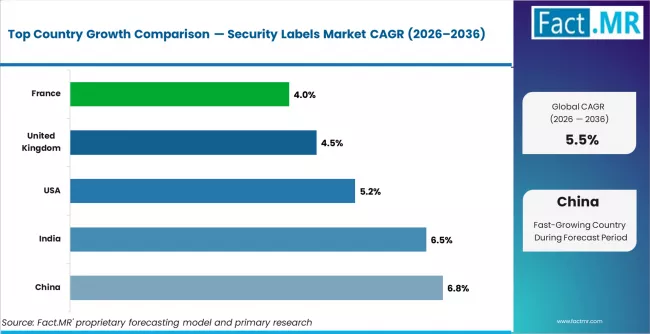
Security Labels Market Cagr Analysis By Country | Source: Fact.MR
| Country | CAGR (2026 to 2036) |
|---|---|
| China | 6.8% |
| India | 6.5% |
| United States | 5.2% |
| United Kingdom | 4.5% |
| France | 4.0% |
Source: Fact.MR analysis. Updated Apr 20, 2026
Asia Pacific Security Labels Market Analysis
Asia Pacific is the fastest-growing security labels region. Growth is driven by China’s NMPA drug track-and-trace mandate and India’s expanding pharmaceutical export compliance programmes. Avery Dennison and CCL Industries lead regional supply through strong converter networks. Domestic Chinese players such as Shanghai Hengyuan Printings support high-volume demand. The region benefits from both regulatory compliance and rising brand protection needs.
- China: The NMPA drug track-and-trace mandate is driving structured label demand. The market is projected to grow at 6.8% CAGR through 2036. In 2024, authorities required encoded labels on all pharmaceuticals. This strengthened compliance-driven procurement across manufacturers. CCL Industries expanded Shanghai production capacity in October 2024. Alibaba’s Tmall platform scaled NFC authentication programmes, boosting demand from e-commerce and luxury brands.
- India: Growth is driven by pharmaceutical exports and domestic authentication rules. The market is projected to expand at 6.5% CAGR through 2036. CDSCO extended barcode requirements in 2024 across more drug categories. This pushed pharma firms to upgrade serialized label systems. Companies such as Sun Pharma and Cipla increased compliance investments. Avery Dennison expanded its Mumbai facility to support regulated export markets.
FACT.MR’s analysis covers China, India, Japan, South Korea, ASEAN, and ANZ. It includes regulatory data, RFID adoption trends, investment benchmarks, and long-term forecasts.
North America Security Labels Market Analysis
Security Labels Market Country Value Analysis | Source: Fact.MR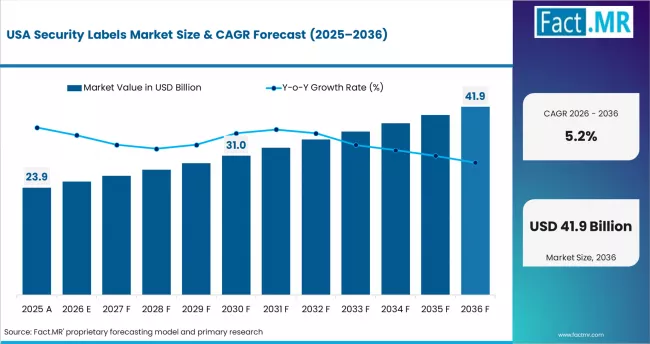
North America is the highest-value region for security labels. Growth is driven by DSCSA pharmaceutical serialisation enforcement and retail RFID mandates. Avery Dennison, Brady Corporation, and CCL Industries lead supply. Honeywell supports label encoding and printer systems integration. The region benefits from strong regulatory enforcement and retailer-driven demand.
- United States: Demand is driven by DSCSA compliance and RFID mandates. The market is projected to grow at 5.2% CAGR through 2036. In 2024, the FDA updated interoperability guidance for data exchange. This reinforced serialized barcode and RFID label demand. Walmart expanded RFID mandates to electronics and home goods. This increased supplier compliance requirements and investments.
FACT.MR’s analysis covers the United States, Canada, and Mexico. It includes DSCSA timelines, RFID mandate expansion, pharma benchmarks, and detailed forecasts.
Europe Security Labels Market Analysis
Security Labels Market Europe Country Market Share Analysis, 2026 & 2036 | Source: Fact.MR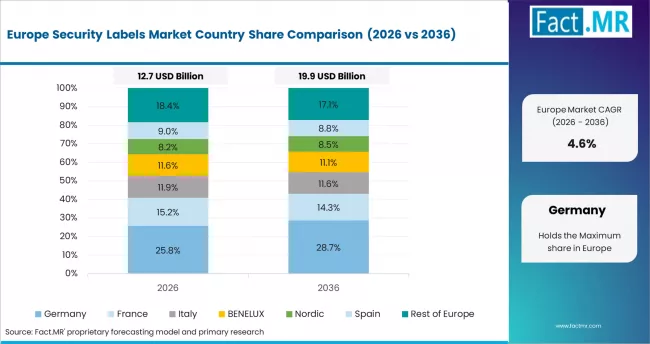
Europe is the global benchmark for regulatory compliance. EU FMD requires serialized 2D barcodes and tamper-evident labels. Avery Dennison, UPM Raflatac, and CCL Industries lead pharmaceutical label supply. 3M leads in luxury authentication labels across key markets. The region is driven by both compliance and brand protection demand.
- United Kingdom: Demand is supported by pharma compliance and retail upgrades. The market is projected to grow at 4.5% CAGR through 2036. MHRA confirmed continued enforcement of FMD-equivalent rules in 2024. This maintained steady pharmaceutical label demand. Retail crime levels increased significantly in 2023. Retailers expanded EAS deployment across high-value products.
- France: Growth is driven by luxury authentication and pharma compliance. The market is projected to grow at 4.0% CAGR through 2036. Luxury groups such as LVMH and Kering expanded NFC and holographic labels. This supports anti-counterfeiting in global markets. ANSM confirmed ongoing FMD compliance monitoring in 2024. Demand remains strong across both luxury and pharmaceutical segments.
FACT.MR’s analysis covers Germany, France, the UK, Italy, Spain, and Rest of Europe. It provides insights on compliance trends, authentication technologies, and regional forecasts.
Competitive Aligners for Market Players
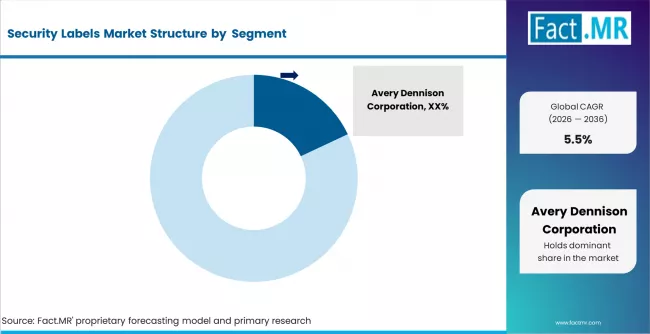
Security Labels Market Analysis By Company | Source: Fact.MR
The security labels market shows moderate concentration at the top level. Large players like Avery Dennison, CCL Industries, and UPM Raflatac hold a strong global presence. They serve pharmaceutical, retail, and consumer goods industries. Their scale gives them consistent revenue advantages. However, competition becomes more fragmented at the technology level. Smaller players focus on RFID chips, holograms, and NFC solutions. These firms compete on innovation rather than size. The key differentiator is the ability to offer complete label and serialization solutions. Compliance capability matters more than just label production.
Avery Dennison benefits from strong vertical integration. It controls both label materials and RFID inlay production. This ensures better quality and consistency. It also supports end-to-end pharmaceutical compliance needs. CCL Industries has a wide global converter network. This allows close proximity to manufacturing hubs. It reduces logistics costs and speeds up delivery. Brady Corporation leverages its legacy in identification solutions. It is well-positioned in government and industrial tenders. Its strength lies in compliance documentation and certification. Large buyers actively manage supplier risk. Pharmaceutical companies prefer dual sourcing strategies. This ensures supply continuity during audits or disruptions.
Retailers follow structured procurement models. Programs like Walmart’s RFID mandate create long-term supply contracts. These provide stable revenue streams for suppliers. However, pricing flexibility remains limited. Advanced labels such as RFID and NFC carry high premiums. Prices can be 3 to 5 times higher than barcode labels. This helps maintain revenue growth even with moderate volume expansion.
Key Players
- Avery Dennison Corporation
- 3M Company
- CCL Industries Inc.
- Honeywell International Inc.
- UPM Raflatac
- Brady Corporation
- Resource Label Group, LLC
Bibliography
- [1] Walmart Inc. (2024). Supplier RFID Compliance Programme Expansion: Electronics Accessories and Home Goods Category RFID Label Requirement Mandate Under GS1 EPC Encoding Standards for Global Vendor Base. 2024. corporate.walmart.com
- [2] U.S. Food and Drug Administration. (2024). Drug Supply Chain Security Act Interoperability Guidance Update: Electronic Serialised Data Exchange Requirements and Trading Partner Compliance Timelines. October 2024. fda.gov/drugs/drug-supply-chain-security-act-dscsa
- [3] National Medical Products Administration, China. (2024). Drug Track-and-Trace System Reinforcement: Digital Encoding Security Label Integration Requirements for National Drug Supervision Data Platform Compliance. 2024. nmpa.gov.cn
- [4] Avery Dennison Corporation. (2024). Capacity Expansion Disclosure: Pharmaceutical-Grade RFID and Barcode Label Production Capacity Expansion in Europe and Asia Pacific for DSCSA and EU FMD Compliance Programme Supply. September 2024. averydennison.com/investor-relations
- [5] UPM Raflatac. (2024). Product Launch: Rafsec NFC RFID Label Range for Pharmaceutical Packaging with Tamper-Evident Paper and Polyester Substrate Options for EU FMD and DSCSA Dual-Compliance Applications. 2024. upmraflatac.com
- [6] GS1 Global Office. (2024). RFID in Retail and Healthcare Survey 2024: Polyester-Substrate RFID Label Adoption Growth Data in Pharmaceutical and Electronics Security Label Applications. October 2024. gs1.org/resources
- [7] Honeywell International Inc. (2024). Portfolio Expansion: Honeywell Safety and Productivity Solutions RFID Label Printer and Encoding System Expansion for Pharmaceutical Packaging DSCSA Compliance at Contract Manufacturing Facilities. October 2024. honeywell.com/investor-relations
- [8] 3M Company. (2024). Product Range Expansion: Scotchprint Graphics and Security Holographic Label Range with Enhanced Optical Variable Device Features for Luxury Goods Brand Protection Programmes in France and China. 2024. 3m.com/brands
- [9] Brady Corporation. (2024). FY2024 Annual Results: NFC-Enabled Security Label Programme Enquiry Growth of 34% Year-on-Year from Pharmaceutical and Electronics Customers Seeking Consumer-Facing Authentication Label Solutions. 2024. bradycorp.com/investor-relations
This Report Addresses
- Strategic insights on security label demand across pharmaceutical DSCSA and EU FMD track-and-trace compliance, retail EAS and RFID loss prevention deployment, luxury goods holographic authentication, and supply chain serialisation investment globally.
- Market forecast from USD 49.2 billion in 2026 to USD 84.0 billion by 2036 at a CAGR of 5.5%.
- Growth opportunity mapping across China NMPA pharmaceutical compliance, India CDSCO drug authentication expansion, U.S. Walmart RFID mandate supplier programmes, EU FMD serialised label requirements, and luxury brand NFC authentication investment.
- Segment-wise analysis by material type (paper, polyester, foil), product type (RFID, NFC, holographic, EAS, barcode, QR), application (boxes, bottles, bags), and pattern type (VOID, destructible, checkboard).
- Regional outlook covering Asia Pacific pharmaceutical serialisation leadership, North America retailer-mandated RFID compliance, and Europe regulatory-driven pharmaceutical and luxury brand authentication label adoption.
- Competitive landscape analysis of Avery Dennison, CCL Industries, UPM Raflatac, Brady Corporation, Honeywell, 3M, and Resource Label Group covering RFID encoding capability, pharmaceutical programme qualification, and geographic converter network depth.
- Technology tracking including GS1 digital link QR code development, NFC consumer authentication label advances, polyester RFID substrate engineering, holographic optical variable device security element innovation, and tamper-evident destructible label formulation.
- Report delivery in PDF, Excel datasets, and presentation formats supported by primary interviews with pharmaceutical packaging procurement managers, retail loss prevention directors, label converters, and brand protection technology specialists.
Security Labels Market Definition
The security labels market covers tamper-evident, authentication, and track-and-trace labels. These labels are applied to packaging, products, and shipments. They help prevent counterfeiting, enable traceability, and deter theft. Key products include RFID, barcodes, holograms, EAS tags, NFC labels, QR codes, and VOID or destructible labels. Applications span pharmaceuticals, retail, electronics, and luxury goods.
Security Labels Market Inclusions
Includes global and regional forecasts from 2026 to 2036. Segmentation covers material type, product type, application, and pattern type. Materials include paper, plastic, polyester, vinyl, PP, foam, and foil. Product formats include RFID, barcode, holographic, EAS, NFC, QR, and VOID labels. Applications cover boxes, cartons, bottles, jars, bags, pouches, and other containers.
Security Labels Market Exclusions
Excludes plain labels without security features. Does not include standalone RFID hardware or readers. Omits packaging design without authentication or tamper-evidence functions. Excludes electronic shelf labels used only for pricing. Also excludes industrial RFID tags not used on consumer packaging.
Security Labels Market Research Methodology
- Primary Research: Interviews with pharmaceutical procurement managers and retail loss prevention teams. Inputs from brand protection officers and label converters. Discussions with track-and-trace technology providers. Coverage includes North America, Europe, China, and India.
- Desk Research: Analysis of DSCSA serialisation data and EU FMD compliance reports. Review of China NMPA regulations and GS1 standards. Study of label manufacturer reports from 2024 to 2025.
- Market-Sizing and Forecasting: Hybrid model based on shipment volumes and applications. Uses average selling prices by technology and material. Includes pharmaceutical serialisation spending and retail EAS benchmarks.
- Data Validation and Update Cycle: Validated through company revenues and regulatory data. Cross-checked with retail shrinkage statistics and expert interviews. Updated periodically.
Segmentation
Scope of Report
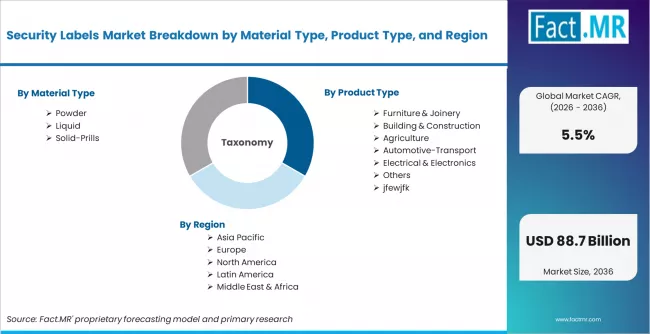
Security Labels Market Breakdown By Material Type, Product Type, And Region | Source: Fact.MR
| Quantitative Units | USD 49.2 billion (2026) to USD 84.0 billion (2036), at a CAGR of 5.5% |
|---|---|
| Market Definition | Tamper-evident, authentication, and track-and-trace label products including RFID, NFC, barcodes, holographic, EAS, QR, and pattern-type labels applied to pharmaceutical, retail, electronics, and luxury goods packaging to prevent counterfeiting and enable supply chain traceability. |
| Material Type Segmentation | Paper, Plastic, Polyester, Vinyl, PP, Foam (EPS), Foil |
| Product Type Segmentation | RFID, Barcodes, Holographic Labels, EAS, NFC, QR Codes, Others |
| Application Segmentation | Boxes and Cartons, Bottles and Jars, Bags and Pouches, Other Containers (IBCs, Drums, etc.) |
| Pattern Type Segmentation | VOID, Checkboard, Destructible, Other Customized Patterns |
| Application Coverage | Pharmaceutical DSCSA and EU FMD serialisation, retail EAS theft prevention, luxury goods holographic authentication, electronics supply chain traceability, e-commerce shipment authentication, and government document security labelling. |
| Regions Covered | North America, Europe, Asia Pacific, Latin America, Middle East and Africa |
| Countries Covered | USA, Canada, Mexico, Germany, UK, France, Italy, Spain, Nordic, BENELUX, Eastern Europe, China, Japan, South Korea, India, ASEAN, Australia and New Zealand, Brazil, Argentina, Chile, Saudi Arabia, GCC, Turkey, South Africa, Rest of MEA |
| Key Companies Profiled | Avery Dennison Corporation, 3M Company, CCL Industries Inc., Honeywell International Inc., UPM Raflatac, Brady Corporation, Resource Label Group LLC |
| Forecast Period | 2026 to 2036 |
| Approach | Hybrid top-down and bottom-up model using security label unit shipment volumes by product type and application, average selling prices by technology tier, pharmaceutical serialisation programme procurement values, retail RFID mandate deployment scope, and primary interviews with pharmaceutical packaging managers and retail loss prevention directors. |
Source: Fact.MR analysis. Updated Apr 20, 2026
Security Labels Market by Segments
-
By Material Type:
- Paper
- Plastic
- Polyester
- Vinyl
- PP
- Foam (EPS)
- Foil
-
By Product Type:
- Radio Frequency Identification (RFID)
- Barcodes
- Holographic Labels
- Electronic Article Surveillance (EAS)
- Near-Field Communication (NFC)
- QR Codes
- Others
-
By Application:
- Boxes and Cartons
- Bottles and Jars
- Bags and Pouches
- Other Containers (IBCs, Drums, etc.)
-
By Pattern Type:
- VOID
- Checkboard
- Destructible
- Other Customized Patterns
-
By Region:
-
North America
- United States
- Canada
- Mexico
-
Latin America
- Brazil
- Mexico
- Argentina
- Chile
- Rest of Latin America
-
Western Europe
- Germany
- United Kingdom
- France
- Italy
- Spain
- Nordic Countries
- BENELUX
- Rest of Western Europe
-
Eastern Europe
- Russia
- Poland
- Hungary
- Balkan and Baltic
- Rest of Eastern Europe
-
East Asia
- China
- Japan
- South Korea
-
South Asia and Pacific
- India
- ASEAN
- Australia and New Zealand
- Rest of South Asia and Pacific
-
Middle East and Africa
- Kingdom of Saudi Arabia
- Other GCC Countries
- Turkey
- South Africa
- Rest of Middle East and Africa
-
Frequently Asked Questions
How large is the security labels market in 2025?
What will the market size be in 2026?
What is the projected market size by 2036?
What is the expected CAGR of the security labels market?
What is the absolute dollar opportunity in this market?
Which product type segment leads the market?
Which material type holds the largest share?
Which application segment dominates?
Which region grows fastest?
Which country shows the fastest growth?
Who worked on this report


Preview the report firsthand - request a free sample
Free SampleGet the brochure for pricing and purchase details
Download PDF