- Base Value(2025): 10.2 Bn
- Estimated Value(2026): 10.9 Bn
- Forecast Value (2036): 23.1 Bn
- CAGR (2026 - 2036): 7.8%
Tourism Security Market Forecast and Outlook By Fact.MR
In 2025, the tourism security market was valued at USD 10.2 billion. Based on Fact.MR analysis, demand for tourism security services is estimated to grow to USD 10.9 billion in 2026 and USD 23.1 billion by 2036. FACT.MR projects a CAGR of 7.8% during the forecast period.
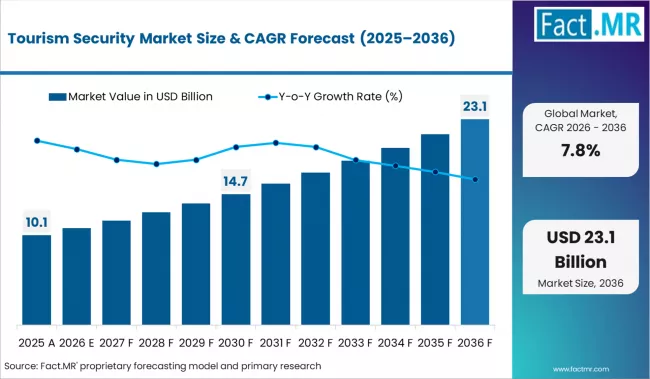
Tourism Security Market Market Value Analysis | Source: Fact.MR
Summary
- Market Definition
- The market covers professional security and risk management services for travelers and tourism operators, spanning VIP protection, crisis management, threat intelligence, and medical evacuation across global high-risk corridors.
- Demand Drivers
- Rising geopolitical instability across Southeast Asia and the Middle East is compelling multinational corporates to expand duty-of-care security contracts for business and NGO traveler protection.
- Mandatory tourism security frameworks enacted by India and UAE governments are driving direct procurement of threat intelligence and secure transportation services at high-footfall heritage and event venues.
- Growing solo traveler and journalist risk exposure in conflict-adjacent destinations is accelerating demand for emergency medical evacuation and crisis management service subscriptions.
- Key Segments Analyzed
- By Service Type: Secure Transportation holds approximately 30% share in 2026, driven by demand from corporate clients and government delegations requiring vetted ground and air mobility in risk-elevated corridors.
- By End User: Tourists lead with approximately 45% share in 2026, representing the broadest client base across government-regulated destination security programmes and commercial travel risk service packages.
- By Geography: India leads with 11.3% CAGR through 2036 through expanding inbound tourism security infrastructure and government-driven heritage site protection mandates.
- Analyst Opinion at FACT.MR
- Shambhu Nath Jha, Principal Consultant at Fact.MR, opines, 'CXOs in the tourism security space will find that AI-integrated threat intelligence and duty-of-care compliance platforms are displacing traditional reactive security models, with government and corporate procurement increasingly favouring integrated risk management partners over single-service providers through 2036.'
- Strategic Implications
- Invest in AI-driven threat intelligence platforms to access premium government and corporate contracts in high-risk tourism corridors.
- Target emerging duty-of-care compliance mandates in India and UAE to expand secure transportation and crisis management service agreements.
- Develop modular, subscription-based risk consulting packages for NGO and journalist clients operating in conflict-adjacent destinations.
- Methodology
- Based on security firm revenues, government tender data, and contract values. Validated with 2024 to 2025 procurement inputs.
- Uses UNWTO, U.S. State Department, and FCDO travel risk and security programme data to support demand analysis by service type.
- Forecasts include geopolitical risk indices, corporate duty-of-care compliance trends, and expert security industry insights.
| Metric | Value |
|---|---|
| Estimated Value in 2026 | USD 10.9 billion |
| Forecast Value in 2036 | USD 23.1 billion |
| Forecast CAGR (2026 to 2036) | 7.8% |
Source: Fact.MR analysis. Updated Mar 27, 2026
Between 2026 and 2036, the market is expected to create USD 12.2 billion in new opportunity. Growth is structural and accelerating. Demand is driven by rising geopolitical risks and stricter duty-of-care requirements for multinational companies. Government-led tourism security initiatives in high-traffic destinations are also supporting expansion. Growth is moderated by budget constraints in public sector spending. Regulatory enforcement remains uneven across regions. High costs of deploying trained security personnel in remote areas also limit expansion.
Geopolitical instability and major tourism incidents are pushing both public and private buyers to increase security spending. Secure transportation and threat intelligence are the fastest-growing segments. VIP protection continues to command the highest contract values among corporate and government clients.
Country growth reflects geopolitical risk exposure, inbound tourism volume growth, corporate duty-of-care regulatory maturity, and government security programme investment. India leads at 11.3% CAGR through 2036, driven by rising inbound tourism volumes and government-mandated security frameworks for heritage and high-footfall tourism sites. China follows at 11% through outbound corporate travel risk management demand and government-backed secure transportation deployments. UAE records 10.6% through Gulf tourism expansion and mandatory event security frameworks linked to mega-event hosting. USA posts 10.2% through corporate duty-of-care compliance investment and threat intelligence procurement by multinational clients. UK registers 9.4% driven by crisis management services demand and digitally-integrated tourism security deployments across government and NGO clients.
Segmental Analysis
Tourism Security Market Analysis by Service Type
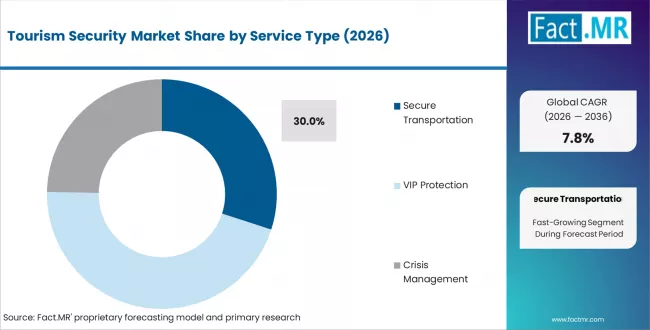
Tourism Security Market Analysis By Service Type | Source: Fact.MR
Based on FACT.MR's tourism security market report, Secure Transportation is estimated to hold 30% share in 2026. Its dominance reflects the non-negotiable mobility requirements of government delegations, corporate executives, and high-risk destination tourists who require verified vetted ground and air transport as the baseline security layer across all risk-exposure scenarios.
- G4S Investment: In 2024, G4S Secure Solutions expanded its armoured transportation fleet in the UAE and Saudi Arabia to support growing demand from corporate and government clients linked to Gulf tourism and event security. [2]
- Control Risks Technology Launch: In 2025, Control Risks launched its RiskMap digital threat intelligence platform update, integrating real-time transportation corridor risk scoring for corporate travel security managers. [3]
- Secure Transport Trend: UNWTO's 2024 global tourism safety report confirmed secure ground transportation as the fastest-growing tourism security procurement category across Gulf and South Asian markets. [4]
Tourism Security Market Analysis by End User
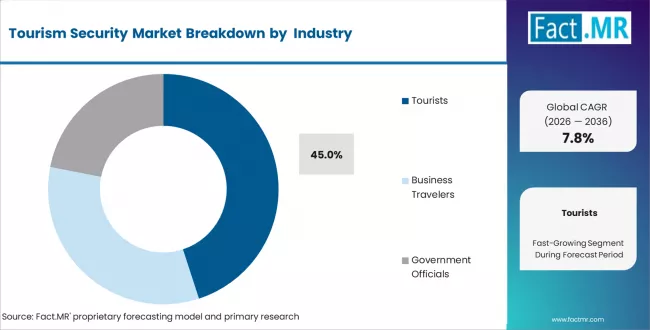
Tourism Security Market Analysis By End User | Source: Fact.MR
Based on FACT.MR's tourism security market report, Tourists are estimated to hold 45% share in 2026. This dominance reflects the scale and diversity of leisure traveler exposure to destination-level risk, where government security programmes and commercial OTA-linked insurance and evacuation products are increasingly bundled as standard service components across high-volume inbound markets.
- Triple Canopy Partnership: In 2024, Triple Canopy secured a multi-year contract with a Gulf state tourism authority to provide integrated tourist protection services across heritage and high-footfall destination sites. [5]
- MEDEX Global Technology: In 2025, MEDEX Global Solutions enhanced its mobile emergency medical evacuation app with real-time destination health and security alerts for solo traveler and NGO client segments. [6]
- Tourist Security Trend: U.S. State Department 2024 travel advisory data confirmed a 19% increase in Level 2 and Level 3 advisories, directly expanding corporate and individual tourism security service procurement. [7]
Drivers, Restraints, and Opportunities
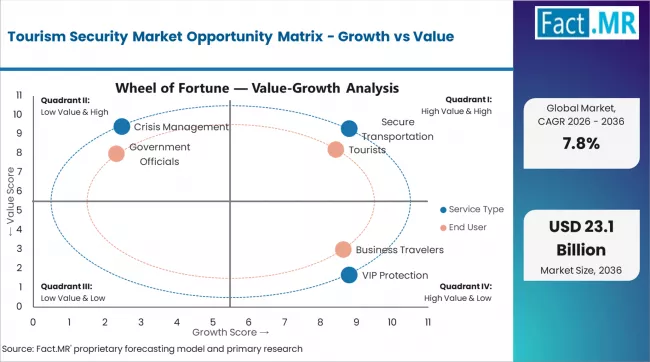
Tourism Security Market Opportunity Matrix Growth Vs Value | Source: Fact.MR
FACT.MR analysts note the tourism security market has transitioned from a niche high-net-worth service category to a mainstream compliance and risk management sector, valued at USD 10.2 billion in 2025. Growth is driven by multinational corporate duty-of-care obligations, government destination security mandates, and the rising frequency of geopolitical disruption in high-tourism corridors.
The market shows a clear bifurcation. Reactive perimeter security and ad-hoc escort services face margin compression and commoditisation. AI-integrated threat intelligence and proactive risk consulting platforms command 30 to 50% premium pricing and are securing multi-year government and corporate retainer contracts. This higher-value segment sustains overall revenue expansion despite moderate volume growth in traditional service categories.
- UAE Mandatory Event Security: The UAE's National Tourism Strategy 2031 mandates certified security service deployment at all permitted tourism events and heritage sites, directly expanding compulsory procurement from licensed operators like G4S and Olive Group through 2026. [1]
- India Heritage Tourism Security Drive: India's Ministry of Tourism 2024 guidelines require documented security protocols at ASI-protected heritage tourism sites, expanding government tender pipeline for risk consulting and threat intelligence services. [8]
- Corporate Duty-of-Care Growth: The Global Business Travel Association's 2024 survey confirmed 68% of multinational corporates increased travel security budgets in 2024, with threat intelligence and crisis management as the two fastest-growing line items across all corporate travel categories. [9]
Regional Analysis
The tourism security market is analysed across North America, Europe, Asia Pacific, Latin America, and Middle East and Africa, covering 40+ countries with distinct demand profiles shaped by geopolitical risk exposure, inbound tourism volumes, duty-of-care regulatory frameworks, and government security procurement investment. The full report offers market attractiveness analysis across risk index benchmarks, destination security programme pipeline, and service type adoption trajectories.
.webp "Top Country Growth Comparison Tourism Security Market Cagr (2026 2036)")
Top Country Growth Comparison Tourism Security Market Cagr (2026 2036) | Source: Fact.MR
| Country | CAGR (2026 to 2036) |
|---|---|
| India | 11.3% |
| China | 11% |
| UAE | 10.6% |
| USA | 10.2% |
| UK | 9.4% |
Source: Fact.MR analysis. Updated Mar 27, 2026
Source: Fact.MR (FACT.MR) analysis, based on proprietary forecasting model and primary research
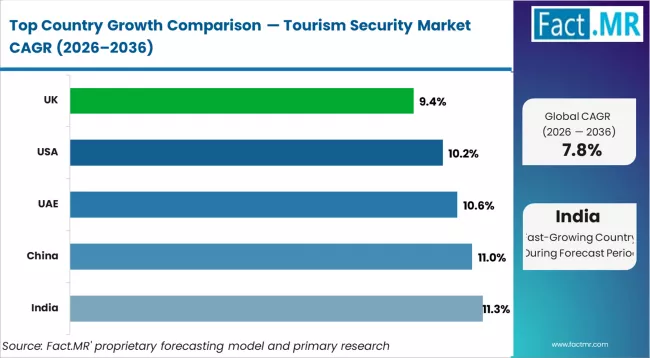
Tourism Security Market Cagr Analysis By Country | Source: Fact.MR
Asia Pacific Tourism Security Market
Asia Pacific is the fastest-growing region for tourism security services. Growth is supported by government-led safety programmes in India and rising corporate travel risk management demand from China. Leading players such as Control Risks, G4S, and Triple Canopy maintain strong presence across high-risk corridors in South and East Asia.
- India: Demand is projected to grow at 11.3% CAGR through 2036. Growth is driven by 2024 heritage site security guidelines and the Swadesh Darshan 2.0 programme covering 50 tourism circuits. Government spending on tourist safety infrastructure is expanding rapidly. Olive Group scaled operations in 2024 across key heritage states. India’s model is largely government-funded and focused on inbound tourism safety.
- China: Demand is projected to grow at 11% CAGR through 2036. Growth is driven by outbound corporate travel and stricter duty-of-care compliance. Control Risks reported a 24% increase in China-origin consulting mandates in 2024. Investment in risk consulting and threat intelligence is rising. China’s demand is primarily corporate-driven and export-oriented.
FACT.MR’s Asia Pacific analysis covers India, China, Japan, South Korea, ASEAN, and Australia & New Zealand, including procurement trends and risk benchmarks.
Middle East and Africa Tourism Security Market
The Middle East is a regulatory-driven market with strong government-backed procurement. Demand is linked to mega-events, tourism expansion, and national safety mandates. G4S and Olive Group are key suppliers across the region.
- UAE: Demand is projected to grow at 10.6% CAGR through 2036. The National Tourism Strategy 2031 mandates certified security deployment at tourism events. This creates a consistent procurement pipeline. G4S expanded operations in 2024 across Dubai and Abu Dhabi. Growth is driven by structured licensing and commercial contracts rather than subsidies.
FACT.MR’s MEA analysis includes UAE, Saudi Arabia, GCC, Turkey, South Africa, and others, covering event security demand and procurement frameworks.
North America Tourism Security Market
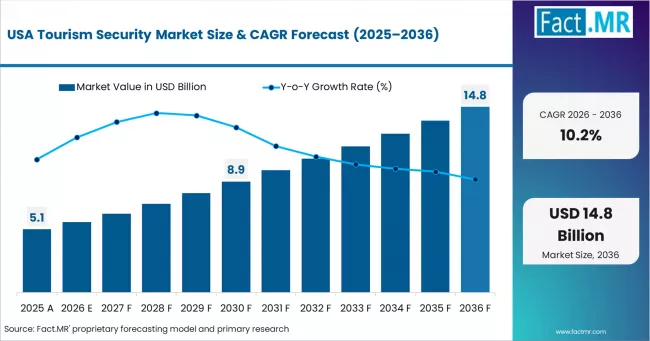
Tourism Security Market Country Value Analysis | Source: Fact.MR
North America is driven by corporate duty-of-care compliance and rising travel risk awareness. Multinational companies are increasing spending on employee safety during travel. Triple Canopy, Control Risks, and MEDEX are key service providers.
- USA: Demand is projected to grow at 10.2% CAGR through 2036. A 2024 survey showed 68% of firms increased travel security budgets. Crisis management, secure transport, and threat intelligence are key focus areas. MEDEX expanded its corporate client base by 31% in 2024. Growth is driven by employer liability and compliance frameworks across industries.
FACT.MR’s North America analysis includes the U.S., Canada, and Mexico, covering compliance trends and service adoption.
Europe Tourism Security Market
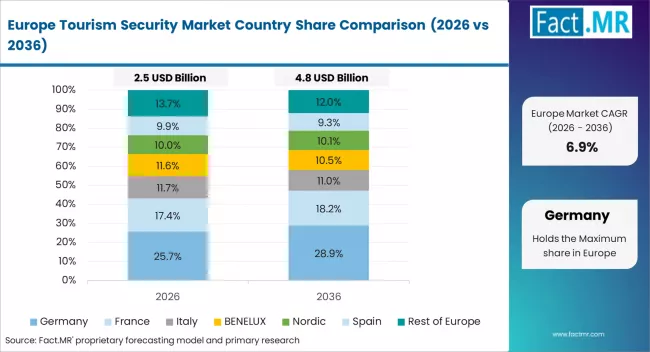
Tourism Security Market Europe Country Market Share Analysis, 2026 & 2036 | Source: Fact.MR
Europe is a regulation-driven and digitally advanced market. Adoption of GDPR-compliant threat intelligence and integrated risk platforms is increasing. Control Risks, G4S, and Olive Group lead across corporate and government segments.
- UK: Demand is projected to grow at 9.4% CAGR through 2036. Updated 2025 FCDO guidance has increased demand for crisis management and evacuation services. NGOs, media, and corporates are key buyers. Control Risks reported strong growth in digital risk consulting in 2024. Demand is shaped by advisory frameworks and institutional risk policies.
FACT.MR’s Europe analysis includes the UK, Germany, France, Italy, Spain, and others, covering regulatory compliance and digital adoption trends.
Competitive Aligners for Market Players
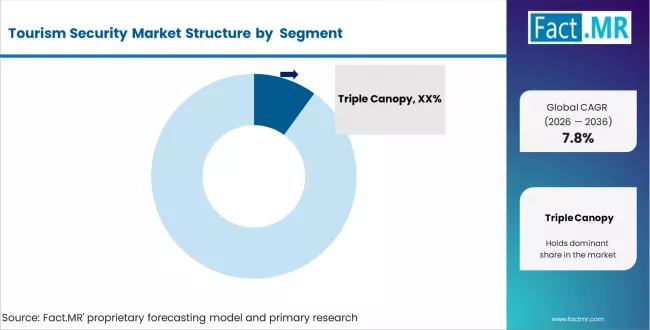
Tourism Security Market Analysis By Company | Source: Fact.MR
The global tourism security market is moderately concentrated, with a few large players holding a significant share of commercial contracts. Companies such as Triple Canopy, Control Risks, G4S Secure Solutions, Olive Group, and MEDEX Global Solutions together account for roughly 40 to 50% of the market. Competition in this space is not just about size. It depends heavily on advanced threat intelligence capabilities, the ability to operate across multiple countries, and compliance with local regulatory requirements.
Leading firms have clear structural advantages. Many hold government licenses that are difficult to obtain and maintain. They also have established infrastructure that allows them to deploy services quickly across regions. G4S, for example, has strong positioning in Gulf and South Asian government contracts. Control Risks stands out for its analytics-driven approach and diverse corporate client base. Triple Canopy benefits from long-term U.S. government contracts, which provide stable revenue and reduce exposure to pricing pressure in the commercial market.
Buyers also shape how the market operates. Governments and multinational corporations usually work with more than one provider to reduce dependency. They follow strict qualification processes and periodically re-tender contracts. This makes it difficult for new entrants to replace established players quickly. NGOs and media organizations are more cost-sensitive. They often prefer subscription-based digital intelligence services over expensive on-ground personnel. This creates a split market, where premium full-service providers and agile, technology-focused firms both find opportunities to grow.
Key Players
- Triple Canopy
- Olive Group
- Control Risks
- G4S Secure Solutions
- MEDEX Global Solutions
Bibliography
- [1] UAE Ministry of Economy. (2024). National Tourism Strategy 2031: Certified Security Deployment Requirements for Licensed Tourism Events and Heritage Sites. September 2024.
- [2] G4S Secure Solutions. (2024). Operational Expansion: Armoured Transportation Fleet and Event Security Personnel Deployment in UAE and Saudi Arabia Under Gulf Government Framework Contracts. Q3 2024.
- [3] Control Risks. (2025). RiskMap Platform Update: Real-Time Transportation Corridor Risk Scoring for Corporate Travel Security Manager Integration. January 2025.
- [4] UNWTO. (2024). Global Tourism Safety and Security Report 2024: Secure Ground Transportation as Fastest-Growing Procurement Category Across Gulf and South Asian Markets. December 2024.
- [5] Triple Canopy. (2024). Contract Award: Multi-Year Integrated Tourist Protection Services Agreement with Gulf State Tourism Authority Covering Heritage and High-Footfall Destination Sites. 2024.
- [6] MEDEX Global Solutions. (2025). Product Enhancement: Mobile Emergency Medical Evacuation Application Update with Real-Time Destination Health and Security Alerts for Solo Traveler and NGO Segments. January 2025.
- [7] U.S. Department of State. (2024). Travel Advisory Annual Summary 2024: 19% Increase in Level 2 and Level 3 Country Advisories and Corporate Travel Security Procurement Implications. December 2024.
- [8] Ministry of Tourism, Government of India. (2024). Swadesh Darshan 2.0 Programme Guidelines: Tourist Safety Infrastructure Budget Allocation Across 50 Cultural Tourism Circuits Including Heritage Site Security Protocols. 2024.
- [9] Global Business Travel Association. (2024). Corporate Travel Security Survey 2024: 68% of Multinational Corporates Increased Travel Security Budgets with Threat Intelligence and Crisis Management as Fastest-Growing Line Items. October 2024.
This Report Addresses
- Insights on tourism security demand across key service areas including VIP protection, transport, crisis management, and intelligence.
- Market forecast from USD 10.9 billion in 2026 to USD 23.1 billion by 2036 at a CAGR of 7.8%.
- Growth opportunities across India, UAE, U.S., and UK driven by government policies and corporate compliance.
- Segment analysis by service type and end user categories.
- Regional outlook covering Asia Pacific, Middle East, and North America demand trends.
- Competitive landscape of major players with focus on technology and contract positioning.
- Regulatory analysis including UAE, India, and UK security frameworks.
- Report available in PDF, Excel, and presentation formats backed by primary and secondary research data.
Tourism Security Market Definition
The tourism security market covers protective and risk management services deployed for travelers, tourism operators, and destination stakeholders. It includes VIP protection, secure ground and air transportation, crisis response, threat intelligence, emergency medical evacuation, and risk consulting.
Tourism Security Market Inclusions
Covers global and regional market sizes from 2026 to 2036 segmented by service type and end user. Includes VIP protection, secure transportation, crisis management, risk consulting, emergency medical evacuation, and threat intelligence services. Regional analysis spans North America, Europe, Asia Pacific, Latin America, and the Middle East and Africa.
Tourism Security Market Exclusions
Excludes domestic law enforcement and military services not commercially contracted by tourism operators or corporates. Also excludes cybersecurity services unless integrated within a broader travel risk management contract, and general insurance products not bundled with active security service deployment.
Tourism Security Market Research Methodology
- Primary Research: Interviews with corporate travel risk managers, government tourism security officials, private security firm operations heads, and NGO field security coordinators across key markets.
- Desk Research: Analysis of UNWTO security reports, U.S. State Department travel advisory data, UK Foreign Commonwealth and Development Office guidelines, and company investor disclosures from 2024 to 2025.
- Market-Sizing and Forecasting: Hybrid model integrating top-down government procurement estimates with bottom-up service contract revenue data by end user segment and geography.
- Data Validation and Update Cycle: Validated using private security firm revenues, government tender records, corporate travel risk budget data, and expert interviews with regular annual updates.
Segmentation
Scope of Report
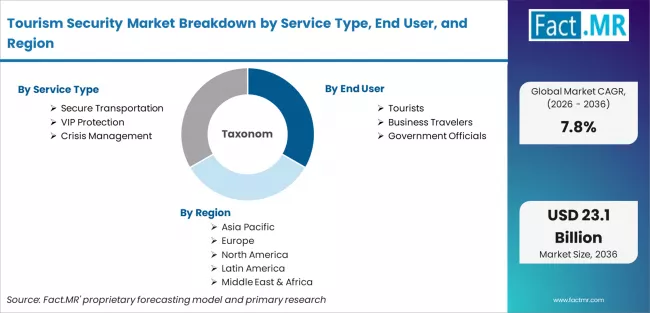
Tourism Security Market Breakdown By Service Type, End User, And Region | Source: Fact.MR
| Attribute | Details |
|---|---|
| Quantitative Units | USD 10.9 billion (2026) to USD 23.1 billion (2036), at a CAGR of 7.8% |
| Market Definition | Professional security and risk management services for travelers and tourism operators, spanning VIP protection, secure transportation, threat intelligence, crisis management, risk consulting, and emergency medical evacuation. |
| Service Type Segmentation | VIP Protection, Secure Transportation, Crisis Management, Risk Consulting, Emergency Medical Evacuation, Threat Intelligence |
| End User Segmentation | Tourists, Business Travelers, Government Officials, Corporate Clients, Journalists, NGOs |
| Regions Covered | North America, Europe, Asia Pacific, Latin America, Middle East and Africa |
| Countries Covered | USA, Canada, Mexico, UK, Germany, France, Italy, Spain, Nordic, BENELUX, China, Japan, South Korea, India, ASEAN, Australia and New Zealand, UAE, Saudi Arabia, GCC, Turkey, South Africa, Brazil, Argentina, Chile, Rest of MEA |
| Key Companies Profiled | Triple Canopy, Olive Group, Control Risks, G4S Secure Solutions, MEDEX Global Solutions |
| Forecast Period | 2026 to 2036 |
| Approach | Hybrid top-down and bottom-up model using government procurement records, corporate travel risk budget data, service contract revenues, risk index benchmarks, and primary interviews with travel security professionals. |
Source: Fact.MR analysis. Updated Mar 27, 2026
Tourism Security Market by Segments
-
By Service Type :
- VIP Protection
- Secure Transportation
- Crisis Management
- Risk Consulting
- Emergency Medical Evacuation
- Threat Intelligence
-
By End User :
- Tourists
- Business Travelers
- Government Officials
- Corporate Clients
- Journalists
- NGOs
-
By Region :
- North America
- United States
- Canada
- Mexico
- Latin America
- Brazil
- Mexico
- Argentina
- Chile
- Rest of Latin America
- Western Europe
- Germany
- United Kingdom
- France
- Italy
- Spain
- Nordic Countries
- BENELUX
- Rest of Western Europe
- Eastern Europe
- Russia
- Poland
- Hungary
- Balkan and Baltic
- Rest of Eastern Europe
- East Asia
- China
- Japan
- South Korea
- South Asia and Pacific
- India
- ASEAN
- Australia and New Zealand
- Rest of South Asia and Pacific
- Middle East and Africa
- UAE
- Kingdom of Saudi Arabia
- Other GCC Countries
- Turkey
- South Africa
- Rest of Middle East and Africa
- North America
Frequently Asked Questions
How large is the global tourism security market in 2025?
What will the tourism security market size be by 2036?
What is the expected CAGR for the tourism security market from 2026 to 2036?
Which service type segment is poised to lead the tourism security market?
Which end user segment leads the tourism security market?
How significant is Asia Pacific in the global tourism security market?
What is driving growth in the tourism security market?
Which service segment is growing the fastest?
Which segment generates the highest value?
Who are the key end users of tourism security services?
Which region is growing the fastest?
Why are corporations investing more in tourism security?
How do regulations impact the market?
What role does technology play in this market?
Who worked on this report


Preview the report firsthand - request a free sample
Free SampleGet the brochure for pricing and purchase details
Download PDF