- Market Value (2025): USD 670.5 Mn
- Estimated Value (2026): USD 762.0 Mn
- Forecast Value (2036): USD 2737.0 Mn
- CAGR (2026-2036): 13.6%
What is the Shelf-Life Extending Nanomaterials Market forecast to be worth by 2036?
USD 762.0 million in 2026 to USD 2737.0 million by 2036, at a 13.6% CAGR.
- The Shelf-Life Extending Nanomaterials Market crossed a valuation of USD 670.5 million in 2025.
- Demand is projected to increase from USD 762.0 million in 2026 to USD 2737.0 million by 2036.
- The market is forecast to record 13.6% CAGR from 2026 to 2036 as food processors need longer protection from oxygen damage and spoilage.
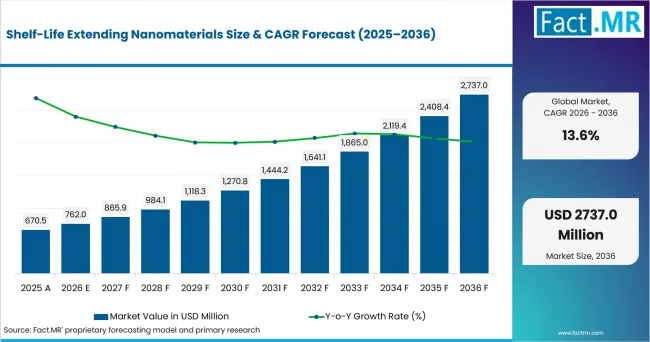
Shelf Life Extending Nanomaterials Value Analysis | Source: Fact.MR
What are the defining numbers behind Shelf-Life Extending Nanomaterials Market growth?
USD 1974.9500 million absolute opportunity by 2036, led by nanoclay and fresh-produce applications.
- Demand Drivers in the Market
- Demand is increasing for packaging which helps to keep the fruits and vegetables stay fresh for long time. USDA Economic Research Service reported in June 2026 that total U.S. food spending reached USD 2.51 trillion in 2025.
- As per Fact.MR analysis, growing use of oxygen-control packaging in meat and seafood supports demand by helping products stay fresh during chilled storage.
- Dairy packaging create demand for materials that reduce light and oxygen exposure, especially in longer supply chains.
- Demand will also rise as flexible-film producers seek better barrier performance without making packaging thicker or changing existing production lines.
- Key Segments Analyzed
- By Nanomaterial Platform: Nanoclay holds 29.0% share in 2026 because it helps to block the oxygen and moisture from passing through packaging.
- By Shelf-Life Mechanism: Oxygen barrier is expected to hold 32.0% share in 2026 as oxygen can directly harm flavor and nutrients in packaged foods.
- By Packaging Format: Flexible film leads with 31.0% share in 2026 due to its broader use in dairy and dry-food packs.
- By Food Application: Fresh produce captures 26.0% share in 2026 because fruits and vegetables loses their freshness during storage and transport.
- Analyst Opinion at Fact.MR
- Shambhu Nath Jha, Principal Consultant at Fact.MR, states, “Demand will grow for materials that are easy to use with current packaging machines. Suppliers need to give clear details about safety and product use.”
- Strategic Implications
- Packaging companies can check how well nanomaterials mix and how well they protect the product during normal production. Food brands can choose packaging based on what causes the product to spoil.
- Additive suppliers can share clear details on food safety and recycling before larger tests start.
- Packaging teams need to test the material during storage to see how well it helps to keep the food fresh. The European Commission reported in August 2026 that EU packaging waste could rise by 19% by 2030 compared with 2018 if no further action is taken.
South Korea is expected to record 14.7% CAGR through 2036 as food exports and packaged-food manufacturing widen the market for shelf-life technologies. The USA is expected to post 14.0% CAGR as large food spending and food-waste prevention create a broad use case. Germany is expected at 12.4%, Italy at 11.4%, and Japan at 9.7%, with each market shaped by food production and waste-reduction pressure.
How does the Shelf-Life Extending Nanomaterials Market break down by segment?
Nanoclay leads Nanomaterial Platform at 29.0%; oxygen barrier leads Shelf-Life Mechanism at 32.0%.
Which Nanomaterial Platform leads?
Nanoclay is expected to hold 29.0% share in 2026.
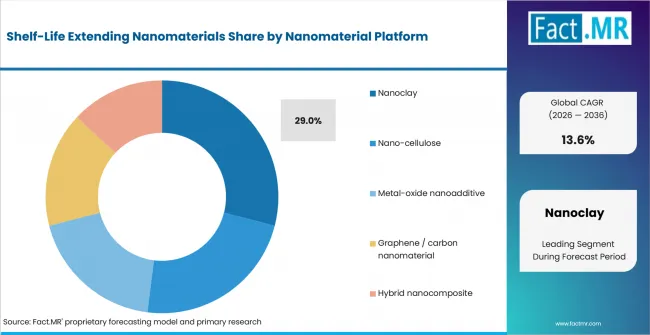
Shelf Life Extending Nanomaterials Analysis By Nanomaterial Platform | Source: Fact.MR
Nanoclay lead because it helps to stop gas from passing through packaging. Nano-cellulose offers a plant-based option for coatings and barrier layers. Metal-oxide additives can help block light and control germs. Graphene and other carbon materials improve gas protection even when it uses in small amounts. Hybrid materials combine different features to give better protection.
What leads the Shelf-Life Mechanism segment?
Oxygen barrier is expected to hold 32.0% share in 2026.
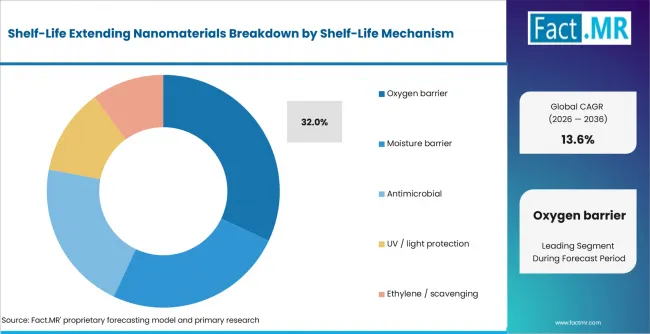
Shelf Life Extending Nanomaterials Analysis By Shelf Life Mechanism | Source: Fact.MR
Oxygen control hold the largest share in 2026 because oxygen can lower food quality during storage. Moisture barriers help keep food crisp and prevent it from becoming too dry or lumpy. Antimicrobial layers help reduce food spoilage.
How does Packaging Format shape demand?
Flexible film is expected to hold 31.0% share in 2026.
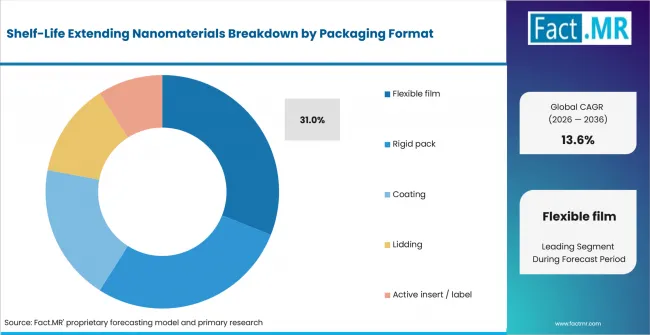
Shelf Life Extending Nanomaterials Analysis By Packaging Format | Source: Fact.MR
Flexible film is growing because it can protect food. Rigid packs are important for strong packaging. Coatings added extra protection to paper or plastic packs. Lidding is used on trays for meat and dairy products. It is also important for ready to eat meals.
What supports Fresh Produce within Food Application?
Fresh produce is expected to hold 26.0% share in 2026.
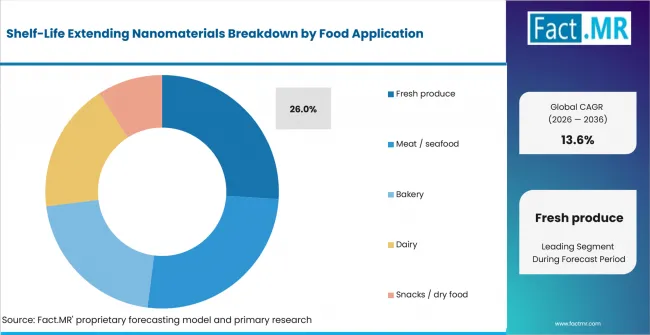
Shelf Life Extending Nanomaterials Analysis By Food Application | Source: Fact.MR
Fresh produce is estimated to lead application segment. Eurostat reported in August 2025 that Italy produced 13.9 million tonnes of fresh vegetables, in 2024 including melons. Meat and seafood packaging helps to keep the food fresh by controlling oxygen and germs. Bakery and dairy products need another types of protection to stay fresh.
What is accelerating Shelf-Life Extending Nanomaterials Market adoption, and what is holding it back?
For packaging demand is growing which helps to keep the food fresh longer, while material quality and recycling needs can limit its use.
Drivers Impact Analysis
| Driver | (~) % Impact on CAGR | Geographic Relevance | Impact Timeline |
|---|---|---|---|
| Food-waste prevention | +1.8% | Global | Short term (<= 2 years) |
| Oxygen and moisture barrier improvement | +1.5% | Global | Short term (<= 2 years) |
| Light protection for sensitive foods | +0.9% | North America, Europe, East Asia | Medium term (2-4 years) |
| Thin-film material efficiency | +0.7% | Global | Medium term (2-4 years) |
Source: Fact.MR analysis. Updated Sep 28, 2026
Opportunity Impact Analysis
| Opportunity | (~) % Impact on CAGR | Geographic Relevance | Impact Timeline |
|---|---|---|---|
| Hybrid oxygen-moisture barriers | +1.2% | Global | Medium term (2-4 years) |
| Active labels and inserts | +0.9% | North America, Europe, East Asia | Short term (<= 2 years) |
| Recyclable mono-material barrier films | +0.8% | Europe, North America | Long term (>= 4 years) |
| Produce-specific ethylene management | +0.5% | Global fresh-produce chains | Medium term (2-4 years) |
Source: Fact.MR analysis. Updated Sep 28, 2026
Restraints Impact Analysis
| Restraint | (~) % Impact on CAGR | Geographic Relevance | Impact Timeline |
|---|---|---|---|
| Food-contact and migration qualification | -0.8% | Global | Short term (<= 2 years) |
| Nanomaterial dispersion and agglomeration | -0.6% | Global | Short term (<= 2 years) |
| Recycling-stream compatibility | -0.5% | Europe, North America | Medium term (2-4 years) |
| Cost of validation at pack level | -0.4% | Global | Medium term (2-4 years) |
Source: Fact.MR analysis. Updated Sep 28, 2026
Which countries are scaling Shelf-Life Extending Nanomaterials Market through 2036?
- South Korea stands 0.7 percentage point above the USA, supported by packaged-food production and export-oriented food categories.
- The USA follows at 14.0% CAGR, with a large food economy and strong rule focus on food-contact packaging.
- Germany posts 12.4% CAGR as fresh-food output and ready-meal production create broad packaging demand under strict recycling rules.
- Italy reaches 11.4% CAGR, supported by a large agri-food base and high fresh-vegetable production alongside packaging-recycling targets.
- Japan records 9.7% CAGR, with food-loss reduction policy and household consumption supporting demand for shelf-life control.
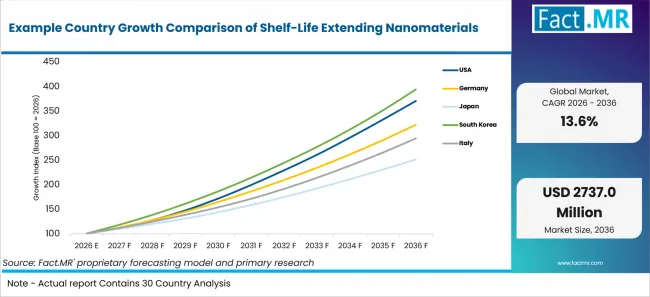
Example Country Growth Comparison Of Shelf Life Extending Nanomaterials | Source: Fact.MR
| Country | CAGR (2026-2036) |
|---|---|
| South Korea | 14.7% |
| United States | 14.0% |
| Germany | 12.4% |
| Italy | 11.4% |
| Japan | 9.7% |
Source: Fact.MR analysis. Updated Sep 28, 2026
What supports the United States outlook?
14.0% CAGR, supported by a packaging requirements for large food.
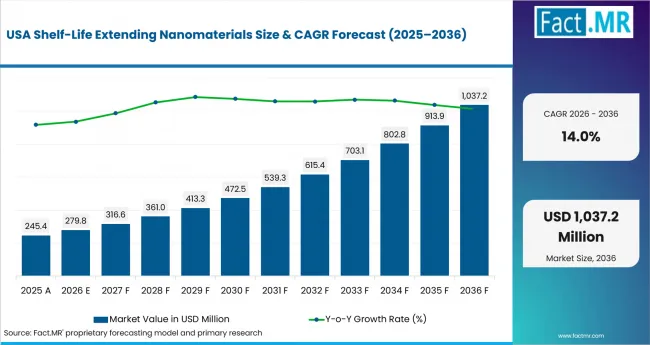
Shelf Life Extending Nanomaterials Country Value Analysis | Source: Fact.MR
U.S. food brands choose shelf-life materials based on the food type and storage needs. In January 2025, the U.S. Food and Drug Administration stated that 35 food contact notifications for PFAS-based grease-proofing materials used in paper and paperboard food packaging are no longer effective.
What supports the Germany outlook?
12.4% CAGR, led by fresh-food output and processed-food packaging.
Germany has a big fresh-food market, which increases the demand for packaging that helps to keep the food fresh and safe. According to Destatis, German farms produced 4.5 million tonnes of vegetables in 2025, up 8.1% from 2024, as reported in February 2026.
What supports the Japan outlook?
9.7% CAGR, backed by packaging of high-performance and reduction of food-loss efforts.
Japan demand is high for packaging which helps the food stay fresh and protect its quality. In June 2026, the Ministry of Agriculture, Forestry and Fisheries reported 2.37 million tonnes of food loss from businesses in fiscal 2024.
What supports the South Korea outlook?
14.7% CAGR, shaped by agri-food exports and packaged-food production.
Demand is increasing in South Korea for packaging which keeps the food fresh and safe during transportation. From the Ministry of Agriculture, Food and Rural Affairs an agri-food exports reached USD 10.41 billion in 2025 reported in January 2026.
What supports the Italy outlook?
11.4% CAGR, driven by a different fresh-food uses and high agri-food economy.
Sales are growing in Italy for packaging because different types of food products needed for meats. According to Istat, Italy’s agri-food sector reached EUR 89 billion in value added in 2025, up from EUR 83.4 billion in 2024.
Who leads the Shelf-Life Extending Nanomaterials Market?
Haydale and MBN Nanomaterialia supply improve food packaging for advanced materials. These materials protect food from oxygen and light.
Smart Planet Technologies, GRAPHMATECH, and Reinste Nano Ventures also work with materials used in barrier packaging. Buyers are looking for how to meet the needs of food-contact and protect food materials.
NanoXplore offers GrapheneBlack xGnP™ masterbatch for plastic films. The material can improve film performance and support more efficient material use. Suppliers focuses on packaging that keeps the food safe and easy to use.
Which companies are the key providers?
Key companies include Haydale; MBN Nanomaterialia; Smart Planet Technologies; GRAPHMATECH; Reinste Nano Ventures; and NanoXplore.
- Haydale
- MBN Nanomaterialia
- Smart Planet Technologies
- GRAPHMATECH
- Reinste Nano Ventures
- NanoXplore
Bibliography
- Zeballos, E., & Sinclair, W. (2026, June 11). Total U.S. food spending reached $2.51 trillion in 2025. U.S. Department of Agriculture, Economic Research Service.
- European Commission, Directorate-General for Environment. (2026, August 11). New EU packaging rules start to apply, including restrictions on PFAS in food-contact packaging.
- U.S. Food and Drug Administration. (2025, January 3). FDA determines authorization for 35 food contact notifications related to PFAS are no longer effective.
- Statistisches Bundesamt (Destatis). (2026, February 26). Gemüseernte erreicht 2025 neuen Höchststand [Vegetable harvest reaches a new record high in 2025].
- Ministry of Agriculture, Food and Rural Affairs, Republic of Korea. (2026, January 20). Exports of K-Food Plus reached USD 13.6 billion in 2025, up 5.1% year-over-year.
- Italian National Institute of Statistics (Istat). (2026, June 12). Economic accounts for agriculture – Year 2025.
- Eurostat. (2025, August 25). How much fruit and vegetables does the EU harvest?
- NanoXplore Inc. (2026, June 15). NanoXplore and Techmer PM launch revolutionary GrapheneBlack xGnP™ masterbatch for high-performance plastic films.
This Report Answers
- The report explains where shelf-life nanomaterials are used across platform type and shelf-life mechanism. It also covers packaging format and food application.
- Segment analysis identifies nanoclay, oxygen barrier systems, flexible film, and fresh produce as the 2026 leaders within their respective dimensions.
- Country analysis examines South Korea, the United States, Germany, Italy, and Japan through their reported CAGR outlook and market-specific demand conditions.
- Competitive analysis reviews Haydale, MBN Nanomaterialia, Smart Planet Technologies, GRAPHMATECH, Reinste Nano Ventures and NanoXplore across additive, barrier, oxygen-control and advanced-material capabilities.
What does the Shelf-Life Extending Nanomaterials Market cover?
Nanoclay, nano-cellulose, metal-oxide, carbon-based, and hybrid nanocomposite systems used to protect packaged food quality during storage and distribution.
The market covers nanomaterials and nanocomposite additives that add a shelf-life function to food packaging. Included mechanisms are oxygen and moisture barriers, antimicrobial action, UV or visible-light protection, and ethylene or scavenging functions. The material may be compounded into a film or rigid package, applied as a coating, used in lidding, or configured as an active insert or label.
The scope focuses on packaging where shelf-life performance comes from a nanoscale additive, nanocomposite structure, or nanomaterial-enabled functional layer. Conventional structural packaging remains in adjacent categories. Cold-chain equipment and direct food preservatives are treated separately, which keeps the analysis centered on packaging materials that manage food quality during storage and distribution.
What is included in the scope?
Nanomaterial-enabled packaging structures used to control oxygen, moisture, light, microbes, or ripening gases around packaged foods.
The scope covers nanoclay, nano-cellulose, metal-oxide additives, graphene materials, and hybrid nanocomposites used in food packaging. Related coverage includes nano-enabled packaging for nanoscale barrier functions, oxygen scavenger materials for active oxygen control, and active oxygen scavenger labels for localized active systems. Formats include films, rigid packs, coatings, lidding, inserts, and labels. Applications span produce, meat, seafood, bakery, dairy, and dry foods. The use boundary overlaps with fresh food packaging when the nanomaterial directly protects quality during distribution.
What is excluded from the scope?
Conventional structural packaging, direct food preservatives, cold-chain equipment, and general packaging machinery are outside the scope.
The assessment separates ordinary polyethylene, polypropylene, PET, paper, and multilayer packaging from the target category when shelf-life performance comes from conventional structure alone. Direct food preservatives, refrigeration equipment, modified-atmosphere gas hardware, aseptic filling machinery, and general processing aids remain in adjacent categories. The market boundary stays focused on finished packaging that carries a nanoscale barrier or active function.
How Was the Analysis Built?
The analysis draws on 120+ sources, 35+ company portfolios, 25+ countries, and more than 20 industry interviews.
- Primary Research: Primary research includes discussions with manufacturers, service providers, technology developers, distributors, end users, and subject-matter experts. These conversations examine purchasing priorities, product adoption, operational challenges, approval requirements, competitive positioning, and the factors that influence wider market acceptance.
- Desk Research: Desk research covers government statistics, regulatory publications, company filings, trade data, technical studies, industry associations, standards, public policy, and other authoritative sources. Every source used in the analysis is documented in the bibliography.
- Market Sizing and Forecasting: Market estimates combine historical performance, demand indicators, pricing and volume trends, segment shares, company participation, country-level growth, adoption patterns, investment activity, and barriers to market expansion.
- Data Validation and Update Cycle: Findings are validated by comparing primary interviews with public data, company activity, regulatory changes, trade patterns, and industry developments. Regular updates review new product launches, capacity changes, partnerships, approvals, and shifts in commercial adoption.
Segmentation
What is the report’s scope and coverage?
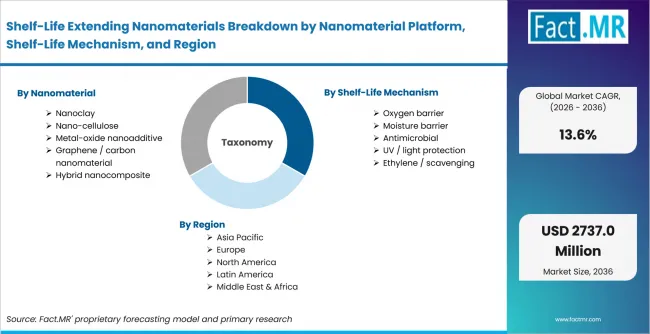
Shelf Life Extending Nanomaterials Breakdown By Nanomaterial Platform, Shelf Life Mechanism, And Region | Source: Fact.MR
| Attribute | Details |
|---|---|
| Quantitative Units | USD million |
| Market Definition | Nanomaterials and nanocomposite systems used in food packaging to extend shelf life through barrier, active, light-protection, moisture-control, or scavenging functions. |
| Nanomaterial Platform | Nanoclay; Nano-cellulose; Metal-oxide nanoadditive; Graphene / carbon nanomaterial; Hybrid nanocomposite |
| Shelf-Life Mechanism | Oxygen barrier; Moisture barrier; Antimicrobial; UV / light protection; Ethylene / scavenging |
| Packaging Format | Flexible film; Rigid pack; Coating; Lidding; Active insert / label |
| Food Application | Fresh produce; Meat / seafood; Bakery; Dairy; Snacks / dry food |
| Regions Covered | North America; Latin America; Western Europe; Eastern Europe; East Asia; South Asia & Pacific; Middle East & Africa |
| Countries Profiled | United States; Germany; Japan; South Korea; Italy |
| Key Companies Profiled | Haydale; MBN Nanomaterialia; Smart Planet Technologies; GRAPHMATECH; Reinste Nano Ventures; NanoXplore |
| Forecast Period | 2026 to 2036 |
| Approach | Primary-source review of food production, food loss, packaging regulation, barrier technologies, country demand, and verified provider portfolios. |
Source: Fact.MR analysis. Updated Sep 28, 2026
How is the market segmented?
-
By Nanomaterial Platform:
- Nanoclay
- Nano-cellulose
- Metal-oxide Nanoadditive
- Graphene / Carbon nanomaterial
- Hybrid nanocomposite
-
By Shelf-Life Mechanism:
- Oxygen barrier
- Moisture barrier
- Antimicrobial
- UV / Light protection
- Ethylene / Scavenging
-
By Packaging Format:
- Flexible film
- Rigid pack
- Coating
- Lidding
- Active insert / Label
-
By Food Application:
- Fresh produce
- Meat / Seafood
- Bakery
- Dairy
- Snacks / Dry food
-
By Region:
- North America
- Latin America
- Western Europe
- Eastern Europe
- East Asia
- South Asia & Pacific
- Middle East & Africa
Frequently Asked Questions
How big is the Shelf-Life Extending Nanomaterials Market in 2026?
What is the CAGR of the Shelf-Life Extending Nanomaterials Market from 2026 to 2036?
Which Nanomaterial Platform leads the Shelf-Life Extending Nanomaterials Market?
Which Shelf-Life Mechanism leads the Shelf-Life Extending Nanomaterials Market?
Who are the leading companies in the Shelf-Life Extending Nanomaterials Market?
Who worked on this report


Preview the report firsthand - request a free sample
Free SampleGet the brochure for pricing and purchase details
Download PDF