- Base Value(2025): 6.4 Bn
- Estimated Value(2026): 6.7 Bn
- Forecast Value (2036): 9.7 Bn
- CAGR (2026 - 2036): 3.8%
Shoe Insoles Market Forecast 2026 to 2036
In 2025, the shoe insoles market was valued at USD 6.4 billion. Based on Fact MR analysis, demand for shoe insoles is estimated to grow to USD 6.7 billion in 2026 and USD 9.7 billion by 2036. FMR projects a CAGR of 3.8% during the forecast period.
The absolute dollar growth from 2026 to 2036 is USD 3 billion. This growth is driven by increasing consumer awareness of foot health, comfort, and the growing demand for orthotic and performance-enhancing insoles in sports, healthcare, and everyday footwear. Rising concerns about foot-related health issues, such as plantar fasciitis, and the growth of the sports and wellness sector are key factors supporting market expansion. However, challenges such as price sensitivity and competition from low-cost alternatives may impact growth in some regions.
As Trip Randall, Chief Executive Officer of Superfeet Worldwide, noted regarding the shoe insoles category’s potential and broader market opportunity,
‘The insole category might be one of the best-kept secrets in the performance and wellness space.’
India leads with a CAGR of 7.2%, supported by growing consumer health awareness and the increasing demand for comfort and performance in footwear. China follows with 6.5%, driven by rising disposable income and the growing sports and health-conscious population. The USA grows at 4.8%, reflecting steady demand for comfort and orthotic insoles. The UK grows at 4.5%, supported by increasing interest in foot health and wellness products. Germany shows growth at 4.2%, benefiting from the strong demand for premium footwear solutions. Australia grows at 5.1%, driven by rising interest in active lifestyle and health products. Japan grows at 3.9%, with steady demand for foot care solutions in an aging population.
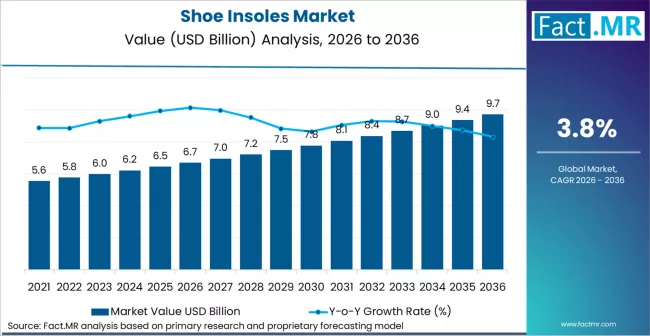
Shoe Insoles Market Market Value Analysis | Source: Fact.MR
| Metric | Value |
|---|---|
| Estimated Value in (2026E) | USD 6.7 billion |
| Forecast Value in (2036F) | USD 9.7 billion |
| Forecast CAGR (2026 to 2036) | 3.8% |
Source: Fact.MR analysis. Updated Mar 3, 2026
Shoe Insoles Market Definition
The Shoe Insoles Market involves the manufacture and sale of removable inserts placed inside footwear to provide cushioning, support, comfort, and corrective alignment for a range of activities and foot conditions.
Market Inclusions
This report covers global and regional market sizes for shoe insoles over a defined forecast period, including product types (gel, foam, orthotic, sport‑specific), end‑use segments (athletic, casual, medical/therapeutic), and distribution channels (retail, e‑commerce, clinical supply).
Market Exclusions
The scope excludes footwear products without separate insole components and general foot care accessories not classified as insoles. Custom orthotic manufacturing services and unrelated orthopedic devices not integrated into insoles are also omitted.
Research Methodology
- Primary Research: Interviews were conducted with product designers, podiatrists, and retail buyers.
- Desk Research: Data was sourced from industry reports, consumer surveys, and trade association statistics.
- Market‑Sizing and Forecasting: A hybrid model combining top‑down footwear accessory demand forecasts with bottom‑up shipment and revenue data was used.
- Data Validation and Update Cycle; Findings were validated through expert review and aligned with recent production and trade figures.
Summary of the Shoe Insoles Market
- Market Definition
- The Shoe Insoles Market refers to the production and sale of insoles designed to provide comfort, support, cushioning, and corrective alignment for various footwear applications. These insoles are essential for improving foot health and are available in materials like foam, gel, and rubber. They are widely used in casual, athletic, and orthotic footwear, catering to a diverse consumer base seeking comfort and performance.
- Demand Drivers
- Growing Health Awareness: Increasing consumer awareness regarding foot health and comfort is driving the demand for shoe insoles, especially in the orthotic and comfort segments.
- Sports and Wellness: The rise in athletic activities and interest in wellness products has led to a surge in the demand for performance-enhancing insoles designed for specific sports and active lifestyles.
- Foot-Related Conditions: Foot conditions such as plantar fasciitis, flat feet, and heel pain are fueling the demand for therapeutic and orthotic insoles.
- Key Segments Analyzed
- Application: Casual applications are expected to lead the market, with a 43.7% share by 2026. These insoles provide comfort and support for everyday footwear, catering to those who spend long hours on their feet.
- Material: Foam is projected to dominate the material segment with 47.5% of the market share, due to its cushioning properties, comfort, and affordability.
- Geography: India, China, and the USA are expected to lead the market, with India showing the highest growth at a 7.2% CAGR.
- Analyst Opinion at Fact MR
- Shambhu Nath Jha, Principal Consultant at Fact MR, emphasized the growing market for shoe insoles, stating, "As consumers increasingly prioritize foot health and comfort, the demand for insoles in sports, wellness, and orthotic applications will continue to grow."
- Strategic Implications/Executive Takeaways
- Focus on Comfort and Wellness: Companies should prioritize the development of insoles that provide superior comfort and address specific foot health needs, particularly in the orthotic and sports segments.
- Innovative Materials: The use of advanced materials like memory foam, gel, and carbon fiber will help companies cater to the growing demand for high-performance insoles in both everyday and athletic footwear.
- Geographical Focus: Expanding into high-growth markets like India and China, where awareness of foot health is increasing, offers significant growth opportunities for insole manufacturers.
- Methodology
- Primary research conducted with product designers, podiatrists, and retail buyers.
- Desk research sourced from industry reports, consumer surveys, and trade association data.
- Market sizing and forecasting used top-down footwear accessory demand projections and bottom-up shipment and revenue data.
Segmental Analysis
Shoe Insoles Market Analysis by Application
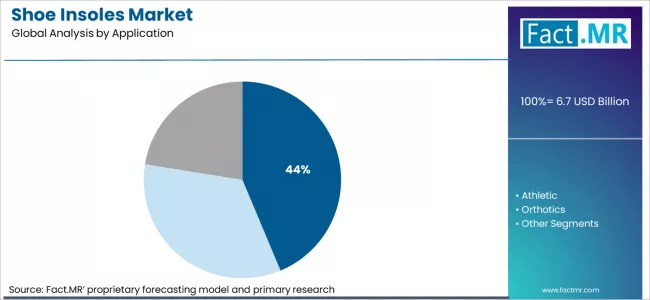
Shoe Insoles Market Analysis By Application | Source: Fact.MR
- Market Overview: Casual applications are expected to hold 43.7% of the shoe insoles market by 2026. Casual shoe insoles are designed for everyday use, offering comfort and support for daily activities. These insoles are widely used in casual footwear, such as sneakers, loafers, and boots, to enhance comfort, reduce foot fatigue, and improve overall foot health.
- Demand Drivers:
- Rising Demand for Comfort: As consumers spend long hours on their feet, there is an increasing demand for insoles that offer comfort and support throughout the day. Casual insoles are designed to alleviate foot pressure, making them popular among those who are on their feet for extended periods.
- Growing Health Awareness: As more consumers become aware of the importance of foot health, the demand for insoles that promote proper foot alignment and reduce discomfort is rising. Casual insoles are often chosen for their ability to provide relief from common foot problems such as arch pain or flat feet.
- Increasing Popularity of Everyday Footwear: The rise of athleisure and casual footwear trends is contributing to the growth of the casual insole segment. Consumers are looking for insoles that improve the fit and comfort of their everyday shoes, driving demand for this category.
Shoe Insoles Market Analysis by Material
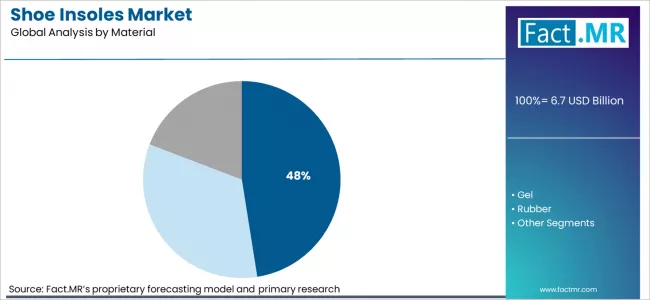
Shoe Insoles Market Analysis By Material | Source: Fact.MR
- Market Overview: Foam is projected to capture 47.5% of the market share by 2026. Foam insoles are popular due to their softness, cushioning properties, and versatility. They are widely used in various types of shoes, including casual, athletic, and orthotic footwear.
- Demand Drivers:
- Comfort and Cushioning: Foam insoles provide excellent cushioning, making them highly sought after for their comfort benefits. Foam materials, such as memory foam or EVA, mold to the shape of the foot, offering personalized comfort and support, which is a key driver in their widespread adoption.
- Cost-Effectiveness: Foam insoles are generally more affordable compared to other materials like gel or carbon fiber, making them an attractive option for consumers looking for a budget-friendly insole that still offers comfort and support.
- Versatility in Use: Foam insoles are versatile and can be used in various applications, including casual, athletic, and orthotic shoes. Their adaptability to different shoe types and consumer needs contributes to their dominance in the market.
Shoe Insoles Market Drivers, Restraints, and Opportunities
FMR analysts observe that the shoe insoles market is a growth‑aligned, comfort‑and‑wellness segment anchored in rising consumer focus on foot health, activity levels, and ergonomic footwear solutions. Historically, basic foam or cushioning inserts addressed general comfort needs; as awareness of biomechanical support, injury prevention, and performance enhancement has increased, structural demand emerged for anatomically designed, material‑engineered insoles used in athletic, occupational, and medical footwear. The 2026 valuation reflects this shift, with adoption tied to both everyday consumer use and targeted applications in sports and clinical foot care.
While demand for basic cushioned insoles remains large in cost‑sensitive segments, advanced orthotic, gel‑infused, and customized 3D‑printed insoles are gaining share. These higher‑value products often command premium pricing, contributing to net market value growth even as unit volumes grow with footwear purchases. The market exists because consumers and clinicians alike prioritize support, comfort, and injury mitigation, and regulatory/medical guidance encourages evidence‑based solutions for specific foot conditions.
- Comfort & Wellness Demand: Growing user preference for ergonomic support and pain mitigation drives uptake of performance‑focused insoles beyond basic cushioning.
- Clinical & Sports Applications: Therapeutic and athletic inserts that improve alignment and reduce impact replace generic options in specific use cases.
- Regional Consumer Trends: In North America and Europe, strong health awareness and active lifestyles accelerate premium insole adoption, while cost‑sensitive markets in Asia‑Pacific retain demand for basic cushioning options.
Regional Analysis
The market analysis covers key global regions, including South Asia, East Asia, North America, Western Europe, and Australia. It is segmented geographically, with specific market dynamics for each region. The full report provides a detailed market attractiveness analysis.
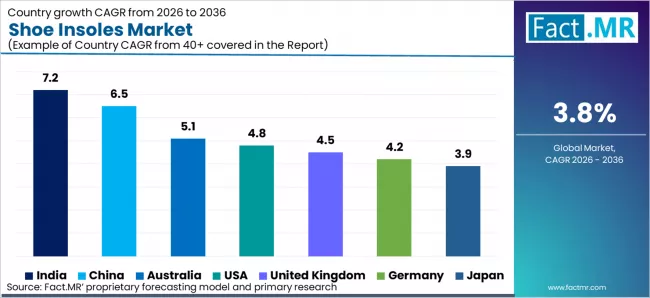
Shoe Insoles Market Cagr Analysis By Country | Source: Fact.MR
| Country | CAGR (2026-2036) |
|---|---|
| India | 7.2% |
| China | 6.5% |
| USA | 4.8% |
| Germany | 4.2% |
| United Kingdom | 4.5% |
| Australia | 5.1% |
| Japan | 3.9% |
Source: Fact.MR analysis. Updated Mar 3, 2026
Source: Fact MR (FMR) analysis, based on proprietary forecasting model and primary research.
South Asia
In South Asia, India is leading the demand for shoe insoles, driven by rising consumer awareness about foot health, growing disposable income, and increasing demand for comfort-based footwear products.
- India: Demand for shoe insoles in India is projected to rise at 7.2% CAGR through 2036. India’s expanding footwear market, growing focus on foot care, and increasing adoption of comfort-oriented products continue to drive strong market growth.
East Asia
In East Asia, China and Japan are major markets for shoe insoles, supported by the growing demand for foot health products, rising disposable incomes, and increasing consumer interest in comfort and sports-related footwear.
- China: Demand for shoe insoles in China is projected to rise at 6.5% CAGR through 2036. China’s growing awareness of foot health, rapid urbanization, and increasing adoption of foot care solutions contribute to market growth.
- Japan: Demand for shoe insoles in Japan is projected to rise at 3.9% CAGR through 2036. Japan’s aging population, high demand for foot care products, and focus on comfort and convenience in footwear continue to support steady market growth.
North America
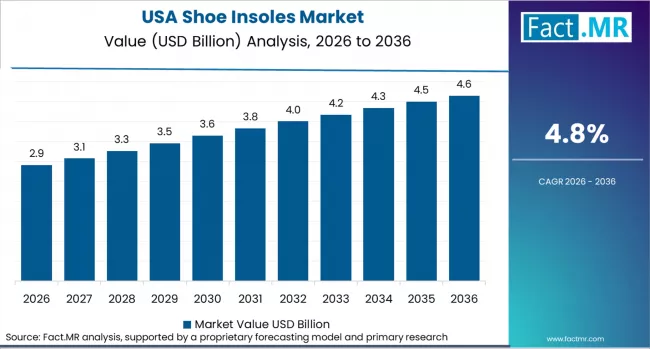
Shoe Insoles Market Country Value Analysis | Source: Fact.MR
In North America, the USA is a dominant market for shoe insoles, driven by increasing awareness about foot health, rising disposable incomes, and a growing interest in sports, fitness, and comfort-driven products.
- USA: Demand for shoe insoles in the U.S. is projected to rise at 4.8% CAGR through 2036. The USA’s growing focus on comfort and foot health, increasing sports and fitness trends, and rising demand for orthotic and comfort-oriented insoles contribute to steady market growth.
Western Europe
In Western Europe, Germany and the United Kingdom are key markets for shoe insoles, supported by increasing demand for foot health products, growing interest in comfort and wellness, and a rising focus on orthotic footwear.
- Germany: Demand for shoe insoles in Germany is projected to rise at 4.2% CAGR through 2036. Germany’s strong healthcare infrastructure and increasing demand for foot care solutions continue to support steady market demand.
- United Kingdom: Demand for shoe insoles in the UK is projected to rise at 4.5% CAGR through 2036. The UK’s growing awareness of foot health and increasing consumer focus on comfort-driven footwear contribute to the demand for shoe insoles.
Australia
In Australia, the demand for shoe insoles is growing due to increasing consumer awareness of foot care, a focus on comfort and health, and rising adoption of sports and fitness-related products.
- Australia: Demand for shoe insoles in Australia is projected to rise at 5.1% CAGR through 2036. Australia’s growing sports and fitness sector and increasing awareness of foot health continue to drive market growth.
Fact MR's analysis of the Shoe Insoles Market in South Asia, East Asia, North America, Western Europe, and Australia consists of country-wise assessments that include India, China, the USA, Germany, the United Kingdom, Japan, and Australia. Readers can find detailed trends, regulatory updates, and company-specific investments shaping the market’s growth in these countries.
How Are Key Players Competing in the Shoe Insoles Market?
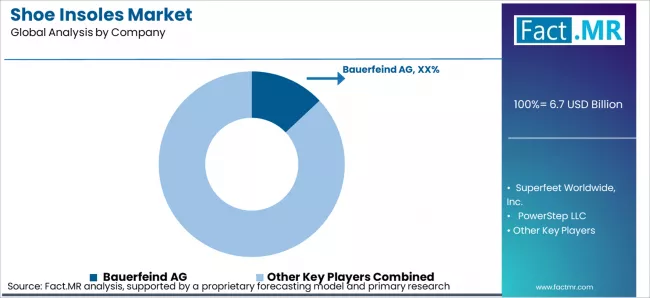
Shoe Insoles Market Analysis By Company | Source: Fact.MR
The shoe insoles market is seeing competition from established players like Bauerfeind, Superfeet, and PowerStep, which focus on providing orthopedic and comfort insoles designed to enhance foot health and comfort. Companies like Spenco Medical and ProFoot are emphasizing medical-grade insoles that target specific conditions such as plantar fasciitis and arch support. Aetrex and FootScience International are leading the market with innovative insole solutions for both athletic and everyday use, combining technology with comfort. CURREX and Sidas offer performance-oriented insoles tailored for sports and active lifestyles. Sports giants like ASICS, New Balance, and YONEX leverage their strong brand recognition to introduce branded insoles for athletic shoes. Meanwhile, Scholl’s Wellness and Birkenstock focus on lifestyle and comfort products, targeting mass-market consumers. Companies like Texon and FootBalance are also innovating in custom-fit insole technology, while retailers such as Decathlon and Li Ning expand their reach through affordable insole options.
Recent Industry Developments
- Currex and Volumental AI 3D-Scanning Partnership
- In February 2026, Currex entered a strategic partnership with Volumental to deploy AI-powered 3D foot scanning technology across retail locations. This system allows for clinical-grade gait and foot analysis in roughly five seconds, mapping a user's unique biomechanical data directly to a specific "Dynamic Arch" insole profile to ensure a personalized fit.
- Coats Group Completion of OrthoLite Acquisition
- On October 30, 2025, the Coats Group completed its $770 million acquisition of OrthoLite, the global leader in premium open-cell foam insoles. Following the merger, Coats has reorganized its business into two primary divisions-Apparel and Footwear-to accelerate the development of sustainable, bio-based insole materials like OrthoLite's Cirql brand for the 2026 season.
- Aetrex BioRocker™ and Serena Walking Shoe
- In early 2026, Aetrex debuted its Fall/Winter 2026 collection, featuring the Serena casual walking shoe integrated with BioRocker™ Technology. This double-rocker design is specifically engineered to reduce pressure on both the heel and forefoot simultaneously, catering to the "preventative foot health" segment focused on chronic pain relief.
Key Players of the Shoe Insoles Market
- Bauerfeind AG
- Superfeet Worldwide, Inc.
- PowerStep LLC
- Spenco Medical Corporation
- ProFoot, Inc.
- Aetrex Worldwide, Inc.
- Foot Science International (FSI)
- SOLO Laboratories, Inc.
- Texon International Group Ltd.
- FootBalance System Ltd.
- CURREX GmbH
- Sidas S.A.
- ENERTOR USA, Inc.
- Rehband Sweden AB
- YONEX Co., Ltd.
- ASICS Corporation
- New Balance Athletics, Inc.
- Decathlon S.A. (Aptonia is a brand)
- Li Ning Company Limited
- Scholl’s Wellness Co.
- Implus Footcare LLC
- Pedag International GmbH
- Birkenstock Group GmbH & Co. KG
Report Scope
| Metric | Value |
|---|---|
| Quantitative Units | USD 6.7 billion (2026) to USD 9.7 billion (2036), at a CAGR of 3.8% |
| Market Definition | The shoe insoles market includes products designed to provide comfort, support, and cushioning to footwear, available in different materials and designs for various applications such as casual, athletic, and orthotics. |
| By Application | Casual, Athletic, Orthotics |
| By Material | Foam, Gel, Rubber, Plastic, Carbon Fiber, Polyurethane, Others (Cork, Wool, Felt) |
| By Gender | Men, Women |
| By Price Outlook | Economy (Under USD 15), Medium (USD 15-30), Premium (Over USD 30) |
| Regions Covered | North America, Latin America, Europe, East Asia, South Asia, Oceania, Middle East and Africa |
| Countries Covered | United States, Canada, Mexico, Brazil, Argentina, Germany, France, United Kingdom, Italy, Spain, China, India, Japan, South Korea, Indonesia, Australia, and 40+ countries |
| Key Companies Profiled | Bauerfeind AG, Superfeet Worldwide, Inc., PowerStep LLC, Spenco Medical Corporation, ProFoot, Inc., Aetrex Worldwide, Inc., Foot Science International (FSI), SOLO Laboratories, Inc., Texon International Group Ltd., FootBalance System Ltd., CURREX GmbH, Sidas S.A., ENERTOR USA, Inc., Rehband Sweden AB, YONEX Co., Ltd., ASICS Corporation, New Balance Athletics, Inc., Decathlon S.A. (Aptonia is a brand), Li Ning Company Limited, Scholl’s Wellness Co., Implus Footcare LLC, Pedag International GmbH, Birkenstock Group GmbH & Co. KG |
| Forecast Period | 2026 to 2036 |
| Approach | Hybrid top-down and bottom-up market modeling validated through primary interviews with manufacturers and supported by trade data benchmarking and market research. |
Source: Fact.MR analysis. Updated Mar 3, 2026
Bibliographies
- Aetrex Worldwide, Inc. (2025). Orthotic and performance insole solutions for athletic and everyday footwear applications. Aetrex Worldwide, Inc.
- Bauerfeind AG. (2025). Medical-grade and orthopedic insole solutions for foot support and rehabilitation. Bauerfeind AG.
- PowerStep LLC. (2025). Orthotic insoles designed to support foot health and address plantar fasciitis and arch conditions. PowerStep LLC.
- Spenco Medical Corporation. (2025). Therapeutic insole products for comfort, arch support, and foot condition management. Spenco Medical Corporation.
- Superfeet Worldwide, Inc. (2025). Performance-oriented insoles for athletic and daily wear applications. Superfeet Worldwide, Inc.
- Aetrex Newsroom. (2026, January). Aetrex introduces BioRocker™ technology and Serena walking shoe in Fall/Winter 2026 expansion [Press release]. Aetrex Worldwide, Inc.
- Coats Group plc. (2025/2026, October). Coats Group completes acquisition of OrthoLite to expand footwear solutions portfolio [Corporate announcement]. Coats Group plc.
- Currex GmbH. (2026, February). Currex partners with Volumental to integrate AI-powered 3D foot scanning into insole fitting solutions [Press release]. Currex GmbH.
This report addresses
- Market Intelligence enabling comprehensive assessment of leading countries and service segments across the Shoe Insoles Market globally.
- Market Volume (Sales Units) estimates and 10-year revenue forecasts from 2026 to 2036, validated through sales channel data, end-use industry demand modeling, and regional market analysis.
- Growth Opportunity Mapping across material types (foam, gel, rubber), applications (casual, athletic, orthotics), and regions.
- Segment and Regional Revenue Forecasts by application, material, price outlook, and geography across 40+ countries.
- Competition Strategy Analysis covering key market players, product offerings, distribution networks, and market share dynamics.
- Product and Regulatory Compliance Tracking aligned with industry standards, health and safety regulations for foot care, and insole material certifications.
- Regulatory Impact Analysis addressing global standards, sustainability regulations, and consumer protection laws affecting the shoe insoles market.
- Report Delivery in PDF, Excel, PowerPoint, and interactive dashboard formats for executive, procurement, and operational planning use.
Segmentation
Shoe Insoles Market Analysis by Segments
-
Application:
- Casual
- Everyday Comfort
- Fashion Footwear Inserts
- Work/Standing Insoles
- Athletic
- Running
- Hiking/Trail
- Sports-Specific (Golf, Basketball, etc.)
- Orthotics
- Plantar Fasciitis
- Arch Support
- Heel Pain
- Diabetic/Medical
- Casual
-
Material:
- Foam
- Memory Foam
- EVA (Ethylene-Vinyl Acetate)
- Polyurethane
- Latex
- Gel
- Full-Length Gel
- Heel Gel Cups
- Rubber
- Plastic
- Polypropylene Shells
- Thermoplastic
- Carbon Fiber
- Polyurethane
- Others (Cork, Wool, Felt)
- Foam
-
Gender:
- Men
- Women
-
Price Outlook:
- Economy (Under USD 15)
- Medium (USD 15-30)
- Premium (Over USD 30)
-
Region:
- North America
- United States
- Canada
- Mexico
- Latin America
- Brazil
- Argentina
- Chile
- Colombia
- Rest of Latin America
- Europe
- Germany
- United Kingdom
- France
- Italy
- Spain
- Russia
- Nordic
- Benelux
- Rest of Europe
- East Asia
- China
- Japan
- South Korea
- South Asia & Pacific
- India
- Thailand
- Vietnam
- Indonesia
- Australia
- New Zealand
- Rest of South Asia & Pacific
- Middle East & Africa
- Saudi Arabia
- UAE
- South Africa
- Rest of Middle East & Africa
- North America
Frequently Asked Questions
How large is the demand for Shoe Insoles in the global market in 2026?
What will be the market size of Shoe Insoles in the global market by 2036?
What is the expected demand growth for Shoe Insoles in the global market between 2026 and 2036?
Which material is expected to dominate the market?
Which region is expected to show the highest growth rate for Shoe Insoles?
How significant is the growth outlook for China in this market?
What is the growth outlook for the United States in the Shoe Insoles market?
What is the growth forecast for Germany in the Shoe Insoles market?
What is the growth forecast for the United Kingdom in the Shoe Insoles market?
What is the growth forecast for Australia in the Shoe Insoles market?
What is the growth forecast for Japan in the Shoe Insoles market?
Which company is identified as a leading player in the Shoe Insoles market?
What are Shoe Insoles used for?
What does the Shoe Insoles market include in this report?
How is the market forecast developed in this report?
What is meant by the Shoe Insoles market in this report?
Who worked on this report


Preview the report firsthand - request a free sample
Free SampleGet the brochure for pricing and purchase details
Download PDF