- Market Value (2025): USD 630.7 Mn
- Estimated Value (2026): USD 660.0 Mn
- Forecast Value (2036): USD 1040.0 Mn
- CAGR (2026-2036): 4.7%
What is the Silicone-Free Defoamers Market forecast to be worth by 2036?
USD 660.0 million in 2026 to USD 1,040.0 million by 2036, at 4.7% CAGR.
- The silicone-free defoamers market valued at USD 630.7 million in 2025.
- Demand is projected to increase from USD 660.0 million to USD 1,040.0 million by 2036.
- The market is forecast to record a 4.7% CAGR from 2026 to 2036 as manufacturers seek fast foam control without surface marks, poor spreading, or residue.
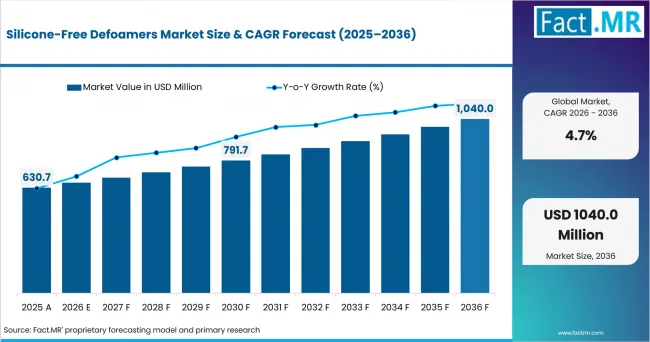
Silicone Free Defoamers Market Market Value Analysis | Source: Fact.MR
What are the defining numbers behind Silicone-Free Defoamers Market growth?
USD 380.0 million absolute opportunity by 2036, led by Coatings application and Mineral oil chemistry.
- Demand Drivers in the Market
- Coating companies need products that meet biodegradability needs and leave little residue. After the foam falls, quality staff still check for surface marks, poor spreading, and print defects before approving the batch.
- Mineral oil-based products need careful testing because they can change plant performance. The product must spread at the chosen dose and reduce foam without causing problems in the formula. It should also clean away easily before the next batch.
- Cleaning product makers prefer materials that stay evenly mixed during normal use. This helps them repeat the same dose and tell whether poor results come from weak foam control, dirt transfer, or residue on equipment and surfaces.
- Paint makers approve products faster when they reduce rework. They compare rejected material, extra dosing, cleaning time, and any later effect on coating or print quality.
- Plant quality staff use silicone-free products when they control foam without harming spreading or bonding. Repeat orders become easier when one test record covers the dose, foam reduction, lasting control, surface quality, and equipment cleanliness.
- Key Segments Analyzed
- By Application: Coatings are expected to hold 43% share in 2026 supported by direct checks on craters, fisheyes, wetting, intercoat behavior, print appearance, and rework.
- By Chemistry: Mineral Oil is projected to account for 30% share in 2026 owing to rapid foam knockdown, formulation fit, persistence, and easier cleanup.
- By Performance: Low Crater is anticipated to capture 31% share in 2026 due to the need to remove foam without creating visible defects during coating and drying.
- By End User: Paint Makers are estimated to represent 33% share in 2026 attributable to their role in production checks, surface-quality review, and repeat-use approval.
- By Regulatory Profile: Silicone-Free is forecast to account for 30% share in 2026 driven by contamination concerns and review against VOC-compliant, Food-Contact, Eco-Label, and Microplastic-Aware requirements.
- Analyst Opinion at Fact.MR
- Shambhu Nath Jha, Senior Analyst at Fact.MR, states, “Silicone-free defoamers are approved only after the full result is checked. Fast foam reduction is the first step. Manufacturers also review how long the control lasts and whether the product spreads well. Surface quality, bonding, residue transfer, and equipment cleanup are then checked before the product is approved for regular use.”
- Strategic Implications
- Companies should test coating performance under the customer’s normal working conditions. The record should show where the product was added and the dose used. It should also note how quickly foam fell, whether it returned, and how well the product spread.
- Before replacing an approved product, plant staff should test both products under the same formula and process steps. This makes it easier to see whether residue moves to another surface or affects a later coating or adhesive layer.
- Distributors should keep clear test records for new product versions. Each record should identify the product, dose, and handling conditions. These details help manufacturers find the cause of surface defects without repeating the full approval process.
In July 2026, BYK received the ALTANA Innovation Award for its PFAS-free defoamer work and the shift toward a PFAS-free product range. This matters because coating companies check foam control, residue, and product chemistry before replacing an approved grade. Biodegradability and use in water-based products also influence selection, but plant testing remains necessary. Silicone-free defoamers must reduce foam without harming spreading, coating quality, bonding, printing, or equipment cleanliness. Wider use follows when one product lowers both foam and rework.
Germany is anticipated to grow at a 5.4% CAGR by 2036. Brazil is estimated to reach 4.9%, while the United States is forecast to record 4.4% from 2026 to 2036.
How does the Silicone-Free Defoamers Market break down by segment?
Coatings lead the Application at 43% in 2026. Mineral oil leads Chemistry at 30%.
What leads the Application segment?
Coatings hold 43% share in 2026.
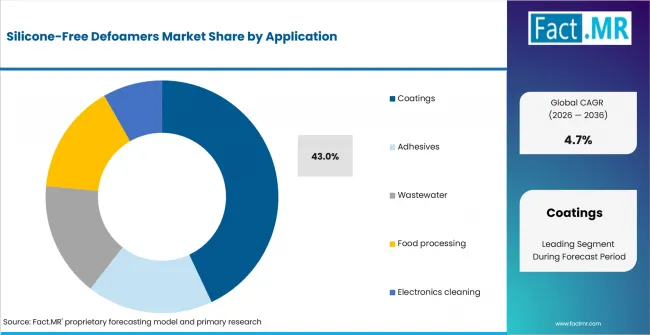
Silicone Free Defoamers Market Analysis By Application | Source: Fact.MR
Coatings are expected to hold 43% share in 2026. Foam problems are easy to spot on the final surface. Manufacturers check how quickly foam falls and whether the coating spreads evenly. They also look for craters, fisheyes, print problems, and weak bonding between layers. Adhesives follow, while Wastewater, Food Processing, and Electronics Cleaning have different needs for lasting control and low residue.
How does Chemistry shape demand?
Mineral Oil accounts for 30% share in 2026.
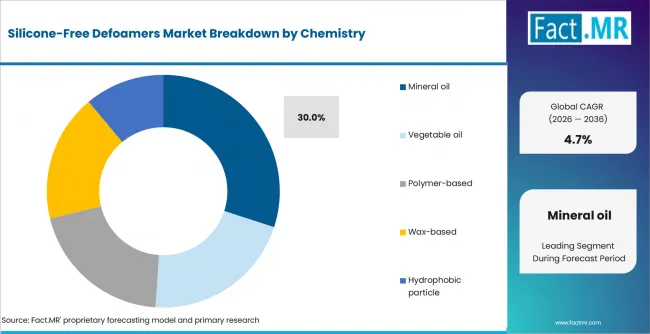
Silicone Free Defoamers Market Analysis By Chemistry | Source: Fact.MR
Mineral Oil is projected to account for 30% share in 2026 due to fast foam reduction and common use in existing formulas. Vegetable Oil, Polymer-Based, Wax-Based, and Hydrophobic Particle products offer other choices for spreading, cleanup, and longer control. The selected chemistry affects how quickly foam falls and whether it returns. Mineral Oil stays ahead when plant tests show steady results without creating extra work.
Where is Performance demand strongest?
Low Crater holds 31% share in 2026.
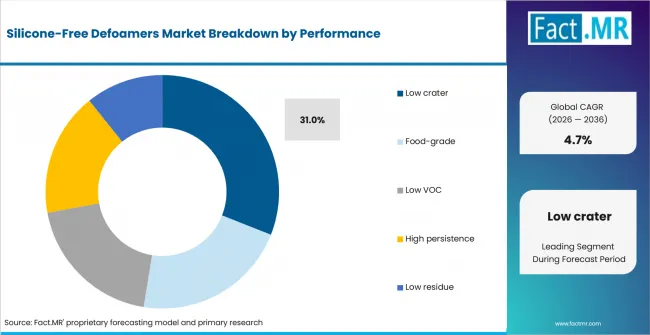
Silicone Free Defoamers Market Analysis By Performance | Source: Fact.MR
Low Crater is anticipated to capture 31% share in 2026. Surface marks can lead to a rejected coating even when foam falls quickly. Craters may appear during drying, while later printing or bonding can also be affected. Food-Grade, Low VOC, High Persistence, and Low Residue serve other needs. Low Crater remains the leading profile where final surface quality carries the most weight.
What supports End User adoption?
Paint Makers lead with 33% share in 2026.
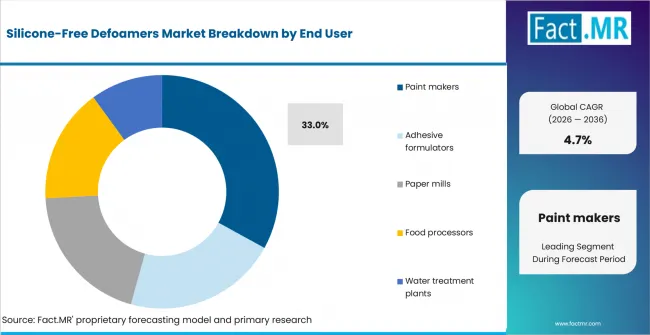
Silicone Free Defoamers Market Analysis By End User | Source: Fact.MR
Paint Makers are estimated to represent 33% share in 2026. They control mixing, product testing, and final approval. Foam reduction is reviewed together with spreading, crater formation, bonding between coats, and print quality. Adhesive Formulators, Paper Mills, Food Processors, and Water Treatment Plants follow with different needs. Repeat use starts only after the product performs well during normal production.
Which Regulatory Profile dominates?
Silicone-Free holds 30% share in 2026.
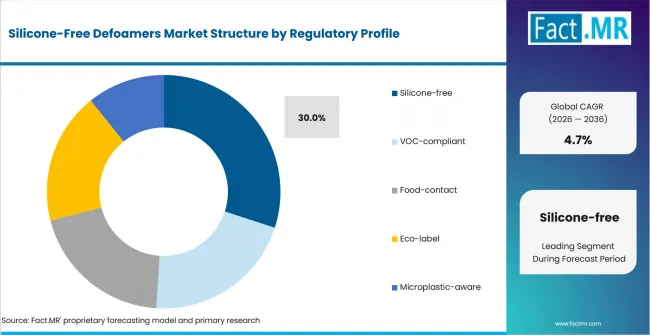
Silicone Free Defoamers Market Analysis By Regulatory Profile | Source: Fact.MR
Silicone-Free is forecast to account for 30% share in 2026. Silicone residue can affect coating, printing, and bonding. VOC-Compliant, Food-Contact, Eco-Label, and Microplastic-Aware products remain important for other approval needs. A silicone-free claim alone does not confirm performance. Manufacturers still test foam reduction, lasting control, product fit, and equipment cleanliness before approval.
What is accelerating Silicone-Free Defoamers Market adoption, and what is holding it back?
Foam balance and low-residue performance support adoption where tests show clean downstream quality. Qualification cost and process fit restrain faster change.
Drivers Impact Analysis
| DRIVER | (~) % IMPACT ON CAGR | GEOGRAPHIC RELEVANCE | IMPACT TIMELINE |
|---|---|---|---|
| Foam balance control in Coatings | +0.8% | China and export producers | Medium term (2-4 years) |
| Biodegradability testing | +0.6% | Europe and North America | Short term (<= 2 years) |
| Coatings and inks approval programs | +0.5% | Asia Pacific | Medium term (2-4 years) |
| Local support near formulation chemists | +0.4% | Global | Long term (>= 4 years) |
Source: Fact.MR analysis. Updated Jul 17, 2026
- Foam balance control in coatings: Coating companies need products that remove foam quickly without creating surface marks later. Plant trials check foam reduction, spreading, surface finish, and the quality of the final coating before approval.
- Biodegradability testing: Companies in Europe and North America review biodegradability together with foam control and product fit. The new European detergents agreement also adds more attention to biodegradability for some materials. Products still need to keep surfaces clean and maintain good coating quality during production.
- Coatings and inks approval programs: Companies in Asia Pacific are carrying out more plant trials before approving new products. They check for craters, fisheyes, print defects, residue, and repeat performance. Products that give the same result in every trial move through approval more easily.
- Local technical support: Nearby technical teams help manufacturers adjust the dose and foam control during plant trials. They can quickly find whether a problem comes from the product, residue, or the formula. This helps companies reach steady production in less time.
Opportunity Impact Analysis
| OPPORTUNITY | (~) % IMPACT ON CAGR | GEOGRAPHIC RELEVANCE | IMPACT TIMELINE |
|---|---|---|---|
| Grades tuned for Coatings and inks | +0.5% | Global | Medium term (2-4 years) |
| Application labs for Mineral oil | +0.4% | Asia Pacific and Europe | Short term (<= 2 years) |
| Rule-ready documentation | +0.4% | Europe and United Kingdom | Medium term (2-4 years) |
| Local trials with cleaning product developers | +0.3% | India and Brazil | Long term (>= 4 years) |
Source: Fact.MR analysis. Updated Jul 17, 2026
- Grades made for coatings and inks: Products made for coatings and inks have better chances of approval when customers can repeat the same results in their own process. Testing covers foam reduction, spreading, surface marks, print quality, bonding, and cleanup.
- Application labs for mineral oil: Labs help companies find the right dose and compare quick foam removal with longer control. They also check for residue, poor product fit, and surface problems before full production trials begin. This saves time and gives customers clearer proof.
- Clear technical records: Companies in Europe and the United Kingdom need records that link each product with its dose, working conditions, and final result. Quality staff can then review foam control, residue, surface defects, and cleanup in one place. Clear records can make approval faster and support repeat use.
- Local trials with cleaning product makers: Plant trials in India and Brazil show whether lab results hold during normal production. These tests cover product spreading, foam reduction, lasting control, residue transfer, and equipment cleanliness. Local staff can also adjust the dose and check whether the same result continues during longer production runs.
Restraints Impact Analysis
| RESTRAINT | (~) % IMPACT ON CAGR | GEOGRAPHIC RELEVANCE | IMPACT TIMELINE |
|---|---|---|---|
| Qualification cost | -0.4% | Global processors | Medium term (2-4 years) |
| Fit limits in Mineral oil | -0.3% | Global | Short term (<= 2 years) |
| Documentation burden | -0.3% | Europe and North America | Medium term (2-4 years) |
| Scale-up risk | -0.2% | High-volume plants | Long term (>= 4 years) |
Source: Fact.MR analysis. Updated Jul 17, 2026
- Qualification cost: Replacing an approved additive takes time and plant resources. Manufacturers must adjust the formula and run production tests. They also check the surface, bonding, printing, and equipment cleanup. Many companies avoid changing a stable process unless the new product clearly improves foam control and final quality.
- Fit limits in mineral oil: Some mineral oil products remove foam quickly but stay in the formula too long or leave residue. This can cause poor spreading, surface marks, weak bonding, and more cleaning work. These problems can delay approval even when the first foam drop looks good.
- Documentation burden: Quality staff need clear records for the product, dose, working conditions, foam result, and final quality. Missing details make good trials hard to repeat and failed trials hard to understand. This slows approval work in Europe and North America.
- Scale-up risk: A product that works in the lab may behave differently during full production. Mixing, spreading, and lasting foam control can change on larger lines. Manufacturers often wait for results from coating, bonding, printing, transfer, cleanup, and final inspection before approval.
Which countries are scaling Silicone-Free Defoamers Market fastest?
Germany 5.4%, Brazil 4.9%, United States 4.4%.
Regional analysis covers North America, Europe, Asia Pacific, Latin America, and the Middle East & Africa.
.webp "Top Country Growth Comparison Silicone Free Defoamers Market Cagr (2026 2036)")
Top Country Growth Comparison Silicone Free Defoamers Market Cagr (2026 2036) | Source: Fact.MR
| COUNTRY | CAGR (2026 to 2036) |
|---|---|
| Germany | 5.4% |
| Brazil | 4.9% |
| United States | 4.4% |
| United Kingdom | 4.0% |
| Japan | 3.5% |
Source: Fact.MR analysis. Updated Jul 17, 2026
How is Germany developing demand?
5.4% CAGR, backed by coating production and documented qualification work.
Germany is anticipated to post a 5.4% CAGR through 2036. In 2026, Destatis reported that production in industry excluding energy and construction was down 0.2% in December 2025 against December 2024. That backdrop keeps qualification work selective instead of volume-led. Laboratory review sets an initial dosage range and flags residue concerns before plant evaluation begins. Knockdown and persistence then decide whether the trial moves forward, while coating quality, printing, bonding and equipment cleanup close the review.
How is Brazil developing demand?
4.9% CAGR, driven by paint production and local application support.
Brazil is expected to register a 4.9% CAGR from 2026 to 2036. In June 2026, IBGE reported that chemical products fell 4.5% in April 2026 against April 2025 and listed paints and varnishes for construction among the pressure points. The signal fits a slower but practical route for silicone-free defoamers because companies have to translate laboratory methods into the customer formulation and operating sequence. Repeat buying gets easier once one controlled dose delivers foam control and a clean downstream result.
What is driving United States growth through 2036?
4.4% CAGR, led by residue-sensitive coatings and established technical service channels.
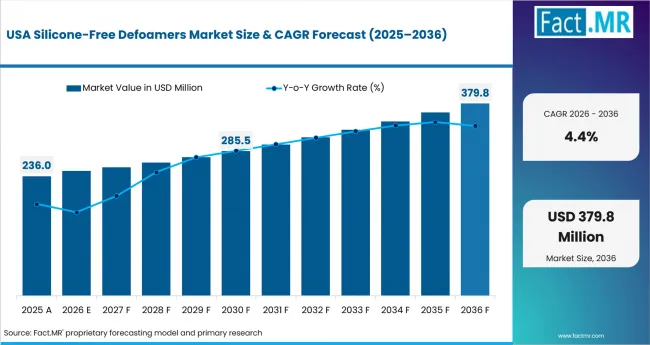
Silicone Free Defoamers Market Country Value Analysis | Source: Fact.MR
The United States is estimated to record a 4.4% CAGR by 2036. In March 2026, the U.S. Census Bureau reported that chemical manufacturing establishments rose 10.2% from 2017 to 2022. It also reported chemical manufacturing shipments increasing from USD 735.9 billion to USD 901.0 billion over the same period. This gives companies a broad technical-service base but not an automatic approval route. Each trial has to confirm knockdown and persistence before procurement treats the grade as production-ready, and surface condition and cleanup close the approval check.
Who leads the Silicone-Free Defoamers Market?
BYK and Evonik lead direct defoamer and foam-control additive coverage, while Münzing and BASF support across coatings, inks and industrial processing applications.
BYK and Evonik lead the named provider set, with Münzing, BASF, Dow, and Elementis rounding it out. Competition favors companies that answer process questions before a customer considers changing an approved grade. Paint and coating customers review residue, chemistry profile, wetting and downstream cleanliness before they accept a new silicone-free defoamer.
Evonik strengthened its coating-additives case in March 2025 by launching TEGO Foamex 812 eCO as part of its first mass-balanced products for coatings and inks. In 2025, Münzing said it would present MAGRABAR defoamers and food-grade antifoams at Vitafoods Europe 2025.
Which companies are the key providers?
BYK and Evonik are key providers. Münzing and BASF are also profiled. Dow and Elementis complete the company set.
- BYK
- Evonik
- Münzing
- BASF
- Dow
- Elementis
Bibliography
- BYK. (2026, July 3). BYK team wins the ALTANA Innovation Award. BYK.
- Elementis plc. (2026). Annual Report and Accounts 2025. Elementis plc.
- European Commission. (2025, June 11). Commission welcomes political agreement on product safety for detergents in the Single Market. European Commission.
- Evonik Industries AG. (2025, March 12). Evonik Coating Additives launches first mass balanced products for coatings and inks. Evonik Industries AG.
- Instituto Brasileiro de Geografia e Estatística. (2026, June 3). Brazilian industrial production changed 0.7% in April. IBGE News Agency.
- Münzing Chemie GmbH. (2025). Meet us at VITAFOODS on booth 5H45. Münzing.
This Report Addresses
- The report provides strategic intelligence on Silicone-Free Defoamers across Application, Chemistry, Performance, End User, and Regulatory Profile choices that shape foam-control approval across industrial processes.
- Segment analysis covers Coatings and Mineral Oil as the leading Application and Chemistry positions within the 2026 market structure, while Low Crater, Paint Makers, and Silicone-Free lead their respective categories.
- Regional outlook evaluates China and India alongside Germany, Brazil, and the United States, while broader coverage across North America, Europe, Asia Pacific, Central and South America, and the Middle East and Africa completes the geographic comparison.
- Competitive analysis profiles BYK and Evonik alongside Münzing and BASF, followed by Dow and Elementis as active providers of defoamers and wider foam-control additives.
- Performance assessment covers Low Crater, Food-Grade, Low VOC, High Persistence, and Low Residue profiles across applications that require different balances of foam knockdown, compatibility, and cleanliness.
- Use-case assessment covers Coatings and Adhesives alongside Wastewater, Food Processing, and Electronics Cleaning applications where foam control protect surface quality, bonding, printing, and equipment cleanliness.
What does the Silicone-Free Defoamers Market cover?
The market covers Coatings and Mineral oil within the defined Application and Chemistry structure. It also covers Coatings and inks across defined commercial uses. Performance and End User complete the demand view.
The silicone-free defoamers market covers products sold for a specific foam-control function within defoamers and coating additives. Market value tracks that function and the proof gathered during customer approval. The product has to address foam without creating residue problems in wetting and coating. Printing and adhesion also stay inside the boundary. Cleanup and later process steps are part of the same scope.
This market is narrower than its parent chemical group because only products sold for the named function count. General material availability does not establish inclusion. The purchase has to relate to silicone-free foam control in one of the stated applications and within the stated scope.
What is included in the scope?
The scope includes defoamers formulated without silicone for coating and adhesive processes. Food-contact, wastewater and electronics-sensitive processes are covered when residue control affects approval. The article covers market sizing and segment demand. Country growth and company positioning are also included.
Revenue enters the scope after grade approval and covers use support and repeat deliveries following qualification. Application work includes trial structure and dosage. Knockdown and persistence come before downstream quality decides customer approval. Compatibility and residue review remain part of the same application work.
What is excluded from the scope?
Commodity status alone does not put a material inside the boundary. Inclusion requires sale within the silicone-free defoamers market for a named application. A material does not enter the scope only because it appears in a formulation. It has to be delivered against the defined foam-control use.
How was the analysis built?
120+ sources, 40+ company portfolios, 25+ countries, 20+ interviews.
- Primary Research: Primary research includes discussions with manufacturers, service providers, technology developers, distributors, end users, procurement teams, and subject-matter experts. These conversations examine purchasing priorities, product adoption, operational challenges, approval requirements, competitive positioning, and the factors that influence wider market acceptance.
- Desk Research: Desk research covers government statistics, regulatory publications, company filings, trade data, technical studies, industry associations, standards, public policy, and other authoritative sources. Every source used in the analysis is documented in the bibliography.
- Market Sizing and Forecasting: Market estimates combine historical performance, demand indicators, pricing and volume trends, segment shares, company participation, country-level growth, adoption patterns, investment activity, and barriers to market expansion.
- Data Validation and Update Cycle: Findings are validated by comparing primary interviews with public data, company activity, regulatory changes, trade patterns, and industry developments. Regular updates review new product launches, capacity changes, partnerships, approvals, procurement trends, and shifts in commercial adoption.
Segmentation
What is the report’s scope and coverage?
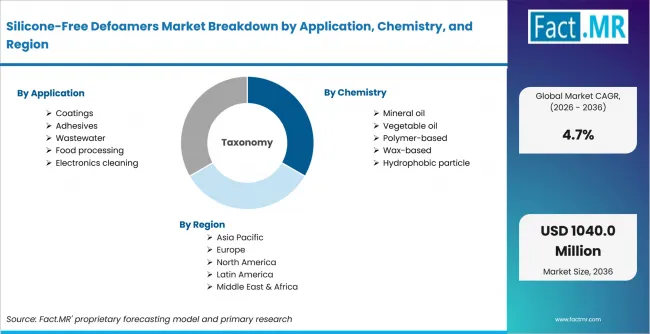
Silicone Free Defoamers Market Breakdown By Application, Chemistry, And Region | Source: Fact.MR
| Attribute | Details |
|---|---|
| Quantitative Units | USD Million |
| Market Definition | Defoamers formulated without silicone for coating, adhesive, food-contact, wastewater, and electronics-sensitive processes. |
| Application | Coatings; Adhesives; Wastewater; Food processing; Electronics cleaning |
| Chemistry | Mineral oil; Vegetable oil; Polymer-based; Wax-based; Hydrophobic particle |
| Performance | Low crater; Food-grade; Low VOC; High persistence; Low residue |
| End User | Paint makers; Adhesive formulators; Paper mills; Food processors; Water treatment plants |
| Regulatory Profile | Silicone-free; VOC-compliant; Food-contact; Eco-label; Microplastic-aware |
| Regions Covered | North America; Europe; Asia Pacific; Central and South America; Middle East and Africa |
| Countries Covered | China; India; Germany; Brazil; United States |
| Key Companies Profiled | BYK; Evonik; Münzing; BASF; Dow; Elementis |
| Forecast Period | 2026 to 2036 |
| Approach | Hybrid top-down and bottom-up approach using defoamers and coating additives, segment shares, country growth, company coverage, and technical validation. |
Source: Fact.MR analysis. Updated Jul 17, 2026
How is the market segmented?
-
By Application
- Coatings
- Adhesives
- Wastewater
- Food processing
- Electronics cleaning
-
By Chemistry
- Mineral oil
- Vegetable oil
- Polymer-based
- Wax-based
- Hydrophobic particle
-
By Performance
- Low crater
- Food-grade
- Low VOC
- High persistence
- Low residue
-
By End User
- Paint makers
- Adhesive formulators
- Paper mills
- Food processors
- Water treatment plants
-
By Regulatory Profile
- Silicone-free
- VOC-compliant
- Food-contact
- Eco-label
- Microplastic-aware
-
By Region
- North America
- United States
- Canada
- Europe
- Germany
- United Kingdom
- France
- Italy
- Spain
- Asia Pacific
- India
- China
- Japan
- South Korea
- Australia
- Central & South America
- Brazil
- Argentina
- Mexico
- Chile
- Middle East & Africa
- UAE
- Saudi Arabia
- South Africa
- North America
Frequently Asked Questions
Which Application leads the Silicone-Free Defoamers Market?
Which Chemistry leads the Silicone-Free Defoamers Market?
Which Performance leads the Silicone-Free Defoamers Market?
What is the primary driver in the Silicone-Free Defoamers Market?
What is the main restraint in the Silicone-Free Defoamers Market?
Why does Coatings lead?
Who worked on this report


Preview the report firsthand - request a free sample
Free SampleGet the brochure for pricing and purchase details
Download PDF