- Base Value(2025): 0.7 Bn
- Forecast Value (2036): 3.1 Bn
- CAGR (2036): 14.5%
What is the single-use mixing liners market forecast to be worth by 2036?
USD 0.8 billion in 2026 to USD 3.1 billion by 2036 at 14.5% CAGR.
- The Single-Use Mixing Liners Market was valued at USD 0.7 billion in 2025.
- The market is estimated at USD 0.8 billion in 2026 and is projected to reach USD 3.1 billion by 2036.
- The market is forecast to expand at 14.5% CAGR during the forecast period as biologics production, vaccine manufacturing and cell therapy development continue expanding.
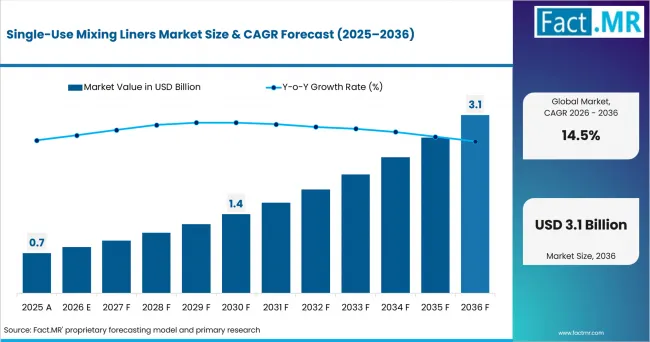
Single Use Mixing Liners Market Market Value Analysis | Source: Fact.MR
What are the defining numbers behind single-use mixing liner growth?
USD 2.3 billion absolute opportunity by 2036 led by the United States and Germany.
- Demand Drivers in the Market
- Single-use manufacturing continues expanding across biopharmaceutical facilities.
- Biologics production is increasing worldwide.
- Cell therapy development requires sterile processing systems.
- Manufacturers continue reducing cleaning and validation time.
- Key Segments Analyzed
- By Capacity: 200-1,000 L is expected to hold 35.0% share in 2026 because it supports most commercial bioprocess applications.
- By Film Structure: Multi-Layer Barrier Film is projected to account for 34.0% share in 2026 because it provides excellent product protection.
- By Mixing Mode: Magnetic Impeller is expected to hold 33.0% share in 2026 because it supports efficient sterile mixing.
- By Application: Buffer Preparation is projected to account for 31.0% share in 2026 because most bioprocess workflows require large buffer volumes.
- By Geography: The United States is projected to record 15.2% CAGR through 2036.
- Analyst Opinion at Fact.MR
- Shambhu Nath Jha, Senior Analyst at Fact.MR, states, "Single-use mixing liners have become an essential part of modern bioprocess manufacturing. They improve operational flexibility while reducing contamination risk and production downtime."
- Strategic Implications
- Expand production of high-performance mixing liners.
- Develop films with lower extractables.
- Strengthen partnerships with CDMOs and biologics manufacturers.
- Invest in larger capacity disposable mixing systems.
Single-use mixing liners are disposable bags used inside bioprocess mixing systems. They support sterile preparation of media, buffers and biologic formulations. They also reduce cleaning time and improve manufacturing flexibility.
The United States is projected to record 15.2% CAGR through 2036 because biologics manufacturing capacity continues expanding. Germany is expected to grow at 14.8% CAGR due to strong biopharmaceutical production. China is forecast to expand at 14.4% CAGR as biotechnology investment increases. South Korea is projected to register 14.0% CAGR through 2036 because biologics manufacturing continues growing. India is expected to grow at 13.6% CAGR due to rising vaccine production and CDMO investment.
How does the single-use mixing liners market break down by segment?
200-1,000 L leads at 35.0%. Buffer Preparation leads at 31.0%.
Which capacity dominates?
200-1,000 L holds 35.0% share in 2026.
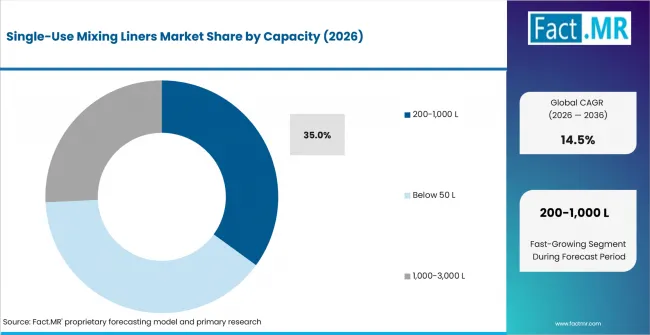
Single Use Mixing Liners Market Analysis By Capacity | Source: Fact.MR
The 200-1,000 L segment leads because it supports commercial biologics production. It also fits most single-use manufacturing platforms. Manufacturers prefer this capacity because it balances production flexibility with operating efficiency. It is widely used across media and buffer preparation. Demand remains strong across commercial bioprocess facilities. Cytiva / Pall legacy showcased its Xcellerex™ single-use magnetic mixer at INTERPHEX 2024. The system uses a novel mixer biocontainer design and is positioned for large-volume media and buffer preparation with added leak-protection safeguards. [1]
Which film structure dominates?
Multi-Layer Barrier Film holds 34.0% share in 2026.
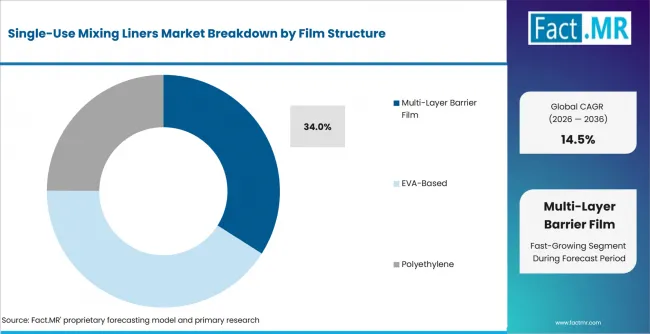
Single Use Mixing Liners Market Analysis By Film Structure | Source: Fact.MR
Multi-layer barrier film leads because it provides strong chemical resistance. It also protects process fluids from external contamination. Biopharma companies prefer these films because they reduce extractables. They also maintain product quality during mixing operations. Demand continues increasing across regulated manufacturing facilities. Merck launched the Mobius® ADC Reactor, described as the first single-use reactor designed specifically for antibody-drug conjugate manufacturing. The reactor uses single-use assemblies made with Ultimus® Film technology, which supports enhanced bag strength and durability. [2]
Which mixing mode dominates?
Magnetic Impeller holds 33.0% share in 2026.
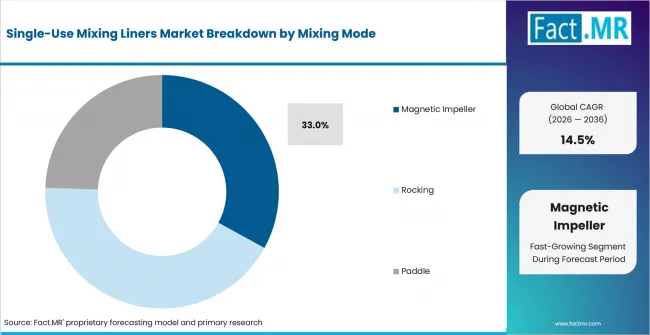
Single Use Mixing Liners Market Analysis By Mixing Mode | Source: Fact.MR
Magnetic impeller systems lead because they provide efficient mixing without shaft seals. This design helps maintain sterile processing conditions. Manufacturers use magnetic mixing to improve batch consistency. The technology also supports automated production systems. Demand remains high across biologics manufacturing. MDI announced the launch of its Universal Single-Use Mix Bags, designed to be compatible with multiple mixing platforms from leading bioprocess equipment suppliers. The bags are available in volumes ranging from 50 L to 2,000 L and are intended for media preparation, buffer preparation, and biopharmaceutical manufacturing processes. [3]
Which application dominates?
Buffer Preparation holds 31.0% share in 2026.
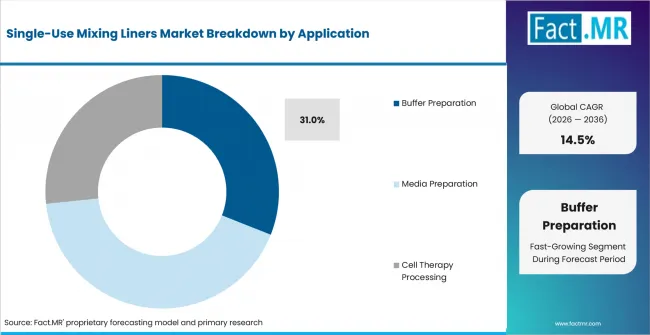
Single Use Mixing Liners Market Analysis By Application | Source: Fact.MR
Buffer preparation remains the leading application because most bioprocess workflows require large buffer volumes. Reliable mixing systems improve process consistency. Single-use liners reduce cleaning requirements. They also shorten production changeover time. Growing biologics output continues supporting demand. Avantor unified its Masterflex® portfolio to cover standard, configurable, and engineered-to-order peristaltic pumps, single-use assemblies, and systems from R&D through high-volume manufacturing. [4]
What is accelerating single-use mixing liner demand and what is holding it back?
Single-use manufacturing drives demand while film cost restrains adoption.
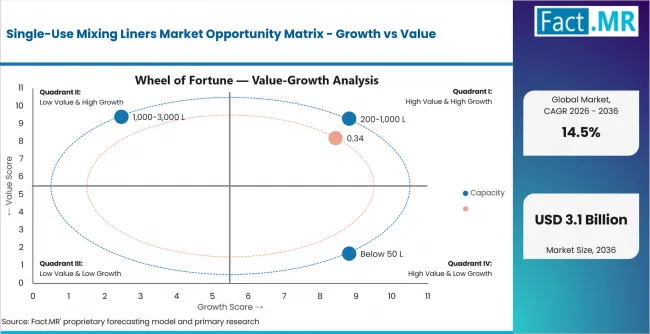
Single Use Mixing Liners Market Opportunity Matrix Growth Vs Value | Source: Fact.MR
The main growth driver is increasing biologics production. Companies continue replacing stainless steel vessels with disposable processing systems. Cell therapy manufacturing is also creating strong demand. Vaccine production continues supporting adoption across commercial facilities.
Single-use systems improve manufacturing flexibility. They also reduce cleaning and validation work. The main restraint is higher material cost. Multi-layer films remain more expensive than conventional process materials. Waste management also remains a challenge. Disposal requirements can increase operating costs. Avantor announced and showcased its Magnetic Mixing Systems at INTERPHEX 2025, including a new 10 L tabletop mixer and larger-scale systems extending to 1,500 L. The mixers were developed as fully single-use, closed-system solutions for biologics manufacturing, media preparation, and buffer preparation. The systems are designed to operate with disposable mixing bags/liners and support scale-up from process development to commercial production. [5]
Where do the biggest single-use mixing liner opportunities sit?
- Biologics Manufacturing:Biopharma companies continue expanding commercial production capacity. This creates steady demand for larger mixing liners.
- Vaccine Production:Vaccine manufacturers continue investing in disposable processing technologies. Mixing liners improve production flexibility.
- Cell Therapy:Cell therapy developers require sterile mixing systems. Single-use liners help reduce cross-contamination risk.
- CDMO Facilities:Contract manufacturers continue expanding single-use production capacity. Flexible mixing systems support multi-product operations.
- Buffer and Media Preparation:Manufacturing facilities continue increasing investment in dedicated preparation systems. Demand for high-performance liners continues growing.
Which countries are scaling single-use mixing liner adoption fastest?
United States 15.2%, Germany 14.8%, China 14.4%, South Korea 14.0%, India 13.6%.
Based on regional analysis the single-use mixing liners market is segmented into North America, Western Europe, Asia Pacific, Latin America and Middle East & Africa.
.webp "Top Country Growth Comparison Single Use Mixing Liners Market Cagr (2026 2036)")
Top Country Growth Comparison Single Use Mixing Liners Market Cagr (2026 2036) | Source: Fact.MR
| Country | CAGR (2026-2036) |
|---|---|
| United States | 15.2% |
| Germany | 14.8% |
| China | 14.4% |
| South Korea | 14.0% |
| India | 13.6% |
Source: Fact.MR analysis. Updated Jun 26, 2026
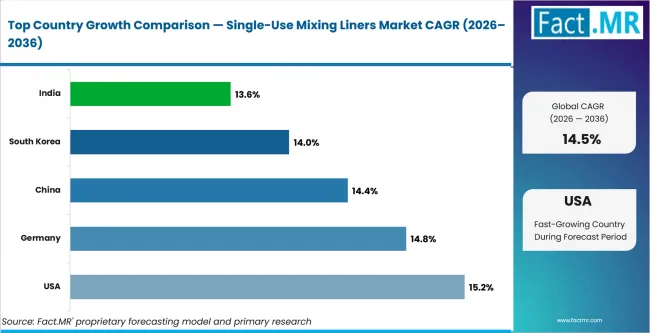
Single Use Mixing Liners Market Cagr Analysis By Country | Source: Fact.MR
Why is the United States leading the single-use mixing liners market?
15.2% CAGR, supported by biologics manufacturing
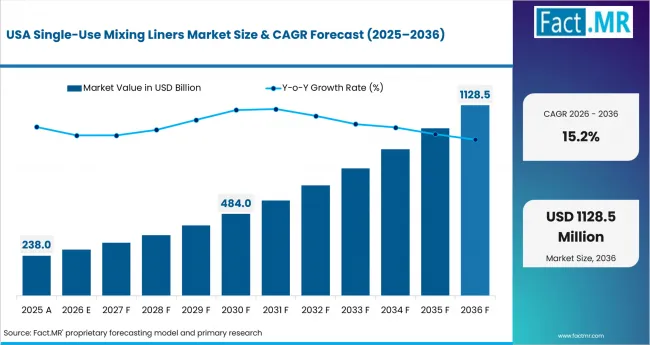
Single Use Mixing Liners Market Country Value Analysis | Source: Fact.MR
The United States is projected to record 15.2% CAGR through 2036 because biologics manufacturing continues expanding. Companies are investing in flexible production systems across commercial facilities. Demand is also rising from cell therapy developers. Vaccine manufacturers continue adopting disposable processing technologies. The country remains the largest market for single-use bioprocess equipment.
What is driving growth in Germany?
14.8% CAGR, driven by pharmaceutical production
Germany is expected to post 14.8% CAGR through 2036 because biopharmaceutical production continues increasing. Manufacturers are expanding single-use manufacturing capacity. CDMOs are investing in advanced mixing technologies. High demand for sterile processing also supports market growth. Germany remains a major European life science hub.
How is China expanding adoption?
14.4% CAGR, supported by biotechnology investment
China is forecast to advance at 14.4% CAGR through 2036 because biotechnology investment continues growing. Biopharma companies are increasing commercial manufacturing capacity. Demand for disposable mixing systems continues rising. Expansion of biosimilar production also supports market growth. The country remains an important manufacturing location.
Why is South Korea becoming a strong market?
14.0% CAGR, supported by biologics expansion
South Korea is projected to register 14.0% CAGR because biologics manufacturing continues expanding. Companies are investing in modern single-use facilities. Cell therapy production is creating additional demand. Government support also encourages biotechnology investment. The country continues strengthening its global biologics position.
What supports market growth in India?
13.6% CAGR, driven by vaccine manufacturing
India is expected to grow at 13.6% CAGR through 2036 because vaccine production continues expanding. CDMOs are also increasing investment in disposable manufacturing technologies. Biopharma exports continue increasing. Single-use processing systems help manufacturers improve production flexibility. The country remains an important supplier of vaccines and biologics.
Who leads the single-use mixing liners landscape?
Sartorius, Thermo Fisher Scientific, Cytiva / Pall legacy, and Merck KGaA / MilliporeSigma lead through single-use processing expertise and bioprocess manufacturing capabilities.
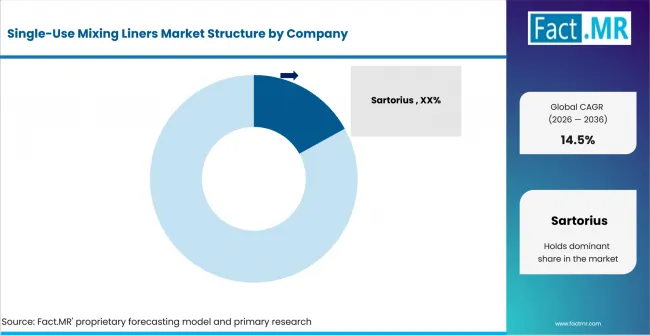
Single Use Mixing Liners Market Analysis By Company | Source: Fact.MR
Competition remains balanced among established bioprocess suppliers. Product performance and manufacturing reliability continue shaping purchasing decisions. Manufacturers are introducing stronger liner films that improve mixing efficiency. Many suppliers are also focusing on lower extractable materials for sensitive bioprocess applications.
Demand is led by biopharma manufacturers because they rely heavily on single-use processing. CDMOs are expanding purchases as clients shift toward flexible production models. Buffer preparation accounts for the highest demand across applications. Media preparation also supports steady liner consumption in commercial facilities.
Leading companies continue investing in new film technologies and production capacity. They are also strengthening customer support and global supply networks. Future competition will depend on consistent product quality and dependable supply. Companies with proven validation data and strong technical expertise are expected to gain a competitive advantage through 2036.
Which companies are the key players?
Sartorius, Thermo Fisher Scientific, Cytiva / Pall legacy, Merck KGaA / MilliporeSigma, Entegris
- Sartorius
- Thermo Fisher Scientific
- Cytiva / Pall legacy
- Merck KGaA / MilliporeSigma
- Entegris
- Meissner Corporation
Bibliography
- [1] BioPharm International. (2024, April 17). Cytiva showcases single-use mixing system at INTERPHEX 2024. BioPharm International.
- [2] Merck KGaA. (2024, September 10). Merck launches Mobius® ADC Reactor, the first single-use reactor tailored for antibody-drug conjugate manufacturing. Merck KGaA.
- [3] CCubed Biotech. (2025, January 13). MDI launches single-use Universal Mix Bags. CCubed Biotech.
- [4] Avantor, Inc. (2026, April 21). Avantor® unifies Masterflex® portfolio to streamline fluid management from R&D to bioprocess manufacturing. Avantor, Inc.
- [5] Avantor, Inc. (2025, April 1). Avantor® showcases scalable fluid handling innovations at INTERPHEX. Avantor, Inc.
This Report Addresses
- Strategic intelligence on single-use mixing liner technologies.
- Segment analysis covering capacity and film structures.
- Assessment of mixing modes and application demand.
- Regional outlook covering the United States and Germany.
- Analysis of China South Korea and India.
- Competitive assessment of leading single-use suppliers.
- Evaluation of biologics manufacturing trends.
- Analysis of vaccine production and cell therapy processing.
- Primary interviews and supplier benchmarking.
- Assessment of opportunities across disposable bioprocess systems.
What does the single-use mixing liners market cover?
Disposable liners used in bioprocess mixing systems.
The market covers sterile mixing liners used for media preparation, buffer preparation and biologics manufacturing. These products support upstream and downstream bioprocess operations.
What is included in the scope?
Single-use mixing liners and disposable mixing technologies.
The scope includes liners designed for magnetic mixing, rocking systems, paddle mixing, recirculation mixing and powder-liquid mixing.
What is excluded from the scope?
Reusable stainless steel mixing vessels and permanent mixing equipment.
The scope excludes stainless steel bioreactors, reusable tanks and conventional industrial mixing systems.
How was the analysis built?
100+ sources, 30+ company assessments, 25+ countries and industry interviews.
- Primary Research: Interviews with bioprocess engineers, equipment suppliers and biopharma manufacturers.
- Desk Research: Analysis of biologics production, vaccine manufacturing and single-use technology adoption.
- Market Sizing and Forecasting: Estimates based on bioprocess capacity, disposable system demand and manufacturing expansion.
- Data Validation and Update Cycle: Forecasts validated through supplier benchmarking and industry interviews.
Segmentation
What is the report's scope and coverage?
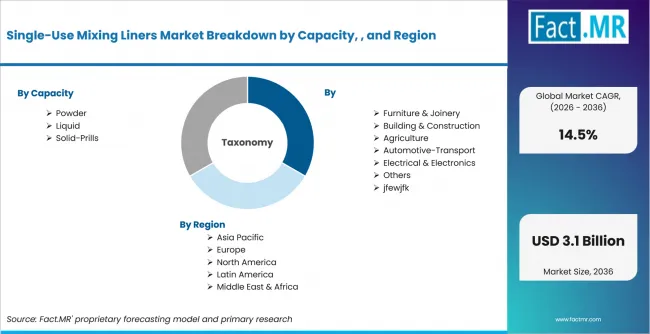
Single Use Mixing Liners Market Breakdown By Capacity, , And Region | Source: Fact.MR
| Attribute | Details |
|---|---|
| Quantitative Units | USD Billion in 2026 to USD Billion by 2036 |
| Market Definition | Disposable mixing liners used for sterile fluid preparation in biopharmaceutical manufacturing |
| Capacities Covered | Below 50 L, 50-200 L, 200-1,000 L, 1,000-3,000 L, Above 3,000 L |
| Film Structures Covered | EVA-Based, Polyethylene, Multi-Layer Barrier, Low-Extractable Film, Gamma-Stable Film |
| Mixing Modes Covered | Magnetic Impeller, Rocking, Paddle, Recirculation, Powder-Liquid Mixing |
| Applications Covered | Buffer Preparation, Media Preparation, Vaccine Formulation, Biologics Formulation, Cell Therapy Processing |
| Regions Covered | North America, Western Europe, Asia Pacific, Latin America, Middle East & Africa |
| Key Countries Covered | United States, Germany, China, South Korea, India |
| Companies Covered | Sartorius, Thermo Fisher Scientific, Cytiva / Pall legacy, Merck KGaA / MilliporeSigma, Entegris, Meissner Corporation |
| Forecast Period | 2026 to 2036 |
| Research Approach | Hybrid top-down and bottom-up methodology using bioprocess capacity, single-use adoption and biologics manufacturing analysis |
Source: Fact.MR analysis. Updated Jun 26, 2026
How is the market segmented?
-
By Capacity
- Below 50 L
- 50-200 L
- 200-1,000 L
- 1,000-3,000 L
- Above 3,000 L
-
By Film Structure
- EVA-Based
- Polyethylene
- Multi-Layer Barrier
- Low-Extractable Film
- Gamma-Stable Film
-
By Mixing Mode
- Magnetic Impeller
- Rocking
- Paddle
- Recirculation
- Powder-Liquid Mixing
-
By Application
- Buffer Preparation
- Media Preparation
- Vaccine Formulation
- Biologics Formulation
- Cell Therapy Processing
-
Region:
- North America
- United States
- Canada
- Europe
- Germany
- United Kingdom
- France
- Italy
- Spain
- Asia Pacific
- China
- Japan
- South Korea
- India
- Singapore
- Latin America
- Brazil
- Mexico
- Argentina
- Middle East & Africa
- GCC Countries
- South Africa
- Israel
- North America
Frequently Asked Questions
Which capacity leads the market?
Which film structure accounts for the largest share?
What is driving demand for single-use mixing liners?
Which country is growing the fastest?
What is the primary challenge facing the market?
Which application accounts for the largest share?
What opportunities exist for suppliers?
Why are manufacturers adopting single-use mixing liners?
Which mixing mode generates the highest demand?
Why are multi-layer barrier films widely adopted?
Who worked on this report


Preview the report firsthand - request a free sample
Free SampleGet the brochure for pricing and purchase details
Download PDF