- Forecast Value (2036): 810.0 Mn
- CAGR (2036): 9.9%
What is the smoke-evacuating trocars market forecast to be worth by 2036?
USD 315.0 million in 2026 to USD 810.0 million by 2036, at 9.9% CAGR.
- The smoke-evacuating trocars market crossed a valuation of USD 280.0 million in 2025.
- The market is expected to increase from USD 315.0 million in 2026 to USD 810.0 million by 2036.
- The market is forecast to record 9.9% CAGR from 2026 to 2036 as surgical teams add smoke capture closer to laparoscopic access points.
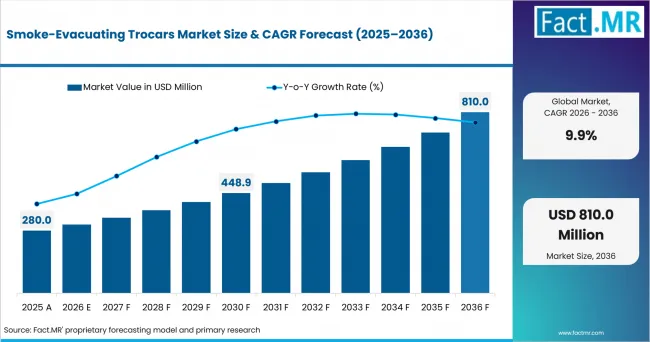
Smoke Evacuating Trocars Market Market Value Analysis | Source: Fact.MR
What are the defining numbers behind smoke-evacuating trocars growth?
USD 495.0 million absolute opportunity by 2036, led by India and China.
- Demand Drivers in the Market
- Hospitals need smoke capture at the source as state laws make plume removal a formal operating-room requirement.
- Surgeons need clearer views during energy-based laparoscopic cases where smoke can interrupt workflow.
- Ambulatory surgery centers need products that connect to existing suction without adding another equipment tower.
- System suppliers need trocar-compatible solutions because hospitals want smoke control built into access planning.
- Key Segments Analyzed
- By Trocar Type: Integrated smoke trocars are expected to hold 38.0% share in 2026 because buyers prefer fewer separate tubing steps.
- By Size: 5 mm trocars are projected to capture 32.0% share in 2026 due to frequent use as routine access ports.
- By Procedure: General surgery is anticipated to account for 34.0% share in 2026 as abdominal cases use energy devices often.
- By End User: Hospitals are estimated to hold 55.0% share in 2026 because case density and compliance review stay concentrated there.
- By Sales Channel: Direct tender sales are forecast to hold 41.0% share in 2026 where supply committees standardize access products.
- By Geography: India is projected to record 11.8% CAGR through 2036 as hospital expansion widens laparoscopic procedure capacity.
- Analyst Opinion at Fact.MR
- Shambhu Nath Jha, Senior Analyst at Fact.MR, states, "Smoke-evacuating trocars are moving from a preference-card option to a practical compliance product. Hospitals are asking whether smoke can be removed without slowing the case. That question makes trocar fit, seal control and filter compatibility more important than catalogue breadth alone. Suppliers that make plume capture easy for nurses and predictable for surgeons are better placed in laparoscopic and robotic rooms."
- Strategic Implications
- Trocar suppliers should treat smoke capture as a core access feature rather than a late-stage accessory.
- Hospitals should review port seal, tubing burden and filter compatibility before product standardization.
- Ambulatory surgery centers should compare adapter systems against integrated trocars on training time.
- Distributors should build bundled offers that connect access devices with smoke evacuation consumables.
The Association of periOperative Registered Nurses reported that 20 U.S. states had enacted surgical smoke evacuation laws by September 2025.
India is projected to record 11.8% CAGR through 2036 as hospital expansion widens laparoscopic access. China is expected to expand at 11.1% CAGR because tertiary hospitals are scaling minimally invasive procedure capacity. South Korea is forecast at 10.6% CAGR as medical device buyers favor compact operating-room workflows. The United States is projected to post 10.0% CAGR because smoke evacuation rules make compliance a purchasing trigger.
How does the smoke-evacuating trocars market break down by segment?
Integrated smoke trocars lead at 38.0%; hospitals lead end users at 55.0%.
Which trocar type dominates?
Integrated smoke trocars hold 38.0% share in 2026.
Integrated smoke trocars lead because they combine access and smoke capture in one product selection. Their role is strongest in operating rooms that already use disposable trocars and want fewer setup steps. Surgical teams value designs that preserve pneumoperitoneum while smoke is removed through a controlled path.
Which size dominates?
5 mm trocars account for 32.0% share in 2026.
The 5 mm size class leads because routine laparoscopic procedures often use smaller accessory ports. Hospitals can standardize these sizes across general surgery and laparoscopic gynecological procedures. Larger 12 mm ports retain value in stapling cases, but daily use favors smaller access.
Which procedure dominates?
General surgery holds 34.0% share in 2026.
General surgery leads because abdominal procedures often use electrosurgical instruments that create smoke. Trocar-level evacuation connects directly with energy-based instruments and visualization needs. Bariatric and colorectal procedures add higher value because longer cases make stable smoke control more important.
Which end user dominates?
Hospitals lead with 55.0% share in 2026.
Hospitals lead because they handle higher laparoscopic case volumes and run formal safety reviews. Purchasing committees can move smoke-evacuating trocars from individual preference to standard use. Ambulatory surgery centers are growing, but their buying cycles are more cost-sensitive.
Which sales channel dominates?
Direct tenders hold 41.0% share in 2026.
Direct tenders lead because hospitals buy access products through supply committees and product trials. This channel helps suppliers prove compatibility with existing suction, insufflation and sterile storage workflows. Distributors remain important in ambulatory sites and smaller hospitals.
What is accelerating smoke-evacuating trocars demand, and what is holding it back?
State smoke evacuation laws and minimally invasive workloads drive demand; disposable cost and workflow training restrain adoption.
The main driver is the move toward source capture in operating rooms. AORN reported in February 2026 that surgical smoke evacuation legislation was under consideration in 11 states. This supports demand for trocar-linked removal because the product captures plume before it spreads into the room.
The main restraint is the cost of single-use integrated ports. Smaller facilities may start with adapters before they move to higher-priced integrated products. Training also matters because nurses need a setup that works during high procedure volume without adding avoidable steps.
Where do the biggest smoke-evacuating trocars opportunities sit?
Integrated ports, ambulatory surgery centers and robotic laparoscopic workflows.
- Integrated Port Design: Suppliers can win when smoke flow and access stability are handled through one product.
- Ambulatory Surgery Centers: Distributors can support sites that need compact smoke-control setups without large capital purchases.
- Robotic Laparoscopy: Longer cases support products that maintain visibility while instruments stay docked through small ports.
Which countries are scaling smoke-evacuating trocars fastest?
India 11.8%, China 11.1%, South Korea 10.6%, USA 10.0%, Germany 9.5%, UK 9.3%, Japan 9.1%.
Based on regional analysis, the smoke-evacuating trocars market covers North America, Latin America, Western Europe, Eastern Europe, East Asia, South Asia & Pacific, and the Middle East & Africa.
| Country | CAGR |
|---|---|
| India | 11.8% |
| China | 11.1% |
| South Korea | 10.6% |
| United States | 10.0% |
| Germany | 9.5% |
| United Kingdom | 9.3% |
| Japan | 9.1% |
Source: Fact.MR analysis. Updated Jun 29, 2026
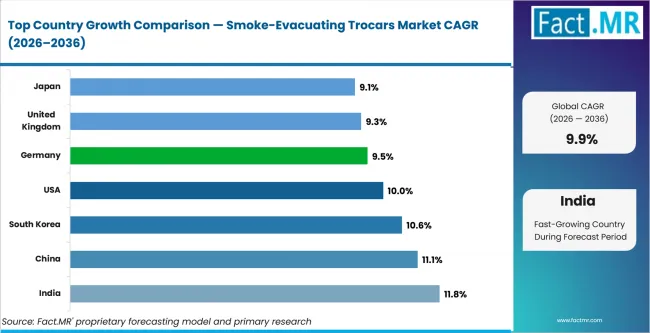
Smoke Evacuating Trocars Market Cagr Analysis By Country | Source: Fact.MR
What is powering India’s lead?
11.8% CAGR, supported by hospital expansion and wider laparoscopic access.
India is moving faster because private hospitals and specialty centers are widening minimally invasive procedure access. Hospitals are price-sensitive, so adapter-ready smoke solutions can enter before fully integrated trocar systems. India is projected to record 11.8% CAGR through 2036 as hospital expansion widens laparoscopic procedure capacity. Suppliers that combine training support with distributor reach have the clearest path.
How is China scaling demand?
11.1% CAGR, driven by tertiary hospitals and minimally invasive procedure capacity.
China has large tertiary hospitals that can standardize laparoscopic access products across many departments. Domestic procurement favors products that show visible workflow value and reliable supply. China is expected to expand at 11.1% CAGR through 2036 because higher procedure density supports smoke-control attach rates. Localized stocking and hospital education are the main supplier requirements.
Why does South Korea perform above the global average?
10.6% CAGR, supported by operating-room modernization and compact surgical workflows.
South Korea’s hospital purchasing teams tend to evaluate product fit closely because procedure rooms are already equipment-intensive. Smoke-evacuating trocars fit this environment when they reduce tubing burden during laparoscopic work. South Korea is forecast at 10.6% CAGR through 2036 as hospitals favor compact operating-room workflows. Suppliers with clinician training programs are better placed.
What supports the USA outlook?
10.0% CAGR, backed by smoke evacuation laws and hospital compliance reviews.
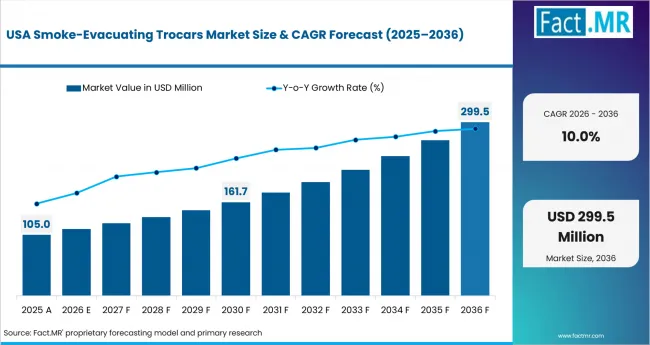
Smoke Evacuating Trocars Market Country Value Analysis | Source: Fact.MR
The United States is shaped by state-level laws and hospital safety policies. The United States is projected to post 10.0% CAGR through 2036 because smoke rules make compliance a purchasing trigger. Products that connect easily to existing suction lines are likely to move faster through trials.
What underpins Germany’s growth?
9.5% CAGR, backed by laparoscopic procedure intensity and strict hospital procurement.
Germany is a steady market because hospitals evaluate medical devices through structured purchasing and clinical review. Smoke-evacuating trocar demand is tied to minimally invasive procedure planning rather than broad equipment replacement. Germany is expected to advance at 9.5% CAGR through 2036 as hospitals match smoke-control products with surgical workflows. Suppliers must prove compatibility and sterile handling.
Why is the United Kingdom important?
9.3% CAGR, due to National Health Service procedure volume and day-surgery pressure.
The United Kingdom has a large public hospital base that reviews device choices through cost and clinical utility. NHS Digital published Hospital Admitted Patient Care Activity for 2023-24 in September 2024. The United Kingdom is forecast to grow at 9.3% CAGR through 2036 as day-surgery pressure keeps laparoscopic workflow efficiency important. Products that reduce setup time have better appeal.
How does Japan perform?
9.1% CAGR, supported by surgical discipline and supplier preference for documented performance.
Japan’s hospital purchasing teams favor reliable device behavior and conservative product validation. Smoke-evacuating trocars fit this setting when they improve visibility without adding procedural complexity. Japan is expected to post 9.1% CAGR through 2036 as high-quality laparoscopic programs keep the category relevant. Growth is lower than India because the installed procedure base is already more developed.
Who leads the smoke-evacuating trocars landscape?
Medtronic, CONMED and Stryker lead through laparoscopic access, insufflation and smoke-control portfolios.
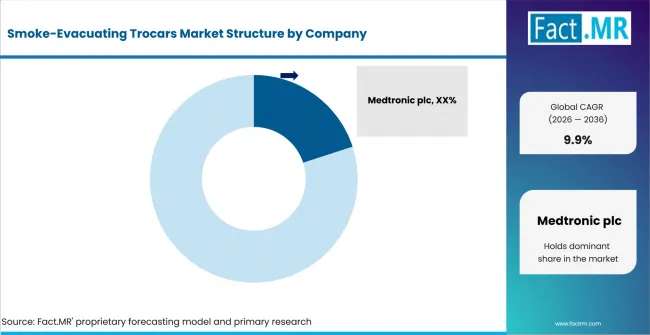
Smoke Evacuating Trocars Market Analysis By Company | Source: Fact.MR
Smoke-evacuating trocars are sold into a practical buyer problem: remove plume without disrupting access. CONMED supports this logic through AirSeal, which combines insufflation, constant smoke evacuation and stable pneumoperitoneum. This places the company close to endoscopy operative devices and operating-room workflow decisions.
Medtronic plc brings large hospital account reach. Stryker lists PneumoClear as a 50-liter insufflator with heating, humidification, and active smoke evacuation for laparoscopic and robotic surgery.
CooperSurgical, B. Braun and Olympus compete through access breadth, adapter products or laparoscopic platform fit. CooperSurgical lists See Clear as a passive disposable multistage laparoscopic filter system. Reusable access systems also matter where buyers compare waste and cost against reprocessed medical devices.
Which companies are the key players?
Medtronic, CONMED, Stryker, CooperSurgical, B. Braun and Olympus.
- Medtronic plc
- CONMED / Buffalo Filter
- Stryker Corporation
- CooperSurgical Inc.
- B. Braun SE
- Olympus Corporation
Bibliography
- Association of periOperative Registered Nurses. (2025, September 24). Score! Surgical smoke evacuation mandates now the law in 20 U.S. states. AORN.
- Association of periOperative Registered Nurses. (2026, February 19). Your voice in action: Surgical smoke legislation moves forward in 11 states. AORN.
- Eurostat. (2026, March 9). Surgical procedures. European Commission.
- Organisation for Economic Co-operation and Development. (2025, November 13). Ambulatory surgery. In Health at a Glance 2025. OECD Publishing.
- NHS Digital. (2024, September 26). Hospital admitted patient care activity, 2023–24. NHS Digital.
- Medtronic plc. (2025, June 20). 2025 annual report on Form 10-K. Medtronic plc.
- Medtronic plc. (2026). Valleylab™ laparoscopic smoke evacuation system. Medtronic plc.
- Stryker Corporation. (2026). PneumoClear insufflator. Stryker Corporation.
- CooperSurgical Inc. (2026). See Clear® smoke evacuation system. CooperSurgical Inc.
- B. Braun SE. (2026). Reusable and hybrid trocar system. B. Braun SE.
- Olympus. (2023, February 2). Olympus awarded Vizient contract for smoke evacuation portfolio. Olympus.
This Report Addresses
- Strategic intelligence on smoke-evacuating trocars across trocar type, size, procedure, and end user.
- Segment analysis covering integrated smoke trocars, 5 mm access products, general surgery, and hospital use.
- Regional outlook covering India, China, South Korea, the United States, Germany, the United Kingdom, and Japan.
- Competitive analysis of Medtronic plc, CONMED / Buffalo Filter, Stryker Corporation, CooperSurgical Inc., B. Braun SE and Olympus Corporation.
- Product assessment covering integrated ports, adapter-supported smoke removal and trocar-linked filtration workflows.
- Policy assessment covering surgical smoke evacuation laws and procurement implications for hospitals.
- Primary interviews, official source review, provider checks and product portfolio validation support the forecast.
What does the smoke-evacuating trocars market cover?
Laparoscopic access ports and compatible accessories that remove surgical plume from the abdominal cavity.
The smoke-evacuating trocars market covers access ports and compatible tubing that remove smoke during minimally invasive surgery. It sits within laparoscopic access and insufflation workflows because the product must preserve abdominal access while moving plume away from the operative field.
What is included in the scope?
Bladed, bladeless, optical and integrated smoke trocars used in laparoscopic procedures.
The scope includes bladed and bladeless trocars only when they include smoke capture features or are sold with compatible smoke evacuation accessories. It also covers optical and balloon access ports, filter tubing and adapter products that connect trocar access to suction or smoke evacuation equipment.
What is excluded from the scope?
Standalone room smoke evacuators and standard trocars without smoke-control function.
The scope excludes open-surgery smoke pencils and standalone suction pumps. It also excludes insufflators without trocar linkage and standard access ports sold without smoke evacuation function.
How was the analysis built?
100+ sources, 35+ company portfolios, 22+ countries, 18+ interviews.
- Primary Research: Primary research includes interviews with hospital procurement teams, laparoscopic surgeons and operating-room nurses. It also includes input from ambulatory surgery center managers and device distributors.
- Desk Research: Desk research reviews smoke evacuation laws, surgical procedure data and official company product portfolios. It also covers occupational safety guidance and laparoscopic access product specifications.
- Market-Sizing and Forecasting: Forecasting uses trocar replacement demand, laparoscopic case volume and smoke-control attach rates. Country estimates reflect procedure mix and compliance readiness.
- Data Validation and Update Cycle: Forecasts were reconciled against official procedure data and supplier portfolios. Updates to smoke evacuation laws and company product pages were checked before finalizing the model.
Segmentation
What is the report’s scope and coverage?
| Attribute | Details |
|---|---|
| Quantitative Units | USD Million in 2026 to USD Million by 2036 at CAGR |
| Market Definition | Laparoscopic trocar access products and compatible accessories that remove surgical plume from the abdominal cavity during energy-based minimally invasive surgery |
| Trocar Type | Bladed, bladeless, optical, balloon, integrated smoke |
| Size | 5 mm, 8 mm, 10 mm, 12 mm, specialty |
| Procedure | General surgery, bariatric, gynecology, urology, colorectal, robotic surgery |
| End User | Hospitals, ambulatory surgery centers, specialty centers, teaching hospitals, ambulatory operating rooms |
| Sales Channel | Direct tender, distributor, group purchasing organization, OEM bundle, online catalog |
| Regions Covered | North America, Latin America, Western Europe, Eastern Europe, East Asia, South Asia and Pacific, Middle East and Africa |
| Countries Covered | India, China, South Korea, United States, Germany, United Kingdom, Japan |
| Key Companies Profiled | Medtronic plc, CONMED / Buffalo Filter, Stryker Corporation, CooperSurgical Inc., B. Braun SE, Olympus Corporation |
| Forecast Period | 2026 to 2036 |
| Approach | Hybrid top-down and bottom-up approach using laparoscopic procedure volume, trocar replacement cycles, smoke-control attach rates, policy signals and provider validation |
Source: Fact.MR analysis. Updated Jun 29, 2026
How is the market segmented?
-
By Trocar Type:
- Bladed
- Bladeless
- Optical
- Balloon
- Integrated smoke
-
By Size:
- 5 mm
- 8 mm
- 10 mm
- 12 mm
- Specialty
-
By Procedure:
- General surgery
- Bariatric
- Gynecology
- Urology
- Colorectal
- Robotic surgery
-
By End User:
- Hospitals
- Ambulatory surgery centers
- Specialty centers
- Teaching hospitals
- Ambulatory operating rooms
-
By Sales Channel:
- Direct tender
- Distributor
- Group purchasing organization
- OEM bundle
- Online catalog
-
By Region:
- North America
- United States
- Canada
- Mexico
- Latin America
- Brazil
- Argentina
- Rest of Latin America
- Europe
- Germany
- United Kingdom
- France
- Italy
- Spain
- Rest of Europe
- Asia Pacific
- China
- India
- Japan
- South Korea
- ASEAN
- Middle East & Africa
- GCC Countries
- South Africa
- UAE
- Rest of Middle East & Africa
- North America
Frequently Asked Questions
Which trocar type leads the Smoke-Evacuating Trocars Market?
Which size leads the Smoke-Evacuating Trocars Market?
Which country expands fastest in the Smoke-Evacuating Trocars Market?
How does China perform in the Smoke-Evacuating Trocars Market?
How does the United States perform in the Smoke-Evacuating Trocars Market?
What is the primary driver in the Smoke-Evacuating Trocars Market?
What is the main restraint in the Smoke-Evacuating Trocars Market?
Why are hospitals important in this market?
Do smoke-evacuating trocars replace full smoke evacuation systems?
Who worked on this report


Preview the report firsthand - request a free sample
Free SampleGet the brochure for pricing and purchase details
Download PDF