- Market Value (2025): USD 17.5 Bn
- Estimated Value (2026): USD 18.6 Bn
- Forecast Value (2036): USD 33.9 Bn
- CAGR (2026-2036): 6.2%
What is the Gram Positive Bacterial Infections Treatment Market forecast to be worth by 2036?
USD 18.6 billion in 2026 to USD 33.9 billion by 2036 at 6.2% CAGR.
- The gram positive bacterial infections treatment market reached USD 17.5 billion in 2025 as hospitals and outpatient providers continued to use established antibacterial classes.
- Demand is projected to increase from USD 18.6 billion in 2026 to USD 33.9 billion by 2036.
- The market is forecast to record 6.2% CAGR from 2026 to 2036.
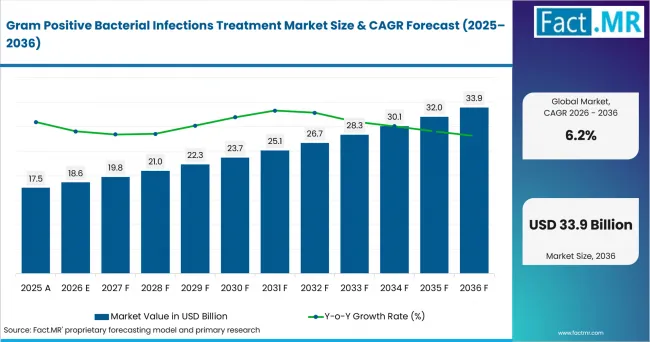
Gram Positive Bacterial Infections Treatment Market Value Analysis | Source: Fact.MR
What are the defining numbers behind Gram Positive Bacterial Infections Treatment Market growth?
USD 15.3 billion absolute opportunity is expected by 2036.
- Demand Drivers in the Market
- Hospitals require reliable empiric and targeted options for suspected Staphylococcus species plus Streptococcus and Enterococcus infections before susceptibility results refine therapy.
- Stewardship programs are expected to favor therapies with clear indication boundaries and predictable safety monitoring across anti-infective agents.
- Skin and soft tissue infection treatment supports recurring demand because emergency and outpatient teams often need prompt prescribing decisions.
- Hospital pharmacy procurement remains central since injectable agents and formulary oversight shape access to serious-infection treatment.
- Key Segments Analyzed
- By Therapeutic Class: Beta-lactam Antibiotics are expected to hold 39.0% share in 2026 because physicians use them across established Gram-positive treatment pathways.
- By Infection Type: Skin & Soft Tissue Infections are projected to account for 28.0% share in 2026 as early therapy decisions are common across urgent care settings.
- By End User: Hospitals are anticipated to capture 44.0% share in 2026 since serious infections often require culture review and intravenous therapy.
- By Distribution Channel: Hospital Pharmacies are estimated to represent 53.0% share in 2026 due to formulary management and inpatient supply requirements.
- By Drug Class: Penicillin Derivatives are forecast to hold 36.0% share in 2026 as protocol-led prescribing supports their use in susceptible infections.
- Analyst Opinion at Fact.MR
- Shambhu Nath Jha, Senior Consultant at Fact.MR, states, “Gram-positive infection treatment remains a protocol-led market. Suppliers that support stewardship plus hospital formulary access and reliable availability are expected to remain better positioned than companies that rely only on broad antibacterial coverage.”
- Strategic Implications
- Payers and providers benefit from linking product positioning with culture confirmation and susceptibility testing before broader use.
- Manufacturers need reliable supply for hospital-administered therapies where substitutions may disrupt protocol compliance.
- Portfolio teams can separate older protocol-based antibiotics from newer agents that require stronger clinical evidence.
- Commercial teams strengthen access discussions by training field staff on infection type and pathogen fit before making stewardship claims.
The USA leads at 7.1% CAGR through specialist care access and hospital procurement depth. Germany follows at 6.8% as structured reimbursement supports protocol-led use. Japan reaches 6.5% through aging-related treatment needs and hospital-based prescribing. The UK records 6.1% through national treatment pathways. Canada reaches 5.8% through institutional pharmacy control. South Korea posts 5.4% through advanced hospital infrastructure. France records 5.1% as mature treatment pathways support measured demand.
How does the Gram Positive Bacterial Infections Treatment Market break down by segment?
Beta-lactam Antibiotics are expected to lead Therapeutic Class at 39.0% share in 2026. Skin & Soft Tissue Infections are projected to lead Infection Type at 28.0% share in 2026.
Which therapeutic class dominates?
Beta-lactam Antibiotics are projected to account for 39.0% share in 2026.
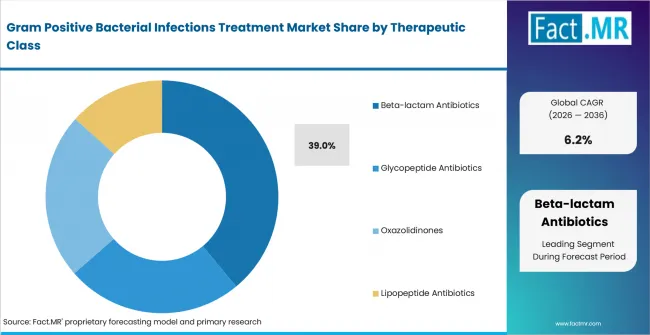
Gram Positive Bacterial Infections Treatment Market Analysis By Therapeutic Class | Source: Fact.MR
Beta-lactam Antibiotics lead because physicians use them across established Gram-positive treatment pathways. Their role is strongest where susceptibility results support narrow therapy. Glycopeptide antibiotics and oxazolidinones remain important when resistance or allergy requires a different approach.
Which infection type leads demand?
Skin & Soft Tissue Infections are expected to hold 28.0% share in 2026.
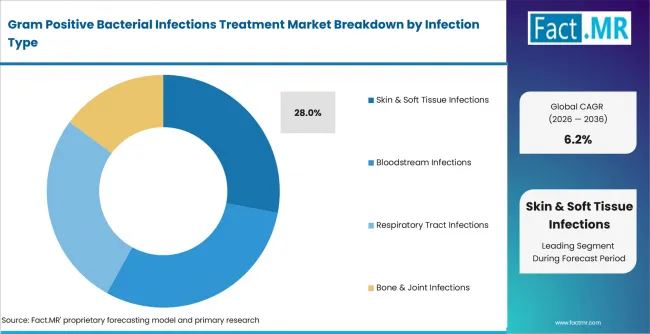
Gram Positive Bacterial Infections Treatment Market Analysis By Infection Type | Source: Fact.MR
Skin & Soft Tissue Infections create steady demand because cellulitis and abscesses require fast decisions. Wound infections add another treatment route. Many cases begin outside hospitals. Complicated presentations can move into inpatient care when drainage or intravenous treatment is needed. Organism confirmation can extend the care pathway.
How do hospitals shape end-user demand?
Hospitals are anticipated to capture 44.0% share in 2026.
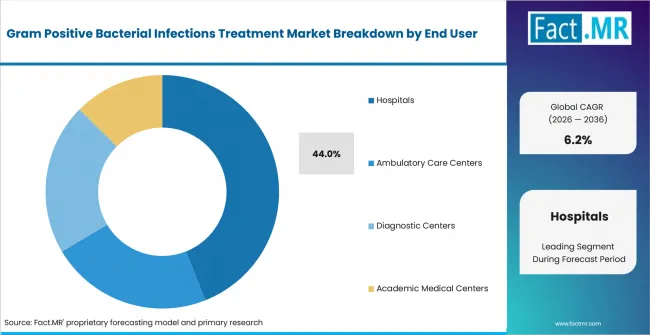
Gram Positive Bacterial Infections Treatment Market Analysis By End User | Source: Fact.MR
Hospitals lead because serious Gram-positive infections often need culture review and intravenous therapy. Specialist oversight can decide whether treatment continues. Bacteremia and pneumonia can require longer care pathways. Complicated skin infections can follow the same pattern. Stewardship teams influence formulary access and use.
What supports Hospital Pharmacies?
Hospital Pharmacies are estimated to represent 53.0% share in 2026.
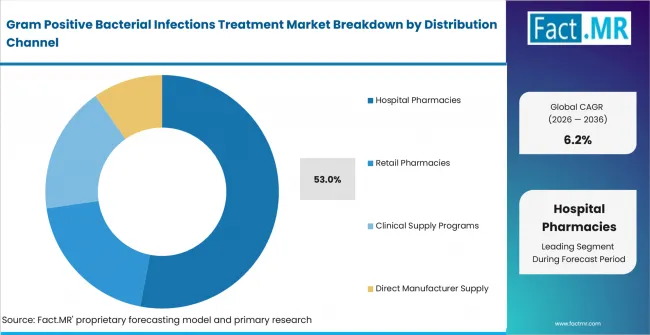
Gram Positive Bacterial Infections Treatment Market Analysis By Distribution Channel | Source: Fact.MR
Hospital Pharmacies control access through formulary review and inpatient dosing protocols. This channel is closely associated with hospital acquired infections therapeutics because serious infection care depends on timely supply and protocol compliance.
What keeps Penicillin Derivatives ahead?
Penicillin Derivatives are forecast to hold 36.0% share in 2026.
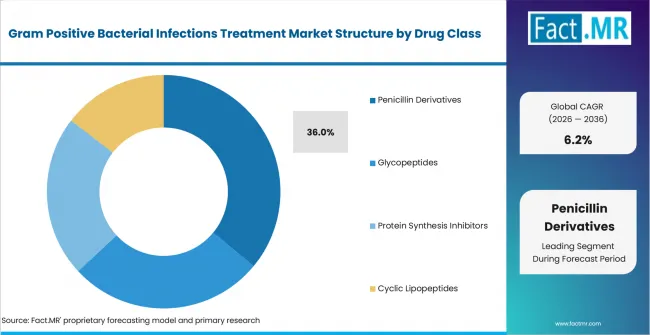
Gram Positive Bacterial Infections Treatment Market Analysis By Drug Class | Source: Fact.MR
Penicillin Derivatives remain important where susceptibility-directed treatment allows narrower therapy. Physicians understand dosing and safety across common use cases. Resistance and allergy considerations leave room for cephalosporins and vancomycin. Linezolid and daptomycin remain options in selected cases.
What is accelerating Gram Positive Bacterial Infections Treatment Market adoption, and what is holding it back?
Demand is expected to rise through hospital-managed infection treatment and culture-guided prescribing. Growth is expected to be limited by resistance pressure and stewardship restrictions across antibiotics procurement. Supply reliability adds another constraint.
Drivers Impact Analysis
| DRIVER | (~) % IMPACT ON CAGR | GEOGRAPHIC RELEVANCE | IMPACT TIMELINE |
|---|---|---|---|
| Hospital-managed serious infections | +1.8% | North America, Europe, East Asia | Short term (<= 2 years) |
| Culture-guided treatment selection | +1.5% | Global hospital systems | Short term (<= 2 years) |
| Formulary access for proven agents | +1.2% | USA, Germany, UK, Canada | Medium term (2-4 years) |
| Stewardship-compatible prescribing | +1.0% | Mature healthcare markets | Medium term (2-4 years) |
| Outpatient and step-down treatment use | +0.8% | USA, Japan, France | Long term (>= 4 years) |
- Hospital-managed serious infections: Bacteremia and pneumonia are expected to sustain demand for therapies that work inside strict care pathways.
- Culture-guided treatment selection: Microbiology results are expected to shape prescribing decisions and support demand for antimicrobial susceptibility test workflows that guide antibacterial choice.
- Formulary access for proven agents: Hospital committees are expected to favor therapies with clear indication fit and stable supply.
Opportunity Impact Analysis
| OPPORTUNITY | (~) % IMPACT ON CAGR | GEOGRAPHIC RELEVANCE | IMPACT TIMELINE |
|---|---|---|---|
| Targeted use in severe infections | +0.9% | USA, Germany, Japan | Medium term (2-4 years) |
| Oral step-down pathways | +0.8% | USA, UK, Canada | Medium term (2-4 years) |
| Hospital pharmacy protocol support | +0.6% | Mature hospital systems | Long term (>= 4 years) |
| Specialist infectious disease review | +0.5% | North America and Europe | Long term (>= 4 years) |
- Targeted use in severe infections: Newer agents are expected to gain traction only where labels and evidence match hospital treatment gaps.
- Oral step-down pathways: Carefully selected patients are expected to move from inpatient therapy toward outpatient care where extended oral antibiotics fit stewardship rules.
- Hospital pharmacy protocol support: Vendors that help pharmacists manage dosing and restrictions are expected to face lower access friction.
Restraints Impact Analysis
| RESTRAINT | (~) % IMPACT ON CAGR | GEOGRAPHIC RELEVANCE | IMPACT TIMELINE |
|---|---|---|---|
| Resistance and susceptibility uncertainty | -1.2% | Global | Short term (<= 2 years) |
| Stewardship limits on broad use | -1.0% | USA, Germany, UK, Canada | Short term (<= 2 years) |
| Generic price pressure | -0.7% | Mature markets | Medium term (2-4 years) |
| Hospital supply and stocking risk | -0.5% | Global hospital systems | Long term (>= 4 years) |
- Resistance and susceptibility uncertainty: Physicians may delay or change therapy when culture results do not support the initial choice.
- Stewardship limits on broad use: Hospitals are expected to restrict newer agents when older therapies remain suitable for susceptible infections.
- Generic price pressure: Established molecules can limit premium uptake unless a branded product solves a clear clinical access issue in sterile active pharmaceutical ingredient supply.
Which countries are scaling Gram Positive Bacterial Infections Treatment Market fastest?
- The country comparison spans 2.0 percentage points across the forecast period.
- The USA remains 0.3 percentage point above Germany through specialist care access and hospital procurement depth.
- Germany remains 0.3 percentage point above Japan because structured reimbursement supports protocol-led use.
- Japan remains 0.4 percentage point above the UK through aging-related treatment needs and hospital-based prescribing.
- The UK remains 0.3 percentage point above Canada with national treatment pathways and clinical review structures.
- Canada remains 0.4 percentage point above South Korea through institutional pharmacy control and specialist access.
- South Korea remains 0.3 percentage point above France as hospital technology adoption supports treatment oversight.
Comparable CAGRs can create different entry conditions due to stewardship rules and reimbursement settings. Hospital purchasing behavior and infectious disease specialist access shape the remaining differences. Full report coverage includes North America, Latin America, Europe, East Asia, South Asia and Pacific, Middle East and Africa.
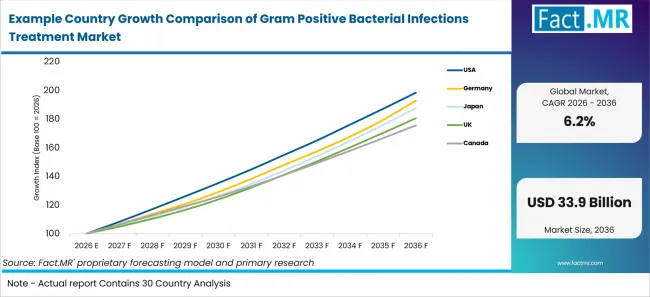
Example Country Growth Comparison Of Gram Positive Bacterial Infections Treatment Market | Source: Fact.MR
| Country | CAGR (2026-2036) |
|---|---|
| USA | 7.1% |
| Germany | 6.8% |
| Japan | 6.5% |
| UK | 6.1% |
| Canada | 5.8% |
| South Korea | 5.4% |
| France | 5.1% |
What supports USA adoption?
7.1% CAGR, supported by hospital procurement depth and specialist infectious disease care.
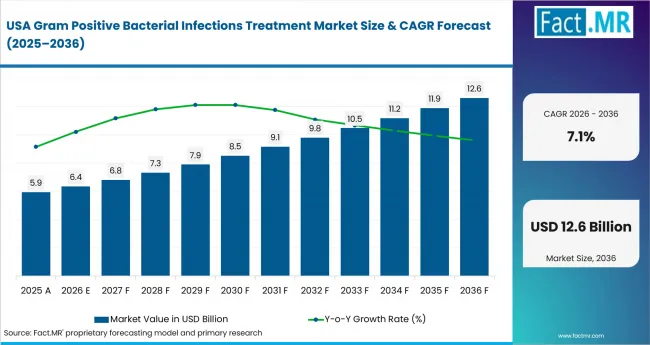
Gram Positive Bacterial Infections Treatment Market Country Value Analysis | Source: Fact.MR
US adoption is expected to reflect a care setting where formulary review and stewardship documentation shape serious-infection treatment. Large hospital networks favor agents with clear labels and predictable access.
How is Germany scaling demand?
6.8% CAGR, led by structured reimbursement and protocol-led hospital care.
Germany is expected to scale through organized inpatient pathways and careful antibiotic selection. Supplier access depends on evidence and availability across major care centers. Compatibility with stewardship-led prescribing remains a separate access test.
What is driving Japan’s growth from 2026 to 2036?
6.5% CAGR, backed by aging-related treatment needs and hospital-based prescribing.
Japan’s demand is shaped by older patient groups and a hospital system that manages complex infections through specialist review. Established pharmacy channels support measured adoption of antibacterial options.
How is the UK developing demand?
6.1% CAGR, driven by national treatment pathways and clinical review structures.
UK uptake is expected to reflect a prescribing environment where stewardship rules and health-system evaluation affect access. Adoption remains tied to local protocols and documented infection-management pathways.
What supports Canada’s growth?
5.8% CAGR, supported by institutional pharmacy control and specialist access.
Canada’s growth is connected to hospital pharmacy oversight and infectious disease consultation for serious infections. Demand is expected to be steadier for products with reliable supply and defined use cases.
How does South Korea perform?
5.4% CAGR, led by hospital technology adoption and treatment oversight.
South Korea’s performance is shaped by advanced hospital infrastructure and controlled prescribing. Competition remains shaped by generic alternatives and protocol fit. Resistance pressure adds another limit to wider use.
What supports France’s growth?
5.1% CAGR, backed by mature treatment pathways and regulated hospital access.
France is expected to advance through established hospital prescribing standards and structured antibacterial access. Demand remains concentrated in defined infection settings instead of open-ended antibiotic use.
Who leads the Gram Positive Bacterial Infections Treatment Market?
Pfizer and Merck hold the strongest relevance in Gram-positive infection treatment, while GSK and Sanofi add broader antibacterial and hospital-market depth.
Melinta, Paratek and Basilea strengthen the field through focused antibiotic portfolios for serious infections. Roche, Baxter and Cumberland extend the provider base through hospital access, injectable therapy support and treatment availability across protocol-led care settings.
Which companies are the key providers?
Key companies include Pfizer Inc., Merck & Co., Inc., GSK plc, Sanofi SA, Melinta Therapeutics LLC, F. Hoffmann-La Roche Ltd., Paratek Pharmaceuticals, Inc., Baxter International Inc., Basilea Pharmaceutica Ltd., and Cumberland Pharmaceuticals Inc.
- Pfizer Inc.
- Merck & Co., Inc.
- GSK plc
- Sanofi SA
- Melinta Therapeutics LLC
- F. Hoffmann-La Roche Ltd.
- Paratek Pharmaceuticals, Inc.
- Baxter International Inc.
- Basilea Pharmaceutica Ltd.
- Cumberland Pharmaceuticals Inc.
Bibliography
- Basilea Pharmaceutica Ltd. (2025, May 20). Basilea announces commercial availability of antibiotic Zevtera® (ceftobiprole) in the United States.
- GSK plc. (2025, March 25). Blujepa (gepotidacin) approved by US FDA for treatment of uncomplicated urinary tract infections (uUTIs) in female adults and pediatric patients 12 years of age and older.
- World Health Organization. (2025, October 13). Global antibiotic resistance surveillance report 2025.
This Report Answers
- The report provides strategic intelligence on the Gram Positive Bacterial Infections Treatment Market across Therapeutic Class and Infection Type choices that shape prescribing decisions.
- Segment analysis covers Beta-lactam Antibiotics and Skin & Soft Tissue Infections as the share leaders within the 2026 market.
- Country outlook evaluates the USA and Germany alongside Japan and the UK. Canada and South Korea complete the growth comparison with France across the profiled markets.
- Competitive analysis profiles the approved company set without adding company share.
- Treatment assessment covers hospital prescribing and pharmacy access. Diagnostic confirmation supports therapy selection. The same assessment reflects adjacent demand in infectious disease diagnostic and point-of-care diagnostics workflows.
What does the Gram Positive Bacterial Infections Treatment Market cover?
Gram-positive bacterial infection treatments are prescription antibacterial therapies used when clinicians suspect or confirm infections caused by Gram-positive organisms.
The Gram Positive Bacterial Infections Treatment Market covers therapies used for Staphylococcus species plus Streptococcus and Enterococcus infections. Coverage extends to skin and soft tissue infections plus respiratory tract infections. Bloodstream infections and bone and joint infections remain included.
What is included in the scope?
The scope includes prescription therapies used across hospitals and specialty clinics. Ambulatory care centers and homecare settings are included where they supply approved therapy.
The scope includes Therapeutic Class and Infection Type. End User, Distribution Channel, and Drug Class complete the segmentation view. Coverage spans Beta-lactam Antibiotics and Glycopeptide Antibiotics. Oxazolidinones and Lipopeptides remain part of the therapeutic view. It includes Skin & Soft Tissue Infections and Respiratory Tract Infections.
What is excluded from the scope?
Antibacterial products that do not treat Gram-positive bacterial infections remain outside the scope of this market.
The scope excludes vaccines and antivirals. Antifungal therapies, disinfectants, diagnostic-only products, and infection-control devices remain outside the market. It excludes veterinary antibacterial use and non-prescription products.
How Was the Analysis Built?
The analysis draws on 120+ sources, 35+ company portfolios, 25+ countries, and more than 20 industry interviews.
- Primary Research: Primary research includes discussions with manufacturers, service providers, technology developers, distributors, end users, procurement teams, and subject-matter experts. These conversations examine purchasing priorities, product adoption, operational challenges, approval requirements, competitive positioning, and the factors that influence wider market acceptance.
- Desk Research: Desk research covers government statistics, regulatory publications, company filings, trade data, technical studies, industry associations, standards, public policy, and other authoritative sources. Every source used in the analysis is documented in the bibliography.
- Market Sizing and Forecasting: Market estimates combine historical performance, demand indicators, pricing and volume trends, segment shares, company participation, country-level growth, adoption patterns, investment activity, and barriers to market expansion.
- Data Validation and Update Cycle: Findings are validated by comparing primary interviews with public data, company activity, regulatory changes, trade patterns, and industry developments. Regular updates review new product launches, capacity changes, partnerships, approvals, procurement trends, and shifts in commercial adoption.
What is the report’s scope and coverage?
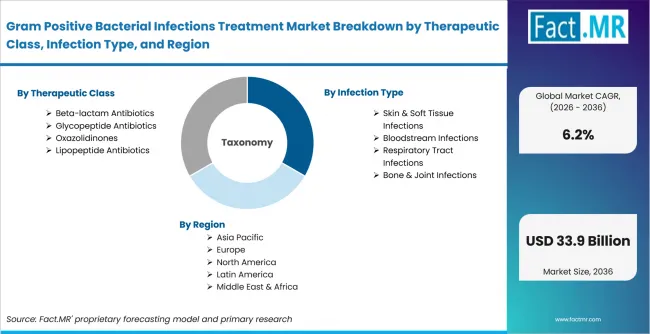
Gram Positive Bacterial Infections Treatment Market Breakdown By Therapeutic Class, Infection Type, And Region | Source: Fact.MR
| Attribute | Details |
|---|---|
| Quantitative Units | USD billion in 2026 to USD billion by 2036 at CAGR |
| Market Definition | Prescription antibacterial therapies used to treat infections caused by Gram-positive pathogens including Staphylococcus, Streptococcus, and Enterococcus species |
| Therapeutic Class | Beta-lactam Antibiotics; Glycopeptide Antibiotics; Oxazolidinones; Lipopeptides; Other Therapeutic Classes |
| Infection Type | Skin & Soft Tissue Infections; Respiratory Tract Infections; Bloodstream Infections; Bone & Joint Infections; Other Infection Types |
| End User | Hospitals; Specialty Clinics; Ambulatory Care Centers; Homecare Settings; Other End Users |
| Distribution Channel | Hospital Pharmacies; Retail Pharmacies; Online Pharmacies; Specialty Pharmacies; Other Distribution Channels |
| Drug Class | Penicillin Derivatives; Cephalosporins; Vancomycin; Linezolid; Daptomycin; Other Drug Classes |
| Regions Covered | North America; Latin America; Europe; East Asia; South Asia and Pacific; Middle East and Africa |
| Countries Covered | USA; Germany; Japan; UK; Canada; South Korea; France |
| Key Companies Profiled | Pfizer Inc.; Merck & Co., Inc.; GSK plc; Sanofi SA; Melinta Therapeutics LLC; F. Hoffmann-La Roche Ltd.; Paratek Pharmaceuticals, Inc.; Baxter International Inc.; Basilea Pharmaceutica Ltd.; Cumberland Pharmaceuticals Inc. |
| Forecast Period | 2026 to 2036 |
| Approach | Hybrid top-down and bottom-up approach using antibacterial treatment demand; hospital procurement behavior; infection-type use cases; therapeutic class selection; drug class mix; distribution channel control; country adoption patterns; stewardship rules; product availability; company portfolio review; and forecast validation |
How is the market segmented?
-
By Therapeutic Class
- Beta-lactam Antibiotics
- Anti-staphylococcal Penicillins
- Cephalosporins
- Glycopeptide Antibiotics
- Vancomycin
- Teicoplanin
- Oxazolidinones
- Linezolid
- Tedizolid
- Lipopeptide Antibiotics
- Daptomycin
- Long-acting Lipopeptides
- Beta-lactam Antibiotics
-
By Infection Type
- Skin & Soft Tissue Infections
- Cellulitis
- Surgical Site Infections
- Bloodstream Infections
- Bacteremia
- Endocarditis
- Respiratory Tract Infections
- Hospital-acquired Pneumonia
- Community-acquired Pneumonia
- Bone & Joint Infections
- Osteomyelitis
- Septic Arthritis
- Skin & Soft Tissue Infections
-
By End User
- Hospitals
- Tertiary Care Hospitals
- Infectious Disease Centers
- Ambulatory Care Centers
- Specialty Clinics
- Long-term Care Facilities
- Diagnostic Centers
- Clinical Research Institutes
- Public Health Laboratories
- Academic Medical Centers
- University Hospitals
- Orthopedic Specialty Hospitals
- Hospitals
-
By Distribution Channel
- Hospital Pharmacies
- Institutional Pharmacies
- Specialty Pharmacies
- Retail Pharmacies
- Online Pharmacies
- Direct Hospital Supply
- Clinical Supply Programs
- Early Access Programs
- Government Procurement
- Direct Manufacturer Supply
- Accredited Treatment Centers
- Controlled Distribution Network
- Hospital Pharmacies
-
By Drug Class
- Penicillin Derivatives
- Penicillinase-resistant Penicillins
- First-generation Cephalosporins
- Glycopeptides
- Lipoglycopeptides
- Glycopeptide Derivatives
- Protein Synthesis Inhibitors
- Oxazolidinones
- Novel Oxazolidinones
- Cyclic Lipopeptides
- Calcium-dependent Lipopeptides
- Long-acting Injectable Antibiotics
- Penicillin Derivatives
-
By Region
- North America
- Latin America
- Western Europe
- Eastern Europe
- East Asia
- South Asia and Pacific
- Middle East & Africa