- Market Value (2025): USD 3.4 Bn
- Estimated Value (2026): USD 3.9 Bn
- Forecast Value (2036): USD 16.8 Bn
- CAGR (2026-2036): 15.7%
What is the Artificial Intelligence in Ultrasound Imaging Market forecast to be worth by 2036?
USD 3.9 billion in 2026 to USD 16.8 billion by 2036 at 15.7% CAGR.
- The Artificial Intelligence in Ultrasound Imaging Market surpassed a value of USD 3.4 billion in 2025.
- Demand is projected to reach from USD 3.9 billion to USD 16.8 billion by 2036 as AI functions move into general imaging and point-of-care ultrasound platforms.
- The market is forecast to record 15.7% CAGR from 2026 to 2036 as buyers compare validation evidence and integration fit.
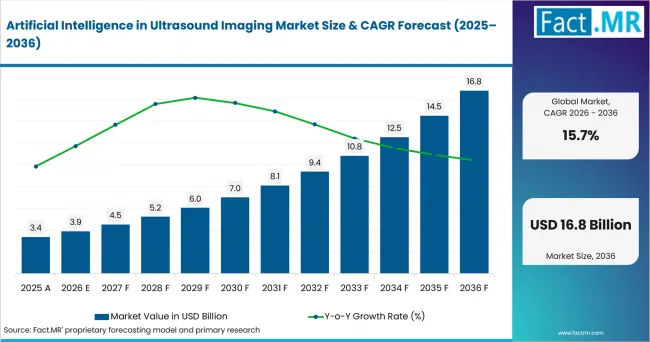
Artificial Intelligence In Ultrasound Imaging Market Value Analysis | Source: Fact.MR
What are the defining numbers behind Artificial Intelligence in Ultrasound Imaging Market growth?
USD 12.9 billion absolute opportunity by 2036, led by Image Analysis Software and Image Acquisition alongside General Imaging, Hospitals and Deep Learning.
- Demand Drivers in the Market
- Scan quality changes with operator skill, so departments need acquisition guidance and automatic measurements.
- Networked hospitals prefer AI tools that place image capture and report steps inside existing clinical systems.
- Emergency and critical-care teams need bedside imaging that gives a focused answer before a patient reaches central imaging.
- Key Segments Analyzed
- By AI Imaging Solution: With an estimated 38.0% share in 2026, Image Analysis Software leads because automated measurements reduce manual review time.
- By Clinical Workflow: Image Acquisition is projected to hold 36.0% share in 2026 as real-time enhancement is expected to improve scan usability during the examination.
- By Application Area: General Imaging is anticipated to capture 40.0% share in 2026 owing to abdominal and liver imaging use.
- By End User: Hospitals are estimated to represent 43.0% share in 2026 since they manage credentialing and fleet-level governance.
- By AI Technology: Deep Learning is forecast to account for 39.0% share in 2026 through anatomy recognition and image segmentation.
- Analyst Opinion at Fact.MR
- Shambhu Nath Jha, Senior Consultant at Fact.MR, states, “AI is changing ultrasound buying from a hardware-only choice into a workflow and evidence choice. Hospital teams are expected to compare guidance quality and measurement repeatability. Integration depth and cybersecurity are expected to face the same review before wider use. Companies with reliable imaging and governed software updates are better placed to turn pilots into network use.”
- Strategic Implications
- Ultrasound vendors gain stronger hospital credibility by testing AI functions across different devices and care settings before making workflow claims.
- Hospital procurement teams can combine training review with quality assurance so clinical users have clear scan-escalation rules.
- Specialist AI developers benefit from building tools that connect with imaging archives and medical records rather than operating as stand-alone review systems.
The USA leads at 17.1% CAGR through FDA-cleared functions and hospital innovation programs. Japan follows at 16.5% CAGR through diagnostic imaging capability. Germany reaches 15.9% CAGR through hospital-system scale and medical AI governance. The UK posts 15.4% CAGR through diagnostic capacity pressure. Canada records 14.8% CAGR as ML-device guidance clarifies product evidence. South Korea reaches 14.3% CAGR with domestic ultrasound manufacturing. Singapore advances at 13.8% CAGR through structured healthcare AI governance.
How does the Artificial Intelligence in Ultrasound Imaging Market break down by segment?
Image Analysis Software is expected to lead AI Imaging Solution at 38.0% share in 2026. Image Acquisition is projected to lead Clinical Workflow at 36.0% share in 2026.
Which AI Imaging Solution dominates?
Image Analysis Software holds 38.0% share in 2026.
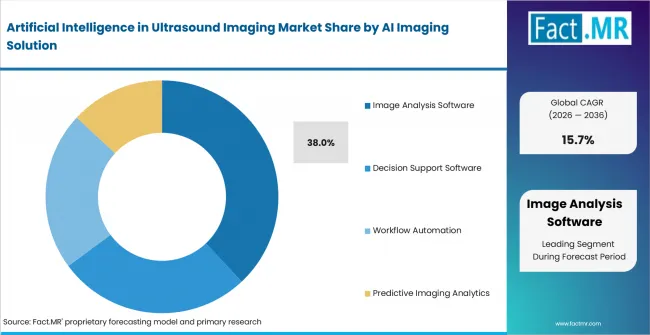
Artificial Intelligence In Ultrasound Imaging Market Analysis By Ai Imaging Solution | Source: Fact.MR
Automated measurements give Image Analysis Software the strongest position by reducing repeat review work. Decision Support Software adds value during lesion and severity assessment, while Workflow Automation focuses more on documentation and reporting. Its role inside routine ultrasound platforms supports wider use across high-volume imaging settings.
What leads the Clinical Workflow segment?
Image Acquisition leads with 36.0% share in 2026.
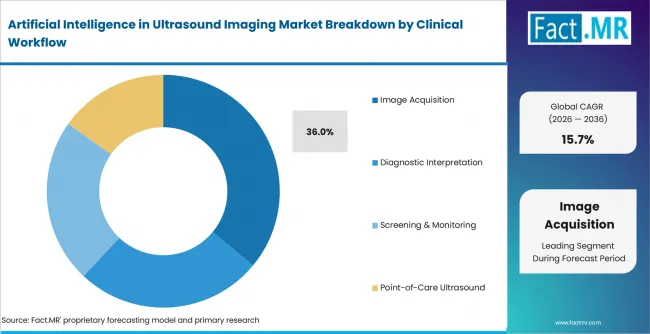
Artificial Intelligence In Ultrasound Imaging Market Analysis By Clinical Workflow | Source: Fact.MR
Usable image capture comes before interpretation, which places Image Acquisition at the center of the workflow. Wireless handheld devices and cart-based systems both benefit from real-time guidance and enhancement. Diagnostic Interpretation then supports lesion review, whereas Point-of-Care Ultrasound extends scanning into emergency and critical-care environments.
Which Application Area leads adoption?
General Imaging holds 40.0% share in 2026.
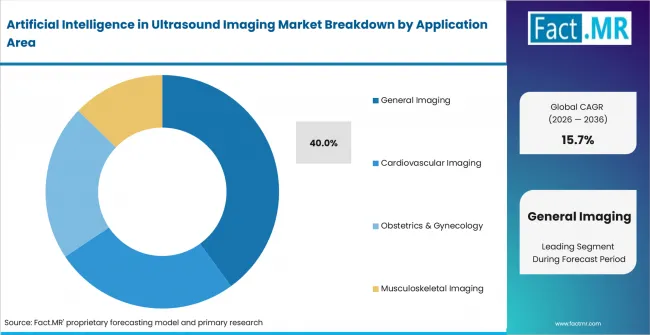
Artificial Intelligence In Ultrasound Imaging Market Analysis By Application Area | Source: Fact.MR
Broad use across abdominal and liver examinations keeps General Imaging ahead. These scans rely on clear anatomy recognition and consistent measurements across repeated studies. Cardiovascular Imaging remains important for cardiac assessments, while Obstetrics and Gynecology uses AI for fetal views and biometric checks.
Which End User accounts for the largest share?
Hospitals account for 43.0% share in 2026.
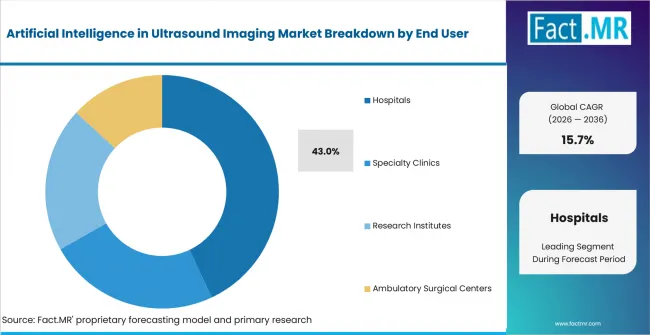
Artificial Intelligence In Ultrasound Imaging Market Analysis By End User | Source: Fact.MR
Hospitals hold the leading position due to their responsibility for clinical governance, user credentialing and fleet-wide quality control. Diagnostic Imaging Centers place more emphasis on exam speed and reporting consistency. Community Healthcare Centers contribute where point-of-care ultrasound is used for focused bedside decisions.
Which AI Technology leads?
Deep Learning holds 39.0% share in 2026.
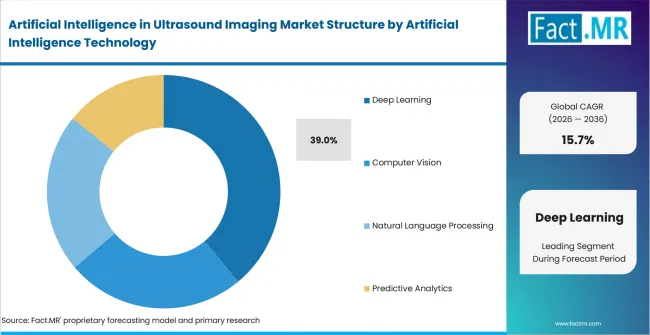
Artificial Intelligence In Ultrasound Imaging Market Analysis By Artificial Intelligence Technology | Source: Fact.MR
Anatomy recognition and image segmentation give Deep Learning a broad role across ultrasound workflows. Computer Vision is used during view detection and scan guidance. Natural Language Processing supports structured reporting, while update planning and validation remain important for commercial deployment.
What is accelerating Artificial Intelligence in Ultrasound Imaging Market adoption, and what is holding it back?
system integration are expected to restrain broader use.
Drivers Impact Analysis
| DRIVER | COMMERCIAL EFFECT | GEOGRAPHIC RELEVANCE | IMPACT TIMELINE |
|---|---|---|---|
| AI-assisted acquisition reducing operator-dependent variability | Reduces repeat scans and supports guided capture | North America, Europe, and Asia Pacific | Medium term (2-4 years) |
| Hospital throughput and diagnostic capacity pressure | Improves examination capacity | USA, UK, Germany, and Canada | Near to medium term (<= 4 years) |
| Expansion of portable and point-of-care ultrasound | Extends imaging into bedside care | USA, Japan, South Korea, and Singapore | Medium term (2-4 years) |
| Automated measurement and structured reporting requirements | Standardizes measurements and reporting | Global hospital and imaging networks | Medium term (2-4 years) |
| Lifecycle rules for machine-learning medical devices | Supports governed software updates | USA, Canada, UK, South Korea, and Singapore | Short term (<= 2 years) |
Source: Fact.MR analysis. Updated Aug 8, 2026
- Acquisition guidance: Ultrasound begins with the right view. AI prompts and quality feedback are expected to help non-specialist users capture usable images with fewer repeat attempts.
- Workflow standardization: Hospitals need bedside scans to reach the picture archiving and communication system with clear review steps. This is expected to raise demand for software that fits enterprise governance.
- Portable use expansion: Emergency teams need critical care diagnostics near the patient. AI guidance is expected to make focused scans easier to govern outside central imaging rooms.
Opportunity Impact Analysis
| OPPORTUNITY | COMMERCIAL EFFECT | GEOGRAPHIC RELEVANCE | IMPACT TIMELINE |
|---|---|---|---|
| Real-time enhancement and artifact reduction during scanning | Adds value during acquisition | Global diagnostic imaging markets | Medium term (2-4 years) |
| AI-guided cardiovascular and emergency ultrasound | Expands acute-care use | USA, UK, Canada, Japan, and Singapore | Short to medium term (<= 4 years) |
| Obstetric image-quality assurance and fetal measurements | Improves measurement consistency | Asia Pacific and North America | Medium term (2-4 years) |
| Enterprise reporting and credentialing platforms | Creates recurring software demand | Large hospital networks | Medium term (2-4 years) |
Source: Fact.MR analysis. Updated Aug 8, 2026
- Guided clinical expansion: The main opportunity is controlled use in settings where clinicians need one focused answer under a defined scan protocol.
- Enterprise software demand: Reporting automation and quality scoring are expected to add value after equipment purchase.
Restraints Impact Analysis
| RESTRAINT | COMMERCIAL EFFECT | GEOGRAPHIC RELEVANCE | IMPACT TIMELINE |
|---|---|---|---|
| Clinical validation across devices and users | Raises validation cost | Global | Medium term (2-4 years) |
| Cybersecurity and software change-control obligations | Extends compliance review | North America, Europe, and advanced Asian markets | Short to medium term (<= 4 years) |
| Integration with hospital records and imaging infrastructure | Lengthens deployment | Large hospital systems | Medium term (2-4 years) |
| Budget cycles and uncertain reimbursement | Delays lower-priority procurement | Global | Long term (>= 4 years) |
Source: Fact.MR analysis. Updated Aug 8, 2026
- Evidence and generalizability: An algorithm is expected to perform differently across devices and user groups. Buyers need clear limits before broad clinical use.
- Governance and integration: Connected ultrasound software handles patient images and measurements. Cybersecurity review and record integration are expected to extend purchase timelines.
- Training burden: Bedside users need simple escalation rules. Without these rules, a fast scan is expected to leave clinical responsibility unclear.
Which countries are scaling Artificial Intelligence in Ultrasound Imaging Market fastest?
- The displayed country range spans 3.3 percentage points and is expected to form three practical adoption bands through 2036.
- The USA remains ahead through FDA-cleared AI functions and a large hospital buyer base.
- Japan and Germany follow through diagnostic imaging depth and evidence-led hospital purchasing.
- The UK and Canada form the middle band through diagnostic access pressure and ML-device guidance.
- South Korea and Singapore complete the list through domestic ultrasound capability and structured health AI governance.
Comparable CAGRs are expected to create different entry conditions due to hospital scale and local review rules. Full report coverage includes North America and Europe. Asia Pacific is included. Central and South America and the Middle East and Africa complete the regional scope.
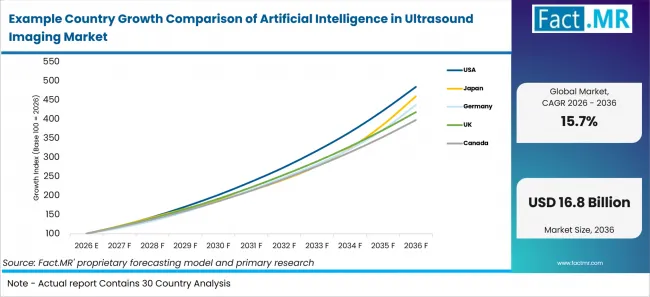
Example Country Growth Comparison Of Artificial Intelligence In Ultrasound Imaging Market | Source: Fact.MR
| Country | CAGR (2026-2036) |
|---|---|
| USA | 17.1% |
| Japan | 16.5% |
| Germany | 15.9% |
| UK | 15.4% |
| Canada | 14.8% |
| South Korea | 14.3% |
| Singapore | 13.8% |
Source: Fact.MR analysis. Updated Aug 8, 2026
What is driving USA growth through 2036?
17.1% CAGR, driven by FDA-cleared AI functions and point-of-care ultrasound development.
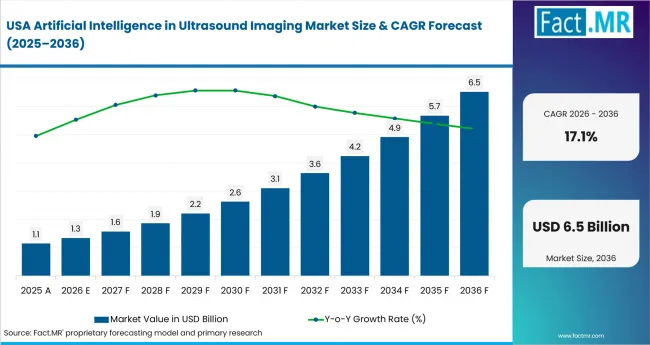
Artificial Intelligence In Ultrasound Imaging Market Country Value Analysis | Source: Fact.MR
The USA has the largest buyer base for regulated medical-device software. FDA review gives hospitals a familiar path for assessing AI functions before fleet use. Adoption is expected to move fastest where vendors prove image-capture guidance and user training. Record integration must work in the same workflow.
How is Japan scaling AI in Ultrasound Imaging demand?
16.5% CAGR, supported by diagnostic imaging capability and demand for reproducible examinations.
Japan’s imaging-equipment base supports close work between hospitals and manufacturers. Buyers place high value on image quality and local service. User consistency matters during hospital review. AI tools are expected to gain attention in cardiology and abdominal imaging because these areas need repeatable measurements.
What supports Germany’s outlook?
15.9% CAGR, owing to hospital-system scale and regulated demand for high-risk medical AI.
Germany’s hospital market is expected to favor technology that arrives with clear evidence and post-market controls. This is expected to support AI ultrasound tools that document clinical limits and fit privacy requirements. Cardiology and general imaging are expected to create practical routes for automated measurement.
How is the UK developing AI in Ultrasound Imaging demand?
15.4% CAGR, shaped by diagnostic capacity pressure and community imaging expansion.
The UK needs faster diagnostic pathways across hospitals and community settings. AI-guided scanning is expected to help standardize image capture where trained staff are limited. Independent-sector imaging is expected to give vendors another route for adoption outside public procurement.
What underpins Canada’s growth?
14.8% CAGR, attributable to regulatory clarity for machine-learning medical devices and distributed diagnostic access.
Canada’s growth is shaped by a need for imaging access across wide service areas. Health Canada’s April 2026 MLMD guidance clarifies product lifecycle evidence for companies. That helps vendors plan clinical validation and change controls earlier in product design.
How is South Korea strengthening market adoption?
14.3% CAGR, supported by domestic ultrasound manufacturing and women’s health AI activity.
South Korea combines advanced hospitals with domestic ultrasound manufacturing. Samsung Medison’s September 2024 completion of the Sonio acquisition strengthened fetal ultrasound AI depth. Women’s health imaging is expected to give a clear route for measurement and reporting support.
Why is Singapore an important adoption market?
13.8% CAGR, driven by healthcare AI governance and software-as-a-medical-device controls.
Singapore offers vendors a practical environment for controlled healthcare AI deployment. Clear guidance from MOH and HSA helps define responsibilities for safe use. Structured software-change controls also support planned updates while keeping clinical oversight and cybersecurity requirements visible.
Who leads the Artificial Intelligence in Ultrasound Imaging Market?
GE HealthCare shows the direct position through cardiac acquisition guidance and handheld ultrasound integration.
Siemens Healthineers and Philips add enterprise ultrasound depth. Samsung Medison strengthens women’s health AI through Sonio. Competition is expected to center on clinical validation and workflow fit. Broader adjacency exists with portable imaging systems when hospitals compare imaging-platform investments.
Which companies are the key providers?
Key companies include the following AI ultrasound and imaging technology providers.
- GE HealthCare Technologies Inc.
- Siemens Healthineers AG
- Koninklijke Philips N.V.
- Canon Medical Systems Corporation
- Samsung Medison Co., Ltd.
- Butterfly Network, Inc.
- Clarius Mobile Health Corp.
- EchoNous, Inc.
Bibliography
- Butterfly Network, Inc. (2025, November 17). Butterfly Network launches Compass AI to power the next generation of POCUS program management.
- Butterfly Network, Inc. (2026, March 30). Butterfly Network secures first FDA clearance for blind sweep ultrasound AI tool, marking a major stride for women’s health.
- Clarius Mobile Health Corp. (2025, April 25). FDA clears new Clarius Prostate AI to help physicians assess and diagnose common urologic conditions in minutes.
- GE HealthCare Technologies Inc. (2024, April 3). GE HealthCare introduces Caption AI on Vscan Air SL wireless handheld ultrasound system to help more clinicians capture diagnostic-quality cardiac images.
- Health Sciences Authority. (2024, December 4). Pilot run: Change Management Program (CMP) for SaMD, including machine learning-enabled SaMD.
This Report Answers
- The report provides strategic intelligence on Artificial Intelligence in Ultrasound Imaging Market choices across AI Imaging Solution and Clinical Workflow categories.
- Segment analysis covers Image Analysis Software and Image Acquisition as the share leaders within the 2026 market.
- Country outlook evaluates the USA and Japan alongside Germany and the UK. Canada and South Korea complete the growth comparison with Singapore.
- Competitive analysis profiles GE HealthCare and Siemens Healthineers alongside Philips and Samsung Medison. Butterfly Network and EchoNous complete the focused POCUS view.
- Technology assessment covers Deep Learning and Computer Vision. Natural Language Processing and Predictive Analytics complete the AI technology view.
What does the Artificial Intelligence in Ultrasound Imaging Market cover?
AI-enabled ultrasound software is used to guide scan capture and support image review where operator skill affects exam consistency.
The Artificial Intelligence in Ultrasound Imaging Market covers software used for acquisition guidance and image enhancement. Coverage extends to automated measurements and decision support. Reporting tools and workflow management are included when they serve ultrasound imaging work. Conventional ultrasound hardware is counted only when the AI function materially shapes use or purchase decisions.
What is included in the scope?
The scope includes AI tools used across hospitals and imaging providers for ultrasound examination support.
Coverage includes AI Imaging Solution and Clinical Workflow alongside Application Area and End User. The scope includes Deep Learning and Computer Vision tools used in ultrasound work. It covers general imaging and cardiovascular imaging. Obstetrics and gynecology follow when AI supports capture or review.
What is excluded from the scope?
Conventional ultrasound hardware without a material AI function remains outside the scope of this market.
The scope excludes non-ultrasound AI used in MRI and CT. X-ray and endoscopy are outside the scope. Pathology and administrative software remain outside the scope. Generic hospital AI platforms are excluded unless they directly support ultrasound image capture or review. Reporting and quality oversight must connect to ultrasound work.
How Was the Analysis Built?
The analysis draws on 120+ sources, 35+ company portfolios, 25+ countries, and more than 20 industry interviews.
- Primary Research: Primary research includes discussions with manufacturers, service providers, technology developers, distributors, end users, procurement teams, and subject-matter experts. These conversations examine purchasing priorities, product adoption, operational challenges, approval requirements, competitive positioning, and the factors that influence wider market acceptance.
- Desk Research: Desk research covers government statistics, regulatory publications, company filings, trade data, technical studies, industry associations, standards, public policy, and other authoritative sources. Every source used in the analysis is documented in the bibliography.
- Market Sizing and Forecasting: Market estimates combine historical performance, demand indicators, pricing and volume trends, segment shares, company participation, country-level growth, adoption patterns, investment activity, and barriers to market expansion.
- Data Validation and Update Cycle: Findings are validated by comparing primary interviews with public data, company activity, regulatory changes, trade patterns, and industry developments. Regular updates review new product launches, capacity changes, partnerships, approvals, procurement trends, and shifts in commercial adoption.
Segmentation
What is the report’s scope and coverage?
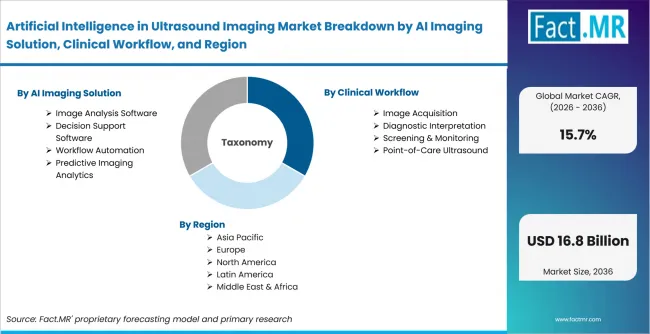
Artificial Intelligence In Ultrasound Imaging Market Breakdown By Ai Imaging Solution, Clinical Workflow, And Region | Source: Fact.MR
| Attribute | Details |
|---|---|
| Quantitative Units | USD billion in 2026 to USD billion by 2036 at CAGR |
| Market Definition | AI-enabled ultrasound software used for guided acquisition, image enhancement, analysis, reporting and workflow governance where scan quality, measurement repeatability, clinical validation and system integration shape adoption |
| AI Imaging Solution | Image Analysis Software; Decision Support Software; Workflow Automation; Predictive Imaging Analytics |
| Clinical Workflow | Image Acquisition; Diagnostic Interpretation; Screening and Monitoring; Point-of-Care Ultrasound |
| Application Area | General Imaging; Cardiovascular Imaging; Obstetrics and Gynecology; Musculoskeletal Imaging |
| End User | Hospitals; Diagnostic Imaging Centers; Specialty Clinics; Research Institutes; Ambulatory Surgical Centers; Community Healthcare Centers; Primary Care Networks |
| AI Technology | Deep Learning; Computer Vision; Natural Language Processing; Predictive Analytics |
| Regions Covered | North America; Europe; Asia Pacific; Central and South America; Middle East and Africa |
| Countries Covered | USA; Japan; Germany; UK; Canada; South Korea; Singapore |
| Key Companies Profiled | GE HealthCare Technologies Inc.; Siemens Healthineers AG; Koninklijke Philips N.V.; Canon Medical Systems Corporation; Samsung Medison Co., Ltd.; Butterfly Network, Inc.; Clarius Mobile Health Corp.; EchoNous, Inc. |
| Forecast Period | 2026 to 2036 |
| Approach | Hybrid top-down and bottom-up approach using AI ultrasound demand; guided image acquisition; automated measurement and reporting; point-of-care ultrasound adoption; hospital fleet requirements; clinical validation across devices and users; cybersecurity and software change controls; imaging-system integration; regulatory review; country adoption patterns; buyer interviews; and company portfolio assessment |
Source: Fact.MR analysis. Updated Aug 8, 2026
How is the market segmented?
-
By AI Imaging Solution
- Image Analysis Software
- Decision Support Software
- Workflow Automation
- Predictive Imaging Analytics
-
By Clinical Workflow
- Image Acquisition
- Diagnostic Interpretation
- Screening and Monitoring
- Point-of-Care Ultrasound
-
By Application Area
- General Imaging
- Cardiovascular Imaging
- Obstetrics and Gynecology
- Musculoskeletal Imaging
-
By End User
- Hospitals
- Diagnostic Imaging Centers
- Specialty Clinics
- Research Institutes
- Ambulatory Surgical Centers
- Community Healthcare Centers
- Primary Care Networks
-
By AI Technology
- Deep Learning
- Computer Vision
- Natural Language Processing
- Predictive Analytics
-
By Region
- North America
- Europe
- Asia Pacific
- Central and South America
- Middle East and Africa
Frequently Asked Questions
How big is the Artificial Intelligence in Ultrasound Imaging Market in 2026?
What is the CAGR of the Artificial Intelligence in Ultrasound Imaging Market from 2026 to 2036?
Which AI imaging solution leads the Artificial Intelligence in Ultrasound Imaging Market?
Which end-user segment leads the Artificial Intelligence in Ultrasound Imaging Market?
Who are the leading companies in the Artificial Intelligence in Ultrasound Imaging Market?
Who worked on this report


Preview the report firsthand - request a free sample
Free SampleGet the brochure for pricing and purchase details
Download PDF