- Base Value(2025): 1.10 Bn
- Estimated Value(2026): 1.14 Bn
- Forecast Value (2036): 1.68 Bn
- CAGR (2026 - 2036): 3.9%
Sodium Chlorite Market Size, Market Forecast and Outlook By Fact.MR
The sodium chlorite market was valued at USD 1.10 billion in 2025, projected to reach USD 1.14 billion in 2026, and is forecast to expand to USD 1.68 billion by 2036 at a 3.9% CAGR. Municipal water utility adoption of chlorine dioxide disinfection systems, which require sodium chlorite as the primary precursor chemical, continues to expand as utilities transition away from chlorine gas handling for safety and regulatory compliance reasons. Water treatment plant managers now procure sodium chlorite under long-term supply agreements linked to plant throughput capacity, treating the chemical as a non-substitutable operational input.
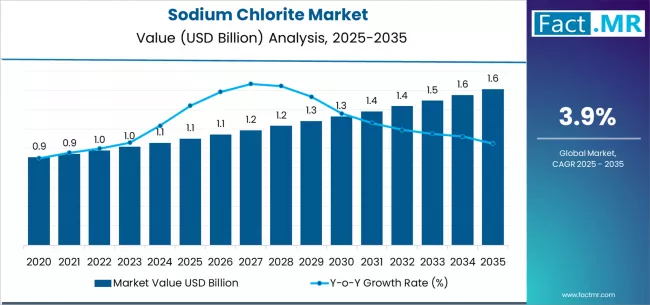
Sodium Chlorite Market Market Value Analysis | Source: Fact.MR
Summary of Sodium Chlorite Market
- Market Snapshot
- The sodium chlorite market is valued at USD 1.10 billion in 2025 and is projected to reach USD 1.68 billion by 2036.
- The industry is expected to grow at a 3.9% CAGR from 2026 to 2036, creating an incremental opportunity of USD 0.54 billion.
- The market operates as a precursor-chemical, water-utility-driven category where chlorine dioxide disinfection system adoption and drinking water compliance requirements determine sodium chlorite procurement volumes.
- Demand and Growth Drivers
- Demand is driven by municipal water utility conversion from gaseous chlorine to chlorine dioxide disinfection systems that require sodium chlorite as the non-substitutable precursor chemical.
- Safe Drinking Water Act compliance upgrades and disinfection byproduct reduction mandates compel US water utilities to adopt chlorine dioxide systems with lower trihalomethane formation potential.
- Pulp and paper mill transitions to elemental chlorine-free (ECF) bleaching processes create incremental demand for sodium chlorite as the chlorine dioxide generating chemical.
- Among key countries, the USA leads at 4.2% CAGR, followed by Mexico at 4.0%, Germany at 3.8%, France at 3.5%, South Korea at 3.3%, the UK at 3.1%, and Japan at 2.9%.
- Product and Segment View
- Sodium chlorite is an inorganic salt (NaClO2) used primarily as a precursor for chlorine dioxide generation in water disinfection, pulp bleaching, and industrial antimicrobial applications.
- Water Treatment leads the Application segment with 54.0% share in 2026, reflecting municipal utility consumption for chlorine dioxide generation in drinking water disinfection systems.
- 25% Liquid form commands 69.0% of Form share in 2026, preferred for automated feed systems at water treatment plants requiring precise volumetric metering and safe handling.
- Municipal Utilities account for 46.0% of End Use share in 2026, as publicly operated drinking water plants procure sodium chlorite continuously for daily disinfection requirements.
- The scope includes sodium chlorite in 25% liquid solution and powder/tablet forms, while excluding sodium chlorate, sodium hypochlorite, gaseous chlorine, and chlorine dioxide generating equipment.
- Geography and Competitive Outlook
- The USA and Mexico are the fastest-growing markets due to water utility chlorine dioxide adoption and infrastructure expansion, while Germany and France represent mature markets with established industrial disinfection and pulp bleaching demand.
- Competition is shaped by chlorate reduction production scale and water utility contract networks, with key players including Severn Trent Chemicals, Solvay, Kemira, Nouryon, and OxyChem.
- Severn Trent Chemicals holds approximately 10% market share, leveraging its dedicated sodium chlorite production facilities and long-term supply contracts with municipal water utilities across North America.
Sodium Chlorite Market Key Takeaways
| Metric | Details |
|---|---|
| Industry Size (2026) | USD 1.14 billion |
| Industry Value (2036) | USD 1.68 billion |
| CAGR (2026 to 2036) | 3.90% |
Source: Fact.MR analysis. Updated Mar 27, 2026
Source: Fact.MR, 2026
The forecast period projects an absolute dollar expansion of approximately USD 0.54 billion between 2026 and 2036. This growth trajectory reflects the steady conversion of municipal water systems from gaseous chlorine to chlorine dioxide disinfection, combined with incremental demand from pulp and paper bleaching operations transitioning to elemental chlorine-free (ECF) processes. Sodium chlorate feedstock pricing and electrochemical cell efficiency directly affect sodium chlorite production costs for manufacturers operating chlorate reduction processes.
The USA leads at 4.2% CAGR through 2036, supported by municipal utility chlorine dioxide system installations and Safe Drinking Water Act compliance upgrades. Mexico follows at 4.0%, driven by water treatment infrastructure expansion in urban areas. Germany registers 3.8% growth through industrial disinfection and pulp bleaching chemical demand. France tracks at 3.5%, benefiting from water utility modernization programmes. South Korea records 3.3%, the UK maintains 3.1% expansion, and Japan registers 2.9%, anchored by municipal water treatment and healthcare facility disinfection requirements.
Why is the Sodium Chlorite Market Growing?
Market expansion is being supported by the increasing global focus on water quality and safety driven by population growth and urbanization, alongside the corresponding need for effective water treatment chemicals that can provide reliable disinfection, maintain water safety standards, and support regulatory compliance across various municipal, industrial, and commercial water treatment applications. Modern water utilities and industrial operators are increasingly focused on implementing sodium chlorite solutions that can optimize disinfection effectiveness, reduce environmental impact, and provide comprehensive water treatment while maintaining operational safety and cost effectiveness.
The growing focus on environmental sustainability and chemical safety is driving demand for sodium chlorite that can support chlorine dioxide generation, enable effective disinfection without harmful byproducts, and ensure comprehensive water treatment through environmentally responsible chemical processes. Water treatment operators' preference for chemicals that combine disinfection effectiveness with environmental compatibility and operational safety is creating opportunities for innovative sodium chlorite implementations. The rising influence of stringent water quality regulations and public health requirements is also contributing to increased adoption of sodium chlorite that can provide superior disinfection performance without compromising environmental safety or regulatory compliance.
Segmental Analysis
What factors enable the water treatment application and 25 percent liquid form segments to lead market growth and dominate demand?
The market is segmented by application, form, and end use. By application, the market is divided into water treatment, pulp & paper bleaching, and industrial disinfectants. Based on form, the market is categorized into 25% liquid and powder/tablet formulations. By end use, the market is segmented into municipal utilities, industrial, and healthcare applications.
By Application, the Water Treatment Segment Leads the Market
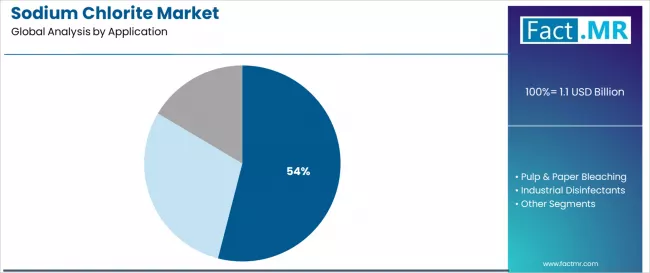
Sodium Chlorite Market Analysis By Application | Source: Fact.MR
The water treatment segment is projected to maintain its leading position in the market in 2026 with a 54.0% market share, reaffirming its role as the primary application for sodium chlorite utilization in municipal and industrial water disinfection systems. Water treatment operators and utilities increasingly utilize sodium chlorite for its effective chlorine dioxide generation, broad-spectrum antimicrobial activity, and proven effectiveness in treating diverse water sources while maintaining safety and regulatory compliance. Sodium chlorite technology's proven effectiveness and safety profile directly address industry requirements for reliable water disinfection and quality assurance across diverse water treatment applications and regulatory environments.
This application segment forms the foundation of modern water disinfection, as it represents the application with the greatest contribution to public health protection and established performance record across multiple water treatment scenarios and quality requirements. Water treatment industry investments in sodium chlorite technologies continue to strengthen adoption among utilities and operators. With regulatory requirements demanding effective disinfection and public health protection, sodium chlorite aligns with both safety objectives and regulatory compliance requirements, making it the central component of comprehensive water treatment strategies.
By Form, the 25% Liquid Segment Dominates Market Demand
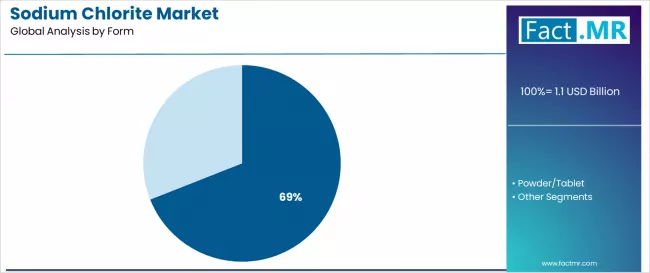
Sodium Chlorite Market Analysis By Form | Source: Fact.MR
The 25% liquid form segment is projected to represent the largest share of sodium chlorite demand in 2026 with a 69.0% market share, underscoring its critical role as the preferred delivery format for most water treatment and industrial applications. Operators prefer 25% liquid sodium chlorite due to its ease of handling, precise dosing capabilities, and proven effectiveness in automated dosing systems while supporting safe storage and operational procedures. Positioned as the standard format for commercial applications, 25% liquid sodium chlorite offers both handling convenience and application efficiency advantages.
The segment is supported by continuous innovation in chemical handling and the growing availability of specialized liquid formulations that enable superior application performance with enhanced stability and dosing accuracy. The chemical suppliers are investing in comprehensive liquid handling systems to support increasingly sophisticated application requirements and safety optimization demands. As automation increases and precise chemical dosing becomes more important, the 25% liquid format will continue to dominate the market while supporting advanced application control and operational efficiency optimization.
What are the Drivers, Restraints, and Key Trends of the Sodium Chlorite Market?
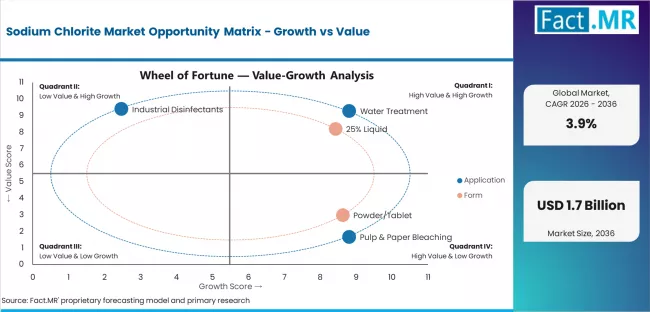
Sodium Chlorite Market Opportunity Matrix Growth Vs Value | Source: Fact.MR
The sodium chlorite market is advancing steadily due to increasing water treatment demand driven by population growth and water quality concerns, alongside growing need for effective disinfection chemicals that provide reliable pathogen control, regulatory compliance, and operational safety across various municipal, industrial, and healthcare water treatment applications. The market faces challenges, including regulatory restrictions on chemical handling and storage, competition from alternative disinfection technologies, and safety concerns related to chemical transportation and use. Innovation in stabilized formulations and safer handling technologies continues to influence product development and application expansion patterns.
Expansion of Water Infrastructure and Treatment Capacity
The growing water infrastructure development is driving demand for sodium chlorite in new water treatment facilities, system upgrades, and capacity expansions that require reliable disinfection chemicals capable of treating diverse water sources and meeting stringent quality standards. Water utilities require sodium chlorite solutions that deliver consistent disinfection performance across varying water quality conditions while maintaining operational flexibility and regulatory compliance. Municipal authorities are increasingly recognizing the advantages of sodium chlorite-based systems for water treatment reliability and public health protection, creating opportunities for specialized applications designed for municipal water treatment and distribution systems.
Integration of Advanced Disinfection and Environmental Compliance
Modern sodium chlorite manufacturers are incorporating advanced formulation technologies and environmental compliance features to enhance product safety, reduce environmental impact, and support comprehensive regulatory compliance through improved stability and reduced byproduct formation. Leading companies are developing stabilized formulations, implementing green chemistry principles, and advancing production technologies that optimize disinfection effectiveness while minimizing environmental concerns and operational risks. These technologies improve regulatory acceptance while enabling new application opportunities, including sensitive water treatment applications, environmental remediation, and specialized industrial processes.
Development of Specialized Industrial and Healthcare Applications
The expansion of industrial hygiene requirements and healthcare disinfection standards is driving demand for specialized sodium chlorite applications in food processing, pharmaceutical manufacturing, and healthcare facility disinfection that require precise chemical control and validated disinfection effectiveness. These specialized applications require advanced formulation capabilities and quality assurance systems that exceed traditional water treatment requirements, creating premium market segments with enhanced performance specifications. Manufacturers are investing in specialized application development and regulatory validation to serve demanding industrial and healthcare applications while supporting innovation in advanced disinfection technologies and process optimization.
Analysis of the Sodium Chlorite Market by Key Countries
.webp "Top Country Growth Comparison Sodium Chlorite Market Cagr (2026 2036)")
Top Country Growth Comparison Sodium Chlorite Market Cagr (2026 2036) | Source: Fact.MR
| Country | CAGR (2026-2036) |
|---|---|
| USA | 4.2% |
| Mexico | 4.0% |
| Germany | 3.8% |
| France | 3.5% |
| South Korea | 3.3% |
| UK | 3.1% |
| Japan | 2.9% |
Source: Fact.MR analysis. Updated Mar 27, 2026
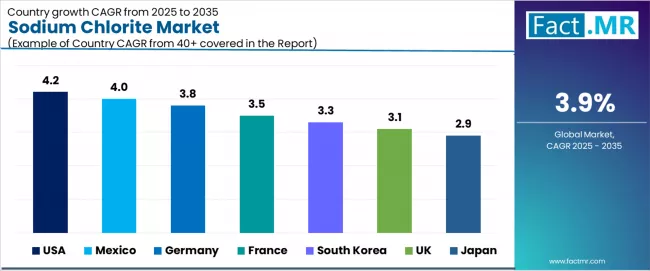
Sodium Chlorite Market Cagr Analysis By Country | Source: Fact.MR
The market is experiencing solid growth globally, with the USA leading at a 4.2% CAGR through 2036, driven by extensive water treatment infrastructure, stringent water quality regulations, and growing industrial disinfection requirements supporting sodium chlorite demand. Mexico follows at 4.0%, supported by expanding water infrastructure, growing industrial development, and increasing water treatment needs. Germany shows growth at 3.8%, emphasizing environmental regulations, water quality standards, and advanced chemical processing capabilities. France demonstrates 3.5% growth, supported by water utility modernization, industrial applications, and regulatory compliance requirements. South Korea records 3.3%, focusing on water infrastructure development and industrial growth. The UK exhibits 3.1% growth, emphasizing water treatment efficiency and environmental compliance. Japan shows 2.9% growth, supported by advanced water treatment technologies and quality standards.
Why does the USA lead global market growth through water treatment excellence?
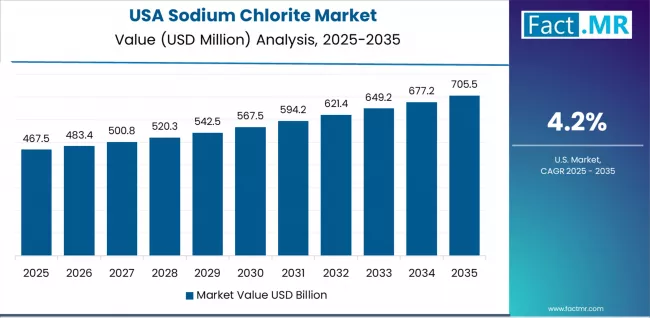
Sodium Chlorite Market Country Value Analysis | Source: Fact.MR
The USA is projected to exhibit strong growth with a CAGR of 4.2% through 2036, driven by extensive water treatment infrastructure and rapidly growing regulatory requirements supporting sodium chlorite adoption among water utilities, industrial facilities, and chemical processing companies. The country's established water treatment industry and increasing focus on water quality are creating substantial demand for sodium chlorite solutions. Major chemical manufacturers and water treatment providers are establishing comprehensive supply capabilities to serve both municipal and industrial market opportunities.
- Strong water treatment infrastructure and regulatory compliance requirements are driving demand for sodium chlorite throughout water utilities, industrial facilities, and treatment system providers across major metropolitan areas and industrial regions.
- Growing industrial disinfection needs and water quality standards are supporting the rapid adoption of sodium chlorite technologies among facilities seeking reliable disinfection and competitive advantages in regulatory compliance and operational efficiency.
How does Mexico demonstrate strong market potential through infrastructure development?
Mexico is expanding at a CAGR of 4.0%, supported by the country's expanding water infrastructure, growing industrial development, and increasing investment in water treatment facilities and environmental compliance systems. The country's infrastructure growth and industrial development are driving demand for water treatment chemicals throughout various sectors. Leading water utilities and industrial companies are establishing comprehensive treatment capabilities to address growing water quality and regulatory requirements.
- Strong water infrastructure expansion and industrial development are creating opportunities for sodium chlorite adoption across water treatment facilities, industrial plants, and municipal utilities in major urban development regions.
- Growing environmental regulations and water quality requirements are driving adoption of effective disinfection chemicals among operators seeking regulatory compliance and competitive positioning in water treatment excellence.
How does Germany demonstrate chemical excellence through environmental leadership?
Germany is expanding at a CAGR of 3.8%, driven by the country's environmental regulations, water quality standards, and comprehensive chemical processing capabilities supporting advanced sodium chlorite production and utilization. Germany's chemical expertise and environmental leadership are driving demand for high-quality sodium chlorite solutions. Leading chemical manufacturers and water treatment companies are establishing comprehensive innovation programs for advanced water treatment applications.
- Advanced environmental regulations and water quality standards are creating demand for specialized sodium chlorite applications among water treatment facilities seeking superior regulatory compliance and environmental performance.
- Strong chemical industry expertise and environmental leadership are supporting the adoption of advanced sodium chlorite formulations across high-performance applications and precision water treatment throughout major industrial regions.
How does France focus on water utility modernization and industrial applications?
France is expanding at a CAGR of 3.5%, driven by the country's water utility modernization initiatives, industrial application development, and comprehensive approach to water quality and environmental compliance supporting sodium chlorite integration into modern water treatment systems. France's water management expertise and industrial capabilities are supporting investment in advanced chemical technologies. Major water utilities and industrial facilities are establishing comprehensive modernization programs incorporating sodium chlorite solutions.
- Advanced water utility modernization and quality improvement requirements are creating demand for sodium chlorite throughout water treatment facilities, industrial applications, and environmental compliance projects serving modern water management standards.
- Strong industrial development and environmental compliance focus are driving the adoption of effective disinfection chemicals across industrial facilities and water treatment applications meeting French quality and regulatory requirements.
How does South Korea demonstrate industrial growth through water infrastructure development?
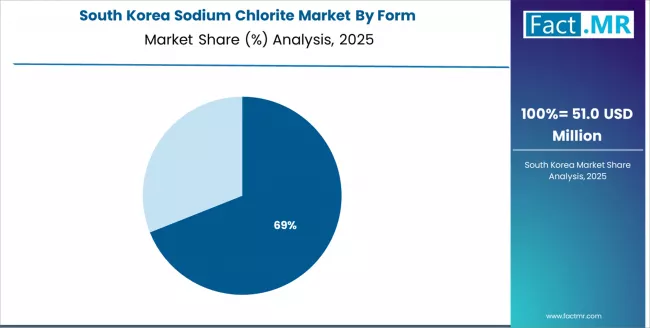
Sodium Chlorite Market South Korea Market Share Analysis By Form | Source: Fact.MR
South Korea is expanding at a CAGR of 3.3%, supported by the country's water infrastructure development, industrial growth, and growing focus on water quality and environmental compliance supporting sodium chlorite adoption across municipal and industrial applications. The nation's infrastructure development and industrial advancement are driving demand for reliable water treatment solutions. Leading utilities and industrial companies are investing extensively in water treatment capabilities and chemical processing technologies.
- Strong water infrastructure development and industrial growth are creating demand for sodium chlorite throughout water treatment facilities, industrial operations, and municipal utilities serving major development regions and industrial facilities.
- Growing water quality focus and environmental compliance requirements are supporting the adoption of effective disinfection chemicals designed for advanced water treatment applications and comprehensive regulatory compliance.
How does the UK demonstrate market leadership through a focus on water treatment efficiency?
The UK is expanding at a CAGR of 3.1%, supported by the country's water treatment efficiency initiatives, environmental compliance requirements, and comprehensive approach to water quality management supporting sodium chlorite utilization across diverse treatment applications. The UK's water management standards and environmental focus are driving demand for efficient sodium chlorite solutions. Leading water companies and treatment providers are investing in advanced chemical technologies and operational optimization.
- Advanced water treatment efficiency and environmental compliance standards are creating opportunities for sodium chlorite throughout water utilities, industrial facilities, and treatment system providers serving efficiency-focused market segments.
- Strong environmental regulations and water quality focus are driving the adoption of effective disinfection chemicals across water treatment applications seeking enhanced compliance and operational excellence.
How does Japan demonstrate a premium focus through advanced water treatment applications?
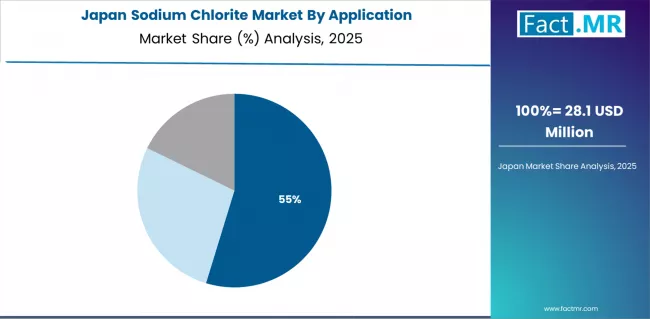
Sodium Chlorite Market Japan Market Share Analysis By Application | Source: Fact.MR
Japan is expanding at a CAGR of 2.9%, supported by the country's advanced water treatment technologies, quality standards, and strong focus on precision chemical applications supporting premium sodium chlorite utilization in specialized treatment systems. Japan's technological excellence and quality consciousness are driving demand for specialized sodium chlorite products. Leading chemical companies are investing in advanced capabilities for precision water treatment applications and quality-driven chemical processing.
- Advanced water treatment technology and quality focus are creating opportunities for premium sodium chlorite throughout high-end water treatment facilities and precision chemical applications serving specialized treatment requirements.
- Strong quality standards and technological excellence focus are driving adoption of specialized sodium chlorite formulations meeting Japanese standards for purity and advanced performance across diverse water treatment applications.
Europe Market Split by Country
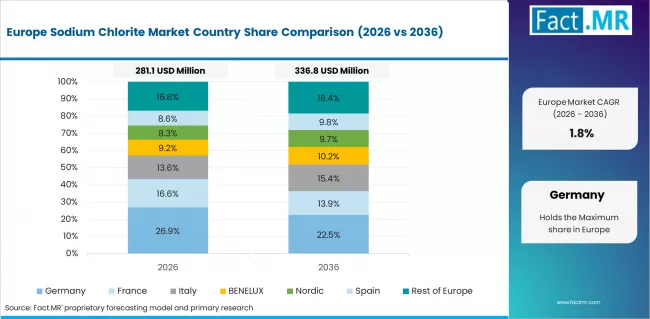
Sodium Chlorite Market Europe Country Market Share Analysis, 2026 & 2036 | Source: Fact.MR
The sodium chlorite market in Europe is projected to grow from USD 320.0 million in 2026 to USD 450.0 million by 2036, registering a CAGR of 3.5% over the forecast period. Germany is expected to maintain leadership with a 32.8% market share in 2026, moderating to 32.4% by 2036, supported by environmental regulations, chemical industry excellence, and advanced water treatment capabilities.
United Kingdom follows with 24.1% in 2026, projected to reach 23.8% by 2036, driven by water treatment efficiency, environmental compliance, and utility modernization initiatives. France holds 21.3% in 2026, expected to reach 21.6% by 2036 due to water utility modernization and industrial application development. Italy commands 12.5% in 2026, rising to 12.7% by 2036, while Spain accounts for 6.6% in 2026, reaching 6.8% by 2036. The Rest of Europe region is anticipated to hold 2.7% in 2026 and 2.7% by 2036, reflecting steady water treatment chemical adoption in Nordic countries and emerging water infrastructure markets in Eastern European countries.
How is the competitive landscape of the sodium chlorite market structured and what key factors influence competition?
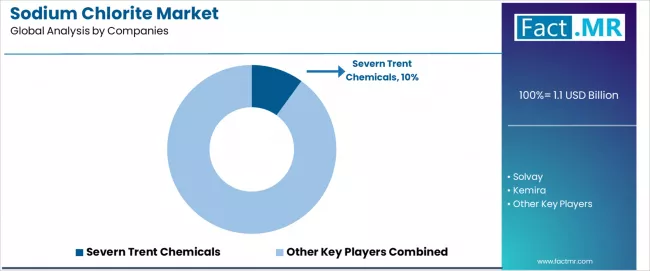
Sodium Chlorite Market Analysis By Company | Source: Fact.MR
The market is characterized by competition among established chemical manufacturers, water treatment solution providers, and specialty chemical companies. Companies are investing in production capacity expansion, formulation development, supply chain optimization, and comprehensive technical service capabilities to deliver reliable, high-quality, and cost-effective sodium chlorite solutions. Innovation in stabilized formulations, environmental compliance, and specialized applications is central to strengthening market position and competitive advantage.
Severn Trent Chemicals leads the market with a 10.0% share, offering comprehensive sodium chlorite solutions with focus on water treatment applications, product quality, and extensive global supply networks serving diverse municipal, industrial, and commercial water treatment requirements. The company continues investing in production capacity and technical support while expanding formulation capabilities and customer service programs. Solvay provides integrated chemical solutions with focus on sustainability and innovation. Kemira specializes in water treatment chemicals and municipal applications. Nouryon focuses on specialty chemicals and industrial applications. OxyChem emphasizes large-scale production and supply reliability. Lonza offers high-purity formulations and specialized applications.
Key Players in the Sodium Chlorite Market
- Severn Trent Chemicals
- Solvay
- Kemira
- Nouryon
- OxyChem
- Lonza
- Arkema
- Occidental Chemical
- Suez
- Clariant
Bibliography
- U.S. Environmental Protection Agency. (2024). Safe Drinking Water Act: Disinfection and Disinfection Byproduct Rules Update. EPA.
- Solvay S.A. (2024). Annual Integrated Report 2024: Special Chemicals Division. Solvay S.A.
- Kemira Oyj. (2024). Annual Report 2024. Kemira Oyj.
- European Commission. (2024). Drinking Water Directive Recast: Implementation Progress Report. European Commission.
- Technical Association of the Pulp and Paper Industry. (2024). Bleaching Technology Survey 2024. TAPPI.
- Nouryon. (2024). Sustainability and Business Report 2024. Nouryon.
This bibliography is provided for reader reference. The full Fact.MR report contains the complete reference list with primary research documentation.
This Report Addresses
- Market sizing and quantitative forecast metrics detailing precise precursor chemical expenditure dedicated to sodium chlorite across water treatment and industrial disinfection sectors through 2036.
- Segmentation analysis mapping the consumption velocity of specific sodium chlorite forms and evaluating the water utility system specifications driving liquid versus powder product selection.
- Regional deployment intelligence comparing the chlorine dioxide system adoption rates in North American water utilities against the established industrial disinfection demand in European markets.
- Regulatory compliance assessment analyzing how Safe Drinking Water Act disinfection byproduct rules and EU Drinking Water Directive requirements force municipal utility conversion to chlorine dioxide systems.
- Competitive posture evaluation tracking the chlorate reduction production scale and water utility contract network advantages of established sodium chlorite producers.
- Feedstock cost assessment analyzing how sodium chlorate pricing and electrochemical production energy costs affect sodium chlorite manufacturing economics and utility procurement budgets.
- Supply chain vulnerability analysis identifying the production facility concentration risks and hazardous material transportation constraints that affect sodium chlorite delivery reliability to remote water utilities.
- Custom data delivery formats encompassing interactive dashboards, raw Excel datasets, and comprehensive PDF narrative reports.
Sodium Chlorite Market Definition
Sodium chlorite is an inorganic oxidizing salt (NaClO2) produced by the reduction of sodium chlorate, used primarily as a precursor chemical for on-site chlorine dioxide generation in water disinfection systems. It also serves pulp and paper bleaching, industrial surface disinfection, and healthcare facility sanitation applications. The market covers liquid solution and powder/tablet product forms.
Sodium Chlorite Market Inclusions
Market scope includes sodium chlorite in 25% aqueous solution, solid powder, and tablet forms for water treatment, pulp bleaching, and industrial disinfection applications. Regional and segment-level market sizes, forecast values from 2026 to 2036, and sodium chlorate feedstock pricing analysis are covered.
Sodium Chlorite Market Exclusions
The scope excludes sodium chlorate, sodium hypochlorite, gaseous chlorine, and chlorine dioxide generating equipment. Downstream finished disinfected water and bleached pulp products are not covered.
Sodium Chlorite Market Research Methodology
- Primary Research: Analysts engaged with municipal water utility treatment managers, pulp mill chemical procurement officers, and sodium chlorite producers to map consumption volumes, contract structures, and system installation timelines.
- Desk Research: Data collection aggregated Safe Drinking Water Act compliance schedules, municipal chlorine dioxide system installation records, and published pulp bleaching chemical consumption statistics from paper industry associations.
- Market-Sizing and Forecasting: Baseline values derive from a bottom-up aggregation of sodium chlorite consumption volumes by application and form, applying region-specific water treatment plant capacity and pulp production indices to project demand velocity.
- Data Validation and Update Cycle: Projections are tested against publicly reported water treatment chemical revenue from listed producers and cross-referenced with municipal utility capital improvement plan databases.
Segmentation
Scope of the Report
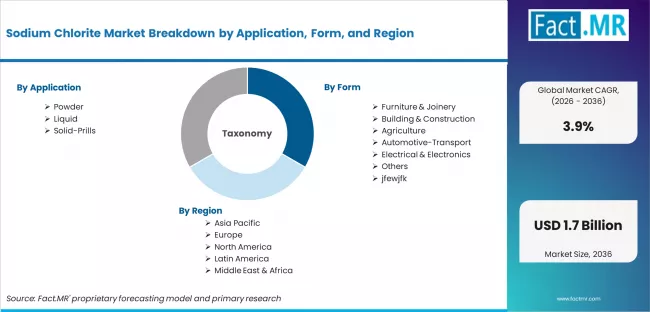
Sodium Chlorite Market Breakdown By Application, Form, And Region | Source: Fact.MR
| Metric | Value |
|---|---|
| Quantitative Units | USD 1.14 billion to USD 1.68 billion, at a CAGR of 3.90% |
| Market Definition | Sodium chlorite is an inorganic oxidizing salt (NaClO2) produced by the reduction of sodium chlorate, used primarily as a precursor chemical for on-site chlorine dioxide generation in water disinfection systems. It also serves pulp and paper bleaching, industrial surface disinfection, and healthcare facility sanitation applications. |
| Application Segmentation | Water Treatment, Pulp & Paper Bleaching, Industrial Disinfectants |
| Form Segmentation | 25% Liquid, Powder/Tablet |
| End Use Segmentation | Municipal Utilities, Industrial, Healthcare |
| Regions Covered | North America, Latin America, Europe, East Asia, South Asia, Oceania, Middle East & Africa |
| Countries Covered | USA, Mexico, Germany, France, South Korea, UK, Japan, and 40 plus countries |
| Key Companies Profiled | Severn Trent Chemicals, Solvay, Kemira, Nouryon, OxyChem, Lonza, Arkema |
| Forecast Period | 2026 to 2036 |
| Approach | Baseline values derive from a bottom-up aggregation of sodium chlorite consumption volumes by application and form, applying region-specific water treatment plant capacity and pulp production indices to project demand velocity. |
Source: Fact.MR analysis. Updated Mar 27, 2026
Sodium Chlorite Market by Segments
-
Application :
- Water Treatment
- Pulp & Paper Bleaching
- Industrial Disinfectants
-
Form :
- 25% Liquid
- Powder/Tablet
-
End Use :
- Municipal Utilities
- Industrial
- Healthcare
-
Region :
- North America
- United States
- Canada
- Mexico
- Europe
- Germany
- United Kingdom
- France
- Italy
- Spain
- Netherlands
- Rest of Europe
- Asia-Pacific
- Japan
- South Korea
- China
- India
- Australia
- Rest of Asia-Pacific
- Latin America
- Brazil
- Argentina
- Rest of Latin America
- Middle East & Africa
- Kingdom of Saudi Arabia
- South Africa
- Rest of Middle East & Africa
- North America
Frequently Asked Questions
How large is the demand for Sodium Chlorite in the global market in 2026?
What will be the market size of Sodium Chlorite in the global market by 2036?
What is the expected demand growth for Sodium Chlorite between 2026 and 2036?
Which Application is poised to lead global sales by 2026?
How significant is the role of Municipal Utilities in driving Sodium Chlorite demand in 2026?
What is driving demand in the USA?
What is Germany's growth outlook in this report?
What is Japan's growth outlook in this report?
Who worked on this report


Preview the report firsthand - request a free sample
Free SampleGet the brochure for pricing and purchase details
Download PDF