- Base Value(2026): 18.3 Bn
- Estimated Value(2026): 18.3 Bn
- Forecast Value (2036): 28.1 Bn
- CAGR (2026 - 2036): 4.4%
Sodium Hypochlorite Market Forecast and Outlook 2026 to 2036
The global sodium hypochlorite market is set to grow from USD 18.3 billion in 2026 to USD 28.1 billion by 2036, advancing at a CAGR of 4.4%. Growth is driven by escalating demand for water treatment validation, expanding sanitation infrastructure across regulated markets, and accelerating disinfection requirements among municipal and industrial organizations seeking effective hygiene solutions.
Key Takeaways from the Sodium Hypochlorite Market
- Sodium Hypochlorite Market Value (2026): USD 18.3 billion
- Sodium Hypochlorite Market Forecast Value (2036): USD 28.1 billion
- Sodium Hypochlorite Market Forecast CAGR: 4.4%
- Leading Application in Sodium Hypochlorite Market: Cleaning & Disinfection (48.9%)
- Key Growth Regions in Sodium Hypochlorite Market: Asia Pacific, North America, and Middle East
- Top Players in Sodium Hypochlorite Market: Unilever, AkzoNobel, PPG Industries, Westlake Chemical Corporation, Mitsui Chemical Corporation
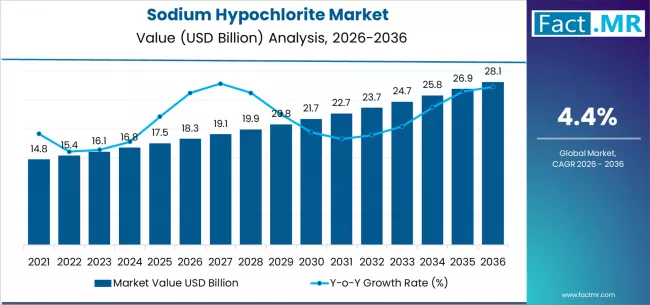
Sodium Hypochlorite Market Market Value Analysis | Source: Fact.MR
Sodium hypochlorite technologies are increasingly recognized as essential chemicals for sanitation practitioners, offering precise antimicrobial capabilities, oxidation assurance, and comprehensive disinfection characteristics compared to traditional sanitization approaches. Cleaning & disinfection applications dominate the market, favored in municipal and household environments for their established efficacy properties, providing broad-spectrum antimicrobial mechanisms, cost-effective capabilities, and operational acceptance across diverse sanitation applications and consumer demographics.
Water treatment remains fundamental in municipal protocols where routine disinfection and pathogen control match operational requirements and public health confidence standards. Cleaning & disinfection service providers are advancing among application categories as specialized water treatment facility networks expand and sanitation infrastructure increases accessibility in population-convenient locations with stringent health structures.
Sodium Hypochlorite Market
| Metric | Value |
|---|---|
| Market Value (2026) | USD 18.3 billion |
| Market Forecast (2036) | USD 28.1 billion |
| Growth Rate | 4.4% CAGR |
Source: Fact.MR analysis. Updated Dec 23, 2025
Category
| Category | Segments |
|---|---|
| Application | Cleaning and Disinfection (Household; Water Treatment; Swimming Pool Sanitation; Other Cleaning and Disinfection); Bleaching (Textile Industry; Paper and Pulp Industry; Other Bleaching); Production of Other Chemicals |
| Region | North America; Europe; Asia Pacific; Latin America; Middle East & Africa |
Source: Fact.MR analysis. Updated Dec 23, 2025
Segmental Analysis
Which Application Category Captures the Highest Share of the Sodium Hypochlorite Market?
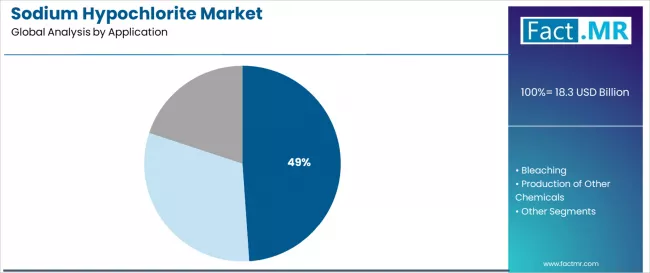
Sodium Hypochlorite Market Analysis By Application | Source: Fact.MR
Cleaning & disinfection commands the leading position in the sodium hypochlorite market with a 48.9% market share. Sodium hypochlorite is incorporated in cleaning solutions due to its superior antimicrobial characteristics, including established pathogen elimination presence, extensive efficacy documentation, and proven disinfection pathways that enable municipalities and households to achieve predictable sanitation outcomes across varied application categories and diverse user demographics.
The segment benefits from broad-spectrum advantages through bacterial and viral inactivation optimization, rapid action without lengthy contact time procedures, and established safety validation documentation without requiring extensive health authorization procedures. Advanced formulation technology enables household cleaning optimization, water treatment variation, and swimming pool sanitation customization, where disinfection efficacy and cost-effectiveness represent critical hygiene requirements.
What are the Drivers, Restraints, and Key Trends of the Sodium Hypochlorite Market?
The sodium hypochlorite market is driven by rising investments in water treatment infrastructure and stricter sanitation regulations across municipal and industrial systems. Growing public health awareness and higher hygiene standards continue to support demand for reliable disinfection solutions, while sustained textile and industrial bleaching requirements expand non-municipal consumption.
However, market growth faces constraints from handling and storage challenges linked to the chemical’s corrosive nature and limited stability. In parallel, increasing adoption of alternative disinfection technologies, such as UV and ozone systems, is intensifying substitution pressure in advanced and environmentally sensitive facilities.
Key trends include the growing adoption of on-site generation and electrochlorination systems, which reduce transportation risks and improve safety profiles. Automation and smart dosing integration are also gaining traction, enabling precise chemical control, operational efficiency, and consistent compliance within modern water treatment environments.
Analysis of the Sodium Hypochlorite Market by Key Countries
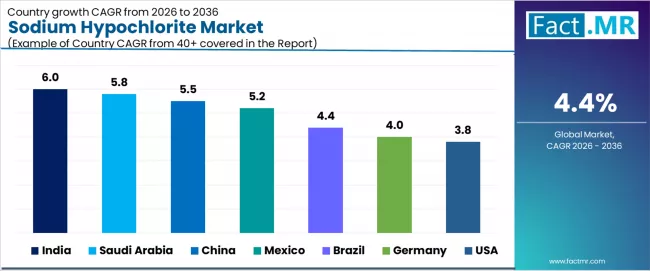
Sodium Hypochlorite Market Cagr Analysis By Country | Source: Fact.MR
| Country | CAGR 2026-2036 |
|---|---|
| India | 6.0% |
| Saudi Arabia | 5.8% |
| China | 5.5% |
| Mexico | 5.2% |
| Brazil | 4.4% |
| Germany | 4.0% |
| USA | 3.8% |
Source: Fact.MR analysis. Updated Dec 23, 2025
Why is India the Fastest-Growing Sodium Hypochlorite Market?
India’s sodium hypochlorite demand is expanding rapidly, supported by a projected CAGR of 6.0% as urbanisation accelerates investment in municipal water treatment and sanitation systems. Growth is strongest across major metropolitan regions where utilities are upgrading capacity to meet stricter public health and drinking water standards. Municipal authorities are adopting standardized chlorination protocols backed by domestic production and partnerships with water treatment solution providers.
Expansion of dosing systems, operator training, and technician certification programs is improving safety compliance and operational consistency. Wider distributor networks are also improving access across tier-one and tier-two cities, reinforcing sustained adoption of cost-effective disinfection solutions.
How does Saudi Arabia’s Water Security Focus Support Market Expansion?
Saudi Arabia’s sodium hypochlorite market is advancing at a CAGR of 5.8%, driven by national water security priorities and large-scale desalination investment. Municipal utilities and desalination plants in Riyadh, Jeddah, and the Eastern Province rely on hypochlorite-based disinfection to address water scarcity and rising public health expectations.
Vision 2030 infrastructure programs continue to support municipal and industrial water treatment expansion. Utilities increasingly favor on-site generation systems to reduce chemical handling risks and ensure supply reliability. Continued investment in desalination capacity and documentation-driven quality assurance practices supports sustained demand.
Why does Urban Infrastructure Drive China’s Market Growth?
China’s sodium hypochlorite market is projected to grow at a CAGR of 5.5%, closely linked to its mature urban water treatment infrastructure. Municipal utilities, wastewater treatment plants, and industrial facilities routinely deploy hypochlorite within established treatment frameworks.
Demand is concentrated in highly urbanized regions such as the Beijing-Tianjin-Hebei corridor, Yangtze River Delta, and Pearl River Delta. Utilities operate within structured regulatory systems supported by long-term supplier relationships and compliance protocols. Ongoing wastewater treatment expansion and drinking water quality upgrades sustain repeat procurement.
How do Municipal Sanitation Programs Support Mexico’s Market Development?
Mexico’s sodium hypochlorite market is expanding at a CAGR of 5.2%, reflecting steady adoption driven by municipal sanitation priorities and urban infrastructure investment. Major cities such as Mexico City, Guadalajara, and Monterrey integrate hypochlorite-based disinfection into established water treatment practices.
Utilities emphasize cost-effectiveness, dosing flexibility, and safety integration while maintaining alignment with federal water quality standards. Demand favors reliable products supported by technical service and stability documentation, supporting consistent chemical usage across municipal facilities.
Why is Brazil Recording Steady Growth in Sodium Hypochlorite Demand?
Brazil’s sodium hypochlorite market is growing at a CAGR of 4.4%, supported by gradual expansion of municipal water and wastewater treatment infrastructure. Urban centers including São Paulo, Rio de Janeiro, and Brasília are strengthening sanitation systems to address population growth and public health requirements.
Utilities prioritize operational reliability, dosing accuracy, and documented chemical performance. Sodium hypochlorite remains a preferred disinfection option within established treatment programs aligned with national water quality policies.
How do Industrial Standards Influence Germany’s Market Trajectory?
Germany’s sodium hypochlorite market is progressing at a CAGR of 4.0%, shaped by strong industrial demand and rigorous safety standards. Adoption is concentrated among industrial processors and advanced water utilities in regions such as North Rhine-Westphalia, Bavaria, and Baden-Württemberg.
Buyers prioritize purity specifications, stability data, and comprehensive safety documentation. Established textile, paper, and chemical processing industries support consistent usage under strict regulatory frameworks, reinforcing disciplined procurement practices.
Why does the USA Show Stable Sodium Hypochlorite Market Growth?
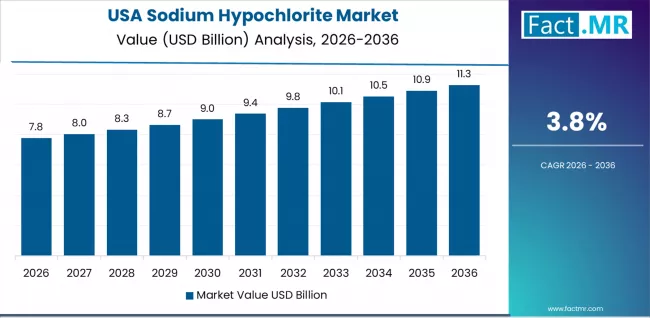
Sodium Hypochlorite Market Country Value Analysis | Source: Fact.MR
The USA sodium hypochlorite market is advancing at a CAGR of 3.8%, reflecting maturity and regulatory consistency rather than rapid expansion. Municipal utilities and industrial users operate within well-defined EPA and state-level water quality frameworks.
Demand emphasizes certified products supported by EPA registration, NSF approvals, and detailed technical documentation. Established treatment protocols and extensive monitoring systems drive predictable procurement patterns across municipal and industrial applications.
Competitive Landscape of the Sodium Hypochlorite Market
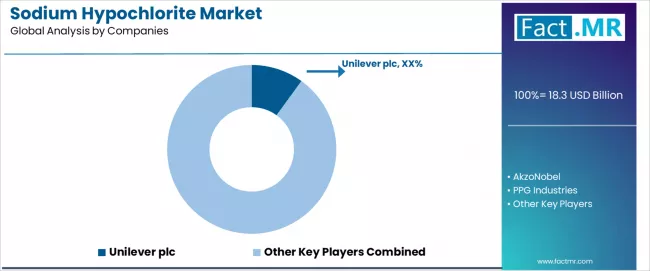
Sodium Hypochlorite Market Analysis By Company | Source: Fact.MR
The sodium hypochlorite market reflects a moderately consolidated competitive structure, with an estimated 40–60 active participants operating across global chemical supply chains and regional distribution networks. Competition spans multinational chemical producers, diversified consumer goods companies, and regional manufacturers, indicating a mature technology landscape supported by established production methods and standardized applications. Larger suppliers typically benefit from brand recognition, manufacturing scale, and long-standing customer relationships, while smaller and regional players compete through localized supply capabilities, flexible pricing structures, and niche application focus.
Competitive positioning is shaped by factors extending beyond production capacity. Extensive distribution networks allow suppliers to address varied regulatory frameworks and serve municipal utilities, industrial processors, and household product markets. Technical support capabilities, including application engineering, dosing optimization, and safety management guidance, remain critical differentiators, particularly for water treatment and sanitation applications. Manufacturing efficiency, supply reliability, and product concentration consistency further distinguish established suppliers from smaller competitors, while comprehensive technical documentation supports regulatory compliance and customer confidence.
Emerging competition is increasingly visible in on-site generation and electrochlorination technologies, which challenge traditional bulk supply models by emphasizing improved safety and reduced handling risks. Nevertheless, bulk supply remains competitive due to entrenched logistics infrastructure and customer familiarity. Suppliers offering integrated sanitation solutions, automated dosing systems, and application-specific formulations continue to strengthen customer retention beyond purely transactional chemical supply.
Key Players in the Sodium Hypochlorite Market
- Unilever plc
- AkzoNobel
- PPG Industries
- Westlake Chemical Corporation
- Mitsui Chemical Corporation
- Lanxess AG
- Chlorotec
- Tessenderlo Group
- Vynova
- ICL
Segmentation
Scope of the Report
| Items | Values |
|---|---|
| Quantitative Units (2026) | USD 18.3 billion |
| Application | Cleaning & Disinfection (Household, Water Treatment, Swimming Pool Sanitation, Other Cleaning & Disinfection), Bleaching (Textile Industry, Paper & Pulp Industry, Other Bleaching), Production of Other Chemicals |
| Regions Covered | North America, Europe, Asia Pacific, Latin America, MEA |
| Countries Covered | USA, China, India, Germany, UK, France, Brazil, Mexico, Saudi Arabia, and 15+ additional countries |
| Key Companies Profiled | Unilever, AkzoNobel, PPG Industries, Westlake Chemical Corporation, Mitsui Chemical Corporation, LANXESS |
| Additional Attributes | Dollar sales by application categories, regional adoption trends across Asia Pacific, North America, and Middle East, competitive landscape with established chemical corporations and specialized water treatment companies, customer preferences for Cleaning & Disinfection applications and cost-effectiveness, integration with municipal water facilities and industrial processing organizations, innovations in on-site generation technologies and automated dosing platforms, and development of sophisticated sanitation systems with enhanced stability profiles and comprehensive safety documentation frameworks. |
Source: Fact.MR analysis. Updated Dec 23, 2025
Sodium Hypochlorite Market by Segments
-
Application :
- Cleaning & Disinfection
- Household
- Water Treatment
- Swimming Pool Sanitation
- Other Cleaning & Disinfection
- Bleaching
- Textile Industry
- Paper & Pulp Industry
- Other Bleaching
- Production of Other Chemicals
- Cleaning & Disinfection
-
Region :
- North America
- USA
- Canada
- Mexico
- Europe
- Germany
- France
- UK
- Italy
- Spain
- Rest of Europe
- Asia Pacific
- India
- China
- Japan
- South Korea
- ASEAN
- Australia & New Zealand
- Rest of Asia Pacific
- Latin America
- Brazil
- Rest of Latin America
- MEA
- GCC Countries
- South Africa
- Rest of MEA
- North America
Frequently Asked Questions
How big is the sodium hypochlorite market in 2026?
What will be the size of sodium hypochlorite market in 2036?
How much will be the sodium hypochlorite market growth between 2026 and 2036?
What are the key product types in the sodium hypochlorite market?
Which segment to contribute significant share in the sodium hypochlorite market in 2026?
Who worked on this report


Preview the report firsthand - request a free sample
Free SampleGet the brochure for pricing and purchase details
Download PDF