- Market Value (2025): USD 1.3 Bn
- Estimated Value (2026): USD 1.5 Bn
- Forecast Value (2036): USD 6.0 Bn
- CAGR (2026-2036): 14.7%
What is the Soluble Bio-Based Pouch Films Market forecast to be worth by 2036?
USD 1.5 billion in 2026 to USD 6.0 billion by 2036 at a 14.7% CAGR.
- The Soluble Bio-Based Pouch Films Market reached USD 1.3 billion in 2025.
- Demand is projected to increase from USD 1.5 billion in 2026 to USD 6.0 billion by 2036.
- The market is forecast to record a 14.7% CAGR from 2026 to 2036 as detergent brands, food packers and agrochemical formulators qualify soluble pouch formats.
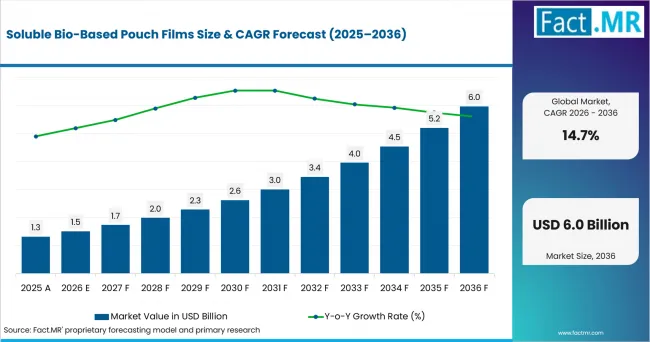
Soluble Bio Based Pouch Films Value Analysis | Source: Fact.MR
What are the defining numbers behind Soluble Bio-Based Pouch Films Market growth?
USD 4.5 billion absolute opportunity by 2036, led by PVOH/PVA, cold-water dissolution and unit-dose pouches.
- Demand Drivers in the Market
- Home-care brands need soluble films that release detergent during use and reduce direct contact with concentrated formulas.
- Food packers need measured sachets for powders and drink mixes where portion control supports consistent preparation.
- Agrochemical formulators need sealed dose packs for cleaner tank mixing in field and greenhouse applications.
- Hygiene converters need water-dispersible substrates as wet-wipe and pouch developers face closer end-of-life review.
- Key Segments Analyzed
- By Material Platform: PVOH/PVA is expected to hold 34.0% share in 2026, supported by established use in soluble detergent systems.
- By Dissolution: Cold-water films are projected to account for 37.0% share in 2026 owing to low-temperature wash and cleaner dosing needs.
- By Application: Unit-dose pouches are anticipated to capture 33.0% share in 2026, driven by measured release in home-care and chemical packs.
- By Environmental Position: Microplastic-free claim is estimated to represent 36.0% share in 2026, shaped by residue proof and customer-facing claims.
- Analyst Opinion at Fact.MR
- Shambhu Nath Jha, Principal Consultant at Fact.MR, states, "Soluble film selection now extends beyond dissolving in water. Brand owners are expected to compare each grade by seal behavior, storage stability and residue proof before launching new pouches. Suppliers with test documentation and converter support are expected to move faster across food, hygiene and agrochemical programs."
- Strategic Implications
- Film producers should publish dissolution windows by temperature and application so converters select grades with fewer trial cycles.
- Packaging converters should test seal strength and humidity tolerance before filling powders, concentrates or active liquid blends.
- Brand owners should separate bio-based content claims from biodegradation claims so packaging language matches verified film behavior.
- Material teams should align PVOH, cellulose and starch platforms with local wastewater guidance and food-contact checks.
China is projected to record 15.0% CAGR through 2036, supported by online retail scale and refill pack conversion. The USA and Japan are forecast to post 14.5% CAGR as food sachets and cleaner dosing create application pull. Germany is anticipated to advance at 14.3% CAGR due to EU packaging rules, while France is estimated to reach 13.8% CAGR as single-use plastic reduction steers selective adoption.
How does the Soluble Bio-Based Pouch Films Market break down by segment?
PVOH/PVA leads at 34.0%; Cold-water leads at 37.0%.
Which Material Platform dominates?
PVOH/PVA holds 34.0% share in 2026.
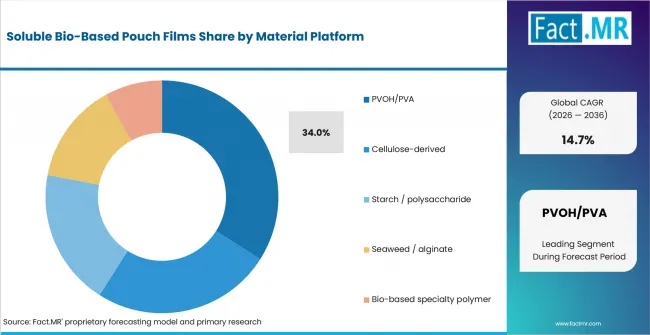
Soluble Bio Based Pouch Films Analysis By Material Platform | Source: Fact.MR
PVOH/PVA is expected to lead material platform revenue at 34.0% share in 2026. The platform has a long use record in detergent and chemical dose packs. European Bioplastics reported in December 2025 that global biobased plastics production capacity was 2.31 million tonnes in 2025.
What leads the Dissolution segment?
Cold-water films lead with 37.0% share in 2026.
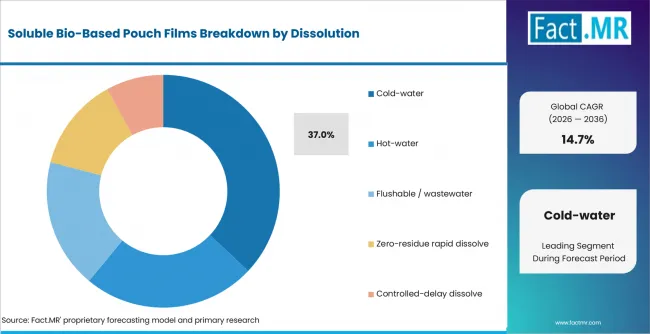
Soluble Bio Based Pouch Films Analysis By Dissolution | Source: Fact.MR
Cold-water films lead because they dissolve reliably at lower wash temperatures, supporting laundry, dishwashing and household-cleaner packs. Their predictable release helps ensure product activation without hot water, while compatibility with unit-dose formats makes them suitable for consumer cleaning applications.
How does Application shape demand?
Unit-dose pouches account for 33.0% share in 2026.
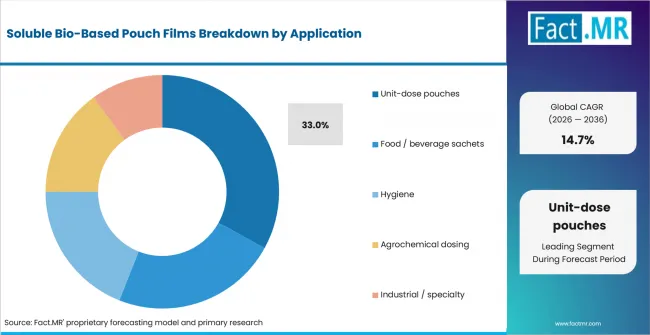
Soluble Bio Based Pouch Films Analysis By Application | Source: Fact.MR
Unit-dose pouches are anticipated to capture 33.0% share in 2026. They turn powders and concentrates into measured packs that improve dose consistency. The format fits food sachets, agrochemical doses and home-care refills where pack function is part of product use.
What supports Environmental Position?
Microplastic-free claim represents 36.0% share in 2026.
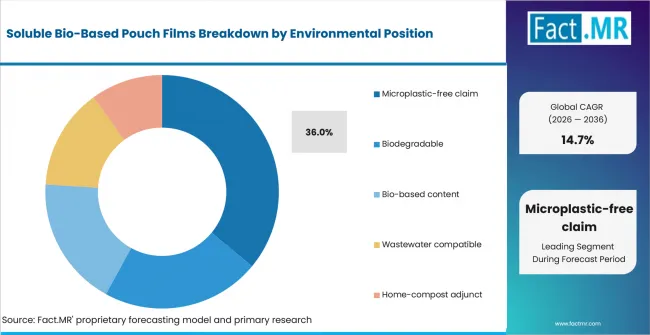
Soluble Bio Based Pouch Films Analysis By Environmental Position | Source: Fact.MR
Microplastic-free claim is estimated to represent 36.0% share in 2026. Brands use this positioning when the film dissolves cleanly and the supplier has proof for end-of-life behavior. Aquapak says Hydropol is based on PVOH and is used for paper, barrier film and nonwoven applications. The claim depends on testing clarity and simple consumer language.
What is accelerating Soluble Bio-Based Pouch Films Market adoption, and what is holding it back?
Measured dosing drives it; wastewater proof restrains it.
Drivers Impact Analysis
| Driver | (~) % Impact on CAGR | Geographic Relevance | Impact Timeline |
|---|---|---|---|
| Unit-dose conversion in cleaning products | +1.9% | North America, East Asia, Europe | Short term (<= 2 years) |
| Plastic packaging rules and waste targets | +1.5% | Europe, North America | Medium term (2-4 years) |
| Agrochemical and water-treatment dose safety | +1.2% | USA, China, Japan | Medium term (2-4 years) |
| Food and beverage sachet trials | +0.9% | USA, France, Japan | Long term (>= 4 years) |
| Bio-based material qualification | +0.7% | Europe, Japan | Long term (>= 4 years) |
Opportunity Impact Analysis
| Opportunity | (~) % Impact on CAGR | Geographic Relevance | Impact Timeline |
|---|---|---|---|
| Bio-based PVOH and specialty polymers | +1.3% | Japan, Europe, USA | Medium term (2-4 years) |
| Flushable hygiene films and nonwovens | +1.0% | USA, Europe, Japan | Long term (>= 4 years) |
| Food and beverage sachets | +0.8% | USA, France, China | Medium term (2-4 years) |
| Controlled-delay industrial dosing | +0.6% | Global | Long term (>= 4 years) |
Restraints Impact Analysis
| Restraint | (~) % Impact on CAGR | Geographic Relevance | Impact Timeline |
|---|---|---|---|
| Wastewater and biodegradation proof burden | -0.8% | Europe, USA, Japan | Short term (<= 2 years) |
| Moisture sensitivity during storage | -0.6% | Global | Medium term (2-4 years) |
| Food-contact and formula compatibility checks | -0.5% | USA, Europe, Japan | Medium term (2-4 years) |
| Qualification cost for small brands | -0.4% | Global | Long term (>= 4 years) |
Which countries are scaling the Soluble Bio-Based Pouch Films Market through 2036?
- The country comparison spans 1.2 percentage points across the forecast period.
- China remains 0.5 percentage point above the USA and Japan as e-commerce encourages compact refill formats.
- The USA and Japan remain level at 14.5% CAGR, although U.S. demand leans toward food packs while Japan brings film chemistry depth.
- Germany remains 0.2 percentage point below the USA and Japan as EU packaging rules raise documentation needs.
- France closes the displayed range as plastic-reduction policy supports selective film trials.
Comparable CAGRs create different entry conditions due to food-channel scale, wastewater review and film know-how. Full report coverage includes North America, Latin America, Western Europe, Eastern Europe, East Asia, South Asia & Pacific, Middle East & Africa.
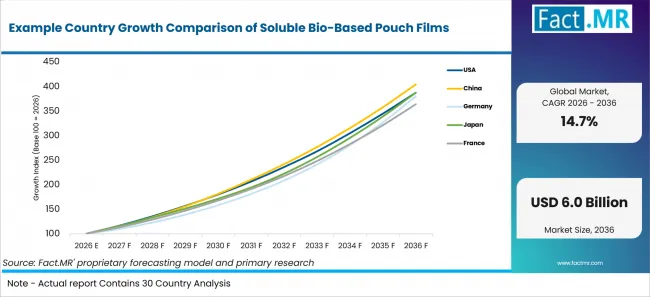
Example Country Growth Comparison Of Soluble Bio Based Pouch Films | Source: Fact.MR
| Country | CAGR (2026-2036) |
|---|---|
| China | 15.0% |
| United States | 14.5% |
| Japan | 14.5% |
| Germany | 14.3% |
| France | 13.8% |
How is China scaling demand?
15.0% CAGR through 2036, supported by online retail scale and refill-pack conversion.
China's online retail channels create a large route for compact refill packs and soluble sachets. NBS reported in January 2026 that online retail sales of physical goods reached 13,092.3 billion yuan in 2025. The market is projected to record 15.0% CAGR through 2036 as detergent and daily-use brands test measured packs.
What supports USA adoption?
14.5% CAGR through 2036, driven by food spending scale and home-care unit dosing.
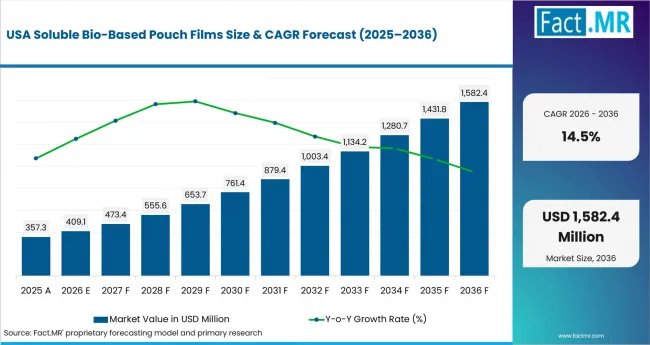
Soluble Bio Based Pouch Films Country Value Analysis | Source: Fact.MR
The USA has a broad retail base that supports early pouch testing in food and home-care products. The U.S. Census Bureau reported in September 2026 that food and beverage stores generated USD 982.2 billion in 2024 revenue. Demand is forecast to post 14.5% CAGR through 2036 as sachets and cleaner dose packs move through established channels.
How does Japan perform?
14.5% CAGR through 2036, led by export packaging needs and domestic film expertise.
Japan combines specialty film know-how with export-oriented food packaging needs. The Statistics Bureau of Japan reported in its August 2026 bulletin that the 2025 Annual Business Survey recorded manufacturing sales of 475.4084 trillion yen in Japan in 2024. The country is anticipated to record 14.5% CAGR through 2036 as local PVOH film capability supports adoption.
What underpins Germany's growth?
14.3% CAGR through 2036, supported by food processing scale and EU packaging rules.
Germany offers food-processing scale and a regulatory setting that favors documented packaging alternatives. Destatis reported in January 2026 that Germany produced 1.7 million tonnes of ready meals in 2024. The market is expected to advance at 14.3% CAGR through 2036 as portioned food and cleaner packs require dissolution proof.
What supports France's outlook?
13.8% CAGR through 2036, shaped by food exports and single-use plastic reduction.
France links food exports with policy pressure on single-use plastic packaging. FranceAgriMer reported in June 2026 that France maintained sixth place among global agricultural and agri-food exporters in 2025, with a 4.2% market share. The market is estimated to reach 13.8% CAGR through 2036 as drink powders and hygiene formats move through qualification cycles.
Who leads the Soluble Bio-Based Pouch Films Market?
Kuraray is a key provider in the soluble-film landscape through its established PVOH/PVA capabilities, a material platform widely used in water-soluble detergent and chemical dose packs. Its relevance is strongest where converters require dependable dissolution behavior, sealing performance and compatibility with measured-release pouch applications.
SmartSolve Industries and Lactips are also included among the key providers. Their positioning is relevant to soluble and dispersible packaging formats where brand owners evaluate water-contact release, storage stability and end-of-life performance alongside application-specific requirements across food, hygiene and specialty uses.
Notpla, SolvoPod and PolyBridge complete the profiled supplier set. These companies participate across alternative soluble, dispersible and bio-based material routes that can support sachets, unit-dose packs and other measured-release formats where conventional plastic packaging is being reconsidered.
Competition therefore centers on dissolution control, humidity stability, seal reliability, residue behavior, application compatibility and end-of-life documentation. Suppliers that combine consistent film performance with converter testing and clear claims are better positioned across detergent, food, hygiene, agrochemical and specialty dosing applications.
Which companies are the key providers?
Key companies include Kuraray; SmartSolve Industries; Lactips; Notpla; SolvoPod; and PolyBridge.
- Kuraray
- SmartSolve Industries
- Lactips
- Notpla
- SolvoPod
- PolyBridge
Bibliography
- Directorate-General for Environment. (2026, August 11). New EU packaging rules start to apply, including restrictions on PFAS in food-contact packaging. European Commission.
- European Bioplastics. (2025, December 2). EUBP presents the results of the 2025 market data report.
- Eurostat. (2025, October 22). Plastic packaging waste in the EU: 35.3 kg per person.
- FranceAgriMer. (2026, June 3). Les performances à l’export des filières agricoles et agroalimentaires françaises.
- Kuraray Co., Ltd. (2025, September 26). Kuraray acquires ISCC PLUS certification at three sites in Japan: Establishment of a certified supply chain for five vinyl acetate-related products in Japan.
- National Bureau of Statistics of China. (2026, January 20). Total retail sales of consumer goods in December 2025.
- Statistics Bureau of Japan. (2026, August 28). News Bulletin August 28, 2026.
- Statistisches Bundesamt. (2026, January 14). Produktion von Fertiggerichten binnen fünf Jahren mengenmäßig um 25,6 % gestiegen [Production of ready meals increased by 25.6% in quantity within five years].
- U.S. Census Bureau. (2026, September 3). Census Bureau releases new Annual Integrated Economic Survey data.
- Zeballos, E., & Sinclair, W. (2026, June 11). Total U.S. food spending reached $2.51 trillion in 2025. U.S. Department of Agriculture, Economic Research Service.
This Report Answers
- The report explains where soluble bio-based pouch films are used across material platform and dissolution type.
- Segment analysis identifies the leading subsegments and the operational reasons brands prioritize them.
- Country analysis examines China, the United States, Japan, Germany and France.
- Competitive analysis reviews Kuraray, SmartSolve Industries, Lactips, Notpla, SolvoPod and PolyBridge.
- Application analysis assesses how dissolution speed, film strength and residue proof influence supplier selection.
What does the Soluble Bio-Based Pouch Films Market cover?
The Soluble Bio-Based Pouch Films Market covers films and converted pouches that dissolve, disperse or break down under defined water-contact conditions. It includes PVOH/PVA, cellulose-derived, starch/polysaccharide, seaweed/alginate and specialty bio-based polymer platforms used for measured release.
The assessment connects directly with water soluble packaging where a pouch or film releases active content in water. It also overlaps with dispersible bio films when the material carries bio-based or recoverable film positioning.
What is included in the scope?
Soluble films and pouch systems used in measured-release packaging.
The scope includes soluble films and pouch structures used for detergent packs, food sachets, hygiene products, agrochemical dosing and industrial specialty dosing. Related polyvinyl alcohol films are included where PVOH/PVA forms the dissolving film base. Adjacent bioplastics for packaging are relevant where the polymer platform supports a pouch or sachet that dissolves during use. Scope review also considers sustainable packaging and biodegradable packaging materials only when the product has water-contact release performance. Related compostable laminate packaging materials are covered when the laminate layer functions as a soluble or dispersible pouch component.
What is excluded from the scope?
Rigid containers and conventional plastic sachets are outside the scope.
Rigid containers, conventional plastic sachets and paper-only wraps remain outside the scope unless the product has water-soluble or dispersible function. Broader bio-based laminate packaging materials remain adjacent unless the laminate is converted into a soluble pouch. Flushable bio packaging films and dispersible instant pouches are treated as adjacent coverage where flushability or instant dispersion is the primary product boundary.
How Was the Analysis Built?
The analysis draws on 110+ sources, 30+ company portfolios, 20+ countries, and more than 20 industry interviews.
- Primary Research: Discussions covered film producers, pouch converters, detergent brands, food packers, agrochemical formulators and hygiene converters. Interview checks focused on dissolution timing, seal performance, storage needs and claim approval steps.
- Desk Research: Desk research covered official statistics, regulatory publications, company product pages, packaging rules and waste data. Company review mapped PVOH/PVA films, Hydropol, Solublon, EcoSol and Watersol against pouch uses.
- Market Sizing and Forecasting: Estimates combined market values, application shares, dissolution needs, country CAGRs, provider participation and qualification barriers. Forecast checks aligned values with segment shares and country growth paths.
- Data Validation and Update Cycle: Findings were validated through supplier portfolio checks, official statistics, company announcements and application-level interviews. Updates review launches, certification activity and qualification trends.
What is the report’s scope and coverage?
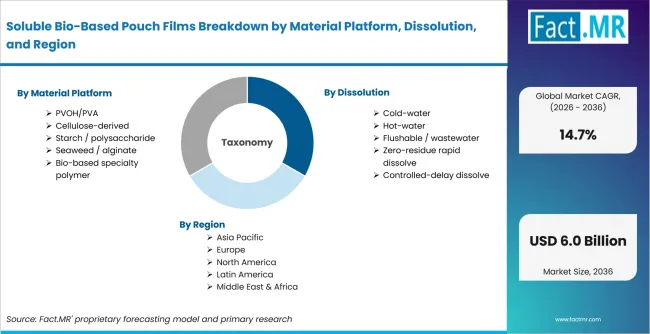
Soluble Bio Based Pouch Films Breakdown By Material Platform, Dissolution, And Region | Source: Fact.MR
| Attribute | Details |
|---|---|
| Quantitative Units | USD Billion |
| Market Definition | Water-soluble or dispersible bio-based film materials used to form pouches, sachets and unit-dose packs for measured release in water-contact conditions. |
| Material Platform | PVOH/PVA; Cellulose-derived; Starch/polysaccharide; Seaweed/alginate; Bio-based specialty polymer |
| Dissolution | Cold-water; Hot-water; Flushable/wastewater; Zero-residue rapid dissolve; Controlled-delay dissolve |
| Application | Unit-dose pouches; Food/beverage sachets; Hygiene; Agrochemical dosing; Industrial/specialty |
| Environmental Position | Microplastic-free claim; Biodegradable; Bio-based content; Wastewater compatible; Home-compost adjunct |
| Regions Covered | North America; Latin America; Western Europe; Eastern Europe; East Asia; South Asia & Pacific; Middle East & Africa |
| Countries Covered | United States; China; Germany; Japan; France |
| Key Companies Profiled | Kuraray; SmartSolve Industries; Lactips; Notpla; SolvoPod; PolyBridge |
| Forecast Period | 2026 to 2036 |
| Approach | Hybrid top-down and bottom-up approach using film-platform mapping, pouch applications, country indicators and provider portfolio review. |
How is the market segmented?
-
By Material Platform
- PVOH/PVA
- Cellulose-derived
- Starch/polysaccharide
- Seaweed/alginate
- Bio-based specialty polymer
-
By Dissolution
- Cold-water
- Hot-water
- Flushable/wastewater
- Zero-residue rapid dissolve
- Controlled-delay dissolve
-
By Application
- Unit-dose pouches
- Food/beverage sachets
- Hygiene
- Agrochemical dosing
- Industrial/specialty
-
By Environmental Position
- Microplastic-free claim
- Biodegradable
- Bio-based content
- Wastewater compatible
- Home-compost adjunct
-
By Region
- North America
- Latin America
- Western Europe
- Eastern Europe
- East Asia
- South Asia & Pacific
- Middle East & Africa