- Base Value(2026): 3.0 Bn
- Estimated Value(2026): 3.0 Bn
- Forecast Value (2036): 9.5 Bn
- CAGR (2026 - 2036): 12.2%
Bio-based Laminate Packaging Materials Market Forecast and Outlook 2026 to 2036
The bio-based laminate packaging materials market records USD 3.0 billion in 2026 and advances to USD 9.5 billion by 2036 at a 12.20% CAGR.
Bio-based Laminate Packaging Materials Market Key Takeaways
- Bio-based Laminate Packaging Materials Market Value (2026): USD 3.0 billion
- Bio-based Laminate Packaging Materials Market Forecast Value (2036): USD 9.5 billion
- Bio-based Laminate Packaging Materials Market Forecast CAGR 2026 to 2036: 12.2%
- Leading Laminate Structure in Bio-based Laminate Packaging Materials Market: Paper biofilm laminates
- Key Growth Regions in Bio-based Laminate Packaging Materials Market: Asia Pacific, North America, Europe, Latin America, Middle East & Africa
- Top Players in Bio-based Laminate Packaging Materials Market: Mondi Group, Walki Group, Amcor plc, Sealed Air Corporation, Greatview Aseptic Packaging, Zijiang Enterprise Group, Futamura Chemical, Toppan Inc.
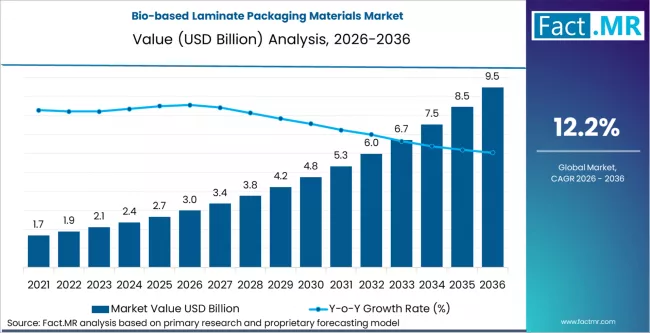
Bio Based Laminate Packaging Materials Market Market Value Analysis | Source: Fact.MR
The build toward this scale can be traced through earlier stages at USD 1.7 billion, USD 2.1 billion, USD 2.7 billion, USD 3.4 billion, and USD 4.2 billion, which reflects planned conversion programs rather than isolated substitutions. Packaging owners treat laminate structures as production infrastructure. Qualification focuses on seal integrity, barrier retention, print stability, and behavior across existing forming and filling lines.
Once a structure is locked into a product family, replacement requires revalidation across tooling, artwork, and shelf life files, which limits change frequency. Converters and brands concentrate volume into a small number of approved constructions and deploy them across multiple SKUs. Expansion follows portfolio migration schedules in food, personal care, and household goods, supported by line-by-line conversion plans rather than short cycle material switching.
Bio-based Laminate Packaging Materials Market
| Metric | Value |
|---|---|
| Market Value (2026) | USD 3.0 billion |
| Forecast Value (2036) | USD 9.5 billion |
| Forecast CAGR 2026 to 2036 | 12.2% |
Source: Fact.MR analysis. Updated Jan 23, 2026
Category
| Category | Segments |
|---|---|
| End-use | Food and beverage packaging; FMCG and retail; Mass packaged foods; Premium food packs; Others |
| Laminate Structure | Paper biofilm laminates; Flexible laminates; Multi-layer bio-laminates; Thin bio-laminates; Others |
| Material | PLA or bio-PE or cellulose films; Bio-PE or starch blends; PLA or PBS; Cellulose films; Others |
| Processing or Technology | Solvent-free lamination and barrier coatings; Low-temperature lamination; High-speed coating and lamination; Precision coating; Others |
| Region | North America; Europe; Asia Pacific; Latin America; Middle East & Africa |
Source: Fact.MR analysis. Updated Jan 23, 2026
Segmental Analysis
Why Does Food and Beverage Packaging Concentrate the Largest Share of Bio-Based Laminate Use?
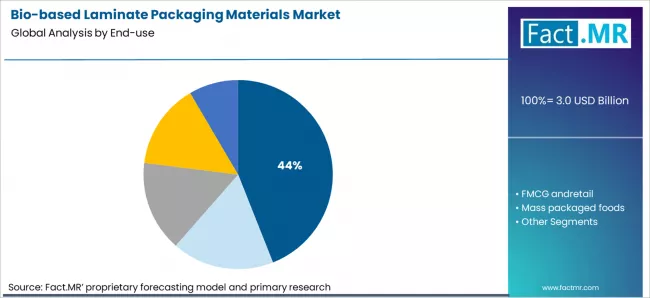
Bio Based Laminate Packaging Materials Market Analysis By End Use | Source: Fact.MR
End-use distribution in the bio-based laminate packaging materials market places food and beverage packaging at 44% of total demand. This segment runs high production volumes across snacks, beverages, and ready meals, which creates continuous consumption of laminate structures. Packaging teams in this area manage frequent product changes while keeping filling lines operating at steady speeds. Material choices must fit existing sealing, printing, and barrier performance requirements. Brand portfolios also rely on consistent pack appearance across regions, which favors materials that can be sourced and converted at scale. FMCG, mass foods, and premium packs contribute additional demand. The daily scale of food packaging operations keeps this end-use segment as the primary volume anchor.
Why Have Paper Biofilm Laminates Become the Most Common Structural Choice?
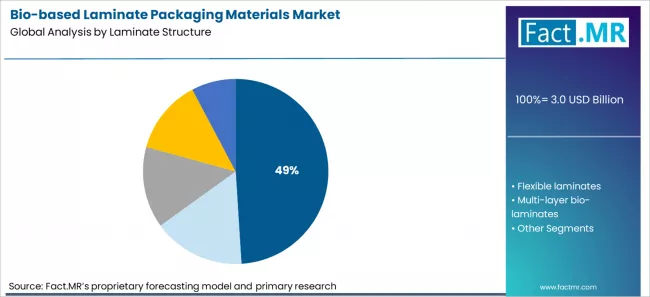
Bio Based Laminate Packaging Materials Market Analysis By Laminate Structure | Source: Fact.MR
Laminate structure mix in this market shows paper biofilm laminates holding a 49% share of usage. This format combines a paper surface suitable for printing with a thin bio-based barrier layer used for sealing and moisture control. Converters use this structure to maintain familiar pack formats while shifting material composition. Production lines handle these laminates with limited changes to cutting and sealing steps. Storage and transport practices also remain close to those used for conventional paper laminates. Flexible, multi-layer, and thin bio-laminates appear in selected programs. Most large volume packaging runs still start from paper based laminate structures as the practical reference format.
What are the Drivers, Restraints, and Key Trends of the Bio-based Laminate Packaging Materials Market?
- Drivers: Brand and retailer specifications for lower carbon footprint material options, regulatory measures targeting reduction of conventional petrochemical laminates, and procurement preferences for bio-based films in food and consumer goods packaging are supporting uptake of bio-based laminate materials.
- Restraint: Higher production costs compared with traditional laminates, variable performance across barrier and seal integrity criteria, and limited processing familiarity among converters restrict broader adoption.
- Trend 1: Development efforts are concentrating on improving oxygen and moisture barrier performance to meet requirements for perishable food and sensitive products.
- Trend 2: Expansion of product offerings with grades compatible with existing flexographic coating and lamination lines is enabling easier integration by packaging converters.
Analysis of the Bio-based Laminate Packaging Materials Market by Key Country
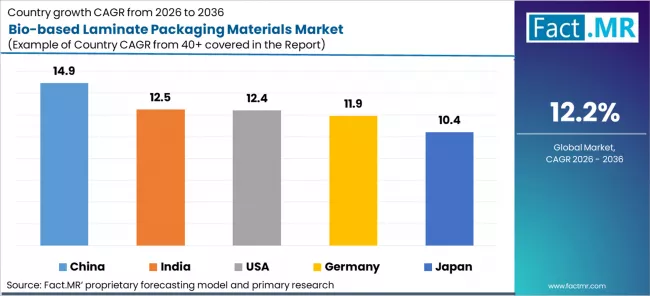
Bio Based Laminate Packaging Materials Market Cagr Analysis By Country | Source: Fact.MR
| Country | CAGR 2026 to 2036 |
|---|---|
| Germany | 11.9% |
| USA | 12.4% |
| China | 14.9% |
| Japan | 10.4% |
| India | 12.5% |
Source: Fact.MR analysis. Updated Jan 23, 2026
The report covers an in-depth analysis of 40+ countries; top-performing countries are highlighted below.
How Are Regulatory and Retail Standards in Germany Shaping Use of Bio-based Laminates?
Growth in Germany runs at about 11.9% per year through 2036. Demand follows packaging compliance programs across food, personal care, and household goods. Brand owners evaluate barrier performance, sealing reliability, and certification status before approvals. Purchasing decisions sit with central packaging and quality teams. Line trials move carefully because shelf life validation and machinability checks take time. Distribution remains concentrated among a limited group of material suppliers and converters. Volume increases track SKU conversions rather than new product launches. Inventory policies stay conservative due to cost pressure. Market development remains tied to regulatory milestones and retailer acceptance rather than marketing driven redesign cycles.
What Is Driving Wider Adoption of Bio-based Laminates in USA?
Growth in USA runs at about 12.4% per year through 2036. Demand is shaped by brand commitments and retailer packaging guidelines. Product teams test seal strength, print quality, and line speed impact. Purchasing balances cost, supply continuity, and certification coverage. Conversions usually start with premium or limited ranges before broader rollout. Distribution relies on direct relationships with polymer suppliers and converters. Volume growth follows portfolio level packaging redesign schedules rather than single product launches. Inventory planning remains cautious because resin pricing fluctuates. Market development stays tied to corporate roadmaps rather than consumer activism or short term campaigns across packaged goods categories.
What Is Supporting Faster Expansion of Bio-based Laminates in China?
Growth in China runs at about 14.9% per year through 2036. Demand rises from food delivery, ready meals, and consumer goods packaging transitions. Operators prioritize scale, availability, and regulatory alignment. Product formats favor pouches and flexible packs suited to high throughput lines. Purchasing aligns with multi-year packaging conversion plans. Local production capacity influences supplier choice. Volume increases follow contract wins with large brand groups. Inventory builds occur around major conversion waves. Market development remains tied to industrial packaging transitions rather than niche positioning or premium branding strategies across mass categories and large distribution networks nationwide.
How Are Corporate Packaging Standards in Japan Changing Use of Bio-based Laminates?
Growth in Japan runs at about 10.4% per year through 2036. Demand follows corporate packaging standards and retailer operating guidelines. Product teams focus on appearance, stiffness, and consistent sealing behavior. Purchasing emphasizes reliability and supplier track record. Conversions proceed cautiously because line stability and defect rates receive close attention. Distribution remains concentrated among approved material suppliers and converters. Volume increases track scheduled packaging specification updates. Inventory management stays conservative due to space limits and cost control. Market development remains tied to structured upgrade cycles rather than rapid experimentation or short term packaging trends across food and household goods channels nationwide.
What Is Influencing Adoption of Bio-based Laminates in India?
Growth in India runs at about 12.5% per year through 2036. Demand rises from packaged food, personal care, and household product expansion. Brand owners focus on cost balance, basic barrier performance, and regulatory alignment. Purchasing emphasizes availability and converter support. Conversions often begin with export oriented or premium lines before mass ranges. Distribution relies on a mix of local producers and importers. Volume growth follows portfolio expansion in packaged goods. Inventory planning remains flexible due to price sensitivity. Market development stays tied to category growth and formalization of packaging standards rather than activism or retailer mandates alone.
How Do Converting Platforms and Barrier Requirements Shape Competition in the Bio Based Laminate Packaging Materials Market?
Line architecture and filling technology usually decide supplier access before commercial terms are discussed. Brand owners first define oxygen transmission limits, moisture barriers, sealing windows, and sterilization conditions, then invite material trials. Mondi, Amcor, Walki, Sealed Air, Toppan, Futamura, Greatview, and Zijiang compete by tailoring laminate structures to specific aseptic, retort, and form fill seal platforms. Technical teams compare candidates using run speed stability, seal integrity, delamination risk, and waste rates across extended production runs.
Procurement groups also assess geographic supply coverage and contingency capacity. Once a laminate structure is qualified for a packaging family, it tends to remain locked across multiple SKUs and refresh cycles. Volume growth follows brand expansions and line utilization rather than spot tenders. Supplier displacement usually occurs after equipment changes, shelf life requirement revisions, or platform redesign programs.
Key Players in Bio-based Laminate Packaging Materials Market
- Mondi Group
- Walki Group
- Amcor plc
- Sealed Air Corporation
- Greatview Aseptic Packaging Co., Ltd.
- Zijiang Enterprise Group Co., Ltd.
- Futamura Chemical Co., Ltd.
- Toppan Inc.
References
- International Organization for Standardization. (2023). ISO 17088: Specifications for compostable plastics. ISO.
- European Commission. (2023). A policy framework for bio-based, biodegradable and compostable plastics in the EU. European Commission.
- European Commission. (2024). Proposal for a regulation of the European Parliament and of the Council on packaging and packaging waste and repealing Directive 94/62/EC. European Commission.
- European Commission, Joint Research Centre. (2023). Biodegradable and compostable plastics in the circular economy. Publications Office of the European Union.
- European Commission. (2023). Proposal for a directive of the European Parliament and of the Council on substantiation and communication of explicit environmental claims (Green Claims Directive). European Commission.
Segmentation
Scope of the Report
| Items | Values |
|---|---|
| Quantitative Units (2026) | USD million |
| End-use | Food and beverage packaging, FMCG and retail, mass packaged foods, premium food packs, others |
| Laminate Structure | Paper biofilm laminates, flexible laminates, multi-layer bio-laminates, thin bio-laminates, others |
| Material | PLA or bio-PE or cellulose films, bio-PE or starch blends, PLA or PBS, cellulose films, others |
| Processing or Technology | Solvent-free lamination and barrier coatings, low-temperature lamination, high-speed coating and lamination, precision coating, others |
| Regions Covered | Asia Pacific, Europe, North America, Latin America, Middle East & Africa |
| Countries Covered | United States, Canada, Mexico, Germany, United Kingdom, France, Italy, Spain, Nordics, BENELUX, China, Japan, South Korea, India, Australia & New Zealand, ASEAN, Brazil, Chile, Saudi Arabia, Turkey, South Africa, and other regional markets |
| Key Companies Profiled | Mondi Group, Walki Group, Amcor, Sealed Air, Greatview Aseptic Packaging, Zijiang Enterprise Group, Futamura Chemical, Toppan |
| Additional Attributes | Dollar sales by end-use, structure, material, and process; seal integrity, barrier retention, print stability, and machinability; adoption driven by portfolio-level laminate conversion programs in food, personal care, and household goods |
Source: Fact.MR analysis. Updated Jan 23, 2026
Bio-based Laminate Packaging Materials Market Segmentation
-
End-use :
- Food & beverage packaging
- FMCG & retail
- Mass packaged foods
- Premium food packs
- Others
-
Laminate Structure :
- Paperbiofilm laminates
- Flexible laminates
- Multi-layer bio-laminates
- Thin bio-laminates
- Others
-
Material :
- PLA or bio-PE or cellulose films
- Bio-PE or starch blends
- PLA or PBS
- Cellulose films
- Others
-
Processing or Technology :
- Solvent-free lamination & barrier coatings
- Low-temperature lamination
- High-speed coating & lamination
- Precision coating
- Others
-
Region :
- Asia Pacific
- China
- Japan
- South Korea
- India
- Australia & New Zealand
- ASEAN
- Rest of Asia Pacific
- Europe
- Germany
- United Kingdom
- France
- Italy
- Spain
- Nordic
- BENELUX
- Rest of Europe
- North America
- United States
- Canada
- Mexico
- Latin America
- Brazil
- Chile
- Rest of Latin America
- Middle East & Africa
- Kingdom of Saudi Arabia
- Other GCC Countries
- Turkey
- South Africa
- Other African Union
- Rest of Middle East & Africa
- Asia Pacific
Frequently Asked Questions
How big is the bio-based laminate packaging materials market in 2026?
What will be the size of bio-based laminate packaging materials market in 2036?
How much will be the bio-based laminate packaging materials market growth between 2026 and 2036?
What are the key product types in the bio-based laminate packaging materials market?
Which laminate structure segment to contribute significant share in the bio-based laminate packaging materials market in 2026?
Who worked on this report


Preview the report firsthand - request a free sample
Free SampleGet the brochure for pricing and purchase details
Download PDF