- Market Value (2025): USD 3.2 Bn
- Estimated Value (2026): USD 3.9 Bn
- Forecast Value (2036): USD 29.9 Bn
- CAGR (2026-2036): 22.6%
What is the AI Training Dataset Market forecast to be worth by 2036?
USD 3.9 Billion in 2026 to USD 29.9 Billion by 2036 at 22.6% CAGR.
- The AI training dataset market reached USD 3.2 billion in 2025.
- Demand is projected to increase from USD 3.9 billion in 2026 to USD 29.9 Billion by 2036.
- The market is forecast to record 22.6% CAGR from 2026 to 2036 as refresh cycles become part of model operations.
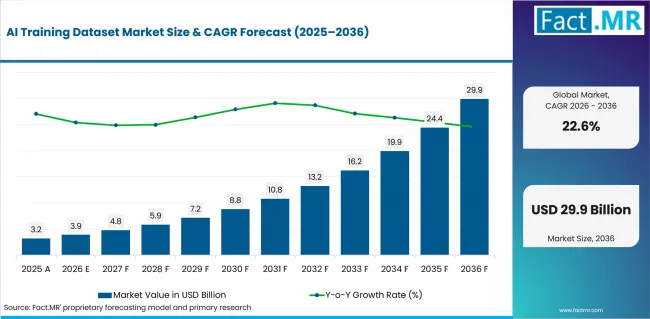
Ai Training Dataset Market Value Analysis | Source: Fact.MR
What are the defining numbers behind AI Training Dataset Market growth?
USD 26.0 Billion absolute opportunity by 2036.
- Demand Drivers in the Market
- Model teams need refreshed datasets for fine-tuning and safety review so training data becomes an ongoing purchase item.
- Computer vision programs need stable image and video labels. Poor labels can delay model release and raise review cost.
- Cloud-based workflow is expected to help buyers scale task teams without building permanent annotation infrastructure.
- Key Segments Analyzed
- By Type: Image/Video is projected to hold 42.0% share in 2026 because visual models need dense labels and edge-case checks.
- By Deployment Model: Cloud-Based is expected to hold 63.0% share in 2026 with buyers using shared storage and task controls.
- By Vertical: Information Technology is anticipated to capture 29.0% share in 2026 since AI developers buy data across model families.
- Analyst Opinion at Fact.MR
- Shambhu Nath Jha, Sr. Consultant at Fact.MR, opines: "AI training data earns repeat spending when the provider can demonstrate rights, label quality and version control for the specific model workflow. Buyers will test those controls before expanding a dataset program."
- Strategic Implications
- AI developers should define ownership rules before retraining starts. Data annotation tools support this review when task instructions and reviewer checks are clear.
- Cloud vendors can improve renewals by matching dataset refresh schedules with model testing. Machine learning as a service remains relevant when buyers want data work near training infrastructure.
- Investors should separate dataset revenue from finished AI application revenue.
South Korea leads with a 23.8% CAGR, supported by AI infrastructure and electronics demand. The USA follows at 23.3%, while Canada reaches 23.0%. The UK, Germany and Australia grow through research, industrial AI and regulated deployment. Japan records 21.6% as buyers prioritize local-language quality and controlled dataset use.
How does the AI Training Dataset Market break down by segment?
Image/Video is expected to lead Type at 42.0% share in 2026. Cloud-Based is projected to lead Deployment Model at 63.0% share in 2026.
Why does Image/Video lead Type?
Image/Video is projected to account for 42.0% share in 2026.
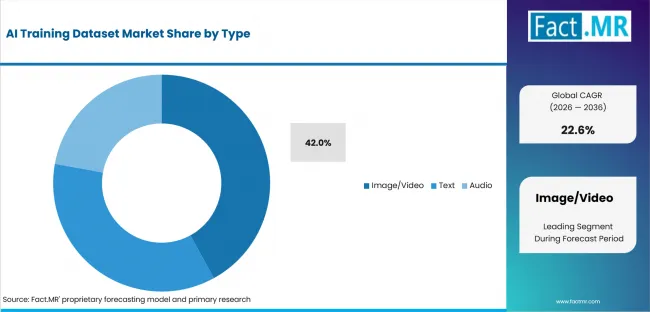
Ai Training Dataset Market Analysis By Type | Source: Fact.MR
Image and video programs require detection and segmentation labels. Tracking and event labels are needed when models must read moving scenes. Buyers pay for stronger checks because weak labels can delay approval and hurt model accuracy.
What supports Cloud-Based Deployment Model demand?
Cloud-Based is expected to hold 63.0% share in 2026.
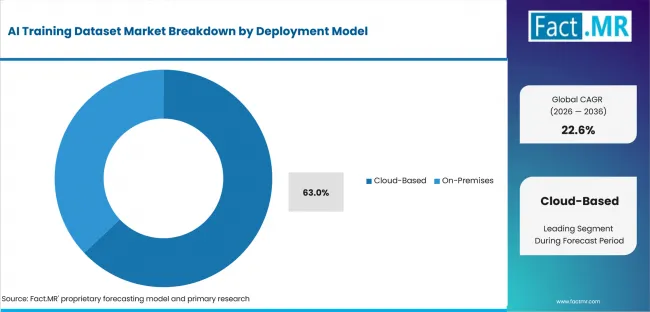
Ai Training Dataset Market Analysis By Deployment Model | Source: Fact.MR
Cloud-based delivery gives buyers one place for contributors and task queues. Review rules and version control stay inside the same environment. Teams can move from pilot batches to larger data work without owning a permanent annotation setup.
Why does Information Technology lead Vertical?
Information Technology is anticipated to lead with 29.0% share in 2026.
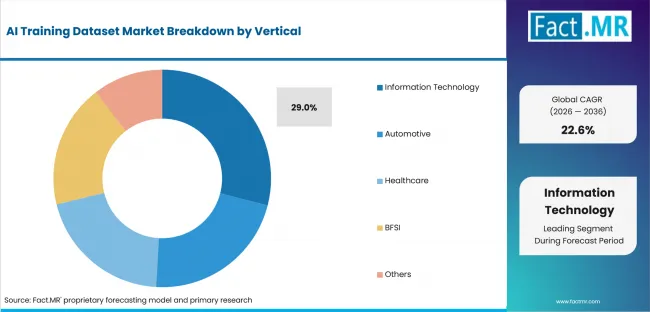
Ai Training Dataset Market Analysis By Vertical | Source: Fact.MR
Technology companies build model platforms and AI products that use several data types. Their data needs recur across training and evaluation. Red-team testing creates another buying point before release.
What is accelerating AI Training Dataset Market adoption, and what is holding it back?
Demand is expected to rise as companies build specialized models and test them regularly. Growth may be limited by data-rights checks and quality-control requirements.
Drivers Impact Analysis
| DRIVER | RELATIVE IMPACT | GEOGRAPHIC RELEVANCE | IMPACT TIMELINE |
|---|---|---|---|
| Model specialization and continuous evaluation | High | USA, South Korea, Canada | Short term (<= 2 years) |
| Multimodal dataset demand | High | USA, UK, Japan | Short term (<= 2 years) |
| Cloud-based annotation workflow | Moderate | North America and East Asia | Medium term (2-4 years) |
| Evaluation and red-team datasets | Moderate | Regulated AI buyers | Medium term (2-4 years) |
| Data provenance controls | Moderate | Germany, UK, Canada | Long term (>= 4 years) |
Source: Fact.MR analysis. Updated Aug 3, 2026
- Model specialization and continuous evaluation: Model teams are expected to buy fresh examples for tuning and drift checks after launch.
- Multimodal dataset demand: Text and image models require separate review paths. Audio and video work expands project scope for dataset suppliers.
- Cloud-based annotation workflow: Shared task queues are expected to shorten dataset cycles when several teams review the same model family.
Opportunity Impact Analysis
| OPPORTUNITY | RELATIVE IMPACT | GEOGRAPHIC RELEVANCE | IMPACT TIMELINE |
|---|---|---|---|
| Governed synthetic and hybrid datasets | Moderate | Japan and Germany | Medium term (2-4 years) |
| Enterprise fine-tuning datasets | Moderate | USA and UK | Medium term (2-4 years) |
| Local-language data programs | Moderate | Japan, Canada, South Korea | Medium term (2-4 years) |
| Secure evaluation data platforms | Low | Regulated enterprise buyers | Long term (>= 4 years) |
Source: Fact.MR analysis. Updated Aug 3, 2026
- Governed synthetic and hybrid datasets: The primary opportunity is concentrated in rare-event and privacy-sensitive use cases with limited real examples.
- Enterprise fine-tuning datasets: Suppliers with licensing proof are expected to gain repeat work from companies adapting models to internal tasks.
- Local-language data programs: Country-specific language coverage is likely to support public-service and customer-support AI use.
Restraints Impact Analysis
| RESTRAINT | RELATIVE IMPACT | GEOGRAPHIC RELEVANCE | IMPACT TIMELINE |
|---|---|---|---|
| Data rights and licensing review | High | Germany, UK, Canada | Short term (<= 2 years) |
| Quality assurance and bias risk | High | Global enterprise buyers | Short term (<= 2 years) |
| Privacy and confidential-data limits | Moderate | Regulated sectors | Medium term (2-4 years) |
| Annotation labor cost pressure | Low | Specialist dataset programs | Long term (>= 4 years) |
Source: Fact.MR analysis. Updated Aug 3, 2026
- Data rights and licensing review: Buyers must confirm that personal information and copyrighted material can be used lawfully.
- Quality assurance and bias risk: Poor task design can create mislabeled or unbalanced datasets. This raises review cost before approval.
- Privacy and confidential-data limits: Sensitive records may require removal or masking before model teams can use them.
Which countries are scaling AI Training Dataset Market fastest?
- South Korea leads through electronics companies and AI platforms that require multimodal training data.
- The USA follows with strong demand from frontier-model developers, while Canada benefits from bilingual coverage and data-sovereignty needs. The UK grows through research and public-service pilots.
- Germany advances through industrial AI and strict data review. Australia gains from regulated enterprise use, while Japan focuses on local-language quality, controlled datasets and careful supplier selection for model development programs.
- Comparable CAGRs still create different market entry conditions. Sales timing depends on language coverage and buyer review depth. Supplier proof of dataset quality remains the final approval point.
The full report provides country-level CAGR analysis across North America, Latin America, Western Europe, Eastern Europe, East Asia, South Asia and Pacific, and Middle East & Africa.
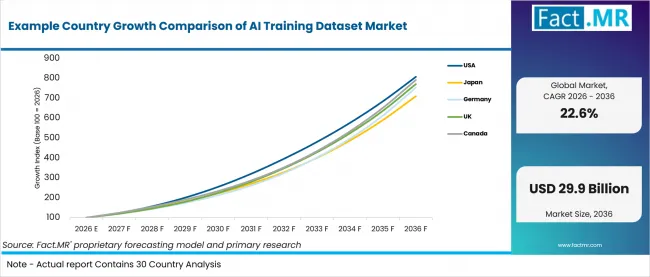
Example Country Growth Comparison Of Ai Training Dataset Market | Source: Fact.MR
| Country | CAGR (2026-2036) |
|---|---|
| South Korea | 23.8% |
| USA | 23.3% |
| Canada | 23.0% |
| UK | 22.7% |
| Germany | 22.4% |
| Australia | 22.1% |
| Japan | 21.6% |
Source: Fact.MR analysis. Updated Aug 3, 2026
What supports USA adoption?
23.3% CAGR, supported by frontier-model development and federal procurement needs.
In the USA, dataset contracts often expand only after security and access controls are reviewed. Frontier-model developers also need frequent data updates, making repeat delivery and reliable governance important factors in vendor selection.
How is Japan building demand?
21.6% CAGR, driven by Japanese-language quality and controlled deployment.
Japan’s market develops around language accuracy and careful internal approval. Suppliers gain stronger interest when their datasets reflect workplace, public-service and cultural use cases rather than offering broad multilingual coverage alone.
What shapes Germany’s growth?
22.4% CAGR, backed by data-protection discipline and industrial AI use.
For German buyers, dataset origin and permission records carry significant weight. Industrial AI programs create demand, but approval usually depends on clear documentation and examples that match sector-specific operating requirements.
How does UK demand develop?
22.7% CAGR, led by research depth and public-service AI pilots.
Research institutions and enterprise AI teams provide the UK with a strong adoption base. Public-service pilots add further demand, although test data must remain controlled and well documented before projects move into wider deployment.
What supports Canada’s outlook?
23.0% CAGR, supported by bilingual coverage and sovereignty concerns.
Canada benefits from demand for English and French datasets across technology and regulated sectors. At the same time, local storage expectations and governance rules influence which providers can secure long-term contracts.
How is Australia using AI datasets?
22.1% CAGR, shaped by regulated enterprise deployment.
Australian banks and public agencies favor datasets that can be explained and reviewed easily. Clear permission records, practical test-set design and evidence of controlled use often matter more than dataset size during procurement.
Why does South Korea record the highest listed CAGR?
23.8% CAGR, driven by electronics-led AI demand and platform development.
South Korea leads as electronics firms and digital platforms require text, image, audio and video datasets at scale. Strong multimodal review capacity allows suppliers to support broader programs and compete for larger enterprise accounts.
Who leads the AI Training Dataset Market?
The profiled companies span managed data operations, annotation services, cloud-based data workflows and developer dataset ecosystems.
Buyer comparison should distinguish a direct training-data service from a broader cloud or developer environment. Contract decisions depend on data rights, annotation quality, security controls and delivery fit for the required modality.
Which companies are the key providers?
Key companies include Scale AI Inc.; Appen Limited; Amazon Web Services, Inc.; Google LLC (Kaggle); Microsoft Corporation; TELUS Digital AI Data Solutions; Cogito Tech LLC; Alegion, Inc.; Kinetic Vision, through Deep Vision Data; and CloudFactory.
- Scale AI Inc.
- Appen Limited
- Amazon Web Services, Inc.
- Google LLC (Kaggle)
- Microsoft Corporation
- TELUS Digital AI Data Solutions
- Cogito Tech LLC
- Alegion, Inc.
- Kinetic Vision, through Deep Vision Data
- CloudFactory
Bibliography
- European Commission. (2025, February 11). EU launches InvestAI initiative to mobilise EUR 200 billion of investment in artificial intelligence.
- Organisation for Economic Co-operation and Development. (2024, June 26). AI, data governance and privacy: Synergies and areas of international co-operation.
- National Institute of Standards and Technology. (2024, November 20). Reducing risks posed by synthetic content: An overview of technical approaches to digital content transparency.
- European Parliament. (2025, April). AI and copyright: The training of general-purpose AI.
- Scale AI. Data Engine for training and evaluation data.
- Amazon Web Services. Training data labeling using humans with Amazon SageMaker Ground Truth.
- TELUS Digital. AI Data Solutions.
This Report Answers
- The report provides strategic intelligence on the AI Training Dataset Market across Type, Deployment Model, Vertical, Data Source and End User choices that shape data operations.
- Segment analysis covers Image/Video and Cloud-Based delivery as the share leaders within the 2026 market.
- Country outlook evaluates South Korea, USA, Canada, UK, Germany, Australia and Japan.
- Competitive analysis compares the listed data-operations, cloud and developer-environment providers while distinguishing direct training-data work from adjacent platform capability.
- Operational assessment covers data rights and quality assurance. Synthetic datasets, cloud workflow and evaluation data demand complete the view.
What does the AI Training Dataset Market cover?
AI training datasets support model training, fine-tuning and evaluation when their quality affects deployment readiness.
The market covers datasets and services sold for model training and improvement. Collection, licensing, annotation, enrichment and validation are included when sold as dataset work. Real-world, synthetic and hybrid datasets are included when used for training or evaluation.
What is included in the scope?
The scope includes Type, Deployment Model, Vertical, Data Source, End User and Region.
Coverage spans image, video, text and audio datasets. Cloud-based delivery and on-premises use are included. The market also covers real-world, enterprise, synthetic and hybrid data when sold for training or evaluation.
What is excluded from the scope?
Finished AI products, unrelated data services and general cloud storage remain outside the scope.
Model-hosting revenue is excluded when dataset work is not sold separately. Internal data preparation without commercial sale is also excluded.
How Was the Analysis Built?
The analysis integrates public policy materials, technical standards, company documentation and market adoption evidence.
- Evidence Review: The review considers public policy materials, technical standards, company documentation and evidence relevant to data rights, quality, deployment and procurement.
- Market Sizing and Forecasting: Estimates combine provider activity, buyer spending indicators, modality demand, deployment mix, vertical adoption, data-source use and country conditions.
- Market Monitoring: The analysis is reviewed as policy requirements, platform capabilities, licensing practice and buyer requirements change.
Segmentation
What is the report’s scope and coverage?
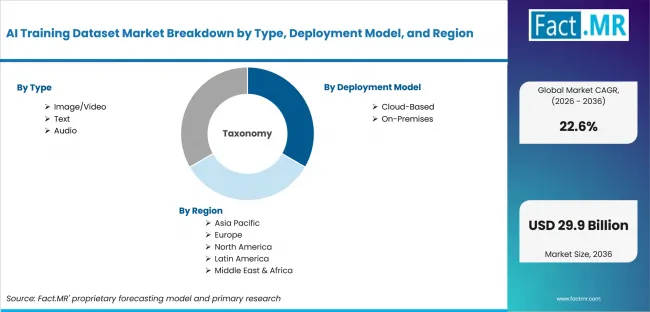
Ai Training Dataset Market Breakdown By Type, Deployment Model, And Region | Source: Fact.MR
| Attribute | Details |
|---|---|
| Quantitative Units | USD 3.9 billion in 2026 to USD 29.9 billion by 2036 at 22.6% CAGR |
| Market Definition | Revenue from datasets and related collection, licensing, annotation, enrichment, validation and quality services sold for AI model training, fine-tuning, evaluation or improvement. |
| Type | Image/Video; Image Annotation; Video Annotation; Text; NLP Datasets; LLM Training Data; Audio; Speech Recognition; Voice Annotation |
| Deployment Model | Cloud-Based; Public Cloud; Private Cloud; On-Premises; Enterprise Infrastructure; Hybrid Deployment |
| Vertical | Information Technology; Generative AI; Machine Learning Platforms; Automotive; Autonomous Driving; ADAS; Healthcare; Medical Imaging AI; Clinical AI; BFSI; Fraud Detection; Risk Analytics; Others; Government; Retail & E-commerce |
| Data Source | Real-World Datasets; User Generated Data; Enterprise Data; Synthetic Datasets; AI-Generated Data; Simulation Data; Hybrid Datasets; Augmented Data; Combined Real & Synthetic |
| End User | Technology Companies; AI Developers; Cloud Providers; Enterprises; Large Enterprises; Small & Medium Enterprises; Research Organizations; Universities; R&D Institutes; Government Agencies; Defense; Public Sector AI Labs |
| Regions Covered | North America; Latin America; Western Europe; Eastern Europe; East Asia; South Asia and Pacific; Middle East & Africa |
| Key Countries Highlighted | South Korea; USA; Canada; UK; Germany; Australia; Japan |
| Key Companies Profiled | Scale AI Inc.; Appen Limited; Amazon Web Services, Inc.; Google LLC (Kaggle); Microsoft Corporation; TELUS Digital AI Data Solutions; Cogito Tech LLC; Alegion, Inc.; Kinetic Vision, through Deep Vision Data; CloudFactory |
| Forecast Period | 2026 to 2036 |
| Approach | Market sizing combines provider activity, buyer spending indicators, modality demand, deployment mix, vertical adoption, data-source use, end-user purchasing patterns and country adoption conditions. |
Source: Fact.MR analysis. Updated Aug 3, 2026
How is the market segmented?
-
By Type
- Image/Video
- Image Annotation
- Video Annotation
- Text
- NLP Datasets
- LLM Training Data
- Audio
- Speech Recognition
- Voice Annotation
- Image/Video
-
By Deployment Model
- Cloud-Based
- Public Cloud
- Private Cloud
- On-Premises
- Enterprise Infrastructure
- Hybrid Deployment
- Cloud-Based
-
By Vertical
- Information Technology
- Generative AI
- Machine Learning Platforms
- Automotive
- Autonomous Driving
- ADAS
- Healthcare
- Medical Imaging AI
- Clinical AI
- BFSI
- Fraud Detection
- Risk Analytics
- Others
- Government
- Retail & E-commerce
- Information Technology
-
By Data Source
- Real-World Datasets
- User Generated Data
- Enterprise Data
- Synthetic Datasets
- AI-Generated Data
- Simulation Data
- Hybrid Datasets
- Augmented Data
- Combined Real & Synthetic
- Real-World Datasets
-
By End User
- Technology Companies
- AI Developers
- Cloud Providers
- Enterprises
- Large Enterprises
- Small & Medium Enterprises
- Research Organizations
- Universities
- R&D Institutes
- Government Agencies
- Defense
- Public Sector AI Labs
- Technology Companies
-
By Region
- North America
- Latin America
- Western Europe
- Eastern Europe
- East Asia
- South Asia and Pacific
- Middle East & Africa
Frequently Asked Questions
Which Type leads the market?
Which Deployment Model leads the market?
Which Vertical leads the market?
Which country records the highest listed CAGR?
What is the primary driver in this market?
What is the main restraint?
Who worked on this report


Preview the report firsthand - request a free sample
Free SampleGet the brochure for pricing and purchase details
Download PDF