- Market Value (2025): USD 3.1 Bn
- Estimated Value (2026): USD 3.8 Bn
- Forecast Value (2036): USD 28.9 Bn
- CAGR (2026-2036): 22.5%
What is the AI Voice Cloning Market forecast to be worth by 2036?
USD 3.8 Billion in 2026 to USD 28.9 Billion by 2036 at 22.5% CAGR.
- The AI voice cloning market reached USD 3.1 Billion in 2025.
- Demand is projected to increase from USD 3.8 Billion in 2026 to USD 28.9 Billion by 2036.
- The market is forecast to record 22.5% CAGR from 2026 to 2036.
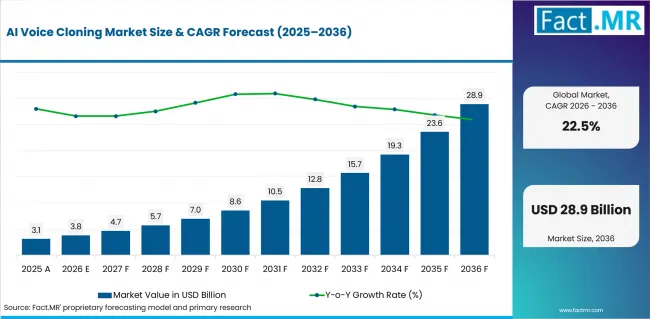
Ai Voice Cloning Market Value Analysis | Source: Fact.MR
What are the defining numbers behind AI Voice Cloning Market growth?
USD 25.1 Billion absolute opportunity by 2036.
- Demand Drivers in the Market
- Licensed localization reduces studio dependence when one approved voice must cover several languages.
- Enterprise assistants need repeatable branded speech for service teams and training teams.
- Accessibility and learning workflows require authorized voices that can be updated without new recording sessions.
- API delivery helps teams connect cloned voices with content systems and contact-center tools.
- Key Segments Analyzed
- By Deployment: Cloud-Based is projected to hold 68.0% share in 2026 since scalable generation reduces internal infrastructure burden.
- By Application: Media & Entertainment is expected to account for 32.0% share in 2026 because dubbing and digital video require approved speech.
- By End User: Large Enterprises are anticipated to represent 47.0% share in 2026 with legal review and integration budgets.
- By Technology: Deep Learning is estimated to hold 45.0% share in 2026 as transformer models improve voice continuity.
- By Industry Vertical: Media & Entertainment is forecast to capture 29.0% share in 2026 where localization volume affects production economics.
- Analyst Opinion at Fact.MR
- Shambhu Nath Jha, Sr. Consultant at Fact.MR, opines: “The next procurement test is not realism alone. Buyers need proof of speaker consent, controls over permitted use and a practical way to withdraw access when rights change. Quality remains important, but ownership terms and audit evidence will determine whether a platform can move into scaled production.”
- Strategic Implications
- Media teams can define approval gates before voice cloning begins.
- Voice-AI providers can place consent controls inside the product interface.
- Enterprise buyers should compare tools on revocation and logs. User-role controls should be clear before rollout.
Among the listed countries, South Korea is projected to record the highest CAGR at 23.9%. The USA is projected at 23.2%, followed by Canada at 22.8%, the UK at 22.5%, Germany at 22.2%, Australia at 21.9% and Japan at 21.5%. The demand context differs by country.
How does the AI Voice Cloning Market break down by segment?
Cloud-Based leads Deployment at 68.0% share in 2026. Media & Entertainment leads Application at 32.0%. Large Enterprises account for 47.0% of End User demand.
Why does Cloud-Based lead Deployment?
Cloud-Based is projected to account for 68.0% share in 2026.
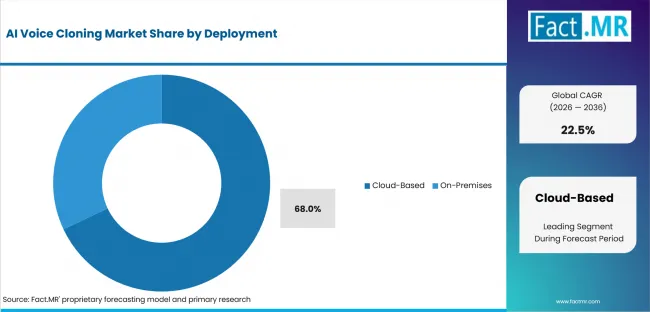
Ai Voice Cloning Market Analysis By Deployment | Source: Fact.MR
Cloud services let buyers scale voice generation without specialist infrastructure. Public APIs support quick integration. Private-cloud settings help when recordings and permissions need tighter control.
Why does Media & Entertainment lead Application?
Media & Entertainment is expected to account for 32.0% share in 2026.
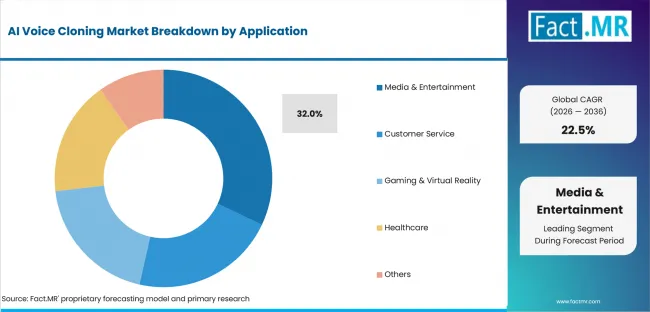
Ai Voice Cloning Market Analysis By Application | Source: Fact.MR
Film and television need repeated voice revisions. Games and podcasts need the same review discipline. Audiobooks need it when narration changes.
What supports Large Enterprises within End User?
Large Enterprises are anticipated to represent 47.0% share in 2026.
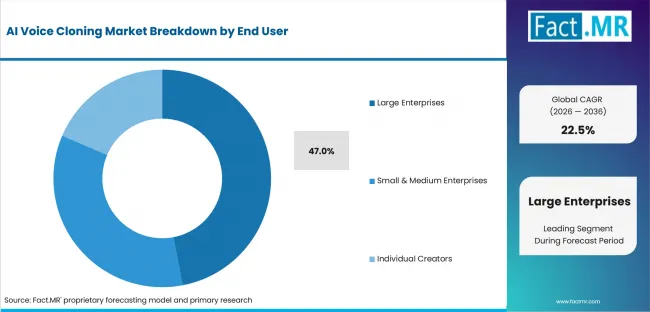
Ai Voice Cloning Market Analysis By End User | Source: Fact.MR
Large enterprises can fund integration review and legal approval. Their service and training content supports voice libraries. Access controls and logs decide approval.
How does Deep Learning shape Technology demand?
Deep Learning is estimated to hold 45.0% share in 2026.
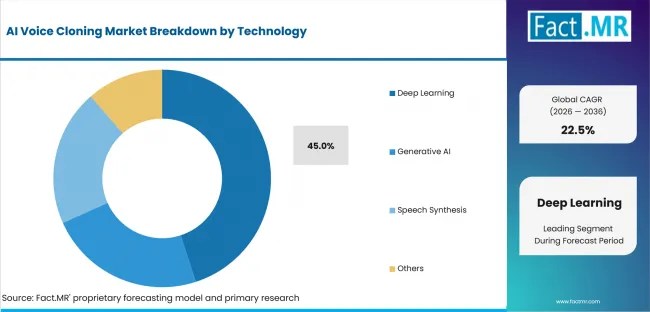
Ai Voice Cloning Market Analysis By Technology | Source: Fact.MR
Transformer models improve timing and tone. Neural text-to-speech supports longer scripts. Buyers notice the benefit when a voice must stay consistent across scripts.
Why does Media & Entertainment lead Industry Vertical?
Media & Entertainment is forecast to capture 29.0% share in 2026.
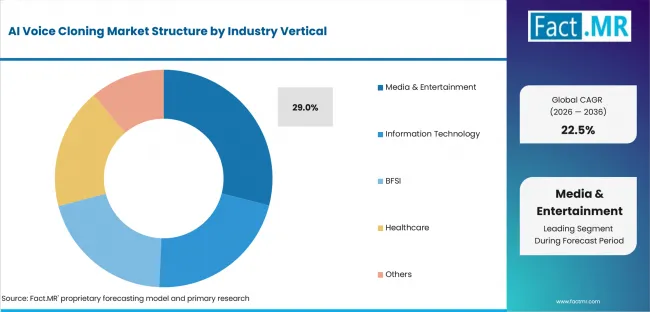
Ai Voice Cloning Market Analysis By Industry Vertical | Source: Fact.MR
Entertainment buyers need continuity across characters and narrators. Localized releases add review pressure. Studios gain when approved voices do not delay schedules.
What is accelerating AI Voice Cloning Market adoption, and what is holding it back?
Demand is expected to rise through localization and conversational AI. Growth may be limited by consent concerns, impersonation risks and unclear voice rights.
Drivers Impact Analysis
| DRIVER | RELATIVE RELEVANCE | GEOGRAPHIC RELEVANCE | IMPACT TIMELINE |
|---|---|---|---|
| Localization and dubbing volume | High | USA, Japan, UK | Short term (<= 2 years) |
| Conversational automation | High | USA, Canada, Australia | Short term (<= 2 years) |
| Enterprise voice governance | High | USA, Germany, UK | Medium term (2-4 years) |
| Accessibility and training use | Medium | North America and Europe | Medium term (2-4 years) |
| Multilingual platform integration | Medium | Japan, South Korea, Canada | Long term (>= 4 years) |
Source: Fact.MR analysis. Updated Aug 3, 2026
- Localization and dubbing volume: Content owners are expected to value cloning when scripts must move across languages without repeated studio scheduling.
- Conversational automation: Service teams can use approved voices for customer updates when audit controls are built into the workflow.
- Enterprise voice governance: Central permissions are likely to influence buying decisions before wider rollout begins.
Opportunity Impact Analysis
| OPPORTUNITY | RELATIVE RELEVANCE | GEOGRAPHIC RELEVANCE | IMPACT TIMELINE |
|---|---|---|---|
| Governed multilingual voice platforms | High | Japan and Canada | Medium term (2-4 years) |
| Consent registry and revocation tools | High | USA and Europe | Medium term (2-4 years) |
| Real-time voice agents | Medium | USA, UK, Australia | Long term (>= 4 years) |
| Studio workflow integration | Medium | Media production hubs | Long term (>= 4 years) |
Source: Fact.MR analysis. Updated Aug 3, 2026
- Governed multilingual voice platforms: The primary opportunity is a managed layer that connects registered voices with approved use rules.
- Consent registry and revocation tools: Buyers are expected to prefer systems that document permission and stop unauthorized reuse quickly.
- Real-time voice agents: Low-latency voices can support live customer communication when brand controls are clear.
Restraints Impact Analysis
| RESTRAINT | RELATIVE RELEVANCE | GEOGRAPHIC RELEVANCE | IMPACT TIMELINE |
|---|---|---|---|
| Consent and impersonation risk | High | USA, Germany, UK | Short term (<= 2 years) |
| Rights uncertainty for performers | High | Media production markets | Short term (<= 2 years) |
| Disclosure and synthetic-content rules | Medium | Europe and North America | Medium term (2-4 years) |
| Model misuse and brand safety | Medium | Global enterprises | Long term (>= 4 years) |
Source: Fact.MR analysis. Updated Aug 3, 2026
- Consent and impersonation risk: A convincing clone can still be unusable if the buyer cannot prove informed consent.
- Rights uncertainty for performers: Contracts become more detailed when reuse affects territory and duration. Compensation and withdrawal rights need separate review.
- Disclosure and synthetic-content rules: Regulatory review can slow deployment where synthetic audio needs labelling or control.
Which countries are scaling AI Voice Cloning Market fastest?
South Korea leads the listed countries at 23.9% CAGR. The USA and Canada follow at 23.2% and 22.8%, respectively. The UK, Germany, Australia and Japan form the next group.
- South Korea: 23.9% CAGR
- USA: 23.2% CAGR
- Canada: 22.8% CAGR
- UK: 22.5% CAGR
- Germany: 22.2% CAGR
- Australia: 21.9% CAGR
- Japan: 21.5% CAGR
Country outlooks are presented as forecast estimates. Market conditions differ in the balance of media demand, enterprise adoption and governance requirements.
The full report provides country-level CAGR analysis across North America and Latin America. It covers Western Europe and Eastern Europe. East Asia completes the view with South Asia and Pacific. The Middle East and Africa are covered separately.
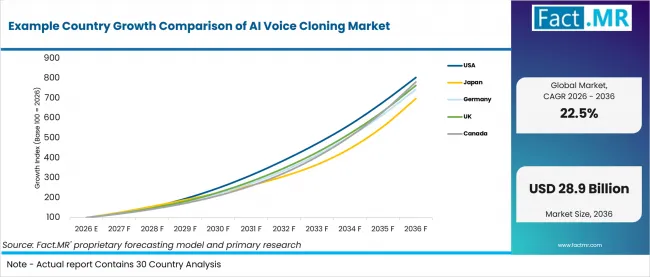
Example Country Growth Comparison Of Ai Voice Cloning Market | Source: Fact.MR
| Country | CAGR (2026-2036) |
|---|---|
| South Korea | 23.9% |
| USA | 23.2% |
| Canada | 22.8% |
| UK | 22.5% |
| Germany | 22.2% |
| Australia | 21.9% |
| Japan | 21.5% |
Source: Fact.MR analysis. Updated Aug 3, 2026
What supports USA adoption?
23.2% CAGR for 2026 to 2036.
USA buyers evaluate platforms through consent proof and customer-channel risk. Media companies need approved speech for localization. Enterprises need branded voices for service and training.
How is Japan building demand?
21.5% CAGR for 2026 to 2036.
Japanese adoption is shaped by character identity and speech timing. Animation studios and game publishers need continuity. Vendors must prove pitch accent and natural delivery.
What shapes Germany’s outlook?
22.2% CAGR for 2026 to 2036.
German enterprises route projects through privacy and legal checks. Security review comes before use. Suppliers gain when permissions and logs are easy to prove.
How does the UK convert voice demand?
22.5% CAGR for 2026 to 2036.
UK demand grows where narration and service voices can be approved contract by contract. Publishers value revision speed. Accessibility teams need clear disclosure.
What supports Canada’s outlook?
22.8% CAGR for 2026 to 2036.
Canadian organizations need English and French voice assets across service and training. Cloud delivery helps smaller teams test use cases.
How is Australia scaling adoption?
21.9% CAGR for 2026 to 2036.
Australian buyers are expected to test cloned voices in contact centers and learning content. Wider adoption depends on brand-safety review.
Why does South Korea lead the listed countries?
23.9% CAGR for 2026 to 2036.
South Korea leads as entertainment and gaming firms test faster voice workflows. Buyers need voices that keep character identity stable across updates.
Who leads the AI Voice Cloning Market?
Microsoft, ElevenLabs, Google, Amazon Web Services, Resemble AI, PlayHT, Murf AI, LOVO AI and Speechify are active in technologies relevant to licensed AI voice cloning.
Microsoft provides consent-gated custom neural voice capabilities. ElevenLabs offers voice cloning and multilingual dubbing. Google Cloud and Amazon Web Services provide custom speech capabilities and APIs. Resemble AI, PlayHT, Murf AI, LOVO AI and Speechify offer custom voice or voice-cloning features for content, localization and enterprise use.
Which companies are the key providers?
Key companies include Microsoft Corporation; ElevenLabs; Google LLC; Amazon Web Services, Inc.; Resemble AI; PlayHT; Murf AI; LOVO AI; Speechify.
- Microsoft Corporation
- ElevenLabs
- Google LLC
- Amazon Web Services, Inc.
- Resemble AI
- PlayHT
- Murf AI
- LOVO AI
- Speechify
Bibliography
- Federal Communications Commission. (2024, February 8). FCC makes AI-generated voices in robocalls illegal.
- U.S. Copyright Office. (2024, July 31). Copyright and artificial intelligence, part 1: Digital replicas.
- European Commission. (2024, August 1). European Artificial Intelligence Act comes into force.
- Microsoft. Custom voice overview.
- ElevenLabs. Voice cloning overview.
- Google Cloud. Custom Voice overview.
- Amazon Web Services. Amazon Polly features.
- Resemble AI. Voice creation.
- PlayHT. AI voice generation and voice cloning.
- Murf. Voice cloning.
- LOVO. Custom voice.
- Speechify. AI voice cloning.
This Report Answers
- The report analyzes the AI Voice Cloning Market across Deployment, Application, End User, Technology, Industry Vertical and Region.
- Segment analysis identifies the 2026 leader within each approved market dimension.
- Country outlook compares the USA, Japan, Germany, UK, Canada, Australia and South Korea.
- Competitive analysis profiles Microsoft Corporation, ElevenLabs, Google LLC, Amazon Web Services, Inc., Resemble AI, PlayHT, Murf AI, LOVO AI and Speechify.
What does the AI Voice Cloning Market cover?
AI voice cloning tools create a synthetic version of an approved speaker voice for commercial use. The market covers software and cloud services, including APIs and enterprise platforms that support authorized cloning.
Coverage includes media localization, content creation, customer service, training and accessibility use. The market differs from general text-to-speech because it concerns reproduction of an approved voice identity.
What is included in the scope?
The scope covers Cloud-Based and On-Premises deployments. It includes licensed voice-cloning applications across Media & Entertainment, Customer Service, Gaming & Virtual Reality, Healthcare and other approved uses.
The scope also includes the end-user groups, technology types and industry verticals listed in the report segmentation. Licensed synthetic-voice services remain within scope when the provider supports authorized creation or use of a voice identity.
What is excluded from the scope?
Generic speech synthesis that does not clone an approved voice is outside the market boundary. Downstream finished-content revenue is excluded. Hardware revenue is excluded unless it is sold as part of a directly associated voice-cloning platform.
The scope excludes unrelated audio-editing tools, general contact-center software and unauthorized voice-impersonation services. Company revenue without a clear connection to licensed voice cloning is not counted.
How Was the Analysis Built?
The assessment combines public regulatory materials, company documentation and market indicators relevant to licensed AI voice cloning. Selected public references are listed in the bibliography.
Market Sizing and Forecasting
Market estimates consider historical performance, provider participation, deployment mix, application demand, enterprise adoption and country conditions. Forecasts are reviewed against public company activity and regulatory developments.
Segmentation
What is the report’s scope and coverage?
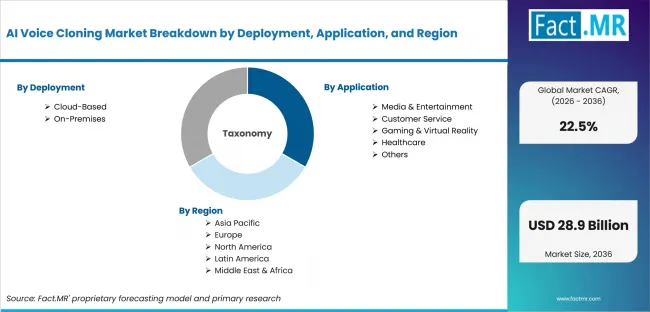
Ai Voice Cloning Market Breakdown By Deployment, Application, And Region | Source: Fact.MR
| Attribute | Details |
|---|---|
| Quantitative Units | USD 3.8 Billion in 2026 to USD 28.9 Billion by 2036 at 22.5% CAGR |
| Market Definition | Revenue from licensed AI voice cloning software, cloud services, APIs, enterprise platforms and directly associated voice-generation capabilities used to create authorized synthetic voices. |
| Deployment | Cloud-Based (Public Cloud; Private Cloud); On-Premises (Enterprise Infrastructure; Hybrid Deployment) |
| Application | Media & Entertainment (Dubbing; Content Creation); Customer Service (AI Call Centers; Virtual Assistants); Gaming & Virtual Reality (Game Character Voices; Interactive Experiences); Healthcare (Patient Communication; Accessibility Solutions); Others (Education; Audiobooks) |
| End User | Large Enterprises (Media Companies; Technology Companies); Small & Medium Enterprises (Marketing Agencies; Content Studios); Individual Creators (YouTubers; Podcasters) |
| Technology | Deep Learning (Transformer Models; Neural Text-to-Speech); Generative AI (Foundation Models; Large Speech Models); Speech Synthesis (Parametric Synthesis; Neural Vocoders); Others (Hybrid AI Models; Custom Voice Engines) |
| Industry Vertical | Media & Entertainment (Film & Television; Digital Content); Information Technology (AI Software; Cloud Platforms); BFSI (Banking; Insurance); Healthcare (Hospitals; Digital Health); Others (Education; Retail; Government) |
| Regions Covered | North America; Latin America; Western Europe; Eastern Europe; East Asia; South Asia and Pacific; Middle East and Africa |
| Key Countries Highlighted | USA; Japan; Germany; UK; Canada; Australia; South Korea |
| Key Companies Profiled | Microsoft Corporation; ElevenLabs; Google LLC; Amazon Web Services, Inc.; Resemble AI; PlayHT; Murf AI; LOVO AI; Speechify |
| Forecast Period | 2026 to 2036 |
| Approach | Hybrid top-down and bottom-up approach using provider revenue, usage patterns, deployment mix, application demand, enterprise adoption, technology evolution, country conditions and company portfolio review. |
Source: Fact.MR analysis. Updated Aug 3, 2026
How is the market segmented?
-
By Deployment:
- Cloud-Based
- Public Cloud
- Private Cloud
- On-Premises
- Enterprise Infrastructure
- Hybrid Deployment
- Cloud-Based
-
By Application:
- Media & Entertainment
- Dubbing
- Content Creation
- Customer Service
- AI Call Centers
- Virtual Assistants
- Gaming & Virtual Reality
- Game Character Voices
- Interactive Experiences
- Healthcare
- Patient Communication
- Accessibility Solutions
- Others
- Education
- Audiobooks
- Media & Entertainment
-
By End User:
- Large Enterprises
- Media Companies
- Technology Companies
- Small & Medium Enterprises
- Marketing Agencies
- Content Studios
- Individual Creators
- YouTubers
- Podcasters
- Large Enterprises
-
By Technology:
- Deep Learning
- Transformer Models
- Neural Text-to-Speech
- Generative AI
- Foundation Models
- Large Speech Models
- Speech Synthesis
- Parametric Synthesis
- Neural Vocoders
- Others
- Hybrid AI Models
- Custom Voice Engines
- Deep Learning
-
By Industry Vertical:
- Media & Entertainment
- Film & Television
- Digital Content
- Information Technology
- AI Software
- Cloud Platforms
- BFSI
- Banking
- Insurance
- Healthcare
- Hospitals
- Digital Health
- Others
- Education
- Retail
- Government
- Media & Entertainment
-
By Region:
- North America
- Latin America
- Western Europe
- Eastern Europe
- East Asia
- South Asia and Pacific
- Middle East and Africa
Frequently Asked Questions
Which Deployment leads the market?
Which Application leads the market?
Which End User leads the market?
Which Technology leads the market?
Which Industry Vertical leads the market?
Which country records the highest listed CAGR?
What is the primary driver in this market?
What is the main restraint?
Who worked on this report


Preview the report firsthand - request a free sample
Free SampleGet the brochure for pricing and purchase details
Download PDF