- Base Value(2025): 7.8 Bn
- Estimated Value(2026): 8.2 Bn
- Forecast Value (2036): 14.0 Bn
- CAGR (2026 - 2036): 5.5%
Specialty Crosslinkers Market Forecast Outlook By Fact.MR
In 2025, the specialty crosslinkers market was valued at USD 7.8 billion. Based on Fact.MR analysis, demand for specialty crosslinkers is estimated to grow to USD 8.2 billion in 2026 and USD 14.0 billion by 2036. FACT.MR projects a CAGR of 5.5% during the forecast period.
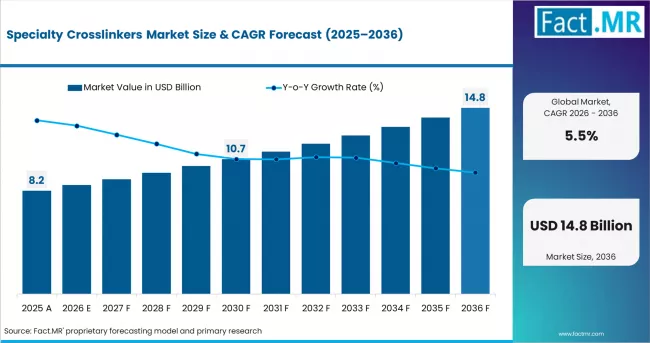
Specialty Crosslinkers Market Value Analysis | Source: Fact.MR
Summary Of Specialty Crosslinkers Market
- Market Definition
- The market covers reactive specialty crosslinker chemicals across amino, isocyanate, carbodiimide, and PCA chemistries supplied to coatings, adhesives, textile, wood panel, and electronics manufacturers globally.
- Demand Drivers
- REACH occupational exposure limits on isocyanates, fully enforced from 2023 onward, are compelling European industrial coatings manufacturers to shift procurement toward carbodiimide and waterborne PCA crosslinker alternatives.
- China’s rapidly expanding automotive OEM production is driving volume demand for high-performance crosslinker systems in waterborne basecoat and clearcoat formulations meeting local VOC emission standards.
- India’s growing technical textiles and construction chemicals sectors are creating incremental demand for amino-based and PCA crosslinkers in fabric finishing and tile adhesive formulations.
- Key Segments Analyzed
- By Chemistry Type: Polycarboxylic Acids (PCA) lead at approximately 30% share in 2026, driven by waterborne coatings reformulation mandates in Europe and North America.
- By Application: Coatings lead at approximately 38% share in 2026 across industrial, automotive, and decorative end-uses globally.
- By End-use Industry: Furniture & Wood holds approximately 35% share in 2026, anchored by formaldehyde-free panel binder demand in Europe and China.
- Analyst Opinion at FACT.MR
- Shambhu Nath Jha, Principal Consultant at Fact.MR, opines, ‘CXOs will find that leadership in the specialty crosslinkers market is shifting toward compliance-driven producers. Companies must combine low-VOC chemistry with strong regulatory documentation. REACH and EPA compliance is becoming a key requirement.’
- Srategic Implications / Executive Takeaways
- Producers should accelerate investment in waterborne PCA and carbodiimide crosslinker capacity to capture the REACH-driven substitution pipeline in European automotive and industrial coatings.
- Companies targeting Asian markets should localise technical support in China and India to support OEM coatings qualification and textile finishing reformulation with compliant specialty crosslinker systems.
- Crosslinker manufacturers should develop blocked isocyanate and high-solids amino-based grades to serve aerospace and high-performance adhesive segments where performance requirements limit substitution to waterborne systems.
- Methodology
- Market sizing based on crosslinker shipment volumes by chemistry and geography, validated with 2024–2025 producer revenue and polymer trade data.
- Uses ECHA REACH, U.S. EPA, EU VOC Directive, and industry association sources to support demand and compliance analysis.
- Forecasts incorporate coatings industry benchmarks, textile chemical growth data, OEM procurement trends, and primary interviews with specialty chemical procurement managers.
| Metric | Value |
|---|---|
| Estimated Value in 2026 | USD 8.2 billion |
| Forecast Value in 2036 | USD 14.0 billion |
| Forecast CAGR (2026 to 2036) | 5.5% |
Source: Fact.MR analysis. Updated Apr 20, 2026
The market is expected to generate an absolute dollar opportunity of USD 5.8 billion between 2026 and 2036. This reflects steady structural expansion rather than cyclical volume swings. Growth is anchored by coatings reformulation toward waterborne and high-solids systems across automotive and construction end-uses. Input cost volatility for isocyanate and melamine feedstocks and compliance costs associated with REACH and U.S. EPA HAPs regulations create margin pressure for standard crosslinker grades while accelerating the shift toward compliant specialty chemistries.
Country growth reflects coatings industry scale, environmental regulation stringency, and specialty polymer manufacturing depth. China leads at 8.0% CAGR through rapidly expanding automotive production, construction coatings volume, and electronics manufacturing crosslinker adoption. India follows at 7.8% through fast industrialisation in textiles, construction chemicals, and furniture panel manufacturing. Germany records 7.0% through advanced coatings and adhesives R&D and stringent EU sustainability compliance. The United States records 6.6% with a structural shift toward eco-friendly waterborne and blocked isocyanate chemistries in aerospace and automotive. Japan records 6.0% through electronics and specialty polymer demand driven by precision component manufacturing. These mature markets generate premium-segment demand constrained by established supplier relationships and high switching costs.
Segmental Analysis
Specialty Crosslinkers Market Analysis by Chemistry Type
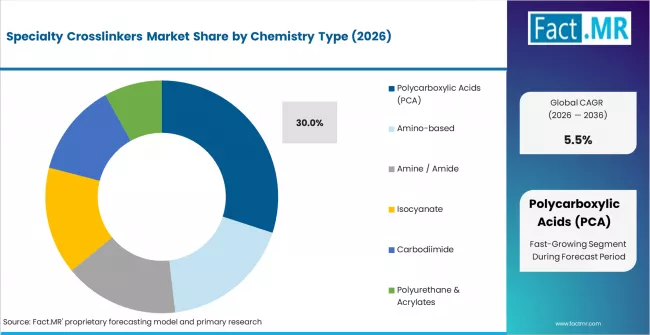
Specialty Crosslinkers Market Analysis By Chemistry Type | Source: Fact.MR
Based on FACT.MR’s analysis, polycarboxylic acids (PCA) are projected to hold 30% share in 2026. PCA leads as a waterborne, formaldehyde-free alternative to melamine systems, meeting REACH and VOC compliance while maintaining performance in textiles and wood applications.
- Evonik PCA Capacity Investment: Evonik expanded VESTAMIN® PCA capacity in Germany in 2024 to support REACH-compliant coatings and textile demand. [3]
- Allnex Carbodiimide Development: Allnex introduced CARBODILITE® grades in 2025 for waterborne polyurethane coatings, achieving zero isocyanate content with OEM performance compliance. [5]
- Isocyanate Substitution Trend: European distributors reported a 14% decline in HDI crosslinker volumes in 2024 due to substitution toward PCA and carbodiimide systems. [2]
Specialty Crosslinkers Market Analysis by Application
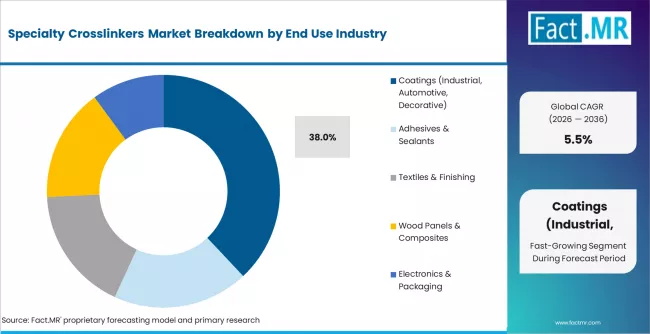
Specialty Crosslinkers Market Analysis By Application | Source: Fact.MR
Coatings are estimated to hold 38% share in 2026. Demand is driven by their critical role in durability, chemical resistance, and regulatory compliance across automotive, industrial, and decorative coatings.
- BASF Automotive Coatings Supply: BASF expanded crosslinker supply agreements with Toyota and Stellantis in 2024, supporting waterborne coatings compliance. [1]
- Wacker Chemie Adhesive Development: Wacker launched silane-based crosslinkers in 2025 for low-VOC construction adhesives aligned with EU green building standards. [6]
- Electronics Packaging Demand Trend: Crosslinker demand in electronics grew 12% in 2024 in South Korea and Japan, driven by semiconductor and display applications. [7]
Drivers, Restraints, and Opportunities
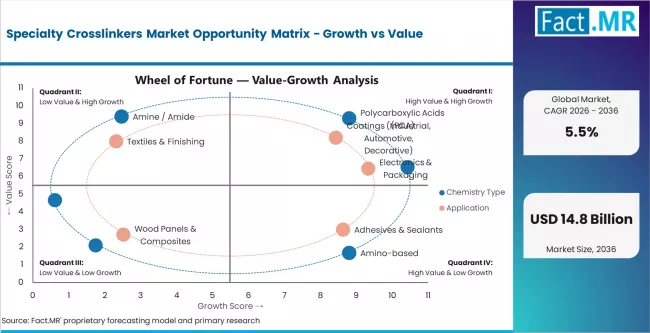
Specialty Crosslinkers Market Opportunity Matrix Growth Vs Value | Source: Fact.MR
FACT.MR analysts observe the specialty crosslinkers market is shifting from a chemistry-defined commodity to a compliance-driven specialty segment. Demand remains stable as crosslinkers are performance-critical in coatings and adhesives, making substitution rather than elimination the key pathway. REACH isocyanate restrictions and EU VOC thresholds are the primary forces reshaping chemistry selection and supplier qualification.
Solventborne isocyanate and melamine formaldehyde crosslinkers are losing share in regulated regions. Waterborne PCA and carbodiimide chemistries carry a 20–40% cost premium but meet REACH and HAPs requirements. This pricing offset supports revenue growth even as legacy volumes plateau in Europe and North America.
- REACH Isocyanate Restriction Impact: ECHA’s REACH Annex XVII restriction on diisocyanates, with mandatory worker training from August 2023, accelerated procurement shifts in Europe. Covestro AG reported an 18% year-on-year increase in waterborne crosslinker enquiries in H1 2024. [2]
- China Automotive Coatings Demand: China’s NEV growth and GB 30981-2020 VOC standards are driving waterborne crosslinker demand. BASF SE reported double-digit growth in China automotive coatings-related crosslinker volumes in 2024. [1]
- India Textile and Construction Growth: India’s PLI scheme expansion for technical textiles is supporting demand for high-performance finishing systems. Archroma expanded crosslinker supply agreements with Indian textile manufacturers in 2024. [4]
Regional Analysis
The specialty crosslinkers market is assessed across Asia Pacific, Europe, North America, Latin America, and Middle East and Africa, covering 40+ countries with distinct demand profiles shaped by coatings industry scale, environmental regulation stringency, specialty polymer manufacturing depth, and industrial end-use sector growth trajectories. The full report provides market attractiveness analysis by region and country.
.webp "Top Country Growth Comparison Specialty Crosslinkers Market Cagr (2026 2036)")
Top Country Growth Comparison Specialty Crosslinkers Market Cagr (2026 2036) | Source: Fact.MR
| Country | CAGR (2026 to 2036) |
|---|---|
| China | 8.0% |
| India | 7.8% |
| Germany | 7.0% |
| United States | 6.6% |
| Japan | 6.0% |
Source: Fact.MR analysis. Updated Apr 20, 2026
Source: Fact.MR (FACT.MR) analysis, based on proprietary forecasting model and primary research
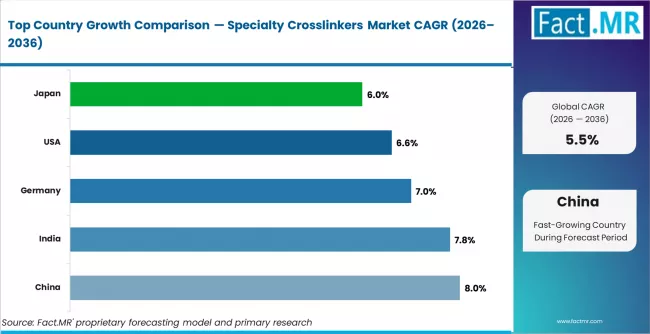
Specialty Crosslinkers Market Cagr Analysis By Country | Source: Fact.MR
Asia Pacific Specialty Crosslinkers Market Analysis
Asia Pacific leads global volume expansion, supported by strong manufacturing activity and rapid regulatory-driven chemistry transition. China’s automotive and construction coatings demand, along with India’s technical textile growth, anchor regional consumption while driving capacity investments.
- China: Demand is projected to grow at 8.0% CAGR through 2036, driven by automotive coatings, electronics manufacturing, and strict VOC enforcement under GB 30981-2020. Waterborne PCA and amino crosslinkers are gaining share as OEMs shift toward compliant systems. BASF reported double-digit waterborne crosslinker growth from Chinese automotive OEMs in 2024. Construction and wood panel demand remains supported by formaldehyde emission standards under GB 18580-2017.
- India: Demand is projected to grow at 7.8% CAGR through 2036, supported by technical textile expansion and construction chemicals growth. The PLI scheme is driving investment in finishing systems requiring amino and PCA crosslinkers. Archroma expanded supply partnerships in 2024, while BIS adhesive standards updated in 2025 are increasing demand for higher-performance crosslinker systems.
FACT.MR’s analysis of the specialty crosslinkers market in Asia Pacific covers China, Japan, South Korea, India, ASEAN, and ANZ, with VOC regulations and demand forecasts included.
Europe Specialty Crosslinkers Market Analysis
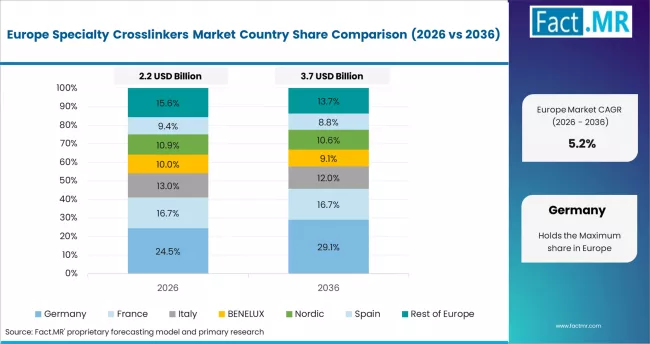
Specialty Crosslinkers Market Europe Country Market Share Analysis, 2026 & 2036 | Source: Fact.MR
Europe sets the global benchmark for compliance-led crosslinker adoption, with REACH and VOC regulations shaping chemistry transitions and supplier qualification.
- Germany: Demand is projected to grow at 7.0% CAGR through 2036, driven by coatings and adhesives innovation and strict REACH enforcement. Increased monitoring of isocyanate restrictions is accelerating adoption of waterborne and blocked systems. Covestro expanded capacity in 2024 to support automotive reformulation demand, while energy-efficient construction policies are boosting adhesive and sealant crosslinker consumption.
FACT.MR’s analysis of the specialty crosslinkers market in Europe covers Germany, France, the UK, Italy, Spain, Nordics, and BENELUX, including compliance and demand insights.
North America Specialty Crosslinkers Market Analysis
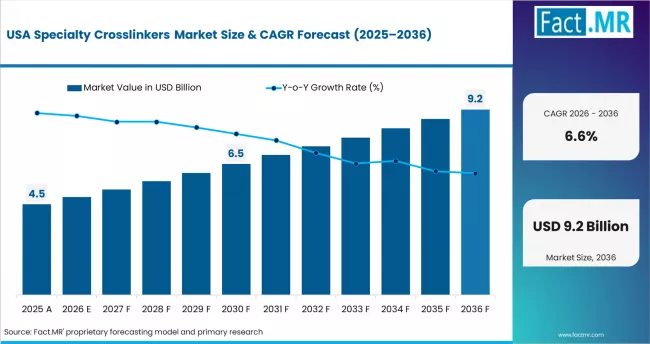
Specialty Crosslinkers Market Country Value Analysis | Source: Fact.MR
North America remains a high-value market focused on performance-driven and regulation-compliant crosslinker systems across advanced industries.
- United States: Demand is projected to grow at 6.6% CAGR through 2036, supported by the shift toward waterborne and low-HAPs chemistries in coatings. EPA NESHAP regulations and CARB standards are sustaining demand for compliant crosslinkers. Allnex introduced carbodiimide grades in 2025, while formaldehyde emission rules continue to drive PCA and MDI crosslinker adoption in wood and furniture applications.
FACT.MR’s analysis of the specialty crosslinkers market in North America covers the United States, Canada, and Mexico, with regulatory and demand trend coverage.
Competitive Aligners for Market Players
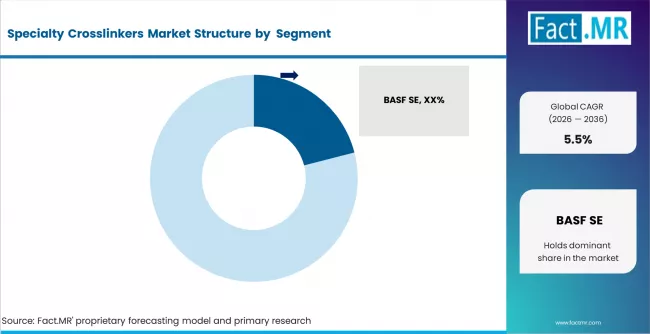
Specialty Crosslinkers Market Analysis By Company | Source: Fact.MR
The specialty crosslinkers market is characterized by a mix of global chemical majors and regional players competing across performance, compliance, and cost dimensions. Large multinational companies such as BASF, Covestro, Evonik, Allnex, and Huntsman maintain a strong competitive position through diversified product portfolios, established relationships with coatings and adhesives OEMs, and global manufacturing footprints. Their ability to offer technically validated, regulation-compliant crosslinker systems gives them an advantage in high-value applications where supplier qualification cycles are long and switching costs are high.
Competition is increasingly shifting toward compliance-driven innovation, with leading players prioritizing the development of low-VOC, waterborne, and formaldehyde-free chemistries. Polycarboxylic acid and carbodiimide crosslinkers are becoming central to product strategies as regulatory frameworks such as REACH and EPA standards reshape demand patterns. European producers, in particular, differentiate themselves through early alignment with regulatory changes, enabling them to secure premium contracts in automotive and industrial coatings markets.
At the same time, Asian manufacturers, especially in China and Japan, compete aggressively on cost and scale, supported by strong domestic demand and expanding production capacity. These players are gaining share in volume-driven segments while gradually improving their compliance capabilities. Companies with backward integration into key raw materials such as isocyanates, amines, and polyols benefit from better margin control and supply stability.
Strategic partnerships with formulators and end users remain critical, as crosslinkers are embedded within complex formulations. Increasingly, innovation in niche applications such as electronics, advanced coatings, and sustainable construction materials is emerging as a key differentiator.
Key Players
- BASF SE
- Dow Inc.
- Huntsman Corporation
- Evonik Industries AG
- Covestro AG
- Wacker Chemie AG
- Allnex Group
- Archroma Management GmbH
- Nuplex Industries Ltd. (Allnex)
- Cytec Industries (Solvay)
Bibliography
- [1] BASF SE. (2024). Q3 2024 Earnings Call Transcript and Investor Presentation: Coatings Ingredients Division Waterborne Crosslinker Volume Growth in Asia Pacific Automotive OEM Supply Channels Including China. October 2024. basf.com/investors
- [2] Covestro AG. (2024). Q2 2024 Investor Update: Waterborne Crosslinker System Demand Increase from European Coatings Manufacturers Under REACH Annex XVII Isocyanate Worker Training Compliance Transition. July 2024. covestro.com/investors
- [3] Evonik Industries AG. (2024). Capacity Expansion Announcement: VESTAMIN Polycarboxylic Acid Crosslinker Production Capacity Increase at Marl Germany Site for REACH-Compliant Waterborne Coatings and Textile Finishing Supply. Q3 2024. evonik.com/newsroom
- [4] Archroma Management GmbH. (2024). Supply Agreement Announcement: Expanded Amino-Based and PCA Crosslinker Supply Partnerships with Indian Technical Textile Manufacturers Under Ministry of Textiles PLI Scheme Capacity Expansion Programme. 2024. archroma.com/news
- [5] Allnex Group. (2025). Product Launch: Updated CARBODILITE Carbodiimide Crosslinker Grade for Automotive Refinish Waterborne Polyurethane Coatings with Zero Isocyanate Content for REACH-Compliant OEM Formulations. January 2025. allnex.com/news
- [6] Wacker Chemie AG. (2025). Product Launch: Silane-Functional Crosslinker System for Construction Adhesives and Sealants Meeting EMICODE EC1 R PLUS VOC Class Requirements for Green Building Certification in Germany and Netherlands. Early 2025. wacker.com/media
- [7] IPC Association Connecting Electronics Industries. (2024). IPC-4101 Revision Update: Laminate Substrate Performance Standards Including Crosslinker System Requirements for Thermal Cycling and Cleanliness in Flexible Electronics and Semiconductor Packaging Applications. 2024. ipc.org/standards
This Report Addresses
- Strategic intelligence on specialty crosslinker demand across REACH-compliant waterborne coatings, EPA HAPs-exempt industrial adhesives, EU VOC-directive-compliant textile finishing, and formaldehyde-free wood panel binder applications globally.
- Market forecast from USD 8.2 billion in 2026 to USD 14.0 billion by 2036 at a CAGR of 5.5%.
- Growth opportunity mapping across China automotive OEM coatings scale-up, India technical textiles PLI expansion, Germany REACH waterborne reformulation, and U.S. EPA HAPs compliance transition demand.
- Segment-wise analysis by chemistry type (amino, isocyanate, carbodiimide, PCA, acrylates), application (coatings, adhesives, textiles, wood panels, electronics), and end-use industry (automotive, construction, electronics, furniture, textile).
- Regional outlook covering Asia Pacific automotive and construction volume leadership, Europe REACH and VOC regulation-driven certified crosslinker adoption, and North America EPA and CARB compliance reformulation trends.
- Competitive landscape covering BASF SE, Covestro AG, Evonik, Allnex, Dow, Huntsman, Wacker, and Archroma across chemistry portfolio breadth, regulatory credential depth, and OEM supply contract positioning.
- Technology and compliance tracking including waterborne PCA and carbodiimide chemistry advances, blocked isocyanate system developments, formaldehyde-free binder certification progress, and REACH Annex XVII update monitoring.
- Report delivery in PDF, Excel datasets, and presentation formats supported by primary interviews, ECHA and EPA regulatory data, producer revenue disclosures, coatings industry benchmarks, and specialty chemical trade association statistics.
Market Definition
The specialty crosslinkers market includes reactive chemical agents used to form covalent bonds between polymer chains in coatings, adhesives, textiles, wood panels, and electronics applications. Specialty crosslinkers improve durability, chemical resistance, adhesion, and thermal stability in finished materials.
Specialty Crosslinkers Market Inclusions
Covers global and regional specialty crosslinker market size from 2026 to 2036. Includes all six chemistry types across coatings, adhesives, textile, wood, and electronics applications. Segments by chemistry, application, and end-use industry. Includes pricing dynamics and trade flow analysis.
Specialty Crosslinkers Market Exclusions
Excludes commodity crosslinkers used in standard paper and basic textile sizing unless formulated into specialty blends. Omits finished coated components and end-use painted parts. Excludes peroxide-based crosslinking systems for rubber and polyolefin applications. Focus is on specialty formulated crosslinker supply to industrial manufacturers.
Specialty Crosslinkers Market Research Methodology
- Primary Research
- Interviews with crosslinker producers, coatings formulators, adhesive manufacturers, and textile chemical buyers across key regions.
- Desk Research
- Uses ECHA REACH restriction data, U.S. EPA HAPs standards, and company disclosures from BASF, Covestro, and Evonik (2024–2025).
- Market Sizing and Forecasting
- Hybrid top-down and bottom-up model using crosslinker shipment volumes, average selling prices by chemistry grade and geography, and end-use application demand benchmarks.
- Data Validation and Update Cycle
- Validated using producer revenues, polymer trade statistics, and regulatory programme data. Cross-checked with industry association outputs and updated regularly.
Segmentation
Scope of Report
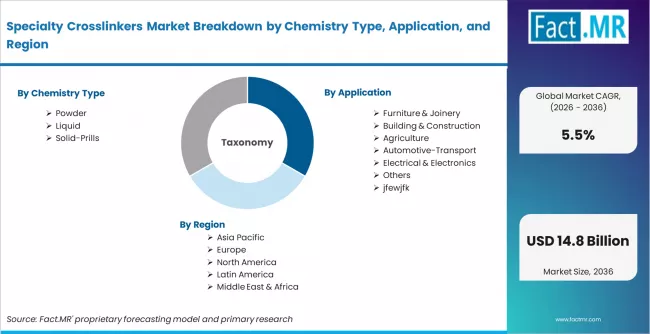
Specialty Crosslinkers Market Breakdown By Chemistry Type, Application, And Region | Source: Fact.MR
| Attribute | Details |
|---|---|
| Quantitative Units | USD 8.2 billion (2026) to USD 14.0 billion (2036), at a CAGR of 5.5% |
| Market Definition | Reactive specialty crosslinker chemicals in amino, isocyanate, carbodiimide, PCA, and acrylate chemistries supplied to coatings, adhesives, textile, wood panel, and electronics manufacturers globally. |
| Chemistry Type Segmentation | Amino-based, Amine/Amide, Isocyanate, Carbodiimide, Polycarboxylic Acids, Polyurethane & Acrylates |
| Application Segmentation | Coatings, Adhesives & Sealants, Textiles & Finishing, Wood Panels & Composites, Electronics & Packaging |
| End-use Industry Segmentation | Automotive, Construction, Electronics, Furniture & Wood, Textile |
| Application Coverage | REACH-compliant waterborne OEM coatings, EPA HAPs-exempt industrial maintenance coatings, CARB Phase 2 formaldehyde-free wood panel binders, EU VOC-directive-compliant adhesives, and technical textile amino crosslinker finishing applications. |
| Regions Covered | North America, Europe, Asia Pacific, Latin America, Middle East and Africa |
| Countries Covered | USA, Canada, Mexico, Germany, UK, France, Italy, Spain, Nordic, BENELUX, Eastern Europe, China, Japan, South Korea, India, ASEAN, Australia and New Zealand, Brazil, Argentina, Chile, Saudi Arabia, GCC, Turkey, South Africa, Rest of MEA |
| Key Companies Profiled | BASF SE, Dow Inc., Huntsman Corporation, Evonik Industries, Covestro AG, Wacker Chemie AG, Allnex Group, Archroma, Cytec Industries (Solvay), Nuplex Industries |
| Forecast Period | 2026 to 2036 |
| Approach | Hybrid top-down and bottom-up model using crosslinker shipment volumes by chemistry and application, average selling prices by grade and geography, REACH and EPA compliance transition data, and primary interviews with coatings formulators and industrial chemical procurement managers. |
Source: Fact.MR analysis. Updated Apr 20, 2026
Specialty Crosslinkers Market by Segments
-
By Chemistry Type:
- Amino-based
- Amine / Amide
- Isocyanate
- Carbodiimide
- Polycarboxylic Acids (PCA)
- Polyurethane & Acrylates
-
By Application:
- Coatings (Industrial, Automotive, Decorative)
- Adhesives & Sealants
- Textiles & Finishing
- Wood Panels & Composites
- Electronics & Packaging
-
By End-use Industry:
- Automotive
- Construction
- Electronics
- Furniture & Wood
- Textile
Frequently Asked Questions
How large is the specialty crosslinkers market in 2025?
What will the market size be by 2036?
What is the expected CAGR for the market from 2026 to 2036?
Which chemistry type is poised to lead the specialty crosslinkers market?
Which application segment is expected to dominate?
Which end-use industry holds the largest share?
Which country shows the fastest growth?
What is driving the shift toward waterborne crosslinkers?
Why are polycarboxylic acid crosslinkers gaining popularity?
Which industry generates the highest demand for specialty crosslinkers?
How are regulations impacting isocyanate-based crosslinkers?
What role do crosslinkers play in coatings?
Why is Asia Pacific a key growth region?
Who worked on this report


Preview the report firsthand - request a free sample
Free SampleGet the brochure for pricing and purchase details
Download PDF